brakes Lexus GS350 2016 Owner's Guide
[x] Cancel search | Manufacturer: LEXUS, Model Year: 2016, Model line: GS350, Model: Lexus GS350 2016Pages: 624, PDF Size: 15.29 MB
Page 457 of 624
4577-2. Steps to take in an emergency
GS350_200t_GS F_OM_OM30E86U_(U)
7
When trouble arises
■Warning buzzer
In some cases, the buzzer may not be heard because of noisy place or an audio sound.
■Customization
The vehicle speed linked seat belt reminder buzzer can be disabled.
(Customizable features: P. 5 6 8 )
WA R N I N G
■If both the ABS and the brake system warning lights remain on
Stop your vehicle in a safe place immediat ely and contact your Lexus dealer. The vehi-
cle will become extremely unstable during braking, and the ABS system may fail, which
could cause an accident resulting in death or serious injury.
■When the electric power steering system warning light comes on
The steering wheel may become extremely heavy.
If the steering wheel becomes heavier than us ual when operating, hold firmly and oper-
ate using more force than usual.
■If the tire pressure warning light comes on
Be sure to observe the following precautions. Failure to do so could cause a loss of
vehicle control and result in death or serious injury.
●Stop your vehicle in a safe place as soon as possible. Adjust the tire inflation pressure
immediately.
●If the tire pressure warning light comes on even after tire inflation pressure adjust-
ment, it is probable that you have a flat tire. Check the tires. If a tire is flat, change it
with the spare tire and have the flat tire repaired by the nearest Lexus dealer.
●Avoid abrupt maneuvering and braking. If the vehicle tires deteriorate, you could lose
control of the steering wheel or the brakes.
■If a blowout or sudden air leakage should occur
The tire pressure warning system may not activate immediately.
Page 460 of 624
4607-2. Steps to take in an emergency
GS350_200t_GS F_OM_OM30E86U_(U)
Warning message and warning buzzer list
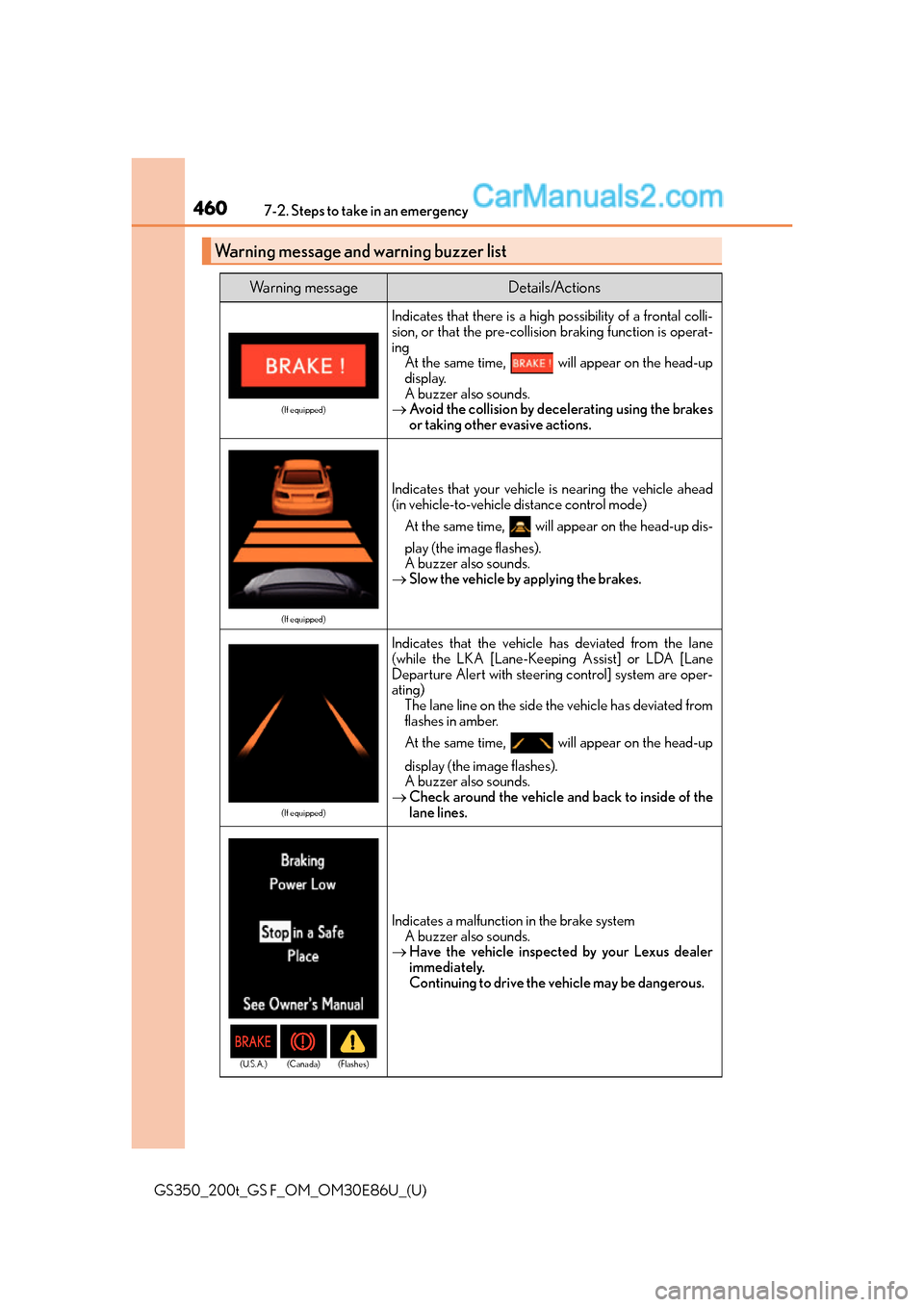
Wa r n i n g m e s s a g eDetails/Actions
(If equipped)
Indicates that there is a high possibility of a frontal colli-
sion, or that the pre-collision braking function is operat-
ingAt the same time, will appear on the head-up
display.
A buzzer also sounds.
Avoid the collision by decelerating using the brakes
or taking other evasive actions.
(If equipped)
Indicates that your vehicle is nearing the vehicle ahead
(in vehicle-to-vehicle distance control mode)
At the same time, will appear on the head-up dis-
play (the image flashes).
A buzzer also sounds.
Slow the vehicle by applying the brakes.
(If equipped)
Indicates that the vehicle has deviated from the lane
(while the LKA [Lane-Keeping Assist] or LDA [Lane
Departure Alert with steering control] system are oper-
ating)
The lane line on the side the vehicle has deviated from
flashes in amber.
At the same time, will appear on the head-up
display (the image flashes).
A buzzer also sounds.
Check around the vehicle and back to inside of the
lane lines.
Indicates a malfunction in the brake system
A buzzer also sounds.
Have the vehicle inspected by your Lexus dealer
immediately.
Continuing to drive the vehicle may be dangerous.
(U.S.A.) (Canada) (Flashes)
Page 477 of 624
4777-2. Steps to take in an emergency
GS350_200t_GS F_OM_OM30E86U_(U)
7
When trouble arises
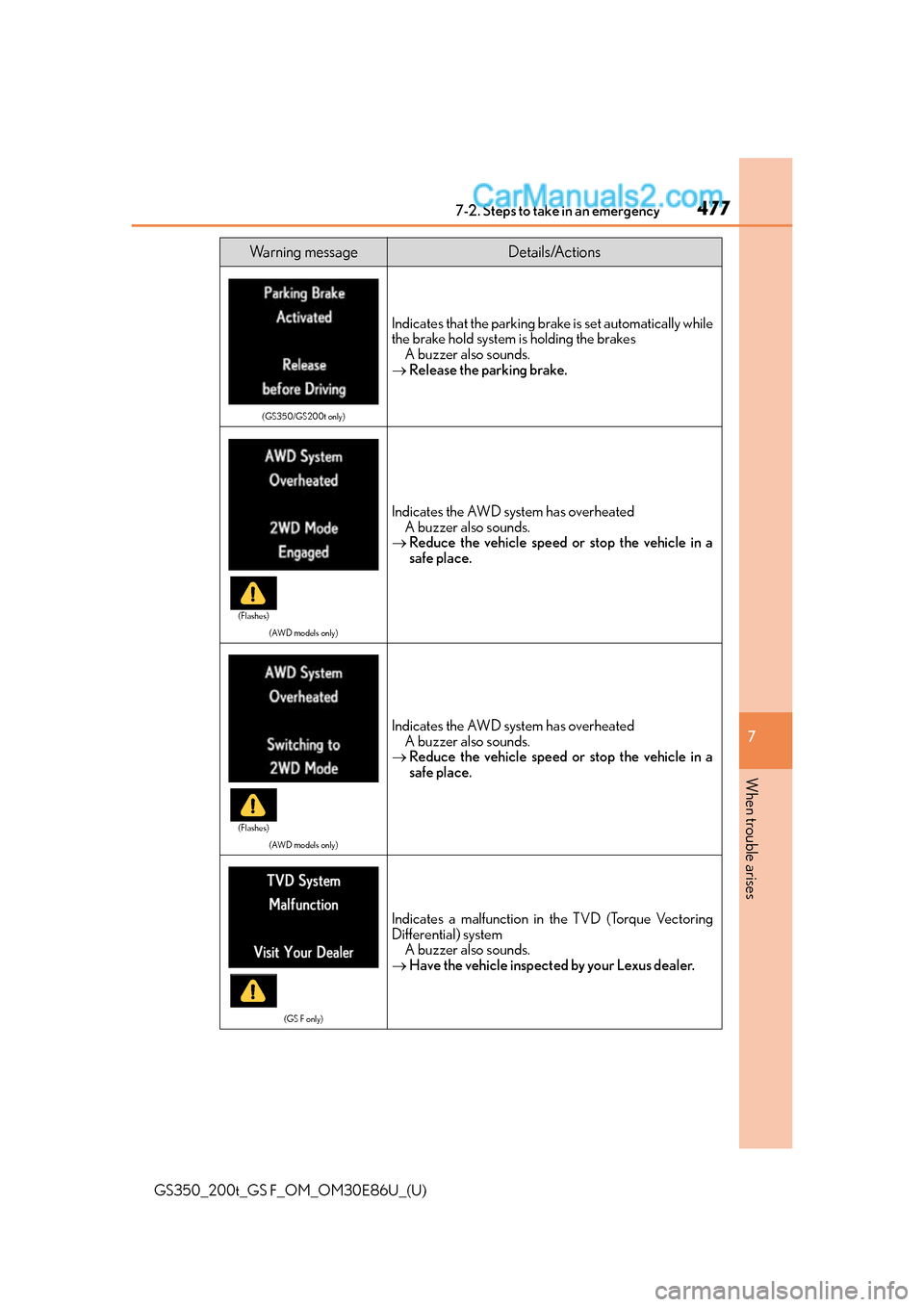
(GS350/GS200t only)
Indicates that the parking brake is set automatically while
the brake hold system is holding the brakes A buzzer also sounds.
Release the parking brake.
(AWD models only)
Indicates the AWD system has overheated
A buzzer also sounds.
Reduce the vehicle speed or stop the vehicle in a
safe place.
(AWD models only)
Indicates the AWD system has overheated
A buzzer also sounds.
Reduce the vehicle speed or stop the vehicle in a
safe place.
(GS F only)
Indicates a malfunction in the TVD (Torque Vectoring
Differential) system
A buzzer also sounds.
Have the vehicle inspected by your Lexus dealer.
Wa r n i n g m e s s a g eDetails/Actions
(Flashes)
(Flashes)
Page 498 of 624
4987-2. Steps to take in an emergency
GS350_200t_GS F_OM_OM30E86U_(U)
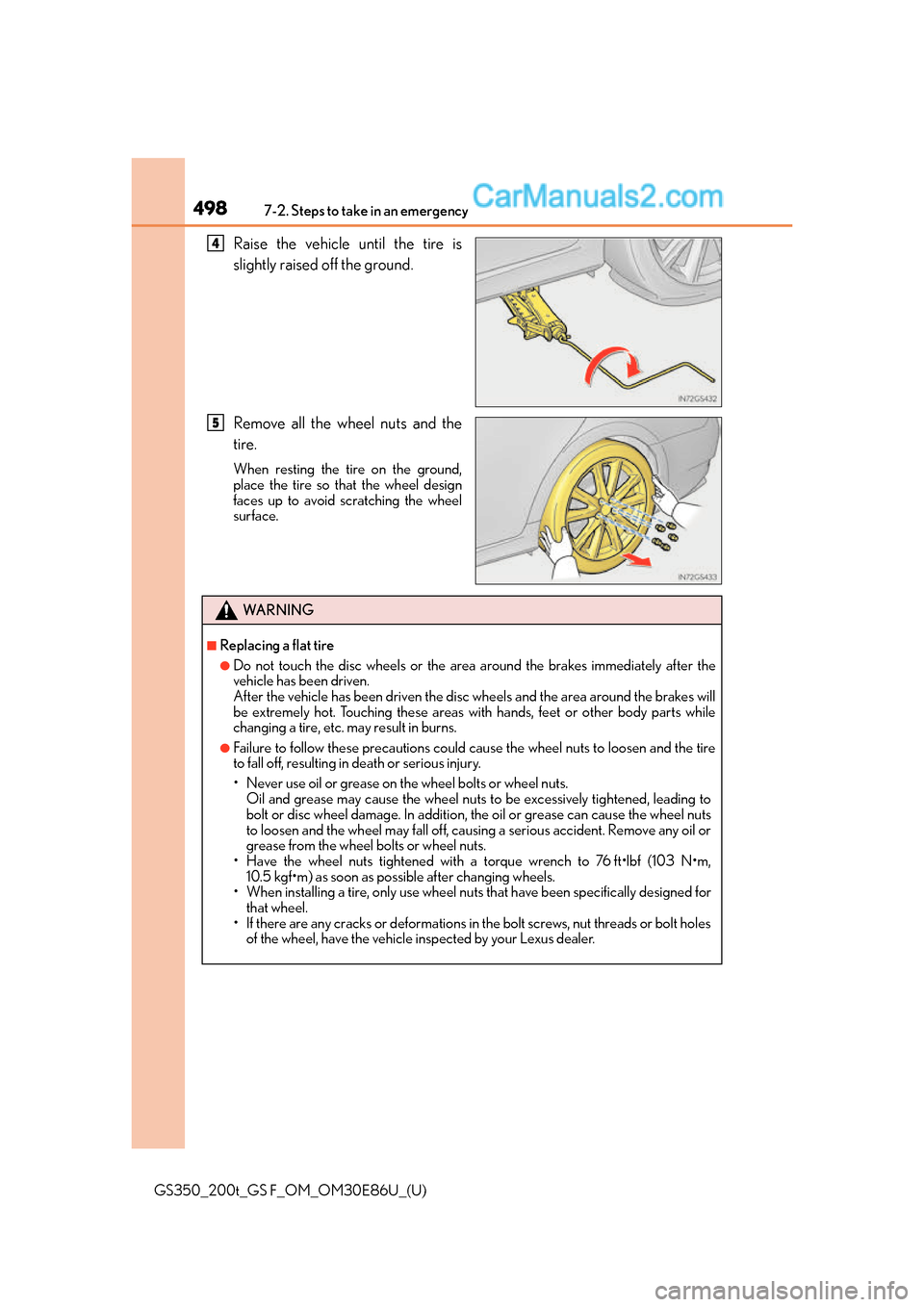
Raise the vehicle until the tire is
slightly raised off the ground.
Remove all the wheel nuts and the
tire.
When resting the tire on the ground,
place the tire so that the wheel design
faces up to avoid scratching the wheel
surface.
4
5
WA R N I N G
■Replacing a flat tire
●Do not touch the disc wheels or the area around the brakes immediately after the
vehicle has been driven.
After the vehicle has been driven the disc wheels and the area around the brakes will
be extremely hot. Touching these areas with hands, feet or other body parts while
changing a tire, etc. may result in burns.
●Failure to follow these precautions could cause the wheel nuts to loosen and the tire
to fall off, resulting in death or serious injury.
• Never use oil or grease on the wheel bolts or wheel nuts.
Oil and grease may cause the wheel nuts to be excessively tightened, leading to
bolt or disc wheel damage. In addition, the oil or grease can cause the wheel nuts
to loosen and the wheel may fall off, caus ing a serious accident. Remove any oil or
grease from the wheel bolts or wheel nuts.
• Have the wheel nuts tightened with a torque wrench to 76 ft•lbf (103 N•m, 10.5 kgf•m) as soon as possible after changing wheels.
• When installing a tire, only use wheel nuts that have been specifically designed for
that wheel.
• If there are any cracks or deformations in the bolt screws, nut threads or bolt holes of the wheel, have the vehicle inspected by your Lexus dealer.
Page 513 of 624
5137-2. Steps to take in an emergency
GS350_200t_GS F_OM_OM30E86U_(U)
7
When trouble arises
WA R N I N G
■Caution while driving
Observe the following precautions.
Failure to do so may cause an accident.
●The emergency tire puncture repair kit is made exclusively for your vehicle. Do not
use it on other vehicles.
●Do not use the emergency tire puncture repair kit for tires that are a different size
than the specified ones or fo r any other purpose. Doing so may cause the tires to not
be repaired properly.
■Precautions for use of the sealant
●Ingesting the sealant is hazardous to your health. If you ingest sealant, consume as
much water as possible, and then immediately consult a doctor.
●If sealant gets in eyes or adheres to skin, immediately wash it off with water. If discom-
fort persists, consult a doctor.
■When fixing the flat tire
●Stop your vehicle in a safe and flat area.
●Do not touch the wheels or the area around the brakes immediately after the vehicle
has been driven.
After the vehicle has been driven, the wheels and the area around the brakes may be
extremely hot. Touching these areas with hands, feet or other body parts may result in
burns.
●Connect the valve and hose securely wi th the tire installed on the vehicle.
●If the hose is not properly connected to the valve, air leakage may occur or sealant
may be sprayed out.
●If the hose comes off the valve while inflating the tire, there is a risk that the hose will
move abruptly due to air pressure.
●After inflation of the tire has completed, the sealant may splatter when the hose is dis-
connected or some air is let out of the tire.
●Follow the operation procedure to repair the tire. If the procedures not followed, the
sealant may spray out.
●Keep back from the tire while it is being re paired, as there is a chance of it bursting
while the repair operation is being perfor med. If you notice any cracks or deforma-
tion of the tire, turn off the compressor sw itch and stop the repair operation immedi-
ately.
●The repair kit may overheat if operated for a long period of time. Do not operate the
repair kit continuously for more than 35 minutes.
●Parts of the repair kit become hot during op eration. Be careful handling the repair kit
during and after operation. Do not touch the metal part connecting the bottle and the
compressor. It will be extremely hot.
●Do not attach the vehicle speed warning sticker to an area other than the one indi-
cated. If the sticker is attached to an area where an SRS airbag is located, such as the
pad of the steering wheel, it may preven t the SRS air bag from operating properly.
Page 549 of 624
GS350_200t_GS F_OM_OM30E86U_(U)
5498-1. Specifications
8
Vehicle specifications
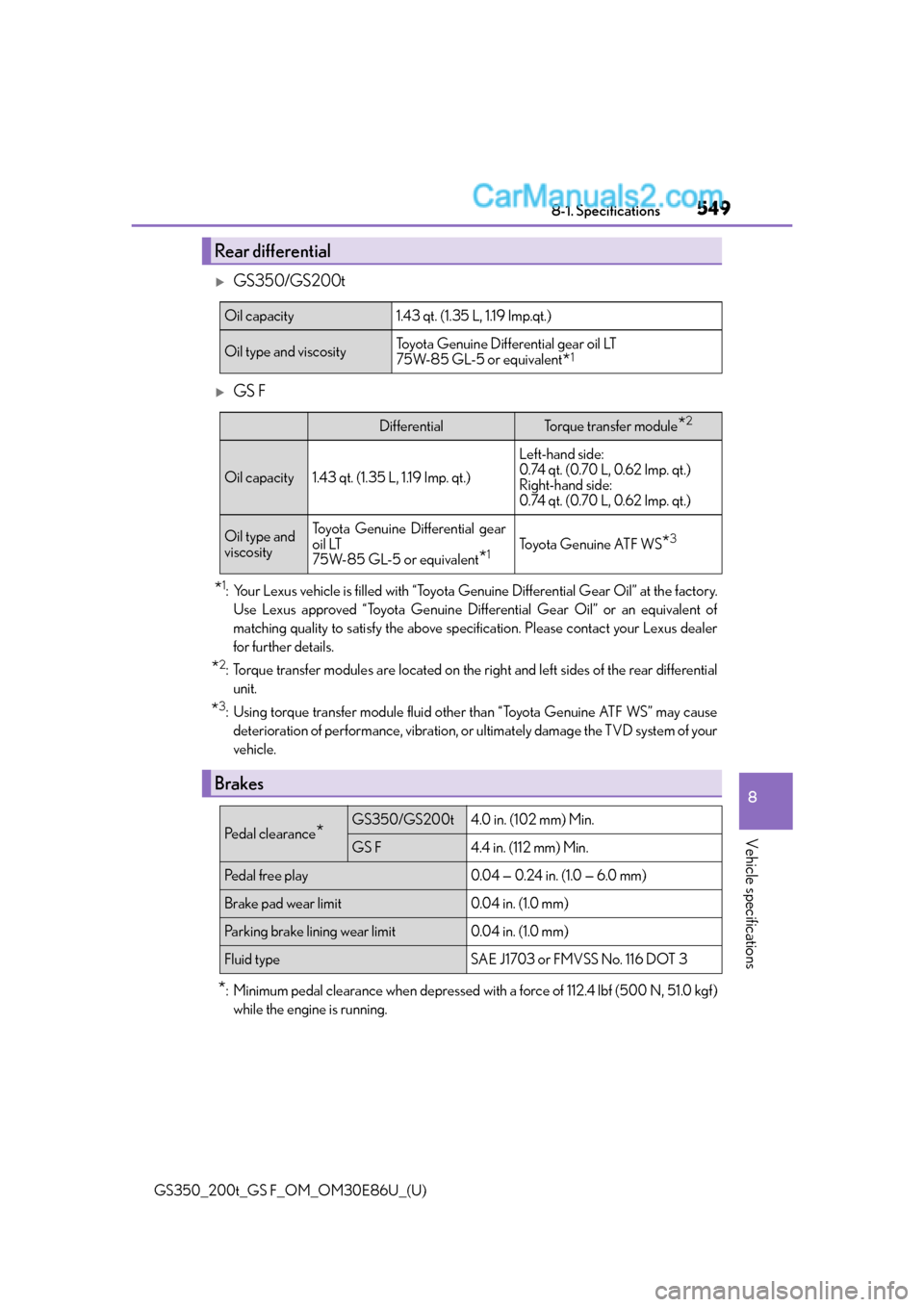
GS350/GS200t
GS F
*1: Your Lexus vehicle is filled with “Toyota Genuine Differential Gear Oil” at the factory.
Use Lexus approved “Toyota Genuine Differential Gear Oil” or an equivalent of
matching quality to satisfy the above specif ication. Please contact your Lexus dealer
for further details.
*2: Torque transfer modules are located on the right and left sides of the rear differential unit.
*3: Using torque transfer module fluid other than “Toyota Genuine ATF WS” may causedeterioration of performance, vibration, or ultimately damage the TVD system of your
vehicle.
*: Minimum pedal clearance when depressed wi th a force of 112.4 lbf (500 N, 51.0 kgf)
while the engine is running.
Rear differential
Oil capacity1.43 qt. (1.35 L, 1.19 Imp.qt.)
Oil type and viscosityToyota Genuine Differential gear oil LT
75W-85 GL-5 or equivalent
*1
DifferentialTo r q u e t r a n s f e r m o d u l e*2
Oil capacity 1.43 qt. (1.35 L, 1.19 Imp. qt.)
Left-hand side:
0.74 qt. (0.70 L, 0.62 Imp. qt.)
Right-hand side:
0.74 qt. (0.70 L, 0.62 Imp. qt.)
Oil type and
viscosity Toyota Genuine Differential gear
oil LT
75W-85 GL-5 or equivalent
*1To y o t a G e n u i n e AT F W S*3
Brakes
Pe d a l c l e a r a n c e*GS350/GS200t4.0 in. (102 mm) Min.
GS F4.4 in. (112 mm) Min.
Pedal free play0.04 — 0.24 in. (1.0 — 6.0 mm)
Brake pad wear limit0.04 in. (1.0 mm)
Parking brake lining wear limit0.04 in. (1.0 mm)
Fluid typeSAE J1703 or FMVSS No. 116 DOT 3
Page 563 of 624
GS350_200t_GS F_OM_OM30E86U_(U)
5638-1. Specifications
8
Vehicle specifications
■Temperature A, B, C
The temperature grades are A (the highest), B, and C, representing the tire’s
resistance to the generation of heat and its ability to dissipate heat when
tested under controlled conditions on a specified indoor laboratory test
wheel.
Sustained high temperature can cause the material of the tire to degenerate and
reduce tire life, and excessive temperature can lead to sudden tire failure.
Grade C corresponds to a level of perfor mance which all passenger car tires must
meet under the Federal Motor Vehicle Safety Standard No. 109.
Grades B and A represent higher levels of performance on the laboratory test
wheel than the minimum required by law.
Warning: The temperature grades of a tire assume that it is properly inflated and
not overloaded.
Excessive speed, underinflation, or excessiv e loading, either separately or in com-
bination, can cause heat buildup and possible tire failure.
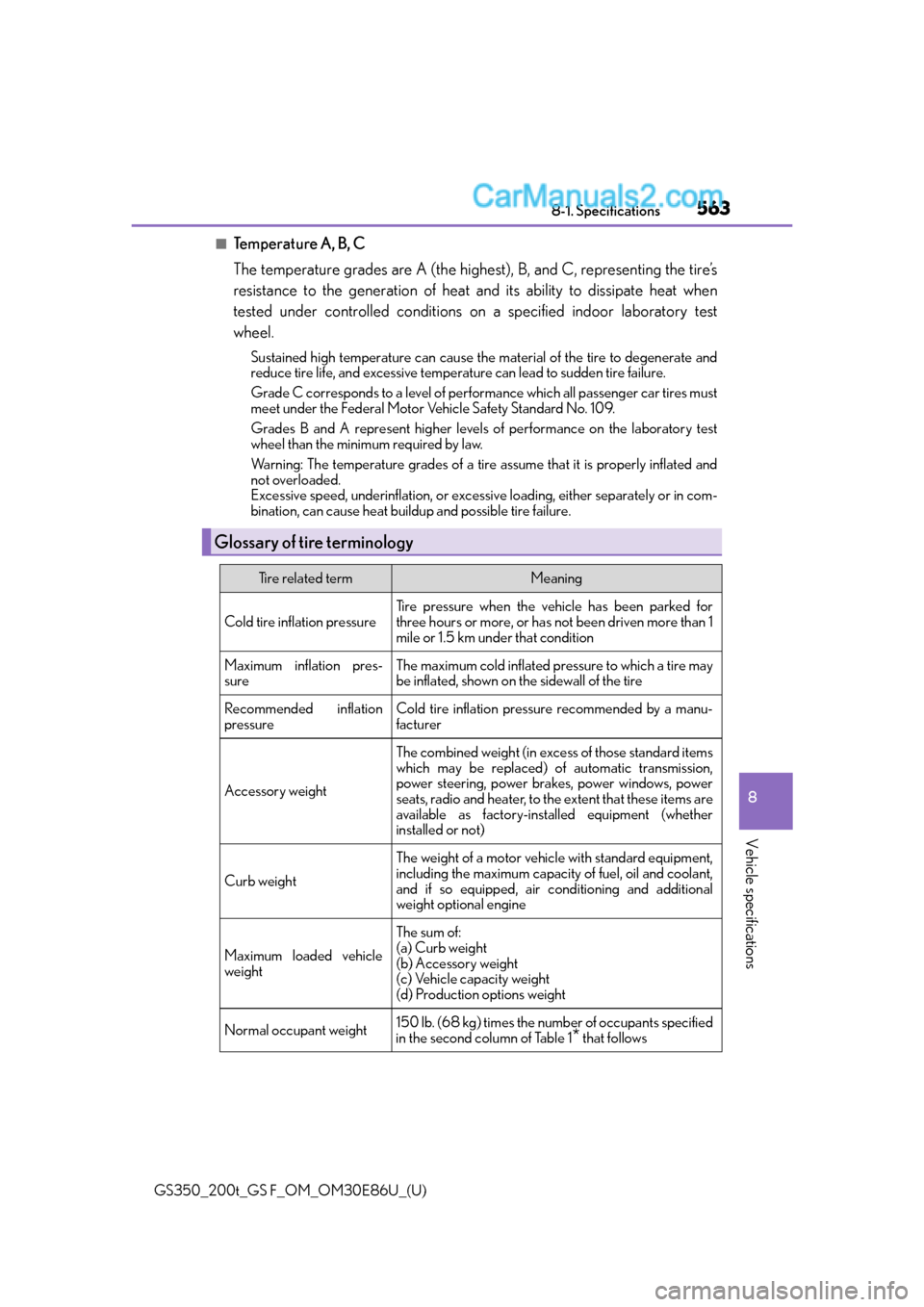
Glossary of tire terminology
Tire related termMeaning
Cold tire inflation pressure
Tire pressure when the vehicle has been parked for
three hours or more, or has not been driven more than 1
mile or 1.5 km un der that condition
Maximum inflation pres-
sureThe maximum cold inflated pressure to which a tire may
be inflated, shown on the sidewall of the tire
Recommended inflation
pressureCold tire inflation pressure recommended by a manu-
facturer
Accessory weight
The combined weight (in excess of those standard items
which may be replaced) of automatic transmission,
power steering, power brakes, power windows, power
seats, radio and heater, to the extent that these items are
available as factory-installed equipment (whether
installed or not)
Curb weight
The weight of a motor vehicle with standard equipment,
including the maximum capacity of fuel, oil and coolant,
and if so equipped, air co nditioning and additional
weight optional engine
Maximum loaded vehicle
weight
The sum of:
(a) Curb weight
(b) Accessory weight
(c) Vehicle capacity weight
(d) Production options weight
Normal occupant weight150 lb. (68 kg) times the numb er of occupants specified
in the second column of Table 1
* that follows
Page 564 of 624
564
GS350_200t_GS F_OM_OM30E86U_(U)8-1. Specifications
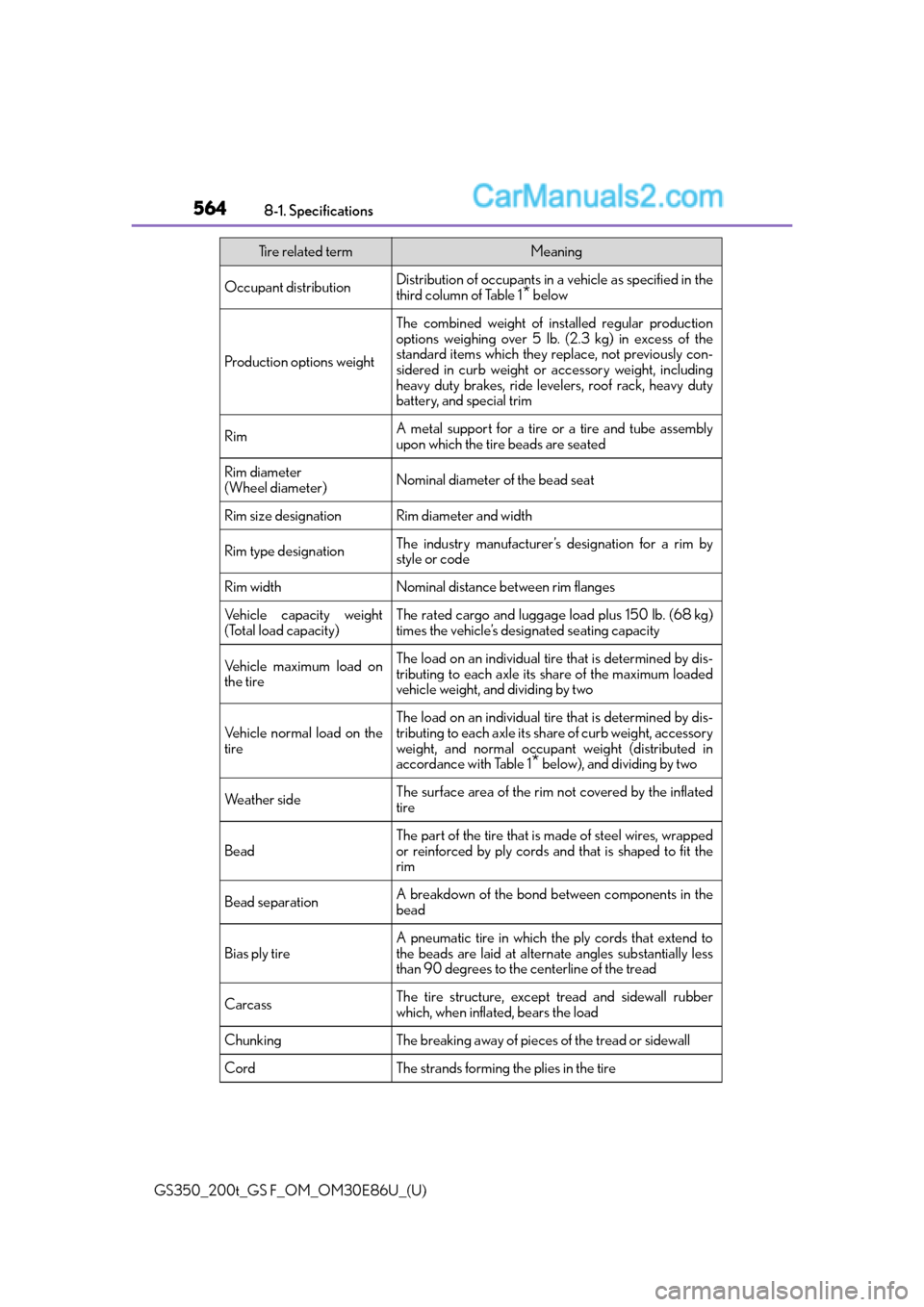
Occupant distributionDistribution of occupants in
a vehicle as specified in the
third column of Table 1* below
Production options weight
The combined weight of installed regular production
options weighing over 5 lb. (2.3 kg) in excess of the
standard items which they replace, not previously con-
sidered in curb weight or accessory weight, including
heavy duty brakes, ride levelers, roof rack, heavy duty
battery, and special trim
RimA metal support for a tire or a tire and tube assembly
upon which the tire beads are seated
Rim diameter
(Wheel diameter)Nominal diameter of the bead seat
Rim size designationRim diameter and width
Rim type designationThe industry manufacturer’s designation for a rim by
style or code
Rim widthNominal distance between rim flanges
Vehicle capacity weight
(Total load capacity)The rated cargo and luggage load plus 150 lb. (68 kg)
times the vehicle’s designated seating capacity
Vehicle maximum load on
the tireThe load on an individual tire that is determined by dis-
tributing to each axle its share of the maximum loaded
vehicle weight, and dividing by two
Vehicle normal load on the
tireThe load on an individual tire that is determined by dis-
tributing to each axle its sh are of curb weight, accessory
weight, and normal occupant weight (distributed in
accordance with Table 1
* below), and dividing by two
We a t h e r s i d eThe surface area of the rim not covered by the inflated
tire
Bead
The part of the tire that is made of steel wires, wrapped
or reinforced by ply cords and that is shaped to fit the
rim
Bead separationA breakdown of the bond be tween components in the
bead
Bias ply tireA pneumatic tire in which the ply cords that extend to
the beads are laid at altern ate angles substantially less
than 90 degrees to the centerline of the tread
CarcassThe tire structure, except tread and sidewall rubber
which, when inflated, bears the load
ChunkingThe breaking away of pieces of the tread or sidewall
CordThe strands forming th e plies in the tire
Tire related termMeaning