ECU Lexus GS350 2016 Repair Manual
[x] Cancel search | Manufacturer: LEXUS, Model Year: 2016, Model line: GS350, Model: Lexus GS350 2016Pages: 624, PDF Size: 15.29 MB
Page 488 of 624
4887-2. Steps to take in an emergency
GS350_200t_GS F_OM_OM30E86U_(U)
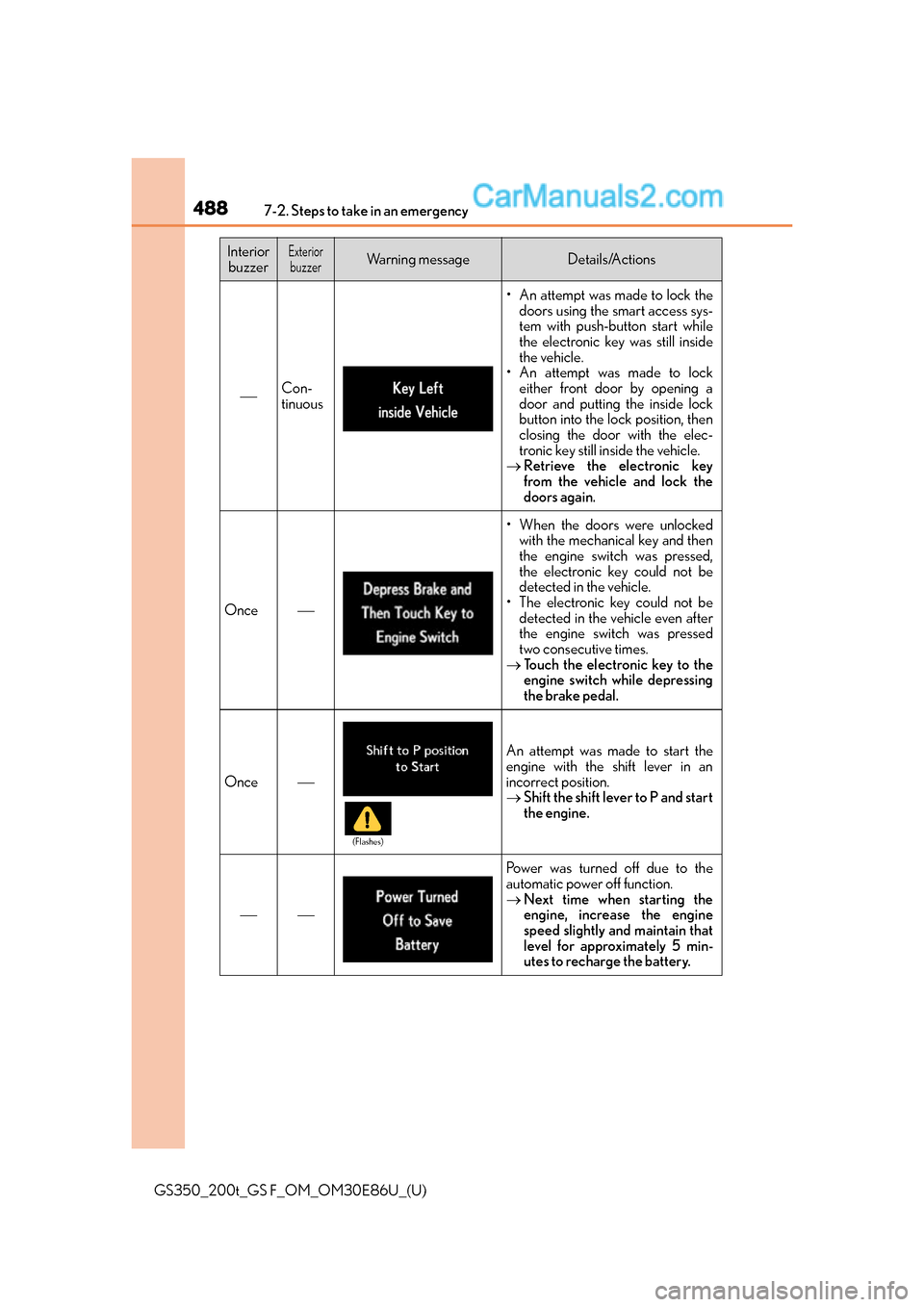
Con-
tinuous
• An attempt was made to lock thedoors using the smart access sys-
tem with push-button start while
the electronic key was still inside
the vehicle.
• An attempt was made to lock either front door by opening a
door and putting the inside lock
button into the lock position, then
closing the door with the elec-
tronic key still inside the vehicle.
Retrieve the electronic key
from the vehicle and lock the
doors again.
Once
• When the doors were unlocked
with the mechanical key and then
the engine switch was pressed,
the electronic key could not be
detected in the vehicle.
• The electronic key could not be
detected in the vehicle even after
the engine switch was pressed
two consecutive times.
Touch the electronic key to the
engine switch while depressing
the brake pedal.
Once
An attempt was made to start the
engine with the shift lever in an
incorrect position.
Shift the shift lever to P and start
the engine.
Power was turned off due to the
automatic power off function.
Next time when starting the
engine, increase the engine
speed slightly and maintain that
level for approximately 5 min-
utes to recharge the battery.
Interior
buzzerExteriorbuzzerWa r n i n g m e s s a g eDetails/Actions
(Flashes)
Page 495 of 624
4957-2. Steps to take in an emergency
GS350_200t_GS F_OM_OM30E86U_(U)
7
When trouble arises
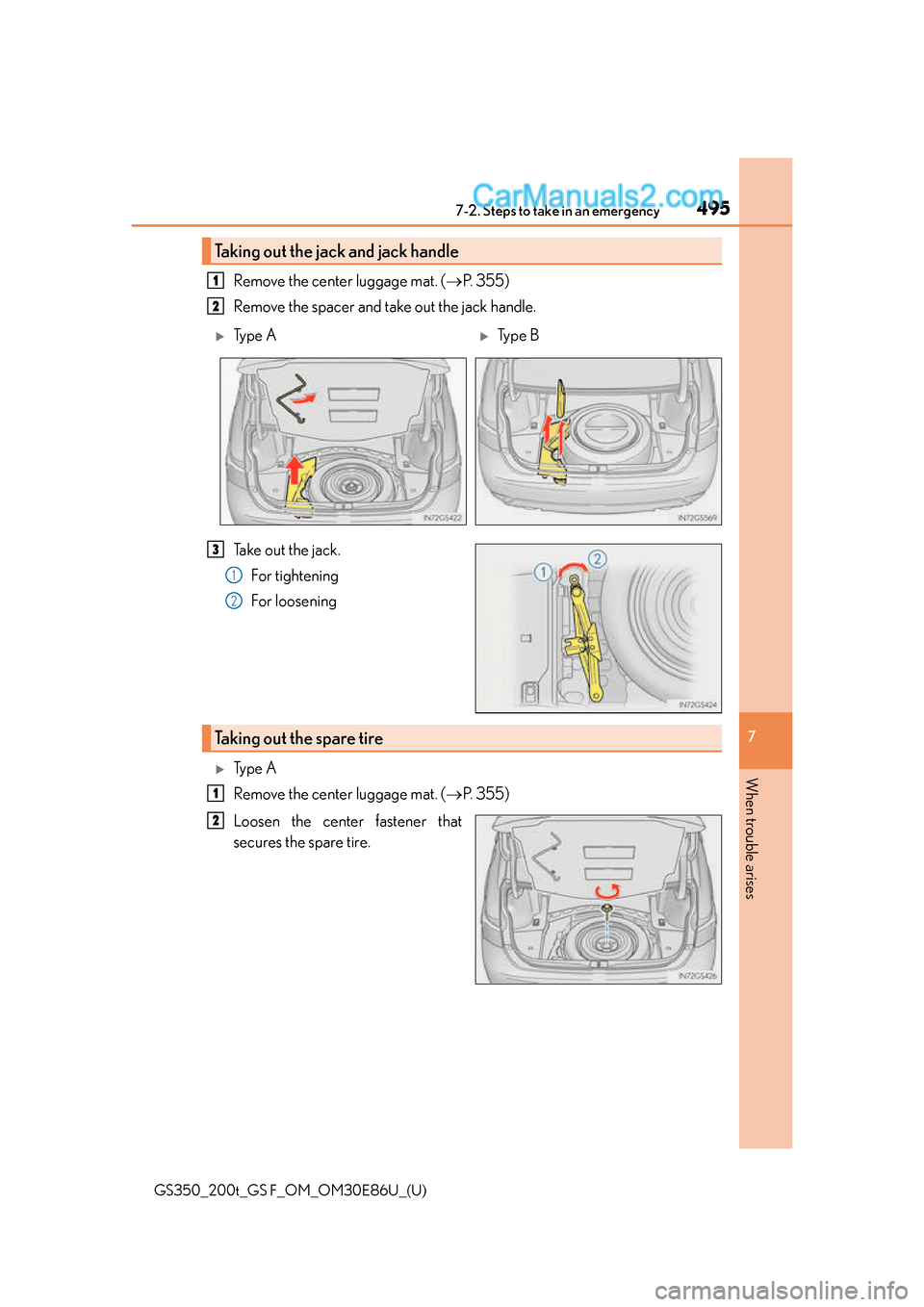
Remove the center luggage mat. ( P. 3 5 5 )
Remove the spacer and take out the jack handle.
Take out the jack. For tightening
For loosening
Ty p e A
Remove the center luggage mat. ( P. 3 5 5 )
Loosen the center fastener that
secures the spare tire.
Taking out the jack and jack handle
1
2
Ty p e ATy p e B
3
1
2
Taking out the spare tire
1
2
Page 496 of 624
4967-2. Steps to take in an emergency
GS350_200t_GS F_OM_OM30E86U_(U)
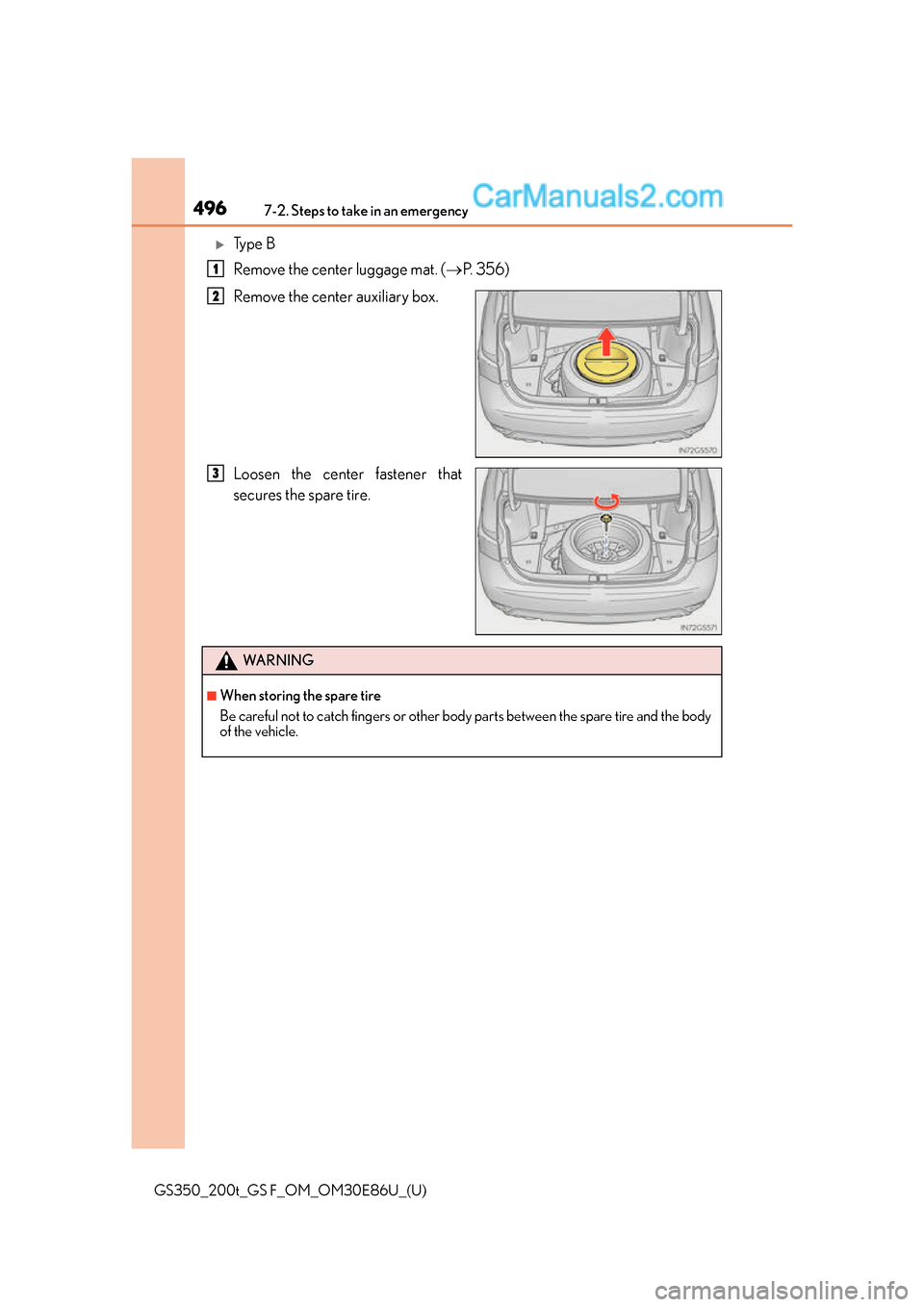
Ty p e B
Remove the center luggage mat. (P. 3 5 6 )
Remove the center auxiliary box.
Loosen the center fastener that
secures the spare tire.
1
2
3
WA R N I N G
■When storing the spare tire
Be careful not to catch fingers or other body parts between the spare tire and the body
of the vehicle.
Page 501 of 624
5017-2. Steps to take in an emergency
GS350_200t_GS F_OM_OM30E86U_(U)
7
When trouble arises
WA R N I N G
■When the spare tire is attached
The vehicle speed may not be correctly detected, and the following systems may not
operate correctly:
Also, not only can the following system not be utilized fully, but it may even negatively
affect the drive-train components:
•AWD system
■Speed limit when using the spare tire
Do not drive at speeds in excess of 50 mp h (80 km/h) when a spare tire is installed on
the vehicle.
The spare tire is not designed for driving at high speeds. Failure to observe this precau-
tion may lead to an accident causing death or serious injury.
■After using the tools and jack
Before driving, make sure all the tools and jack are securely in place in their storage
location to reduce the possibility of personal injury during a collision or sudden brak-
ing.
NOTICE
■Be careful when driving over bumps with the spare tire installed on the vehicle.
The vehicle may become lower when driving with the spare tire compared to when
driving with standard tires. Be careful when driving over uneven road surfaces.
■Driving with tire chains and the spare tire
Do not fit tire chains to the spare tire.
Tire chains may damage the vehicle body and adversely affect driving performance.
■When replacing the tires
When removing or fitting the wheels, tires or the tire pressure warning valve and trans-
mitter, contact your Lexus dealer as the tire pressure warning valve and transmitter
may be damaged if not handled correctly.
• ABS & Brake assist
•VSC
•TRAC
•Cruise control
• Dynamic radar cruise control with
full-speed range (if equipped)
• Dynamic radar cruise control
(if equipped)
• PCS (Pre-Collision System) (if equipped)
•EPS
•AFS (if equipped)
• Adaptive Variable Suspension system (if equipped) • LDA (Lane Departure Alert with
steering control) (if equipped)
• LKA (Lane-Keeping Assist) (if equipped)
• Tire pressure warning system
•VDIM
• Lexus parking assist monitor
• Intuitive parking assist (if equipped)
• Navigation system (if equipped)
• DRS (if equipped)
• VGRS (if equipped)
• LDH (if equipped)
Page 513 of 624
5137-2. Steps to take in an emergency
GS350_200t_GS F_OM_OM30E86U_(U)
7
When trouble arises
WA R N I N G
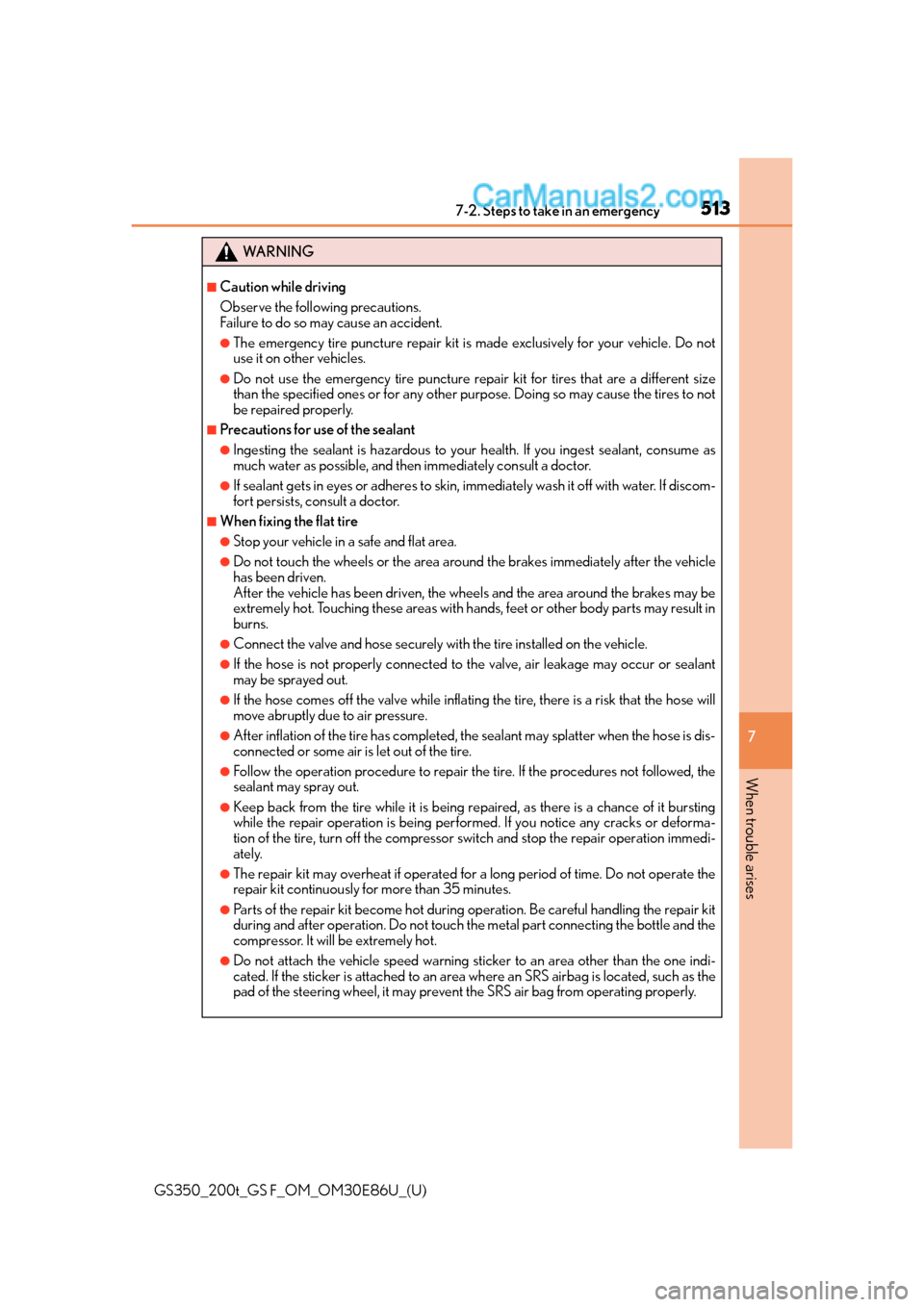
■Caution while driving
Observe the following precautions.
Failure to do so may cause an accident.
●The emergency tire puncture repair kit is made exclusively for your vehicle. Do not
use it on other vehicles.
●Do not use the emergency tire puncture repair kit for tires that are a different size
than the specified ones or fo r any other purpose. Doing so may cause the tires to not
be repaired properly.
■Precautions for use of the sealant
●Ingesting the sealant is hazardous to your health. If you ingest sealant, consume as
much water as possible, and then immediately consult a doctor.
●If sealant gets in eyes or adheres to skin, immediately wash it off with water. If discom-
fort persists, consult a doctor.
■When fixing the flat tire
●Stop your vehicle in a safe and flat area.
●Do not touch the wheels or the area around the brakes immediately after the vehicle
has been driven.
After the vehicle has been driven, the wheels and the area around the brakes may be
extremely hot. Touching these areas with hands, feet or other body parts may result in
burns.
●Connect the valve and hose securely wi th the tire installed on the vehicle.
●If the hose is not properly connected to the valve, air leakage may occur or sealant
may be sprayed out.
●If the hose comes off the valve while inflating the tire, there is a risk that the hose will
move abruptly due to air pressure.
●After inflation of the tire has completed, the sealant may splatter when the hose is dis-
connected or some air is let out of the tire.
●Follow the operation procedure to repair the tire. If the procedures not followed, the
sealant may spray out.
●Keep back from the tire while it is being re paired, as there is a chance of it bursting
while the repair operation is being perfor med. If you notice any cracks or deforma-
tion of the tire, turn off the compressor sw itch and stop the repair operation immedi-
ately.
●The repair kit may overheat if operated for a long period of time. Do not operate the
repair kit continuously for more than 35 minutes.
●Parts of the repair kit become hot during op eration. Be careful handling the repair kit
during and after operation. Do not touch the metal part connecting the bottle and the
compressor. It will be extremely hot.
●Do not attach the vehicle speed warning sticker to an area other than the one indi-
cated. If the sticker is attached to an area where an SRS airbag is located, such as the
pad of the steering wheel, it may preven t the SRS air bag from operating properly.
Page 567 of 624
GS350_200t_GS F_OM_OM30E86U_(U)
5678-1. Specifications
8
Vehicle specifications
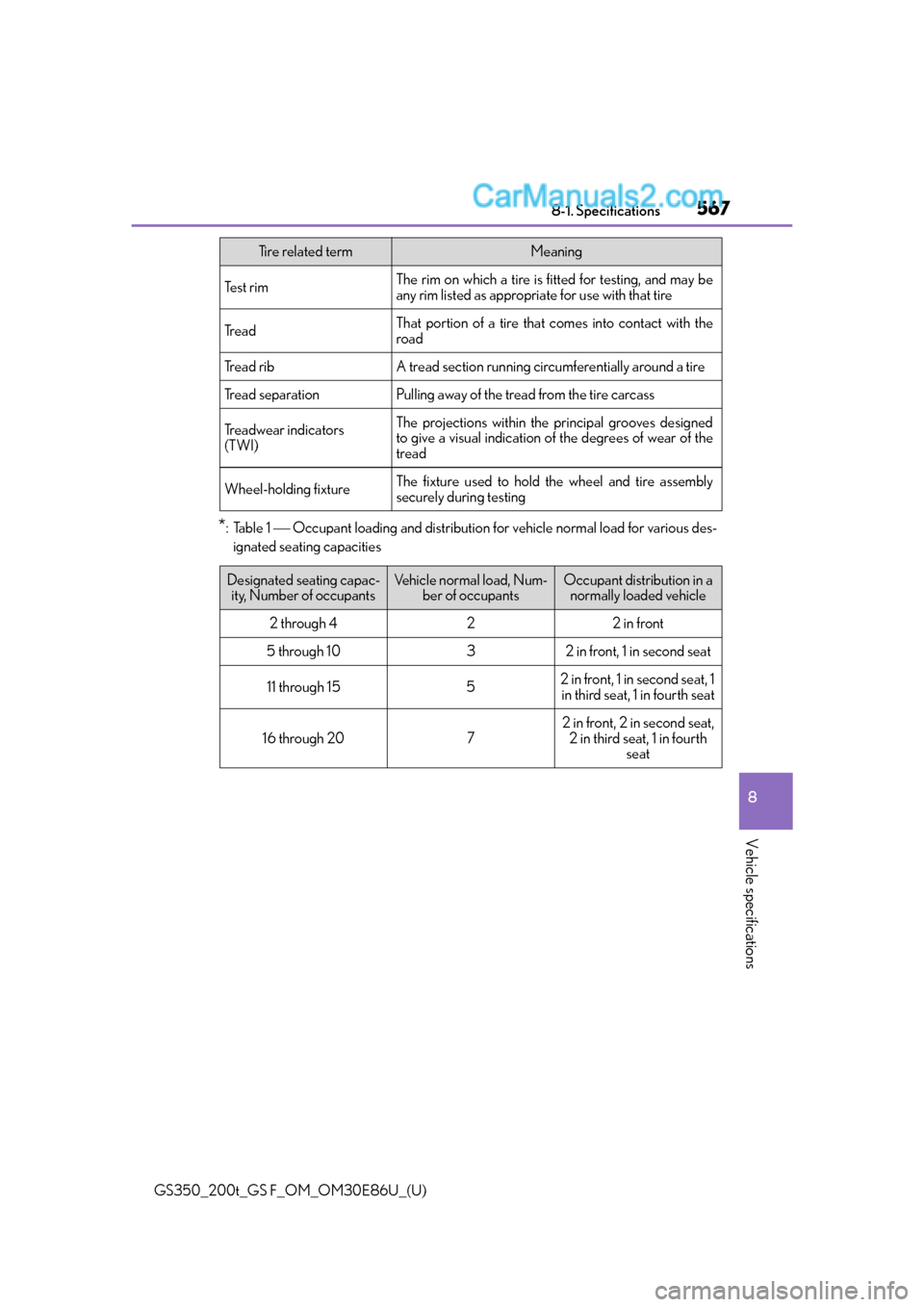
*:Table 1 Occupant loading and distribution for vehicle normal load for various des-
ignated seating capacities
Te s t r i mThe rim on which a tire is fitted for testing, and may be
any rim listed as appropriate for use with that tire
Tr e a dThat portion of a tire that comes into contact with the
road
Tr e a d r i bA tread section running circumferentially around a tire
Tread separationPulling away of the tread from the tire carcass
Treadwear indicators
(TWI)The projections within the principal grooves designed
to give a visual indication of the degrees of wear of the
tread
Wheel-holding fixtureThe fixture used to hold the wheel and tire assembly
securely during testing
Tire related termMeaning
Designated seating capac- ity, Number of occupantsVehicle normal load, Num- ber of occupantsOccupant distribution in a normally loaded vehicle
2 through 422 in front
5 through 1032 in front, 1 in second seat
11 through 1552 in front, 1 in second seat, 1
in third seat, 1 in fourth seat
16 through 207
2 in front, 2 in second seat, 2 in third seat, 1 in fourth seat
Page 575 of 624
GS350_200t_GS F_OM_OM30E86U_(U)
5758-2. Customization
8
Vehicle specifications
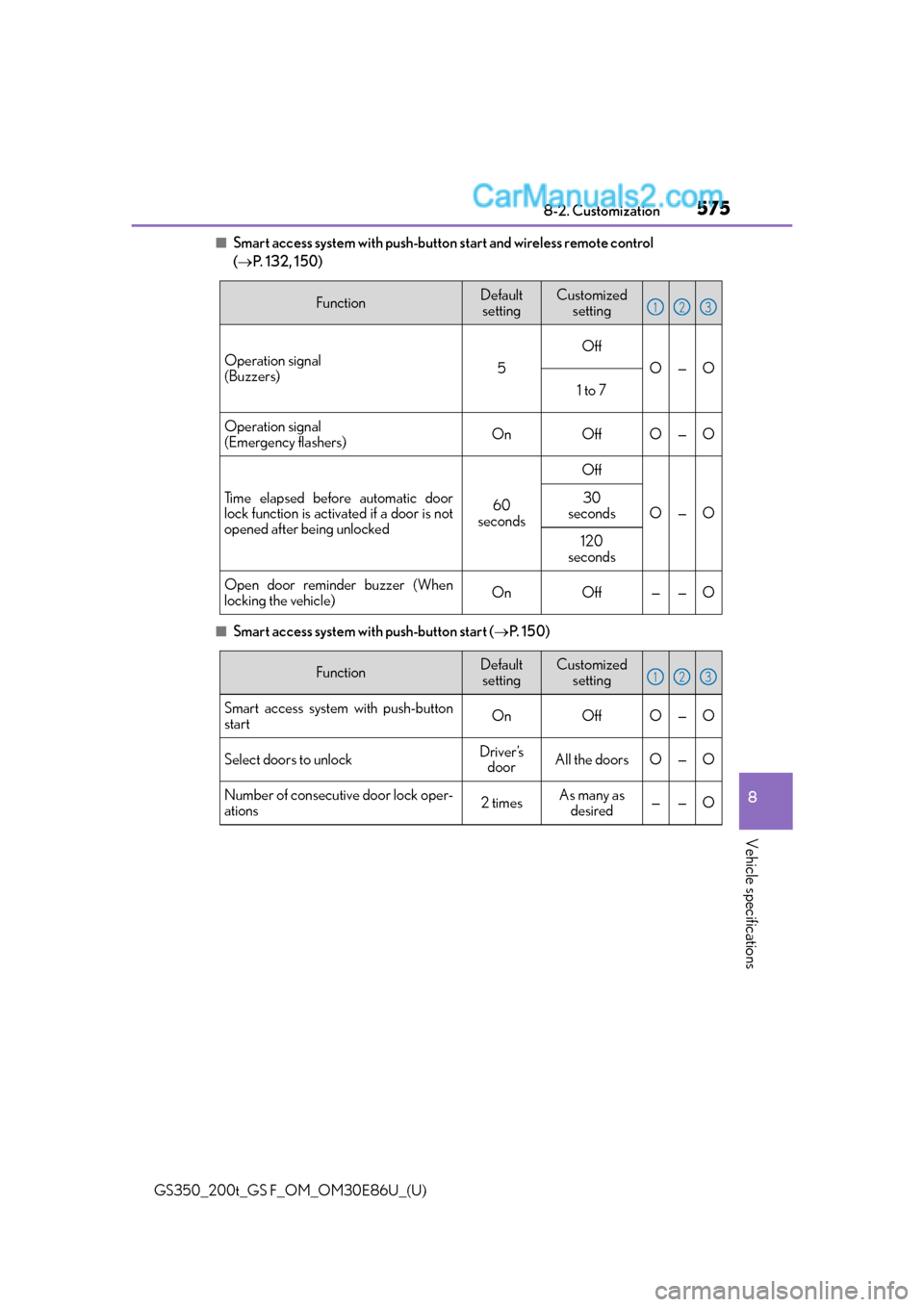
■Smart access system with push-button start and wireless remote control
( P. 132, 150)
■Smart access system with push-button start ( P. 1 5 0 )
FunctionDefault
settingCustomized setting
Operation signal
(Buzzers)5
Off
O—O
1 to 7
Operation signal
(Emergency flashers)OnOffO—O
Time elapsed before automatic door
lock function is activated if a door is not
opened after being unlocked60
seconds
Off
O—O30
seconds
120
seconds
Open door reminder buzzer (When
locking the vehicle)OnOff——O
123
FunctionDefault settingCustomized setting
Smart access system with push-button
startOnOffO—O
Select doors to unlockDriver’s doorAll the doorsO—O
Number of consecutive door lock oper-
ations2 timesAs many as
desired——O
123
Page 587 of 624
587
GS350_200t_GS F_OM_OM30E86U_(U)
9
For owners
Seat belt instructions for Canadian owners (in
French)
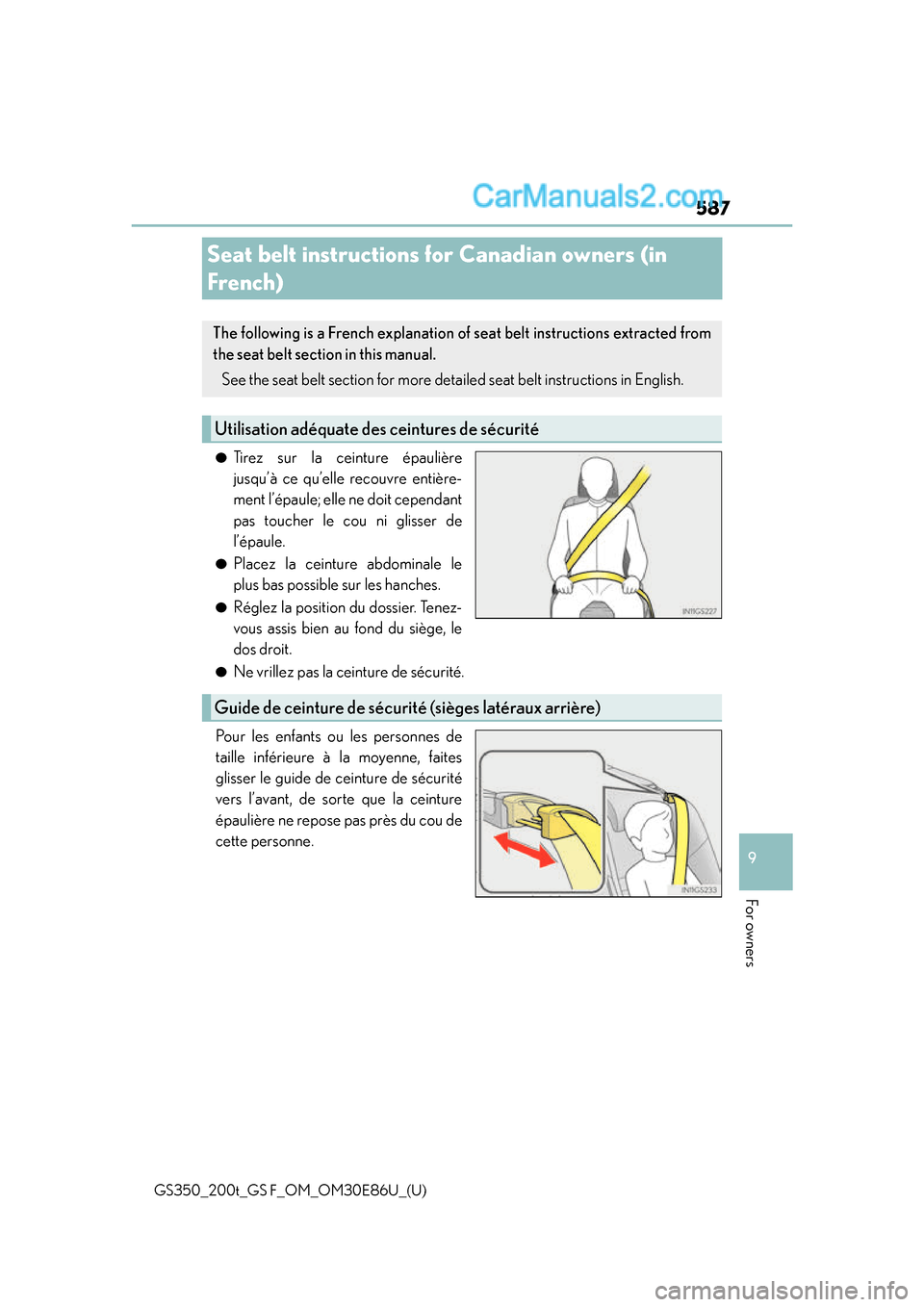
●Tirez sur la ceinture épaulière
jusqu’à ce qu’elle recouvre entière-
ment l’épaule; elle ne doit cependant
pas toucher le cou ni glisser de
l’épaule.
●Placez la ceinture abdominale le
plus bas possible sur les hanches.
●Réglez la position du dossier. Tenez-
vous assis bien au fond du siège, le
dos droit.
●Ne vrillez pas la ceinture de sécurité.
Pour les enfants ou les personnes de
taille inférieure à la moyenne, faites
glisser le guide de ceinture de sécurité
vers l’avant, de sorte que la ceinture
épaulière ne repose pas près du cou de
cette personne.
The following is a French explanation of seat belt instructions extracted from
the seat belt section in this manual. See the seat belt section for more deta iled seat belt instructions in English.
Utilisation adéquate des ceintures de sécurité
Guide de ceinture de sécurité (sièges latéraux arrière)
Page 588 of 624
588
GS350_200t_GS F_OM_OM30E86U_(U)
■Ceintures de sécurité
Avec un chiffon ou une éponge, nettoyez à l’aide d’un savon doux et de l’eau
tiède. Vérifiez aussi les ceintures régulièrement pour vous assurer qu’elles ne
présentent pas d’usure excessive, d’effilochage ou de coupures.
Entretien et soin
AVERTISSEMENT
■Dommages et usure de la ceinture de sécurité
Vérifiez périodiquement le système de ceintures de sécurité. Vérifiez qu’il n’y a pas de
coupures, d’effilochures ni de pièces desserrées. N’utilisez pas une ceinture de sécu-
rité endommagée avant qu’elle ne soit remp lacée. Les ceintures de sécurité endom-
magées ne peuvent pas protéger les occu pants contre les blessures graves, voire
mortelles.
Page 591 of 624
GS350_200t_GS F_OM_OM30E86U_(U)
591
9
For owners
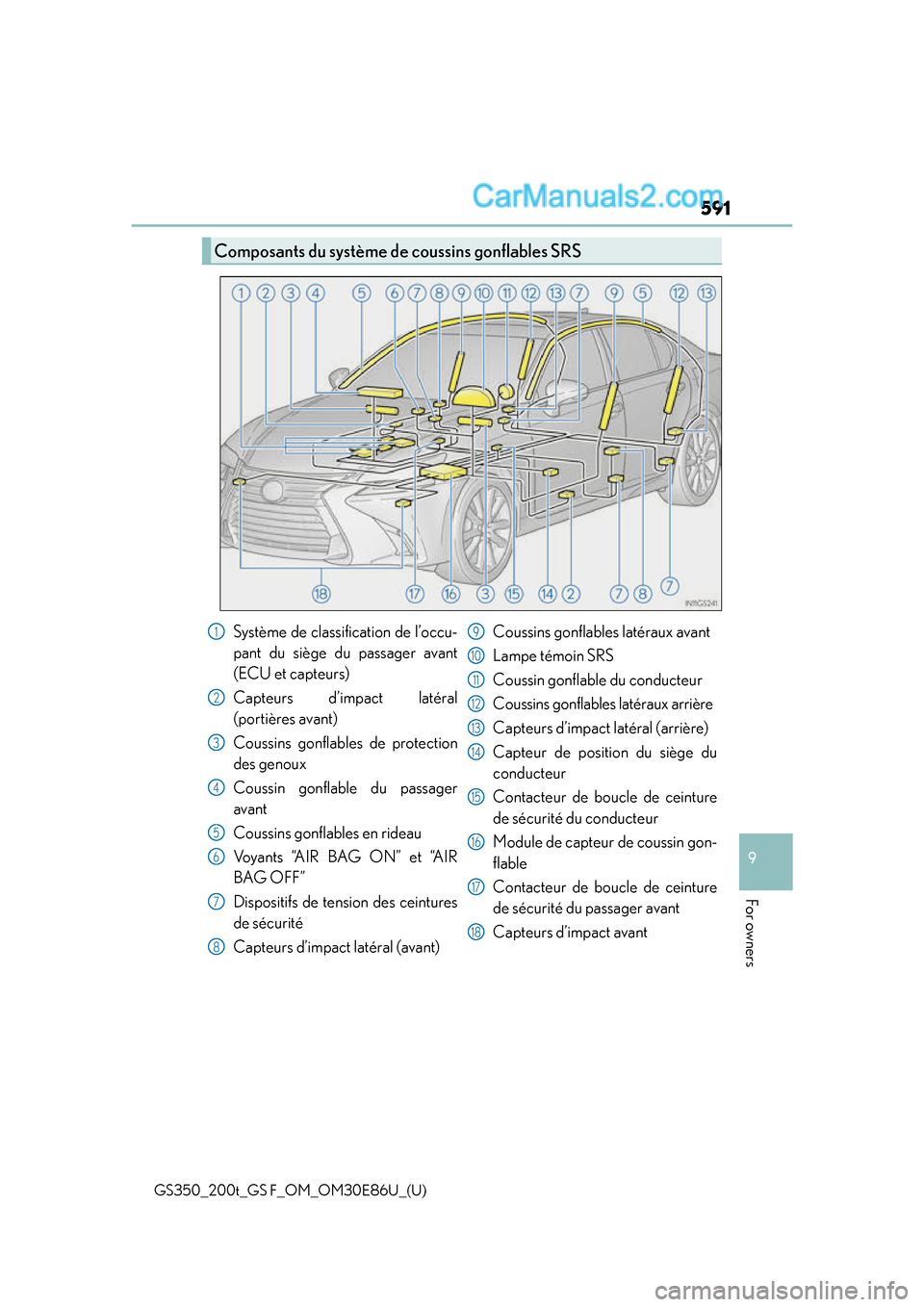
Composants du système de coussins gonflables SRS
Système de classification de l’occu-
pant du siège du passager avant
(ECU et capteurs)
Capteurs d’impact latéral
(portières avant)
Coussins gonflables de protection
des genoux
Coussin gonflable du passager
avant
Coussins gonflables en rideau
Voyants “AIR BAG ON” et “AIR
BAG OFF”
Dispositifs de tension des ceintures
de sécurité
Capteurs d’impact latéral (avant)Coussins gonflables latéraux avant
Lampe témoin SRS
Coussin gonflable du conducteur
Coussins gonflables latéraux arrière
Capteurs d’impact latéral (arrière)
Capteur de position du siège du
conducteur
Contacteur de boucle de ceinture
de sécurité du conducteur
Module de capteur de coussin gon-
flable
Contacteur de boucle de ceinture
de sécurité du passager avant
Capteurs d’impact avant1
2
3
4
5
6
7
8
9
10
11
12
13
14
15
16
17
18