ECU Lexus GS350 2018 Workshop Manual
[x] Cancel search | Manufacturer: LEXUS, Model Year: 2018, Model line: GS350, Model: Lexus GS350 2018Pages: 602, PDF Size: 13.37 MB
Page 422 of 602
420
GS350_300_GS F_OM_OM30G34U_(U)6-3. Do-it-yourself maintenance
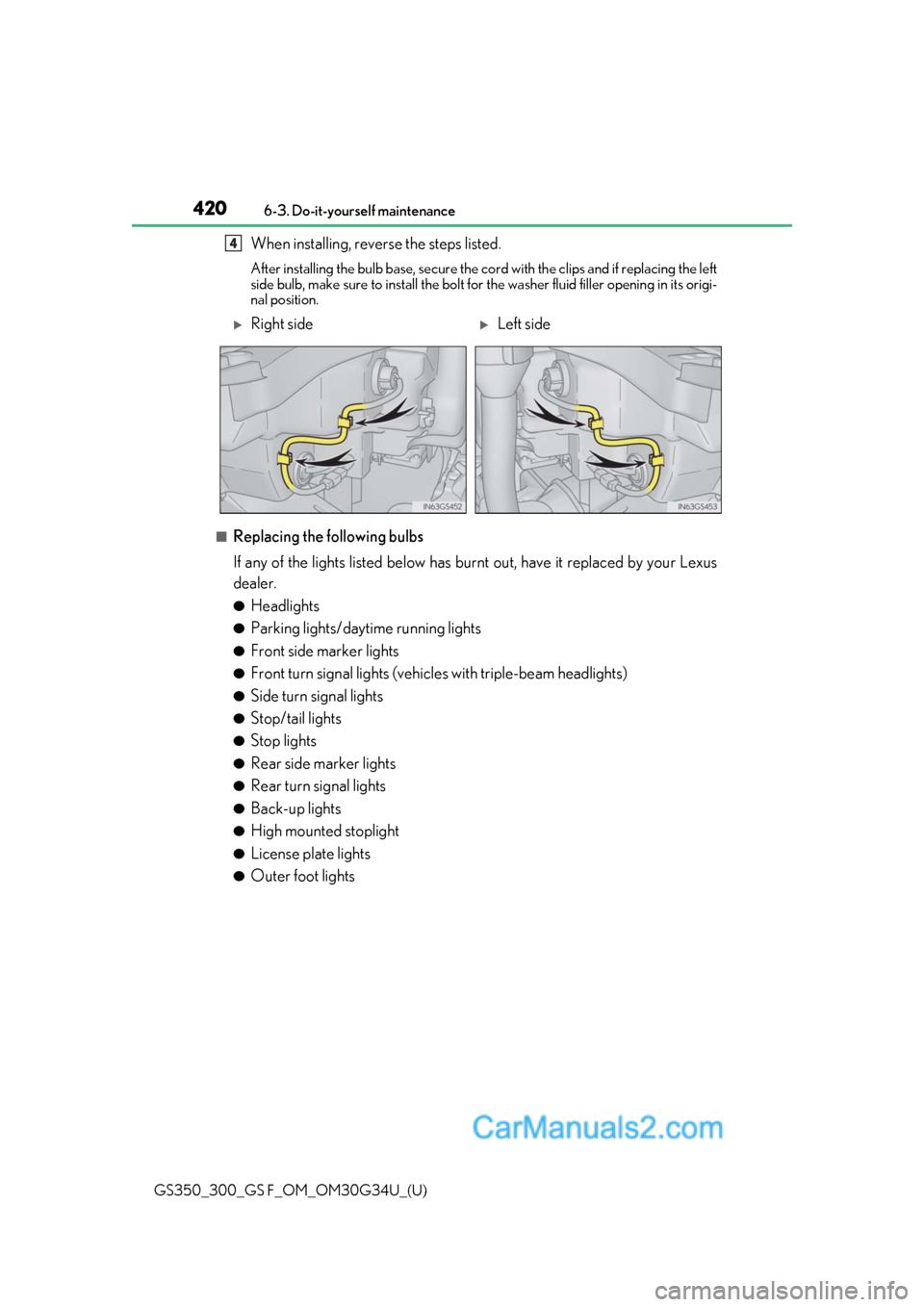
When installing, reverse the steps listed.
After installing the bulb base, secure the co
rd with the clips and if replacing the left
side bulb, make sure to install the bolt for the washer fluid fille r opening in its origi-
nal position.
■Replacing the following bulbs
If any of the lights listed below has burnt out, have it replaced by your Lexus
dealer.
●Headlights
●Parking lights/daytime running lights
●Front side marker lights
●Front turn signal lights (vehic les with triple-beam headlights)
●Side turn signal lights
●Stop/tail lights
●Stop lights
●Rear side marker lights
●Rear turn signal lights
●Back-up lights
●High mounted stoplight
●License plate lights
●Outer foot lights
4
Right sideLeft side
Page 423 of 602
GS350_300_GS F_OM_OM30G34U_(U)
4216-3. Do-it-yourself maintenance
6
Maintenance and care
■LED Lights
The lights other than the front turn signal light (vehicles with single-beam headlights) and
outer foot lights each consist of a number of LEDs. If any of the LEDs burn out, take your
vehicle to your Lexus dealer to have the light replaced.
■Condensation build-up on the inside of the lens
Temporary condensation build-up on the inside of the headlight lens does not indicate a
malfunction. Contact your Lexus dealer for mo re information in the following situations:
●Large drops of water have built up on the inside of the lens.
●Water has built up inside the headlight.
■When replacing light bulbs
→P. 415
WARNING
■Replacing light bulbs
●Turn off the lights. Do not attempt to replac e the bulb immediately after turning off the
lights.
The bulbs become very hot and may cause burns.
●Do not touch the glass portion of the light bu lb with bare hands. When it is unavoid-
able to hold the glass portion, use and hold with a clean dry cloth to avoid getting
moisture and oils on the bulb.
Also, if the bulb is sc ratched or dropped, it may blow out or crack.
●Fully install light bulbs and any parts used to secure them. Failure to do so may result
in heat damage, fire, or water entering th e headlight unit. This may damage the head-
lights or cause condensation to build up on the lens.
■To prevent damage or fire
●Make sure bulbs are fully seated and locked.
●Check the wattage of the bulb before installing to prevent heat damage.
Page 427 of 602
425
GS350_300_GS F_OM_OM30G34U_(U)
7
When trouble arises
7-1. Essential information
If your vehicle has to be stopped in an emergency
Steadily step on the brake pedal with both feet and firmly depress it.
Do not pump the brake pedal repeatedly as this will increase the effort required to
slow the vehicle.
Shift the shift lever to N.
If the shift lever is shifted to N
After slowing down, stop the vehicle in a safe place by the road.
Stop the engine.
If the shift lever cannot be shifted to N
Keep depressing the brake pedal with both feet to reduce vehicle speed as
much as possible.
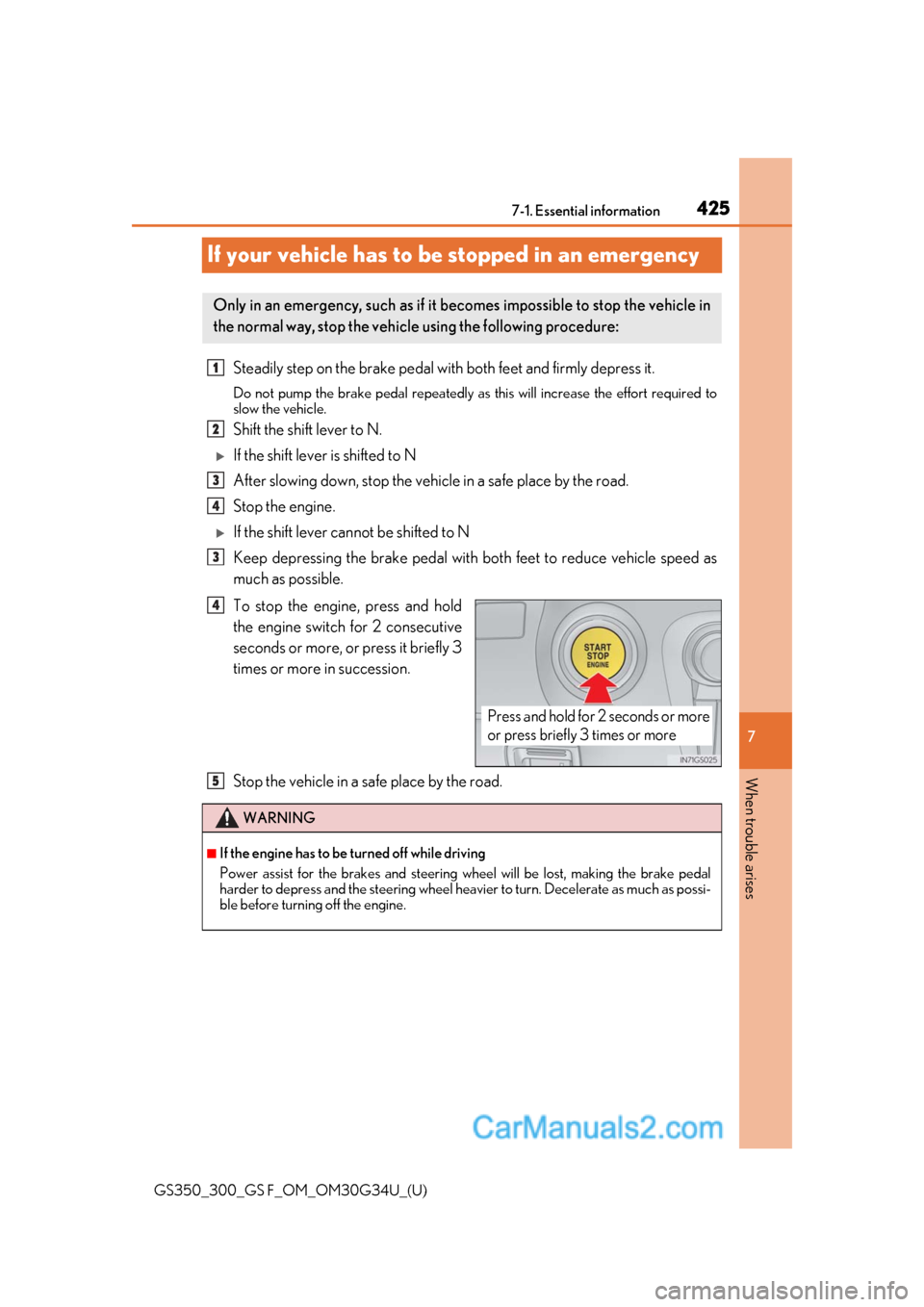
To stop the engine, press and hold
the engine switch for 2 consecutive
seconds or more, or press it briefly 3
times or more in succession.
Stop the vehicle in a safe place by the road.
Only in an emergency, such as if it becomes impossible to stop the vehicle in
the normal way, stop the vehicl e using the following procedure:
1
2
3
4
3
Press and hold for 2 seconds or more
or press briefly 3 times or more
4
WARNING
■If the engine has to be turned off while driving
Power assist for the brakes and steering wheel will be lost, making the brake pedal
harder to depress and the steering wheel heav ier to turn. Decelerate as much as possi-
ble before turning off the engine.
5
Page 429 of 602
4277-2. Steps to take in an emergency
GS350_300_GS F_OM_OM30G34U_(U)
7
When trouble arises
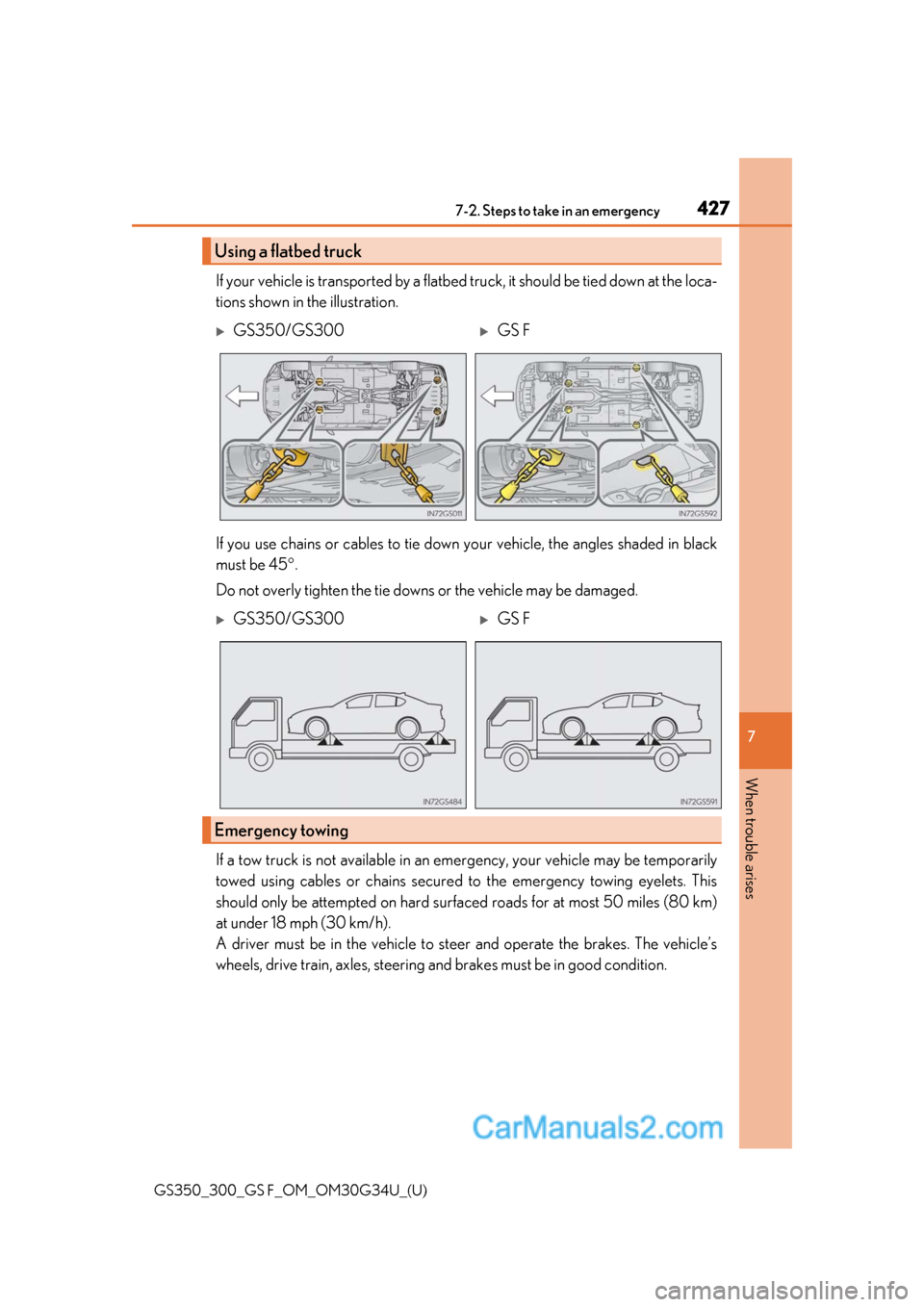
If your vehicle is transported by a flatbed truck, it should be tied down at the loca-
tions shown in the illustration.
If you use chains or cables to tie down your vehicle, the angles shaded in black
must be 45 °.
Do not overly tighten the tie downs or the vehicle may be damaged.
If a tow truck is not available in an em ergency, your vehicle may be temporarily
towed using cables or chains secured to the emergency towing eyelets. This
should only be attempted on hard surf aced roads for at most 50 miles (80 km)
at under 18 mph (30 km/h).
A driver must be in the vehicle to st eer and operate the brakes. The vehicle’s
wheels, drive train, axles, steering an d brakes must be in good condition.
Using a flatbed truck
GS350/GS300GS F
GS350/GS300GS F
Emergency towing
Page 431 of 602
4297-2. Steps to take in an emergency
GS350_300_GS F_OM_OM30G34U_(U)
7
When trouble arises
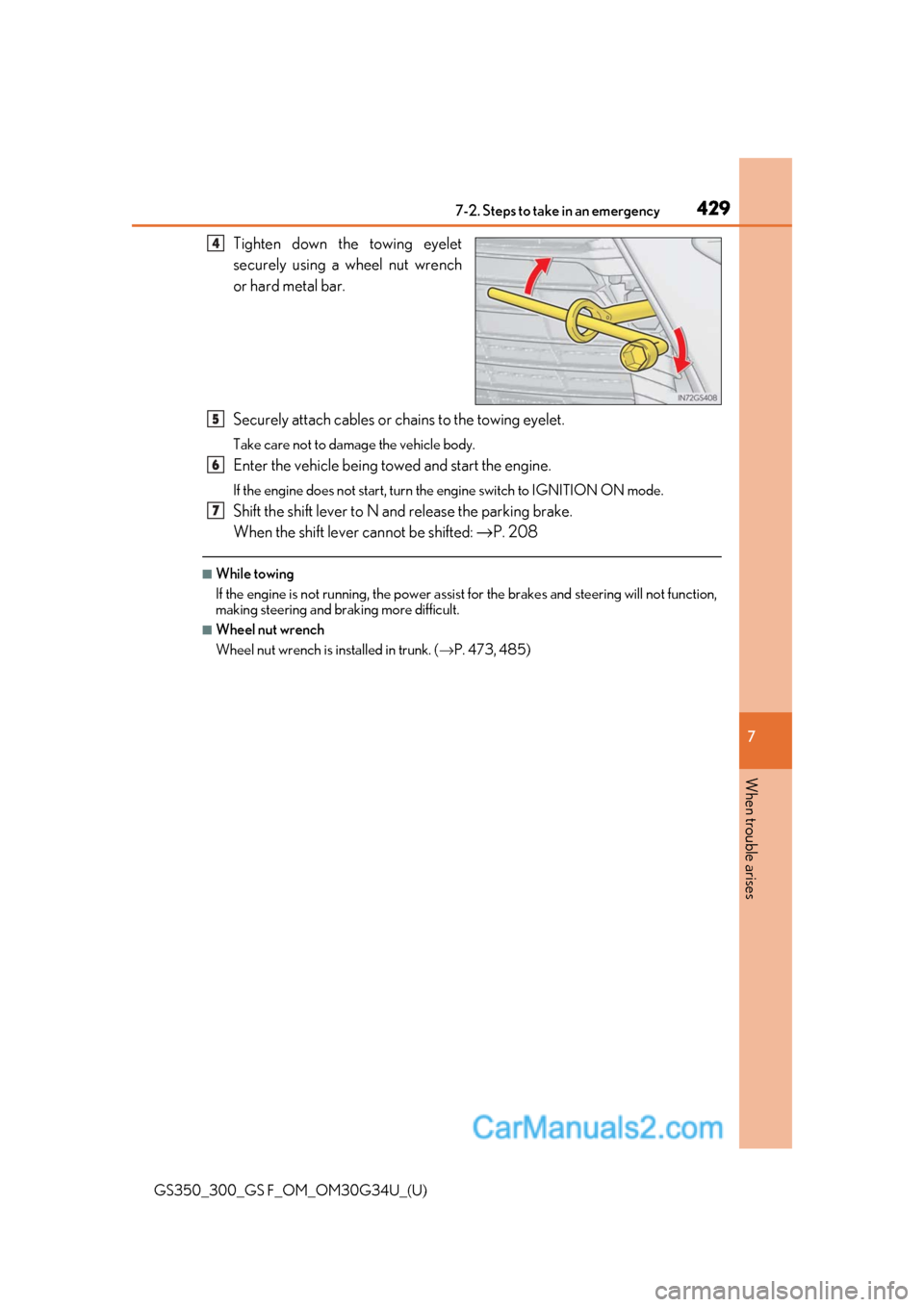
Tighten down the towing eyelet
securely using a wheel nut wrench
or hard metal bar.
Securely attach cables or chains to the towing eyelet.
Take care not to damage the vehicle body.
Enter the vehicle being towed and start the engine.
If the engine does not start, turn the engine switch to IGNITION ON mode.
Shift the shift lever to N and release the parking brake.
When the shift lever cannot be shifted: →P. 208
■While towing
If the engine is not running, the power assist for the brakes and steering will not function,
making steering and br aking more difficult.
■Wheel nut wrench
Wheel nut wrench is installed in trunk. ( →P. 473, 485)
4
5
6
7
Page 432 of 602
4307-2. Steps to take in an emergency
GS350_300_GS F_OM_OM30G34U_(U)
WARNING
Observe the following precautions.
Failure to do so may result in death or serious injury.
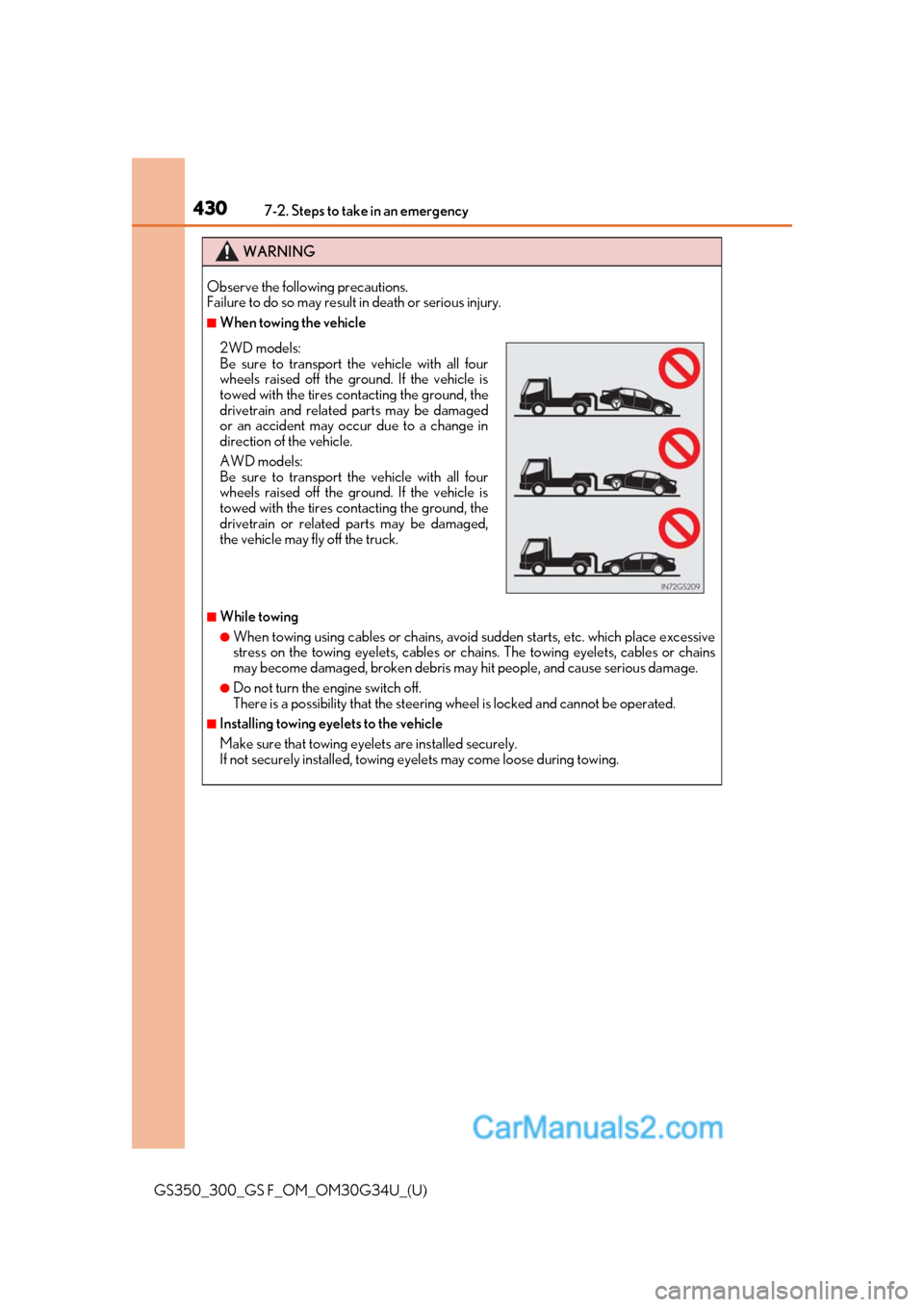
■When towing the vehicle
■While towing
●When towing using cables or chains, avoid sudden starts, etc. which place excessive
stress on the towing eyelets, cables or chains. The towing eyelets, cables or chains
may become damaged, broken debris ma y hit people, and cause serious damage.
●Do not turn the engine switch off.
There is a possibility that the steering wheel is locked and cannot be operated.
■Installing towing eyelets to the vehicle
Make sure that towing eyel ets are installed securely.
If not securely installed, towing ey elets may come loose during towing.
2WD models:
Be sure to transport the vehicle with all four
wheels raised off the ground. If the vehicle is
towed with the tires contacting the ground, the
drivetrain and related parts may be damaged
or an accident may occur due to a change in
direction of the vehicle.
AWD models:
Be sure to transport the vehicle with all four
wheels raised off the ground. If the vehicle is
towed with the tires contacting the ground, the
drivetrain or related parts may be damaged,
the vehicle may fly off the truck.
Page 433 of 602
4317-2. Steps to take in an emergency
GS350_300_GS F_OM_OM30G34U_(U)
7
When trouble arises
NOTICE
■To prevent damage to the vehicle when towing using a wheel-lift type truck
●Do not tow the vehicle from the rear when the engine switch is off. The steering lock
mechanism is not strong enough to hold the front wheels straight.
●When raising the vehicle, ensure adequate ground cleara nce for towing at the oppo-
site end of the raised vehicle. Without ad equate clearance, the vehicle could be dam-
aged while being towed.
■To prevent damage to the vehicle wh en towing with a sling-type truck
Do not tow with a sling-type truck, either from the front or rear.
■To prevent damage to the ve hicle during emergency towing
Do not secure cables or chains to the suspension components.
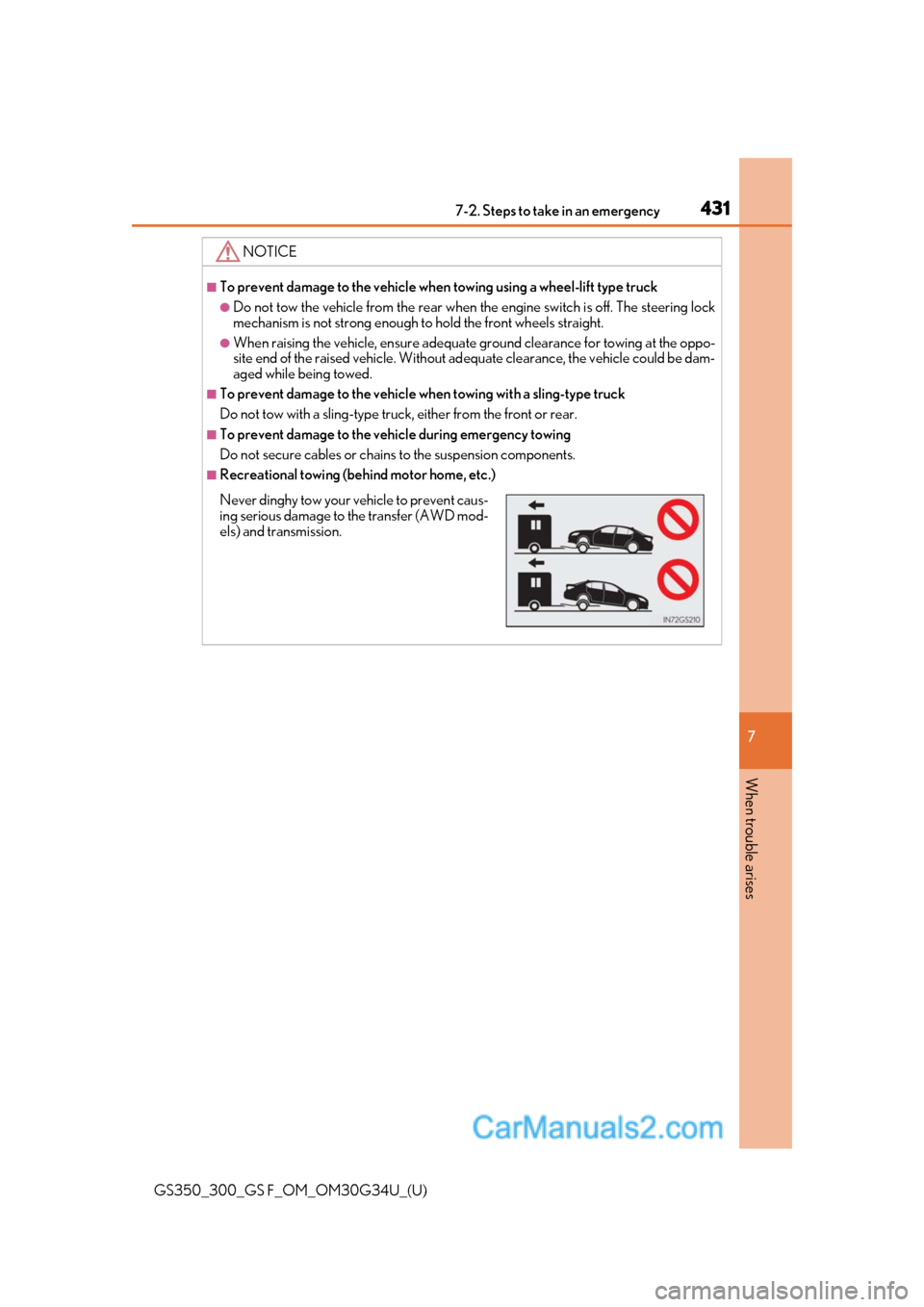
■Recreational towing (behind motor home, etc.)
Never dinghy tow your vehicle to prevent caus-
ing serious damage to the transfer (AWD mod-
els) and transmission.
Page 440 of 602
4387-2. Steps to take in an emergency
GS350_300_GS F_OM_OM30G34U_(U)
■SRS warning light
This warning light system monitors the airbag sensor assembly, front impact sensors, side
impact sensors (front door), side impact se nsors (front), side impact sensors (rear),
driver’s seat position sensor, driver’s seat belt buckle switch, front passenger occupant
classification system, “AIR BAG ON” indicat or light, “AIR BAG OFF” indicator light,
front passenger’s seat belt buckle switch, seat belt pretensioner assemblies, airbags,
interconnecting wiring and power sources. (→P. 43)
■Front passenger detection sensor, seat belt reminder and warning buzzer
If luggage is placed on the front passenger seat, the front passenger detection sensor
may cause the warning light to flash and the warning buzzer to sound even if a passenger
is not sitting in the seat.
■If the malfunction indicator lamp comes on while driving
First check the following:
●Is the fuel tank empty?
If it is, fill the fu el tank immediately.
●Is the fuel tank cap loose?
If it is, tighten it securely.
The light will go off after several driving trips.
If the light does not go off even after severa l trips, contact your Lexus dealer as soon as
possible.
■Electric power steering system warning light (warning buzzer)
When the battery charge becomes insufficien t or the voltage temporarily drops, the
electric power steering system warning li ght may come on and the warning buzzer may
sound.
■When the tire pressure warning light comes on
Check the tire inflation pressure and adjust to the appropriate level. Initializing the tire
pressure warning system will not turn off the tire pressure warning light.
■The tire pressure warning light may come on due to natural causes
The tire pressure warning light may come on due to natural causes such as natural air
leaks and tire inflation pressure changes caus ed by temperature. In this case, adjusting
the tire inflation pressure will turn off the warning light (after a few minutes).
■When a tire is replaced with a spare tire
The compact spare tire is not equipped with a tire pressure warning valve and transmit-
ter. If a tire goes flat, the tire pressure warning light will not turn off even though the flat
tire has been replaced with the spare tire.
■Conditions that the tire pressure wa rning system may not function properly
→ P. 398
■If the tire pressure warning light freque ntly comes on after blinking for 1 minute
If the tire pressure warning light frequently comes on after blinking for 1 minute when the
engine switch is turned to IGNITION ON mo de, have it checked by your Lexus dealer.
Page 471 of 602
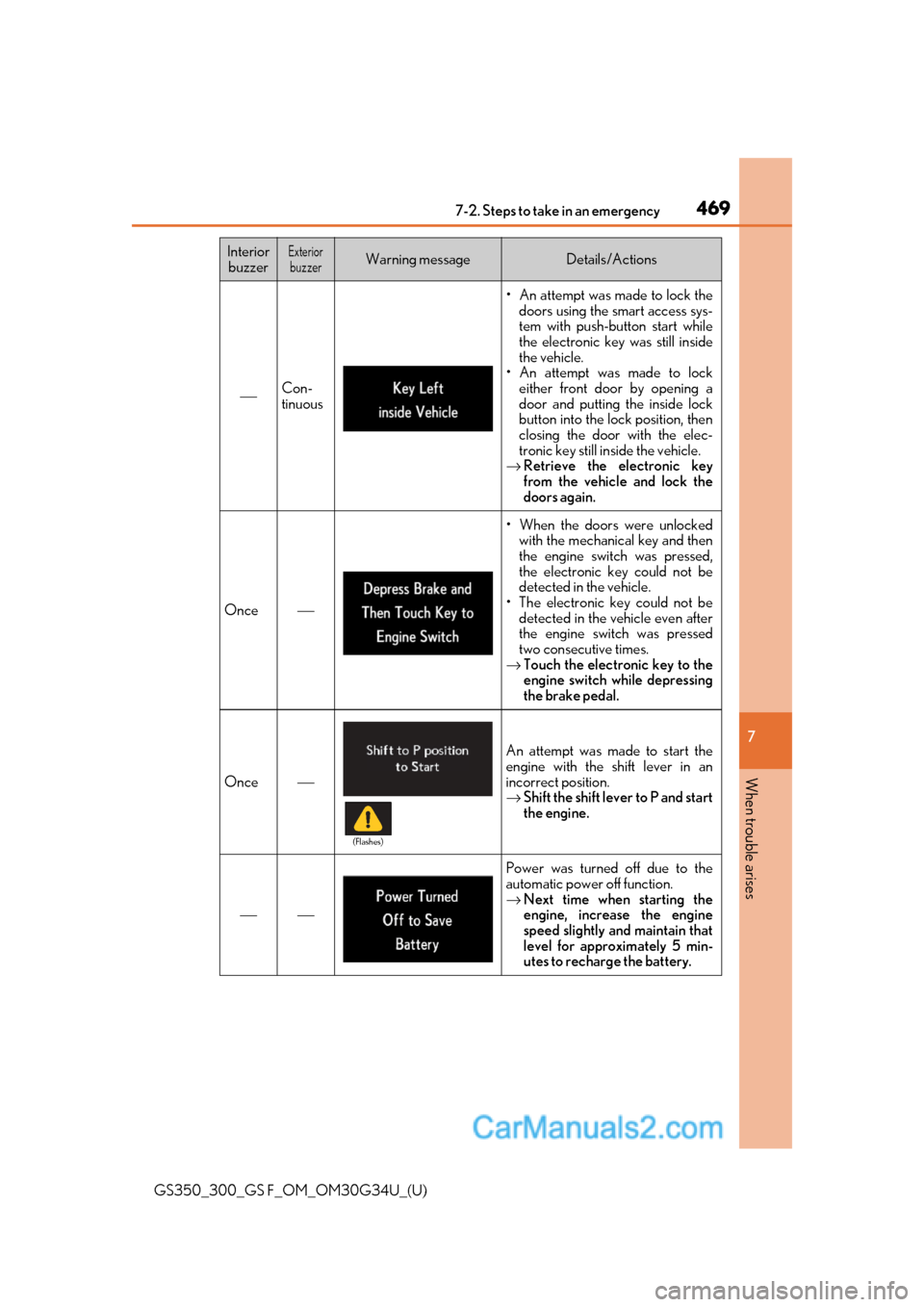
4697-2. Steps to take in an emergency
GS350_300_GS F_OM_OM30G34U_(U)
7
When trouble arises
⎯Con-
tinuous
• An attempt was made to lock the doors using the sm art access sys-
tem with push-button start while
the electronic key was still inside
the vehicle.
• An attempt was made to lock either front door by opening a
door and putting the inside lock
button into the lock position, then
closing the door with the elec-
tronic key still inside the vehicle.
→ Retrieve the electronic key
from the vehicle and lock the
doors again.
Once⎯
• When the doors were unlocked
with the mechanical key and then
the engine swit ch was pressed,
the electronic key could not be
detected in the vehicle.
• The electronic key could not be
detected in the vehicle even after
the engine switch was pressed
two consecutive times.
→ Touch the electronic key to the
engine switch while depressing
the brake pedal.
Once⎯
An attempt was made to start the
engine with the shift lever in an
incorrect position.
→Shift the shift lever to P and start
the engine.
⎯⎯
Power was turned off due to the
automatic power off function.
→Next time when starting the
engine, increase the engine
speed slightly and maintain that
level for approximately 5 min-
utes to recharge the battery.
Interior
buzzerExteriorbuzzerWarning messageDetails/Actions
(Flashes)
Page 478 of 602

4767-2. Steps to take in an emergency
GS350_300_GS F_OM_OM30G34U_(U)
Remove the center luggage mat. (→P. 335)
Remove the spacer and take out the jack handle.
Take out the jack. For tightening
For loosening
Type A
Remove the center luggage mat. (→ P. 335)
Loosen the center fastener that
secures the spare tire.
Taking out the jack and jack handle
1
2
Type AType B
3
1
2
Taking out the spare tire
1
2