steering Lexus GS350 2018 Repair Manual
[x] Cancel search | Manufacturer: LEXUS, Model Year: 2018, Model line: GS350, Model: Lexus GS350 2018Pages: 602, PDF Size: 13.37 MB
Page 295 of 602
GS350_300_GS F_OM_OM30G34U_(U)
2934-5. Using the driving support systems
4
Driving
■Sounds and vibrations caused by the ABS, brake assist, VSC, TRAC, Hill-start assist
control and VGRS systems
●A sound may be heard from the engine compartment when the brake pedal is
depressed repeatedly, when the engine is started or just after the vehicle begins to
move. This sound does not indicate that a malfunction has occurred in any of these sys-
tems.
●Any of the following conditions may occur when the above systems are operating.
None of these indicates that a malfunction has occurred.
• Vibrations may be felt through the vehicle body and steering.
• A motor sound may be heard afte r the vehicle comes to a stop.
• The brake pedal may pulsate slig htly after the ABS is activated.
• The brake pedal may move down s lightly after the ABS is activated.
■EPS, VGRS and DRS operation sound
When the steering wheel is operated, a motor sound (whirring sound) may be heard.
This does not indicate a malfunction.
■Automatic reactivation of TRAC and VSC systems
After turning the TRAC and VSC systems off, the systems will be automatically re-
enabled in the following situations:
●When the engine swit ch is turned off
●If only the TRAC system is turned off, the TRAC will turn on when vehicle speed
increases
If both TRAC and VSC systems are turned off, automatic re-enabling will not occur
when vehicle speed increases.
■Reduced effectiveness of the EPS system
The effectiveness of the EPS system is reduced to prevent the system from overheating
when there is frequent steering input over an extended period of time. The steering
wheel may feel heavy as a result . Should this occur, refrain from excessive steering input
or stop the vehicle and turn the engine off. The EPS system should return to normal
within 10 minutes.
■Operating conditions of hill-start assist control
When the following four conditions are met, the hill-start assist control will operate;
●The shift lever is in a position other than N or P (when starting off forward/backward on
an upward incline).
●The vehicle is stopped.
●The accelerator pedal is not depressed.
●The parking brake is not engaged.
■Automatic system cancelation of hill-start assist control
The hill-start assist control will be cancel ed in any of the following situations;
●The shift lever is shifted to N or P.
●The accelerator pedal is depressed.
●The parking brake is engaged.
●Approximately 2 seconds elapse after the brake pedal is released.
Page 302 of 602
300
GS350_300_GS F_OM_OM30G34U_(U)4-6. Driving tips
WARNING
■Driving with snow tires
Observe the following precautions to
reduce the risk of accidents.
Failure to do so may result in a loss of vehi cle control and cause death or serious injury.
●Use tires of the specified size.
●Maintain the recommended level of air pressure.
●Do not drive in excess of 75 mph (120 km/h ), regardless of the type of snow tires
being used.
●Use snow tires on all, not just some wheels.
■Driving with tire chains (GS350/GS300 with front and rear tires of the same size
except for the vehicles with LDH and 19 inch tires)
Observe the following precautions to reduce the risk of accidents.
Failure to do so may result in the vehicle being unable to be driven safely, and may
cause death or serious injury.
●Do not drive in excess of the speed limit specified for the ti re chains being used, or 30
mph (50 km/h), whichever is lower.
●Avoid driving on bumpy road surfaces or over potholes.
●Avoid sudden acceleration, abrupt steering, sudden braking and shifting operations
that cause sudden engine braking.
●Slow down sufficiently before entering a cu rve to ensure that vehicle control is main-
tained.
●Do not use LKA (Lane-Keeping Assist) system. (if equipped)
NOTICE
■Repairing or replacing snow tires
Request repairs or replacement of snow ti res from Lexus dealers or legitimate tire
retailers.
This is because the removal an d attachment of snow tires affects the operation of the
tire pressure warning va lves and transmitters.
■Fitting tire chains (GS350/GS300 with fron t and rear tires of the same size except
for the vehicles with LDH and 19 inch tires)
The tire pressure warning valv es and transmitters may not function correctly when tire
chains are fitted.
■When standing the windshield wipers up
Raise the wipers in line with the windshield. ( →P. 299)
Failure to do so may result in dama ge to the wipers and/or the hood.
Page 303 of 602
301
GS350_300_GS F_OM_OM30G34U_(U)
5Interior features
5-1. Remote Touch screenRemote Touch/12.3-inch display ......................................... 302
5-2. Using the air conditioning system and defogger
Front automatic air conditio ning system ........ 308
Rear air conditioning system ........................................... 319
Heated steering wheel/ seat heaters/seat
ventilators ...................................322
5-3. Using the interior lights Interior lights list.......................... 327• Interior lights ......................... 328
• Personal lights ...................... 328 5-4. Using the storage features
List of storage features ............330
• Glove box ................................ 331
• Console box............................ 331
• Cup holders ........................... 332
• Auxiliary boxes ..................... 333
Trunk features ............................. 334
5-5. Using the other interior features
Other interior features ............338 • Sun visors ................................338
• Vanity mirrors .......................338
• Clock ........................................ 339
• Ashtrays ................................... 339
• Power outlets.........................340
• Armrest ....................................340
•Rear sunshade/rear door sunshades............ 341
•Trunk storage
extension ................................. 343
• Coat hooks ............................. 344
• Assist grips.............................. 344
Garage door opener ............... 345
LEXUS Enform Safety Connect ...................................... 352
Page 324 of 602
322
GS350_300_GS F_OM_OM30G34U_(U)5-2. Using the air conditio
ning system and defogger
Heated steering wheel∗/seat heaters∗/seat ventilators∗
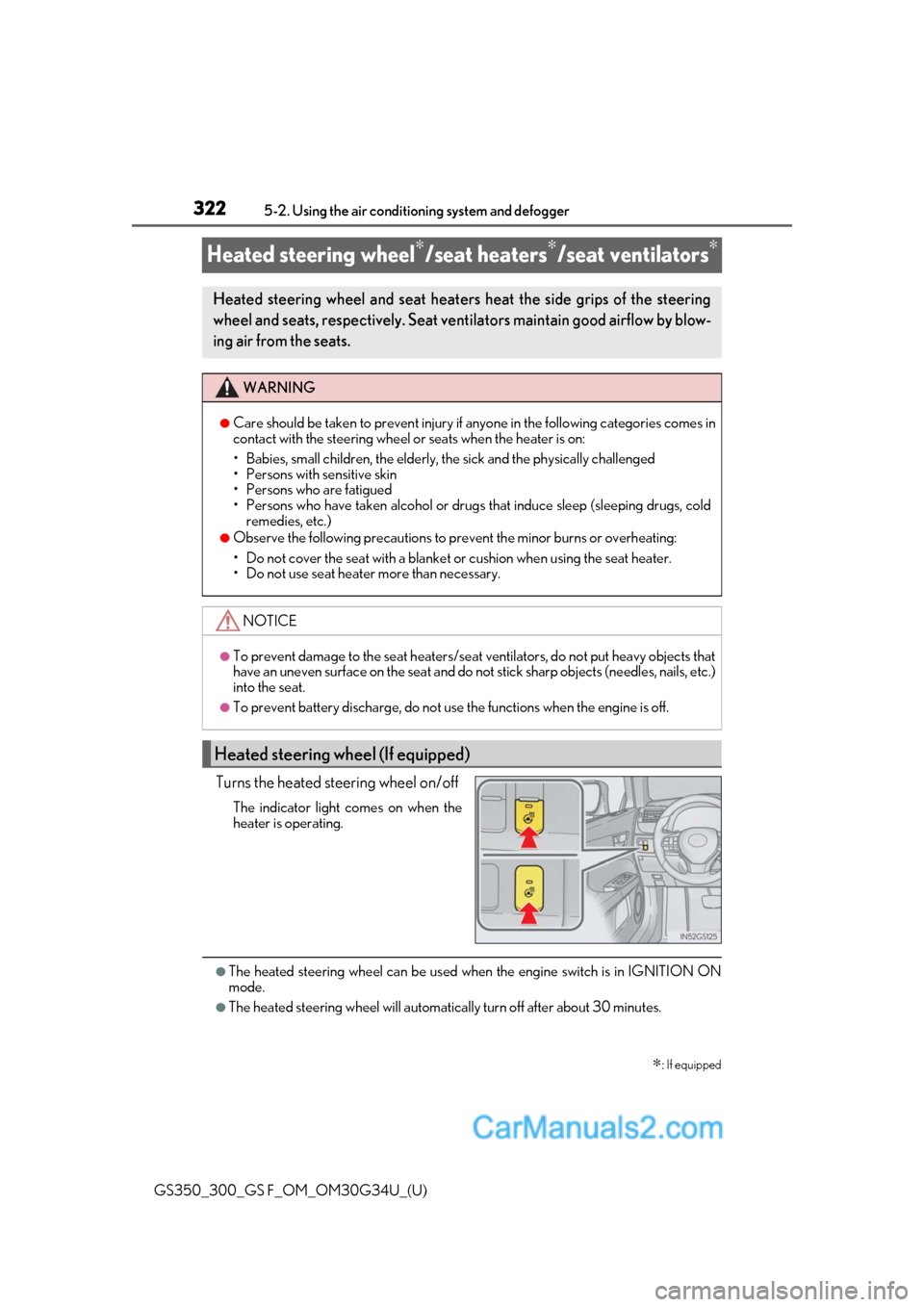
Turns the heated steering wheel on/off
The indicator light comes on when the
heater is operating.
●The heated steering wheel can be used when the engine switch is in IGNITION ON
mode.
●The heated steering wheel will automati cally turn off after about 30 minutes.
∗: If equipped
Heated steering wheel and seat heaters heat the side grips of the steering
wheel and seats, respectively. Seat ventilators maintain good airflow by blow-
ing air from the seats.
WARNING
●Care should be taken to prevent injury if anyone in the following categories comes in
contact with the steering wheel or seats when the heater is on:
• Babies, small children, the elderly, the sick and the physically challenged
• Persons with sensitive skin
• Persons who are fatigued
• Persons who have taken alcohol or drugs that induce sleep (sleeping drugs, cold
remedies, etc.)
●Observe the following precautions to pr event the minor burns or overheating:
• Do not cover the seat with a blanket or cushion when using the seat heater.
• Do not use seat heater more than necessary.
NOTICE
●To prevent damage to the seat heaters/seat ventilators, do not put heavy objects that
have an uneven surface on the seat and do not stick sharp objects (needles, nails, etc.)
into the seat.
●To prevent battery discharge, do not us e the functions when the engine is off.
Heated steering wheel (If equipped)
Page 363 of 602
GS350_300_GS F_OM_OM30G34U_(U)
3616-1. Maintenance and care
6
Maintenance and care
NOTICE
■Application of coatings to the vehicle body (GS F)
Do not apply any kind of coating to the vehicle body as doing so may damage the paint
or reduce its durability.
■To prevent paint deterioration and corrosion on the body and components (aluminum
wheels etc.)
●Wash the vehicle immediatel y in the following cases:
• After driving near the sea coast
• After driving on salted roads
• If coal tar, pollen or tree sap is present on the paint surface
• If dead insects, insect droppings or bird droppings are present on the paint surface
• After driving in an area contaminated wi th soot, oily smoke, mine dust, iron pow-
der or chemical substances
• If the vehicle becomes heavily soiled with dust or mud
• If liquids such as benzene and gasoli ne are spilled on the paint surface
●If the paint is chipped or scratched, have it repaired immediately.
●To prevent the wheels from corroding, remove any dirt and store in a place with low
humidity when storing the wheels.
■Cleaning the exterior lights
●Wash carefully. Do not use organic subs tances or scrub with a hard brush.
This may damage the surfaces of the lights.
●Do not apply wax to the surfaces of the lights.
Wax may cause damage to the lenses.
■When using an automatic car wash (vehicle s with rain-sensing windshield wipers)
Turn off AUTO mode of the wiper to prevent the wiper from operating. (→P. 223)
If AUTO mode is selected, the wipers may operate and the wiper blades may be dam-
aged.
■When using a high-pressure car wash
●When washing the vehicle, do not let water from the high-pressure washer directly hit
the camera or the area around the camera. Due to the shock from high-pressure
water, it is possible that the device may not operate normally.
●Do not bring the nozzle tip close to boots (rubber or resin manufactured cover), con-
nectors or the following parts. The parts may be damaged if they come into contact
with high-pressure water.
• Traction related parts
• Suspension parts •Steering parts
• Brake parts
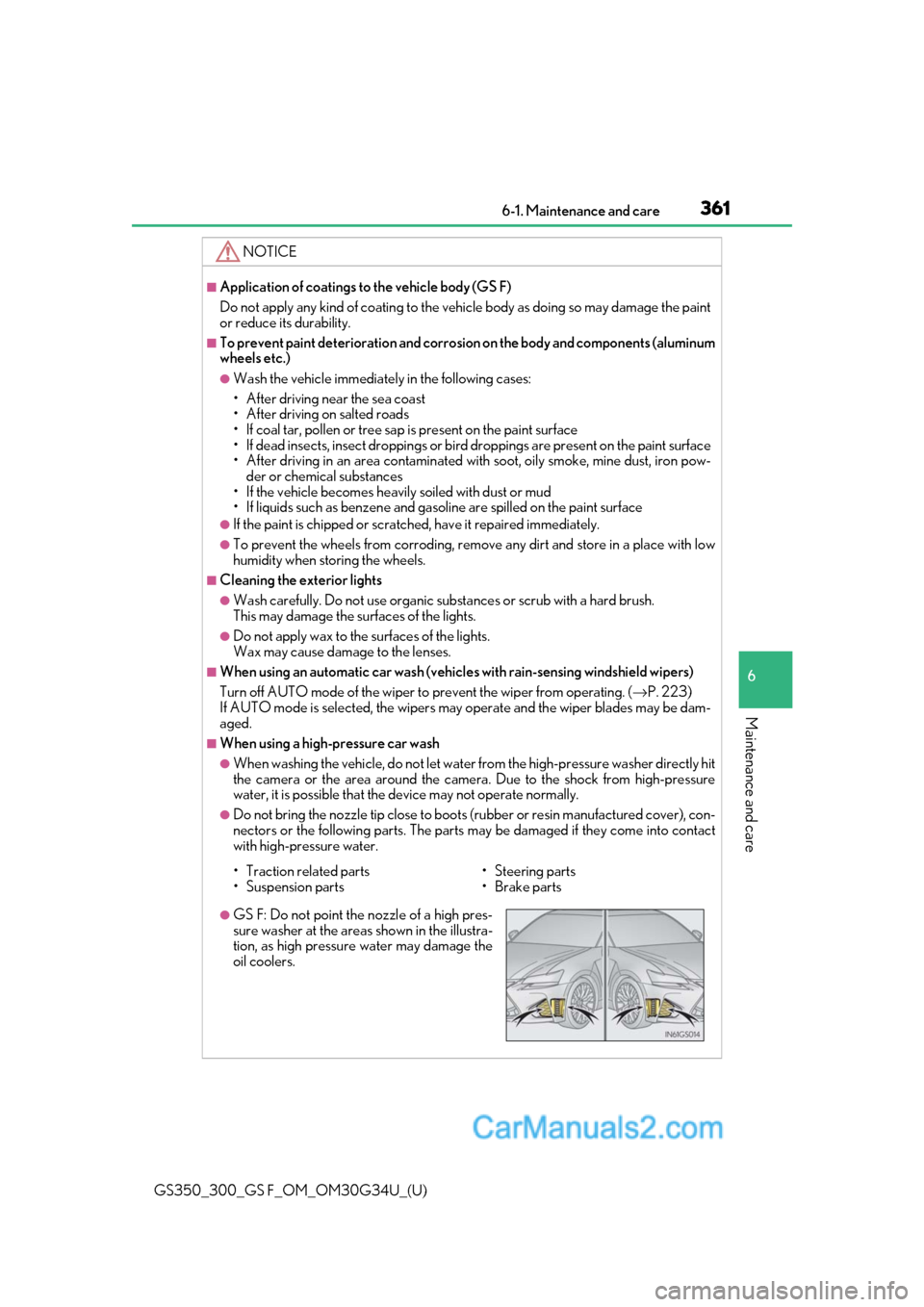
●GS F: Do not point the nozzle of a high pres-
sure washer at the areas shown in the illustra-
tion, as high pressure water may damage the
oil coolers.
Page 370 of 602
368
GS350_300_GS F_OM_OM30G34U_(U)6-2. Maintenance
*: Vehicles with sing
le-beam headlights
Vehicle interior
ItemsCheck points
Accelerator pedal• The accelerator pedal should move smoothly
(without uneven pedal effort or catching).
Automatic transmission “Park”
mechanism• When parked on a slope and the shift lever is in P,is the vehicle securely stopped?
Brake pedal
• Does the brake pedal move smoothly?
• Does the brake pedal have appropriate clearance
from the floor? ( →P. 527)
• Does the brake pedal have the correct amount of
free play? ( →P. 527)
Brakes
• The vehicle should not pull to one side when the
brakes are applied.
• The brakes should work effectively.
• The brake pedal should not feel spongy.
• The brake pedal should not get too close to the floor when the brakes are applied.
Head restraints• Do the head restraints move smoothly and lock
securely?
Indicators/buzzers• Do the indicators and buzzers function properly?
Lights• Do all the lights come on?
• Are the headlights aimed correctly?
* (→ P. 416)
Parking brake• Moves smoothly?
• When parked on a slope and the parking brake is
on, is the vehicle securely stopped?
Seat belts• Do the seat belts operate smoothly?
• The seat belts should not be damaged.
Seats• Do the seat controls operate properly?
Steering wheel
•Does the steering wh eel rotate smoothly?
• Does the steering wheel have the correct amount
of free play?
• There should not be any strange sounds coming from the steering wheel.
Page 427 of 602
425
GS350_300_GS F_OM_OM30G34U_(U)
7
When trouble arises
7-1. Essential information
If your vehicle has to be stopped in an emergency
Steadily step on the brake pedal with both feet and firmly depress it.
Do not pump the brake pedal repeatedly as this will increase the effort required to
slow the vehicle.
Shift the shift lever to N.
If the shift lever is shifted to N
After slowing down, stop the vehicle in a safe place by the road.
Stop the engine.
If the shift lever cannot be shifted to N
Keep depressing the brake pedal with both feet to reduce vehicle speed as
much as possible.
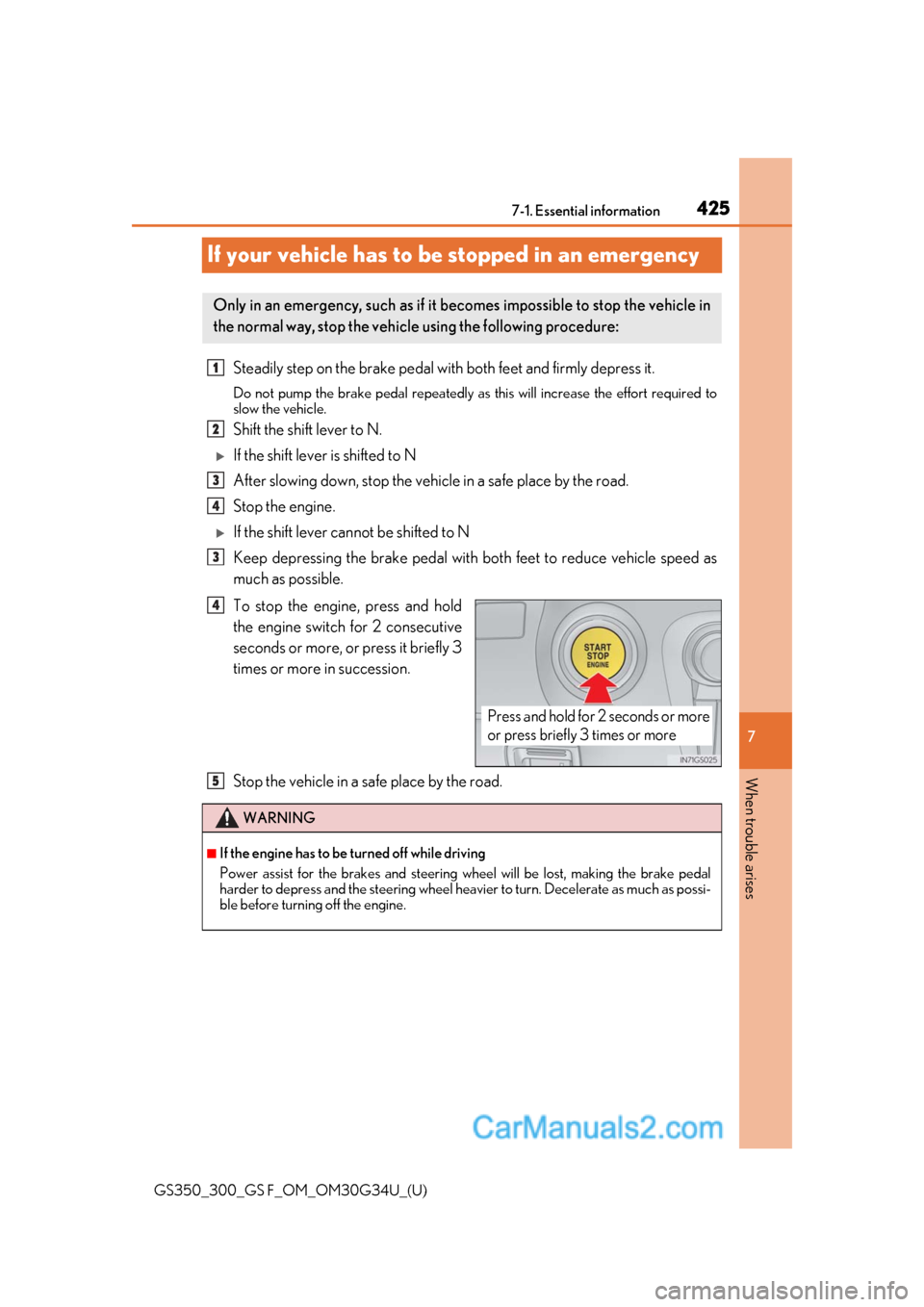
To stop the engine, press and hold
the engine switch for 2 consecutive
seconds or more, or press it briefly 3
times or more in succession.
Stop the vehicle in a safe place by the road.
Only in an emergency, such as if it becomes impossible to stop the vehicle in
the normal way, stop the vehicl e using the following procedure:
1
2
3
4
3
Press and hold for 2 seconds or more
or press briefly 3 times or more
4
WARNING
■If the engine has to be turned off while driving
Power assist for the brakes and steering wheel will be lost, making the brake pedal
harder to depress and the steering wheel heav ier to turn. Decelerate as much as possi-
ble before turning off the engine.
5
Page 429 of 602
4277-2. Steps to take in an emergency
GS350_300_GS F_OM_OM30G34U_(U)
7
When trouble arises
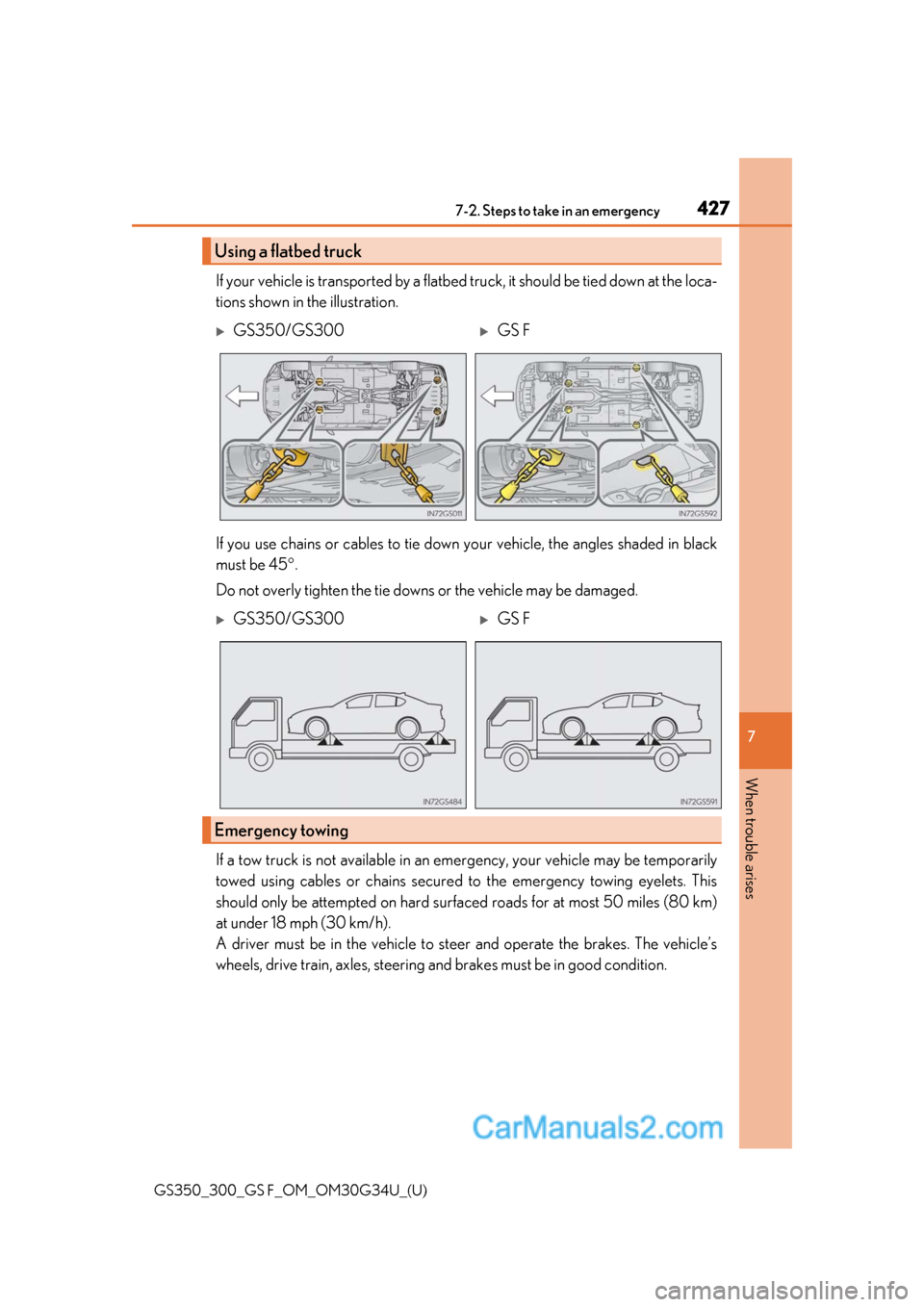
If your vehicle is transported by a flatbed truck, it should be tied down at the loca-
tions shown in the illustration.
If you use chains or cables to tie down your vehicle, the angles shaded in black
must be 45 °.
Do not overly tighten the tie downs or the vehicle may be damaged.
If a tow truck is not available in an em ergency, your vehicle may be temporarily
towed using cables or chains secured to the emergency towing eyelets. This
should only be attempted on hard surf aced roads for at most 50 miles (80 km)
at under 18 mph (30 km/h).
A driver must be in the vehicle to st eer and operate the brakes. The vehicle’s
wheels, drive train, axles, steering an d brakes must be in good condition.
Using a flatbed truck
GS350/GS300GS F
GS350/GS300GS F
Emergency towing
Page 431 of 602
4297-2. Steps to take in an emergency
GS350_300_GS F_OM_OM30G34U_(U)
7
When trouble arises
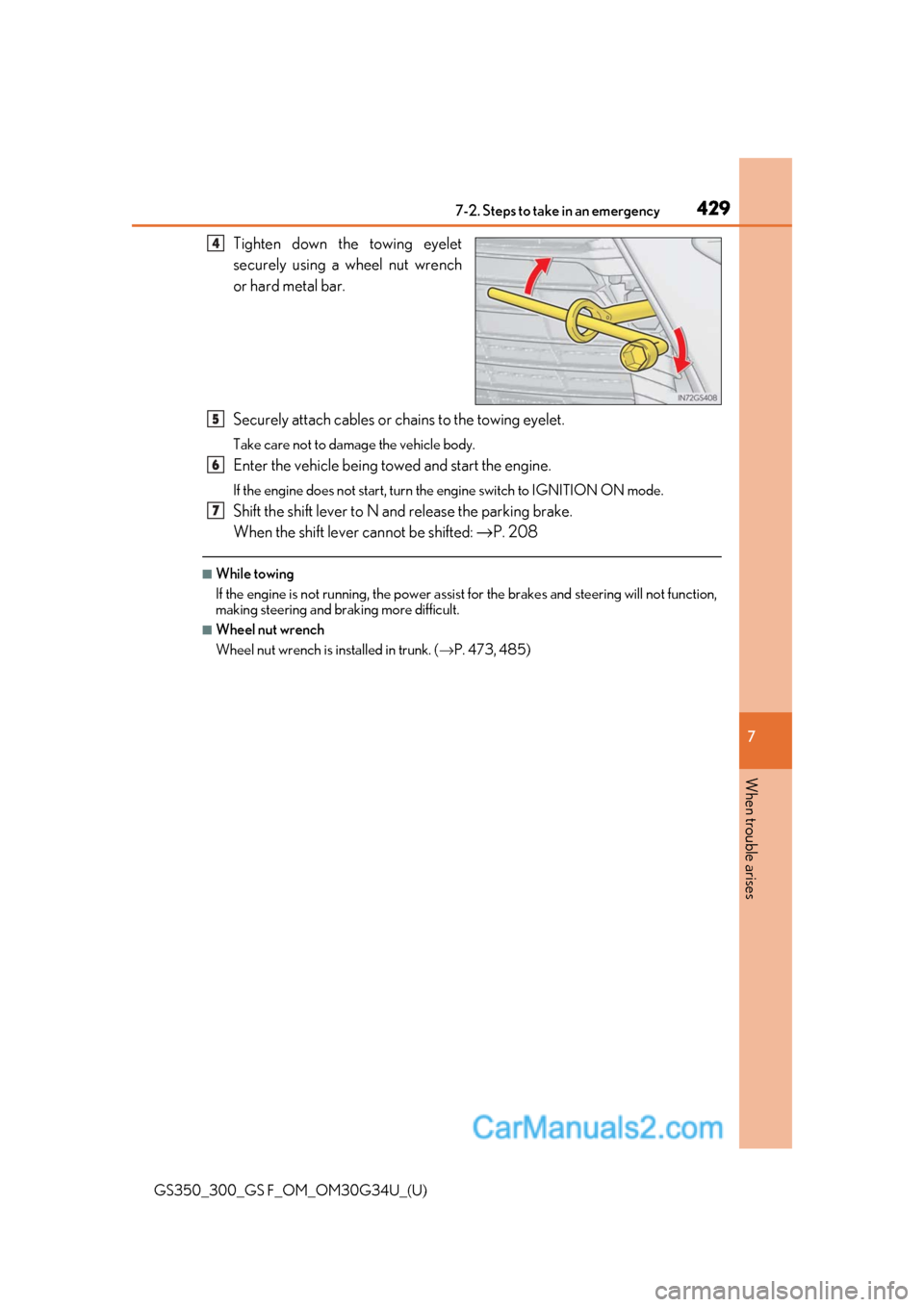
Tighten down the towing eyelet
securely using a wheel nut wrench
or hard metal bar.
Securely attach cables or chains to the towing eyelet.
Take care not to damage the vehicle body.
Enter the vehicle being towed and start the engine.
If the engine does not start, turn the engine switch to IGNITION ON mode.
Shift the shift lever to N and release the parking brake.
When the shift lever cannot be shifted: →P. 208
■While towing
If the engine is not running, the power assist for the brakes and steering will not function,
making steering and br aking more difficult.
■Wheel nut wrench
Wheel nut wrench is installed in trunk. ( →P. 473, 485)
4
5
6
7
Page 432 of 602
4307-2. Steps to take in an emergency
GS350_300_GS F_OM_OM30G34U_(U)
WARNING
Observe the following precautions.
Failure to do so may result in death or serious injury.
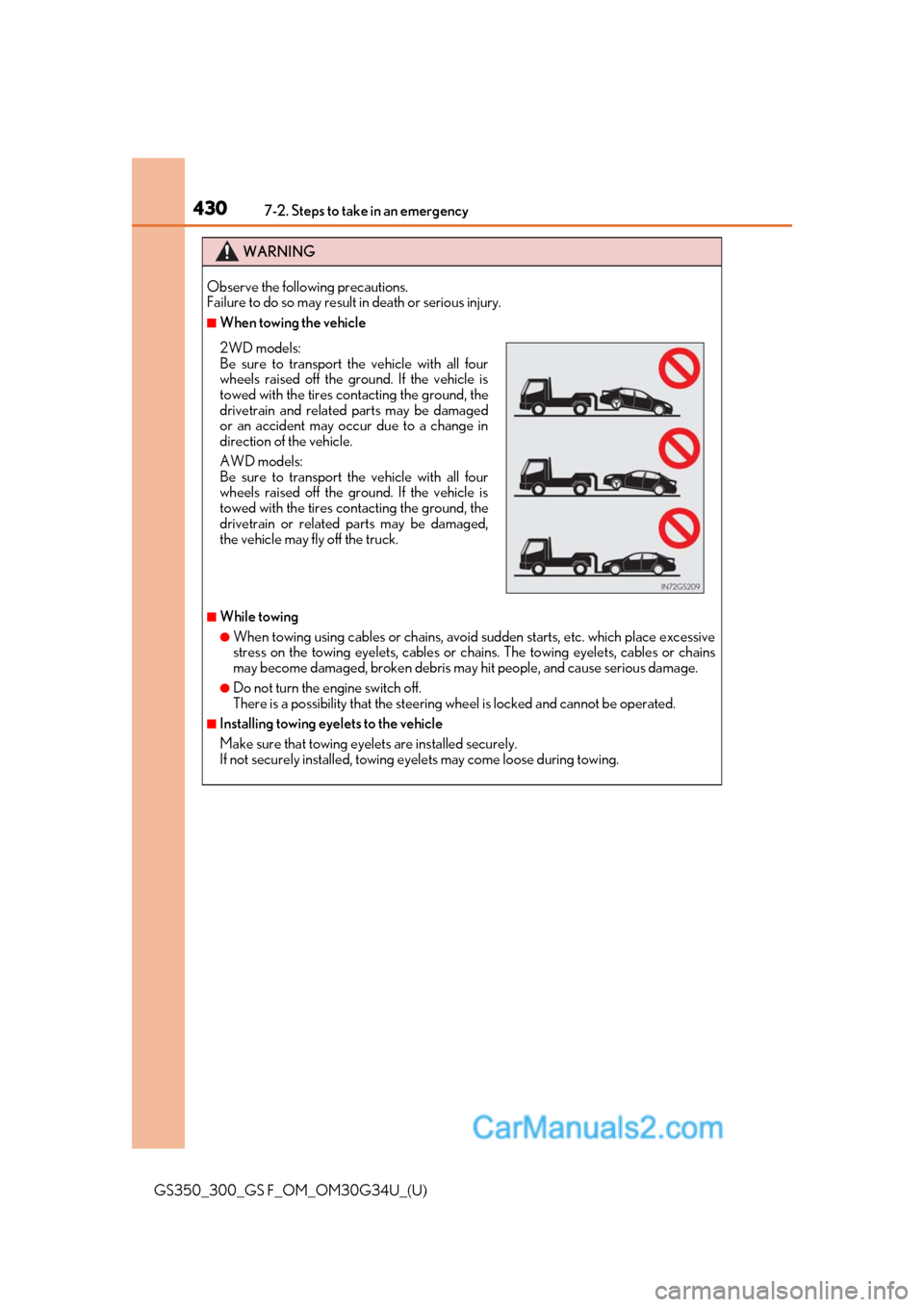
■When towing the vehicle
■While towing
●When towing using cables or chains, avoid sudden starts, etc. which place excessive
stress on the towing eyelets, cables or chains. The towing eyelets, cables or chains
may become damaged, broken debris ma y hit people, and cause serious damage.
●Do not turn the engine switch off.
There is a possibility that the steering wheel is locked and cannot be operated.
■Installing towing eyelets to the vehicle
Make sure that towing eyel ets are installed securely.
If not securely installed, towing ey elets may come loose during towing.
2WD models:
Be sure to transport the vehicle with all four
wheels raised off the ground. If the vehicle is
towed with the tires contacting the ground, the
drivetrain and related parts may be damaged
or an accident may occur due to a change in
direction of the vehicle.
AWD models:
Be sure to transport the vehicle with all four
wheels raised off the ground. If the vehicle is
towed with the tires contacting the ground, the
drivetrain or related parts may be damaged,
the vehicle may fly off the truck.