wheel Lexus GS350 2018 Repair Manual
[x] Cancel search | Manufacturer: LEXUS, Model Year: 2018, Model line: GS350, Model: Lexus GS350 2018Pages: 602, PDF Size: 13.37 MB
Page 360 of 602
358
GS350_300_GS F_OM_OM30G34U_(U)6-1. Maintenance and care
Cleaning and protecting the vehicle exterior
●Working from top to bott
om, liberally apply water to the vehicle body, wheel
wells and underside of the vehicl e to remove any dirt and dust.
●Wash the vehicle body using a sponge or soft cloth, such as a chamois.
●For hard-to-remove marks, use car wa sh soap and rinse thoroughly with
water.
●Wipe away any water.
●Wax the vehicle when the waterproof coating deteriorates.
If water does not bead on a clean surface, apply wax when the vehicle body is cool.
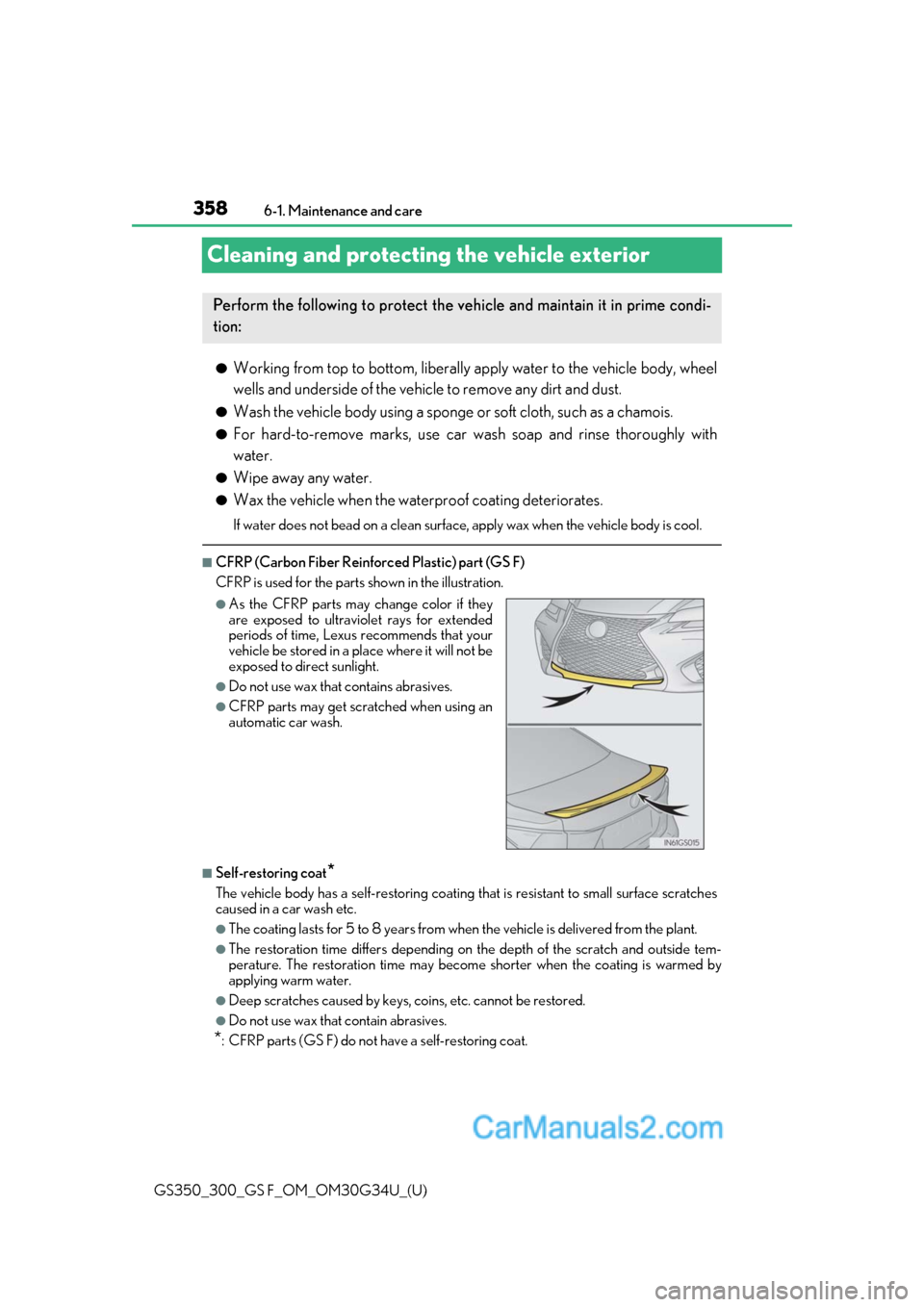
■CFRP (Carbon Fiber Reinforced Plastic) part (GS F)
CFRP is used for the part s shown in the illustration.
■Self-restoring coat*
The vehicle body has a self-restoring coating that is resistant to small surface scratches
caused in a car wash etc.
●The coating lasts for 5 to 8 years from when the vehicle is delivered from the plant.
●The restoration time differs depending on the depth of the scratch and outside tem-
perature. The restoration ti me may become shorter when the coating is warmed by
applying warm water.
●Deep scratches caused by keys, coins, etc. cannot be restored.
●Do not use wax that contain abrasives.
*: CFRP parts (GS F) do not have a self-restoring coat.
Perform the following to protect the ve hicle and maintain it in prime condi-
tion:
●As the CFRP parts may change color if they
are exposed to ultraviolet rays for extended
periods of time, Lexus recommends that your
vehicle be stored in a place where it will not be
exposed to direct sunlight.
●Do not use wax that contains abrasives.
●CFRP parts may get scratched when using an
automatic car wash.
Page 361 of 602
GS350_300_GS F_OM_OM30G34U_(U)
3596-1. Maintenance and care
6
Maintenance and care
■Automatic car washes
●Fold the mirrors before washing the vehicle. Start washing from the front of the vehicle.
Make sure to extend the mirrors before driving.
●Brushes used in automatic car washes may scratch the vehicle surface and harm your
vehicle’s paint.
●Rear spoiler (if equipped) may not be washable in some automatic car washes. There
may also be an increased risk of damage to vehicle.
■High-pressure car washes
●Do not allow the nozzles of the car wash to come within close proximity of the windows.
●Before using the car wash, check that the fuel filler door on your vehicle is closed prop-
erly.
■Notes for a smart access system with push-button start
If the door handle becomes wet while the electronic key is within the effective range, the
door may lock and unlock repeatedly. In that case, follow the following correction proce-
dures to wash the vehicle:
●Place the key in a position 6 ft. (2 m) or more separate from the vehicle while the vehi-
cle is being washed. (Take care to ensure that the key is not stolen.)
●Set the electronic key to battery-saving mode to disable the sm art access system with
push-button start. ( →P. 152)
■Aluminum wheels
●Remove any dirt immediately by using a neutral detergent.
●Wash detergent off with water immediately after use.
●To protect the paint from damage, make sure to observe the following precautions.
• Do not use acidic, alkaline or abrasive detergent
• Do not use hard brushes
• Do not use detergent on the wheels when they are hot, such as after driving or park- ing in hot weather
■Brake
●Brake caliper coating (GS350/GS300 with orange brake calipers for F SPORT mod-
els, and GS F)
• When using detergent, use neutral detergent.
Do not use hard brushes or abrasive cleaners, as they will damage the coating.
• Do not use detergent on the brake calipers when they are hot.
• Wash detergent off immediately after use.
●GS F: Rust may form if the vehicle is parked with wet brake pads or disc rotors, causing
them to stick. Before parking the vehicle after it is washed, drive slowly and apply the
brakes several times to dry the parts.
■Bumpers
Do not scrub with abrasive cleaners.
Page 363 of 602
GS350_300_GS F_OM_OM30G34U_(U)
3616-1. Maintenance and care
6
Maintenance and care
NOTICE
■Application of coatings to the vehicle body (GS F)
Do not apply any kind of coating to the vehicle body as doing so may damage the paint
or reduce its durability.
■To prevent paint deterioration and corrosion on the body and components (aluminum
wheels etc.)
●Wash the vehicle immediatel y in the following cases:
• After driving near the sea coast
• After driving on salted roads
• If coal tar, pollen or tree sap is present on the paint surface
• If dead insects, insect droppings or bird droppings are present on the paint surface
• After driving in an area contaminated wi th soot, oily smoke, mine dust, iron pow-
der or chemical substances
• If the vehicle becomes heavily soiled with dust or mud
• If liquids such as benzene and gasoli ne are spilled on the paint surface
●If the paint is chipped or scratched, have it repaired immediately.
●To prevent the wheels from corroding, remove any dirt and store in a place with low
humidity when storing the wheels.
■Cleaning the exterior lights
●Wash carefully. Do not use organic subs tances or scrub with a hard brush.
This may damage the surfaces of the lights.
●Do not apply wax to the surfaces of the lights.
Wax may cause damage to the lenses.
■When using an automatic car wash (vehicle s with rain-sensing windshield wipers)
Turn off AUTO mode of the wiper to prevent the wiper from operating. (→P. 223)
If AUTO mode is selected, the wipers may operate and the wiper blades may be dam-
aged.
■When using a high-pressure car wash
●When washing the vehicle, do not let water from the high-pressure washer directly hit
the camera or the area around the camera. Due to the shock from high-pressure
water, it is possible that the device may not operate normally.
●Do not bring the nozzle tip close to boots (rubber or resin manufactured cover), con-
nectors or the following parts. The parts may be damaged if they come into contact
with high-pressure water.
• Traction related parts
• Suspension parts •Steering parts
• Brake parts
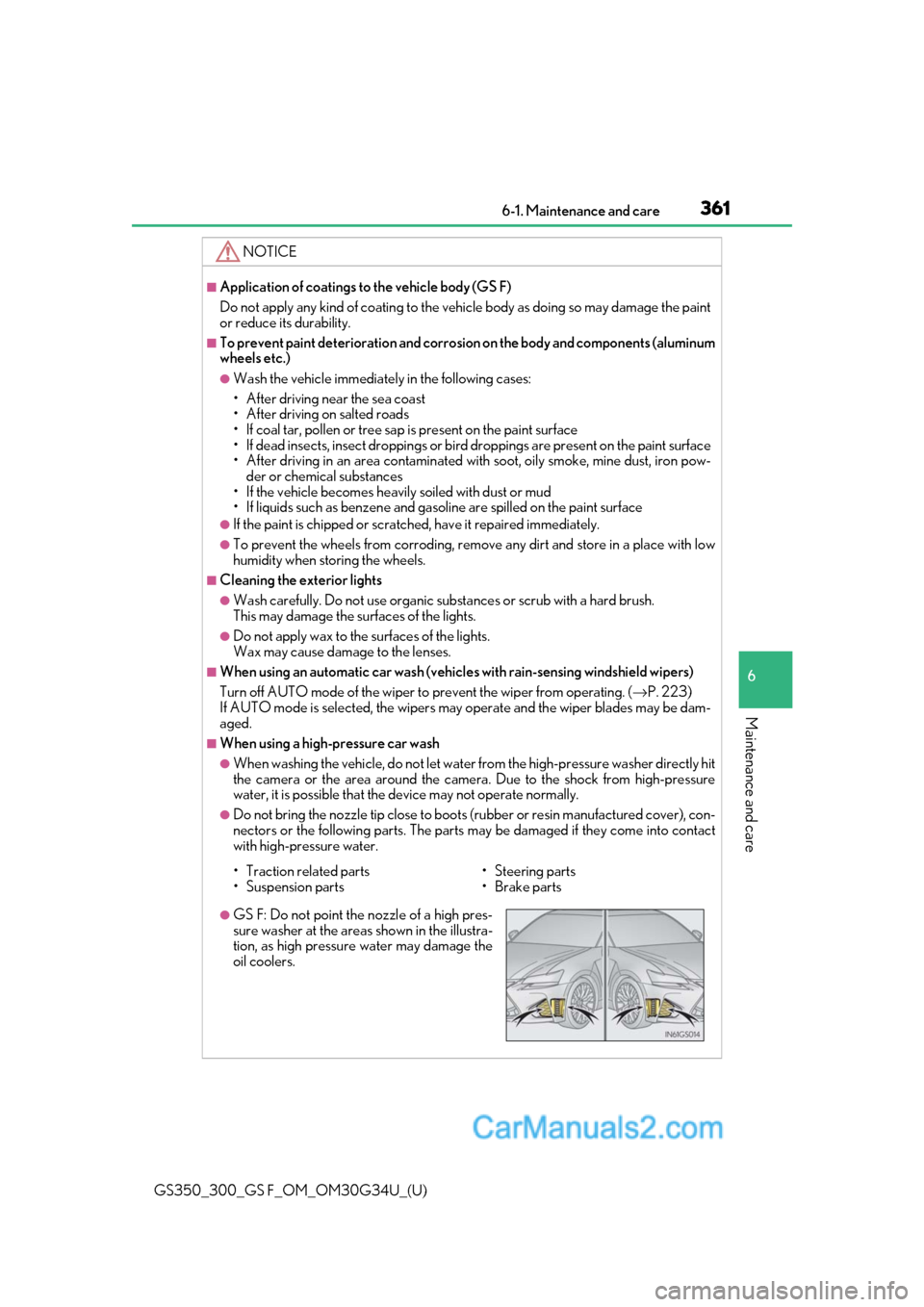
●GS F: Do not point the nozzle of a high pres-
sure washer at the areas shown in the illustra-
tion, as high pressure water may damage the
oil coolers.
Page 370 of 602
368
GS350_300_GS F_OM_OM30G34U_(U)6-2. Maintenance
*: Vehicles with sing
le-beam headlights
Vehicle interior
ItemsCheck points
Accelerator pedal• The accelerator pedal should move smoothly
(without uneven pedal effort or catching).
Automatic transmission “Park”
mechanism• When parked on a slope and the shift lever is in P,is the vehicle securely stopped?
Brake pedal
• Does the brake pedal move smoothly?
• Does the brake pedal have appropriate clearance
from the floor? ( →P. 527)
• Does the brake pedal have the correct amount of
free play? ( →P. 527)
Brakes
• The vehicle should not pull to one side when the
brakes are applied.
• The brakes should work effectively.
• The brake pedal should not feel spongy.
• The brake pedal should not get too close to the floor when the brakes are applied.
Head restraints• Do the head restraints move smoothly and lock
securely?
Indicators/buzzers• Do the indicators and buzzers function properly?
Lights• Do all the lights come on?
• Are the headlights aimed correctly?
* (→ P. 416)
Parking brake• Moves smoothly?
• When parked on a slope and the parking brake is
on, is the vehicle securely stopped?
Seat belts• Do the seat belts operate smoothly?
• The seat belts should not be damaged.
Seats• Do the seat controls operate properly?
Steering wheel
•Does the steering wh eel rotate smoothly?
• Does the steering wheel have the correct amount
of free play?
• There should not be any strange sounds coming from the steering wheel.
Page 371 of 602
GS350_300_GS F_OM_OM30G34U_(U)
3696-2. Maintenance
6
Maintenance and care
Vehicle exterior
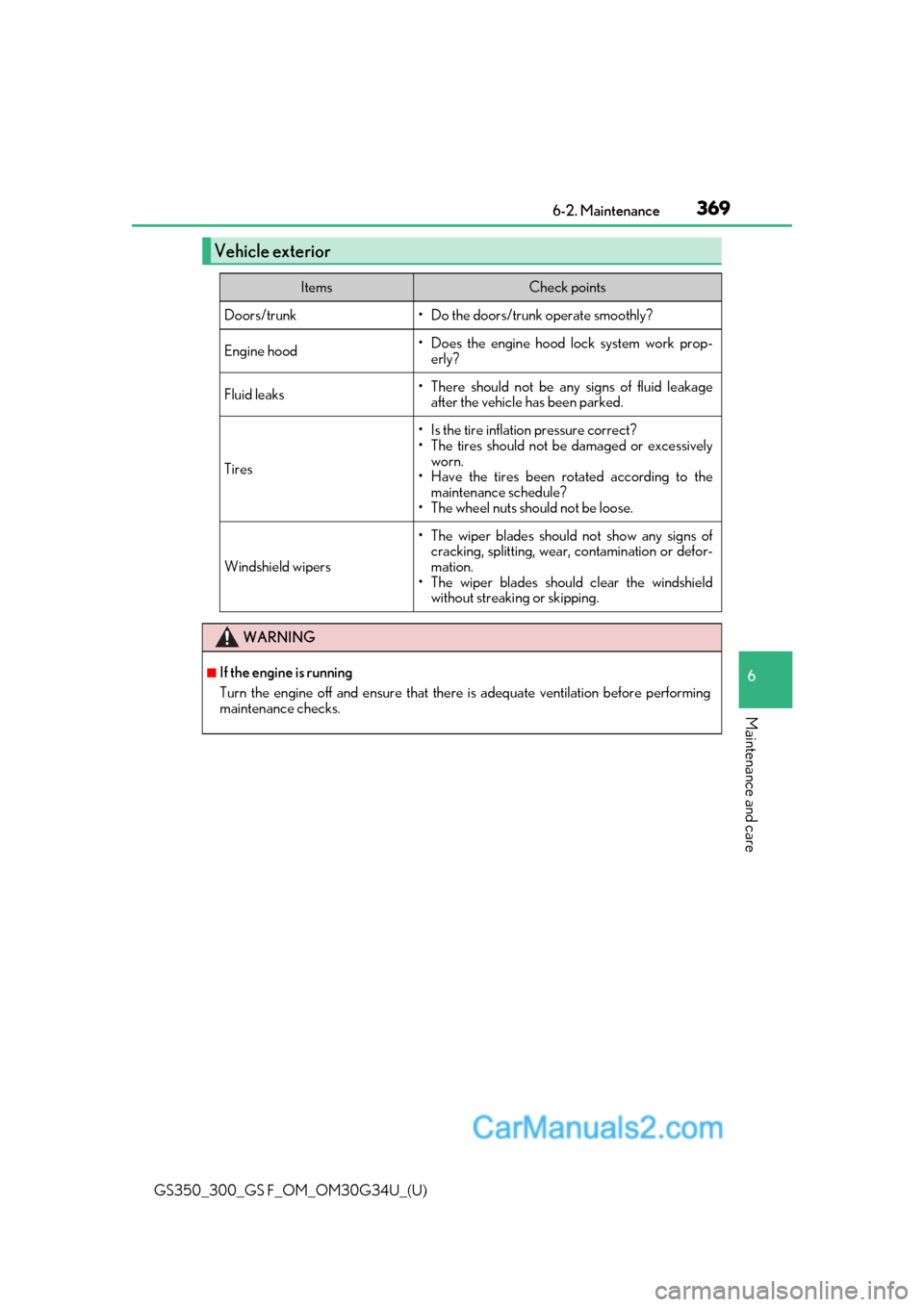
ItemsCheck points
Doors/trunk• Do the doors/trunk operate smoothly?
Engine hood• Does the engine hood lock system work prop-erly?
Fluid leaks•There should not be an y signs of fluid leakage
after the vehicle has been parked.
Tires
• Is the tire inflation pressure correct?
• The tires should not be damaged or excessively
worn.
• Have the tires been rotated according to the
maintenance schedule?
• The wheel nuts should not be loose.
Windshield wipers
•The wiper blades should not show any signs of
cracking, splitting, wear , contamination or defor-
mation.
• The wiper blades should clear the windshield without streaking or skipping.
WARNING
■If the engine is running
Turn the engine off and ensure that there is adequate ventilation before performing
maintenance checks.
Page 396 of 602
394
GS350_300_GS F_OM_OM30G34U_(U)6-3. Do-it-yourself maintenance
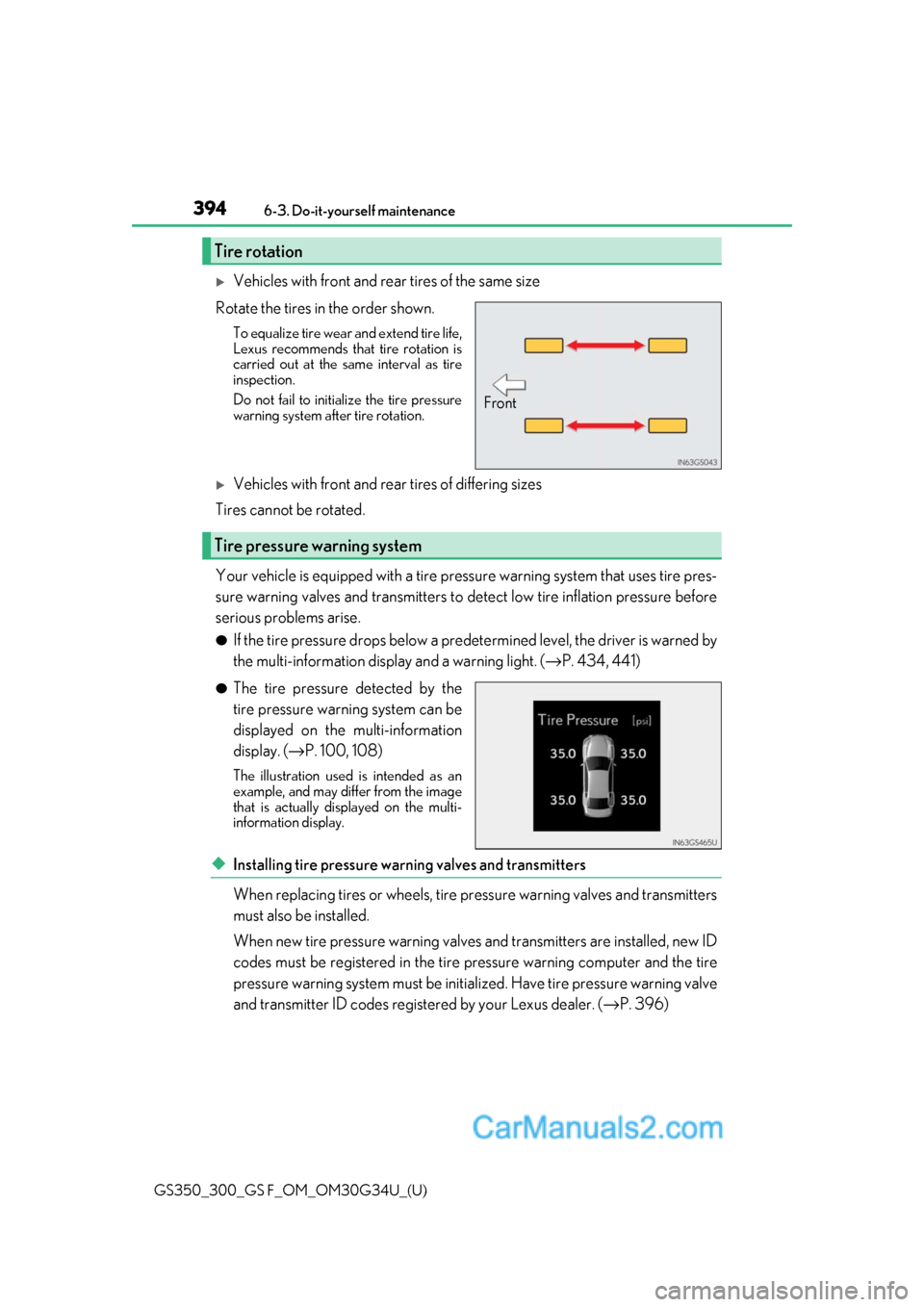
Vehicles with front and rear tires of the same size
Rotate the tires in the order shown.
To equalize tire wear and extend tire life,
Lexus recommends that tire rotation is
carried out at the same interval as tire
inspection.
Do not fail to initialize the tire pressure
warning system after tire rotation.
Vehicles with front and rear tires of differing sizes
Tires cannot be rotated.
Your vehicle is equipped with a tire pressure warning system that uses tire pres-
sure warning valves and transmitters to detect low tire inflation pressure before
serious problems arise.
●If the tire pressure drops below a predet ermined level, the driver is warned by
the multi-information display and a warning light. ( →P. 434, 441)
●The tire pressure detected by the
tire pressure warning system can be
displayed on the multi-information
display. ( →P. 100, 108)
The illustration used is intended as an
example, and may differ from the image
that is actually disp layed on the multi-
information display.
◆Installing tire pressure warning valves and transmitters
When replacing tires or wheels, tire pr essure warning valves and transmitters
must also be installed.
When new tire pressure wa rning valves and transmitters are installed, new ID
codes must be registered in the tire pressure warning computer and the tire
pressure warning system must be initia lized. Have tire pressure warning valve
and transmitter ID codes registered by your Lexus dealer. ( →P. 396)
Tire rotation
Front
Tire pressure warning system
Page 398 of 602
396
GS350_300_GS F_OM_OM30G34U_(U)6-3. Do-it-yourself maintenance
◆Registering ID codes
The tire pressure warning valve and tran
smitter is equipped with a unique ID
code. When replacing a tire pressure warning valve and transmitter, it is nec-
essary to register the ID code. Have the ID code registered by your Lexus
dealer.
■When to replace your vehicle’s tires
Tires should be replaced if:
●The treadwear indicators are showing on a tire.
●You have tire damage such as cuts, splits, cracks deep enough to expose the fabric, and
bulges indicating internal damage
●A tire goes flat repeatedly or cannot be properly repaired due to the size or location of
a cut or other damage
If you are not sure, consult with your Lexus dealer.
■Replacing tires and wheels
If the ID code of the tire pressure warning valve and transmitter is not registered, the tire
pressure warning system will not work proper ly. After driving for about 20 minutes, the
tire pressure warning light blinks for 1 minu te and stays on to indicate a system malfunc-
tion.
■Tire life
Any tire over 6 years old must be checked by a qualified technician even if it has seldom
or never been used or damage is not obvious.
■Routine tire inflation pressure checks
The tire pressure warning syst em does not replace routine tire inflation pressure checks.
Make sure to check tire inflat ion pressure as part of your routine of daily vehicle checks.
■When rotating the tires
Make sure that the engine switch is off. If the tires are rotated while the engine switch is in
IGNITION ON mode, the tire position information will not be updated.
If this accidentally occurs, either turn the engine switch to off and then to IGNITION ON
mode, or initialize the system after checking th at the tire pressure is properly adjusted.
■Low profile tires (except 225/50R17 tires)
Generally, low profile tires will wear more rapidly and tire grip performance will be
reduced on snowy and/or icy roads when comp ared to standard tires. Be sure to use
snow tires or tire chains on snowy and/or icy roads and drive carefully at a speed appro-
priate for road and weather conditions. ( →P. 298)
Page 399 of 602
GS350_300_GS F_OM_OM30G34U_(U)
3976-3. Do-it-yourself maintenance
6
Maintenance and care
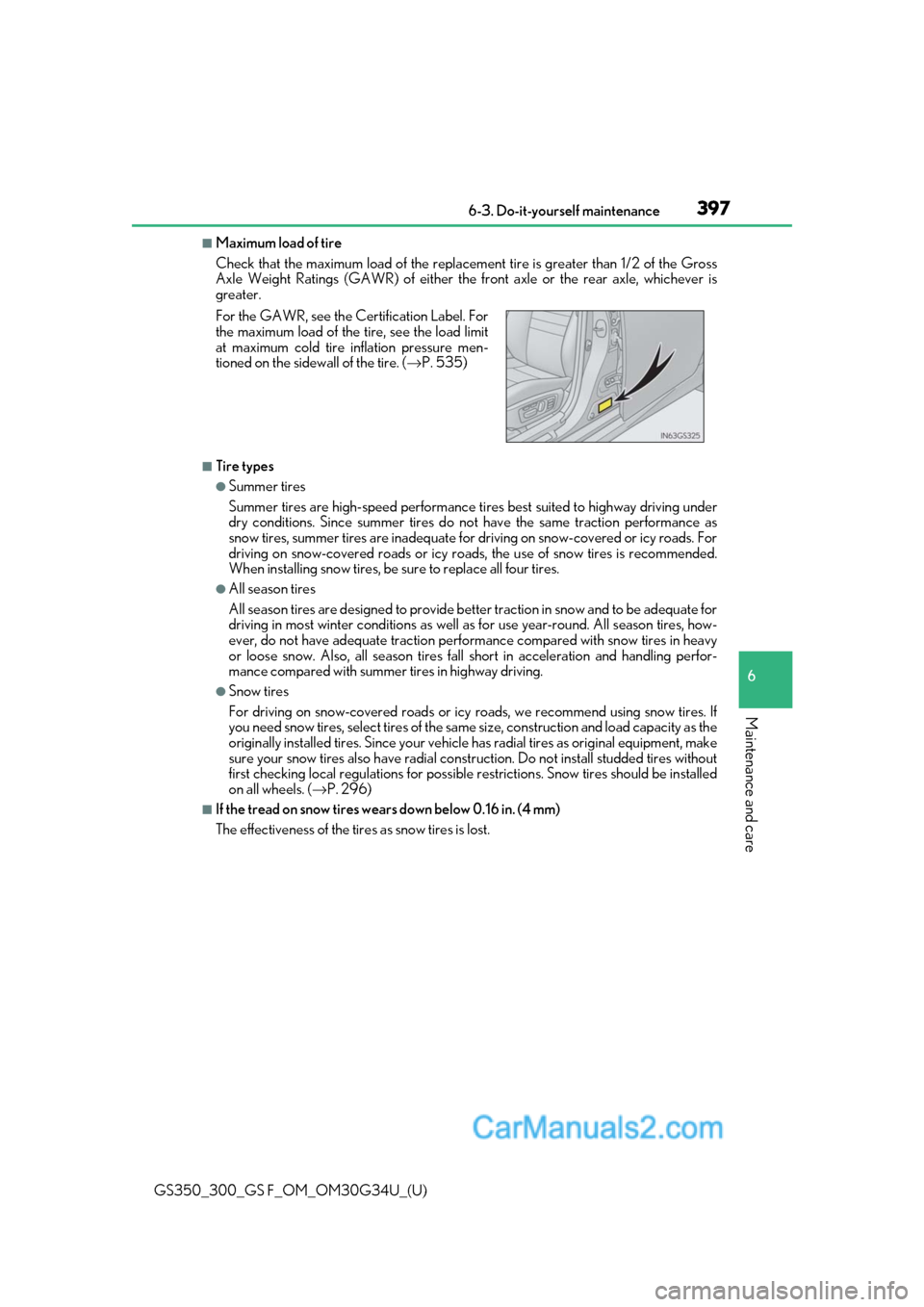
■Maximum load of tire
Check that the maximum load of the replacement tire is greater than 1/2 of the Gross
Axle Weight Ratings (GAWR) of either the front axle or the rear axle, whichever is
greater.
■Tire types
●Summer tires
Summer tires are high-speed performance tires best suited to highway driving under
dry conditions. Since summer tires do not have the same traction performance as
snow tires, summer tires are inadequate for driving on snow-covered or icy roads. For
driving on snow-covered roads or icy road s, the use of snow tires is recommended.
When installing snow tires, be sure to replace all four tires.
●All season tires
All season tires are designed to provide better traction in snow and to be adequate for
driving in most winter conditions as well as for use year-round. All season tires, how-
ever, do not have adequate traction perfor mance compared with snow tires in heavy
or loose snow. Also, all season tires fall short in acceleration and handling perfor-
mance compared with summer tires in highway driving.
●Snow tires
For driving on snow-covered roads or icy roads, we recommend using snow tires. If
you need snow tires, select ti res of the same size, construction and load capacity as the
originally installed tires. Since your vehicle has radial tires as original equipment, make
sure your snow tires also have radial cons truction. Do not install studded tires without
first checking local regulations for possible restrictions. Snow tires should be installed
on all wheels. ( →P. 296)
■If the tread on snow tires wears down below 0.16 in. (4 mm)
The effectiveness of the tire s as snow tires is lost.
For the GAWR, see the Ce
rtification Label. For
the maximum load of the tire, see the load limit
at maximum cold tire inflation pressure men-
tioned on the sidewall of the tire. ( →P. 535)
Page 400 of 602
398
GS350_300_GS F_OM_OM30G34U_(U)6-3. Do-it-yourself maintenance
■Situations in which the tire pressure warning system may not operate properly
●In the following cases, the
tire pressure warning system may not operate properly.
• If non-genuine Lexus wheels are used.
• A tire has been replaced with a tire that is not an OE (Original Equipment) tire.
• A tire has been replaced with a tire that is not of the specified size.
• Tire chains etc. are equipped.
• An auxiliary-supported run-flat tire is equipped.
• If a window tint that affects th e radio wave signals is installed.
• If there is a lot of snow or ice on the vehi cle, particularly around the wheels or wheel
housings.
• If the tire inflation pressure is extr emely higher than the specified level.
• If wheel without the tire pressure warning valve and transmitter are used.
• If the ID code on the tire pressure warning valves and transmitters is not registered
in the tire pressure warning computer.
●Performance may be affected in the following situations.
• Near a TV tower, electric power plant, gas station, radio station, large display, air-
port or other facility that generates st rong radio waves or electrical noise
• When carrying a portable radio, cellular phone, cordless phone or other wireless
communication device
If tire position information is not correctly displayed due to the radio wave conditions,
the display may be corrected by driving and changing the radio wave conditions.
●When the vehicle is parked, the time taken for the warning to start or go off could be
extended.
●When tire inflation pressure declines rapidly for example when a tire has burst, the
warning may not function.
■The initialization operation
●Make sure to carry out initialization afte r adjusting the tire inflation pressure.
Also, make sure the tires are cold before carryi ng out initialization or tire inflation pres-
sure adjustment.
●If you have accidentally turned the engine swit ch off during initialization, it is not neces-
sary to manually restart the in itialization again, as initialization will restart automatically
the next time the engine switch is turned to IGNITION ON mode.
●If you accidentally perform initialization when initialization is not necessary, adjust the
tire inflation pressure to the specified leve l when the tires are cold, and conduct initial-
ization again.
■When initialization of the tire pressure warning system has failed
Initialization can be completed in a few minutes. However, in the following cases, the set-
tings have not been recorded and the system will not operate properly. If repeated
attempts to record tire inflation pressure settings are unsuccessful, have the vehicle
inspected by your Lexus dealer.
●The initialization message is not displayed on the multi-information display when per-
forming initialization.
●After carrying out the initializat ion procedure, the tire pressure warning light blinks for 1
minute then stays on after driving for 20 minutes.
Page 404 of 602
402
GS350_300_GS F_OM_OM30G34U_(U)6-3. Do-it-yourself maintenance
NOTICE
■Repairing or replacing tires, wheels, tire
pressure warning valves, transmitters and
tire valve caps
●When removing or fitting the wheels, tires or the tire pressure warning valves and
transmitters, contact your Lexus dealer as the tire pressure warning valves and trans-
mitters may be damaged if not handled correctly.
●Make sure to install the tire valve caps. If the tire valve caps are not installed, water
could enter the tire pressure warning valves and the tire pressure warning valves
could be bound.
●When replacing tire valve caps, do not use tire valve caps other than those specified.
The cap may become stuck.
■To avoid damage to the tire pressu re warning valves and transmitters
When a tire is repaired with liquid sealants, the tire pressure warning valve and trans-
mitter may not operate properly. If a liquid sealant is used, contact your Lexus dealer or
other qualified service shop as soon as possible. Make sure to replace the tire pressure
warning valve and transmitter when replacing the tire. ( →P. 394)
■Driving on rough roads
Take particular care when driving on roads with loose surfaces or potholes.
These conditions may cause lo sses in tire inflation pressure, reducing the cushioning
ability of the tires. In addition, driving on rough roads may cause damage to the tires
themselves, as well as the vehicle’s wheels and body.
■Low profile tires (except 225/50R17 tires)
Low profile tires may cause greater damage than usual to the tire wheel when sustain-
ing impact from the road surface. Ther efore, pay attention to the following:
●Be sure to use proper tire inflation pressu re. If tires are under-inflated, they may be
damaged more severely.
●Avoid potholes, uneven pavement, curbs an d other road hazards. Failure to do so
may lead to severe tire and wheel damage.
■If tire inflation pressure of ea ch tire becomes low while driving
Do not continue driving, or your tires and/or wheels may be ruined.