tow Lexus GS350 2019 Owner's Guide
[x] Cancel search | Manufacturer: LEXUS, Model Year: 2019, Model line: GS350, Model: Lexus GS350 2019Pages: 604, PDF Size: 14.6 MB
Page 400 of 604
400
GS350_300_OM_OM30G96U_(U)6-3. Do-it-yourself maintenance
■Situations in which the tire pressure warning system may not operate properly
●In the following cases, the
tire pressure warning system may not operate properly.
• If non-genuine Lexus wheels are used.
• A tire has been replaced with a tire that is not an OE (Original Equipment) tire.
• A tire has been replaced with a tire that is not of the specified size.
• Tire chains etc. are equipped.
• An auxiliary-supported run-flat tire is equipped.
• If a window tint that affects th e radio wave signals is installed.
• If there is a lot of snow or ice on the vehi cle, particularly around the wheels or wheel
housings.
• If the tire inflation pressure is extr emely higher than the specified level.
• If wheel without the tire pressure warning valve and transmitter are used.
• If the ID code on the tire pressure warning valves and transmitters is not registered
in the tire pressure warning computer.
●Performance may be affected in the following situations.
• Near a TV tower, electric power plant, gas station, radio station, large display, air-
port or other facility that generates st rong radio waves or electrical noise
• When carrying a portable radio, cellular phone, cordless phone or other wireless
communication device
If tire position information is not correctly displayed due to the radio wave conditions,
the display may be corrected by driving and changing the radio wave conditions.
●When the vehicle is parked, the time taken for the warning to start or go off could be
extended.
●When tire inflation pressure declines rapidly for example when a tire has burst, the
warning may not function.
■The initialization operation
●Make sure to carry out initialization afte r adjusting the tire inflation pressure.
Also, make sure the tires are cold before carryi ng out initialization or tire inflation pres-
sure adjustment.
●If you have accidentally turned the engine swit ch off during initialization, it is not neces-
sary to manually restart the in itialization again, as initialization will restart automatically
the next time the engine switch is turned to IGNITION ON mode.
●If you accidentally perform initialization when initialization is not necessary, adjust the
tire inflation pressure to the specified leve l when the tires are cold, and conduct initial-
ization again.
■When initialization of the tire pressure warning system has failed
Initialization can be completed in a few minutes. However, in the following cases, the set-
tings have not been recorded and the system will not operate properly. If repeated
attempts to record tire inflation pressure settings are unsuccessful, have the vehicle
inspected by your Lexus dealer.
●The initialization message is not displayed on the multi-information display when per-
forming initialization.
●After carrying out the initializat ion procedure, the tire pressure warning light blinks for 1
minute then stays on after driving for 20 minutes.
Page 403 of 604
GS350_300_OM_OM30G96U_(U)
4036-3. Do-it-yourself maintenance
6
Maintenance and care
WARNING
■When inspecting or replacing tires
Observe the following precautions to prevent accidents.
Failure to do so may cause damage to parts of the drive train as well as dangerous han-
dling characteristics, which may lead to an accident resulting in death or serious injury.
●Do not mix tires of different makes, models or tread patterns.
Also, do not mix tires of remarkably different treadwear.
●Do not use tire sizes other than those recommended by Lexus.
●Do not mix differently constructed tires (radial, bias-belted or bias-ply tires).
●Do not mix summer, all season and snow tires.
●Do not use tires that have be en used on another vehicle.
Do not use tires if you do not know how they were used previously.
●Vehicles with spare tire: Do not tow if your vehicle has a spare tire installed.
●Vehicles with emergency tire puncture repair kit: Do not tow anything if a tire that has
been repaired using the emergency tire punc ture repair kit is installed. The load on
the tire may cause unexpected damage to the tire.
■When initializing the tire pressure warning system
Do not initialize tire inflatio n pressure without first adjustin g the tire inflation pressure to
the specified level. Otherwise, the tire pre ssure warning light may not come on even if
the tire inflation pressure is low, or it ma y come on when the tire inflation pressure is
actually normal.
■Caution regarding interference with electronic devices
●Users of any electrical medical device ot her than implantable cardiac pacemakers,
cardiac resynchronization th erapy-pacemakers or implantable cardioverter defibril-
lators should consult the manufacturer of the device for information about its opera-
tion under the influence of radio waves.
Radio waves could have unexpected effects on the operation of such medical
devices.
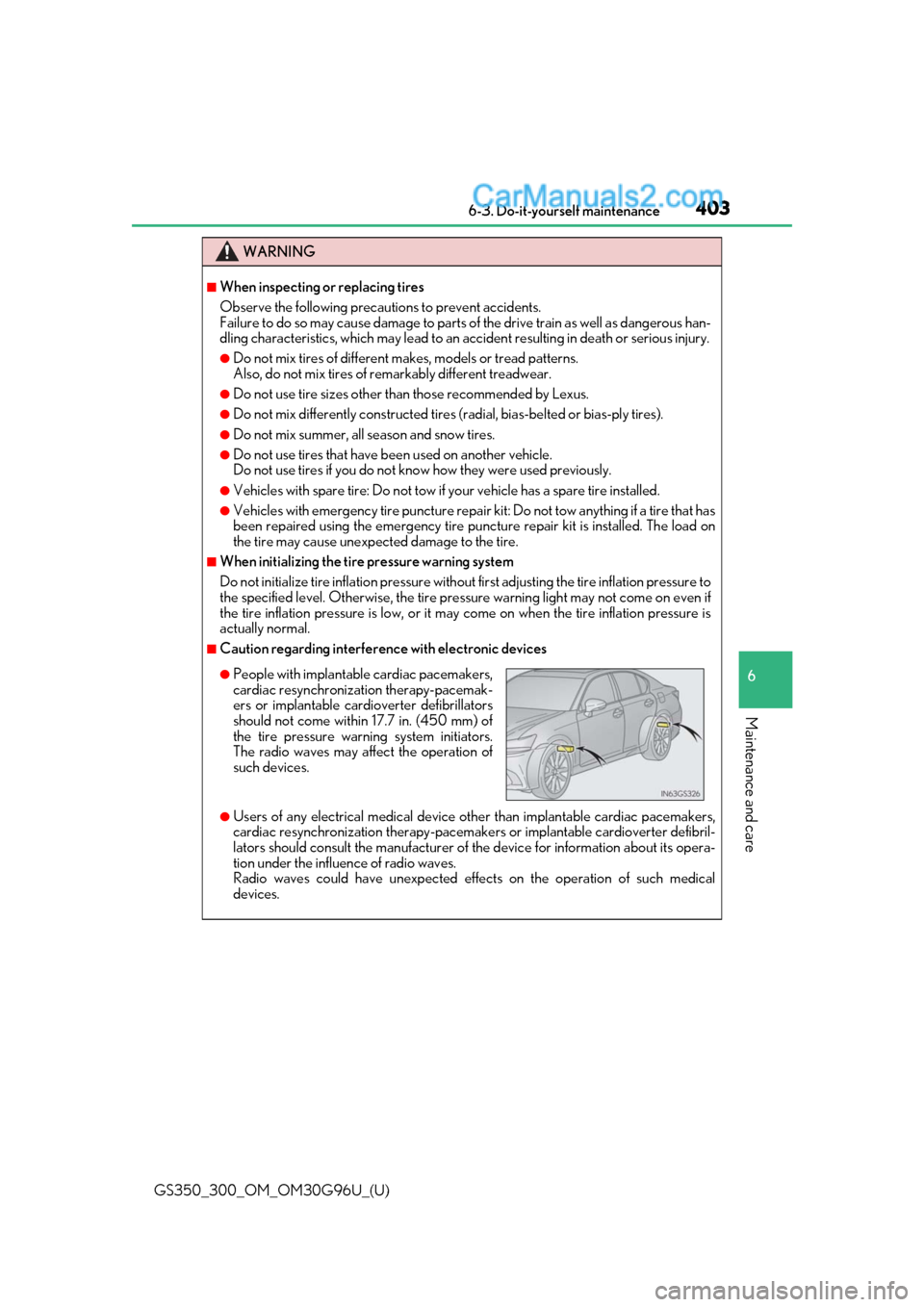
●People with implantabl e cardiac pacemakers,
cardiac resynchronization therapy-pacemak-
ers or implantable cardioverter defibrillators
should not come within 17.7 in. (450 mm) of
the tire pressure warn ing system initiators.
The radio waves may affect the operation of
such devices.
Page 425 of 604
425
GS350_300_OM_OM30G96U_(U)
7When trouble arises
7-1. Essential informationEmergency flashers...................426
If your vehicle has to be stopped in an
emergency ................................. 427
If the vehicle is trapped in rising water ................................428 7-2. Steps to take in an
emergency
If your vehicle needs to be towed................................ 429
If you think something is wrong ................ 435
Fuel pump shut off system ...... 436
If a warning light turns on or a warning buzzer
sounds.......................................... 437
If a warning message is displayed..................................... 444
If you have a flat tire (vehicles with spare tire) ......................... 475
If you have a flat tire (vehicles without spare tire)...................486
If the engine will not start ....... 500
If the parking brake cannot be released ................................502
If the electronic key does not operate properly .....................504
If the vehicle battery is discharged ................................. 507
If your vehicle overheats .......... 512
If the vehicle becomes stuck .............................................. 518
Page 429 of 604
429
GS350_300_OM_OM30G96U_(U)
7
When trouble arises
7-2. Steps to take in an emergency
If your vehicle needs to be towed
The following may indicate a problem with your transmission. Contact your
Lexus dealer or commercial to wing service before towing.
●The engine is running but the vehicle does not move.
●The vehicle makes an abnormal sound.
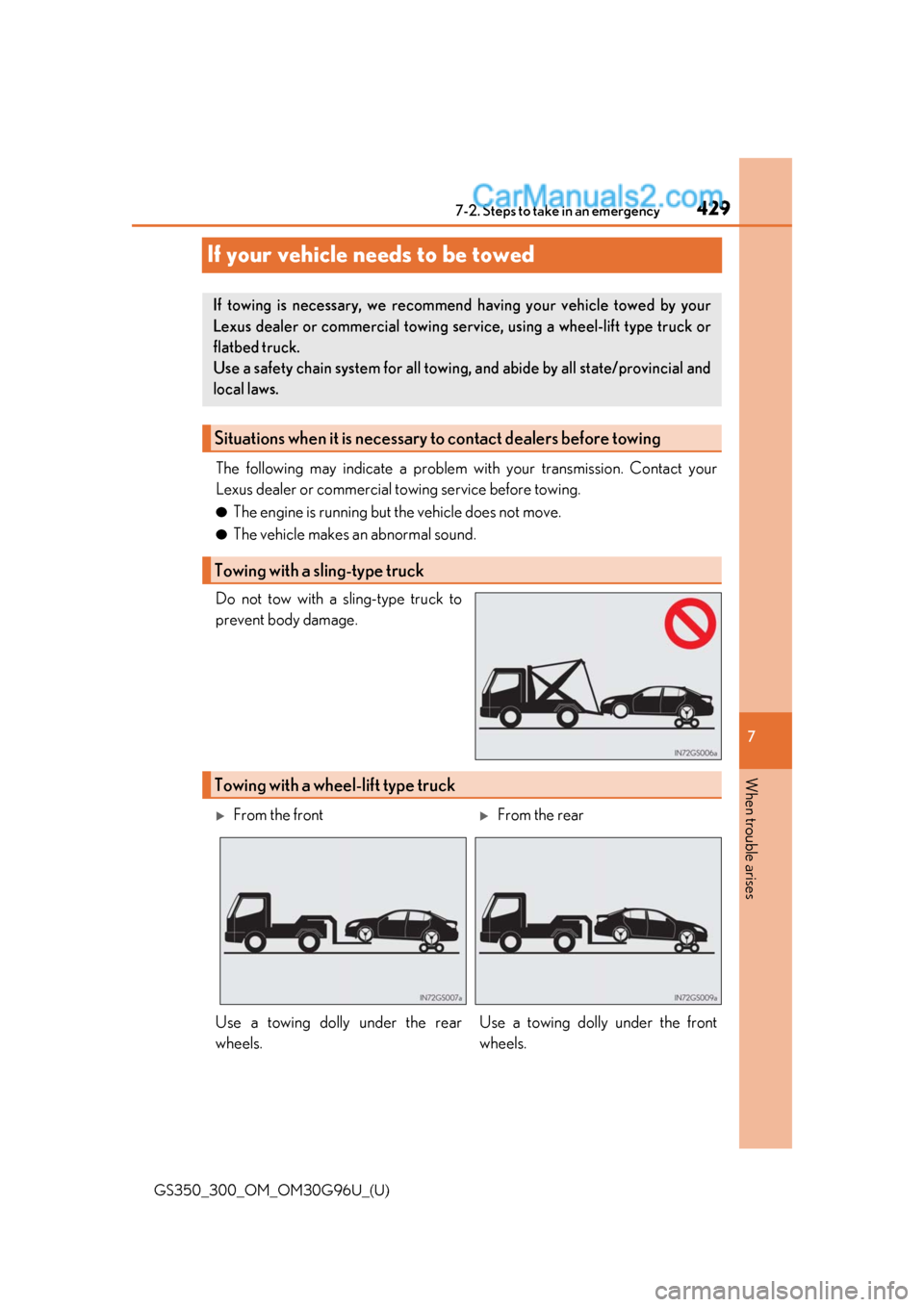
Do not tow with a sling-type truck to
prevent body damage.
If towing is necessary, we recommend having your vehicle towed by your
Lexus dealer or commercial towing se rvice, using a wheel-lift type truck or
flatbed truck.
Use a safety chain system for all towing, and abide by all state/provincial and
local laws.
Situations when it is necessary to contact dealers before towing
Towing with a sling-type truck
Towing with a wheel-lift type truck
From the frontFrom the rear
Use a towing dolly under the rear
wheels. Use a towing dolly under the front
wheels.
Page 430 of 604
4307-2. Steps to take in an emergency
GS350_300_OM_OM30G96U_(U)
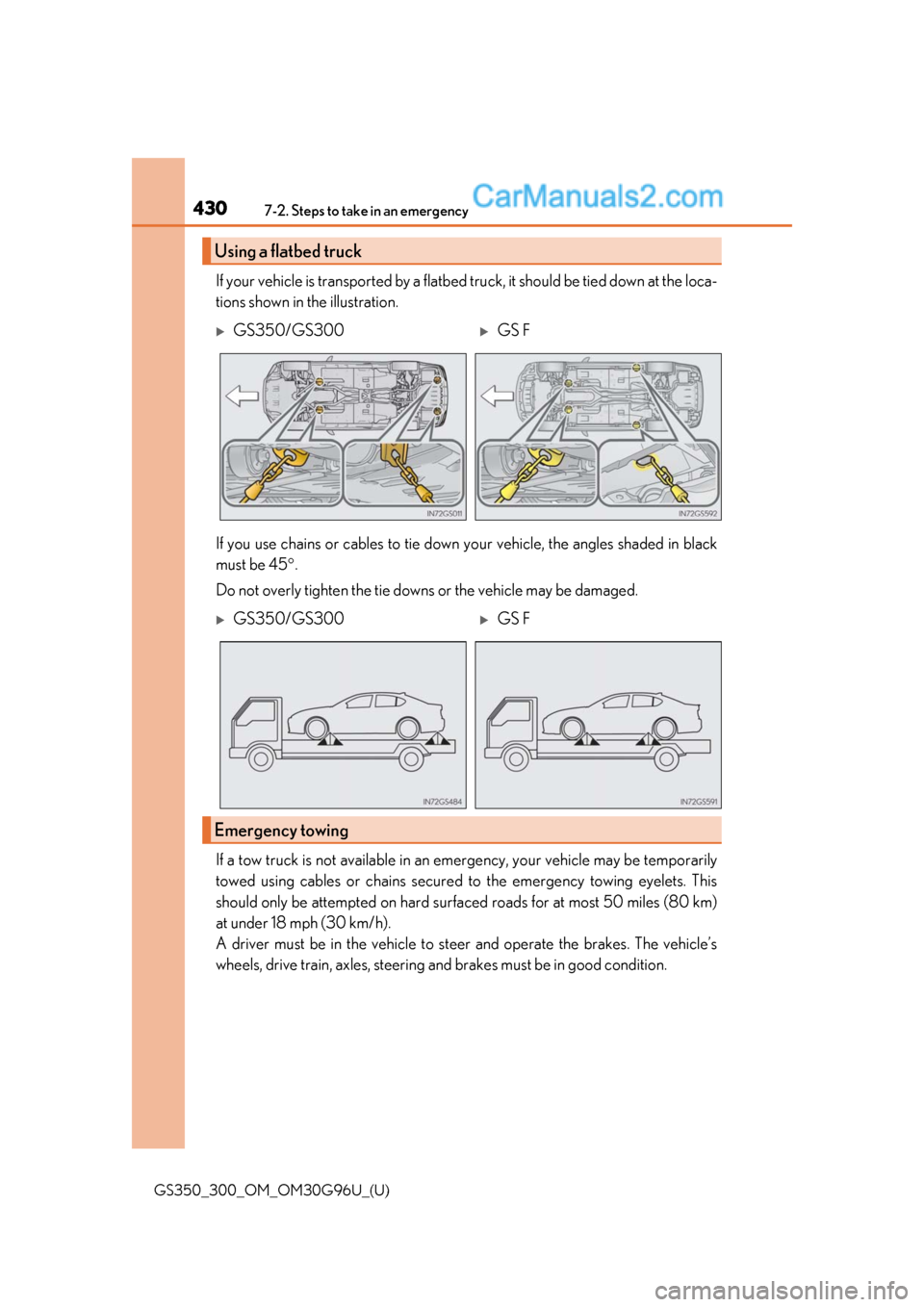
If your vehicle is transported by a flatbed truck, it should be tied down at the loca-
tions shown in the illustration.
If you use chains or cables to tie down your vehicle, the angles shaded in black
must be 45 .
Do not overly tighten the tie downs or the vehicle may be damaged.
If a tow truck is not available in an emergency, your vehicle may be temporarily
towed using cables or chains secured to the emergency towing eyelets. This
should only be attempted on hard surf aced roads for at most 50 miles (80 km)
at under 18 mph (30 km/h).
A driver must be in the vehicle to st eer and operate the brakes. The vehicle’s
wheels, drive train, axles, steering an d brakes must be in good condition.
Using a flatbed truck
GS350/GS300GS F
GS350/GS300GS F
Emergency towing
Page 431 of 604
4317-2. Steps to take in an emergency
GS350_300_OM_OM30G96U_(U)
7
When trouble arises
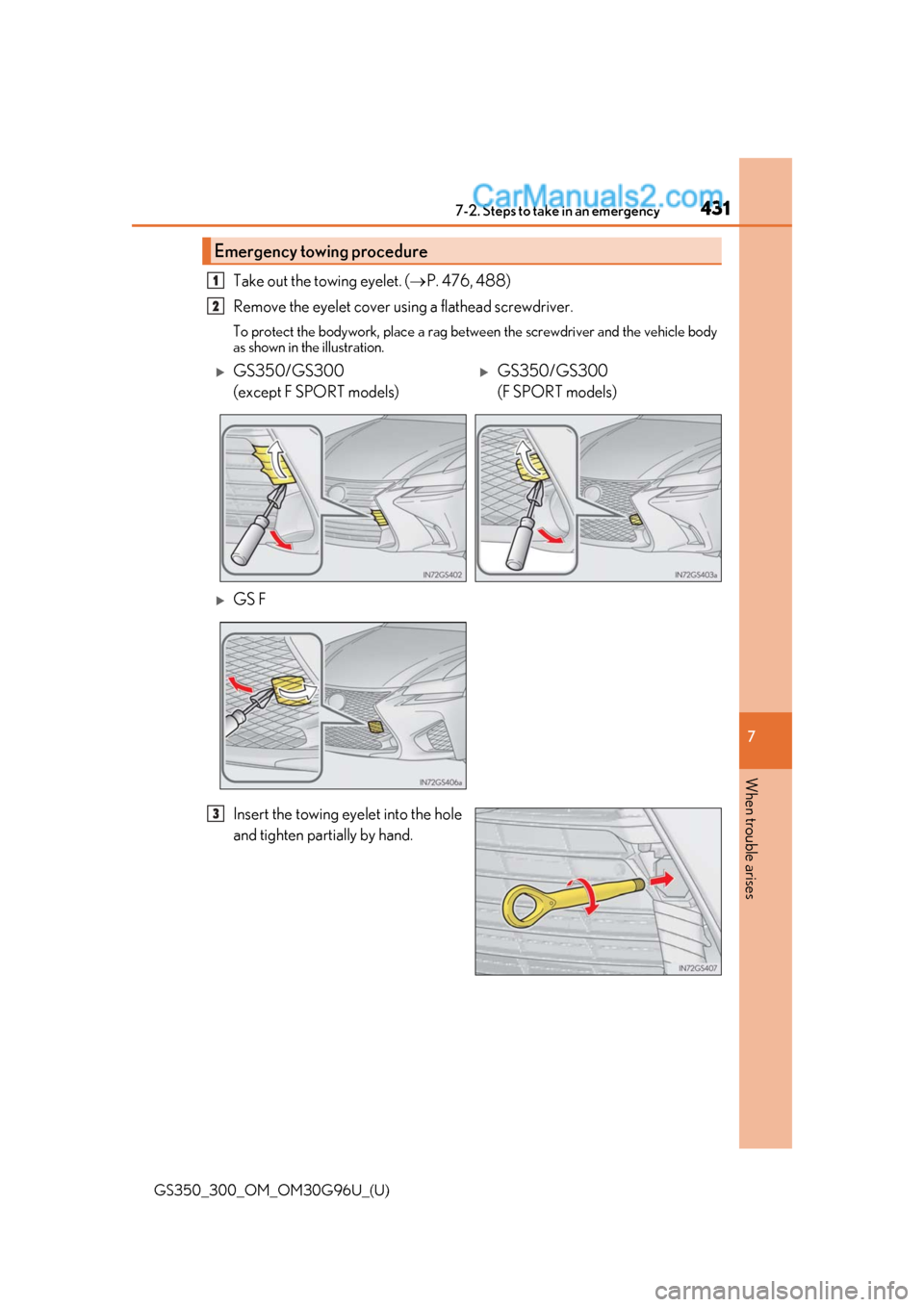
Take out the towing eyelet. ( P. 476, 488)
Remove the eyelet cover using a flathead screwdriver.
To protect the bodywork, place a rag between the screwdriver and the vehicle body
as shown in the illustration.
Insert the towing eyelet into the hole
and tighten partially by hand.
Emergency towing procedure
1
2
GS350/GS300
(except F SPORT models)GS350/GS300
(F SPORT models)
GS F
3
Page 432 of 604
4327-2. Steps to take in an emergency
GS350_300_OM_OM30G96U_(U)
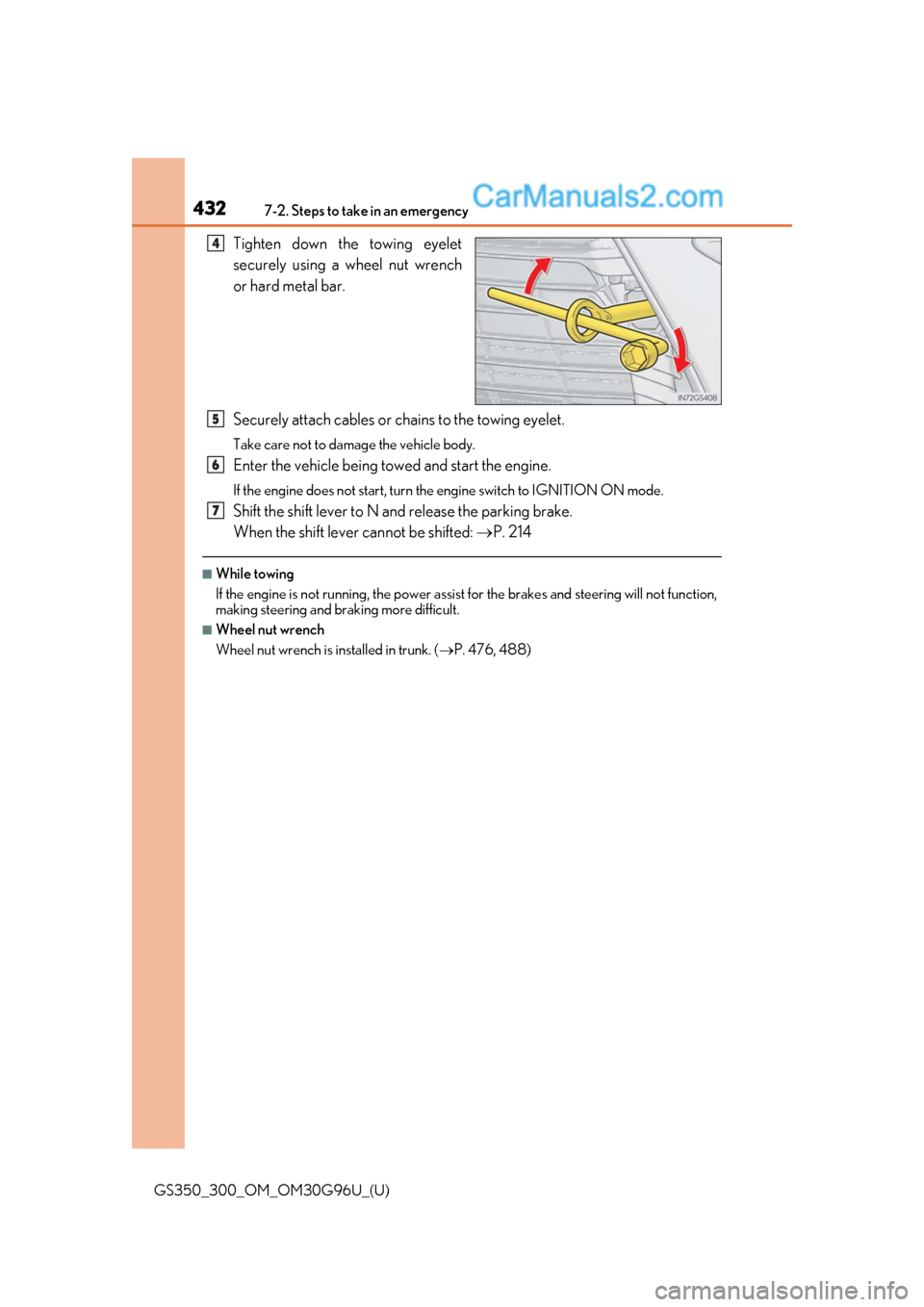
Tighten down the towing eyelet
securely using a wheel nut wrench
or hard metal bar.
Securely attach cables or chains to the towing eyelet.
Take care not to damage the vehicle body.
Enter the vehicle being towed and start the engine.
If the engine does not start, turn the engine switch to IGNITION ON mode.
Shift the shift lever to N and release the parking brake.
When the shift lever cannot be shifted: P. 214
■While towing
If the engine is not running, the power assist for the brakes and steering will not function,
making steering and br aking more difficult.
■Wheel nut wrench
Wheel nut wrench is installed in trunk. ( P. 476, 488)
4
5
6
7
Page 433 of 604
4337-2. Steps to take in an emergency
GS350_300_OM_OM30G96U_(U)
7
When trouble arises
WARNING
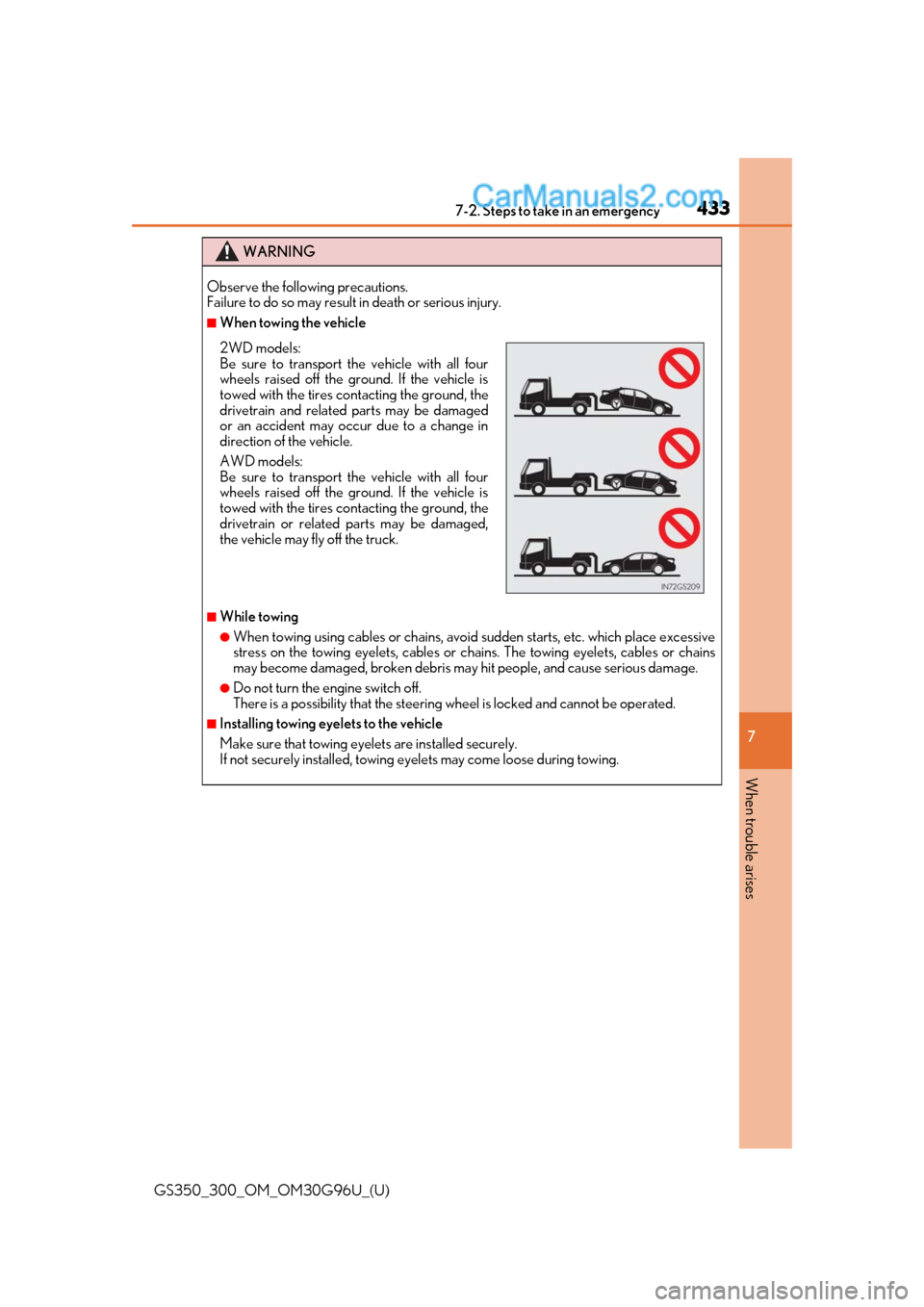
Observe the following precautions.
Failure to do so may result in death or serious injury.
■When towing the vehicle
■While towing
●When towing using cables or chains, avoid sudden starts, etc. which place excessive
stress on the towing eyelets, cables or chains. The towing eyelets, cables or chains
may become damaged, broken debris ma y hit people, and cause serious damage.
●Do not turn the engine switch off.
There is a possibility that the steering wheel is locked and cannot be operated.
■Installing towing eyelets to the vehicle
Make sure that towing eyel ets are installed securely.
If not securely installed, towing ey elets may come loose during towing.
2WD models:
Be sure to transport the vehicle with all four
wheels raised off the ground. If the vehicle is
towed with the tires contacting the ground, the
drivetrain and related parts may be damaged
or an accident may occur due to a change in
direction of the vehicle.
AWD models:
Be sure to transport the vehicle with all four
wheels raised off the ground. If the vehicle is
towed with the tires contacting the ground, the
drivetrain or related parts may be damaged,
the vehicle may fly off the truck.
Page 434 of 604
4347-2. Steps to take in an emergency
GS350_300_OM_OM30G96U_(U)
NOTICE
■To prevent damage to the vehicle when towing using a wheel-lift type truck
●Do not tow the vehicle from the rear when the engine switch is off. The steering lock
mechanism is not strong enough to hold the front wheels straight.
●When raising the vehicle, ensure adequate ground cleara nce for towing at the oppo-
site end of the raised vehicle. Without ad equate clearance, the vehicle could be dam-
aged while being towed.
■To prevent damage to the vehicle wh en towing with a sling-type truck
Do not tow with a sling-type truck, either from the front or rear.
■To prevent damage to the ve hicle during emergency towing
Do not secure cables or chains to the suspension components.
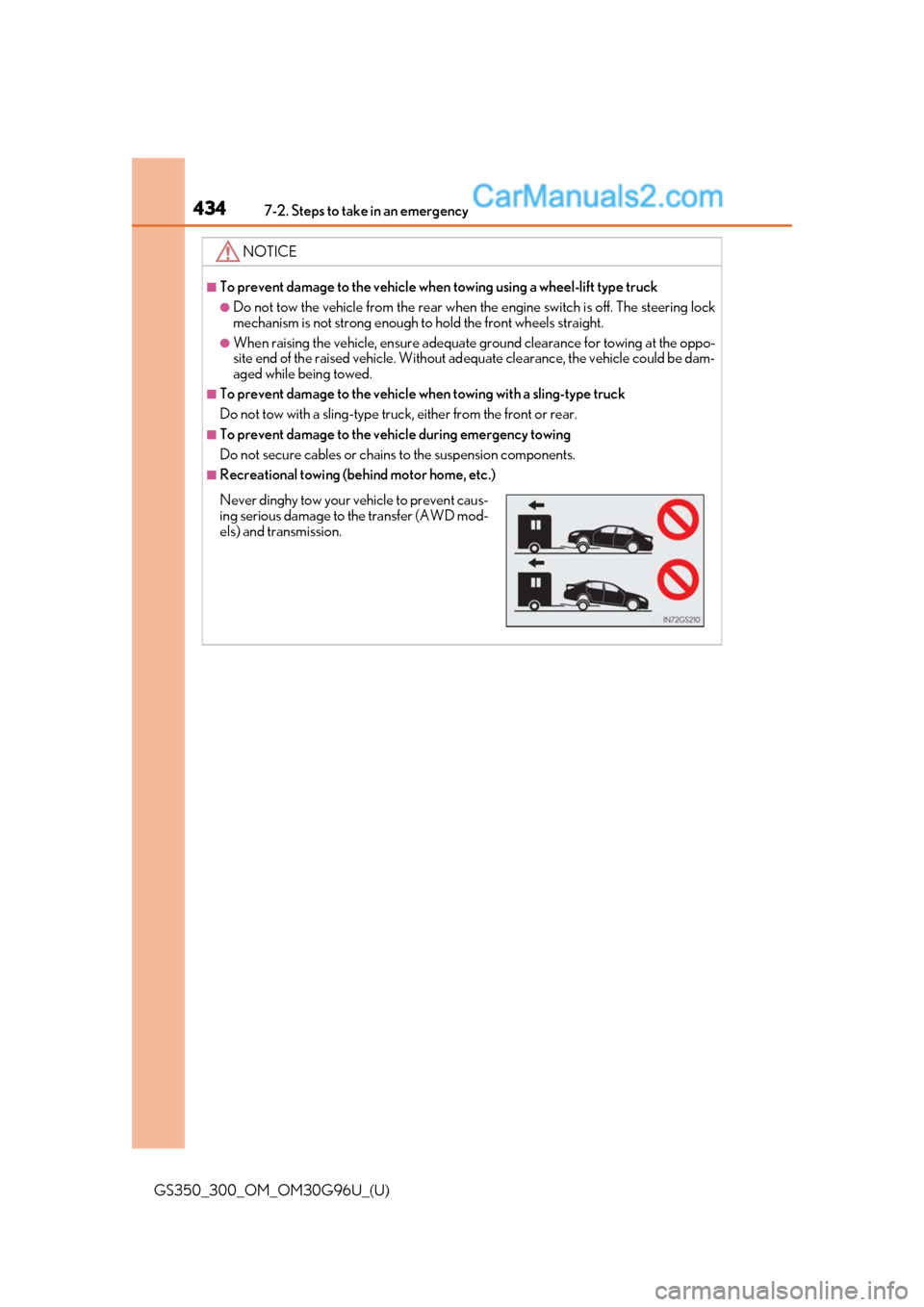
■Recreational towing (behind motor home, etc.)
Never dinghy tow your vehicle to prevent caus-
ing serious damage to the transfer (AWD mod-
els) and transmission.
Page 476 of 604
4767-2. Steps to take in an emergency
GS350_300_OM_OM30G96U_(U)
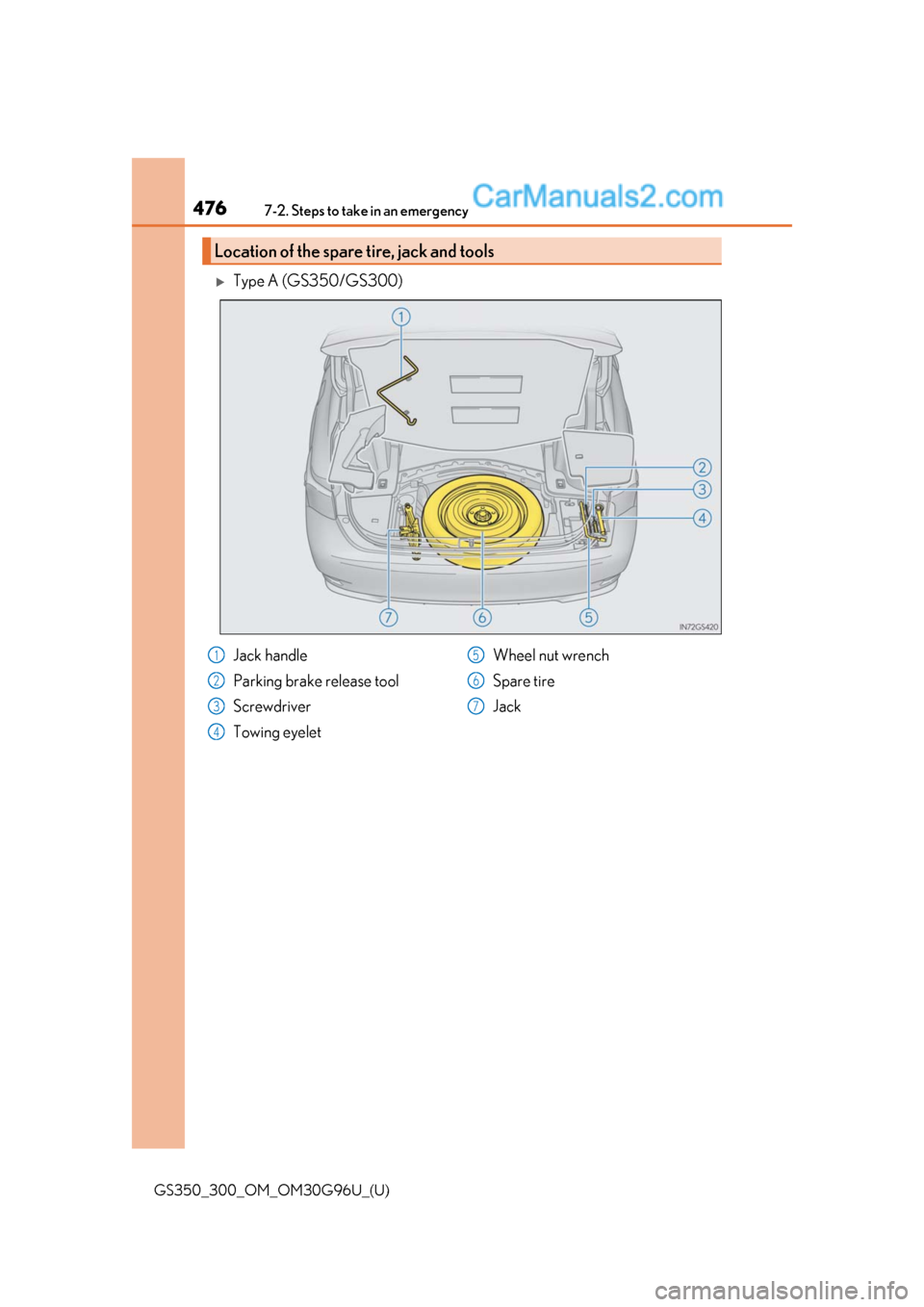
Type A (GS350/GS300)
Location of the spare tire, jack and tools
Jack handle
Parking brake release tool
Screwdriver
Towing eyeletWheel nut wrench
Spare tire
Jack1
2
3
4
5
6
7