inflation Lexus GS450h 2007 Scheduled Maintenance Guide / LEXUS 2007 GS450H FROM JULY 2006 PROD. OWNER'S MANUAL (OM30A05U)
[x] Cancel search | Manufacturer: LEXUS, Model Year: 2007, Model line: GS450h, Model: Lexus GS450h 2007Pages: 548, PDF Size: 16.31 MB
Page 4 of 548
TABLE OF CONTENTSIndex
iv
3-4. Using the hands-free
system......................................... 261
Hands-free system ....................... 261
Using the Bluetooth
®
phone ............................................. 265
Setting the hands-free
system ............................................ 278
3-5. Using the interior lights ......... 303 Interior lights list........................... 303
3-6. Using the storage
features ..................................... 306
List of storage fe atures.............. 306
3-7. Other interior features............ 312 Sun visors.......................................... 312
Vanity mirror ................................... 313
Clock .................................................. 314
Outside temperature
display ............................................. 315
Ashtrays ............................................ 316
Cigarette lighter ............................ 317
Power outlet .................................... 318
Seat heaters ..................................... 319
Seat heaters and
ventilators ...................................... 321
Armrest ............................................ 323
Rear sunshade ............................... 324
Floor mats........................................ 326
Trunk features................................ 327
Garage door opener .................. 329
Compass........................................... 334
Lexus Link System ...................... 338 4-1. Maintenance and care............ 352
Cleaning and protecting the
vehicle exterior .......................... 352
Cleaning and protecting the
vehicle interior............................ 354
4-2. Maintenance.............................. 357 Maintenance requirements ..... 357
General maintena nce ............... 359
Emission inspection and
maintenance (I/M)
programs ...................................... 362
4-3. Do-it-yourself
maintenance............................ 363
Do-it-yourself service
precautions .................................. 363
Hood.................................................. 366
Positioning the jack ..................... 367
Engine compartm ent.................. 369
Tires .................................................. 383
Tire inflation pressure................. 393
Wheels.............................................. 397
Air conditioning filter.................. 399
Electronic key battery ................. 401
Checking and replacing
fuses ............................................... 403
Headlight aim.................................. 419
Light bulbs ........................................ 421
4Maintenance and care
Page 7 of 548
vii
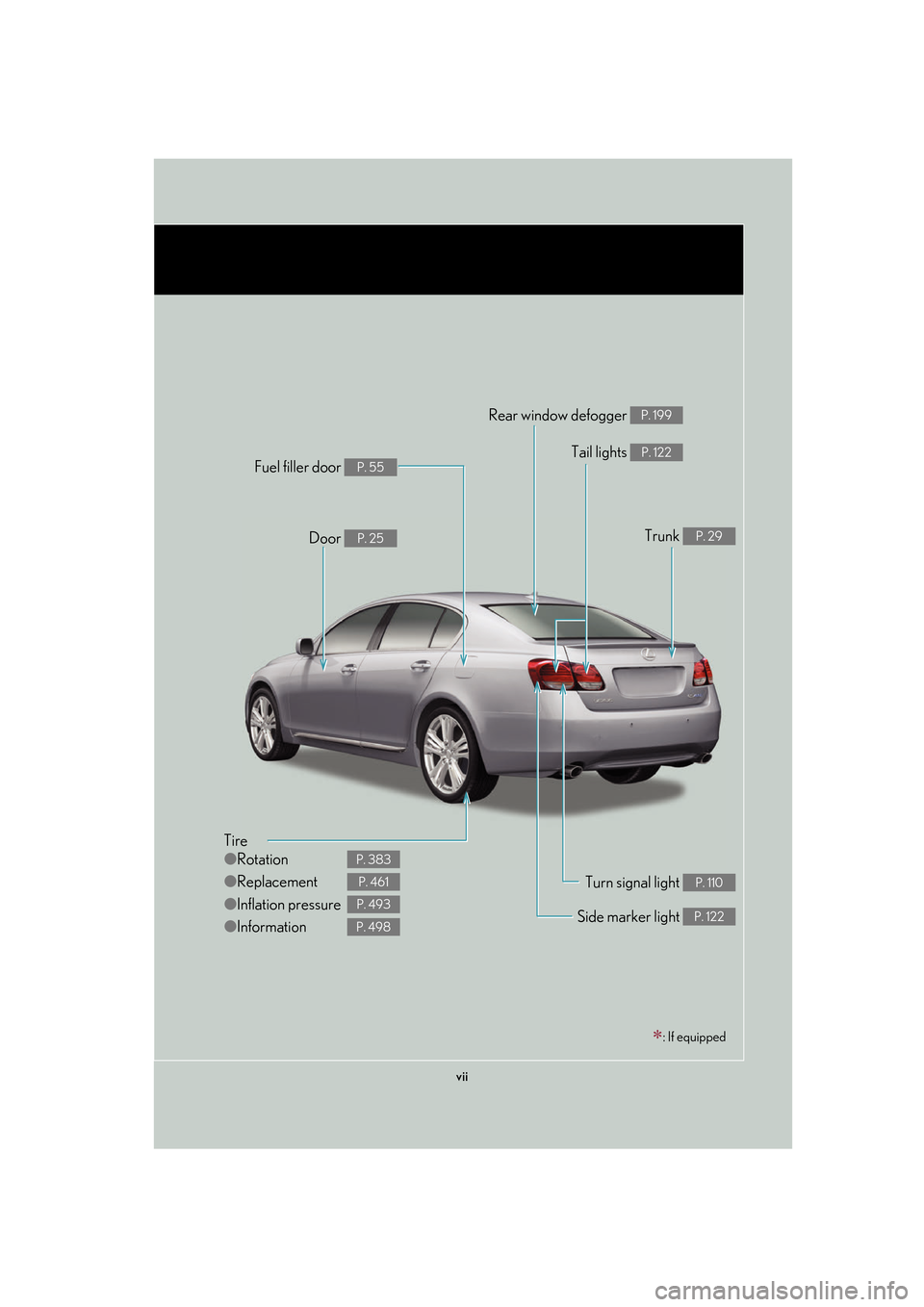
Tire
●Rotation
● Replacement
● Inflation pressure
● Information
P. 383
P. 461
P. 493
P. 498
Tail lights P. 122
Side marker light P. 122
Trunk P. 29
Rear window defogger P. 199
Door P. 25
Fuel filler door P. 55
Turn signal light P. 110
: If equipped
Page 92 of 548
72
1-8. Safety information
CAUTION
■SRS airbag precautions
Observe the following precautions regarding the airbags. Failure to do so may
cause death or serious injury.
●The driver and all passengers in the vehicle must wear their seat belts properly.
The SRS airbags are supplemental devices to be used with the seat belts.
●The SRS driver airbag deploys with considerable force, and can cause death or
serious injury especially if the driver is very close to the airbag. The National
Highway Traffic Safety Administration (“NHTSA”) advises:
Since the risk zone for driver airbag is th e first 2 - 3 in. (50 - 75 mm) of inflation,
placing yourself 10 in. (250 mm) from your driver airbag provides you with a
clear margin of safety. This distance is measured from the center of the steering
wheel to your breastbone. If you sit less than 10 in. (250 mm) away now, you can
change your driving position in several ways:
• Move your seat to the rear as far as you can while still reaching the pedals
comfortably.
• Slightly recline the back of the seat. Al though vehicle designs vary, many driv-
ers can achieve the 10 in. (250 mm) distan ce, even with the driver seat all the
way forward, simply by reclining the back of the seat somewhat. If reclining
the back of your seat makes it hard to see the road, raise yourself by using a
firm, non-slippery cushion, or raise the seat if your vehicle has that feature.
• If your steering wheel is adjustable, ti lt it downward. This points the airbag
toward your chest instead of your head and neck.
The seat should be adjusted as recommended by NHTSA above, while still main-
taining control of the foot pedals, steering wheel, and your view of the instrument
panel controls.
Page 95 of 548
75
1-8. Safety information
1
Before driving
CAUTION
■SRS airbag precautions
●If the vinyl cover is put on the area where the SRS knee airbag will deploy, be sure
to remove it.
●Do not use seat accessories which cover the parts where the SRS side airbags
inflate as they may interfere with inflation of the airbags.
●Do not strike or apply significant levels of force to the area of the SRS airbag
components shown on P. 67. Doing so ca n cause the SRS airbags to malfunction.
●Do not touch any of the component parts immediately after the SRS airbags have
deployed (inflated) as they may be hot.
●If breathing becomes difficult after the SRS airbag has deployed, open a door or
window to allow fresh air in, or leave the vehicle if it is safe to do so. Wash off any
residue as soon as possible to prevent skin irritation.
●If the areas where the SRS airbags are stored, such as the steering wheel pad and
front pillar garnish, are damaged or cracked, have them replaced by your Lexus
dealer.
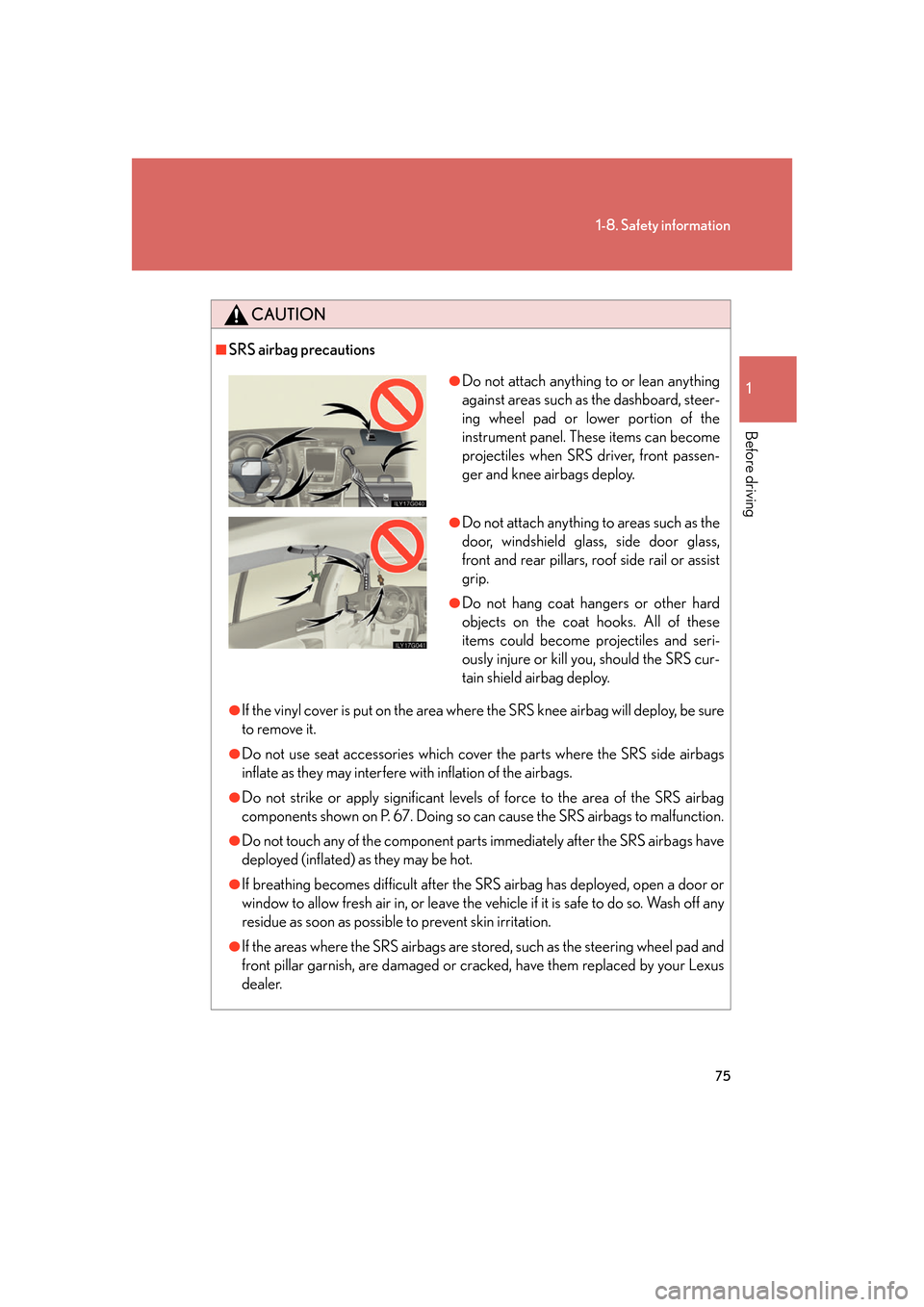
●Do not attach anything to or lean anything
against areas such as the dashboard, steer-
ing wheel pad or lower portion of the
instrument panel. These items can become
projectiles when SRS driver, front passen-
ger and knee airbags deploy.
●Do not attach anything to areas such as the
door, windshield glass, side door glass,
front and rear pillars, roof side rail or assist
grip.
●Do not hang coat hangers or other hard
objects on the coat hooks. All of these
items could become projectiles and seri-
ously injure or kill you, should the SRS cur-
tain shield airbag deploy.
Page 104 of 548
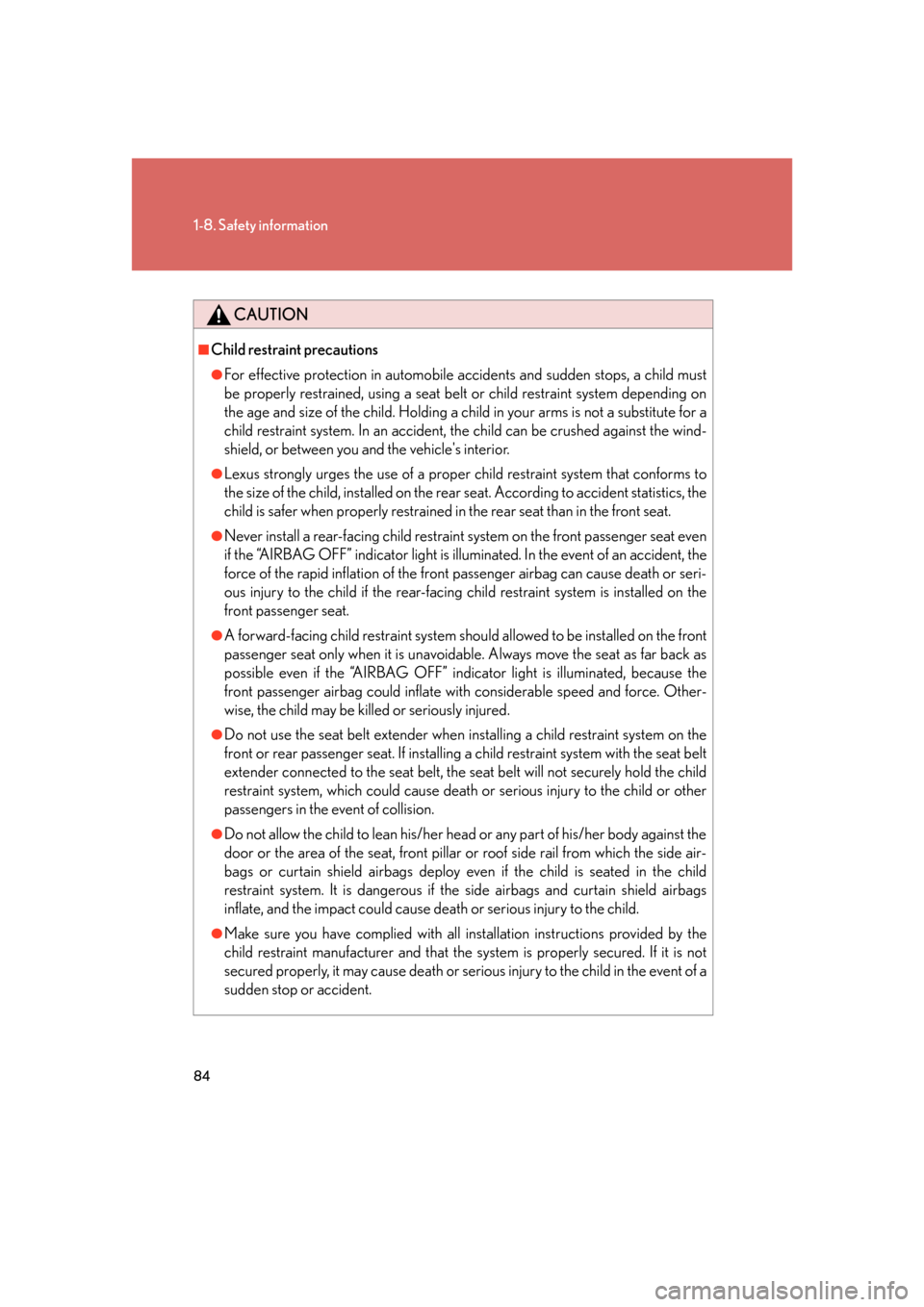
84
1-8. Safety information
CAUTION
■Child restraint precautions
●For effective protection in automobile accidents and sudden stops, a child must
be properly restrained, using a seat belt or child restraint system depending on
the age and size of the child. Holding a child in your arms is not a substitute for a
child restraint system. In an accident, th e child can be crushed against the wind-
shield, or between you and the vehicle's interior.
●Lexus strongly urges the use of a proper child restraint system that conforms to
the size of the child, installed on the rear seat. According to accident statistics, the
child is safer when properly restrained in the rear seat than in the front seat.
●Never install a rear-facing child restraint system on the front passenger seat even
if the “AIRBAG OFF” indicator light is illuminated. In the event of an accident, the
force of the rapid inflation of the front passenger airbag can cause death or seri-
ous injury to the child if the rear-facing child restraint system is installed on the
front passenger seat.
●A forward-facing child restraint system shou ld allowed to be installed on the front
passenger seat only when it is unavoidable. Always move the seat as far back as
possible even if the “AIR BAG OFF” indicator light is illuminated, because the
front passenger airbag could inflate with considerable speed and force. Other-
wise, the child may be killed or seriously injured.
●Do not use the seat belt extender when installing a child restraint system on the
front or rear passenger seat. If installing a child restraint system with the seat belt
extender connected to the seat belt, the seat belt will not securely hold the child
restraint system, which could cause death or serious injury to the child or other
passengers in the event of collision.
●Do not allow the child to lean his/her head or any part of his/her body against the
door or the area of the seat, front pillar or roof side rail from which the side air-
bags or curtain shield airbags deploy even if the child is seated in the child
restraint system. It is dangerous if the side airbags and curtain shield airbags
inflate, and the impact could cause death or serious injury to the child.
●Make sure you have complied with all inst allation instructions provided by the
child restraint manufacturer and that the sy stem is properly secured. If it is not
secured properly, it may cause death or serious injury to the child in the event of a
sudden stop or accident.
Page 199 of 548
179
2-5. Driving information
2
When driving
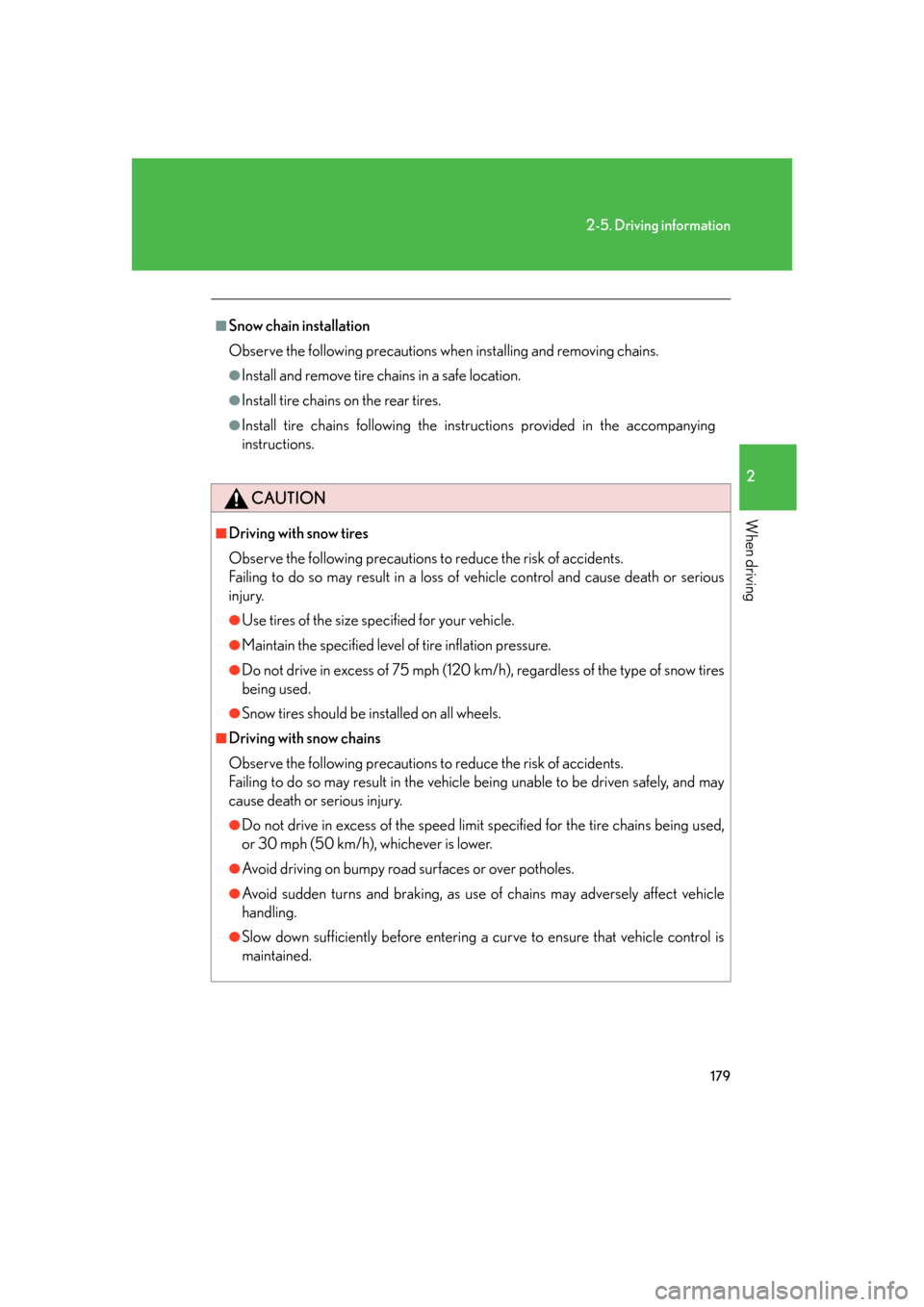
■Snow chain installation
Observe the following precautions when installing and removing chains.
●Install and remove tire chains in a safe location.
●Install tire chains on the rear tires.
●Install tire chains following the instructions provided in the accompanying
instructions.
CAUTION
■Driving with snow tires
Observe the following precautions to reduce the risk of accidents.
Failing to do so may result in a loss of vehicle control and cause death or serious
injury.
●Use tires of the size specified for your vehicle.
●Maintain the specified level of tire inflation pressure.
●Do not drive in excess of 75 mph (120 km/h), regardless of the type of snow tires
being used.
●Snow tires should be installed on all wheels.
■Driving with snow chains
Observe the following precautions to reduce the risk of accidents.
Failing to do so may result in the vehicle being unable to be driven safely, and may
cause death or serious injury.
●Do not drive in excess of the speed limit specified for the tire chains being used,
or 30 mph (50 km/h), whichever is lower.
●Avoid driving on bumpy road surfaces or over potholes.
●Avoid sudden turns and braking, as use of chains may adversely affect vehicle
handling.
●Slow down sufficiently before entering a curve to ensure that vehicle control is
maintained.
Page 371 of 548
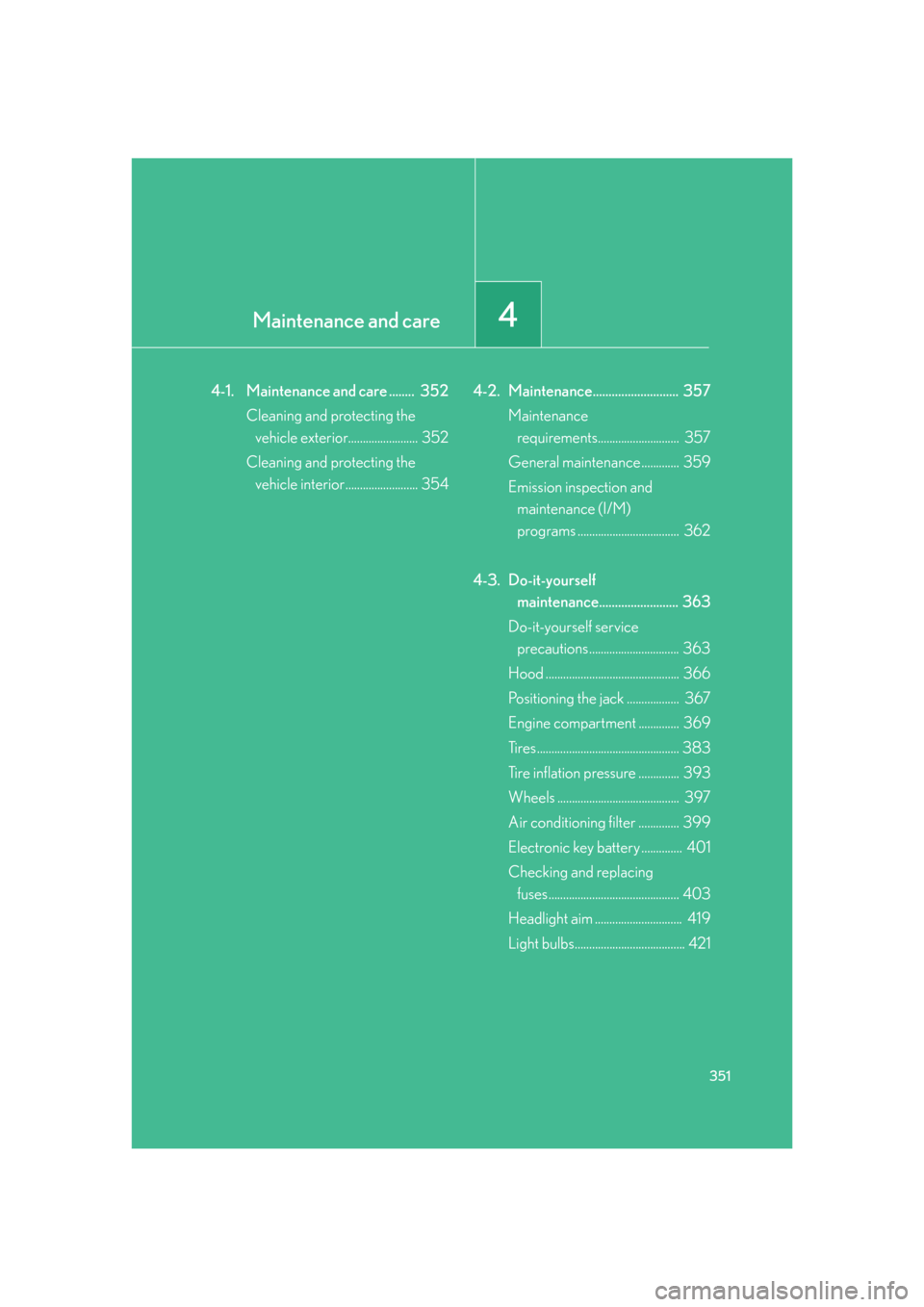
Maintenance and care4
351
4-1. Maintenance and care ........ 352Cleaning and protecting the
vehicle exterior........................ 352
Cleaning and protecting the
vehicle interior......................... 354 4-2. Maintenance........................... 357
Maintenance requirements............................ 357
General maintena nce ............. 359
Emission inspection and
maintenance (I/M)
programs ................................... 362
4-3. Do-it-yourself
maintenance......................... 363
Do-it-yourself service
precautions ............................... 363
Hood .............................................. 366
Positioning the jack .................. 367
Engine compartment .............. 369
Tires ................................................. 383
Tire inflation pressure .............. 393
Wheels .......................................... 397
Air conditioning filter .............. 399
Electronic key battery .............. 401
Checking and replacing
fuses ............................................. 403
Headlight aim .............................. 419
Light bulbs...................................... 421
Page 381 of 548
361
4-2. Maintenance
4
Maintenance and care
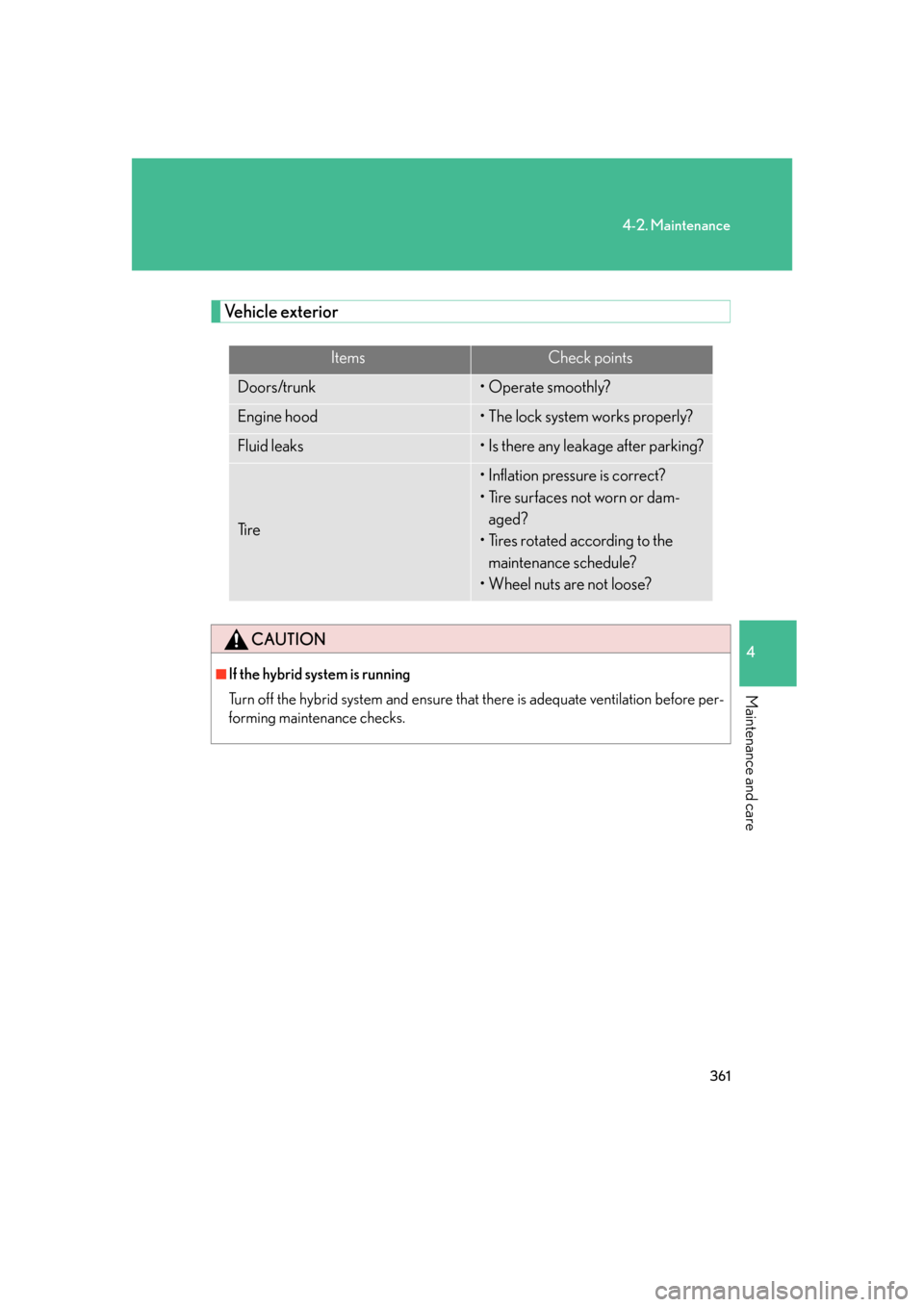
Vehicle exterior
ItemsCheck points
Doors/trunk• Operate smoothly?
Engine hood• The lock system works properly?
Fluid leaks• Is there any leakage after parking?
Ti r e
• Inflation pressure is correct?
• Tire surfaces not worn or dam-aged?
• Tires rotated according to the
maintenance schedule?
• Wheel nuts are not loose?
CAUTION
■If the hybrid system is running
Turn off the hybrid system and ensure that there is adequate ventilation before per-
forming maintenance checks.
Page 384 of 548
364
4-3. Do-it-yourself maintenance
CAUTION
The engine compartment contains many mechanisms and fluids that may move sud-
denly, become hot, or become electrically energized. To avoid death or serious injury.
■When working on the engine compartment:
●Keep hands, clothing, and tools away from the moving fan and engine drive belt.
●Be careful not to touch the engine, inverter, radiator, exhaust manifold, etc. right
after driving as they may be hot. Oil and other fluids may also be hot.
●Do not leave anything that may burn easily , such as paper or rags, in the engine
compartment.
●Do not smoke, cause sparks or expose an open flame to fuel or the battery. Fuel
and battery fumes are flammable.
●Be extremely cautious when working on the battery. It contains poisonous and
corrosive sulfuric acid.
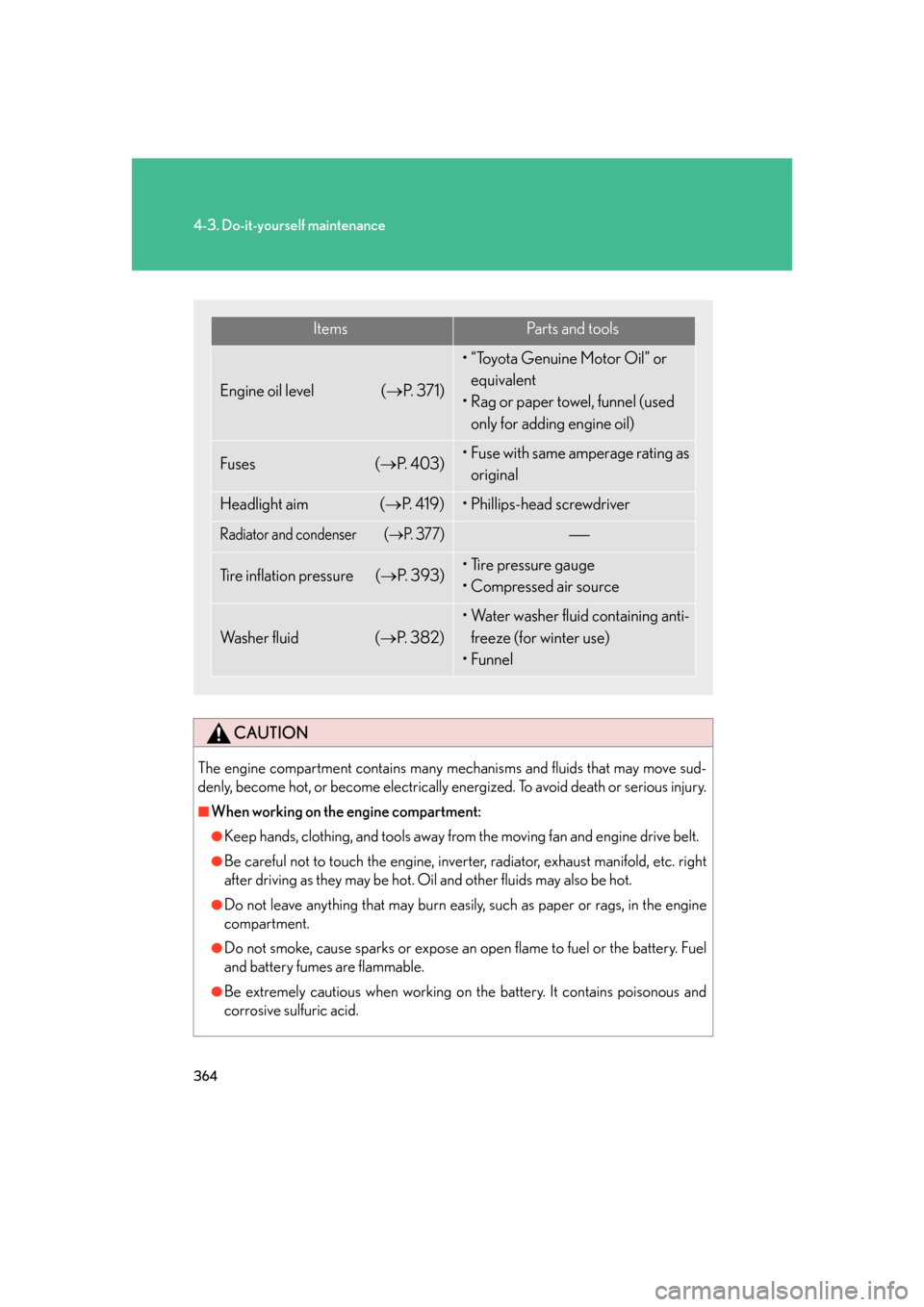
ItemsPa r t s a n d t o o l s
Engine oil level ( P. 3 7 1 )
• “Toyota Genuine Motor Oil” or
equivalent
• Rag or paper towel, funnel (used
only for adding engine oil)
Fuses ( P. 4 0 3 )• Fuse with same amperage rating as
original
Headlight aim ( P. 4 1 9 )• Phillips-head screwdriver
Radiator and condenser (P. 377)
Tire inflation pressure ( P. 393)• Tire pressure gauge
• Compressed air source
Wa s h e r f l u i d ( P. 3 8 2 )
• Water washer fluid containing anti-
freeze (for winter use)
•Funnel
Page 403 of 548
383
4-3. Do-it-yourself maintenance
4
Maintenance and care
Tires
Replace or rotate tires in accordance with maintenance schedule and
treadwear.
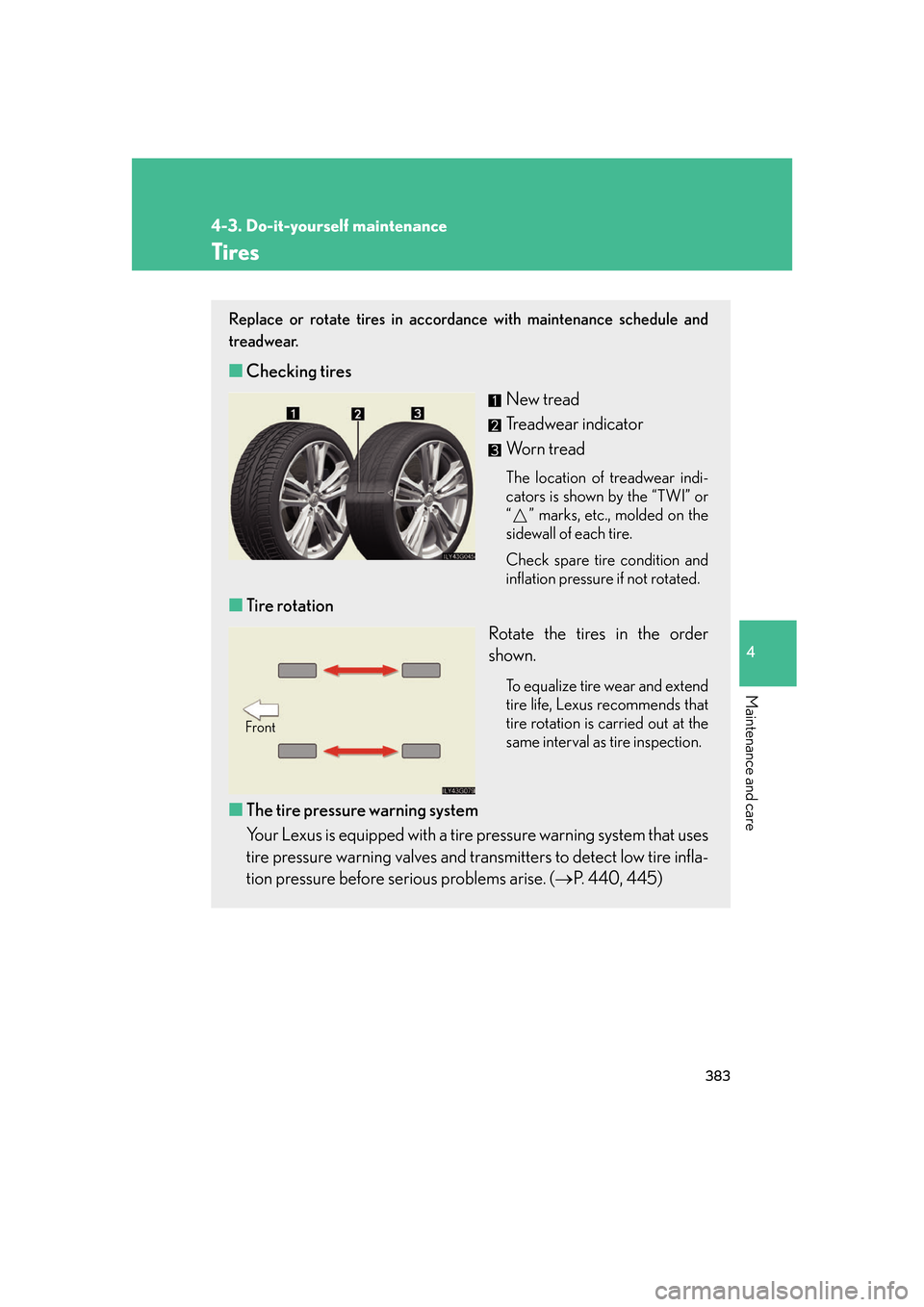
■Checking tires
New tread
Treadwear indicator
Worn tread
The location of treadwear indi-
cators is shown by the “TWI” or
“ ” marks, etc., molded on the
sidewall of each tire.
Check spare tire condition and
inflation pressure if not rotated.
■Tire rotation
Rotate the tires in the order
shown.
To equalize tire wear and extend
tire life, Lexus recommends that
tire rotation is carried out at the
same interval as tire inspection.
■The tire pressure warning system
Your Lexus is equipped with a tire pressure warning system that uses
tire pressure warning valves and tr ansmitters to detect low tire infla-
tion pressure before serious problems arise. ( P. 440, 445)
Front