tow Lexus GX470 2008 User Guide
[x] Cancel search | Manufacturer: LEXUS, Model Year: 2008, Model line: GX470, Model: Lexus GX470 2008Pages: 458, PDF Size: 5.93 MB
Page 58 of 458

57
1
1-3. Adjustable components (seats, mirrors, steering wheel, etc.)
Before driving
Steering wheel
Auto tilt away and auto return
When the ignition key is removed,
the steering wheel returns to its
stowed position by moving up and
away to enable easier driver entry
and exit.
When the key is inserted in the
engine switch, the steering wheel
will return to the original position.
The steering wheel can be adjusted to a comfortable position while the
engine switch is in the “ACC” or “ON” position.
Up
Down
Toward the driver
Away from the driver
CAUTION
■Caution while driving
Do not adjust the steering wheel.
Doing so may cause the driver to mishandle the vehicle and may lead to an acci-
dent, resulting in death or serious injury.
Page 85 of 458
84
1-7. Safety information
CAUTION
■SRS airbag precautions
Observe the following precautions regarding the airbags. Failure to do so may
cause death or serious injury.
●The driver and all passengers in the vehicle must wear their seat belts properly.
The SRS airbags are supplemental devices to be used with the seat belts.
●The SRS driver airbag deploys with considerable force, and can cause death or
serious injury especially if the driver is very close to the airbag. The National
Highway Traffic Safety Administration (“NHTSA”) advises:
Since the risk zone for driver airbag is the first 2 - 3 in. (50 - 75 mm) of inflation,
placing yourself 10 in. (250 mm) from your driver airbag provides you with a
clear margin of safety. This distance is measured from the center of the steering
wheel to your breastbone. If you sit less than 10 in. (250 mm) away now, you can
change your driving position in several ways:
• Move your seat to the rear as far as you can while still reaching the pedalscomfortably.
• Slightly recline the back of the seat. Although vehicle designs vary, many driv- ers can achieve the 10 in. (250 mm) distance, even with the driver seat all the
way forward, simply by reclining the back of the seat somewhat. If reclining
the back of your seat makes it hard to see the road, raise yourself by using a
firm, non-slippery cushion, or raise the seat if your vehicle has that feature.
• If your steering wheel is adjustable, tilt it downward. This points the airbag toward your chest instead of your head and neck.
The seat should be adjusted as recommended by NHTSA above, while still main-
taining control of the foot pedals, steering wheel, and your view of the instrument
panel controls.
Page 87 of 458

86
1-7. Safety information
CAUTION
■SRS airbag precautions
●Do not sit on the edge of the seat or lean
against the dashboard.
●Do not allow a child sit on the knees of a
front passenger while the vehicle is moving.
●Do not drive the vehicle while the driver or
passenger have items resting on their
knees.
●Do not lean against the door, the roof side
rail or the front, side and rear pillars.
●Do not allow anyone to kneel on the pas-
senger seat toward the door or put their
head or hands outside the vehicle.
Page 110 of 458
When driving2
109
2-1. Driving procedures ........ 110Driving the vehicle................... 110
Engine (ignition) switch .......... 118
Automatic transmission ......... 121
Turn signal lever ....................... 124
Parking brake ........................... 125
2-2. Instrument cluster .......... 126 Gauges and meters ................ 126
Indicators and warning lights ......................................... 129
Trip information display ......... 132 2-3. Operating the lights and
windshield wipers ........ 135
Headlight switch ..................... 135
Fog light switch ........................ 137
Windshield wipers and washer ..................................... 138
Rear window wiper and washer ...................................... 141
2-4. Using other driving systems .......................... 142
Cruise control.......................... 142
Four-wheel drive system....... 146
Rear height control air suspension.............................. 149
Electronic modulated suspension.............................. 156
DAC (Downhill Assist Control system) ..................... 157
Driving assist systems ............ 159
2-5. Driving information........ 163 Off-road precautions ............ 163
Cargo and luggage ................ 168
Vehicle load limits .................... 174
Winter driving tips ................... 176
Trailer towing ........................... 180
Dinghy towing.......................... 190
Page 112 of 458

111
2-1. Driving procedures
2
When driving
■Driving in the rain
●Drive carefully when it is raining, because visibility will be reduced, the windows
may become fogged-up, and the road will be slippery.
●Drive carefully when it starts to rain, because the road surface will be especially
slippery.
●Refrain from high speeds when driving on an expressway in the rain, because
there may be a layer of water between the tires and the road surface, preventing
the steering and brakes from operating properly.
■Breaking in your new Lexus
To extend the life of the vehicle, the following precautions are recommended to
observe:
●For the first 200 miles (300 km):
Avoid sudden stops.
●For the first 500 miles (800 km):
Do not tow a trailer.
●For the first 600 miles (1000 km):
• Do not drive at extremely high speeds.
• Avoid sudden acceleration.
• Do not drive continuously in the low gears.
• Do not drive at a constant speed for extended periods.
■Operating your vehicle in a foreign country
Comply with the relevant vehicle registration laws and confirm the availability of the
correct fuel. (→P. 414)
Page 136 of 458
135
2
When driving
2-3. Operating the lights and windshield wipers
Headlight switch
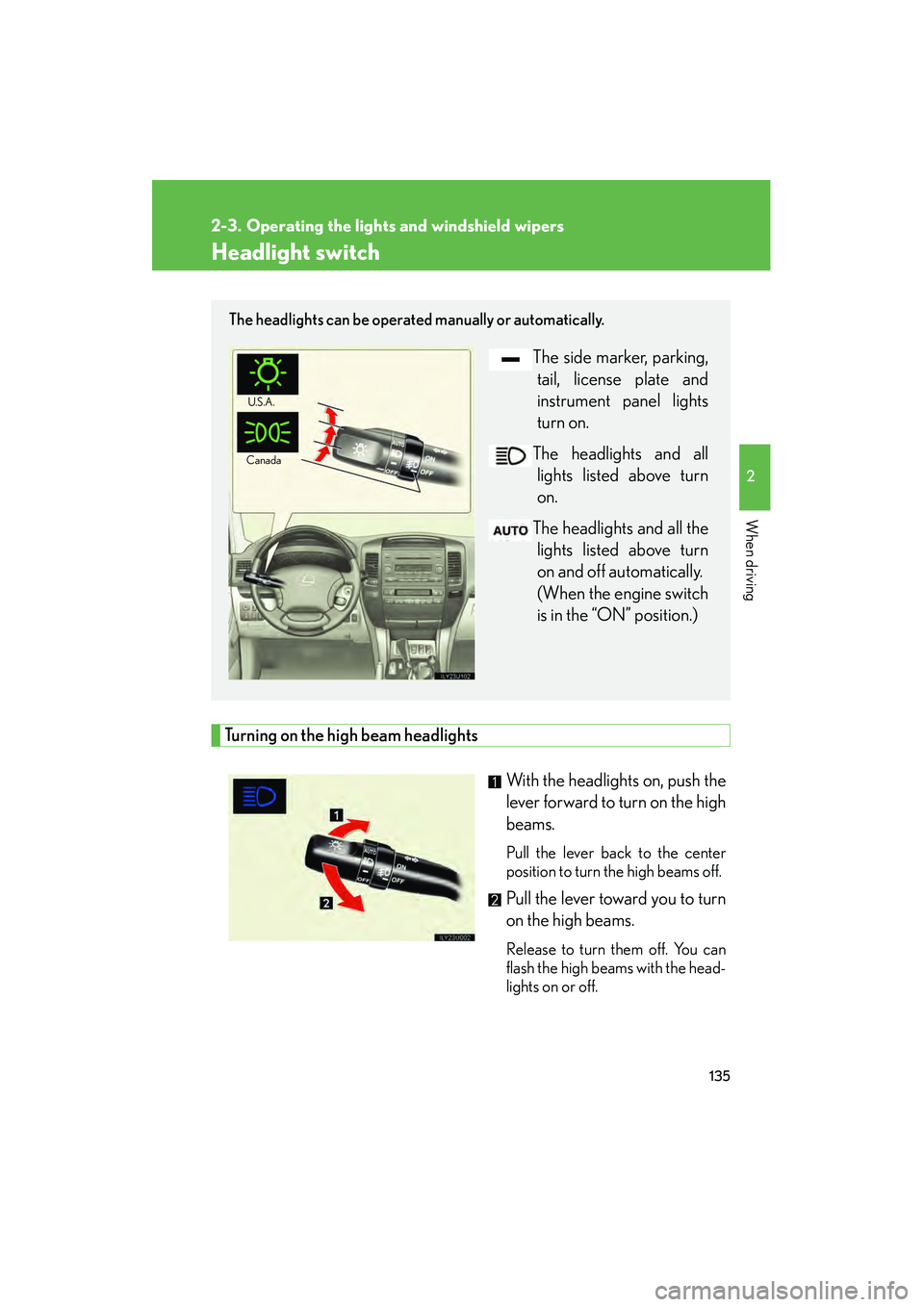
Turning on the high beam headlightsWith the headlights on, push the
lever forward to turn on the high
beams.
Pull the lever back to the center
position to turn the high beams off.
Pull the lever toward you to turn
on the high beams.
Release to turn them off. You can
flash the high beams with the head-
lights on or off.
The headlights can be operated manually or automatically.
The side marker, parking,tail, license plate and
instrument panel lights
turn on.
The headlights and all lights listed above turn
on.
The headlights and all the lights listed above turn
on and off automatically.
(When the engine switch
is in the “ON” position.)
U.S.A .
Canada
Page 141 of 458
140
2-3. Operating the lights and windshield wipers
CAUTION
■Caution regarding the use of windshield wipers in “AUTO” mode
The windshield wipers may operate unexpectedly if the sensor is touched or the
windshield is subject to vibration in “AUTO” mode. Take care that your fingers or
anything else do not become caught in the windshield wipers.
NOTICE
■When the windshield is dry
Do not use the wipers, as they may damage the windshield.
■When there is no washer fluid spray from the nozzle
Damage to the washer fluid pump may be caused if the lever is pulled toward you
and held continually.
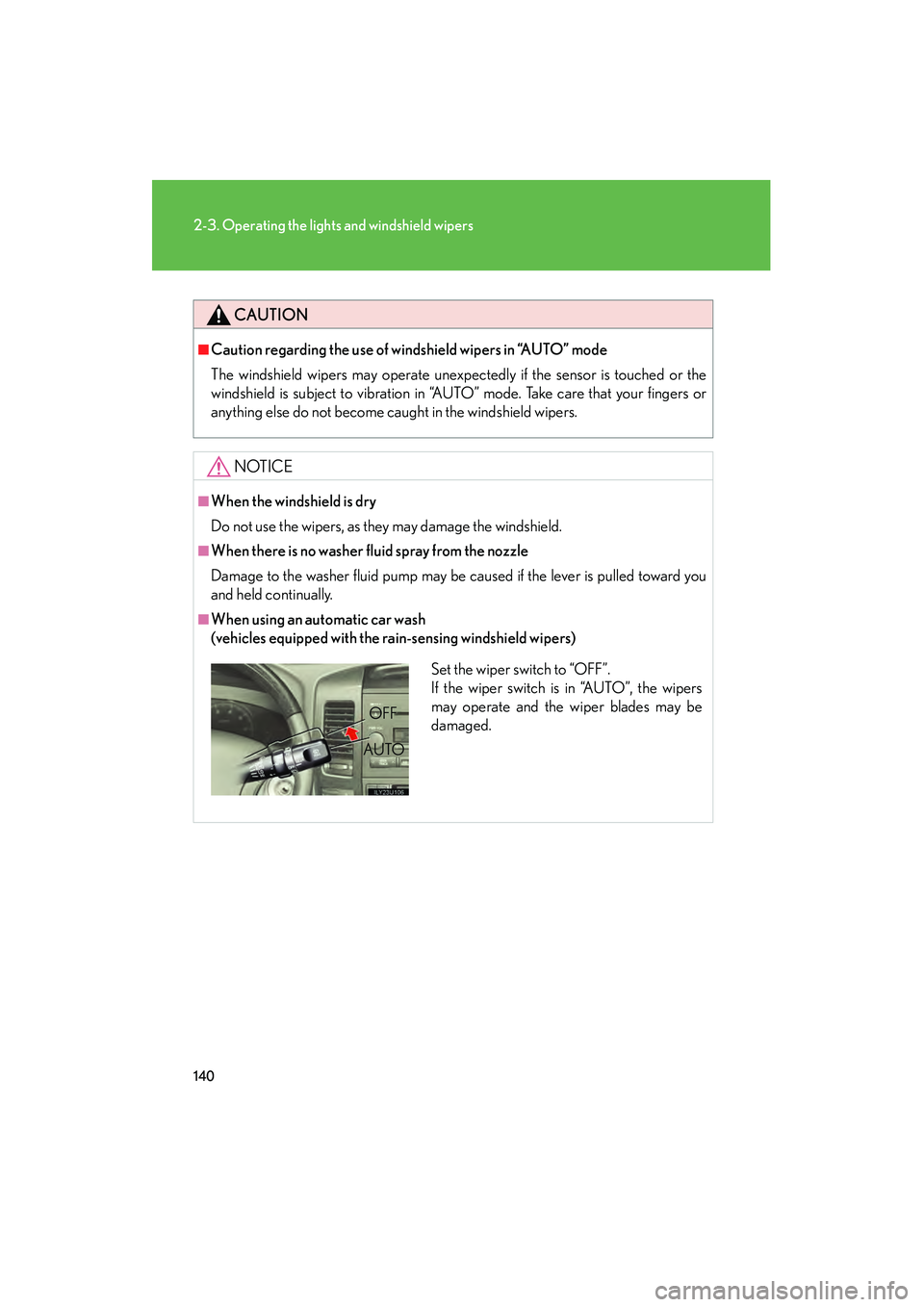
■When using an automatic car wash
(vehicles equipped with the rain-sensing windshield wipers)
Set the wiper switch to “OFF”.
If the wiper switch is in “AUTO”, the wipers
may operate and the wiper blades may be
damaged.
OFF
AUTO
Page 144 of 458

143
2-4. Using other driving systems
2
When driving
■Adjusting the speed setting
Increase speed
Decrease speed
Hold the lever until the desired
speed setting is obtained.
Fine adjustment of the set speed
(approximately 1.0 mph [1.6 km/
h]) can be made by lightly press-
ing the lever up or down and
releasing it.
■Canceling and resuming regular acceleration
Cancel
Push the lever towards you to
cancel cruise control.
The setting is also canceled
when the brake pedal is
depressed.
Resume
To resume cruise control and
return to the set speed, push the
lever up.
Page 155 of 458
154
2-4. Using other driving systems
CAUTION
Failure to observe the following precautions may result in an accident.
■ Using the “HI” (high) mode
This mode should only be used for rough off-road conditions. Because the vehicle’s
center of gravity is higher when in the high mode, the vehicle may become unstable
when turning abruptly.
■When loading cargo on the roof luggage carrier
Do not select the “HI” (high) mode. Because the vehicle’s center of gravity is higher
when in the high mode, the vehicle may become unstable when turning abruptly
and unexpected loss of control or vehicle rollover may occur.
■When jacking up the vehicle or installing tire chains
Turn off the rear height control air suspension and stop the engine, otherwise the
vehicle height may change due to the automatic leveling function.
■ When driving through water deeper than 28 in. (700 mm)
Select the “HI” (high) mode, turn off the rear height control air suspension and drive
at 19 mph (30 km/h) or slower. Otherwise, the vehicle height may change due to
the automatic leveling function.
■If your vehicle must be towed
Put the vehicle height in the normal mode and turn off the rear height control air
suspension, otherwise the vehicle height may change due to the automatic leveling
function.
■If your vehicle becomes stuck in a ditch
Turn off the rear height control air suspension, otherwise the vehicle height may
change due to the automatic leveling function.
Page 169 of 458
168
2-5. Driving information
Cargo and luggage
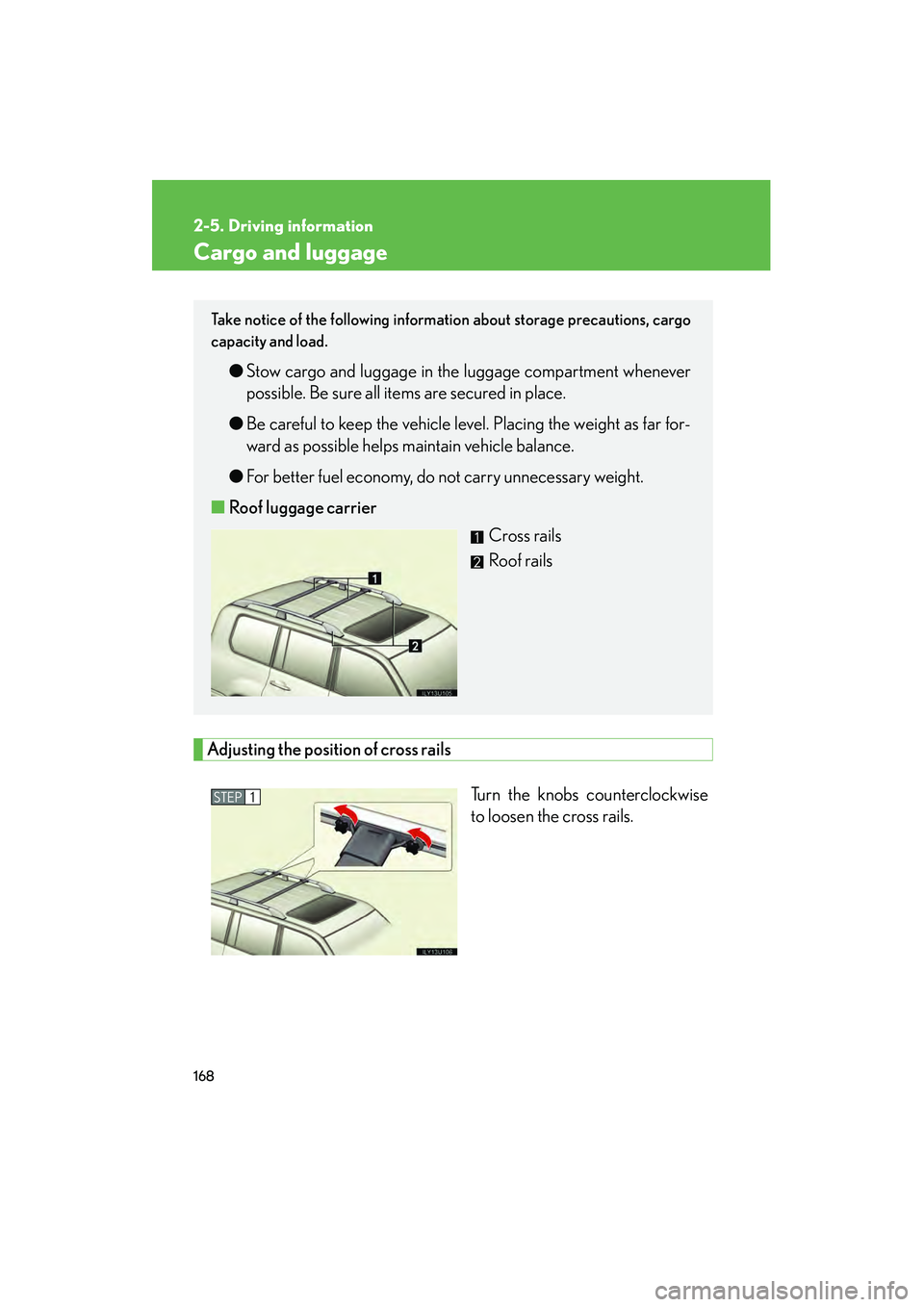
Adjusting the position of cross railsTurn the knobs counterclockwise
to loosen the cross rails.
Take notice of the following information about storage precautions, cargo
capacity and load.
●Stow cargo and luggage in the luggage compartment whenever
possible. Be sure all items are secured in place.
● Be careful to keep the vehicle level. Placing the weight as far for-
ward as possible helps maintain vehicle balance.
● For better fuel economy, do not carry unnecessary weight.
■ Roof luggage carrier
Cross rails
Roof rails
STEP1