wheel Lexus HS250h 2010 Owners Manual
[x] Cancel search | Manufacturer: LEXUS, Model Year: 2010, Model line: HS250h, Model: Lexus HS250h 2010Pages: 611, PDF Size: 11 MB
Page 528 of 611
526
5-2. Steps to take in an emergency
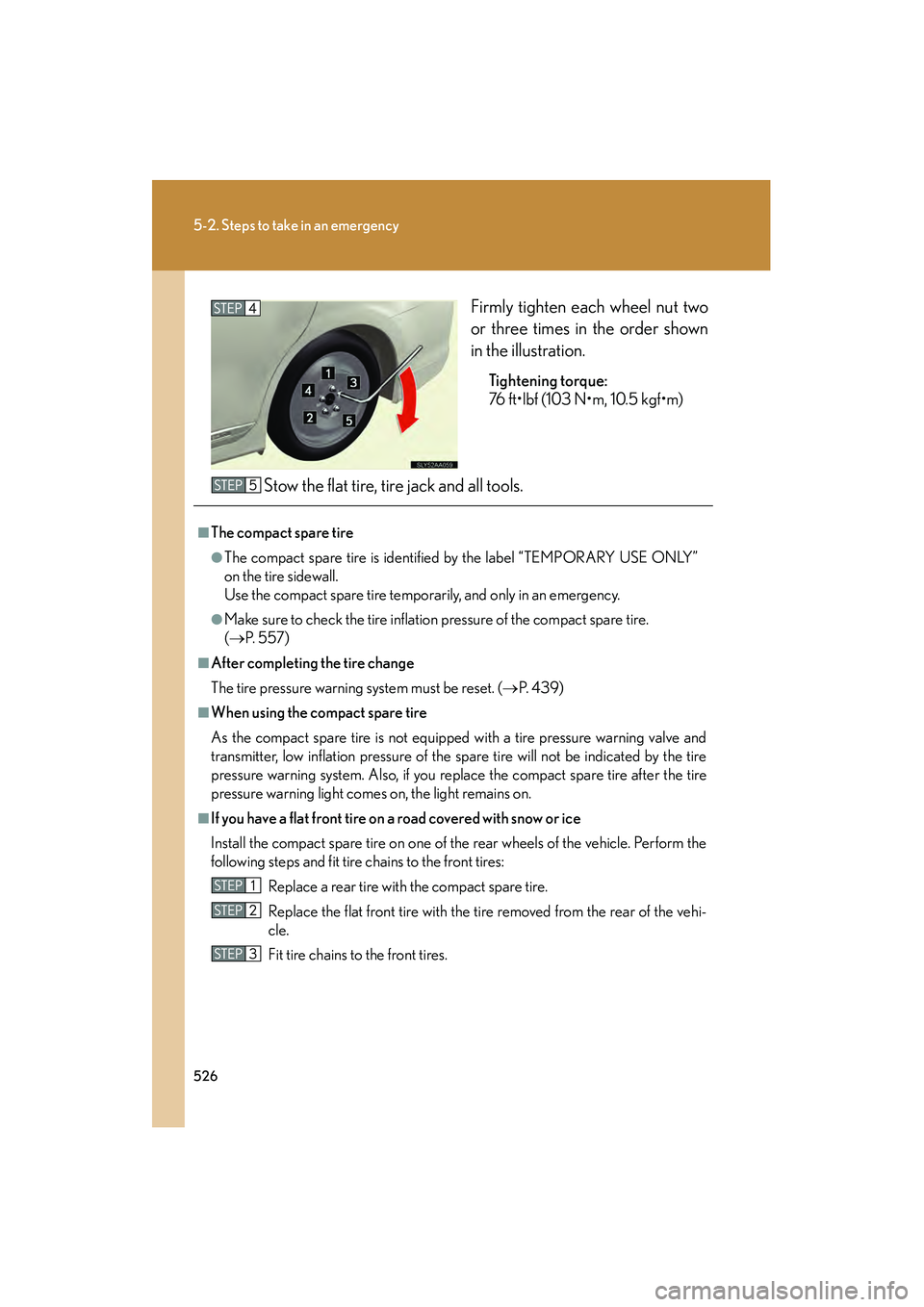
HS250h_U_75033U(Canada)Firmly tighten each wheel nut two
or three times in the order shown
in the illustration.
Tightening torque:
76 ft•lbf (103 N•m, 10.5 kgf•m)
Stow the flat tire, tire jack and all tools.
■The compact spare tire
●The compact spare tire is identified by the label “TEMPORARY USE ONLY”
on the tire sidewall.
Use the compact spare tire temporarily, and only in an emergency.
●Make sure to check the tire inflation pressure of the compact spare tire.
(
→ P. 5 5 7 )
■After completing the tire change
The tire pressure warning system must be reset. ( →P. 4 3 9 )
■When using the compact spare tire
As the compact spare tire is not equipped with a tire pressure warning valve and
transmitter, low inflation pressure of the spare tire will not be indicated by the tire
pressure warning system. Also, if you replace the compact spare tire after the tire
pressure warning light comes on, the light remains on.
■If you have a flat front tire on a road covered with snow or ice
Install the compact spare tire on one of the rear wheels of the vehicle. Perform the
following steps and fit tire chains to the front tires:
Replace a rear tire with the compact spare tire.
Replace the flat front tire with the tire removed from the rear of the vehi-
cle.
Fit tire chains to the front tires.
Page 530 of 611
528
5-2. Steps to take in an emergency
HS250h_U_75033U(Canada)
CAUTION
■Using the tire jack
Improper use of the tire jack may cause the vehicle to suddenly fall off the jack,
leading to death or serious injury.
●Do not use the tire jack for any purpose other than replacing tires or installing and
removing tire chains.
●Only use the tire jack that comes with this vehicle for replacing a flat tire.
Do not use it on other vehicles, and do not use other tire jacks for replacing tires
on this vehicle.
●Always check that the tire jack is securely set to the jack point.
●Do not put any part of your body under the vehicle while it is supported by the
jack.
●Do not start or run the hybrid system while your vehicle is supported by the jack.
●Do not raise the vehicle while someone is inside.
●When raising the vehicle, do not put an object on or under the jack.
●Do not raise the vehicle to a height greater than that required to replace the tire.
●Use a jack stand if it is necessary to get under the vehicle.
Take particular care when lowering the vehicle to ensure that no one working on or
near the vehicle may be injured.
■Replacing a flat tire
Observe the following precautions to reduce the risk of death or serious injury:
●Do not touch the disc wheels or the area around the brakes immediately after the
vehicle has been driven.
After the vehicle has been driven the disc wheels and the area around the brakes
will be extremely hot. Touching these areas with hands, feet or other body parts
while changing a tire, etc. may result in burns.
●Never use oil or grease on the wheel bolts or wheel nuts.
Oil and grease may cause the wheel nuts to be excessively tightened, leading to
bolt or disc wheel damage. In addition, the oil or grease can cause the wheel nuts
to loosen and the wheel may fall off, causing a serious accident. Remove any oil or
grease from the wheel bolts or wheel nuts.
Page 531 of 611
5
When trouble arises
529
5-2. Steps to take in an emergency
HS250h_U_75033U(Canada)
CAUTION
●Have the wheel nuts tightened with a torque wrench to 76 ft•lbf (103 N•m, 10.5
kgf•m) as soon as possible after changing wheels.
Failure to follow these precautions could cause the wheel nuts to loosen and the
tire to fall off, resulting in death or serious injury.
●When installing a tire, only use wheel nuts that have been specifically designed
for that wheel.
●If there are any cracks or deformations in the bolt screws, nut threads or bolt
holes of the wheel, have the vehicle inspected by your Lexus dealer.
Failure to follow these precautions could cause the wheel nuts to loosen and the tire
to fall off, resulting in death or serious injury.
NOTICE
■Do not drive the vehicle with a flat tire
Do not continue driving with a flat tire.
Driving even a short distance with a flat tire can damage the tire and the wheel
beyond repair.
■Be careful when driving over bumps with the compact spare tire installed on the
vehicle.
The vehicle becomes lower when driving with the compact spare tire compared to
when driving with standard tires. Be careful when driving over uneven road sur-
faces.
■Driving with tire chains and the compact spare tire
Do not fit tire chains to the compact spare tire.
Tire chains may damage the vehicle body and adversely affect driving performance.
■When replacing the tires
When removing or fitting the wheels, tires or the tire pressure warning valve and
transmitter, contact your Lexus dealer as the tire pressure warning valve and trans-
mitter may be damaged if not handled correctly.
■To avoid damage to the tire pressure warning valves and transmitters
Do not use liquid sealants on flat tires.
Page 540 of 611
538
5-2. Steps to take in an emergency
HS250h_U_75033U(Canada)
■Starting the hybrid system when the 12-volt battery is discharged
The hybrid system cannot be started by push-starting.
■To prevent 12-volt battery discharge
●Turn off the headlights and the audio system while the hybrid system is off.
●Turn off any unnecessary electrical components when the vehicle is running at a
low speed for an extended period, such as in heavy traffic.
■When the 12-volt battery is discharged
●The hybrid system may not start. (→P. 434)
●If the 12-volt battery is depleted with the shift position in P, it will not be possible
to shift out of P. In this case, the vehicle cannot be towed without lifting both
front wheels because the front wheels are locked by the parking lock.
(→ P. 4 8 3 )
●When the 12-volt battery is reconnected, start the hybrid system, depress the
brake pedal, and confirm that it is possible to shift into each shift position.
Close the exclusive jump starting terminal cover and reinstall
the fuse box cover.
Once the hybrid system starts, ha ve the vehicle inspected at your
Lexus dealer as soon as possible.
Page 548 of 611
546
5-2. Steps to take in an emergency
HS250h_U_75033U(Canada)
NOTICE
■To avoid damage to the hybrid transmission and other components
●Avoid spinning the wheels and depressing the accelerator pedal more than nec-
essary.
●If the vehicle remains stuck even after these procedures are performed, the vehi-
cle may require towing to be freed.
Page 549 of 611
5
When trouble arises
547
5-2. Steps to take in an emergency
HS250h_U_75033U(Canada)
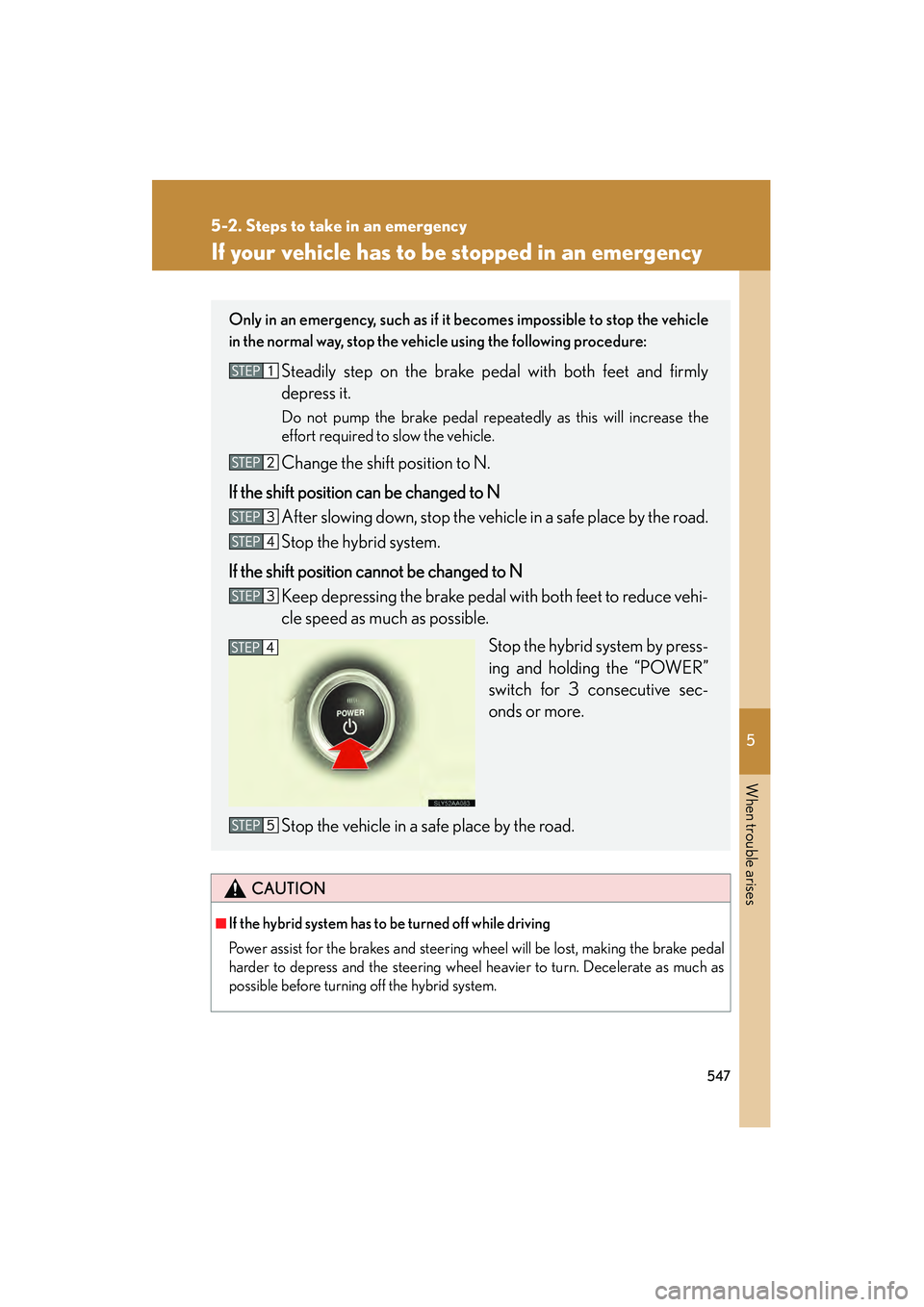
If your vehicle has to be stopped in an emergency
CAUTION
■If the hybrid system has to be turned off while driving
Power assist for the brakes and steering wheel will be lost, making the brake pedal
harder to depress and the steering wheel heavier to turn. Decelerate as much as
possible before turning off the hybrid system.
Only in an emergency, such as if it becomes impossible to stop the vehicle
in the normal way, stop the vehicle using the following procedure:
Steadily step on the brake pedal with both feet and firmly
depress it.
Do not pump the brake pedal repeatedly as this will increase the
effort required to slow the vehicle.
Change the shift position to N.
If the shift position can be changed to N After slowing down, stop the vehicle in a safe place by the road.
Stop the hybrid system.
If the shift position cannot be changed to N Keep depressing the brake pedal with both feet to reduce vehi-
cle speed as much as possible.
Stop the hybrid system by press-
ing and holding the “POWER”
switch for 3 consecutive sec-
onds or more.
Stop the vehicle in a safe place by the road.
Page 552 of 611
550
HS250h_U_75033U(Canada)
6-1. Specifications
Maintenance data (fuel, oil level, etc.)
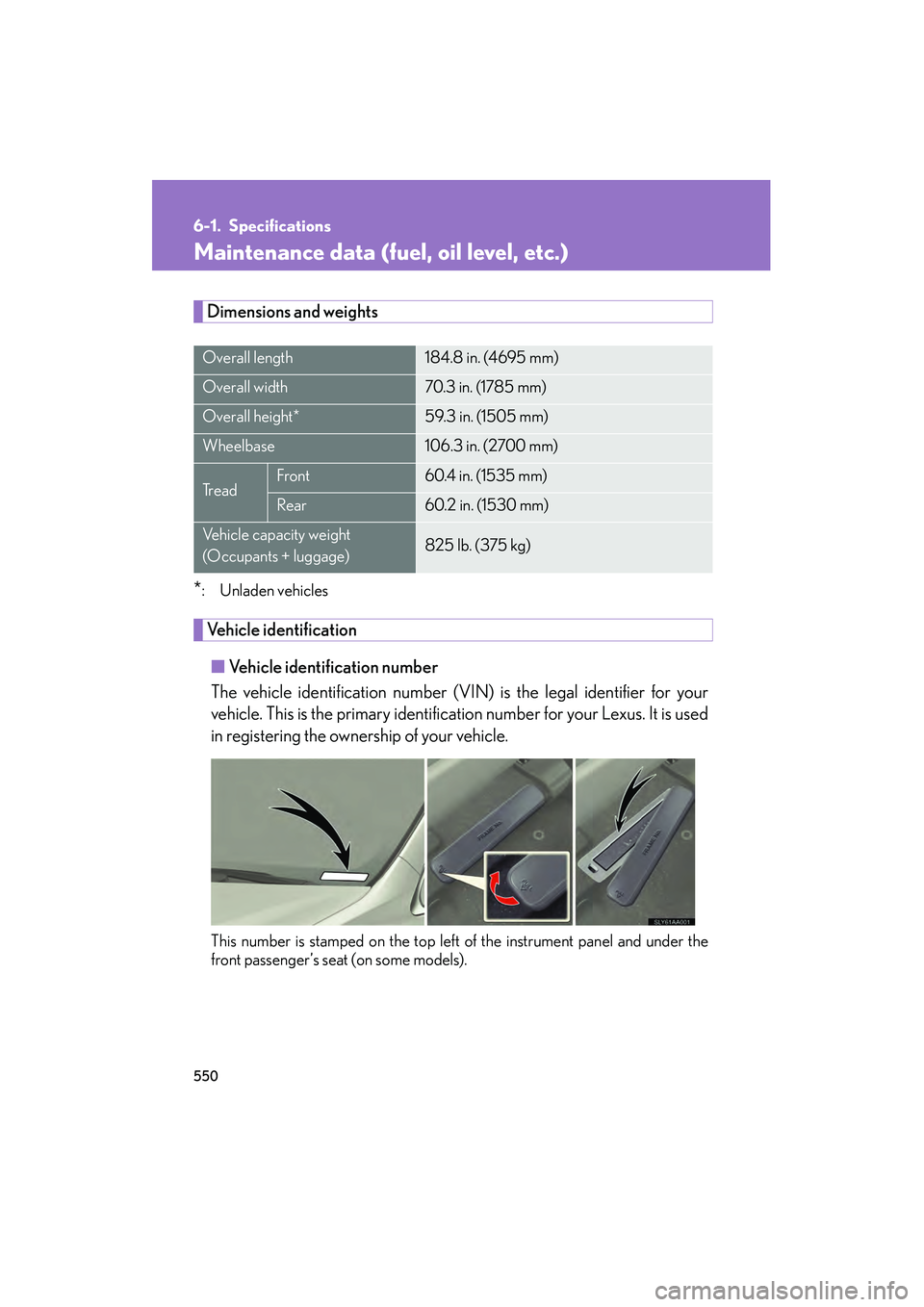
Dimensions and weights
*: Unladen vehicles
Vehicle identification■ Vehicle identification number
The vehicle identification number (VIN) is the legal identifier for your
vehicle. This is the primary identification number for your Lexus. It is used
in registering the ownership of your vehicle.
This number is stamped on the top left of the instrument panel and under the
front passenger’s seat (on some models).
Overall length184.8 in. (4695 mm)
Overall width70.3 in. (1785 mm)
Overall height*59.3 in. (1505 mm)
Wheelbase106.3 in. (2700 mm)
Tr e a dFront60.4 in. (1535 mm)
Rear60.2 in. (1530 mm)
Vehicle capacity weight
(Occupants + luggage)825 lb. (375 kg)
Page 559 of 611
557
6-1. Specifications
6
Vehicle specifications
HS250h_U_75033U(Canada)
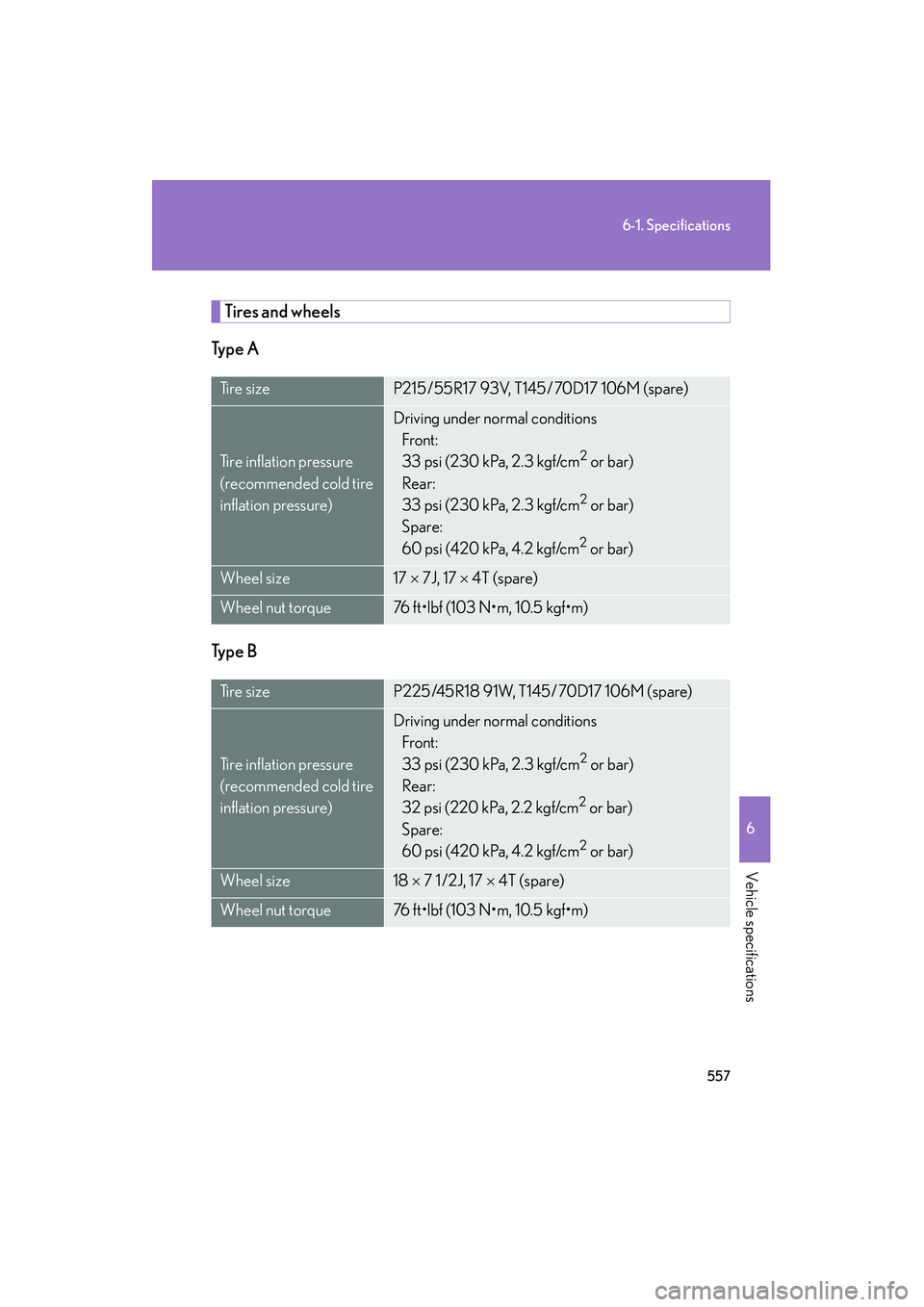
Tires and wheels
Ty p e A
Ty p e B
Ti r e s i z eP215/55R17 93V, T145/70D17 106M (spare)
Tire inflation pressure
(recommended cold tire
inflation pressure)
Driving under normal conditions Front:
33 psi (230 kPa, 2.3 kgf/cm
2 or bar)
Rear:
33 psi (230 kPa, 2.3 kgf/cm
2 or bar)
Spare:
60 psi (420 kPa, 4.2 kgf/cm
2 or bar)
Wheel size17 × 7J, 17 × 4T (spare)
Wheel nut torque76 ft•lbf (103 N•m, 10.5 kgf•m)
Ti r e s i z eP225/45R18 91W, T145/ 70D17 106M (spare)
Tire inflation pressure
(recommended cold tire
inflation pressure)
Driving under normal conditions
Front:
33 psi (230 kPa, 2.3 kgf/cm
2 or bar)
Rear:
32 psi (220 kPa, 2.2 kgf/cm
2 or bar)
Spare:
60 psi (420 kPa, 4.2 kgf/cm
2 or bar)
Wheel size18 × 7 1 /2J, 17 × 4T (spare)
Wheel nut torque76 ft•lbf (103 N•m, 10.5 kgf•m)
Page 567 of 611

565
6-1. Specifications
6
Vehicle specifications
HS250h_U_75033U(Canada)
Tire size■ Typical tire si ze information
The illustration indicates typical tire size.
Ti r e u s e
(P = Passenger car,
T = Temporary use)
Section width (millimeters)
Aspect ratio
(tire height to section width)
Tire construction code
(R = Radial, D = Diagonal)
Wheel diameter (inches)
Load index (2 digits or 3 digits)
Speed symbol
(alphabet with one letter)
■ Tire dimensions
Section width
Tire height
Wheel diameter
Page 569 of 611
567
6-1. Specifications
6
Vehicle specifications
HS250h_U_75033U(Canada)■
Treadwear
The treadwear grade is a comparative rating based on the wear rate of
the tire when tested under controlled conditions on a specified gov-
ernment test course.
For example, a tire graded 150 would wear one and a half (1 - 1 /2) times as
well on the government course as a tire graded 100.
The relative performance of tires depends upon the actual conditions of
their use. Performance may differ significantly from the norm due to varia-
tions in driving habits, service practices and differences in road characteris-
tics and climate.
■Traction AA, A, B, C
The traction grades, from highest to lowest, are AA, A, B and C, and
they represent the tire’s ability to stop on wet pavement as measured
under controlled conditions on specified government test surfaces of
asphalt and concrete.
A tire marked C may have poor traction performance.
Warning: The traction grade assigned to this tire is based on braking
(straight ahead) traction tests and does not include cornering (turning) trac-
tion.
■Temperature A, B, C
The temperature grades are A (the highest), B, and C, representing
the tire’s resistance to the generation of heat and its ability to dissipate
heat when tested under controlled conditions on a specified indoor
laboratory test wheel.
Sustained high temperature can cause the material of the tire to degenerate
and reduce tire life, and excessive temperature can lead to sudden tire fail-
ure.
Grade C corresponds to a level of performance which all passenger car
tires must meet under the Federal Motor Vehicle Safety Standard No. 109.
Grades B and A represent higher levels of performance on the laboratory
test wheel than the minimum required by law.