light Lexus HS250h 2010 Owner's Manual
[x] Cancel search | Manufacturer: LEXUS, Model Year: 2010, Model line: HS250h, Model: Lexus HS250h 2010Pages: 611, PDF Size: 11 MB
Page 400 of 611

398
3-7. Other interior features
HS250h_U_75033U(Canada)
Safety Connect LED light IndicatorsWhen the “POWER” switch is turned to ON mode, the red indicator
light comes on for 2 seconds then turns off. Afterward, the green indica-
tor light comes on, indicating that the service is active.
The following indicator light patterns indicate specific system usage con-
ditions:
● Green indicator light on = Active service
● Green indicator light flashing = Safety Connect call in process
● Red indicator light (except at vehicle start-up) = System malfunction
(contact your Lexus dealer)
● No indicator light (off) = Safety Connect service not active
Safety Connect services
■ Automatic Collis ion Notification
In case of either airbag deployment or severe rear-end collision, the
system is designed to automatically call the response center. The
responding agent receives the vehicle’s location and attempts to speak
with the vehicle occupants to assess the level of emergency. If the
occupants are unable to communicate, the agent automatically treats
the call as an emergency, contacts the nearest emergency services
provider to describe the situation, and requests that assistance be sent
to the location.
■ Stolen Vehicle Location
If your vehicle is stolen, Safety Connect can work with local authorities
to assist them in locating and recovering the vehicle. After filing a
police report, call the Safety Conne ct response center at 1-800-25-
LEXUS (1-800-255-3987) and follow the prompts for Safety Con-
nect to initiate this service.
In addition to assisting law enforcement with recovery of a stolen vehi-
cle, Safety-Connect-equipped vehicle location data may, under cer-
tain circumstances, be shared with third parties to locate your vehicle.
Further information is available at Lexus.com.
Page 403 of 611
Maintenance and care4
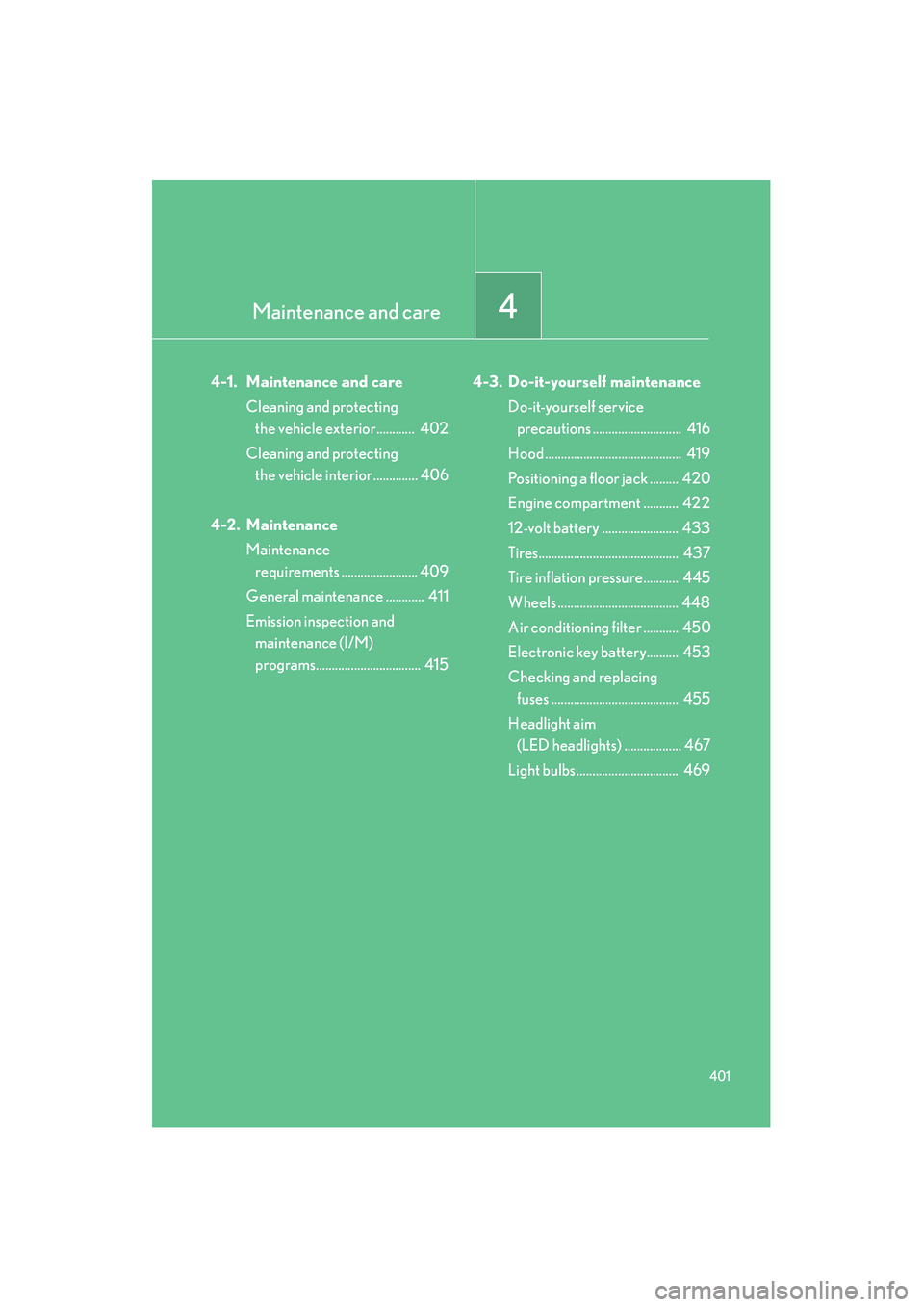
401
HS250h_U_75033U(Canada)
4-1. Maintenance and careCleaning and protecting the vehicle exterior............ 402
Cleaning and protecting the vehicle interior .............. 406
4-2. Maintenance Maintenance requirements ........................ 409
General maintenance ............ 411
Emission inspection and maintenance (I/M)
programs................................. 415 4-3. Do-it-yourself maintenance
Do-it-yourself service precautions ............................ 416
Hood ........................................... 419
Positioning a floor jack ......... 420
Engine compartment ........... 422
12-volt battery ........................ 433
Tires............................................ 437
Tire inflation pressure........... 445
Wheels ...................................... 448
Air conditioning filter ........... 450
Electronic key battery.......... 453
Checking and replacing fuses ........................................ 455
Headlight aim (LED headlights) .................. 467
Light bulbs................................ 469
Page 405 of 611

403
4-1. Maintenance and care
4
Maintenance and care
HS250h_U_75033U(Canada)
■When using a car wash
If the door handle becomes wet while the electronic key is within the effective
range, the door may lock and unlock repeatedly. Place the key in a position 6 ft. (2
m) or more separate from the vehicle while the vehicle is being washed. (Take care
to ensure that the key is not stolen.)
■Aluminum wheels
●Remove any dirt immediately by using a neutral detergent. Do not use hard
brushes or abrasive cleaners. Do not use strong or harsh chemical cleaners.
Use the same mild detergent and wax as used on the paint.
●Do not use detergent on the wheels when they are hot, for example after driving
for long distance in the hot weather.
●Wash detergent from the wheels immediately after use.
■Bumpers and side moldings
Do not scrub with abrasive cleaners.
■Side windows water-repellent coating
●The following precautions can extend the effectiveness of the water-repellent
coating.
• Remove any dirt, etc. from the side windows regularly.
• Do not allow dirt and dust to accumulate on the windows for a long period.Clean the windows with a soft, damp cloth as soon as possible.
• Do not use wax or glass cleaners that contain abrasives when cleaning the windows.
• Do not use any metallic objects to remove condensation build up.
●When the water-repellent performance has become insufficient, the coating
can be repaired. Contact your Lexus dealer.
■Outside rear view mirror rain-clearing coating (if equipped)
Observe the following precautions in order to retain the rain-clearing properties of
the mirrors:
●Clean the mirrors using a car shampoo or glass cleaner that does not contain
silicone or an abrasive compound, and rinse thoroughly with water.
●Allow the mirrors to be exposed to direct sunlight for 1 to 2 days.
Page 407 of 611
405
4-1. Maintenance and care
4
Maintenance and care
HS250h_U_75033U(Canada)
NOTICE
■To prevent paint deterioration and corrosion on the body and components (alu-
minum wheels etc.)
●Wash the vehicle immediately in the following cases:
• After driving near the sea coast
• After driving on salted roads
• If you see coal tar or tree sap on the paint surface
• If you see dead insects, insect droppings or bird droppings on the paint
• After driving in an area contaminated with soot, oily smoke, mine dust, ironpowder or chemical substances
• If the vehicle becomes heavily soiled in dust or mud
• If liquids such as benzene and gasoline are spilled on the paint surface
●If the paint is chipped or scratched, have it repaired immediately.
●To prevent the wheels from corroding, remove any dirt and store in a place with
low humidity when storing the wheels.
■Cleaning the exterior lights
●Wash carefully. Do not use organic substances or scrub with a hard brush.
This may damage the surface of the lights.
●Do not apply wax to the surfaces of the lights.
Wax may cause damage to the lenses.
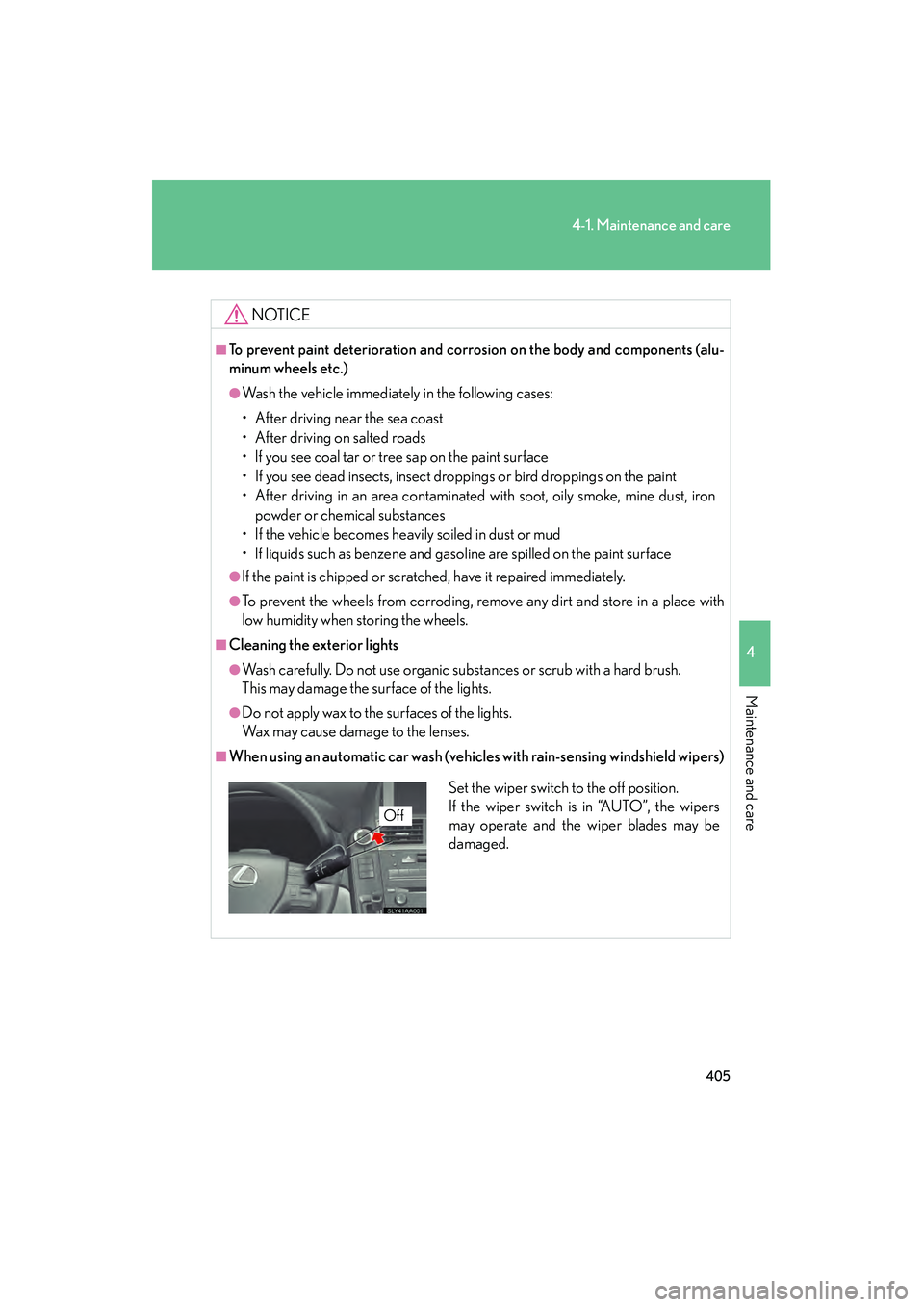
■When using an automatic car wash (vehicles with rain-sensing windshield wipers)
Set the wiper switch to the off position.
If the wiper switch is in “AUTO”, the wipers
may operate and the wiper blades may be
damaged.
Off
Page 410 of 611
408
4-1. Maintenance and care
HS250h_U_75033U(Canada)
NOTICE
■Cleaning detergents
●Do not use the following types of detergent, as they may discolor the vehicle inte-
rior or cause streaks or damage to painted surfaces:
• Non-seat portions: Organic substances such as benzene or gasoline, alkalineor acidic solutions, dye, and bleach
• Seats: Alkaline or acidic solutions, such as thinner, benzene, and alcohol
●Do not use polish wax or polish cleaner. The instrument panel’s or other interior
part’s painted surface may be damaged.
■Preventing damage to leather surfaces
Observe the following precautions to avoid damage to and deterioration of leather
surfaces:
●Remove any dust or dirt from leather surfaces immediately.
●Do not expose the vehicle to direct sunlight for extended periods of time. Park
the vehicle in the shade, especially during summer.
●Do not place items made of vinyl, plastic, or containing wax on the upholstery, as
they may stick to the leather surface if the vehicle interior heats up significantly.
■Water on the floor
Do not wash the vehicle floor with water.
Vehicle systems such as the audio system may be damaged if water comes into
contact with electrical components such as the audio system above or under the
floor of the vehicle. Water may also cause the body to rust.
■Cleaning the inside of the rear window
●Do not use glass cleaner to clean the rear window, as this may cause damage to
the rear window defogger heater wires or antenna. Use a cloth dampened with
lukewarm water to gently wipe the window clean. Wipe the window in strokes
running parallel to the heater wires or antenna.
●Be careful not to scratch or damage the heater wires or antenna.
Page 414 of 611

412
4-2. Maintenance
HS250h_U_75033U(Canada)
Vehicle interior
ItemsCheck points
Accelerator pedal
• The accelerator pedal should move smoothly (without uneven pedal
effort or catching).
Brake pedal
• Does the brake pedal move smoothly?
• Does the brake pedal have appro- priate clearance from the floor?
(→ P. 5 5 6 )
• Does the brake pedal have the cor- rect amount of free play?
(→ P. 5 5 6 )
Brakes
• The vehicle should not pull to one
side when the brakes are applied.
• The brakes should work effectively.
• The brake pedal should not feel spongy.
• The brake pedal should not get too close to the floor when the brakes
are applied.
Head restraints• Do the head restraints move smoothly and lock securely?
Hybrid transmission “Park” mecha-
nism• Can the vehicle be held securely on an incline with the shift position
in P?
Indicators/buzzers• Do the indicators and buzzers
function properly?
Lights
• Do all the lights come on?
• Are the headlights aimed cor-rectly? ( →P. 4 6 7 )
Page 419 of 611
417
4-3. Do-it-yourself maintenance
4
Maintenance and care
HS250h_U_75033U(Canada)
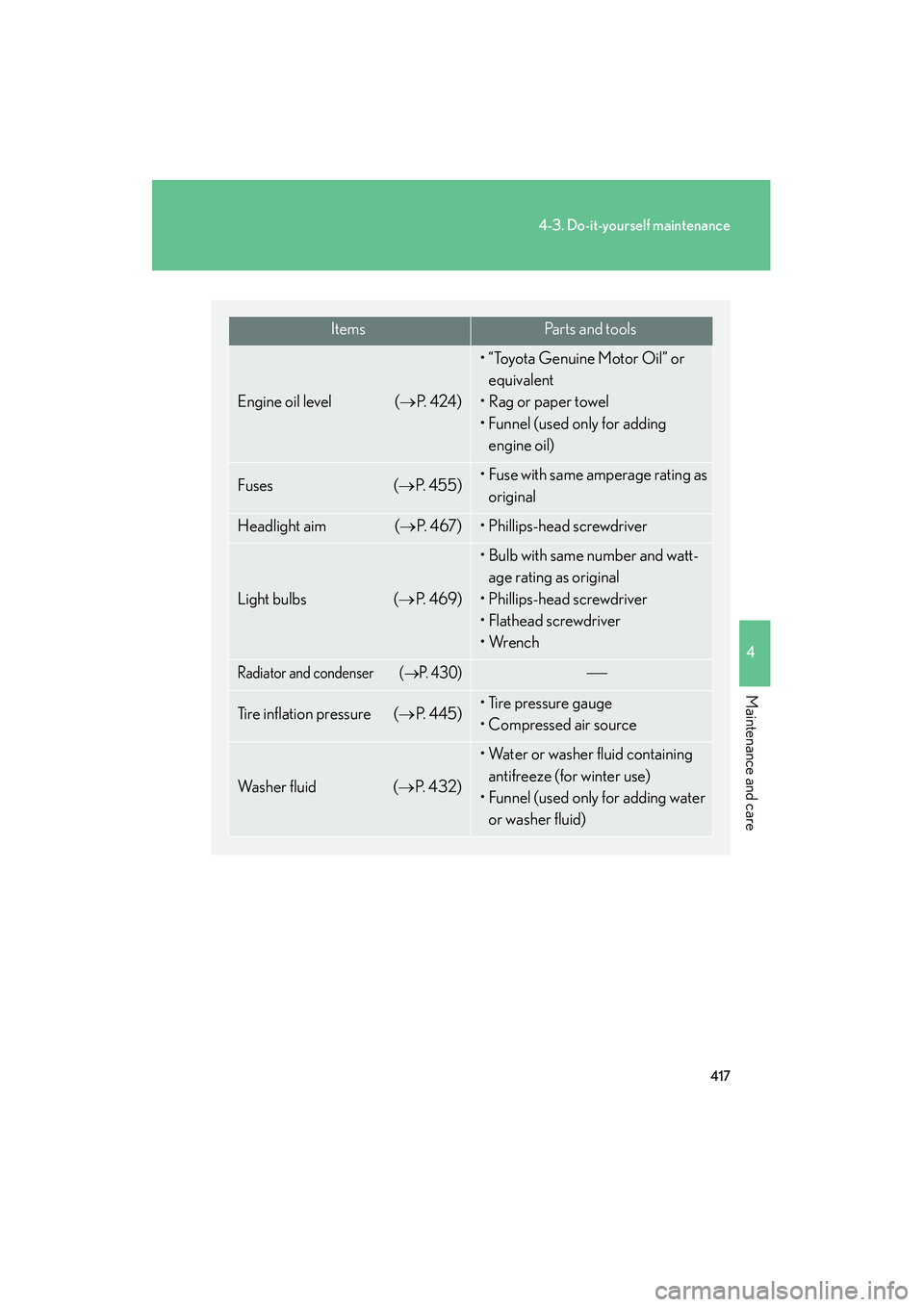
ItemsParts and tools
Engine oil level (→P. 4 2 4 )
• “Toyota Genuine Motor Oil” or
equivalent
•Rag or paper towel
• Funnel (used only for adding
engine oil)
Fuses (→ P. 4 5 5 )• Fuse with same amperage rating as
original
Headlight aim ( →P. 4 6 7 )• Phillips-head screwdriver
Light bulbs (→ P. 4 6 9 )
• Bulb with same number and watt-
age rating as original
• Phillips-head screwdriver
•Flathead screwdriver
•Wrench
Radiator and condenser (→P. 4 3 0 )
Tire inflation pressure ( →P. 4 4 5 )• Tire pressure gauge
• Compressed air source
Wa s h e r f l u i d ( →P. 4 3 2 )
• Water or washer fluid containing
antifreeze (for winter use)
• Funnel (used only for adding water
or washer fluid)
Page 421 of 611
419
4-3. Do-it-yourself maintenance
4
Maintenance and care
HS250h_U_75033U(Canada)
Hood
CAUTION
■Pre-driving check
Check that the hood is fully closed and locked.
If the hood is not locked properly, it may open while the vehicle is in motion and
cause an accident, which may result in death or serious injury.
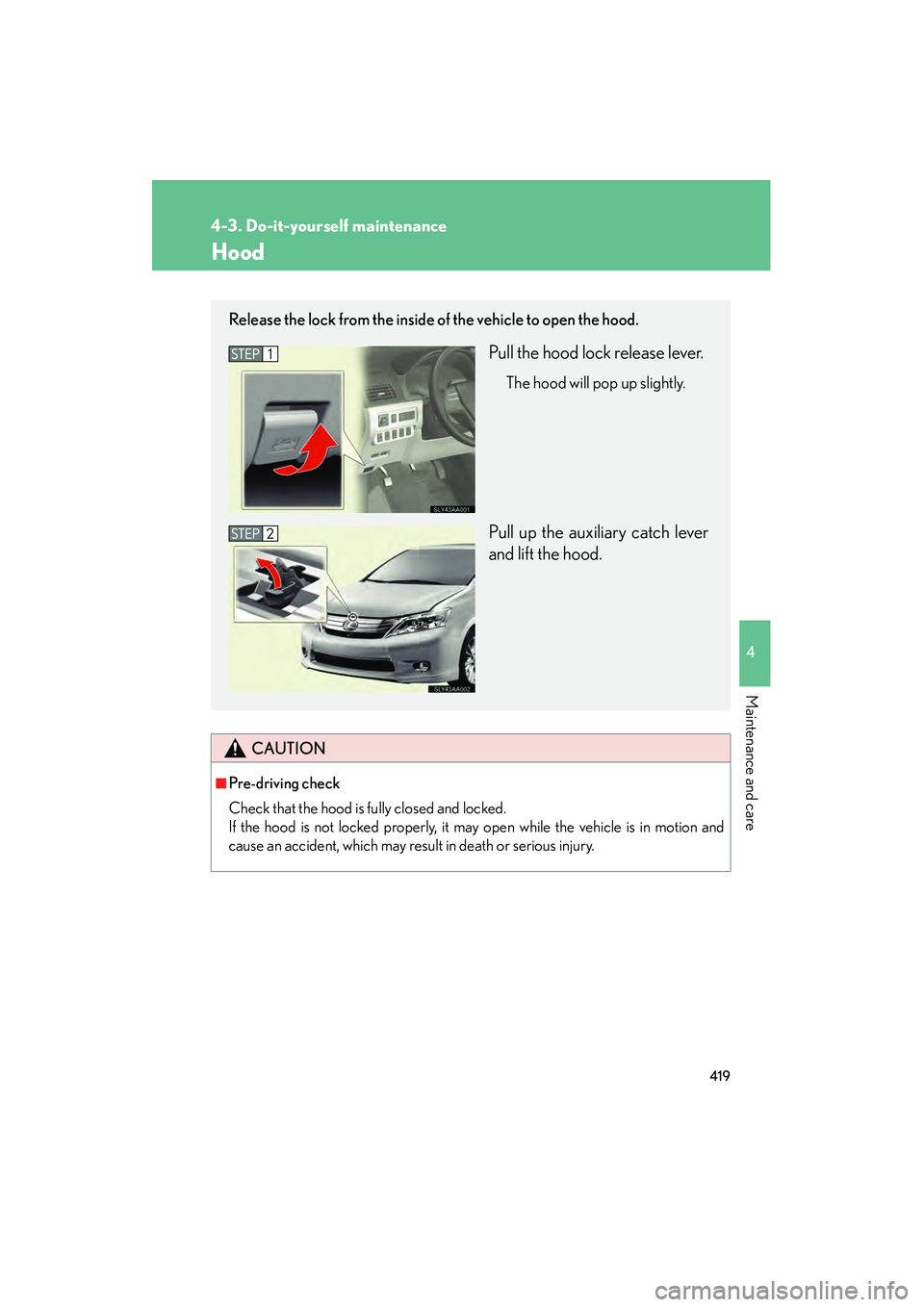
Release the lock from the inside of the vehicle to open the hood.
Pull the hood lock release lever.
The hood will pop up slightly.
Pull up the auxiliary catch lever
and lift the hood.
Page 434 of 611
432
4-3. Do-it-yourself maintenance
HS250h_U_75033U(Canada)
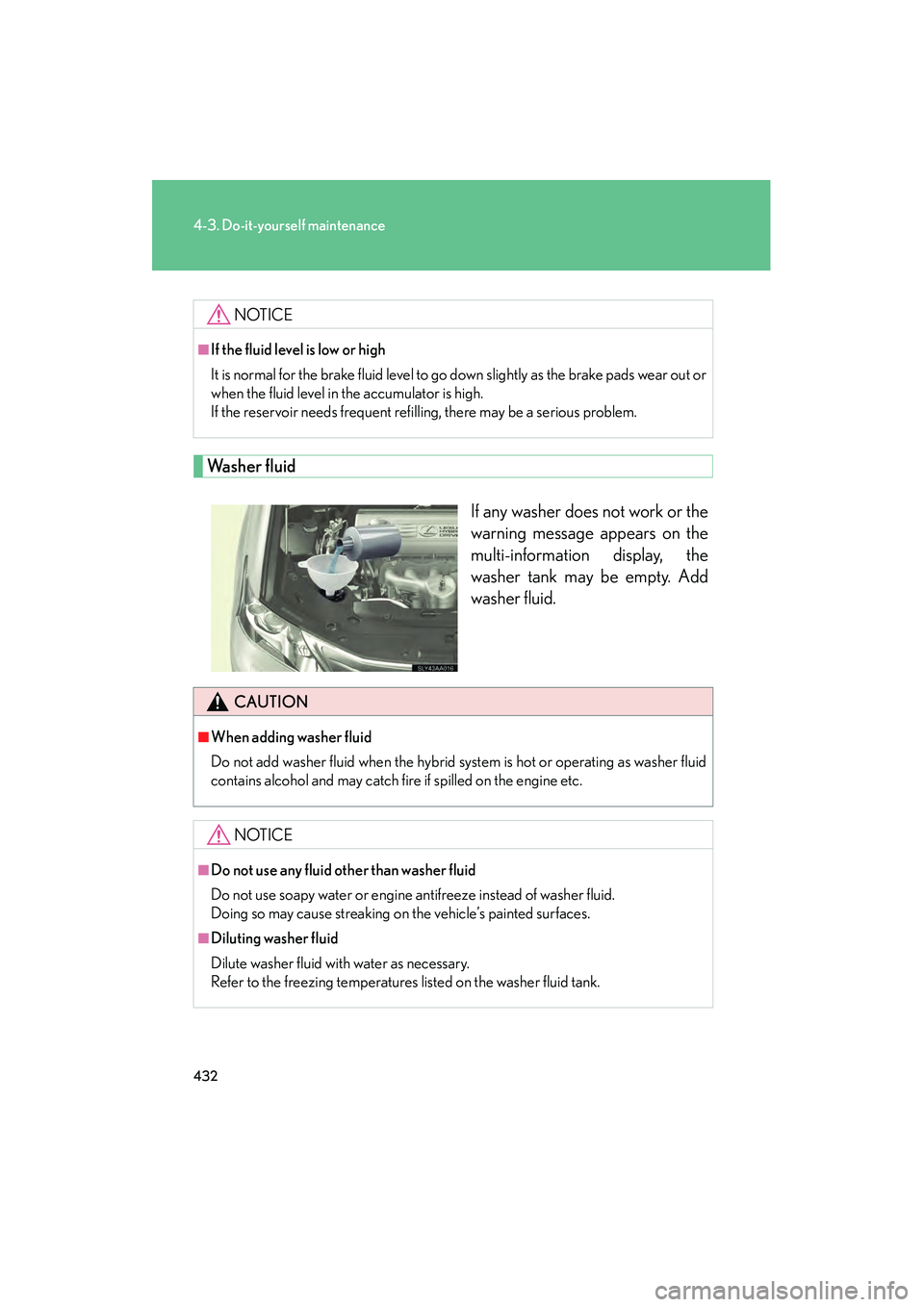
Washer fluidIf any washer does not work or the
warning message appears on the
multi-information display, the
washer tank may be empty. Add
washer fluid.
NOTICE
■If the fluid level is low or high
It is normal for the brake fluid level to go down slightly as the brake pads wear out or
when the fluid level in the accumulator is high.
If the reservoir needs frequent refilling, there may be a serious problem.
CAUTION
■When adding washer fluid
Do not add washer fluid when the hybrid system is hot or operating as washer fluid
contains alcohol and may catch fire if spilled on the engine etc.
NOTICE
■Do not use any fluid other than washer fluid
Do not use soapy water or engine antifreeze instead of washer fluid.
Doing so may cause streaking on the vehicle’s painted surfaces.
■Diluting washer fluid
Dilute washer fluid with water as necessary.
Refer to the freezing temperatures listed on the washer fluid tank.
Page 437 of 611
435
4-3. Do-it-yourself maintenance
4
Maintenance and care
HS250h_U_75033U(Canada)
CAUTION
■Chemicals in the 12-volt battery
The 12-volt battery contains poisonous and corrosive sulfuric acid and may pro-
duce hydrogen gas which is flammable and explosive. To reduce the risk of death or
serious injury, take the following precautions while working on or near the 12-volt
battery:
●Do not cause sparks by touching the 12-volt battery terminals with tools.
●Do not smoke or light a match near the 12-volt battery.
●Avoid contact with eyes, skin and clothes.
●Never inhale or swallow electrolyte.
●Wear protective safety glasses when working near the 12-volt battery.
●Keep children away from the 12-volt battery.
■Where to safely charge the 12-volt battery
Always charge the 12-volt battery in an open area. Do not charge the 12-volt bat-
tery in a garage or closed room where there is insufficient ventilation.
■How to recharge the 12-volt battery
Only perform a slow charge (5 A or less). The 12-volt battery may explode if
charged at a quicker rate.
■Emergency measures regarding electrolyte
●If electrolyte gets in your eyes
Flush your eyes with clean water for at least 15 minutes and get immediate medi-
cal attention. If possible, continue to apply water with a sponge or cloth while
traveling to the nearest medical facility.
●If electrolyte gets on your skin
Wash the affected area thoroughly. If you feel pain or burning, get medical atten-
tion immediately.
●If electrolyte gets on your clothes
It can soak through clothing on to your skin. Immediately take off the clothing and
follow the procedure above if necessary.
●If you accidentally swallow electrolyte
Drink a large quantity of water or milk. Follow with milk of magnesia, beaten raw
egg or vegetable oil. Get emergency medical attention immediately.