Wheel drive Lexus HS250h 2010 User Guide
[x] Cancel search | Manufacturer: LEXUS, Model Year: 2010, Model line: HS250h, Model: Lexus HS250h 2010Pages: 611, PDF Size: 11 MB
Page 81 of 611
79
1
1-4. Adjustable components (seats, mirrors, steering wheel)
Before driving
HS250h_U_75033U(Canada)
Steering wheel
∗: If equipped
The steering wheel can be adjusted to a comfortable position.
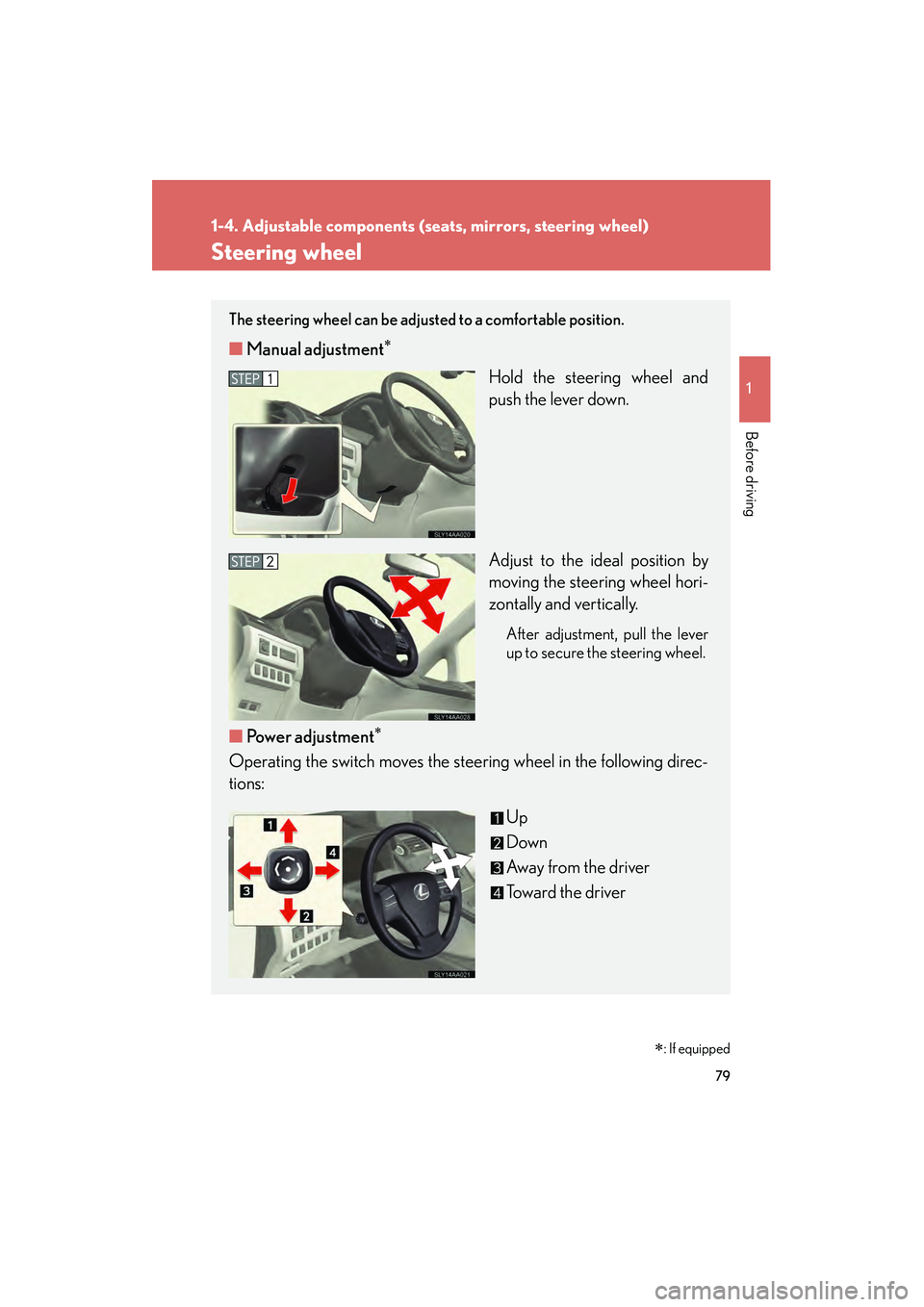
■Manual adjustment∗
Hold the steering wheel and
push the lever down.
Adjust to the ideal position by
moving the steering wheel hori-
zontally and vertically.
After adjustment, pull the lever
up to secure the steering wheel.
■Power adjustment∗
Operating the switch moves the steering wheel in the following direc-
tions:
Up
Down
Away from the driver
Toward the driver
Page 82 of 611
80
1-4. Adjustable components (seats, mirrors, steering wheel)
HS250h_U_75033U(Canada)
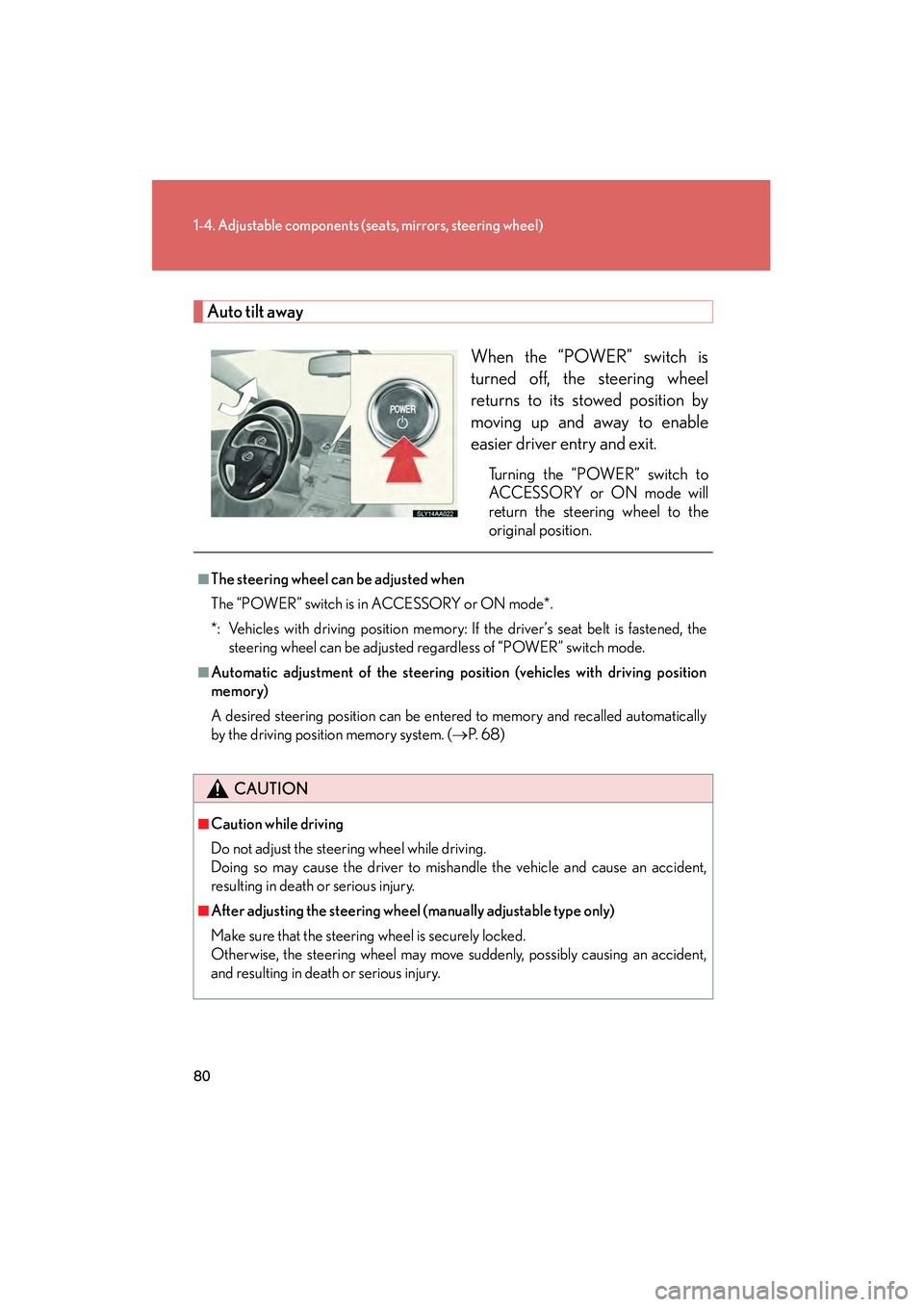
Auto tilt away
When the “POWER” switch is
turned off, the steering wheel
returns to its stowed position by
moving up and away to enable
easier driver entry and exit.
Turning the “POWER” switch to
ACCESSORY or ON mode will
return the steering wheel to the
original position.
■The steering wheel can be adjusted when
The “POWER” switch is in ACCESSORY or ON mode*.
*: Vehicles with driving position memory: If the driver’s seat belt is fastened, thesteering wheel can be adjusted regardless of “POWER” switch mode.
■Automatic adjustment of the steering position (vehicles with driving position
memory)
A desired steering position can be entered to memory and recalled automatically
by the driving position memory system. ( →P. 6 8 )
CAUTION
■Caution while driving
Do not adjust the steering wheel while driving.
Doing so may cause the driver to mishandle the vehicle and cause an accident,
resulting in death or serious injury.
■After adjusting the steering wheel (manually adjustable type only)
Make sure that the steering wheel is securely locked.
Otherwise, the steering wheel may move suddenly, possibly causing an accident,
and resulting in death or serious injury.
Page 87 of 611
85
1-4. Adjustable components (seats, mirrors, steering wheel)
1
Before driving
HS250h_U_75033U(Canada)
CAUTION
■When driving the vehicle
Observe the following precautions while driving.
Failing to do so may result in loss of control of the vehicle and cause an accident,
resulting in death or serious injury.
●Do not adjust the mirrors while driving.
●Do not drive with the mirrors folded.
●Both the driver and passenger side mirrors must be extended and properly
adjusted before driving.
■When a mirror is moving
To avoid personal injury and mirror malfunction, be careful not to get your hand
caught by the moving mirror.
■When the mirror defoggers are operating
Do not touch the rear view mirror surfaces, as they can become very hot and burn
you.
NOTICE
■If the mirrors become iced up (if equipped)
In order to retain the rain-clearing properties of the mirror, do not attempt to scrape
the ice off. Instead, remove it by turning on the mirror defoggers or by applying
warm water.
Page 104 of 611
102
HS250h_U_75033U(Canada)
1-8. Safety information
Correct driving posture
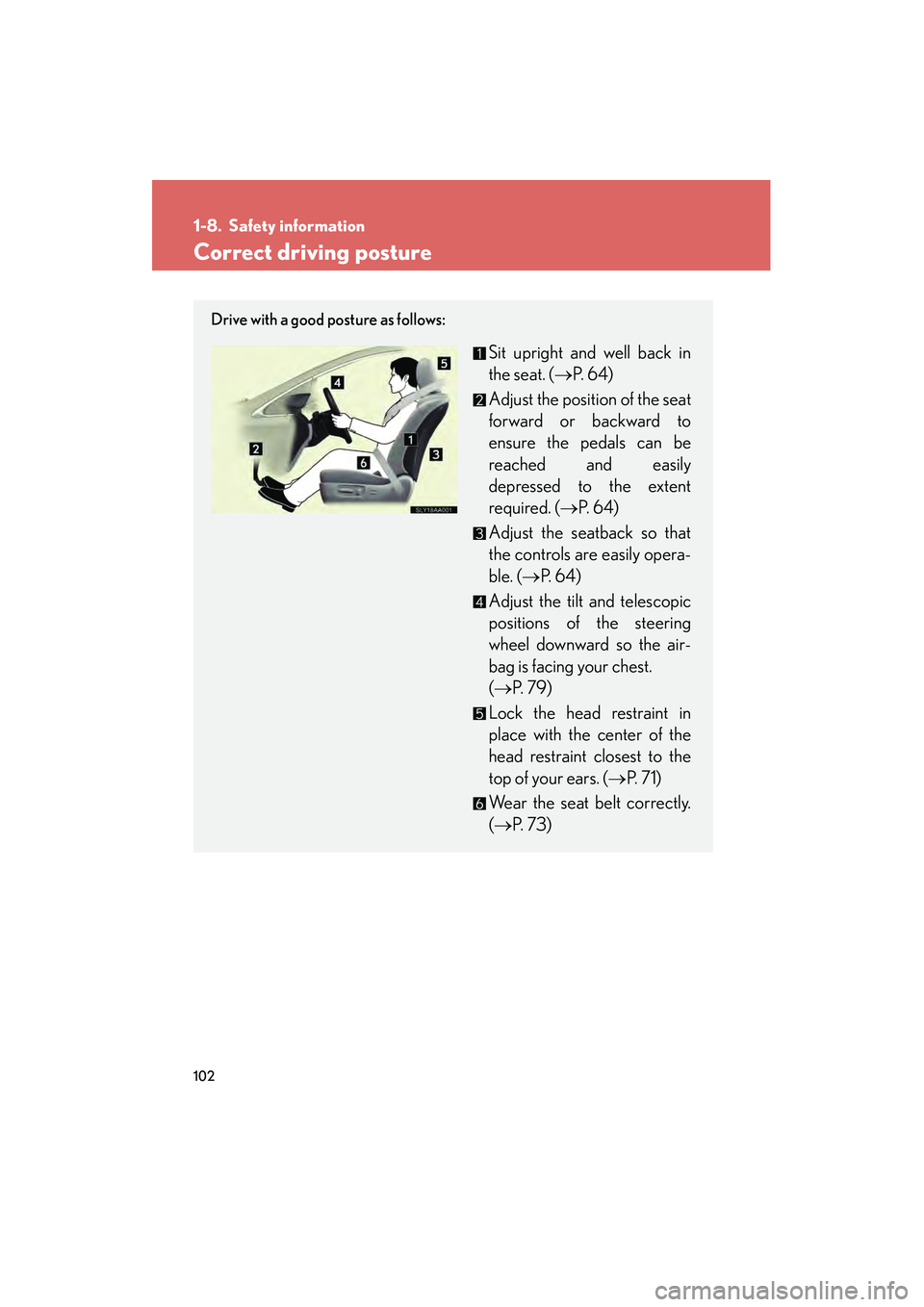
Drive with a good posture as follows:
Sit upright and well back in
the seat. (→P. 6 4 )
Adjust the position of the seat
forward or backward to
ensure the pedals can be
reached and easily
depressed to the extent
required. ( →P. 6 4 )
Adjust the seatback so that
the controls are easily opera-
ble. ( →P. 6 4 )
Adjust the tilt and telescopic
positions of the steering
wheel downward so the air-
bag is facing your chest.
(→ P. 7 9 )
Lock the head restraint in
place with the center of the
head restraint closest to the
top of your ears. ( →P. 7 1 )
Wear the seat belt correctly.
(→ P. 7 3 )
Page 113 of 611
111
1-8. Safety information
1
Before driving
HS250h_U_75033U(Canada)
CAUTION
■SRS airbag precautions
Observe the following precautions regarding the SRS airbags.
Failure to do so may cause death or serious injury.
●The driver and all passengers in the vehicle must wear their seat belts properly.
The SRS airbags are supplemental devices to be used with the seat belts.
●The SRS driver airbag deploys with considerable force, and can cause death or
serious injury especially if the driver is very close to the airbag. The National
Highway Traffic Safety Administration (NHTSA) advises:
Since the risk zone for the driver’s airbag is the first 2 - 3 in. (50 - 75 mm) of infla-
tion, placing yourself 10 in. (250 mm) from your driver airbag provides you with a
clear margin of safety. This distance is measured from the center of the steering
wheel to your breastbone. If you sit less than 10 in. (250 mm) away now, you can
change your driving position in several ways:
• Move your seat to the rear as far as you can while still reaching the pedalscomfortably.
• Slightly recline the back of the seat. Although vehicle designs vary, many drivers can achieve the 10 in. (250 mm)
distance, even with the driver seat all the way forward, simply by reclining the
back of the seat somewhat. If reclining the back of your seat makes it hard to
see the road, raise yourself by using a firm, non-slippery cushion, or raise the
seat if your vehicle has that feature.
• If your steering wheel is adjustable, tilt it downward. This points the airbag toward your chest instead of your head and neck.
The seat should be adjusted as recommended by NHTSA above, while still main-
taining control of the foot pedals, steering wheel, and your view of the instrument
panel controls.
Page 116 of 611

114
1-8. Safety information
HS250h_U_75033U(Canada)
CAUTION
■SRS airbag precautions
●If a vinyl cover is put on the area where the SRS knee airbags will deploy, be sure
to remove it.
●Do not use seat accessories which cover the parts where the SRS side airbags
inflate as they may interfere with inflation of the airbags. Such accessories may
prevent the side airbags from activating correctly, disable the system or cause the
side airbags to inflate accidentally, resulting in death or serious injury.
●Do not strike or apply significant levels of force to the area of the SRS airbag
components.
Doing so can cause the SRS airbags to malfunction.
●Do not touch any of the component parts immediately after the SRS airbags have
deployed (inflated) as they may be hot.
●If breathing becomes difficult after the SRS airbags have deployed, open a door
or window to allow fresh air in, or leave the vehicle if it is safe to do so. Wash off
any residue as soon as possible to prevent skin irritation.
●If the areas where the SRS airbags are stored, such as the steering wheel pad and
front and rear pillar garnishes, are damaged or cracked, have them replaced by
your Lexus dealer.
●Do not attach anything to or lean anything
against areas such as the dashboard, steer-
ing wheel pad and lower portion of the
instrument panel.
These items can become projectiles when
the SRS driver, front passenger and knee
airbags deploy.
●Do not attach anything to areas such as a
door, windshield glass, side door glass,
front or rear pillar, roof side rail, and assist
grip.
●Do not hang coat hangers or other hard
objects on the coat hooks. All of these
items could become projectiles and may
cause death or serious injury, should the
SRS curtain shield airbags deploy.
Page 142 of 611
140
2-1. Driving procedures
HS250h_U_75033U(Canada)
CAUTION
●Do not select shift position R when the vehicle is rolling forward, do not select D
when moving in reverse, and do not press the P position switch before the vehicle
stops fully. Doing so will cause the buzzer to sound and the shift position to
change to N. In addition, excessive force will be applied to the powertrain and
damage may result.
●Do not change the shift position to N while the vehicle is moving.
Doing so may cause insufficient engine braking, resulting in an accident.
●Do not turn the hybrid system off while driving.
The power steering and brake actuator will not operate properly if the hybrid sys-
tem is off.
●Use engine braking (shift position B) to maintain a safe speed when driving down
a steep hill.
Using the brakes continuously may cause the brakes to overheat and lose effec-
tiveness. (→P. 1 5 3 )
●Do not adjust the positions of the steering wheel, the seat, or the inside or outside
rear view mirrors while driving.
Doing so may result in a loss of vehicle control that can cause accidents, resulting
in death or serious injury.
●Always check that all passengers' arms, heads or other parts of their body are not
outside the vehicle, as this may result in death or serious injury.
●Do not drive in excess of the speed limit. Even if the legal speed limit permits it, do
not drive over 85 mph (140 km/h) unless your vehicle has high-speed capability
tires. Driving over 85 mph (140 km/h) may result in tire failure, loss of control and
possible injury. Be sure to consult a tire dealer to determine whether the tires on
your vehicle are high-speed capability tires or not before driving at such speeds.
■When driving on slippery road surfaces
●Sudden braking, acceleration and steering may cause tire slippage and reduce
your ability to control the vehicle, resulting in an accident.
●Abrupt changes from shift position D to B and rapid changes in the engine speed
could cause the vehicle to skid, resulting in an accident.
●After driving through a puddle, lightly depress the brake pedal to make sure that
the brakes are functioning properly. Wet brake pads may prevent the brakes from
functioning properly. If the brakes on only one side are wet and not functioning
properly, steering control may be affected, resulting in an accident.
Page 146 of 611
144
2-1. Driving procedures
HS250h_U_75033U(Canada)
NOTICE
■Avoiding damage to vehicle parts
●Do not turn the steering wheel fully in either direction and hold it there for an
extended period of time.
Doing so may damage the power steering motor.
●When driving over bumps in the road, drive as slowly as possible to avoid damag-
ing the wheels, underside of the vehicle, etc.
■If you get a flat tire while driving
A flat or damaged tire may cause the following situations. Hold the steering wheel
firmly and gradually depress the brake pedal to slow down the vehicle.
●It may be difficult to control your vehicle.
●The vehicle will make abnormal sounds or vibrations.
●The vehicle will lean abnormally.
Information on what to do in case of a flat tire. ( →P. 5 2 1 )
■When encountering flooded roads
Do not drive on a road that has flooded after heavy rain etc. Doing so may cause the
following serious damage to the vehicle:
●Engine stalling
●Short in electrical components
●Engine damage caused by water immersion
In the event that you drive on a flooded road and the vehicle is flooded, be sure to
have your Lexus dealer check the following:
●Brake function
●Changes in quantity and quality of engine oil, transaxle fluid for the hybrid system
etc.
●Lubricant condition for the bearings and suspension joints (where possible), and
the function of all joints, bearings, etc.
As flooding may damage components involved in P position control, the parking
lock may jam in the locked position.
■If the vehicle will not shift out of the P position
There is a possibility that the 12-volt battery is discharged. Check the 12-volt battery
in this situation.
Page 181 of 611

179
2-2. Instrument cluster
2
When driving
HS250h_U_75033U(Canada)
Touch tracer display functionThe switch operation is shown on th e head-up display when the steering
switch provided on the steering wheel is operated. The driver can oper-
ate the steering switch without seeing it on the steering wheel.
The display will change in
response to steering switch opera-
tion.
Touching the steering switch will
cause the touch tracer display to
appear on the head-up display.
Page 219 of 611
217
2-4. Using other driving systems
2
When driving
HS250h_U_75033U(Canada)
LKA (Lane-Keeping Assist)∗∗
: If equipped
While driving on a freeway or motor highway that has lane markers, this
system recognizes the lanes using a camera as a sensor to assist the driver
with staying in the lane. The LKA system has two functions.
■Lane departure warning function
If the system judges that the vehicle may deviate from its lane, it
alerts the driver using rapid beeping, indications on the multi-infor-
mation display, and a sensory warning
* given via the steering wheel.
*: A slight steering torque is applied for a short period of time in the
direction of the center of the lane.
■ Lane keeping assist function
This function will be active when the vehicle-to-vehicle distance
control mode of the cruise control ( →P. 205) is set with vehicle
speed above approx. 45 mph (approx. 72 km/h) and while the lane
departure warning function is active. When the lane keeping assist
function is active, a slight steering torque will be applied, to help the
driver maintain the vehicle inside the lane.