belt Lexus HS250h 2010 Service Manual
[x] Cancel search | Manufacturer: LEXUS, Model Year: 2010, Model line: HS250h, Model: Lexus HS250h 2010Pages: 611, PDF Size: 11 MB
Page 136 of 611
134
1-8. Safety information
HS250h_U_75033U(Canada)
CAUTION
●When a booster seat is installed, always ensure that the shoulder belt is posi-
tioned across the center of the child’s shoulder. The belt should be kept away
from the child’s neck, but not so that it could fall off the child’s shoulder. Failing to
do so may result in death or serious injury in the event of sudden braking, sudden
swerving or an accident.
●Ensure that the belt and plate are securely locked and the seat belt is not twisted.
●Push and pull the child restraint system from side to side and forward to be sure it
is secure.
●After securing a child restraint system, never adjust the seat.
●Follow all installation instructions provided by the child restraint system manufac-
turer.
■Do not use a seat belt extender
If a seat belt extender is used when installing a child restraint system, the seat belt
will not securely hold the child restraint system, which could cause death or serious
injury to the child or other passengers in the event of sudden braking, sudden
swerving or an accident.
■To correctly attach a child restraint system to the anchors
When using the LATCH anchors, be sure that there are no foreign objects around
the anchors and that the seat belt is not caught behind the child restraint. Make sure
the child restraint system is securely attached, or it may cause death or serious
injury to the child or other passengers in the event of a sudden stop, sudden swerve
or accident.
Page 234 of 611
232
2-4. Using other driving systems
HS250h_U_75033U(Canada)
Pre-Collision System∗∗
: If equipped
When the radar sensor detects an unav oidable frontal collision, safety sys-
tems such as the brakes and seat belts are automatically engaged to lessen
impact and injuries to occupants as well as vehicle damage.
■ Pre-collision seat belts (front seat belts only)
If the pre-collision sensor detects that a collision is unavoidable, the pre-
collision system will roll up the seat belt before the collision occurs.
The same will happen if the driver makes an emergency braking or loses
control of the vehicle. ( →P. 74 )
However, when the TRAC/VSC systems are disabled, the system will not
operate in the event of skidding.
■ Pre-collision brake assist
When there is a high possibility of a frontal collision, the system applies
greater braking force in relation to how strongly the brake pedal is
depressed.
■Pre-collision braking
When there is a high possibility of a frontal collision, the system warns the
driver using a warning light, warning display and buzzer. If the system
determines that a collision is unavoi dable, the brakes are automatically
applied to reduce the collision speed . Pre-collision braking can be dis-
abled using the pre-collision braking off button.
■ Driver monitor sys tem (if equipped)
When the system determines that there is a possibility of a collision, and
the driver is not facing forward, PCS warnings are given in advance to
warn the driver. If the driver continues to be not facing forward, and a
probable collision is detected, PCS informs the driver of danger by per-
forming slight braking to provide a physically warning (pre-collision alert
braking). (→P. 2 3 4 )
Page 236 of 611
234
2-4. Using other driving systems
HS250h_U_75033U(Canada)
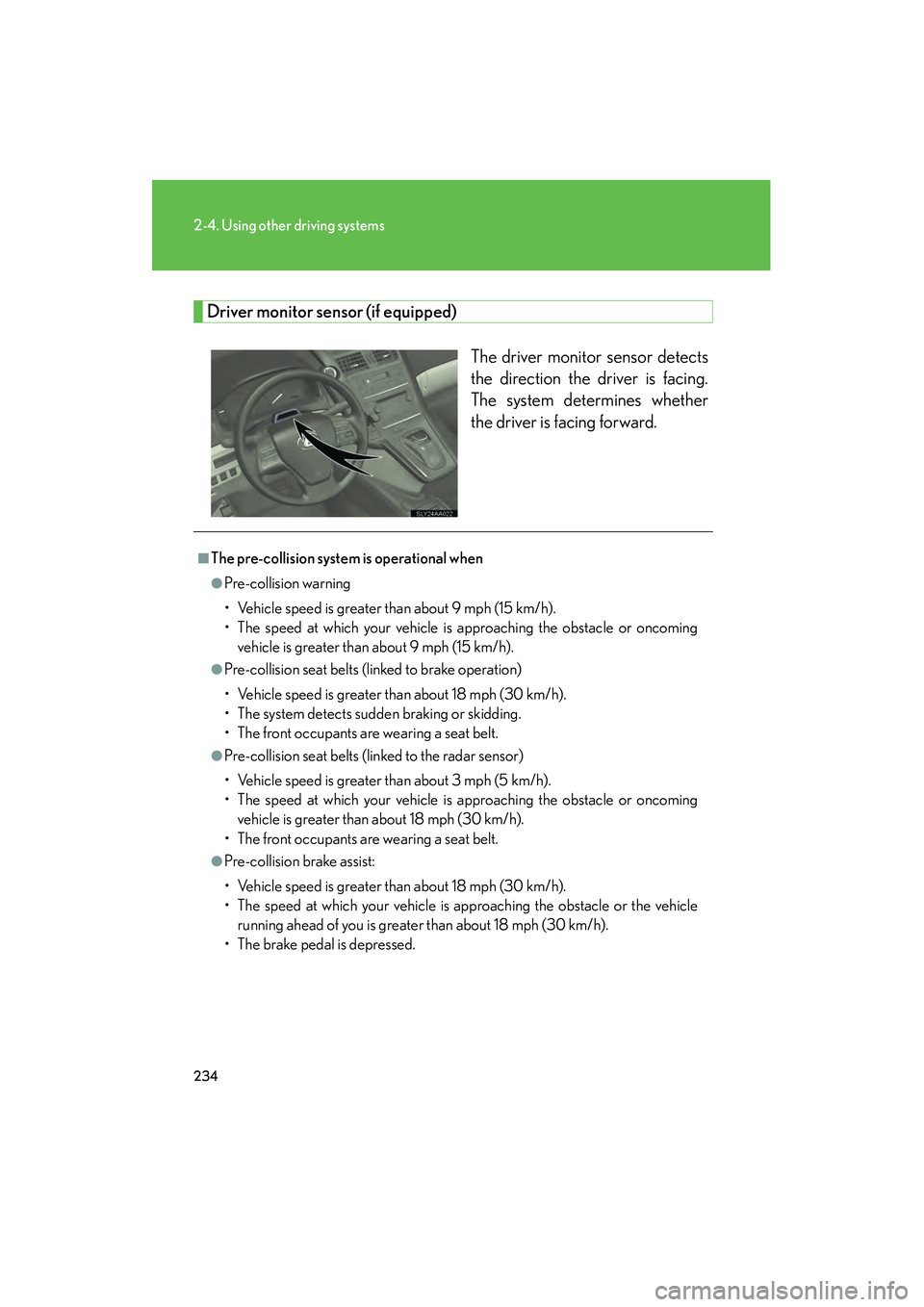
Driver monitor sensor (if equipped)
The driver monitor sensor detects
the direction the driver is facing.
The system determines whether
the driver is facing forward.
■The pre-collision system is operational when
●Pre-collision warning
• Vehicle speed is greater than about 9 mph (15 km/h).
• The speed at which your vehicle is approaching the obstacle or oncomingvehicle is greater than about 9 mph (15 km/h).
●Pre-collision seat belts (linked to brake operation)
• Vehicle speed is greater than about 18 mph (30 km/h).
• The system detects sudden braking or skidding.
• The front occupants are wearing a seat belt.
●Pre-collision seat belts (linked to the radar sensor)
• Vehicle speed is greater than about 3 mph (5 km/h).
• The speed at which your vehicle is approaching the obstacle or oncomingvehicle is greater than about 18 mph (30 km/h).
• The front occupants are wearing a seat belt.
●Pre-collision brake assist:
• Vehicle speed is greater than about 18 mph (30 km/h).
• The speed at which your vehicle is approaching the obstacle or the vehicle running ahead of you is greater than about 18 mph (30 km/h).
• The brake pedal is depressed.
Page 237 of 611
235
2-4. Using other driving systems
2
When driving
HS250h_U_75033U(Canada)
●Pre-collision braking:
• The pre-collision braking off button is not pressed.
• Vehicle speed is greater than about 9 mph (15 km/h).
• The speed at which your vehicle is approaching the obstacle or the vehiclerunning ahead of you is greater than about 9 mph (15 km/h).
●Pre-collision alert braking (vehicle with driver monitor system):
• The pre-collision braking off button is not pressed.
• The system determines that the driver is not facing forward.
• Vehicle speed is greater than about 9 mph (15 km/h).
• The speed at which your vehicle is approaching the obstacle or the vehiclerunning ahead of you is greater than about 24 mph (40 km/h).
■Conditions that may trigger the system even if there is no danger of a collision
●When there is an object by the roadside at the entrance to a curve
●When passing an oncoming vehicle on a curve
●When driving over a narrow iron bridge
●When there is a metal object on the road surface
●When driving on an uneven road surface
●When passing an oncoming vehicle on a left-turn
●When your vehicle rapidly closes on the vehicle in front
When the system is activated in the situations described above, there is also a possi-
bility that the seat belts will roll up quickly and the brakes will be applied with a force
greater than normal. When the seat belt is locked in the retracted position, stop the
vehicle in a safe place, release the seat belt and refasten it.
■Obstacles not detected
The sensor cannot detect plastic obstacles such as traffic cones. There may also be
occasions when the sensor cannot detect pedestrians, animals, bicycles, motorcy-
cles, trees, or snowdrifts.
■When there is a malfunction in the system
Warning lights and/or warning messages will turn on or flash. ( →P. 493, 502, 505)
Page 383 of 611
381
3-7. Other interior features
3
Interior features
HS250h_U_75033U(Canada)
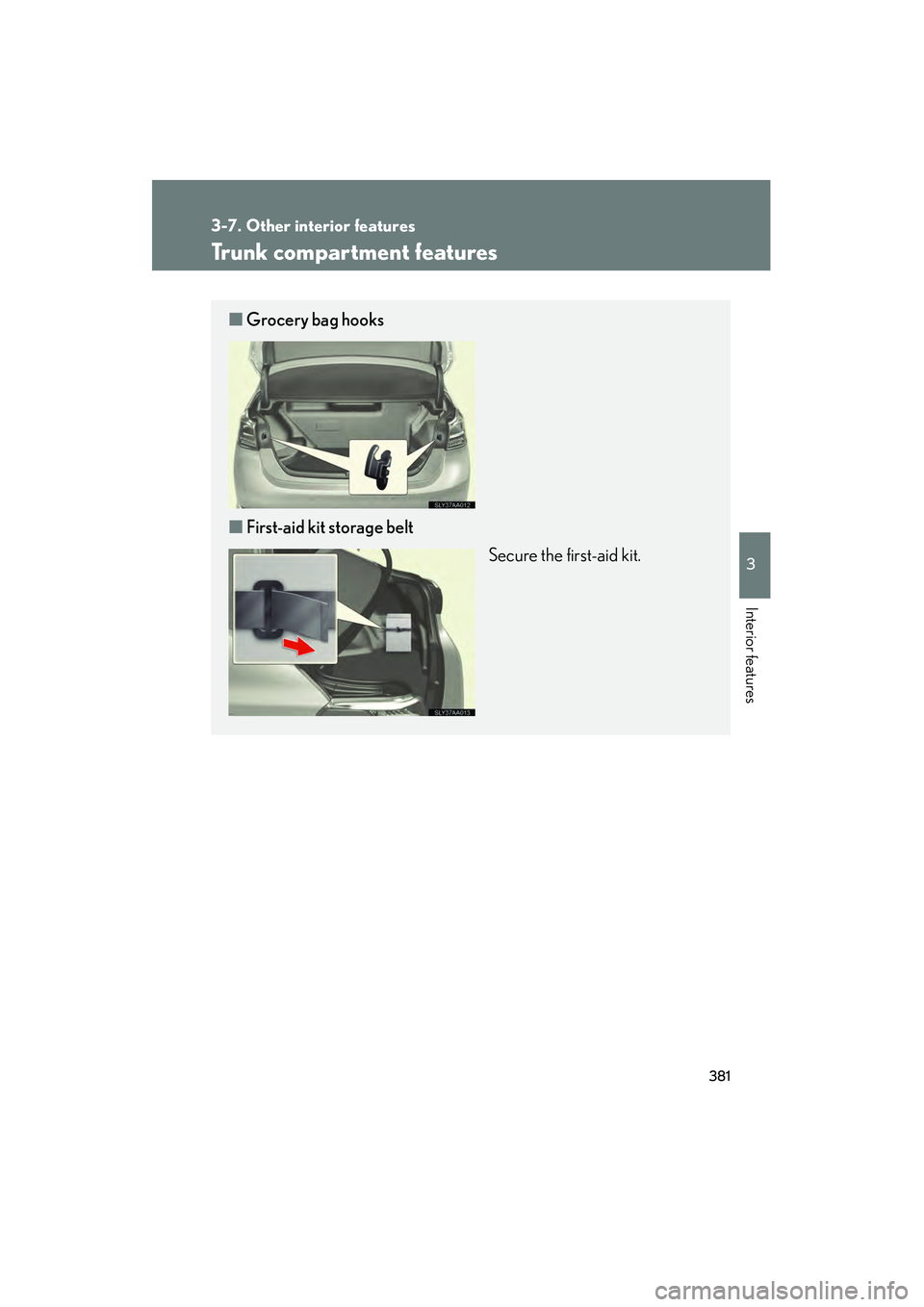
Trunk compartment features
■Grocery bag hooks
■ First-aid kit storage belt
Secure the first-aid kit.
Page 409 of 611
407
4-1. Maintenance and care
4
Maintenance and care
HS250h_U_75033U(Canada)
■Caring for leather areas
Lexus recommends cleaning the interior of the vehicle at least twice a year to main-
tain the quality of the vehicle’s interior.
■Shampooing the carpets
There are several commercial foaming-type cleaners available. Use a sponge or
brush to apply the foam. Rub in overlapping circles. Do not use water. Wipe dirty
surfaces and let them dry. Excellent results are obtained by keeping the carpet as
dry as possible.
■Seat belts
Clean with mild soap and lukewarm water using a cloth or sponge. Also check the
belts periodically for excessive wear, fraying or cuts.
CAUTION
■Water in the vehicle
●Do not splash or spill liquid in the vehicle, such as on the floor, in the hybrid bat-
tery (traction battery) air vents, and in the trunk.
Doing so may cause the hybrid battery, electrical components, etc. to malfunc-
tion or catch fire.
●Do not get any of the SRS components or wiring in the vehicle interior wet.
(→ P. 1 0 6 )
An electrical malfunction may cause the airbags to deploy or not function prop-
erly, resulting in death or serious injury.
■Cleaning the interior (especially instrument panel)
Do not use polish wax or polish cleaner. The instrument panel may reflect off the
windshield, obstructing the driver’s view and leading to an accident, resulting in
death or serious injury.
Page 415 of 611
413
4-2. Maintenance
4
Maintenance and care
HS250h_U_75033U(Canada)
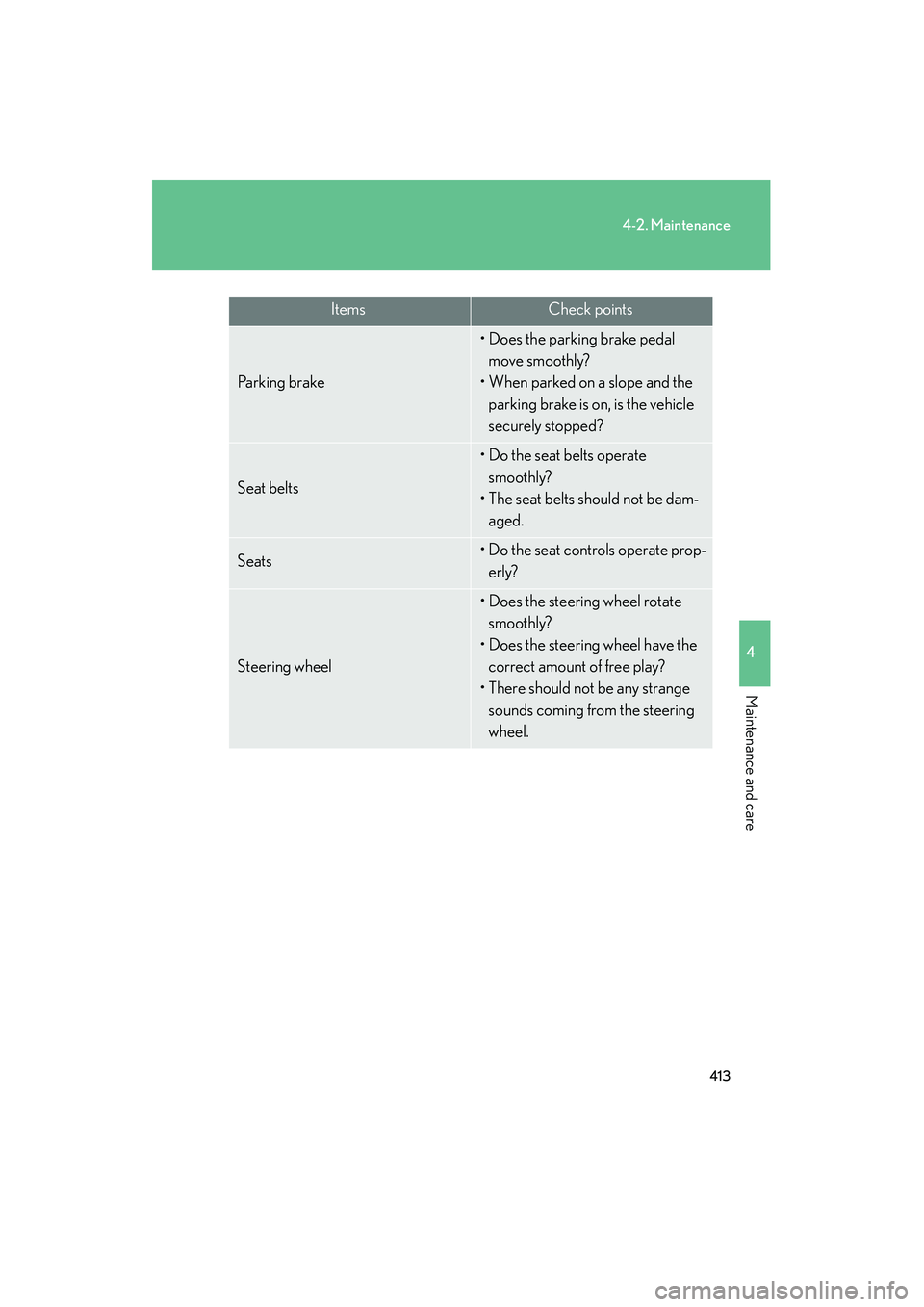
ItemsCheck points
Pa r k i n g b r a ke
• Does the parking brake pedal move smoothly?
• When parked on a slope and the parking brake is on , is the vehicle
securely stopped?
Seat belts
• Do the seat belts operate smoothly?
• The seat belts should not be dam-
aged.
Seats• Do the seat controls operate prop-erly?
Steering wheel
• Does the steering wheel rotate smoothly?
• Does the steering wheel have the correct amount of free play?
• There should not be any strange sounds coming from the steering
wheel.
Page 420 of 611
418
4-3. Do-it-yourself maintenance
HS250h_U_75033U(Canada)
CAUTION
The engine compartment contains many mechanisms and fluids that may move sud-
denly, become hot, or become electrically energized. To avoid death or serious injury,
observe the following precautions:
■When working on the engine compartment
●Make sure that the indicator on the “POWER” switch and the “READY” indicator
are both off.
●Keep hands, clothing and tools away from the moving fans and engine drive belt.
●Be careful not to touch the engine, power control unit, radiator, exhaust manifold,
etc. right after driving as they may be hot. Oil and other fluids may also be hot.
●Do not leave anything that may burn easily, such as paper and rags, in the engine
compartment.
●Do not smoke, cause sparks or expose an open flame to fuel. Fuel fumes are flam-
mable.
■When working near the electric cooling fans or radiator grille
Be sure the “POWER” switch is off.
With the “POWER” switch in ON mode, the electric cooling fans may automati-
cally start to run if the air conditioning is on and/or the coolant temperature is high.
(→ P. 4 3 0 )
■Safety glasses
Wear safety glasses to prevent flying or falling material, fluid spray, etc. from getting
in your eyes.
NOTICE
■If you remove the air cleaner filter
Driving with the air cleaner filter removed may cause excessive engine wear due to
dirt in the air. Also, a backfire could cause a fire in the engine compartment.
Page 445 of 611
443
4-3. Do-it-yourself maintenance
4
Maintenance and care
HS250h_U_75033U(Canada)
CAUTION
■When inspecting or replacing tires
Observe the following precautions to prevent accidents. Failure to do so may cause
damage to parts of the drive train as well as dangerous handling characteristics,
which may lead to an accident resulting in death or serious injury.
●Do not mix tires of different makes, models or tread patterns. Also, do not mix
tires of remarkably different treadwear.
●Do not use tire sizes other than those recommended by Lexus.
●Do not mix differently constructed tires (radial, bias-belted or bias-ply tires).
●Do not mix summer, all season and snow tires.
●Do not use tires that have been used on another vehicle.
Do not use tires if you do not know how they were used previously.
■When initializing the tire pressure warning system
Do not operate the tire pressure warning reset switch without first adjusting the tire
inflation pressure to the specified level. Otherwise, the tire pressure warning light
may not come on even if the tire inflation pressure is low, or it may come on when
the tire inflation pressure is actually normal.
NOTICE
■Repairing or replacing tires, wheels, tire pressure warning valves, transmitters
and tire valve caps
●When removing or fitting the wheels, tires or the tire pressure warning valves and
transmitters, contact your Lexus dealer as the tire pressure warning valves and
transmitters may be damaged if not handled correctly.
●When replacing tire valve caps, do not use tire valve caps other than those speci-
fied. The cap may become stuck.
■To avoid damaging the tire pressure warning valves and transmitters
Do not use liquid sealants on flat tires.
■Driving on rough roads
Take particular care when driving on roads with loose surfaces or potholes.
These conditions may cause losses in tire inflation pressure, reducing the cushion-
ing ability of the tires. In addition, driving on rough roads may cause damage to the
tires themselves, as well as the vehicle’s wheels and body.
Page 464 of 611
462
4-3. Do-it-yourself maintenance
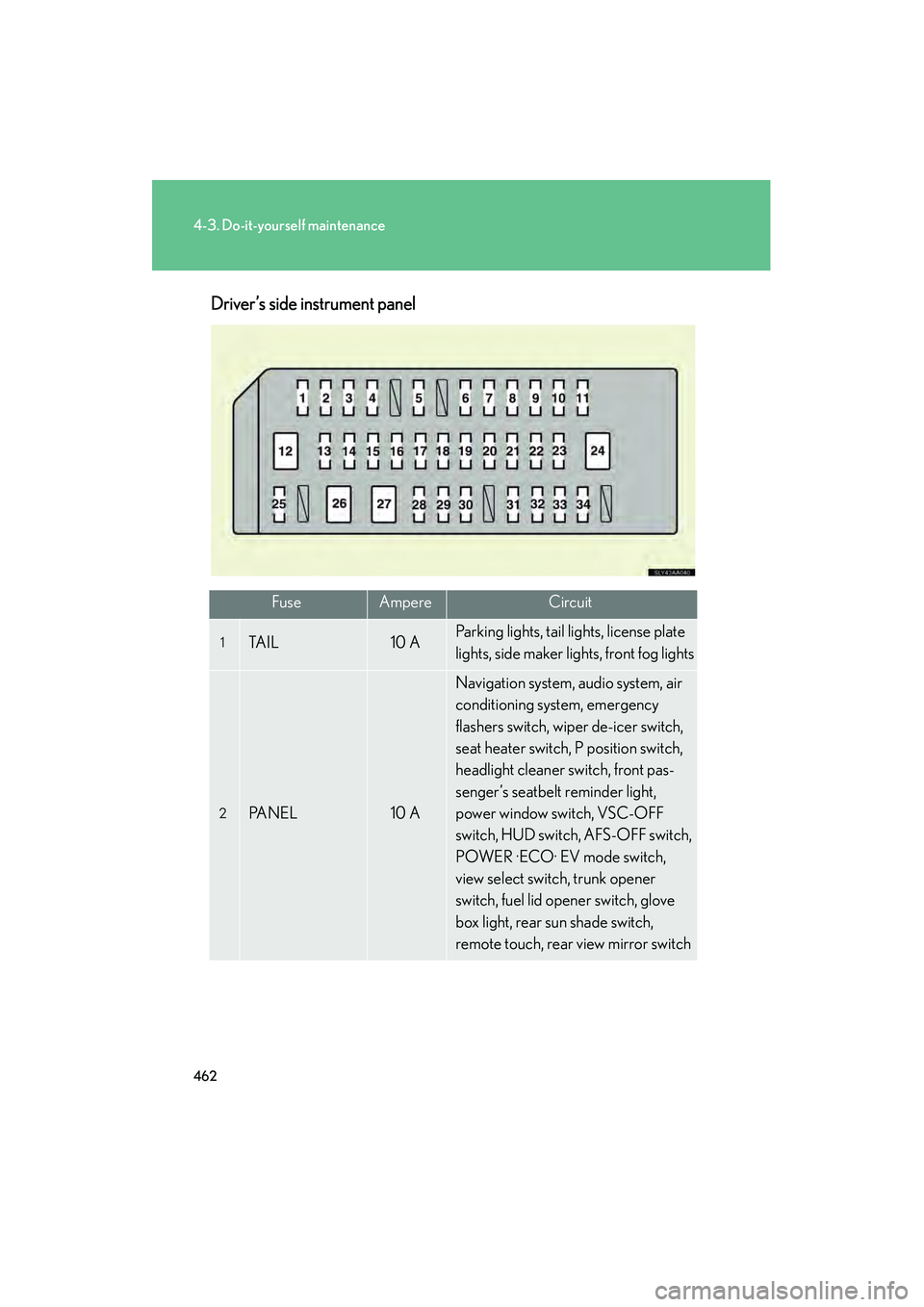
HS250h_U_75033U(Canada)Driver’s side instrument panel
FuseAmpereCircuit
1TA I L10 AParking lights, tail lights, license plate
lights, side maker lights, front fog lights
2PA N E L10 A
Navigation system, audio system, air
conditioning system, emergency
flashers switch, wiper de-icer switch,
seat heater switch, P position switch,
headlight cleaner switch, front pas-
senger’s seatbelt reminder light,
power window switch, VSC-OFF
switch, HUD switch, AFS-OFF switch,
POWER ·ECO· EV mode switch,
view select switch, trunk opener
switch, fuel lid opener switch, glove
box light, rear sun shade switch,
remote touch, rear view mirror switch