tires Lexus HS250h 2010 Owner's Manual
[x] Cancel search | Manufacturer: LEXUS, Model Year: 2010, Model line: HS250h, Model: Lexus HS250h 2010Pages: 611, PDF Size: 11 MB
Page 7 of 611
1
2
3
4
5
6
7
HS250h_U_75033U(Canada)
5
4-1. Maintenance and careCleaning and protecting the vehicle exterior................... 402
Cleaning and protecting the vehicle interior .................... 406
4-2. Maintenance Maintenance requirements.............................. 409
General maintenance ................... 411
Emission inspection and maintenance (I/M)
programs ....................................... 415
4-3. Do-it-yourself maintenance Do-it-yourself service precautions ................................... 416
Hood................................................... 419
Positioning a floor jack ............... 420
Engine compartment.................. 422
12-volt battery................................ 433
Tires ................................................... 437
Tire inflation pressure................. 445
Wheels.............................................. 448
Air conditioning filter................. 450
Electronic key battery ................ 453
Checking and replacing fuses ................................................ 455
Headlight aim (LED headlights) ....................... 467 Light bulbs ....................................... 469
5-1. Essential information Emergency flashers .................... 482
If your vehicle needs to be towed ............................................ 483
If you think something is wrong ............................................ 489
Event data recorder.................... 490
5-2. Steps to take in an emergency If a warning light turns on or a warning buzzer
sounds... ......................................... 492
If a warning message is displayed ........................................ 501
If you have a flat tire...................... 521
If the hybrid system will not start ................................................ 530
If you lose your keys .................... 532
If the electronic key does not operate properly ............... 533
If the vehicle 12-volt battery is discharged ............................... 536
If your vehicle overheats ............ 541
If the vehicle becomes stuck................................................ 545
If your vehicle has to be stopped in
an emergency.............................. 547
4Maintenance and care
5When trouble arises
Page 11 of 611
HS250h_U_75033U(Canada)
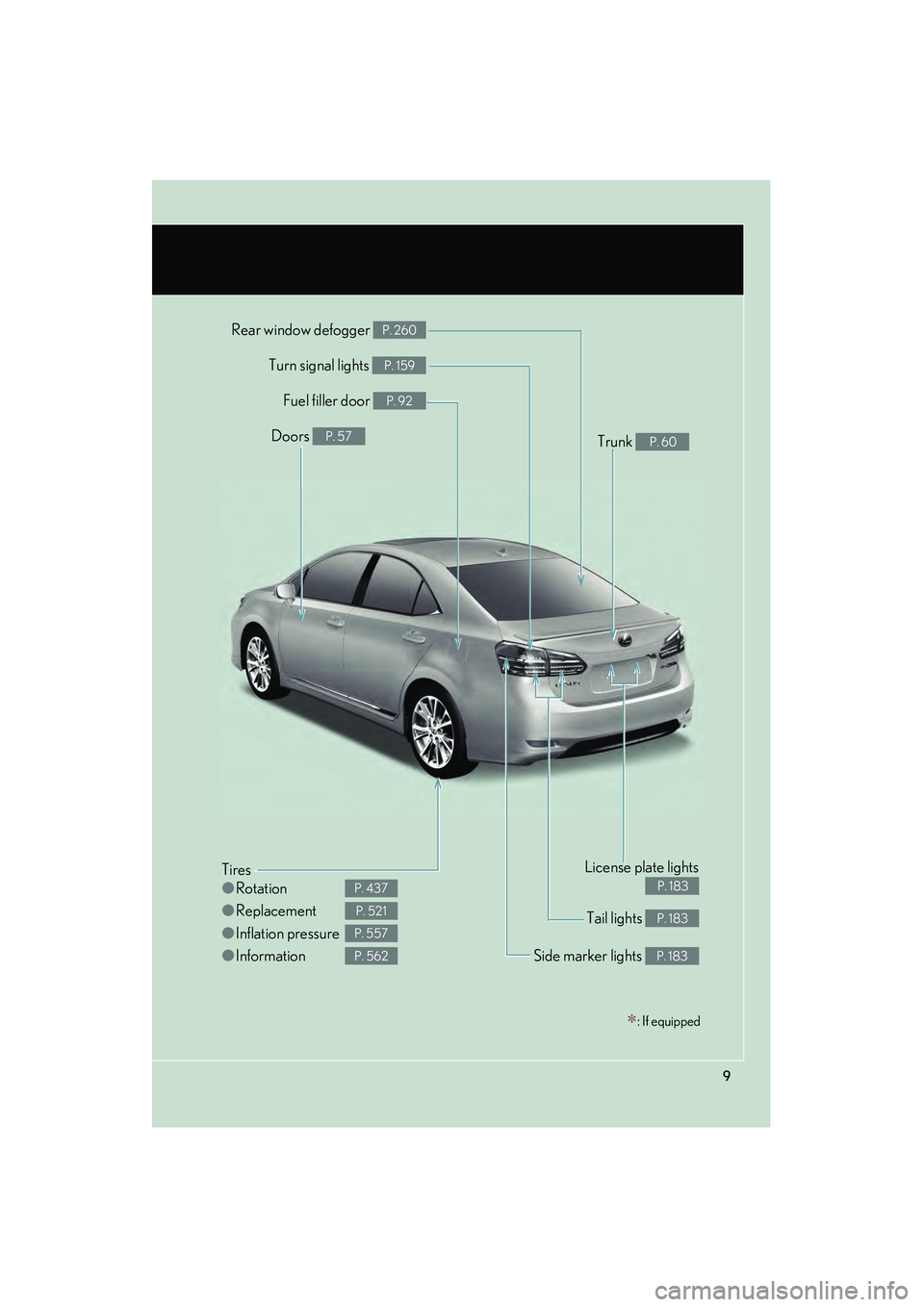
9
Tail lights P. 183
Rear window defogger P. 260
Tires
●Rotation
● Replacement
● Inflation pressure
● Information
P. 437
P. 521
P. 557
P. 562Side marker lights P. 183
Fuel filler door P. 92
Turn signal lights P. 159
License plate lights
P. 183
Doors P. 57Trunk P. 60
∗: If equipped
Page 40 of 611
38
1-1. Hybrid system
HS250h_U_75033U(Canada)
■Air conditioning
Use the air conditioning only when necessary. Doing so can help control
excessive gasoline consumption.
In summer: In high temperatures, use the recirculated air mode. Doing so
will help to reduce the burden on the air conditioner and reduce fuel con-
sumption as well.
In winter: Because the gasoline engine will not automatically cut out until
the gasoline engine and the interior of the vehicle are warm, it will con-
sume fuel. Also, fuel consumption can be improved by avoiding overuse of
the heater.
■ Checking tire inflation pressure
Make sure to check the tire inflation pressure frequently. Improper tire
inflation pressure can cause poor fuel consumption.
Also, as snow tires can cause large amounts of friction, their use on dry
roads can lead to poor fuel consumption. Use a tire that is appropriate for
the season.
■Luggage
Carrying heavy luggage can lead to poor fuel consumption. Avoid carry-
ing unnecessary luggage. Installing a large roof rack can also cause poor
fuel consumption.
■Warming up before driving
Since the gasoline engine starts up and cuts out automatically when cold,
warming up the engine is unnecessary. Moreover, frequently driving short
distances will cause the engine to repeatedly warm up, which can lead to
poor fuel consumption.
Page 139 of 611

137
2-1. Driving procedures
2
When driving
HS250h_U_75033U(Canada)
Starting off on a steep uphillMake sure that the parking brake is set securely, and then select
shift position D.
Check that the shift position indicator shows D.
Gently depress the accelerator pedal.
Release the parking brake.
■Driving in the rain
●Drive carefully when it is raining, because visibility will be reduced, the windows
may become fogged-up, and the road will be slippery.
●Drive carefully when it starts to rain, because the road surface will be especially
slippery.
●Refrain from high speeds when driving on an expressway in the rain, because
there may be a layer of water between the tires and the road surface, preventing
the steering and brakes from operating properly.
■Breaking in your new Lexus
To extend the life of the vehicle, observing the following precautions is recom-
mended:
●For the first 186 miles (300 km):
Avoid sudden stops.
●For the first 994 miles (1600 km):
• Do not drive at extremely high speeds.
• Avoid sudden acceleration.
• Do not drive at a constant speed for extended periods.
■Drum-in-disc type parking brake system
Your vehicle has a drum-in-disc type parking brake system. This type of brake sys-
tem needs bedding-down of the brake shoes periodically or whenever the parking
brake shoes and/or drum are replaced. Have your Lexus dealer perform the bed-
ding down operation.
Page 142 of 611
140
2-1. Driving procedures
HS250h_U_75033U(Canada)
CAUTION
●Do not select shift position R when the vehicle is rolling forward, do not select D
when moving in reverse, and do not press the P position switch before the vehicle
stops fully. Doing so will cause the buzzer to sound and the shift position to
change to N. In addition, excessive force will be applied to the powertrain and
damage may result.
●Do not change the shift position to N while the vehicle is moving.
Doing so may cause insufficient engine braking, resulting in an accident.
●Do not turn the hybrid system off while driving.
The power steering and brake actuator will not operate properly if the hybrid sys-
tem is off.
●Use engine braking (shift position B) to maintain a safe speed when driving down
a steep hill.
Using the brakes continuously may cause the brakes to overheat and lose effec-
tiveness. (→P. 1 5 3 )
●Do not adjust the positions of the steering wheel, the seat, or the inside or outside
rear view mirrors while driving.
Doing so may result in a loss of vehicle control that can cause accidents, resulting
in death or serious injury.
●Always check that all passengers' arms, heads or other parts of their body are not
outside the vehicle, as this may result in death or serious injury.
●Do not drive in excess of the speed limit. Even if the legal speed limit permits it, do
not drive over 85 mph (140 km/h) unless your vehicle has high-speed capability
tires. Driving over 85 mph (140 km/h) may result in tire failure, loss of control and
possible injury. Be sure to consult a tire dealer to determine whether the tires on
your vehicle are high-speed capability tires or not before driving at such speeds.
■When driving on slippery road surfaces
●Sudden braking, acceleration and steering may cause tire slippage and reduce
your ability to control the vehicle, resulting in an accident.
●Abrupt changes from shift position D to B and rapid changes in the engine speed
could cause the vehicle to skid, resulting in an accident.
●After driving through a puddle, lightly depress the brake pedal to make sure that
the brakes are functioning properly. Wet brake pads may prevent the brakes from
functioning properly. If the brakes on only one side are wet and not functioning
properly, steering control may be affected, resulting in an accident.
Page 224 of 611
222
2-4. Using other driving systems
HS250h_U_75033U(Canada)
CAUTION
■Before using the LKA system
Do not rely on the LKA system to remain within a selected lane. The LKA system is
not designed to enable inattentive driving. The steering wheel should be operated
by the driver to maintain the vehicle in a suitable position within its lane. Always
drive carefully.
■Turn the LKA off while driving in any of the following conditions:
Do not use LKA in any of the following situations.
Otherwise, the system may not function correctly and could result in an accident.
●When driving with snow tires, snow chains, a spare tire, or similar equipment.
●When driving with non-standard parts or aftermarket equipment installed.
(including modified tires and suspensions, etc.)
●When towing a trailer.
●When there are objects or structures along the roadside that might be misinter-
preted as lane markers. (such as guardrails, curb, reflector posts, etc.)
●When there are wheel ruts, icy trademarks, etc. or if snow remains on the road
surface.
●When there are shadows on the road running parallel with lane markers, or if a
shadow covers the lane markers.
●When there are visible lines on the pavement from road repairs, or if the remains
of old lane markers are still visible on the road.
●When driving on slippery roads, such as those covered with rain, ice or snow.
●When driving in a lane other than the driving or passing lanes on a freeway or
highway.
●When driving on a road with lane closures due to maintenance, or when driving
in a temporary lane.
●When driving on winding roads or roads that are rough or uneven.
Page 230 of 611

228
2-4. Using other driving systems
HS250h_U_75033U(Canada)
■Reduced effectiveness of the EPS system
The effectiveness of the EPS system is reduced to prevent the system from over-
heating when there is frequent steering input over an extended period of time. The
steering wheel may feel heavy as a result. Should this occur, refrain from excessive
steering input or stop the vehicle and turn the hybrid system off. The EPS system
should return to normal within 10 minutes.
CAUTION
■The ABS does not operate effectively when
●Tires with inadequate gripping ability are used (such as excessively worn tires on
a snow covered road).
●The vehicle hydroplanes while driving at high speed on wet or slick road.
■Stopping distance when the ABS is operating will exceed that of normal condi-
tions
The ABS is not designed to shorten the vehicle’s stopping distance. Always main-
tain a safe distance from the vehicle in front of you in the following situations:
●When driving on dirt, gravel or snow-covered roads
●When driving with tire chains
●When driving over bumps in the road
●When driving over roads with potholes or roads with uneven surfaces
■TRAC may not operate effectively when
Directional control and power may not be achievable while driving on slippery road
surfaces, even if the TRAC system is operating.
Do not drive the vehicle in conditions where stability and power may be lost.
■When the VSC is activated
The slip indicator light flashes and a warning buzzer sounds. Always drive carefully.
Reckless driving may cause an accident. Exercise particular care when the indica-
tor light flashes and a buzzer sounds.
■When the TRAC/VSC systems are turned off
Be especially careful and drive at a speed appropriate to the road conditions. As
these are the systems to ensure vehicle stability and driving force, do not turn the
TRAC/VSC systems off unless necessary.
Page 231 of 611
229
2-4. Using other driving systems
2
When driving
HS250h_U_75033U(Canada)
CAUTION
■Replacing tires
Make sure that all tires are of the specified size, brand, tread pattern and total load
capacity. In addition, make sure that the tires are inflated to the recommended tire
inflation pressure level.
The ABS and VSC systems will not function correctly if different tires are installed
on the vehicle.
Contact your Lexus dealer for further information when replacing tires or wheels.
■Handling of tires and the suspension
Using tires with any kind of problem or modifying the suspension will affect the driv-
ing assist systems, and may cause a system to malfunction.
Page 245 of 611
243
2-5. Driving information
2
When driving
HS250h_U_75033U(Canada)
Vehicle load limits
■Total load capacity and seating capacity
These details are also described on the tire and loading information label.
(→ P. 4 4 5 )
CAUTION
■Overloading the vehicle
Do not overload the vehicle.
It may not only cause damage to the tires, but also degrade steering and braking
ability, resulting in an accident.
Vehicle load limits include total load capacity, seating capacity, towing
capacity and cargo capacity.
■Total load capacity: 825 lb. (375 kg)
Total load capacity means the combined weight of occupants, cargo and
luggage.
■Seating capacity: 5 occupants (Front 2, Rear 3)
Seating capacity means the maximum number of occupants whose esti-
mated average weight is 150 lb. (68 kg) per person.
■Towing capacity
Lexus does not recommend towing a trailer with your vehicle.
■Cargo capacity
Cargo capacity may increase or decrease depending on the weight and
the number of occupants.
Page 246 of 611
244
2-5. Driving information
HS250h_U_75033U(Canada)
Winter driving tips
Carry out the necessary preparations and inspections before driving the
vehicle in winter. Always drive the vehicle in a manner appropriate to the
prevailing weather conditions.
■Pre-winter preparations
●Use fluids that are appropriate to the prevailing outside tempera-
tures.
• Engine oil
• Engine/power control unit coolant
• Washer fluid
● Have the vehicle fitted with four snow tires or purchase a set of
tire chains for the front tires.
Ensure that all tires are the same size and brand, and that chains match
the size of the tires.
■ Before driving the vehicle
Perform the following according to the driving conditions:
●Do not try to forcibly open a window or move a wiper that is fro-
zen. Pour warm water over the frozen area to melt the ice. Wipe
away the water immediately to prevent it from freezing.
● To ensure proper operation of the climate control system fan,
remove any snow that has accumulated on the air inlet vents in
front of the windshield.
● Remove any ice that has accumulated on the vehicle chassis.
● Periodically check for and remove any excess ice or snow that
may have accumulated in the wheel well or on the brakes.
■ When driving the vehicle
Accelerate the vehicle slowly and drive at a reduced speed suitable to the
road conditions.