light Lexus HS250h 2011 Do-it-yourself maintenance / LEXUS 2011 HS250H (OM75037U) Service Manual
[x] Cancel search | Manufacturer: LEXUS, Model Year: 2011, Model line: HS250h, Model: Lexus HS250h 2011Pages: 628, PDF Size: 10.69 MB
Page 128 of 628
128
1-8. Safety information
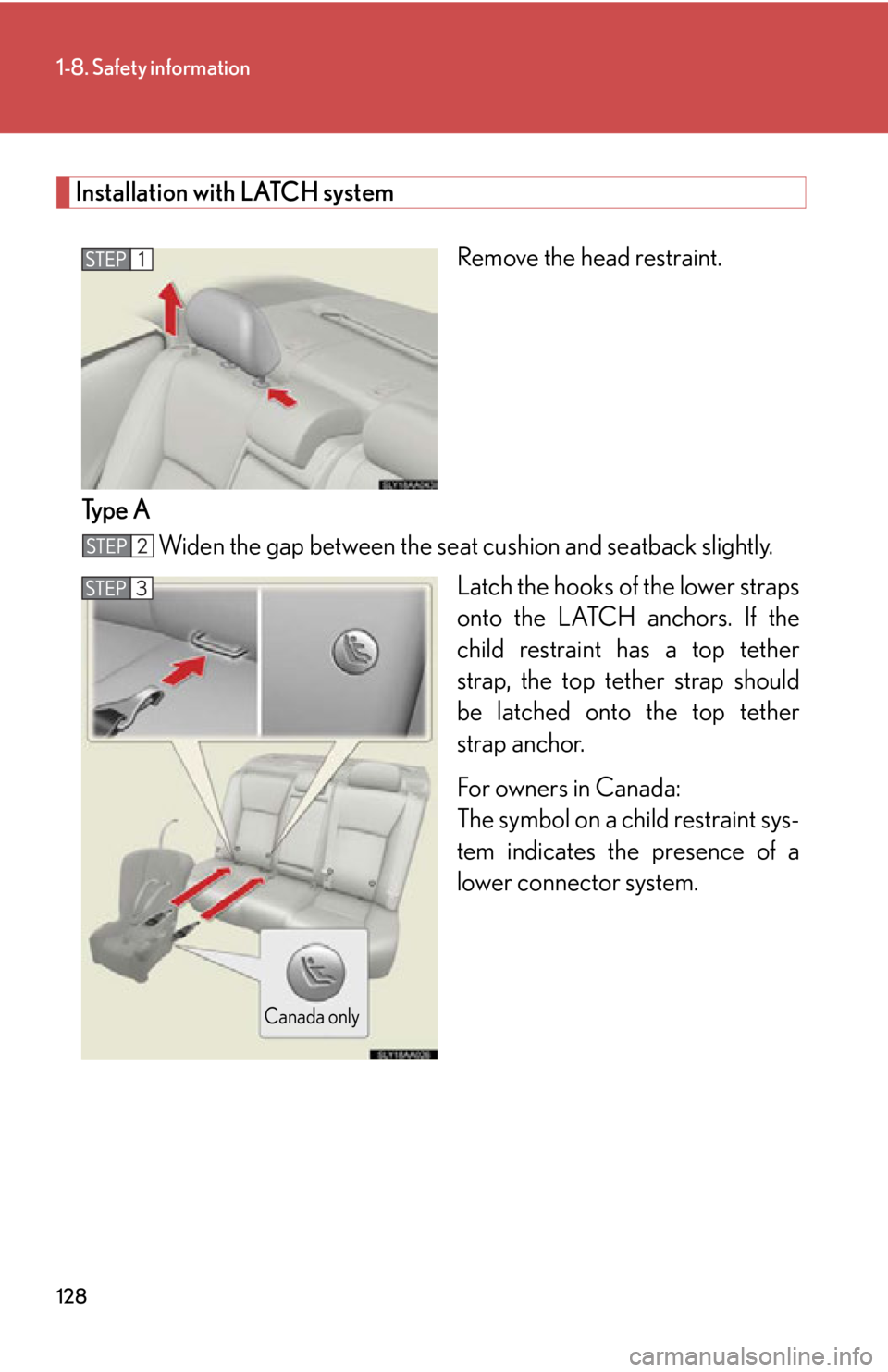
Installation with LATCH systemRemove the head restraint.
Type A Widen the gap between the seat cushion and seatback slightly.
Latch the hooks of the lower straps
onto the LATCH anchors. If the
child restraint has a top tether
strap, the top tether strap should
be latched onto the top tether
strap anchor.
For owners in Canada:
The symbol on a child restraint sys-
tem indicates the presence of a
lower connector system.
Canada only
Page 129 of 628
129
1-8. Safety information
1
Before driving
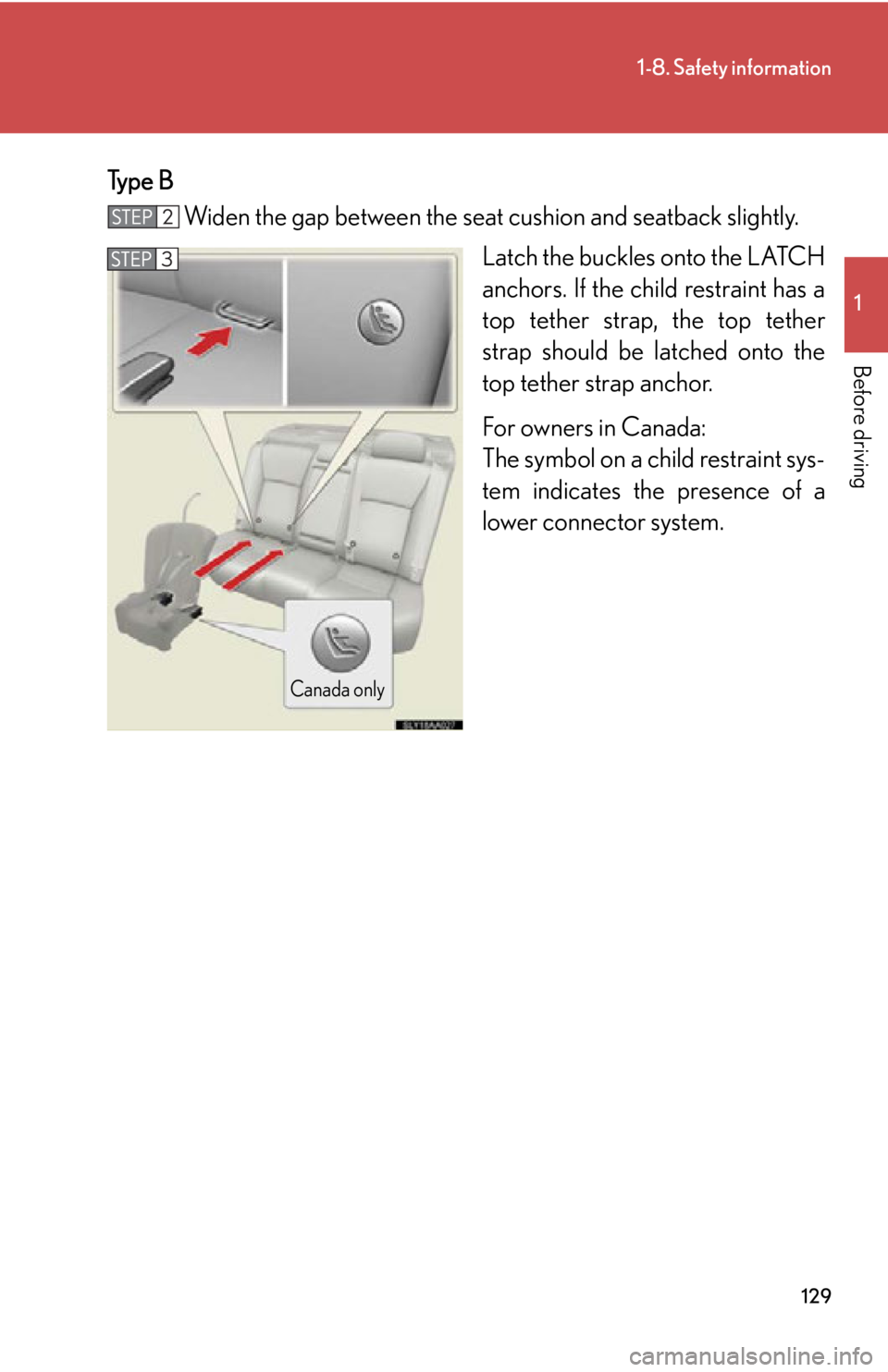
Type BWiden the gap between the seat cushion and seatback slightly.
Latch the buckles onto the LATCH
anchors. If the child restraint has a
top tether strap, the top tether
strap should be latched onto the
top tether strap anchor.
For owners in Canada:
The symbol on a child restraint sys-
tem indicates the presence of a
lower connector system.
Canada only
Page 131 of 628
131
1-8. Safety information
1
Before driving
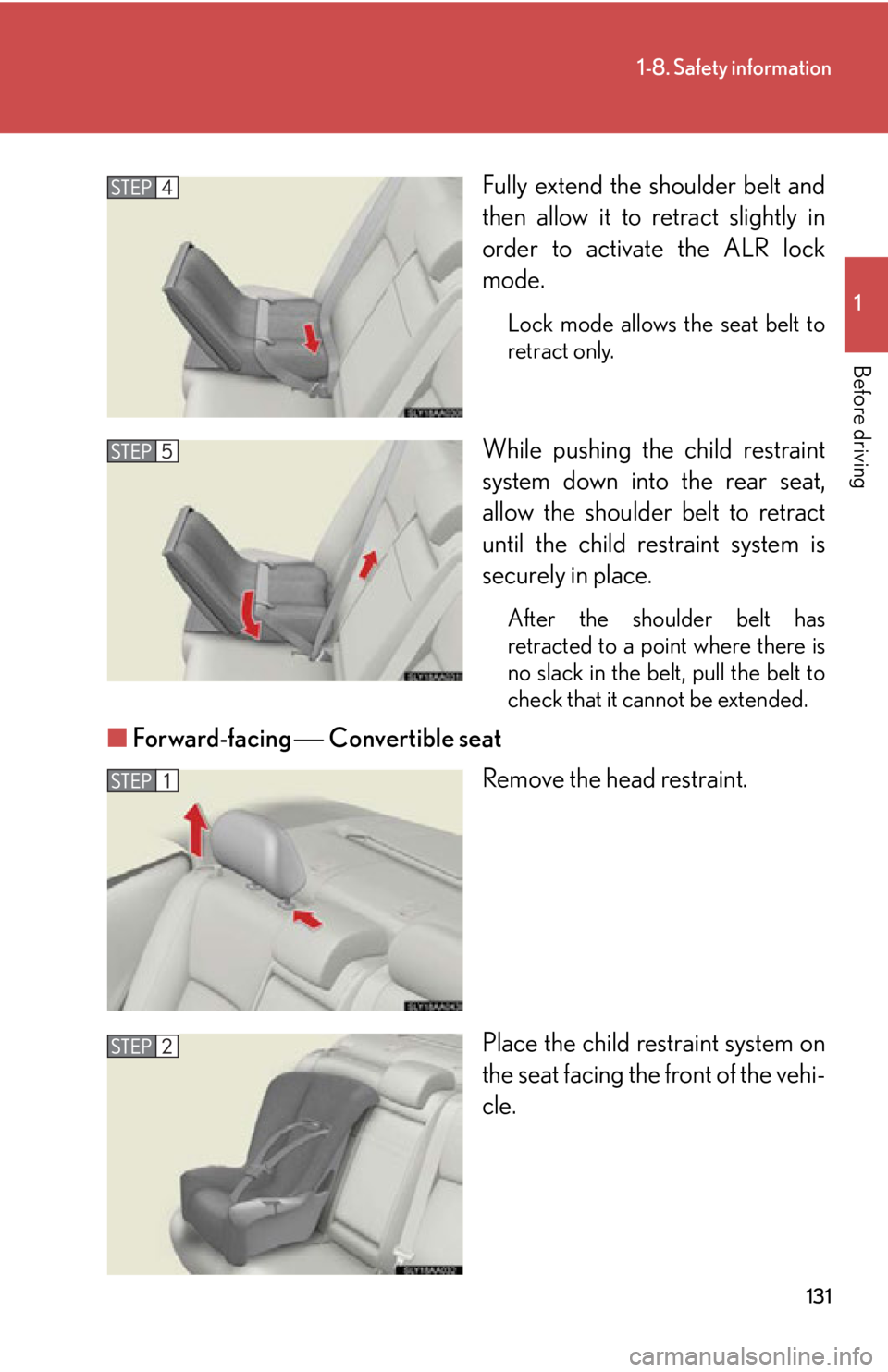
Fully extend the shoulder belt and
then allow it to retract slightly in
order to activate the ALR lock
mode.
Lock mode allows the seat belt to
retract only.
While pushing the child restraint
system down into the rear seat,
allow the shoulder belt to retract
until the child restraint system is
securely in place.
After the shoulder belt has
retracted to a point where there is
no slack in the belt, pull the belt to
check that it cannot be extended.
■Forward-facing Convertible seat
Remove the head restraint.
Place the child restraint system on
the seat facing the front of the vehi-
cle.
Page 132 of 628
132
1-8. Safety information
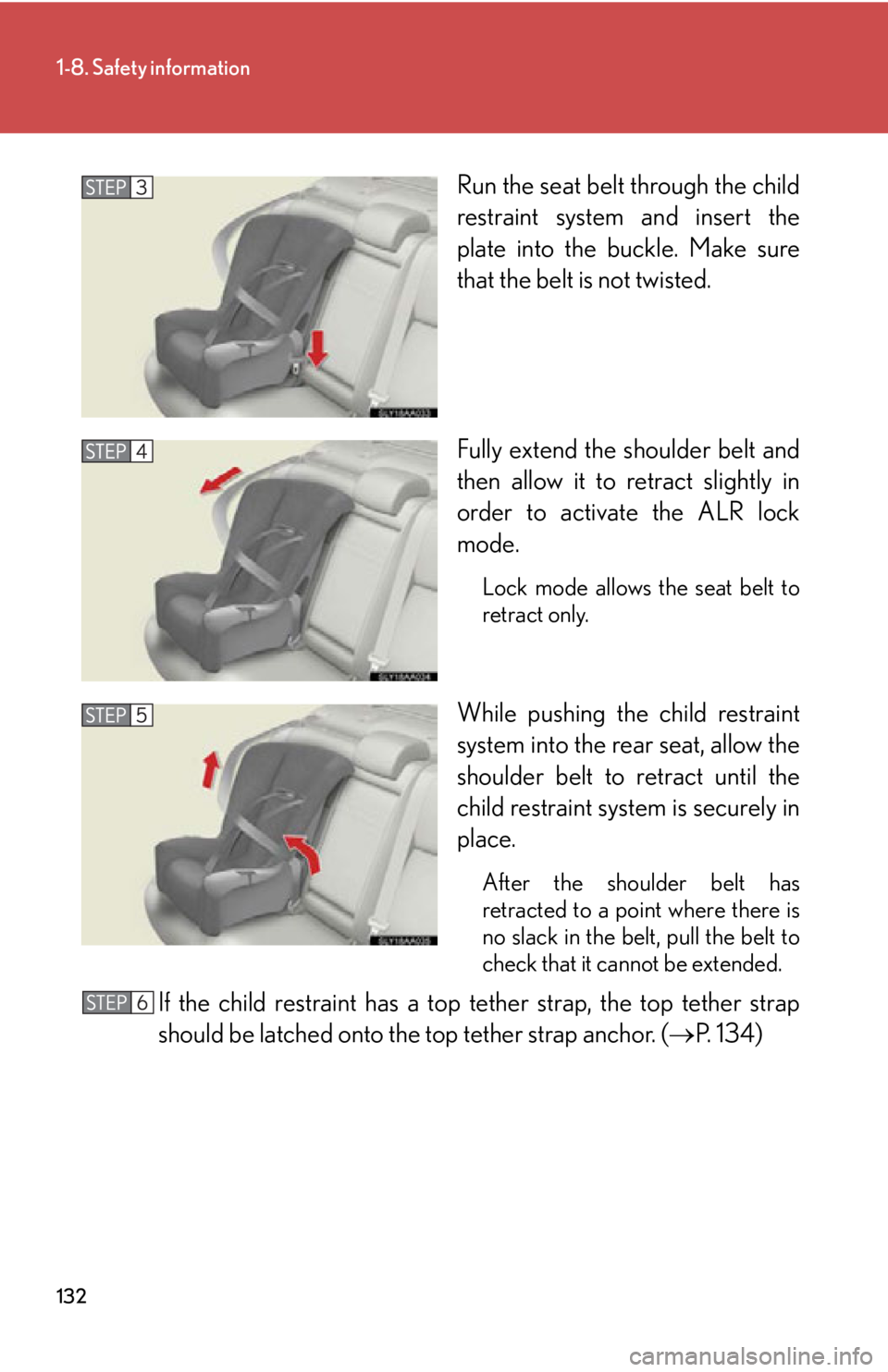
Run the seat belt through the child
restraint system and insert the
plate into the buckle. Make sure
that the belt is not twisted.
Fully extend the shoulder belt and
then allow it to retract slightly in
order to activate the ALR lock
mode.
Lock mode allows the seat belt to
retract only.
While pushing the child restraint
system into the rear seat, allow the
shoulder belt to retract until the
child restraint system is securely in
place.
After the shoulder belt has
retracted to a point where there is
no slack in the belt, pull the belt to
check that it cannot be extended.
If the child restraint has a top tether strap, the top tether strap
should be latched onto the top tether strap anchor. ( P. 1 3 4 )
Page 135 of 628
135
1-8. Safety information
1
Before driving
CAUTION
■When installing a booster seat
To prevent the belt from going into ALR lock mode, do not fully extend the shoulder
belt. ALR mode causes the belt to tighten only. This could cause injury or discom-
fort to the child. ( P. 76 )
■When installing a child restraint system
Follow the directions given in the child re straint system installation manual and fix
the child restraint system securely in place.
If the child restraint system is not correctl y fixed in place, the child or other passen-
gers may be seriously injured or even killed in the event of sudden braking, sudden
swerving or an accident.
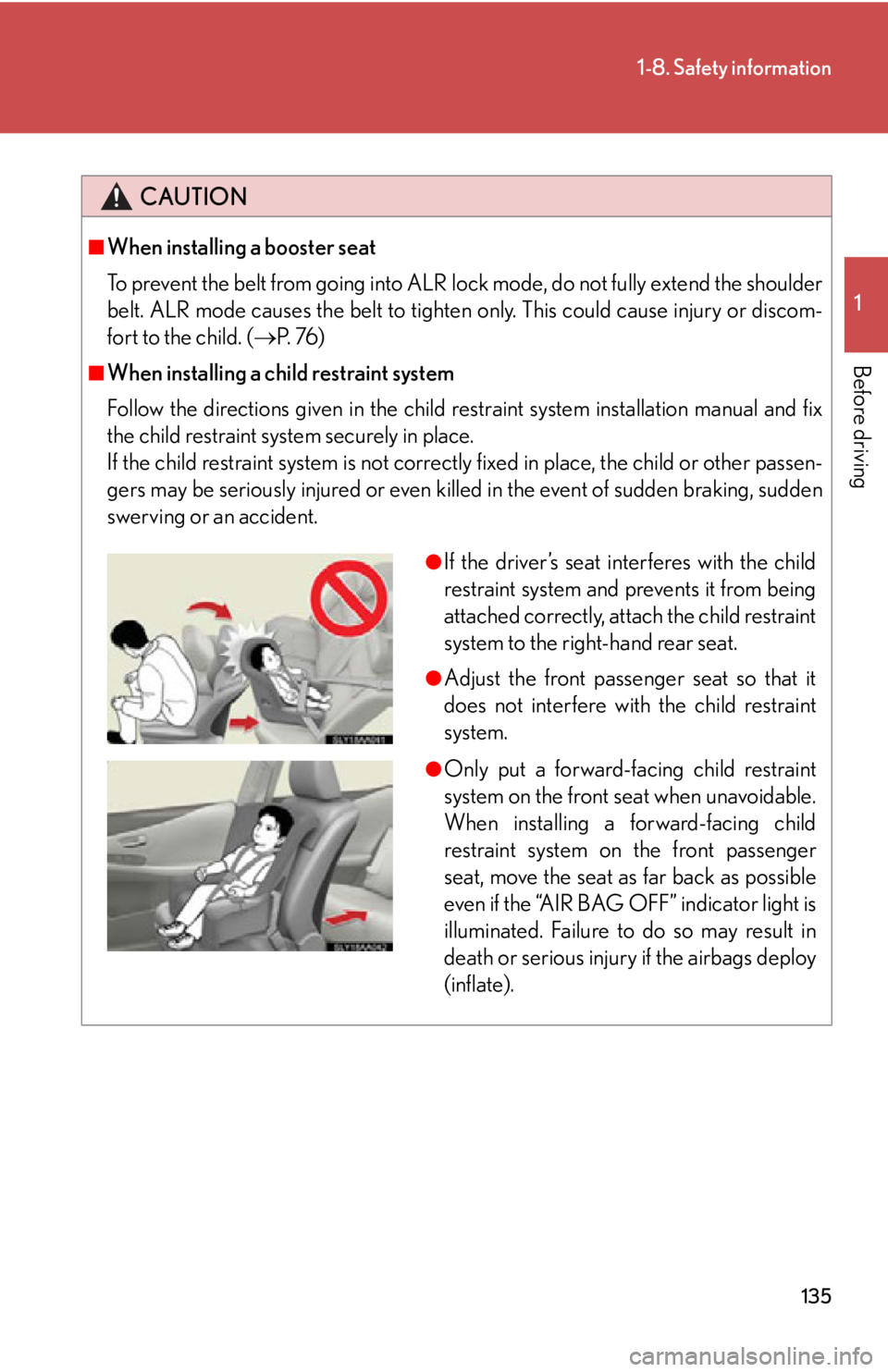
●If the driver’s seat interferes with the child
restraint system and prevents it from being
attached correctly, attach the child restraint
system to the right-hand rear seat.
●Adjust the front passen ger seat so that it
does not interfere with the child restraint
system.
●Only put a forward-facing child restraint
system on the front seat when unavoidable.
When installing a forward-facing child
restraint system on the front passenger
seat, move the seat as far back as possible
even if the “AIR BAG OFF” indicator light is
illuminated. Failure to do so may result in
death or serious injury if the airbags deploy
(inflate).
Page 137 of 628
When driving2
137
2-1. Driving proceduresDriving the vehicle.................. 138
Power (ignition) switch .......... 147
EV drive mode.......................... 152
Hybrid transmission ............... 155
Turn signal lever ........................ 161
Parking brake ........................... 162
Horn ............................................ 163
2-2. Instrument cluster Gauges and meters ................ 164
Indicators and warning lights ......................................... 168
Multi-information display ..... 172
Head-up display ...................... 178
2-3. Operating the lights and windshield wipers
Headlight switch...................... 186
Automatic High Beam ............ 191
Fog light switch ........................ 197
Windshield wipers and washer ..................................... 198
Headlight cleaner switch.... 203 2-4. Using other driving systems
Cruise control......................... 204
Dynamic radar cruise control .................................... 208
LKA (Lane-Keeping Assist) ........ 221
Driving assist systems ........... 229
Hill-start assist control ......... 234
Pre-Collision System ............ 236
2-5. Driving information Cargo and luggage ............... 245
Vehicle load limits .................. 248
Winter driving tips ................. 249
Trailer towing .......................... 252
Dinghy towing ......................... 253
Page 140 of 628

140
2-1. Driving procedures
■Operating your vehicle in a foreign country
Comply with the relevant vehicle registration laws and confirm the availability of the
correct fuel. (P. 5 5 8 )
■For efficient use
●Select the D position when driving.
In the N position, the gasoline engine op erates but electricity cannot be gener-
ated. The hybrid battery (traction battery) will discharge, requiring unnecessary
engine power to recharge.
●Drive your vehicle smoothly.
Avoid abrupt acceleration and deceleration. Gradual acceleration and decel-
eration will make more effective use of the electric motor (traction motor) with-
out having to use gasoline engine power.
●Avoid repeated acceleration.
Repeated acceleration consumes hybrid battery (traction battery) power,
resulting in poor acceleration. Battery power can be restored by driving with
the accelerator pedal slightly released.
●Select the P position when parking.
In the N position, the hybrid battery (traction battery) does not recharge.
Leaving the N position selected for an extended period of time may discharge
the hybrid battery. The vehicle cannot ru n if the hybrid battery is discharged.
■Eco-friendly driving
■Customization
Settings for Eco Driving Indicator Light can be changed.
(Customizable features P. 5 8 0 )
During Eco-friendly acceleration (Eco driv-
ing), Eco Driving Indicator Light will turn on.
When the accelerator pedal is depressed
excessively, and when the vehicle is stopped,
the light turns off.
Eco Driving Indicator Li ght will operate when
the vehicle is being driven with the shift posi-
tion in D at a speed of about 80 mph (130
km/h) or below. The indicator will not operate
when the vehicle is in power mode or EV
drive mode. ( P. 1 5 2 ,
157)
Page 141 of 628

141
2-1. Driving procedures
2
When driving
CAUTION
■When starting the vehicle
Always keep your foot on the brake pedal while stopped with the hybrid system
operating. This prevents the vehicle from creeping.
■When driving the vehicle
●Do not drive if you are unfamiliar with the location of the brake and accelerator
pedals to avoid depressing the wrong pedal.
• Accidentally depressing the accelerator pedal instead of the brake pedal will
result in sudden acceleration that may le ad to an accident that could result in
death or serious injury.
• When backing up, you may twist your bo dy around, leading to a difficulty in
operating the pedals. Make sure to operate the pedals properly.
• Make sure to keep a correct driving posture even when moving the vehicle only slightly. This allows you to depress the brake and accelerator pedals
properly.
• Depress the brake pedal using your right foot. Depressing the brake pedal using your left foot may delay response in an emergency, resulting in an acci-
dent.
●The driver should pay extra attention to pedestrians when the vehicle is powered
only by the electric motor (traction motor). Because there is no engine noise, the
pedestrians may misjudge the vehicle’s movement.
●Do not drive the vehicle over or stop the vehicle near flammable materials.
The exhaust system and exhaust gases can be extremely hot. These hot parts may
cause a fire if there is any flammable material nearby.
●Do not let the vehicle roll backward whil e a forward driving position is selected,
or roll forward while R is selected.
Doing so may result in an acci dent or damage to the vehicle.
●If the smell of exhaust is noticed inside the vehicle, open the windows and check
that the trunk is closed. Large amounts of exhaust in the vehicle can cause driver
drowsiness and an accident, resulting in death or a serious health hazard. Have
the vehicle inspected by your Lexus dealer immediately.
Page 142 of 628

142
2-1. Driving procedures
CAUTION
●Do not select shift position R when the vehicle is rolling forward, do not select D
when moving in reverse, and do not press the P position switch before the vehicle
stops fully. Doing so will cause the buzzer to sound and the shift position to
change to N. In addition, excessive forc e will be applied to the powertrain and
damage may result.
●Do not change the shift position to N while the vehicle is moving.
Doing so may cause insufficient engine braking, resulting in an accident.
●Do not turn the hybrid system off while driving.
The power steering and brake actuator will not operate properly if the hybrid sys-
tem is off.
●Use engine braking (shift position B) to maintain a safe speed when driving down
a steep hill.
Using the brakes continuously may cause the brakes to overheat and lose effec-
tiveness. ( P. 1 5 5 )
●Do not adjust the positions of the steering wheel, the seat, or the inside or outside
rear view mirrors while driving.
Doing so may result in a loss of vehicle control that can cause accidents, resulting
in death or serious injury.
●Always check that all passengers' arms, heads or other parts of their body are not
outside the vehicle, as this may result in death or serious injury.
●Do not drive in excess of the speed limit. Even if the legal speed limit permits it, do
not drive over 85 mph (140 km/h) unless your vehicle has high-speed capability
tires. Driving over 85 mph (140 km/h) may result in tire failure, loss of control and
possible injury. Be sure to consult a tire dealer to determine whether the tires on
your vehicle are high-speed capability tires or not before driving at such speeds.
■When driving on slippery road surfaces
●Sudden braking, acceleration and steer ing may cause tire slippage and reduce
your ability to control the vehi cle, resulting in an accident.
●Abrupt changes from shift position D to B and rapid changes in the engine speed
could cause the vehicle to skid, resulting in an accident.
●After driving through a pudd le, lightly depress the brake pedal to make sure that
the brakes are functioning properly. Wet brake pads may prevent the brakes from
functioning properly. If the brakes on on ly one side are wet and not functioning
properly, steering control may be af fected, resulting in an accident.
Page 143 of 628

143
2-1. Driving procedures
2
When driving
CAUTION
■When changing the shift position
Be careful not to change the shift position with the accelerator pedal depressed.
Changing the shift position to any positions other than P or N may cause the vehicle
to accelerate abruptly, causing an accident and resulting in death or serious injury.
■If you hear a squealing or scraping no ise (brake pad wear limit indicators)
Have your Lexus dealer check and replac e the brake pads as soon as possible.
Rotor damage may result if the pa ds are not replaced when needed.
It is dangerous to drive the vehicle when the wear limits of the brake pads and/or
those of the brake discs are exceeded.
■When the vehicle is stopped
●Do not depress the accelerator pedal unnecessarily.
If the vehicle is in any shift position other than P or N, the vehicle may accelerate
suddenly and unexpectedly , causing an accident.
●Do not leave the vehicle with the hybrid system on for a long time.
If such a situation cannot be avoided, park the vehicle in an open space and
check that exhaust fumes do no t enter the vehicle interior.
●In order to prevent accidents due to the vehicle rolling away, always keep
depressing the brake pedal while the “READY” indicator is on. Apply the parking
brake as necessary.
●If the vehicle is stopped on an incline, in order to prevent accidents caused by the
vehicle rolling forward or backward, always depress the brake pedal and securely
apply the parking brake as needed.
●Avoid revving or racing the engine.
Running the engine at high speed while the vehicle is stopped may cause the
exhaust system to overheat, which could result in a fire if combustible material is
nearby.
■When the vehicle is parked
●Do not leave glasses, cigarette lighters, spray cans, or soft drink cans in the vehi-
cle when it is in the sun.
Doing so may result in the following:
• Gas may leak from a cigarette lighter or spray can, and may lead to a fire.
• The temperature inside the vehicle may cause the plastic lenses and plastic material of glasses to deform or crack.