fuel pressure Lexus HS250h 2011 Do-it-yourself maintenance / LEXUS 2011 HS250H OWNERS MANUAL (OM75037U)
[x] Cancel search | Manufacturer: LEXUS, Model Year: 2011, Model line: HS250h, Model: Lexus HS250h 2011Pages: 628, PDF Size: 10.69 MB
Page 9 of 628
9
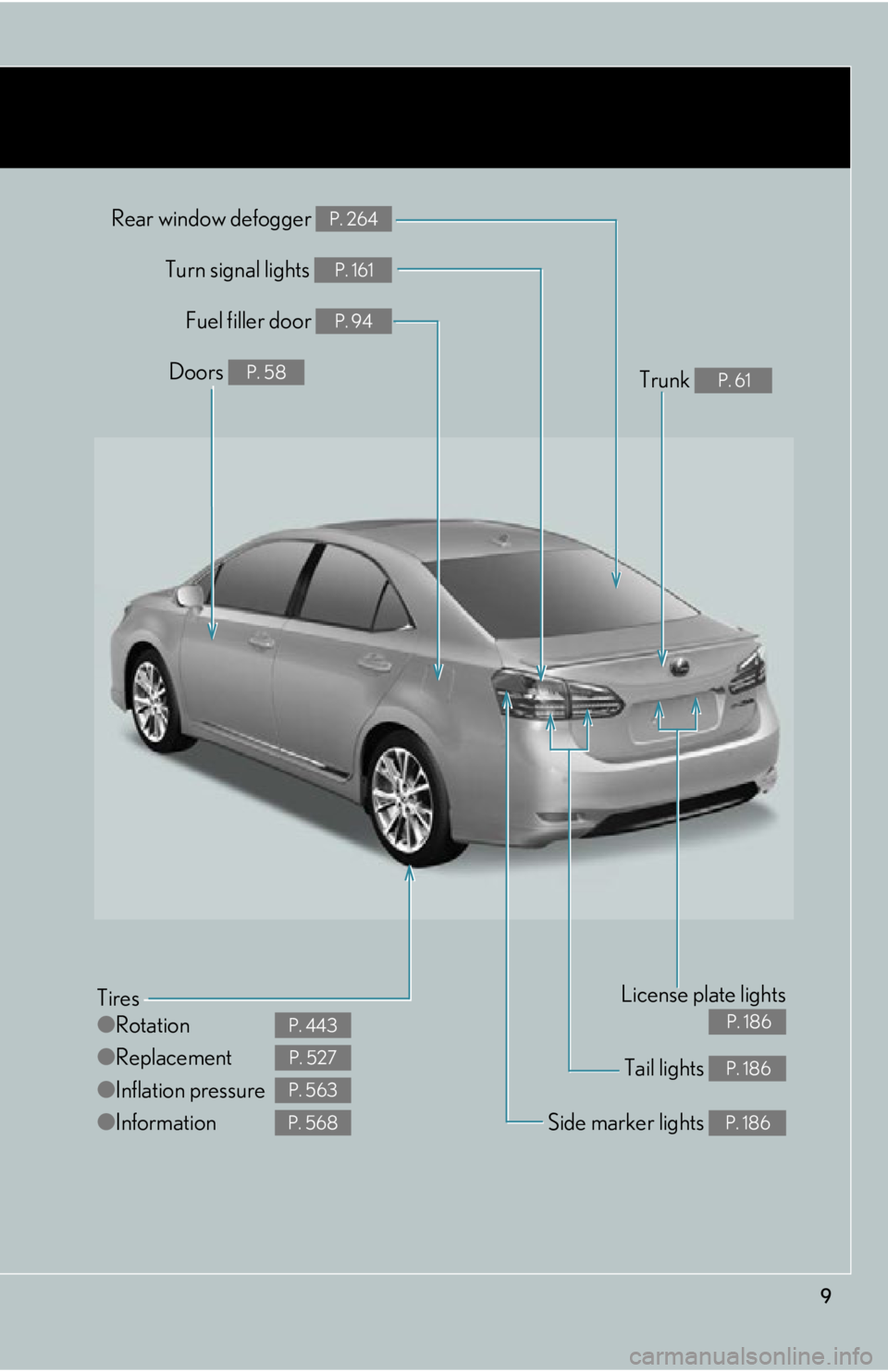
Tail lights P. 186
Rear window defogger P. 264
Tires
●Rotation
● Replacement
● Inflation pressure
● Information
P. 443
P. 527
P. 563
P. 568Side marker lights P. 186
Fuel filler door P. 94
Turn signal lights P. 161
License plate lights
P. 186
Doors P. 58Trunk P. 61
Page 39 of 628
39
1-1. Hybrid system
1
Before driving
■Air conditioning
Use the air conditioning only when necessary. Doing so can help control
excessive gasoline consumption.
In summer: In high temperatures, use the recirculated air mode. Doing so
will help to reduce the burden on the air conditioner and reduce fuel con-
sumption as well.
In winter: Because the gasoline engine will not automatically cut out until
the gasoline engine and the interior of the vehicle are warm, it will con-
sume fuel. Also, fuel consumption can be improved by avoiding overuse of
the heater.
■ Checking tire inflation pressure
Make sure to check the tire inflatio n pressure frequently. Improper tire
inflation pressure can cause poor fuel consumption.
Also, as snow tires can cause large amounts of friction, their use on dry
roads can lead to poor fuel consumptio n. Use a tire that is appropriate for
the season.
■ Luggage
Carrying heavy luggage can lead to poor fuel consumption. Avoid carry-
ing unnecessary luggage. Installing a large roof rack can also cause poor
fuel consumption.
■ Warming up before driving
Since the gasoline engine starts up and cuts out automatically when cold,
warming up the engine is unnecessary. Moreover, frequently driving short
distances will cause the engine to repeatedly warm up, which can lead to
poor fuel consumption.
Page 173 of 628
173
2-2. Instrument cluster
2
When driving
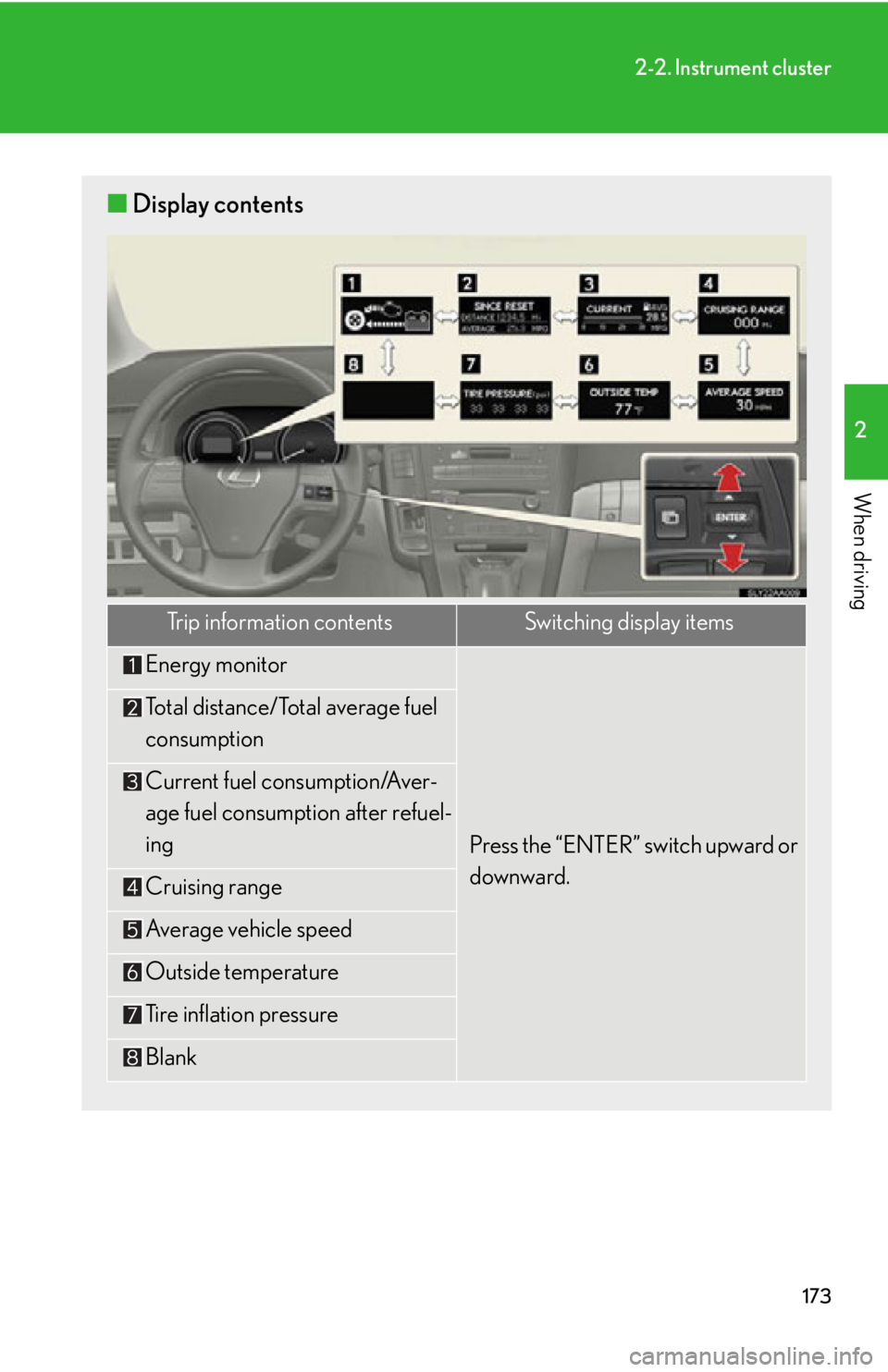
■Display contents
Trip information contentsSwitching display items
Energy monitor
Press the “ENTER” switch upward or
downward.
Total distance/Total average fuel
consumption
Current fuel consumption/Aver-
age fuel consumption after refuel-
ing
Cruising range
Average vehicle speed
Outside temperature
Tire inflation pressure
Blank
Page 408 of 628
408
4-1. Maintenance and care
Cleaning and protecting the vehicle exterior
■Automatic car washes
●Fold the mirrors before washing the vehicle. Start washing from the front of the
vehicle. Make sure to extend the mirrors before driving.
●Roof antenna, rear spoiler (if equipped) may not be washable in some automatic
car washes. There may also be an increased risk of damage to vehicle.
●Brushes used in automatic car washes may scratch the vehicle surface and
harm your vehicle’s paint.
■High pressure car washes
●Do not allow the nozzles of the car wash to come within close proximity of the
windows.
●Before using the car wash, check that the fuel filler door on your vehicle is
closed properly.
Perform the following to protect the vehicle and maintain it in prime condi-
tion:
● Working from top to bottom, liber ally apply water to the vehicle
body, wheel wells and underside of the vehicle to remove any dirt
and dust.
● Wash the vehicle body using a sponge or soft cloth, such as a
chamois.
● For hard-to-remove marks, use car wash soap and rinse thor-
oughly with water.
● Wipe away any water.
● Wax the vehicle when the waterproof coating deteriorates.
If water does not bead on a clean surface, apply wax when the vehicle
body is cool.
Page 452 of 628
452
4-3. Do-it-yourself maintenance
■Tire inflation pressure check interval
You should check tire inflation pressure every two weeks, or at least once a month.
Do not forget to check the spare.
■Effects of incorrect tire inflation pressure
Driving with incorrect tire inflation pressure may result in the following:
●Reduced fuel efficiency
●Reduced driving comfort and tire life
●Reduced safety
●Damage to the drive train
If a tire needs frequent inflating, have it checked by your Lexus dealer.
■Instructions for checking tire inflation pressure
When checking tire inflation pressure, observe the following:
●Check only when the tires are cold.
If your vehicle has been parked for at least 3 hours or has not been driven for
more than 1 mile or 1.5 km, you will get an accurate cold tire inflation pressure
reading.
●Always use a tire pressure gauge.
The appearance of the tire can be mislea ding. In addition, tire inflation pressure
that is even just a few pounds off can affect ride quality and handling.
●Do not reduce tire inflation pressure after driving. It is normal for tire inflation
pressure to be higher after driving.
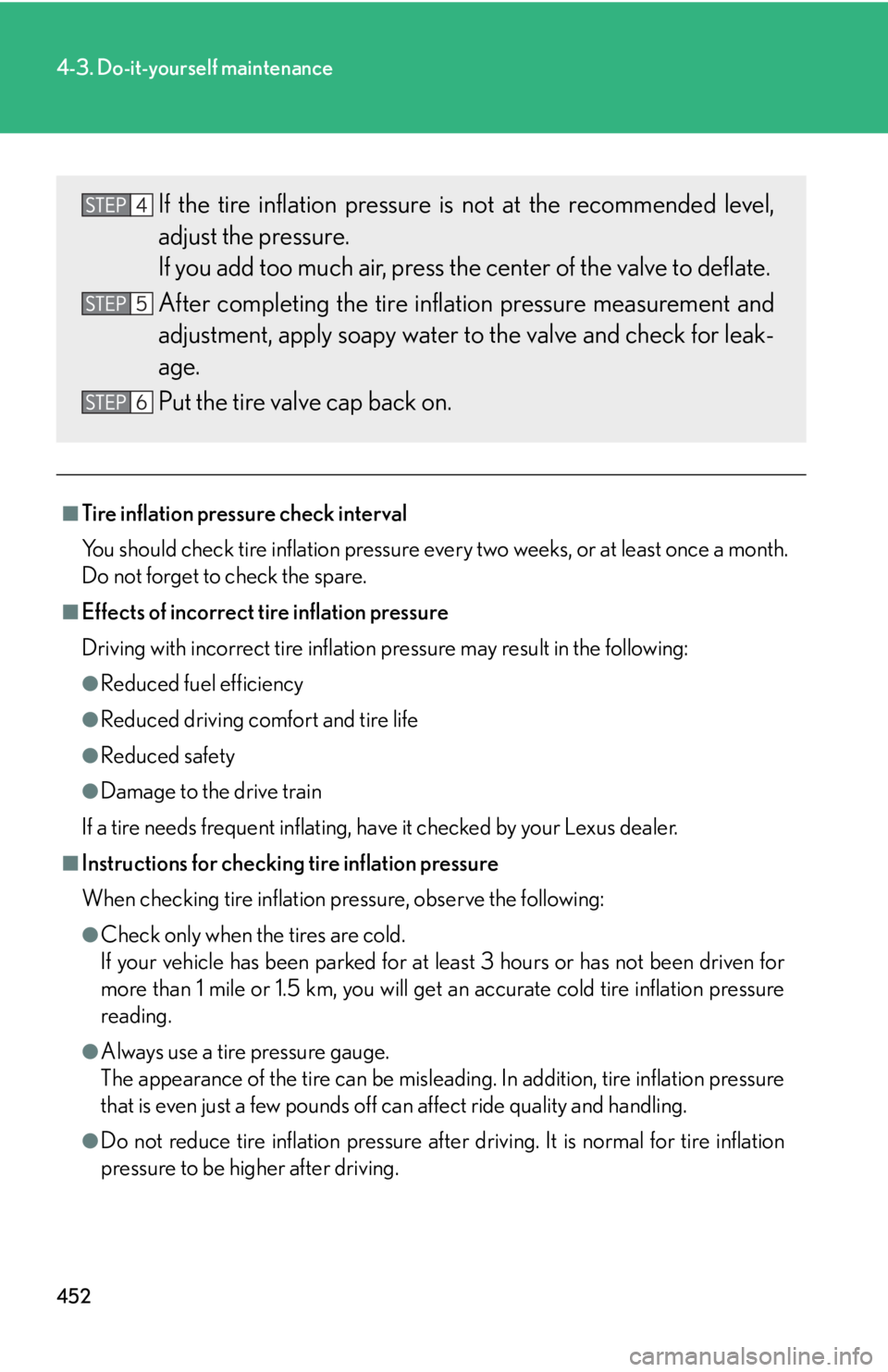
If the tire inflation pressure is not at the recommended level,
adjust the pressure.
If you add too much air, press the center of the valve to deflate.
After completing the tire inflation pressure measurement and
adjustment, apply soapy water to the valve and check for leak-
age.
Put the tire valve cap back on.
Page 469 of 628
469
4-3. Do-it-yourself maintenance
4
Maintenance and care
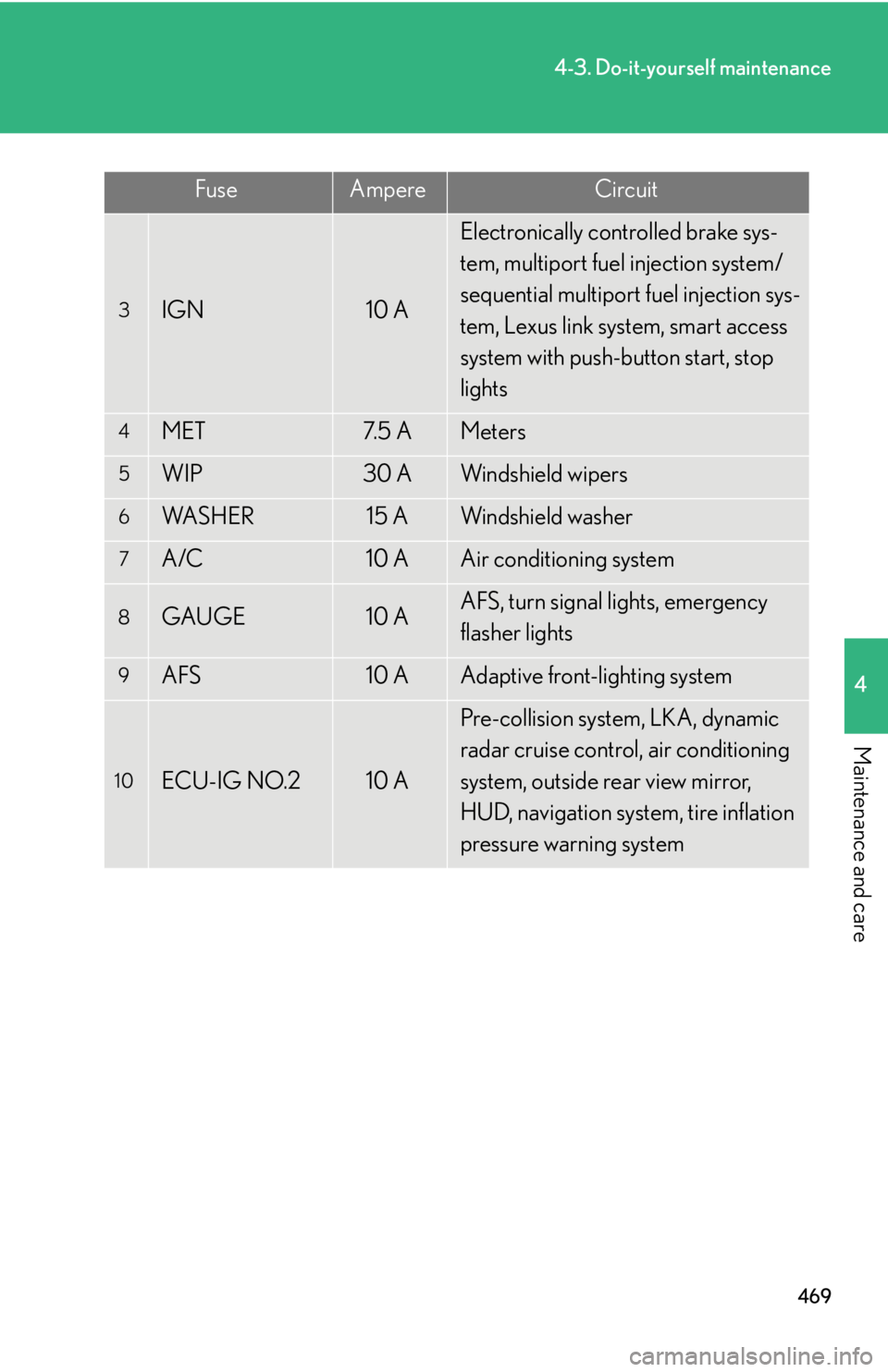
3IGN10 A
Electronically controlled brake sys-
tem, multiport fuel injection system/
sequential multiport fuel injection sys-
tem, Lexus link system, smart access
system with push-button start, stop
lights
4MET7. 5 AMeters
5WIP30 AWindshield wipers
6WA S H E R15 AWindshield washer
7A/C10 AAir conditioning system
8GAUGE10 AAFS, turn signal lights, emergency
flasher lights
9AFS10 AAdaptive front-lighting system
10ECU-IG NO.210 A
Pre-collision system, LKA, dynamic
radar cruise control, air conditioning
system, outside rear view mirror,
HUD, navigation system, tire inflation
pressure warning system
FuseAmpereCircuit
Page 503 of 628

5
When trouble arises
503
5-2. Steps to take in an emergency
■Electric power steering warning light (warning buzzer)
The electric power steering warning light comes on and the warning buzzer sounds
when the voltage is low or the voltage drops.
■If the malfunction indicator lamp comes on while driving
First check the following:
●Is the fuel tank empty?
If it is, fill the fuel tank immediately.
●Is the fuel tank cap loose?
If it is, tighten it securely.
The light will go off after several driving trips.
If the light does not go off even after several trips, contact your Lexus dealer as soon
as possible.
■When the tire pressure warning light comes on
Check the tire inflation pressure and adjust to the appropriate level. Pushing the tire
pressure warning reset switch will not turn off the tire pressure warning light.
■The tire pressure warning light may come on due to natural causes
The tire pressure warning light may come on due to natural causes such as natural
air leaks and tire inflation pressure chan ges caused by temperature. In this case,
adjusting the tire inflation pressure will turn off the warning light (after a few min-
utes).
■When a tire is replaced with a spare tire
The compact spare tire is not equipped with a tire pressure warning valve and trans-
mitter. If a tire goes flat, the tire pressure warning light will not turn off even though
the flat tire has been replaced with the spare tire. Replace the spare tire with the
repaired tire and adjust the tire inflatio n pressure. The tire pressure warning light
will go off after a few minutes.
■If the tire pressure warning system is not functioning
The tire pressure warning system will be disabled in the following conditions:
(When the condition becomes normal, the system will work properly.)
●If tires not equipped with tire pressure warning valves and transmitters are used.
●If the ID code on the tire pressure warning valves and transmitters is not regis-
tered in the tire pressure warning computer.
●If the tire inflation pressure is 73 psi (500 kPa, 5.1 kgf/cm2 or bar) or higher.
Page 505 of 628
5
When trouble arises
505
5-2. Steps to take in an emergency
CAUTION
●Avoid abrupt maneuvering and braking. If the vehicle tires deteriorate, you could
lose control of the steering wheel or the brakes.
■If a blowout or sudden air leakage should occur
The tire pressure warning system may not activate immediately.
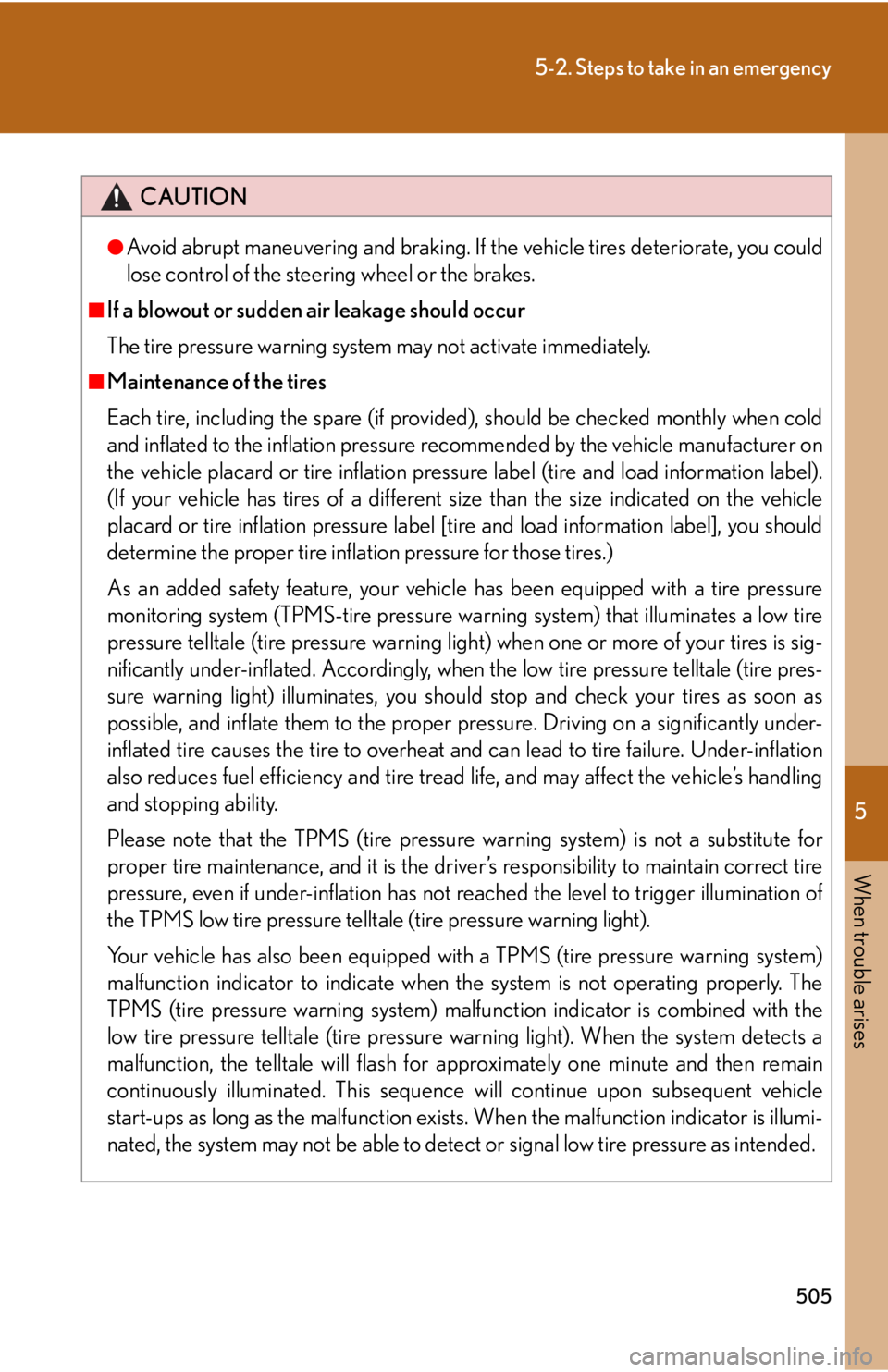
■Maintenance of the tires
Each tire, including the spare (if provided), should be checked monthly when cold
and inflated to the inflation pressure re commended by the vehicle manufacturer on
the vehicle placard or tire inflation pressure label (tire and load information label).
(If your vehicle has tires of a different size than the size indicated on the vehicle
placard or tire inflation pressure label [tire and load information label], you should
determine the proper tire inflation pressure for those tires.)
As an added safety feature, your vehicl e has been equipped with a tire pressure
monitoring system (TPMS-tire pressure warning system) that illuminates a low tire
pressure telltale (tire pressure warning light) when one or more of your tires is sig-
nificantly under-inflated. Accordingly, when the low tire pressure telltale (tire pres-
sure warning light) illuminates, you should stop and check your tires as soon as
possible, and inflate them to the proper pressure. Driving on a significantly under-
inflated tire causes the tire to overheat an d can lead to tire failure. Under-inflation
also reduces fuel efficiency and tire tread life, and may affect the vehicle’s handling
and stopping ability.
Please note that the TPMS (tire pressure warning system) is not a substitute for
proper tire maintenance, and it is the driver’s responsibility to maintain correct tire
pressure, even if under-inflation has not reached the level to trigger illumination of
the TPMS low tire pressure telltale (tire pressure warning light).
Your vehicle has also been equipped with a TPMS (tire pressure warning system)
malfunction indicator to indicate when th e system is not operating properly. The
TPMS (tire pressure warning system) malf unction indicator is combined with the
low tire pressure telltale (tire pressure warning light). When the system detects a
malfunction, the telltale will flash for approximately one minute and then remain
continuously illuminated. This sequence will continue upon subsequent vehicle
start-ups as long as the malfunction exists . When the malfunction indicator is illumi-
nated, the system may not be able to detect or signal low tire pressure as intended.
Page 574 of 628
574
6-1. Specifications
Warning: The temperature grades of a tire assume that it is properly inflated
and not overloaded.
Excessive speed, underinflation, or excess ive loading, either separately or in
combination, can cause heat buildup and possible tire failure.
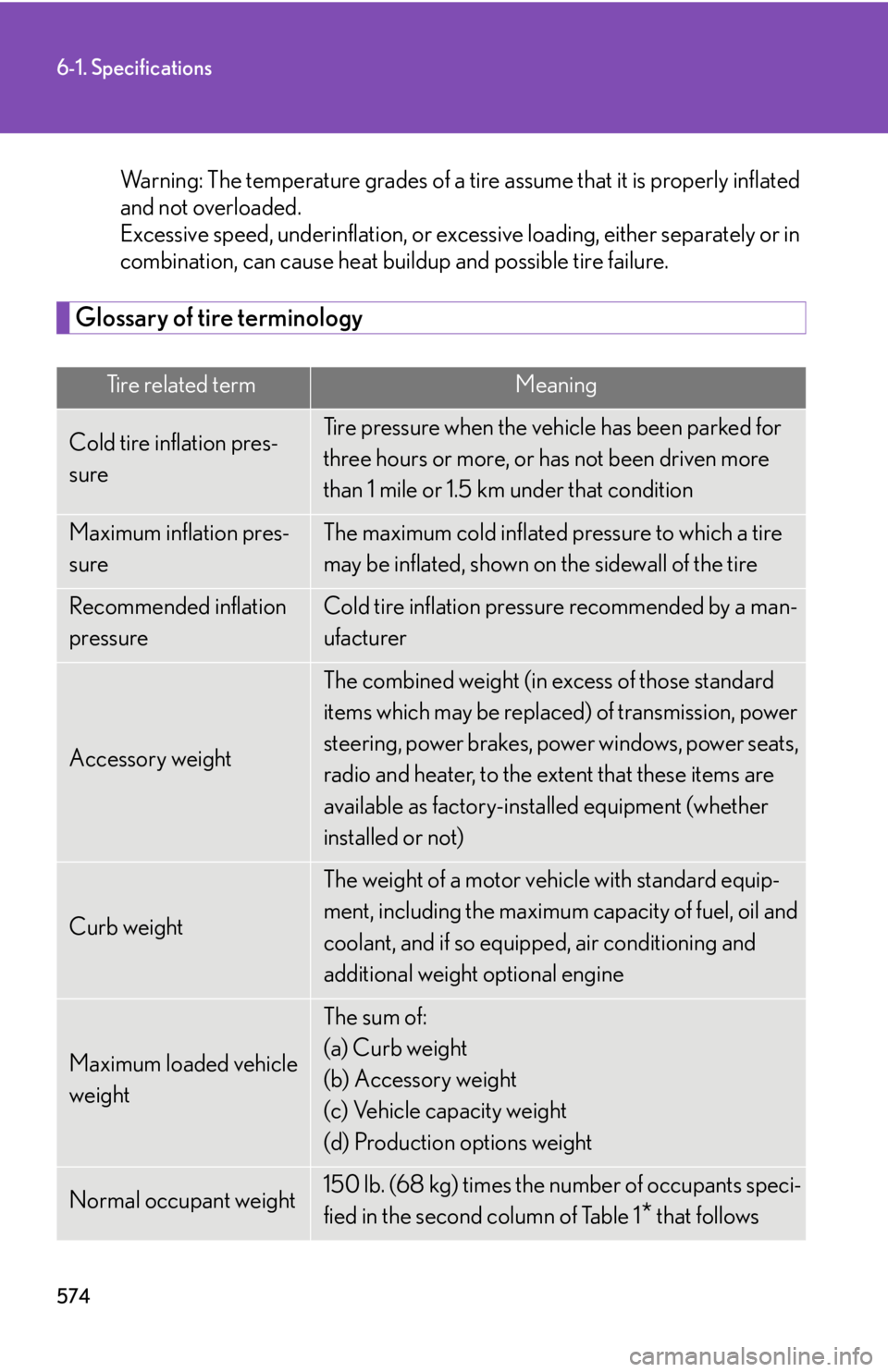
Glossary of tire terminology
Tire related termMeaning
Cold tire inflation pres-
sureTire pressure when the vehicle has been parked for
three hours or more, or has not been driven more
than 1 mile or 1.5 km under that condition
Maximum inflation pres-
sureThe maximum cold inflated pressure to which a tire
may be inflated, shown on the sidewall of the tire
Recommended inflation
pressureCold tire inflation pressure recommended by a man-
ufacturer
Accessory weight
The combined weight (in excess of those standard
items which may be replaced) of transmission, power
steering, power brakes, power windows, power seats,
radio and heater, to the extent that these items are
available as factory-installed equipment (whether
installed or not)
Curb weight
The weight of a motor vehicle with standard equip-
ment, including the maximum capacity of fuel, oil and
coolant, and if so equipp ed, air conditioning and
additional weight optional engine
Maximum loaded vehicle
weight
The sum of:
(a) Curb weight
(b) Accessory weight
(c) Vehicle capacity weight
(d) Production options weight
Normal occupant weight150 lb. (68 kg) times the number of occupants speci-
fied in the second column of Table 1
* that follows
Page 622 of 628

622
Alphabetical index
Warning buzzersBrake system .......................................498
Open door ........................................... 501
Seat belt reminder.............................. 501
Warning lights AFS OFF................................................ 499
Anti-lock brake system................... 499
Brake assist system........................... 499
Brake system .......................................498
Charging system ...............................498
Cruise control ..................................... 499
Electric power steering warning light ..................................... 499
Electronic engine control system .................................................. 499
High coolant temperature ............498
Hybrid battery system ..................... 499
LKA........................................................... 499
Low fuel level ........................................ 501
Low tire pressure................................ 501
Malfunction indicator lamp........... 499
Master warning light ......................... 501
Open door ............................................ 501
Pre-collision system ......................... 499
Pretensioner ......................................... 499
Radar cruise control......................... 499
Seat belt reminder light ................... 501
Slip indicator ........................................ 499
SRS airbags .......................................... 499
Tire pressure warning light ............ 501 Warning messages
Cruise control .....................................508
Dynamic radar cruise control ........................................508, 511
Electric power steering system..................................................508
Engine oil maintenance......................511
Engine oil pressure........................... 507
EV drive mode .......................................511
Headlight ...............................................508
Hood ...........................................................511
Hybrid system..................................... 507
Intuitive parking assist ............508, 511
Key .............................................................. 519
Lane-Keeping Assist ...........................511
Moon roof.................................................511
Open door ...............................................511
Parking brake..........................................511
Pre-collision system................508, 511
Smart access system with push start.............................................. 519
Tire pressure warning system......................................................511
Trunk............................................................511
Washer fluid ............................................511
Washer Checking............................................... 438
Preparing and checking before winter.....................................249
Switch ........................................................198
Washing and waxing...........................408W