brake light Lexus HS250h 2011 Hybrid system / LEXUS 2011 HS250H (OM75037U) User Guide
[x] Cancel search | Manufacturer: LEXUS, Model Year: 2011, Model line: HS250h, Model: Lexus HS250h 2011Pages: 628, PDF Size: 10.69 MB
Page 189 of 628
189
2-3. Operating the lights and windshield wipers
2
When driving
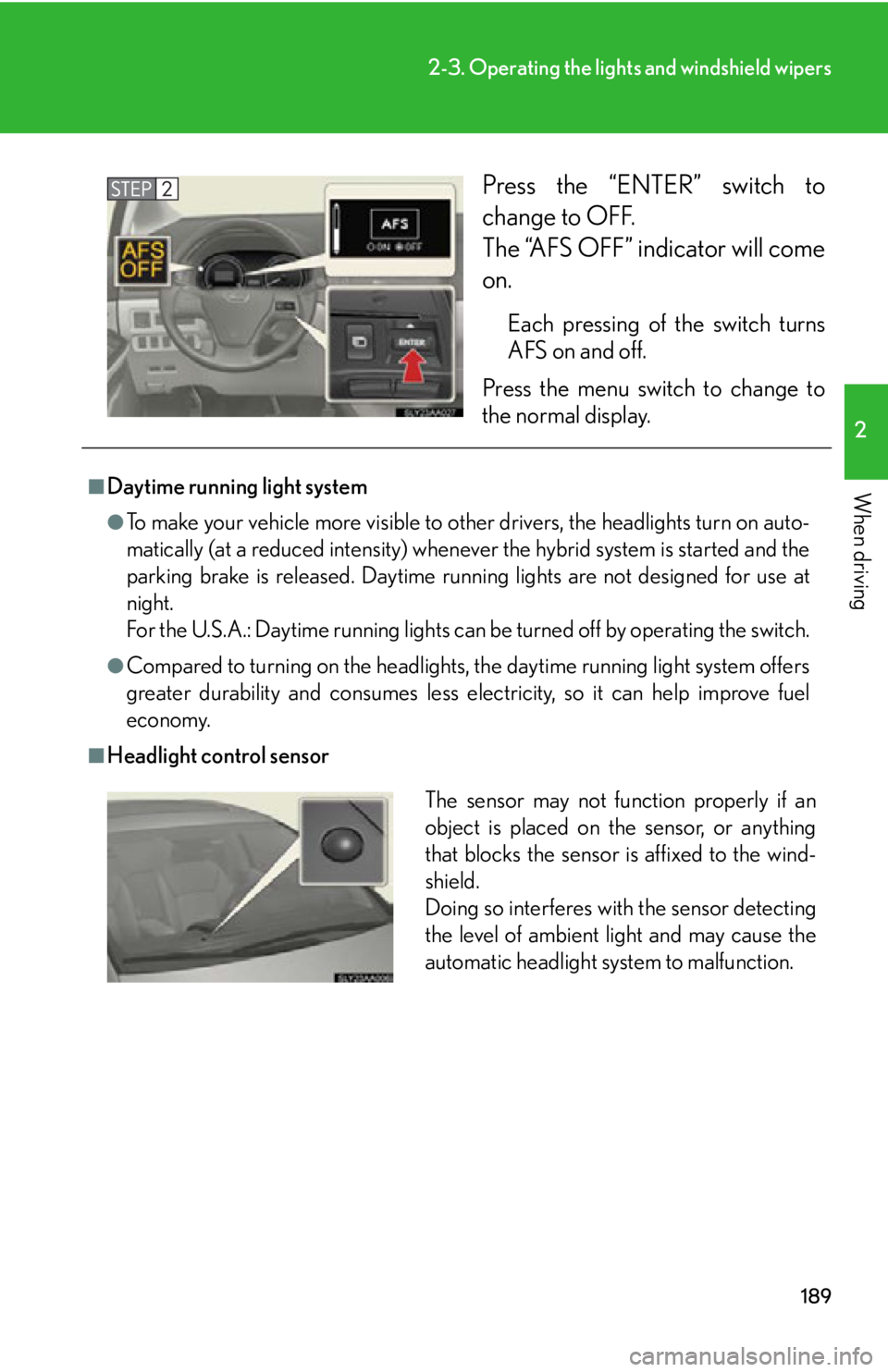
Press the “ENTER” switch to
change to OFF.
The “AFS OFF” indicator will come
on.
Each pressing of the switch turns
AFS on and off.
Press the menu switch to change to
the normal display.
■Daytime running light system
●To make your vehicle more visible to othe r drivers, the headlights turn on auto-
matically (at a reduced intensity) whenever the hybrid system is started and the
parking brake is released. Daytime running lights are not designed for use at
night.
For the U.S.A.: Daytime running lights can be turned off by operating the switch.
●Compared to turning on th e headlights, the daytime running light system offers
greater durability and consumes less electricity, so it can help improve fuel
economy.
■Headlight control sensor
The sensor may not function properly if an
object is placed on the sensor, or anything
that blocks the sensor is affixed to the wind-
shield.
Doing so interferes with the sensor detecting
the level of ambient light and may cause the
automatic headlight system to malfunction.
Page 220 of 628

220
2-4. Using other driving systems
CAUTION
■Conditions under which the vehicle-to-vehicle distance control may not function
correctly
Apply the brakes as necessary in the following conditions as the radar sensor may
not be able to correctly detect vehicles ahead, and a fatal or serious accident may
result:
●When water or snow thrown up by the surrounding vehicles hinders the function-
ing of the sensor
●When your vehicle is pointing upwards (c aused by a heavy load in the trunk etc.)
●When the road curves or when the lanes are narrow
●When steering wheel operation or your position in the lane is unstable
●When the vehicle ahead of you decelerates suddenly
■Handling the radar sensor
Observe the following to ensure the cruise control system can function effectively.
Otherwise, the system may not function correctly and could result in an accident.
●Keep the sensor and front grille cover clean at all times.
Clean the sensor and front grille cover with a soft cloth so you do not mark or
damage them.
●Do not subject the sensor or surrounding area to a strong impact.
If the sensor moves even slightly off position, the system may malfunction. If the
sensor or surrounding area is subject to a strong impact, always have the area
inspected and adjusted by a Lexus dealer.
●Do not disassemble the sensor.
●Do not attach accessories or stickers to the sensor, grille cover or surrounding
area.
●Do not modify or paint the sensor and grille cover.
●Do not replace them with non-genuine parts.
Page 231 of 628

231
2-4. Using other driving systems
2
When driving
■Turning off both TRAC and VSC systems
To turn the TRAC and VSC sys-
tems off, press and hold the button
for more than 3 seconds while the
vehicle is stopped.
A message will be shown on the
multi-information display and
“VSC OFF” indicator will come on.
Press the button again to turn the
systems back on.
■Sounds and vibrations caused by the ABS, brake assist, VSC and TRAC
●A sound may be heard from the engine compartment when the hybrid system is
started, just after the vehicle begins to move, if the brake pedal is depressed
forcefully or repeatedly, or 1-2 minutes after the hybrid system is stopped. This
sound does not indicate that a malfunction has occurred in any of these systems.
●Any of the following conditions may occur when the above systems are operat-
ing. None of these indicates that a malfunction has occurred.
• Vibrations may be felt through the vehicle body and steering.
• A motor sound may be heard after the vehicle comes to a stop.
• The brake pedal may pulsate slightly after the ABS is activated.
• The brake pedal may move down slightly after the ABS is activated.
■EPS operation sound
When the steering wheel is operated, a motor sound (whirring sound) may be
heard. This does not indicate a malfunction.
■Reactivation of the TRAC /VSC systems
Turning off the hybrid system after turning off the TRAC/VSC systems will automat-
ically reactivate them.
■Reactivation of the TRAC sy stem linked to vehicle speed
When only the TRAC system is turned off, the TRAC system will turn on when vehi-
cle speed increases. However, when both TRAC and VSC systems are turned off,
the systems will not turn on even when vehicle speed increases.
Page 234 of 628
234
2-4. Using other driving systems
Hill-start assist control
■Hill-start assist control can be operated when
●The shift position is in a position other than P.
●The parking brake is not applied.
●The accelerator pedal is not depressed.
■Hill-start assist control
●While hill-start assist control is operating, the brakes remain automatically
applied after the driver releases the br ake pedal. The stop lights and the high
mounted stoplight turn on.
●Hill-start assist control operates for about 2 seconds after the brake pedal is
released.
●If the slip indicator does not flash and the buzzer does not sound when the brake
pedal is further depressed, slightly redu ce the pressure on the brake pedal (do
not allow the vehicle to roll backward) and then firmly depress it again. If the sys-
tem still does not operate, check if th e operating conditions explained above
have been met.
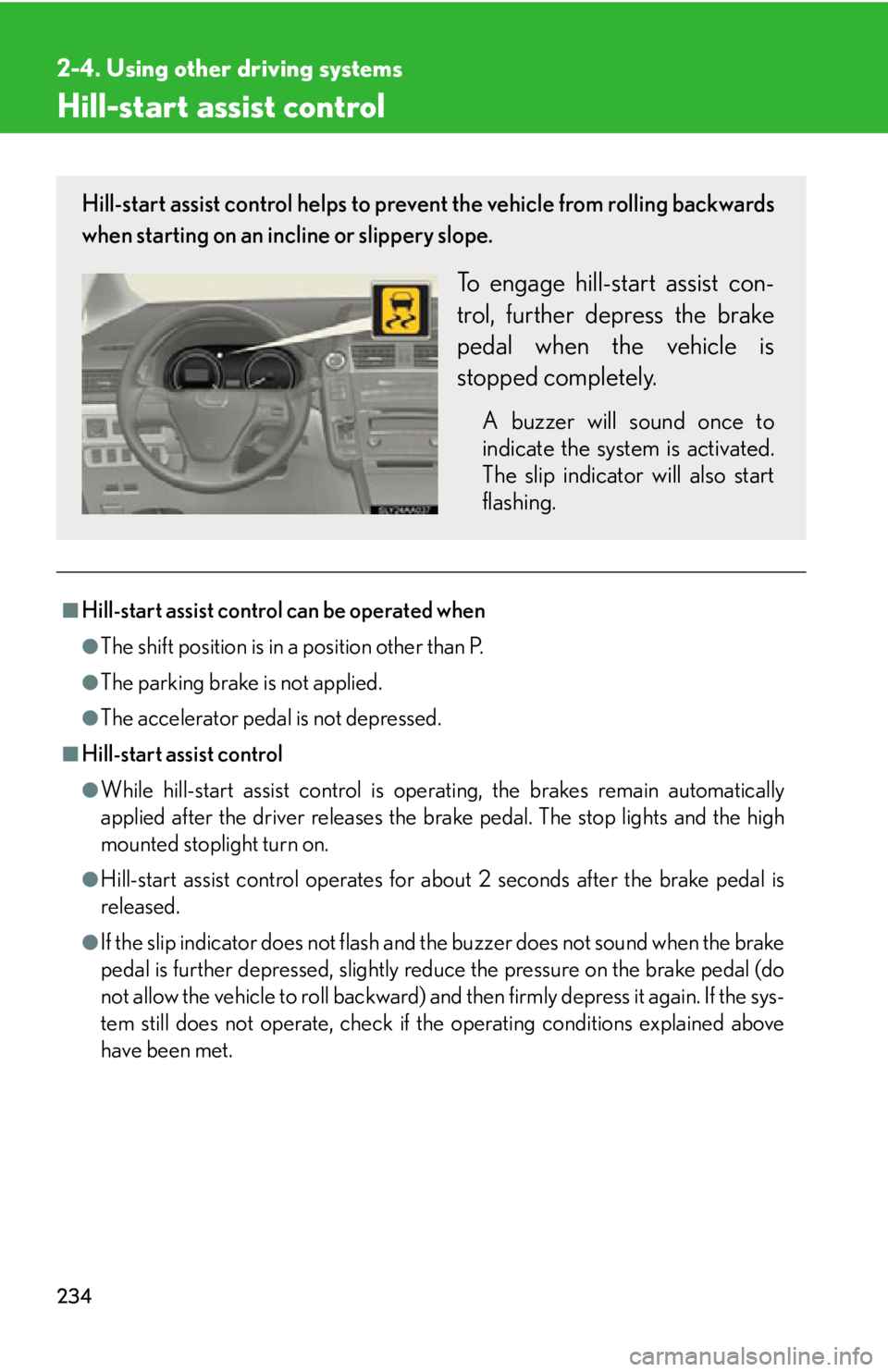
Hill-start assist control helps to prevent the vehicle from rolling backwards
when starting on an incline or slippery slope.
To engage hill-start assist con-
trol, further depress the brake
pedal when the vehicle is
stopped completely.
A buzzer will sound once to
indicate the system is activated.
The slip indicator will also start
flashing.
Page 236 of 628
236
2-4. Using other driving systems
Pre-Collision System
: If equipped
When the radar sensor detects possibilit y of a frontal collision, the pre-col-
lision system such as the brakes and seat belts are automatically engaged
to lessen impact and injuries to occupants as well as vehicle damage.
■Pre-collision seat belts (front seat belts only)
If the pre-collision sensor detects that a collision is unavoidable, the pre-
collision system will retract the seat belt before the collision occurs.
The same will happen if the driver makes an emergency braking or loses
control of the vehicle. ( P. 7 5 )
However, when the VSC system is disabled, the system will not operate in
the event of skidding.
■ Pre-collision brake assist
When there is a high possibility of a frontal collision, the system applies
greater braking force in relation to how strongly the brake pedal is
depressed.
■Pre-collision braking
When there is a high possibility of a frontal collision, the system warns the
driver using a warning light, warning display* and buzzer. If the system
determines that a collision is unavoidable, the brakes are automatically
applied to reduce the collision speed. Pre-collision braking can be dis-
abled using the pre-collision braking off switch.
*: When the pre-collision braking system activates, “BRAKE!” will appear on the multi-information display and head-up display (if equipped), and
the warning light will begin flashing rapidly. ( P. 5 1 4 )
■Driver monitor system (if equipped)
When the system determines that there is a possibility of a frontal collision,
and the driver is not facing forward, PCS warnings are given in advance to
warn the driver. If the driver continue s to be not facing forward, and a high
possibility of a frontal collision is dete cted, PCS informs the driver of high
possibility of a frontal collision by perf orming slight braking to provide a
physically warning (pre-collision alert braking). ( P. 2 3 8 )
Page 243 of 628

243
2-4. Using other driving systems
2
When driving
CAUTION
■When the sensor may not be correctly detecting the vehicle ahead
Apply the brakes as necessary in any of the following situations.
●When water or snow thrown up by the surrounding vehicles hinders the function-
ing of the sensor
●When your vehicle is pointing upwards (caused by a heavy load in the luggage
compartment etc.)
●Vehicles that cut in suddenly
●Vehicles with small rear ends (tra ilers with no load on board etc.)
●Motorcycles traveling in the same lane
■Handling the radar sensor
Observe the following to ensure the pre-collision system can function effectively:
●Keep the sensor and front grille cover clean at all times.
Clean the sensor and front grille cover with a soft cloth so you do not mark or
damage them.
●Do not subject the sensor or surrounding area to a strong impact.
If the sensor moves even slightly off po sition, the system may become inaccurate
or malfunction. If the sensor or surround ing area is subject to a strong impact,
always have the area inspected an d adjusted by your Lexus dealer.
●Do not disassemble the sensor.
●Do not attach accessories or stickers to the sensor, grille cover or surrounding
area.
●Do not modify or paint the sensor and grille cover.
■Determining the direction the driver is fa cing (vehicles with driver monitor sen-
sor)
The direction the driver is facing may not be determined correctly if the following
conditions exist:
●There is an object between the driver mo nitor sensor and the driver’s face, such
as when the sensor is blocked.
●A part of the driver’s face is covered.
●The sensor or the driver’s face is exposed to intense light such as sunlight.
●The driving posture is improper.
Page 418 of 628

418
4-2. Maintenance
Vehicle interior
ItemsCheck points
Accelerator pedal
• The accelerator pedal should move smoothly (without uneven pedal
effort or catching).
Brake pedal
• Does the brake pedal move
smoothly?
• Does the brake pedal have appro- priate clearance from the floor?
( P. 5 6 2 )
• Does the brake pedal have the cor- rect amount of free play?
( P. 5 6 2 )
Brakes
• The vehicle should not pull to one
side when the brakes are applied.
• The brakes should work effectively.
• The brake pedal should not feel
spongy.
• The brake pedal should not get too close to the floor when the brakes
are applied.
Head restraints• Do the head restraints move
smoothly and lock securely?
Hybrid transmission “Park” mecha-
nism• Can the vehicle be held securely on an incline with the shift position
in P?
Indicators/buzzers• Do the indicators and buzzers function properly?
Lights
• Do all the lights come on?
• Are the headlights aimed cor-rectly? ( P. 4 7 3 )
Page 438 of 628

438
4-3. Do-it-yourself maintenance
Washer fluidIf any washer does not work or the
warning message appears on the
multi-information display, the
washer tank may be empty. Add
washer fluid.
NOTICE
■If the fluid level is low or high
It is normal for the brake fluid level to go down slightly as the brake pads wear out or
when the fluid level in the accumulator is high.
If the reservoir needs frequent refilling, there may be a serious problem.
CAUTION
■When adding washer fluid
Do not add washer fluid when the hybrid system is hot or operating as washer fluid
contains alcohol and may catch fire if spilled on the engine etc.
NOTICE
■Do not use any fluid other than washer fluid
Do not use soapy water or engine antifreeze instead of washer fluid.
Doing so may cause streaking on the vehicle’s painted surfaces.
■Diluting washer fluid
Dilute washer fluid with water as necessary.
Refer to the freezing temperatures listed on the washer fluid tank.
Page 441 of 628

441
4-3. Do-it-yourself maintenance
4
Maintenance and care
●When the 12-volt battery is reconnected, start the hybrid system, depress the
brake pedal and confirm that it is possible to shift into each shift position.
If the system will not start even after mult iple attempts, contact your Lexus dealer.
CAUTION
■Chemicals in the 12-volt battery
The 12-volt battery contains poisonous and corrosive sulfuric acid and may pro-
duce hydrogen gas which is flammable and explosive. To reduce the risk of death or
serious injury, take the following precautions while working on or near the 12-volt
battery:
●Do not cause sparks by touching the 12-volt battery terminals with tools.
●Do not smoke or light a match near the 12-volt battery.
●Avoid contact with eyes, skin and clothes.
●Never inhale or swallow electrolyte.
●Wear protective safety glasses when working near the 12-volt battery.
●Keep children away from the 12-volt battery.
■Where to safely charge the 12-volt battery
Always charge the 12-volt battery in an open area. Do not charge the 12-volt bat-
tery in a garage or closed room where there is insufficient ventilation.
■How to recharge the 12-volt battery
Only perform a slow charge (5 A or le ss). The 12-volt battery may explode if
charged at a quicker rate.
Page 464 of 628
464
4-3. Do-it-yourself maintenance
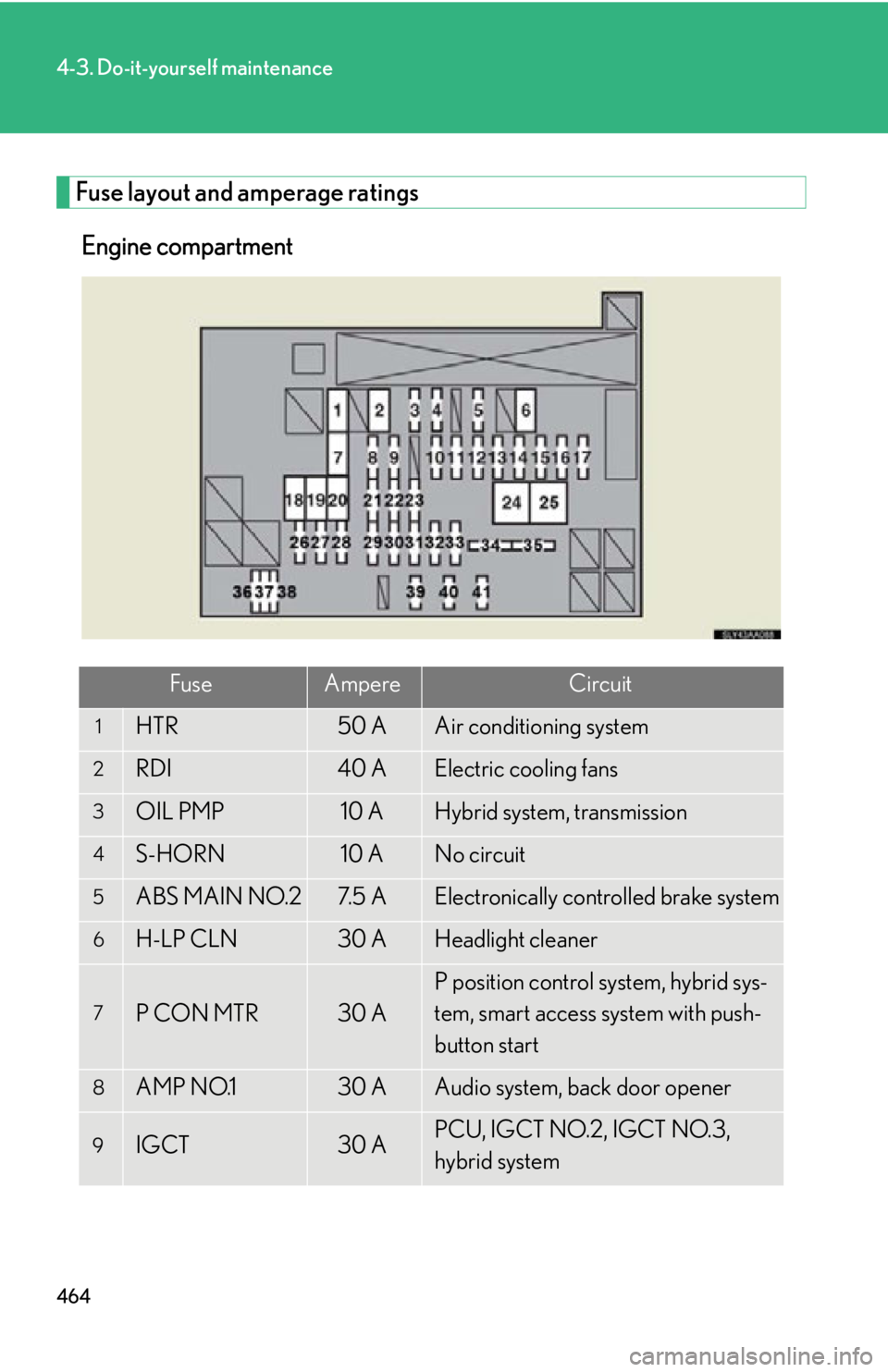
Fuse layout and amperage ratingsEngine compartment
FuseAmpereCircuit
1HTR50 AAir conditioning system
2RDI40 AElectric cooling fans
3OIL PMP10 AHybrid system, transmission
4S-HORN10 ANo circuit
5ABS MAIN NO.27. 5 AElectronically controlled brake system
6H-LP CLN30 AHeadlight cleaner
7P CON MTR30 A
P position control system, hybrid sys-
tem, smart access system with push-
button start
8AMP NO.130 AAudio system, back door opener
9IGCT30 APCU, IGCT NO.2, IGCT NO.3,
hybrid system