engine Lexus HS250h 2011 Hybrid system / LEXUS 2011 HS250H OWNERS MANUAL (OM75037U)
[x] Cancel search | Manufacturer: LEXUS, Model Year: 2011, Model line: HS250h, Model: Lexus HS250h 2011Pages: 628, PDF Size: 10.69 MB
Page 5 of 628

1
2
3
4
5
6
7
5
3-6. Using the storage featuresList of storage features............... 367
• Glove box ................................... 368
• Console box ................................ 369
• Cup holders.................................. 371
• Bottle holders ............................. 373
• Auxiliary boxes........................... 374
3-7. Other interior features Sun visors......................................... 375
Vanity mirrors ................................ 376
Clock ................................................. 377
Power outlets ................................. 378
Seat heaters and ventilators ..................................... 379
Armrest ............................................. 381
Rear sunshade .............................. 382
Floor mat......................................... 384
Trunk compartment features......................................... 386
Garage door opener................. 388
Compass.......................................... 396
Safety Connect ............................ 400 4-1. Maintenance and care
Cleaning and protecting the vehicle exterior.................. 408
Cleaning and protecting the vehicle interior ..................... 412
4-2. Maintenance Maintenance requirements ...... 415
General maintena nce .................. 417
Emission inspection and maintenance (I/M)
programs ....................................... 421
4-3. Do-it-yourself maintenance Do-it-yourself service precautions .................................. 422
Hood ................................................. 425
Positioning a floor jack............... 426
Engine compartment.................. 428
12-volt battery................................ 439
Tires ................................................... 443
Tire inflation pressure.................. 451
Wheels ............................................. 454
Air conditioning filter.................. 456
Electronic key battery ................ 459
Checking and replacing fuses ................................................. 461
Headlight aim (LED headlights) ....................... 473
Light bulbs ....................................... 475
4Maintenance and care
Page 24 of 628
24
1-1. Hybrid system
Hybrid system
Your vehicle is a hybrid vehicle. It has characteristics different from con-
ventional vehicles. Be sure you are clos ely familiar with the characteristics
of your vehicle, and operate with care.
The hybrid system combines the use of a gasoline engine and an electric
motor (traction motor) according to driving conditions, improving fuel effi-
ciency and reducing exhaust emissions.
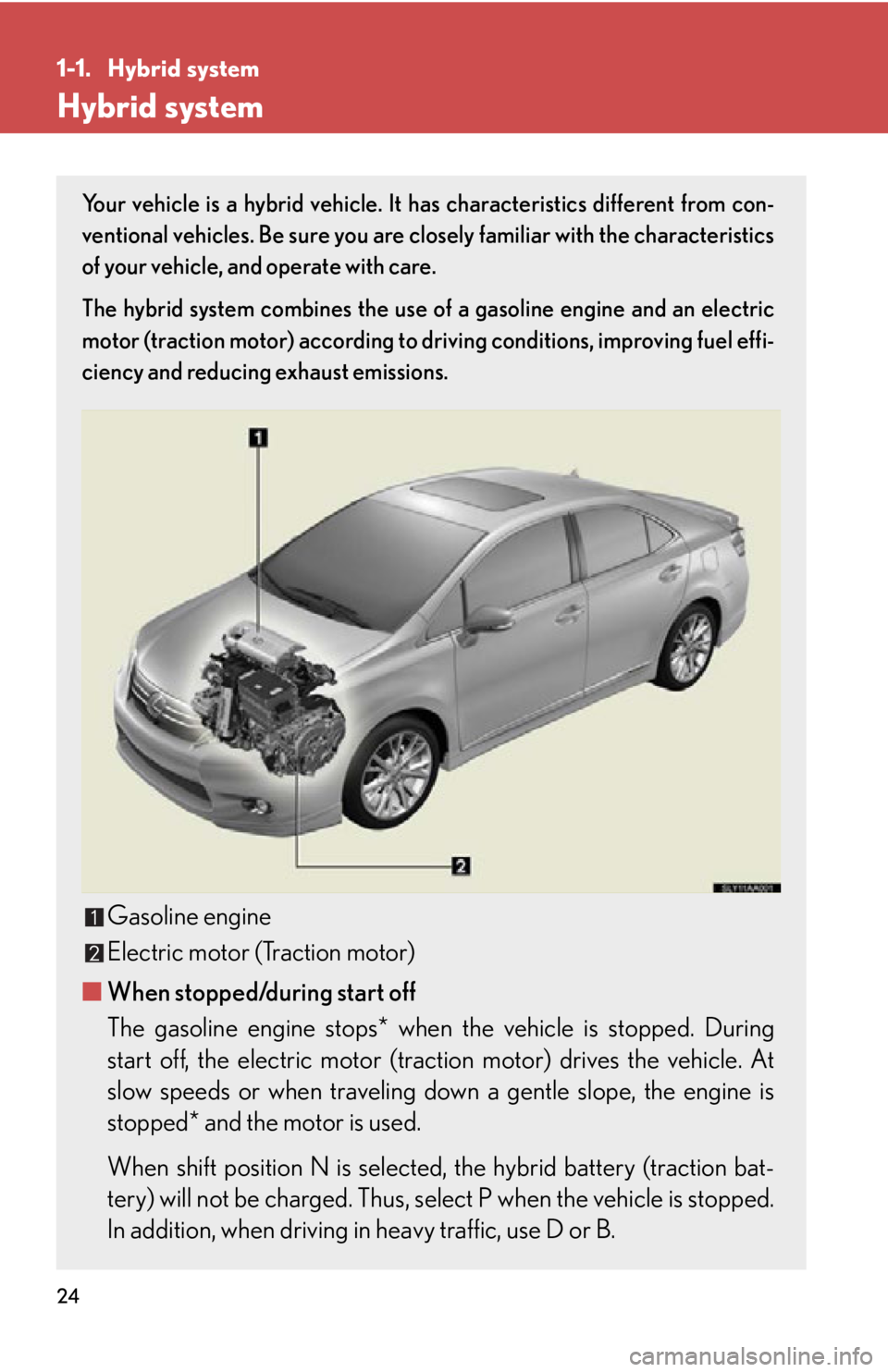
Gasoline engine
Electric motor (Traction motor)
■ When stopped/during start off
The gasoline engine stops* when the vehicle is stopped. During
start off, the electric motor (traction motor) drives the vehicle. At
slow speeds or when traveling down a gentle slope, the engine is
stopped* and the motor is used.
When shift position N is selected, the hybrid battery (traction bat-
tery) will not be charged. Thus, sele ct P when the vehicle is stopped.
In addition, when driving in heavy traffic, use D or B.
Page 25 of 628
25
1-1. Hybrid system
1
Before driving
■Regenerative braking
In the following situations, kinetic energy is converted to electric energy and decel-
eration force can be obtained in conjunction with the recharging of the hybrid bat-
tery (traction battery).
●The accelerator pedal is released while driving with shift position D or B
selected.
●The brake pedal is depressed while driving with shift position D or B selected.
■Conditions in which the gasoline engine may not stop
The gasoline engine starts and stops automatically. However, it may not stop auto-
matically in the following conditions:
●During gasoline engine warm-up
●During hybrid battery (traction battery) charging
●When the temperature of the hybrid battery (traction battery) is high or low
●When the heater is switched on
*: However, when the hybrid battery (traction battery) need to be
charged or while the engine is being warmed up, the gasoline
engine may not stop automatically.
■ During normal driving
The gasoline engine is predomina ntly used. The electric motor
(traction motor) charges the hybrid battery as necessary.
■ When accelerating sharply
The power of the hybrid battery (tract ion battery) is added to that of
the gasoline engine via the electric motor (traction motor).
■ When braking (regenerative braking)
The electric motor (traction moto r) charges the hybrid battery
(traction battery).
Page 26 of 628

26
1-1. Hybrid system
■Charging the battery
As the gasoline engine charges the hybrid battery (traction battery), the battery
does not need to be charged from an outside source. However, if the vehicle is left
parked for a long time the hybrid battery will slowly discharge. For this reason, be
sure to drive the vehicle at least once every few months for at least 30 minutes or
10 miles (16 km). If the hybrid battery becomes fully discharged and you are unable
to jump-start the vehicle with the 12-v olt battery, contact your Lexus dealer.
■After the 12-volt battery has discharged or has been changed or removed
The gasoline engine may not stop even if the vehicle is running on the hybrid battery
(traction battery). If this continues for a few days, contact your Lexus dealer.
■Sounds and vibrations specific to a hybrid vehicle
There may be no engine sounds or vibrat ion even though the vehicle is able to
move. Always change the shift position to P, and apply the parking brake when
parked.
The following sounds or vibrations may occur when the hybrid system is operating
and are not a malfunction:
●Motor sounds may be heard fr om the engine compartment.
●Sounds may be heard from the hybrid ba ttery (traction battery) behind the rear
seats when the hybrid system starts or stops.
●Sounds from the hybrid system may be heard when the trunk lid is open.
●Sounds may be heard from the transaxle when the engine is started or stopped,
or while the engine is idling.
●Engine sounds may be heard when accelerating sharply.
●Sounds may be heard due to regenera tive braking when the brake pedal is
depressed and accelerator is loosened.
●Other sounds, such as motors and mechanical noises, may be heard from the
brake system when the brake pedal is depressed.
●Vibration may be felt when the gasoline engine starts or stops.
●Cooling fan sounds may be heard from the air intake vent on the side of rear left
seatback.
When driving in Eco drive mode, the fan noise may be louder than when driving
normally.
Page 35 of 628
35
1-1. Hybrid system
1
Before driving
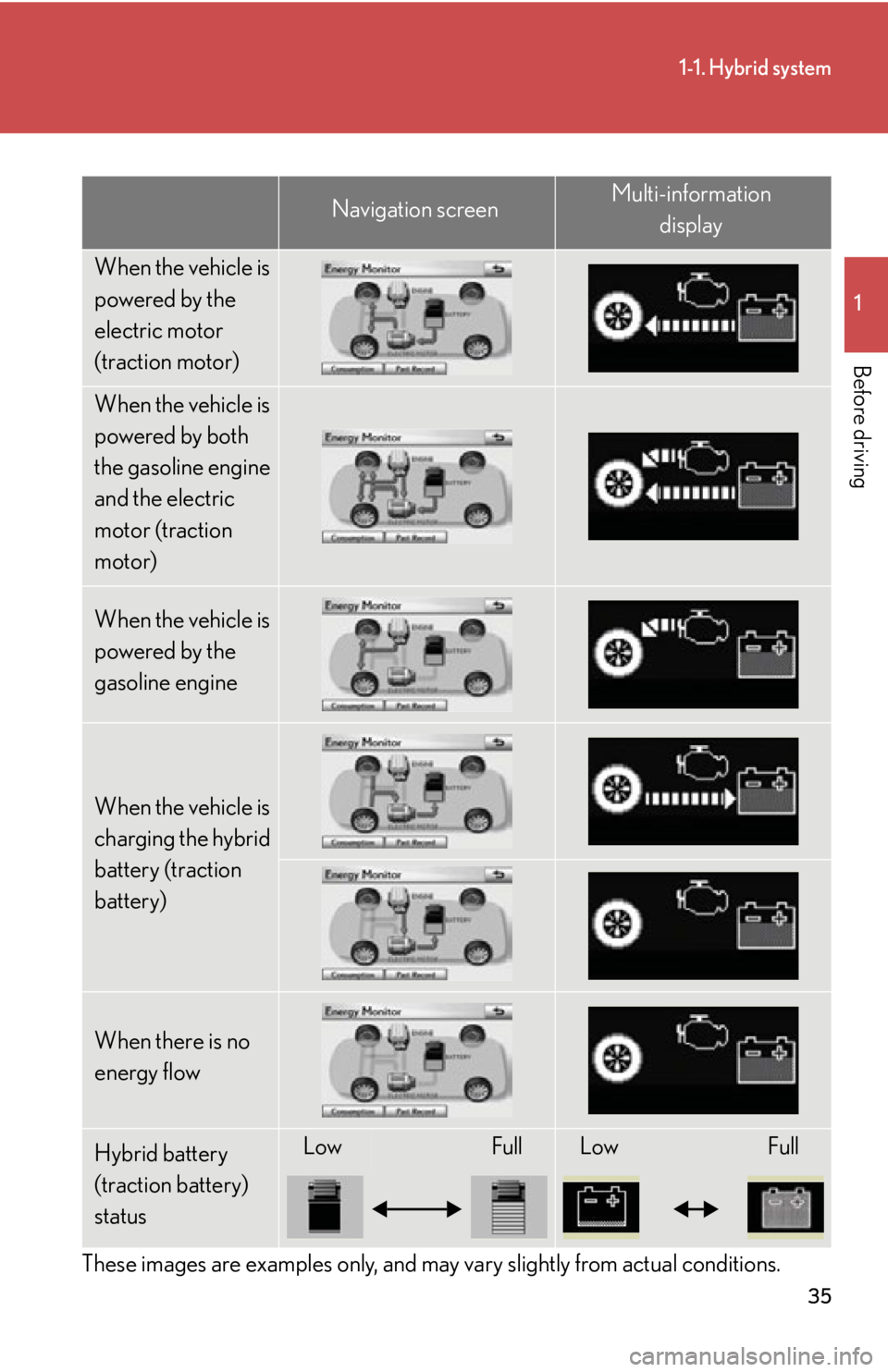
These images are examples only, and may vary slightly from actual conditions.
Navigation screenMulti-information display
When the vehicle is
powered by the
electric motor
(traction motor)
When the vehicle is
powered by both
the gasoline engine
and the electric
motor (traction
motor)
When the vehicle is
powered by the
gasoline engine
When the vehicle is
charging the hybrid
battery (traction
battery)
When there is no
energy flow
Hybrid battery
(traction battery)
statusLowFullLowFull
Page 39 of 628
39
1-1. Hybrid system
1
Before driving
■Air conditioning
Use the air conditioning only when necessary. Doing so can help control
excessive gasoline consumption.
In summer: In high temperatures, use the recirculated air mode. Doing so
will help to reduce the burden on the air conditioner and reduce fuel con-
sumption as well.
In winter: Because the gasoline engine will not automatically cut out until
the gasoline engine and the interior of the vehicle are warm, it will con-
sume fuel. Also, fuel consumption can be improved by avoiding overuse of
the heater.
■ Checking tire inflation pressure
Make sure to check the tire inflatio n pressure frequently. Improper tire
inflation pressure can cause poor fuel consumption.
Also, as snow tires can cause large amounts of friction, their use on dry
roads can lead to poor fuel consumptio n. Use a tire that is appropriate for
the season.
■ Luggage
Carrying heavy luggage can lead to poor fuel consumption. Avoid carry-
ing unnecessary luggage. Installing a large roof rack can also cause poor
fuel consumption.
■ Warming up before driving
Since the gasoline engine starts up and cuts out automatically when cold,
warming up the engine is unnecessary. Moreover, frequently driving short
distances will cause the engine to repeatedly warm up, which can lead to
poor fuel consumption.
Page 95 of 628
95
1-6. Refueling
1
Before driving
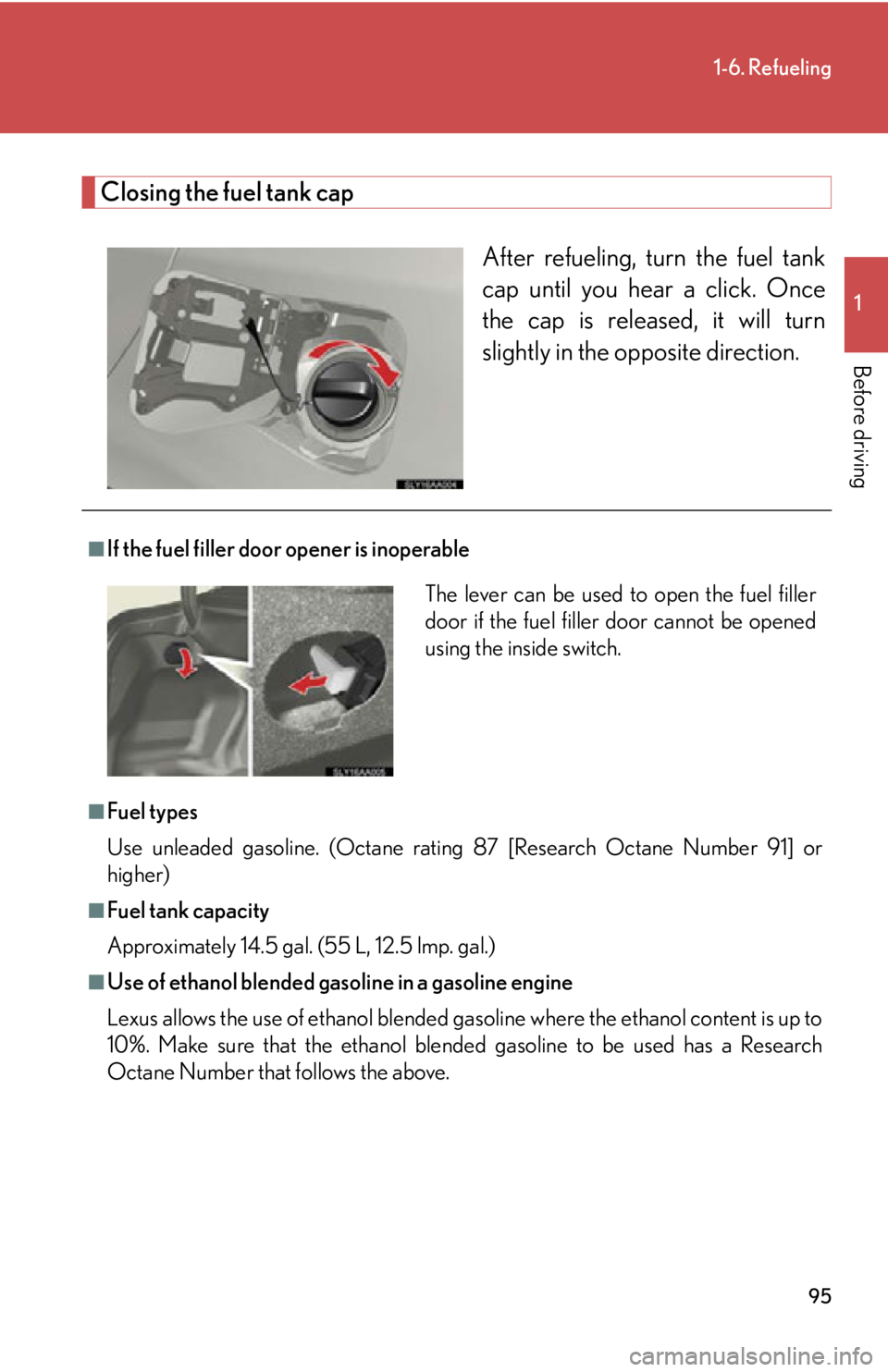
Closing the fuel tank capAfter refueling, turn the fuel tank
cap until you hear a click. Once
the cap is released, it will turn
slightly in the opposite direction.
■If the fuel filler door opener is inoperable
■Fuel types
Use unleaded gasoline. (Octane rating 87 [Research Octane Number 91] or
higher)
■Fuel tank capacity
Approximately 14.5 gal. (55 L, 12.5 lmp. gal.)
■Use of ethanol blended gasoline in a gasoline engine
Lexus allows the use of ethanol blended gasoline where the ethanol content is up to
10%. Make sure that the ethanol blended gasoline to be used has a Research
Octane Number that follows the above.
The lever can be used to open the fuel filler
door if the fuel filler door cannot be opened
using the inside switch.
Page 140 of 628
140
2-1. Driving procedures
■Operating your vehicle in a foreign country
Comply with the relevant vehicle registration laws and confirm the availability of the
correct fuel. (P. 5 5 8 )
■For efficient use
●Select the D position when driving.
In the N position, the gasoline engine op erates but electricity cannot be gener-
ated. The hybrid battery (traction battery) will discharge, requiring unnecessary
engine power to recharge.
●Drive your vehicle smoothly.
Avoid abrupt acceleration and deceleration. Gradual acceleration and decel-
eration will make more effective use of the electric motor (traction motor) with-
out having to use gasoline engine power.
●Avoid repeated acceleration.
Repeated acceleration consumes hybrid battery (traction battery) power,
resulting in poor acceleration. Battery power can be restored by driving with
the accelerator pedal slightly released.
●Select the P position when parking.
In the N position, the hybrid battery (traction battery) does not recharge.
Leaving the N position selected for an extended period of time may discharge
the hybrid battery. The vehicle cannot ru n if the hybrid battery is discharged.
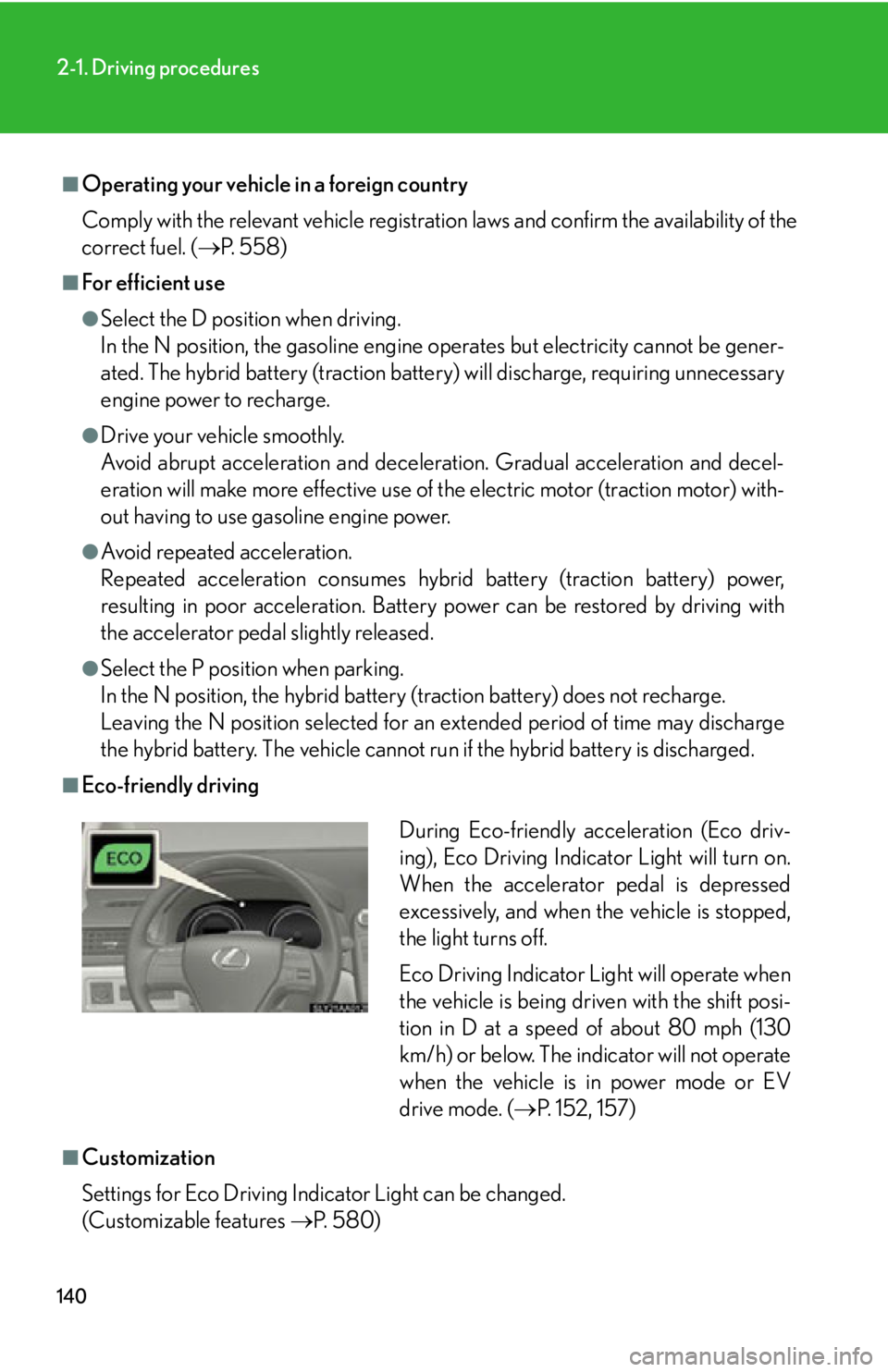
■Eco-friendly driving
■Customization
Settings for Eco Driving Indicator Light can be changed.
(Customizable features P. 5 8 0 )
During Eco-friendly acceleration (Eco driv-
ing), Eco Driving Indicator Light will turn on.
When the accelerator pedal is depressed
excessively, and when the vehicle is stopped,
the light turns off.
Eco Driving Indicator Li ght will operate when
the vehicle is being driven with the shift posi-
tion in D at a speed of about 80 mph (130
km/h) or below. The indicator will not operate
when the vehicle is in power mode or EV
drive mode. ( P. 1 5 2 ,
157)
Page 141 of 628

141
2-1. Driving procedures
2
When driving
CAUTION
■When starting the vehicle
Always keep your foot on the brake pedal while stopped with the hybrid system
operating. This prevents the vehicle from creeping.
■When driving the vehicle
●Do not drive if you are unfamiliar with the location of the brake and accelerator
pedals to avoid depressing the wrong pedal.
• Accidentally depressing the accelerator pedal instead of the brake pedal will
result in sudden acceleration that may le ad to an accident that could result in
death or serious injury.
• When backing up, you may twist your bo dy around, leading to a difficulty in
operating the pedals. Make sure to operate the pedals properly.
• Make sure to keep a correct driving posture even when moving the vehicle only slightly. This allows you to depress the brake and accelerator pedals
properly.
• Depress the brake pedal using your right foot. Depressing the brake pedal using your left foot may delay response in an emergency, resulting in an acci-
dent.
●The driver should pay extra attention to pedestrians when the vehicle is powered
only by the electric motor (traction motor). Because there is no engine noise, the
pedestrians may misjudge the vehicle’s movement.
●Do not drive the vehicle over or stop the vehicle near flammable materials.
The exhaust system and exhaust gases can be extremely hot. These hot parts may
cause a fire if there is any flammable material nearby.
●Do not let the vehicle roll backward whil e a forward driving position is selected,
or roll forward while R is selected.
Doing so may result in an acci dent or damage to the vehicle.
●If the smell of exhaust is noticed inside the vehicle, open the windows and check
that the trunk is closed. Large amounts of exhaust in the vehicle can cause driver
drowsiness and an accident, resulting in death or a serious health hazard. Have
the vehicle inspected by your Lexus dealer immediately.
Page 142 of 628

142
2-1. Driving procedures
CAUTION
●Do not select shift position R when the vehicle is rolling forward, do not select D
when moving in reverse, and do not press the P position switch before the vehicle
stops fully. Doing so will cause the buzzer to sound and the shift position to
change to N. In addition, excessive forc e will be applied to the powertrain and
damage may result.
●Do not change the shift position to N while the vehicle is moving.
Doing so may cause insufficient engine braking, resulting in an accident.
●Do not turn the hybrid system off while driving.
The power steering and brake actuator will not operate properly if the hybrid sys-
tem is off.
●Use engine braking (shift position B) to maintain a safe speed when driving down
a steep hill.
Using the brakes continuously may cause the brakes to overheat and lose effec-
tiveness. ( P. 1 5 5 )
●Do not adjust the positions of the steering wheel, the seat, or the inside or outside
rear view mirrors while driving.
Doing so may result in a loss of vehicle control that can cause accidents, resulting
in death or serious injury.
●Always check that all passengers' arms, heads or other parts of their body are not
outside the vehicle, as this may result in death or serious injury.
●Do not drive in excess of the speed limit. Even if the legal speed limit permits it, do
not drive over 85 mph (140 km/h) unless your vehicle has high-speed capability
tires. Driving over 85 mph (140 km/h) may result in tire failure, loss of control and
possible injury. Be sure to consult a tire dealer to determine whether the tires on
your vehicle are high-speed capability tires or not before driving at such speeds.
■When driving on slippery road surfaces
●Sudden braking, acceleration and steer ing may cause tire slippage and reduce
your ability to control the vehi cle, resulting in an accident.
●Abrupt changes from shift position D to B and rapid changes in the engine speed
could cause the vehicle to skid, resulting in an accident.
●After driving through a pudd le, lightly depress the brake pedal to make sure that
the brakes are functioning properly. Wet brake pads may prevent the brakes from
functioning properly. If the brakes on on ly one side are wet and not functioning
properly, steering control may be af fected, resulting in an accident.