brakes Lexus HS250h 2012 Owner's Guide
[x] Cancel search | Manufacturer: LEXUS, Model Year: 2012, Model line: HS250h, Model: Lexus HS250h 2012Pages: 630, PDF Size: 16.1 MB
Page 500 of 630
5
When trouble arises
499
5-1. Essential information
HS250h_U_75050U
■Before emergency towingTurn the “POWER” switch to ON mode. ( →P. 1 5 3 )
Do not turn the “POWER” switch to ACCESSORY mode.
Release the parking brake.
Change the shift position to N.
When the “POWER” switch is in ACCESSORY mode, the shift position
cannot be changed to N.
■Emergency towing eyelet location
→ P. 5 3 2
CAUTION
■Caution while towing
●Use extreme caution when towing the vehicle.
Avoid sudden starts or erratic driving maneuvers which would place excessive
stress on the emergency towing eyelets and the cables or chains. Always be cau-
tious of the surroundings and other vehicles while towing.
●Do not turn off the power switch.
This may lead to accidents as the parking lock will be engaged.
●If the hybrid system is off, the power assist for the brakes and steering will not
function, making steering and braking more difficult.
■Installing towing eyelets to the vehicle
Make sure that the towing eyelets are installed securely.
If not securely installed, the towing eyelets may come loose during towing. This may
lead to accidents that cause serious injury or even death.
Page 510 of 630
5
When trouble arises
509
5-2. Steps to take in an emergency
HS250h_U_75050U
■If the tire pressure warning light frequently comes on after blinking for 1 minute
If the tire pressure warning light frequently comes on after blinking for 1 minute
when the “POWER” switch is turned to ON mode, have it checked by your Lexus
dealer.
■Customization that can be configured at Lexus dealer
The vehicle speed linked seat belt reminder buzzer can be disabled.
(Customizable features →P. 5 8 4 )
CAUTION
■When the electric power steering system warning light comes on
The steering wheel may become extremely heavy.
If the steering wheel becomes heavier than usual when operating, hold firmly and
operate it using more force than usual.
■If the tire pressure warning light comes on
Be sure to observe the following precautions. Failure to do so could cause loss of
vehicle control and result in death or serious injury.
●Stop your vehicle in a safe place as soon as possible. Adjust the tire inflation pres-
sure immediately.
●If the tire pressure warning light comes on even after tire inflation pressure adjust-
ment, it is probable that you have a flat tire. Check the tires. If a tire is flat, change
it with the spare tire and have the flat tire repaired by the nearest Lexus dealer.
●Avoid abrupt maneuvering and braking. If the vehicle tires deteriorate, you could
lose control of the steering wheel or the brakes.
■If a blowout or sudden air leakage should occur
The tire pressure warning system may not activate immediately.
Page 521 of 630
520
5-2. Steps to take in an emergency
HS250h_U_75050U
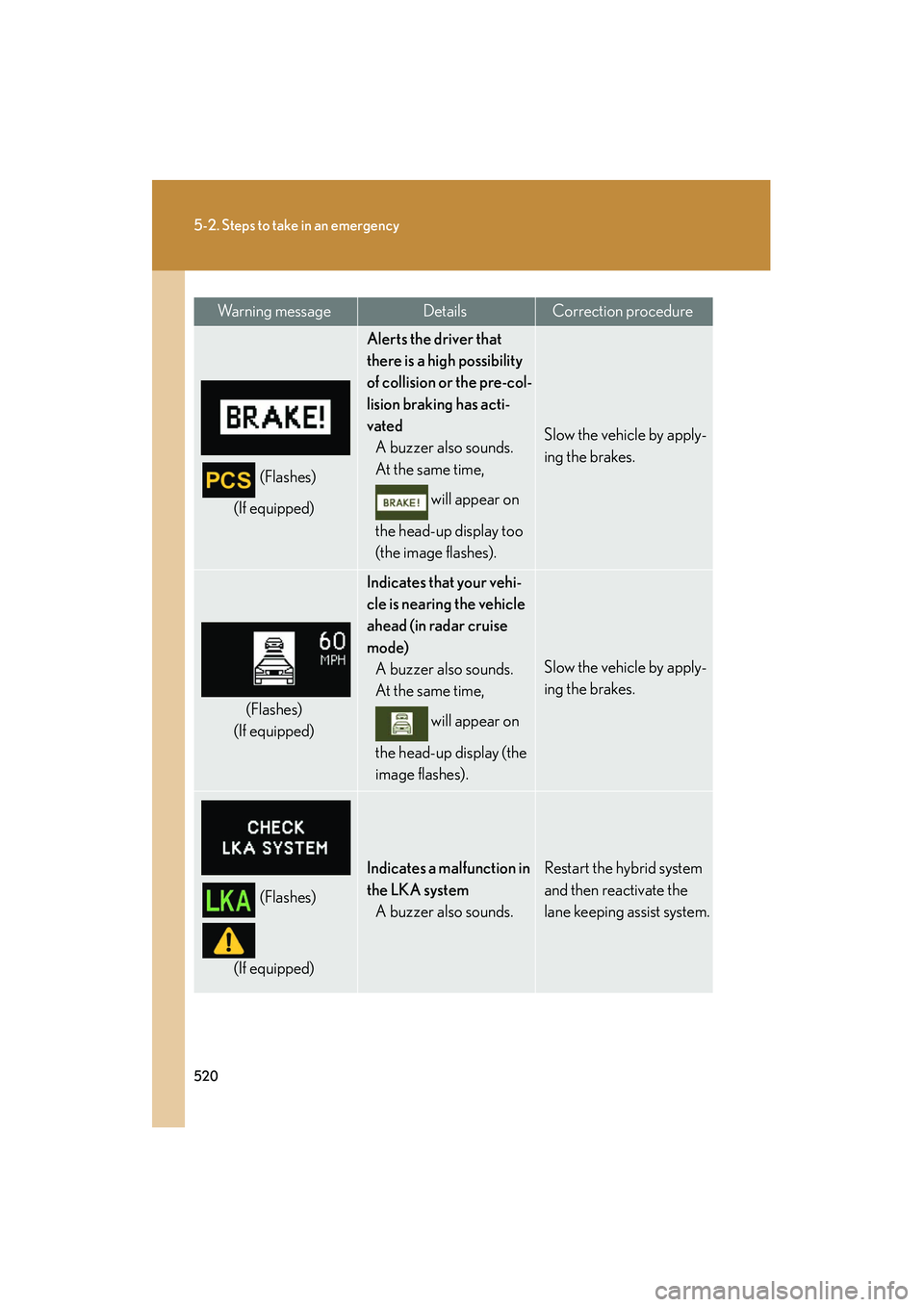
(Flashes)
(If equipped)
Alerts the driver that
there is a high possibility
of collision or the pre-col-
lision braking has acti-
vated A buzzer also sounds.
At the same time,
will appear on
the head-up display too
(the image flashes).
Slow the vehicle by apply-
ing the brakes.
(Flashes)
(If equipped)
Indicates that your vehi-
cle is nearing the vehicle
ahead (in radar cruise
mode) A buzzer also sounds.
At the same time,
will appear on
the head-up display (the
image flashes).
Slow the vehicle by apply-
ing the brakes.
(Flashes)
(If equipped)
Indicates a malfunction in
the LKA system A buzzer also sounds.Restart the hybrid system
and then reactivate the
lane keeping assist system.
Wa r n i n g m e s s a g eDetailsCorrection procedure
Page 540 of 630
5
When trouble arises
539
5-2. Steps to take in an emergency
HS250h_U_75050U
CAUTION
■Using the tire jack
Improper use of the tire jack may cause the vehicle to suddenly fall off the jack,
leading to death or serious injury.
●Do not use the tire jack for any purpose other than replacing tires or installing and
removing tire chains.
●Only use the tire jack that comes with this vehicle for replacing a flat tire.
Do not use it on other vehicles, and do not use other tire jacks for replacing tires
on this vehicle.
●Always check that the tire jack is securely set to the jack point.
●Do not put any part of your body under the vehicle while it is supported by the
jack.
●Do not start or run the hybrid system while your vehicle is supported by the jack.
●Do not raise the vehicle while someone is inside.
●When raising the vehicle, do not put an object on or under the jack.
●Do not raise the vehicle to a height greater than that required to replace the tire.
●Use a jack stand if it is necessary to get under the vehicle.
Take particular care when lowering the vehicle to ensure that no one working on or
near the vehicle may be injured.
■Replacing a flat tire
●Do not touch the disc wheels or the area around the brakes immediately after the
vehicle has been driven.
After the vehicle has been driven the disc wheels and the area around the brakes
will be extremely hot. Touching these areas with hands, feet or other body parts
while changing a tire, etc. may result in burns.
●Failure to follow these precautions could cause the wheel nuts to loosen and the
tire to fall off, resulting in death or serious injury.
• Never use oil or grease on the wheel bolts or wheel nuts. Oil and grease may cause the wheel nuts to be excessively tightened, leading
to bolt or disc wheel damage. In addition, the oil or grease can cause the
wheel nuts to loosen and the wheel may fall off, causing a serious accident.
Remove any oil or grease from the wheel bolts or wheel nuts.
Page 559 of 630
558
5-2. Steps to take in an emergency
HS250h_U_75050U
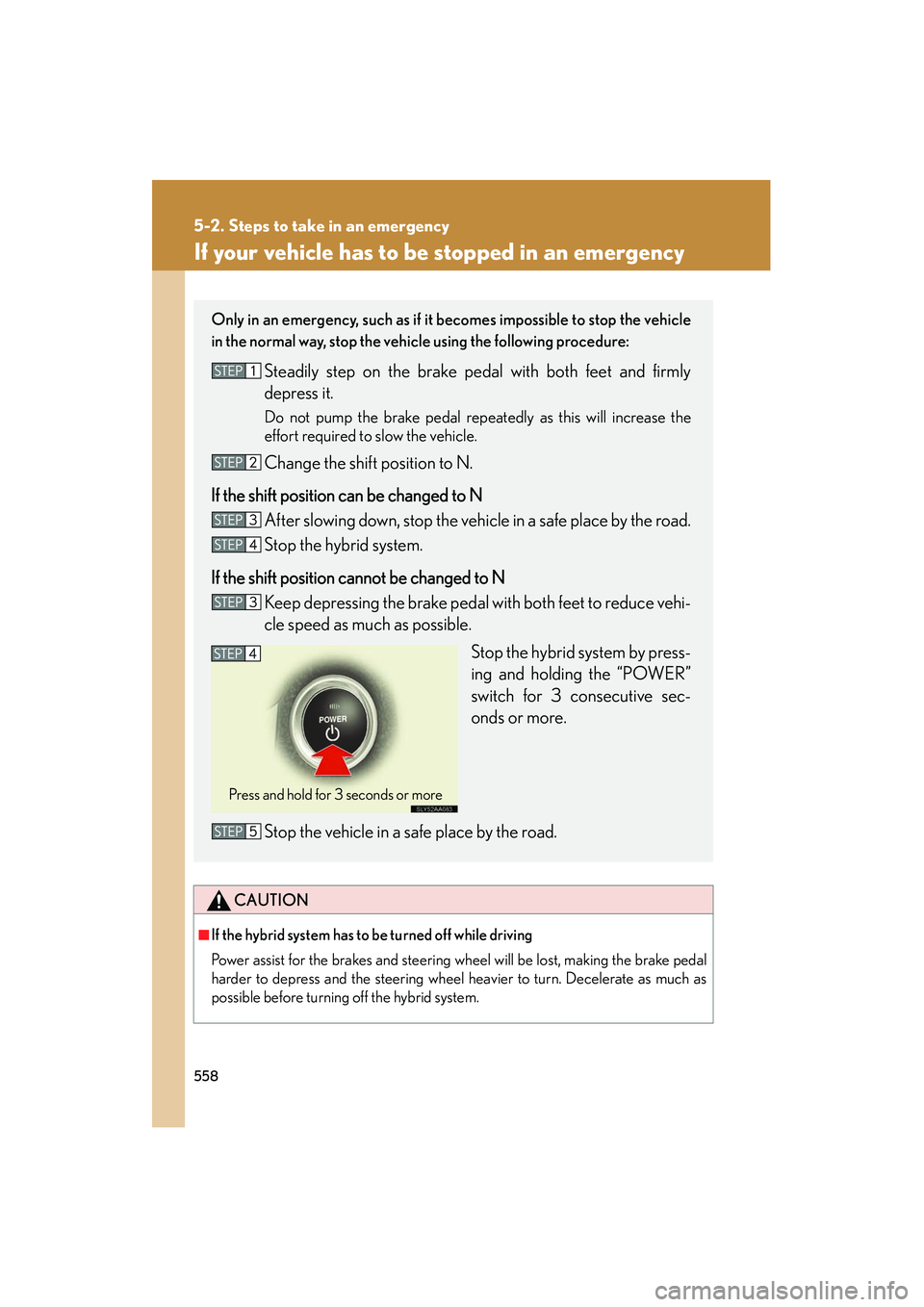
If your vehicle has to be stopped in an emergency
CAUTION
■If the hybrid system has to be turned off while driving
Power assist for the brakes and steering wheel will be lost, making the brake pedal
harder to depress and the steering wheel heavier to turn. Decelerate as much as
possible before turning off the hybrid system.
Only in an emergency, such as if it becomes impossible to stop the vehicle
in the normal way, stop the vehicle using the following procedure:
Steadily step on the brake pedal with both feet and firmly
depress it.
Do not pump the brake pedal repeatedly as this will increase the
effort required to slow the vehicle.
Change the shift position to N.
If the shift position can be changed to N After slowing down, stop the vehicle in a safe place by the road.
Stop the hybrid system.
If the shift position cannot be changed to N Keep depressing the brake pedal with both feet to reduce vehi-
cle speed as much as possible.
Stop the hybrid system by press-
ing and holding the “POWER”
switch for 3 consecutive sec-
onds or more.
Stop the vehicle in a safe place by the road.
Press and hold for 3 seconds or more
Page 567 of 630
566
6-1. Specifications
HS250h_U_75050U
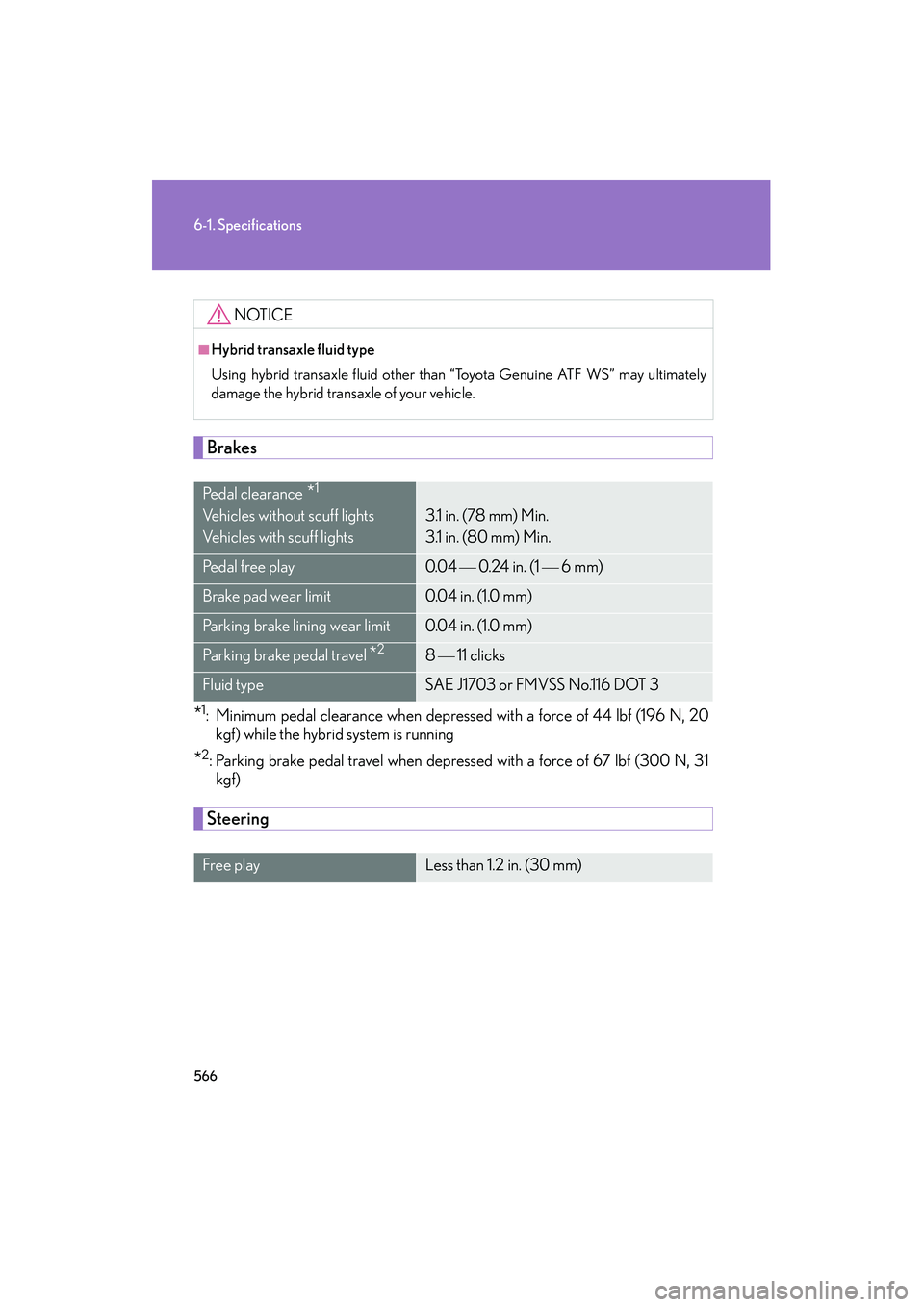
Brakes
*1: Minimum pedal clearance when depressed with a force of 44 lbf (196 N, 20
kgf) while the hybrid system is running
*2: Parking brake pedal travel when depressed with a force of 67 lbf (300 N, 31kgf)
Steering
NOTICE
■Hybrid transaxle fluid type
Using hybrid transaxle fluid other than “Toyota Genuine ATF WS” may ultimately
damage the hybrid transaxle of your vehicle.
Pe d a l c l e a r a n c e *1
Vehicles without scuff lights
Vehicles with scuff lights3.1 in. (78 mm) Min.
3.1 in. (80 mm) Min.
Pedal free play0.04 0.24 in. (1 6 mm)
Brake pad wear limit0.04 in. (1.0 mm)
Parking brake lining wear limit0.04 in. (1.0 mm)
Parking brake pedal travel *28 11 clicks
Fluid typeSAE J1703 or FMVSS No.116 DOT 3
Free playLess than 1.2 in. (30 mm)
Page 579 of 630
578
6-1. Specifications
HS250h_U_75050U
Warning: The temperature grades of a tire assume that it is properly inflated
and not overloaded.
Excessive speed, underinflation, or excessive loading, either separately or in
combination, can cause heat buildup and possible tire failure.
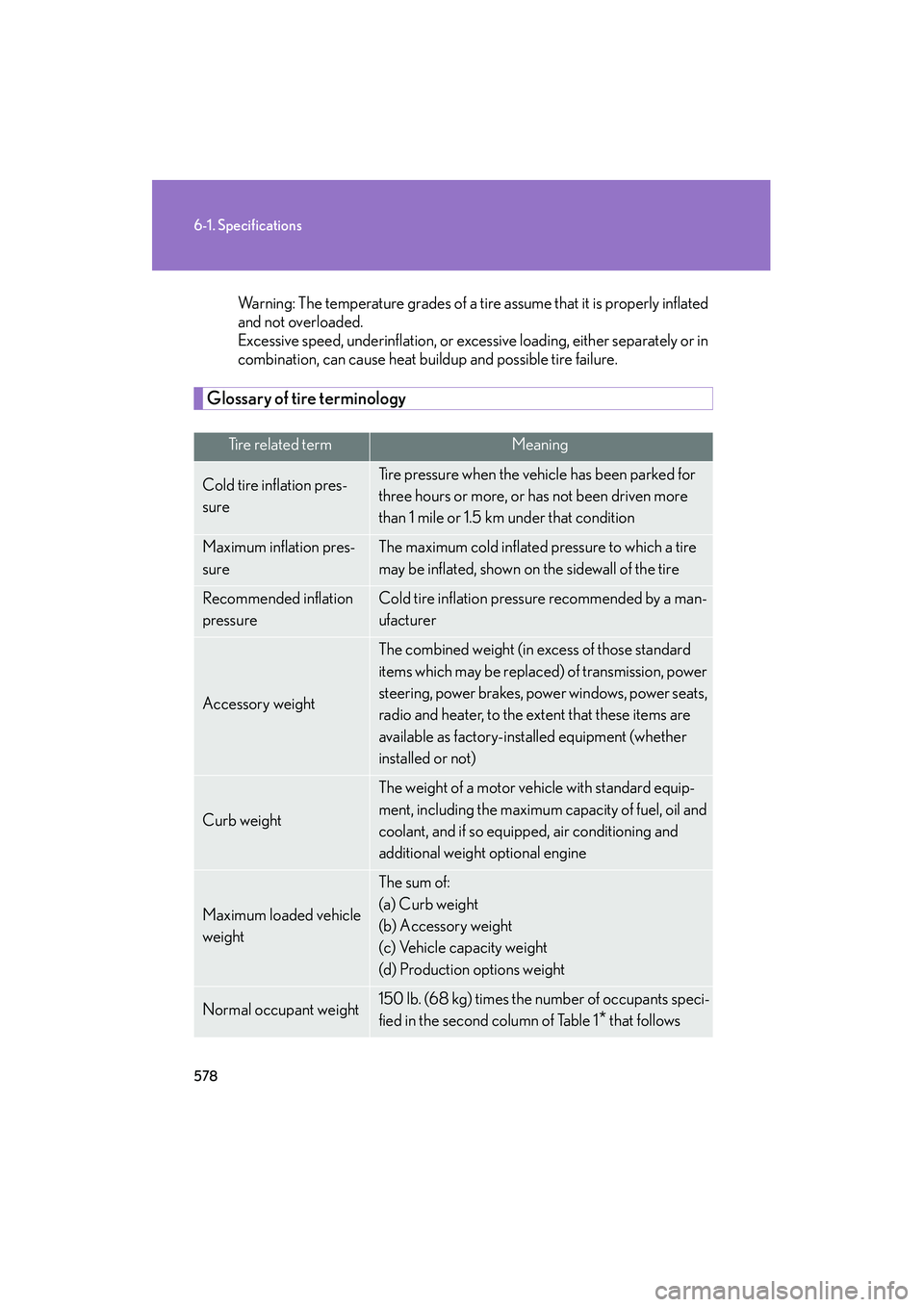
Glossary of tire terminology
Tire related termMeaning
Cold tire inflation pres-
sureTire pressure when the vehicle has been parked for
three hours or more, or has not been driven more
than 1 mile or 1.5 km under that condition
Maximum inflation pres-
sureThe maximum cold inflated pressure to which a tire
may be inflated, shown on the sidewall of the tire
Recommended inflation
pressureCold tire inflation pressure recommended by a man-
ufacturer
Accessory weight
The combined weight (in excess of those standard
items which may be replaced) of transmission, power
steering, power brakes, power windows, power seats,
radio and heater, to the extent that these items are
available as factory-installed equipment (whether
installed or not)
Curb weight
The weight of a motor vehicle with standard equip-
ment, including the maximum capacity of fuel, oil and
coolant, and if so equipped, air conditioning and
additional weight optional engine
Maximum loaded vehicle
weight
The sum of:
(a) Curb weight
(b) Accessory weight
(c) Vehicle capacity weight
(d) Production options weight
Normal occupant weight150 lb. (68 kg) times the number of occupants speci-
fied in the second column of Table 1
* that follows
Page 580 of 630
579
6-1. Specifications
6
Vehicle specifications
HS250h_U_75050U
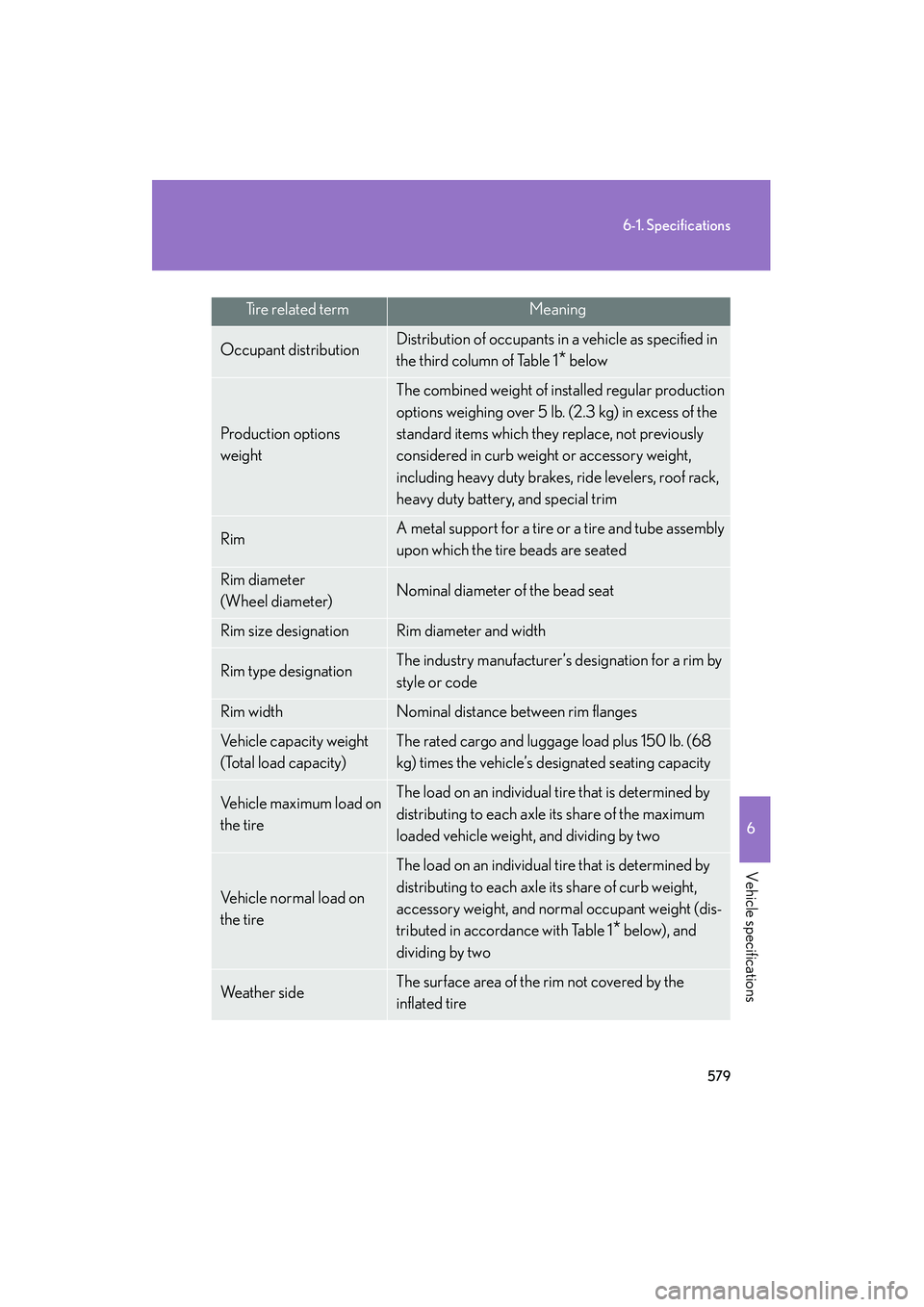
Occupant distributionDistribution of occupants in a vehicle as specified in
the third column of Table 1
* below
Production options
weight
The combined weight of installed regular production
options weighing over 5 lb. (2.3 kg) in excess of the
standard items which they replace, not previously
considered in curb weight or accessory weight,
including heavy duty brakes, ride levelers, roof rack,
heavy duty battery, and special trim
RimA metal support for a tire or a tire and tube assembly
upon which the tire beads are seated
Rim diameter
(Wheel diameter)Nominal diameter of the bead seat
Rim size designationRim diameter and width
Rim type designationThe industry manufacturer’s designation for a rim by
style or code
Rim widthNominal distance between rim flanges
Vehicle capacity weight
(Total load capacity)The rated cargo and luggage load plus 150 lb. (68
kg) times the vehicle’s designated seating capacity
Vehicle maximum load on
the tireThe load on an individual tire that is determined by
distributing to each axle its share of the maximum
loaded vehicle weight, and dividing by two
Vehicle normal load on
the tire
The load on an individual tire that is determined by
distributing to each axle its share of curb weight,
accessory weight, and normal occupant weight (dis-
tributed in accordance with Table 1
* below), and
dividing by two
We a t h e r s i d eThe surface area of the rim not covered by the
inflated tire
Ti r e r e l a t e d t e r mMeaning