service Lexus HS250h 2012 Owner's Guide
[x] Cancel search | Manufacturer: LEXUS, Model Year: 2012, Model line: HS250h, Model: Lexus HS250h 2012Pages: 630, PDF Size: 16.1 MB
Page 427 of 630
426
4-2. Maintenance
HS250h_U_75050U
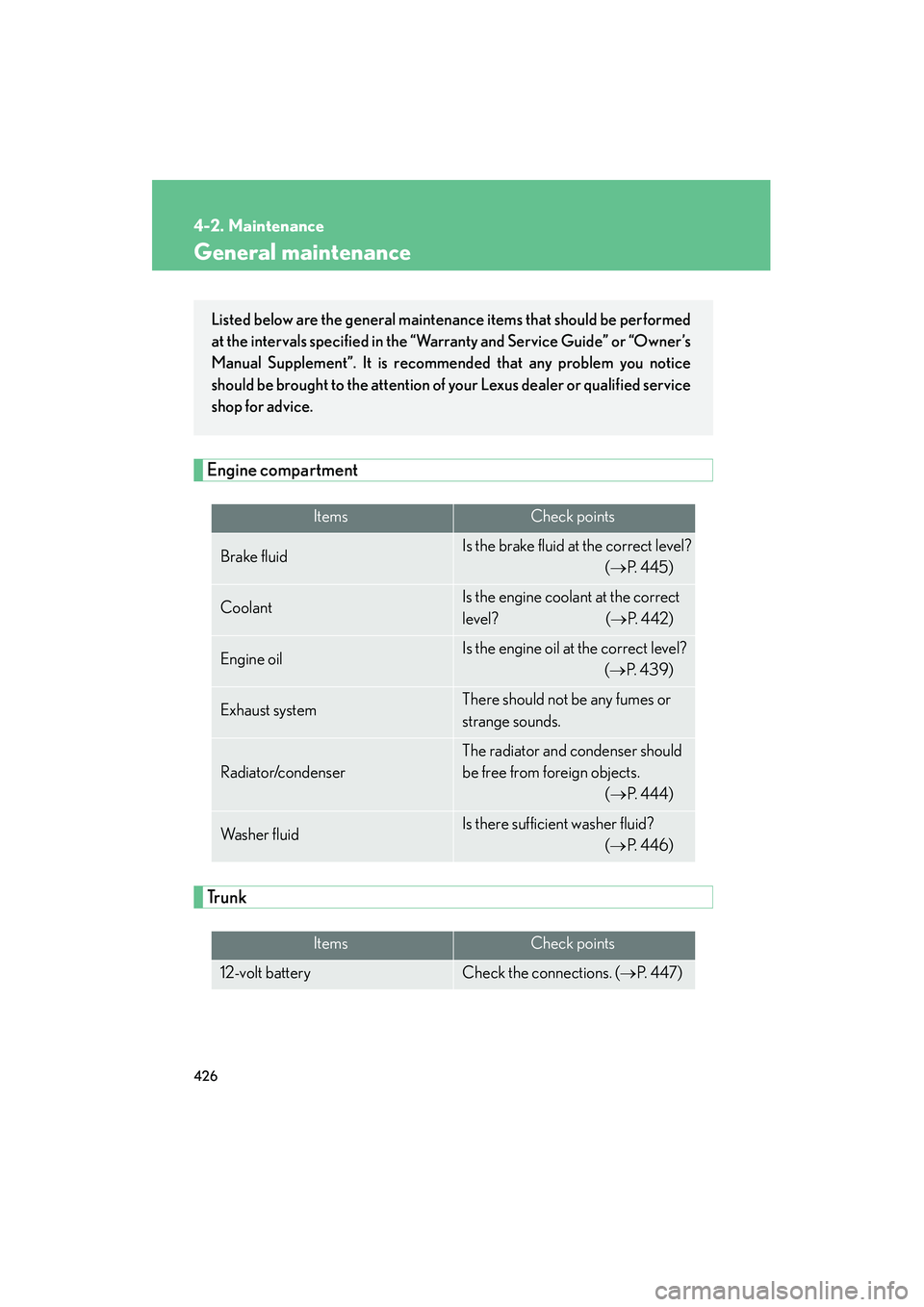
General maintenance
Engine compartment
Tr u n k
ItemsCheck points
Brake fluidIs the brake fluid at the correct level?(→ P. 4 4 5 )
CoolantIs the engine coolant at the correct
level? (→ P. 4 4 2 )
Engine oilIs the engine oil at the correct level?
(→ P. 4 3 9 )
Exhaust systemThere should not be any fumes or
strange sounds.
Radiator/condenser
The radiator and condenser should
be free from foreign objects.
(→ P. 444)
Wa s h e r f l u i dIs there sufficient washer fluid?
(→ P. 446)
ItemsCheck points
12-volt batteryCheck the connections. ( →P. 4 4 7 )
Listed below are the general maintenance items that should be performed
at the intervals specified in the “Warranty and Service Guide” or “Owner’s
Manual Supplement”. It is recommended that any problem you notice
should be brought to the attention of your Lexus dealer or qualified service
shop for advice.
Page 431 of 630
430
4-2. Maintenance
HS250h_U_75050U
Emission inspection and maintenance (I/M) programs
Some states have vehicle emission inspection programs which include
OBD (On Board Diagnostics) checks. The OBD system monitors the oper-
ation of the emission control system.
■If the malfunction indicator lamp comes on
The OBD system determines that a problem exists somewhere in
the emission control system. Your vehicle may not pass the I/M test
and may need to be repaired. Cont act your Lexus dealer to service
the vehicle.
■ Your vehicle may not pass the I/M test in the following situations:
● When the 12-volt battery is disconnected or discharged
Readiness codes that are set dur ing ordinary driving are erased.
Also, depending on your driving habits, the readiness codes may
not be completely set.
● When the fuel tank cap is loose
The malfunction indicator lamp comes on indicating a temporary
malfunction and your vehicle may not pass the I/M test.
■ When the malfunction indicator lamp still remains on after several
driving trips
The error code in the OBD system will not be cleared unless the
vehicle is driven 40 or more times.
■ If your vehicle does not pass the I/M test
Contact your Lexus dealer to prepare the vehicle for re-testing.
Page 432 of 630
431
4
Maintenance and care
HS250h_U_75050U
4-3. Do-it-yourself maintenance
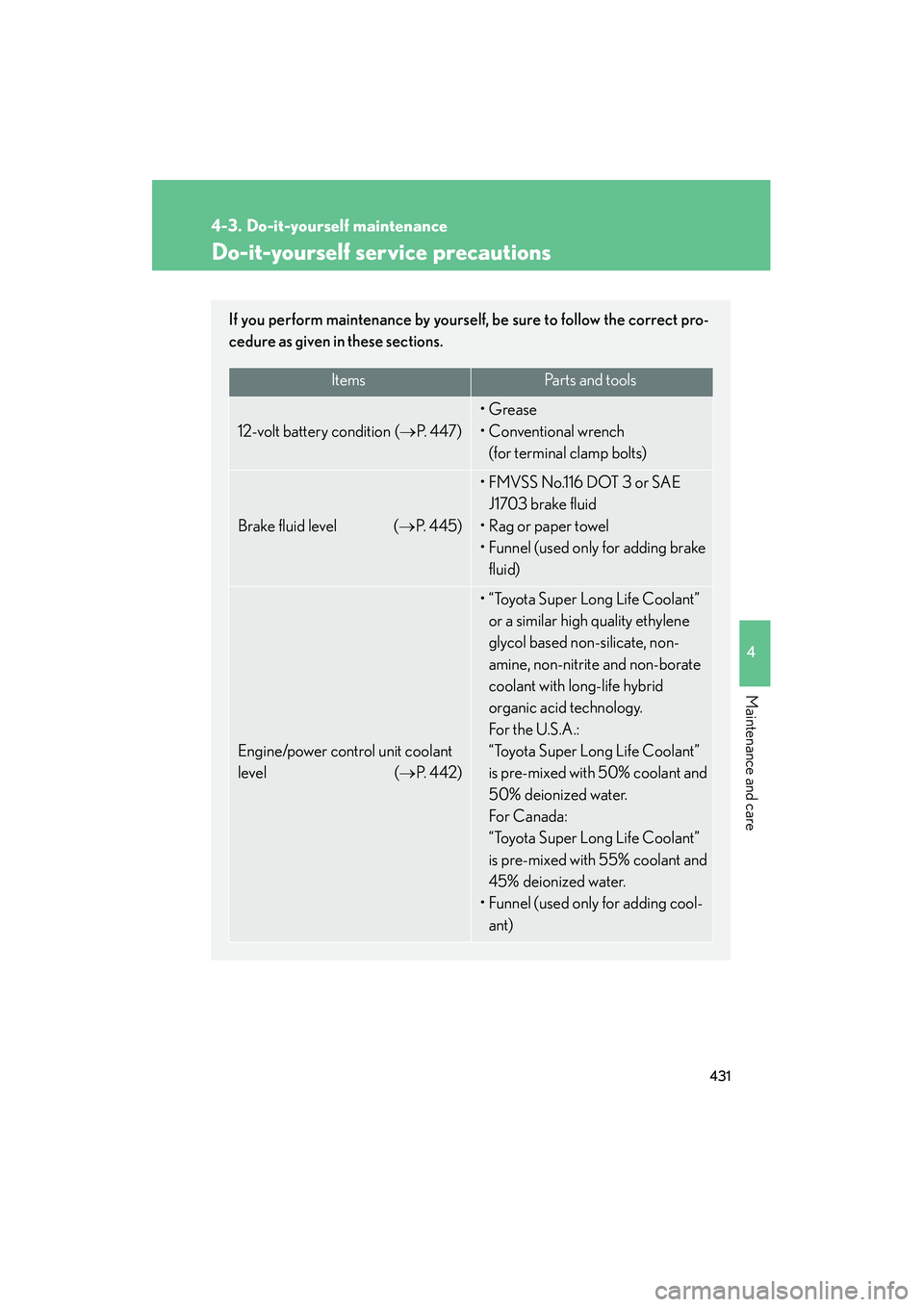
Do-it-yourself service precautions
If you perform maintenance by yourself, be sure to follow the correct pro-
cedure as given in these sections.
ItemsParts and tools
12-volt battery condition ( →P. 4 4 7 )
•Grease
•Conventional wrench
(for terminal clamp bolts)
Brake fluid level ( →P. 4 4 5 )
• FMVSS No.116 DOT 3 or SAE
J1703 brake fluid
•Rag or paper towel
• Funnel (used only for adding brake fluid)
Engine/power control unit coolant
level (→ P. 4 4 2 )
• “Toyota Super Long Life Coolant”
or a similar high quality ethylene
glycol based non-silicate, non-
amine, non-nitrite and non-borate
coolant with long-life hybrid
organic acid technology.
For the U.S.A.:
“Toyota Super Long Life Coolant”
is pre-mixed with 50% coolant and
50% deionized water.
For Canada:
“Toyota Super Long Life Coolant”
is pre-mixed with 55% coolant and
45% deionized water.
• Funnel (used only for adding cool- ant)
Page 442 of 630
441
4-3. Do-it-yourself maintenance
4
Maintenance and care
HS250h_U_75050U
CAUTION
■Used engine oil
●Used engine oil contains potentially harmful contaminants which may cause skin
disorders such as inflammation and skin cancer, so care should be taken to avoid
prolonged and repeated contact. To remove used engine oil from your skin, wash
thoroughly with soap and water.
●Dispose of used oil and filters only in a safe and acceptable manner. Do not dis-
pose of used oil and filters in household trash, in sewers or onto the ground.
Call your Lexus dealer, service station or auto parts store for information con-
cerning recycling or disposal.
●Do not leave used engine oil within the reach of children.
NOTICE
■To prevent serious engine damage
Check the oil level on a regular basis.
■When replacing the engine oil
●Be careful not to spill engine oil on the vehicle components.
●Avoid overfilling, or the engine could be damaged.
●Check the oil level on the dipstick every time you refill the vehicle.
●Be sure the engine oil filler cap is properly tightened.
Page 459 of 630
458
4-3. Do-it-yourself maintenance
HS250h_U_75050U
NOTICE
■Repairing or replacing tires, wheels, tire pressure warning valves, transmitters
and tire valve caps
●When removing or fitting the wheels, tires or the tire pressure warning valves and
transmitters, contact your Lexus dealer as the tire pressure warning valves and
transmitters may be damaged if not handled correctly.
●When replacing tire valve caps, do not use tire valve caps other than those speci-
fied. The cap may become stuck.
■To avoid damage to the tire pressu re warning valves and transmitters
When a tire is repaired with liquid sealants, the tire pressure warning valve and
transmitter may not operate properly. If a liquid sealant is used, contact your Lexus
dealer or other qualified service shop as soon as possible. Make sure to replace the
tire pressure warning valve and transmitter when replacing the tire. ( →P. 4 5 2 )
■Driving on rough roads
Take particular care when driving on roads with loose surfaces or potholes.
These conditions may cause losses in tire inflation pressure, reducing the cushion-
ing ability of the tires. In addition, driving on rough roads may cause damage to the
tires themselves, as well as the vehicle’s wheels and body.
■Low profile tires (vehicles with P225/45R18 91W tires)
Low profile tires may cause greater damage than usual to the tire wheel when sus-
taining impact from the road surface. Therefore, pay attention to the following:
●Be sure to use proper tire inflation pressure. If tires are under-inflated, they may
be damaged more severely.
●Avoid potholes, uneven pavement, curbs and other road hazards. Failure to do so
may lead to severe tire and wheel damage.
■If tire inflation pressure of each tire becomes low while driving
Do not continue driving, or your tires and/or wheels may be ruined.
Page 464 of 630
463
4-3. Do-it-yourself maintenance
4
Maintenance and care
HS250h_U_75050U
CAUTION
■When replacing wheels
●Do not use wheels that are a different size from those recommended in the
Owner’s Manual, as this may result in a loss of handling control.
●Never use an inner tube in a leaking wheel which is designed for a tubeless tire.
Doing so may result in an accident, causing death or serious injury.
■Use of defective wheels prohibited
Do not use cracked or deformed wheels.
Doing so could cause the tire to leak air during driving, possibly causing an acci-
dent.
NOTICE
■Replacing tire pressure warning valves and transmitters
●Because tire repair or replacement may affect the tire pressure warning valves
and transmitters, make sure to have tires serviced by your Lexus dealer or other
qualified service shop. In addition, make sure to purchase your tire pressure
warning valves and transmitters at your Lexus dealer.
●Ensure that only genuine Lexus wheels are used on your vehicle.
Tire pressure warning valves and transmitters may not work properly with non-
genuine wheels.
Page 496 of 630
5
When trouble arises
495
5-1. Essential information
HS250h_U_75050U
If your vehicle needs to be towed
Before towingThe following may indicate a problem with your hybrid transmission.
Contact your Lexus dealer before towing.
● The hybrid system is operating but the vehicle will not move.
● The vehicle makes an abnormal sound.
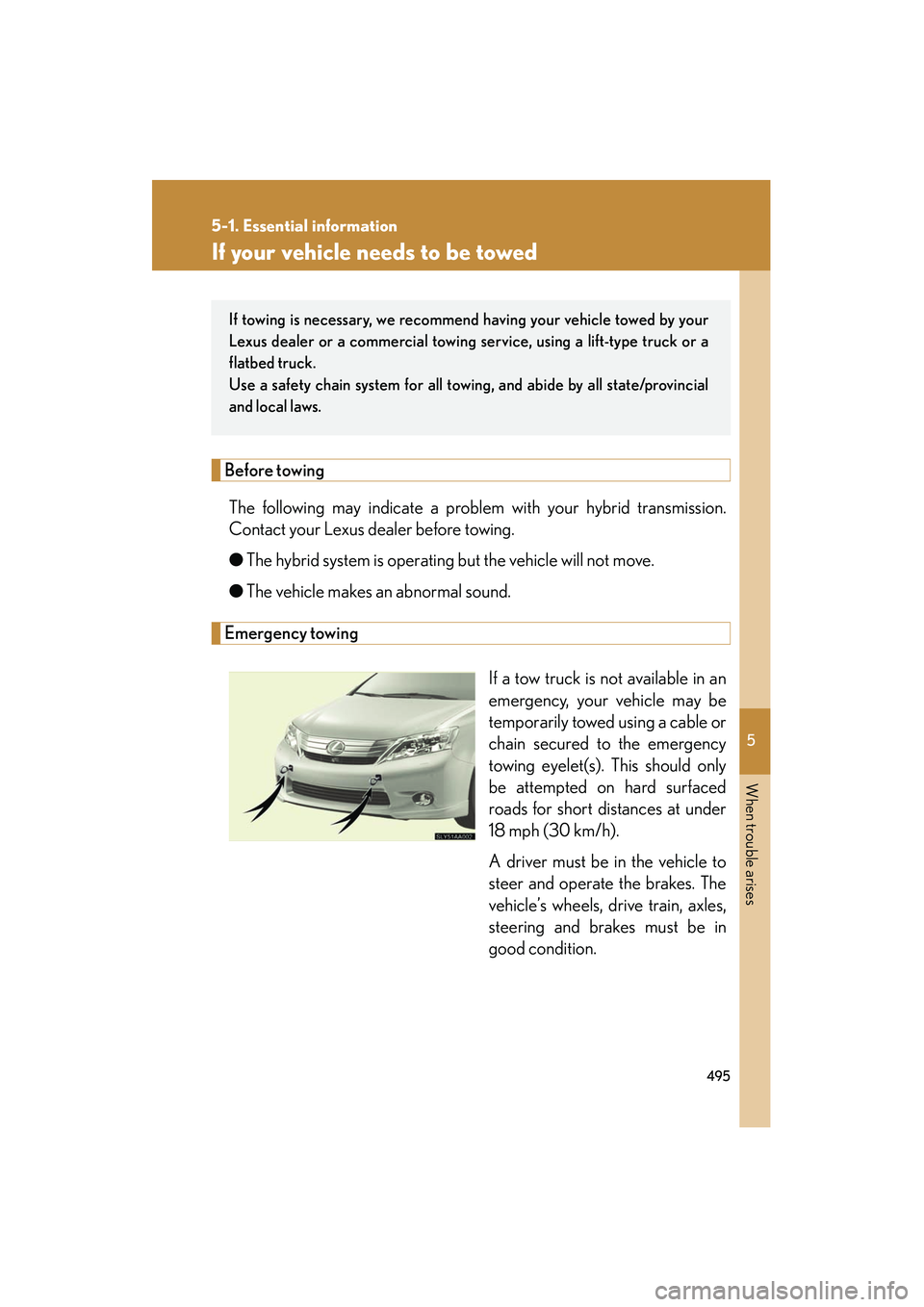
Emergency towing
If a tow truck is not available in an
emergency, your vehicle may be
temporarily towed using a cable or
chain secured to the emergency
towing eyelet(s). This should only
be attempted on hard surfaced
roads for short distances at under
18 mph (30 km/h).
A driver must be in the vehicle to
steer and operate the brakes. The
vehicle’s wheels, drive train, axles,
steering and brakes must be in
good condition.
If towing is necessary, we recommend having your vehicle towed by your
Lexus dealer or a commercial towing service, using a lift-type truck or a
flatbed truck.
Use a safety chain system for all towing, and abide by all state/provincial
and local laws.
Page 541 of 630
540
5-2. Steps to take in an emergency
HS250h_U_75050U
CAUTION
• Have the wheel nuts tightened with a torque wrench to 76 ft•lbf (103 N•m,10.5 kgf•m) as soon as possible after changing wheels.
• When installing a tire, only use wheel nuts that have been specifically designed for that wheel.
• If there are any cracks or deformations in the bolt screws, nut threads or bolt holes of the wheel, have the vehicle inspected by your Lexus dealer.
NOTICE
■Do not drive the vehicle with a flat tire
Do not continue driving with a flat tire.
Driving even a short distance with a flat tire can damage the tire and the wheel
beyond repair.
■Be careful when driving over bumps with the compact spare tire installed on the
vehicle.
The vehicle becomes lower when driving with the compact spare tire compared to
when driving with standard tires. Be careful when driving over uneven road sur-
faces.
■Driving with tire chains and the compact spare tire
Do not fit tire chains to the compact spare tire.
Tire chains may damage the vehicle body and adversely affect driving performance.
■When replacing the tires
When removing or fitting the wheels, tires or the tire pressure warning valve and
transmitter, contact your Lexus dealer as the tire pressure warning valve and trans-
mitter may be damaged if not handled correctly.
■To avoid damage to the tire pressu re warning valves and transmitters
When a tire is repaired with liquid sealants, the tire pressure warning valve and
transmitter may not operate properly. If a liquid sealant is used, contact your Lexus
dealer or other qualified service shop as soon as possible. Make sure to replace the
tire pressure warning valve and transmitter when replacing the tire. ( →P. 4 5 2 )
Page 571 of 630
570
6-1. Specifications
HS250h_U_75050U
■Recommendation of the use of cleaner burning gasoline
Cleaner burning gasoline, including reformulated gasoline that contains oxygen-
ates such as ethanol or MTBE (Methyl Tertiary Butyl Ether) is available in many
areas.
Lexus recommends the use of cleaner burning gasoline and appropriately blended
reformulated gasoline. These types of gasoline provide excellent vehicle perfor-
mance, reduce vehicle emissions and improve air quality.
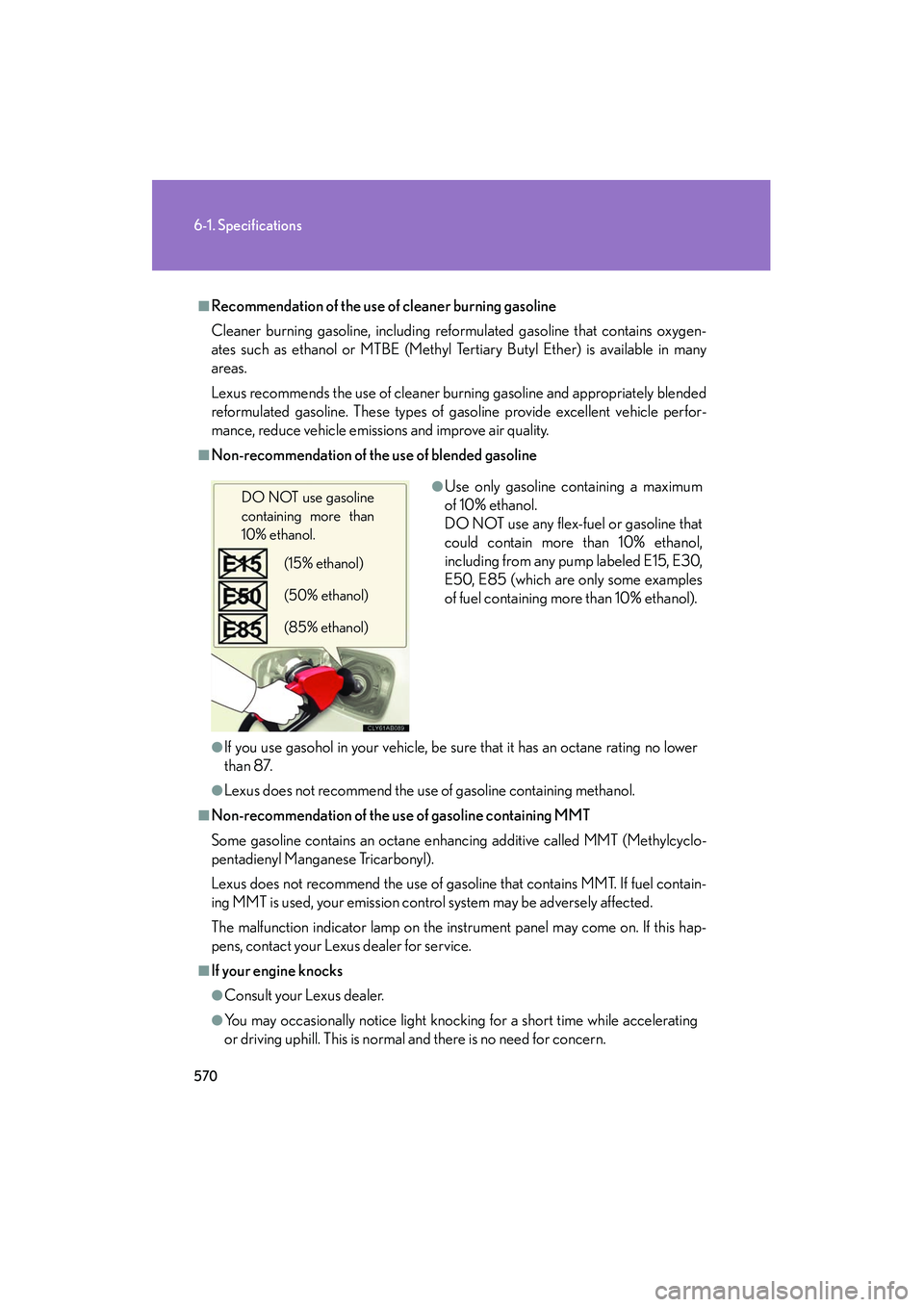
■Non-recommendation of the use of blended gasoline
●If you use gasohol in your vehicle, be sure that it has an octane rating no lower
than 87.
●Lexus does not recommend the use of gasoline containing methanol.
■Non-recommendation of the use of gasoline containing MMT
Some gasoline contains an octane enhancing additive called MMT (Methylcyclo-
pentadienyl Manganese Tricarbonyl).
Lexus does not recommend the use of gasoli ne that contains MMT. If fuel contain-
ing MMT is used, your emission control system may be adversely affected.
The malfunction indicator lamp on the instrument panel may come on. If this hap-
pens, contact your Lexus dealer for service.
■If your engine knocks
●Consult your Lexus dealer.
●You may occasionally notice light knocking for a short time while accelerating
or driving uphill. This is normal and there is no need for concern.
●Use only gasoline containing a maximum
of 10% ethanol.
DO NOT use any flex-fuel or gasoline that
could contain more than 10% ethanol,
including from any pump labeled E15, E30,
E50, E85 (which are only some examples
of fuel containing more than 10% ethanol).DO NOT use gasoline
containing more than
10% ethanol.
(15% ethanol)
(50% ethanol)
(85% ethanol)
Page 578 of 630
577
6-1. Specifications
6
Vehicle specifications
HS250h_U_75050U■
Treadwear
The treadwear grade is a comparative rating based on the wear rate of
the tire when tested under controlled conditions on a specified gov-
ernment test course.
For example, a tire graded 150 would wear one and a half (1 - 1 /2) times as
well on the government course as a tire graded 100.
The relative performance of tires depends upon the actual conditions of
their use. Performance may differ significantly from the norm due to varia-
tions in driving habits, service practices and differences in road characteris-
tics and climate.
■Traction AA, A, B, C
The traction grades, from highest to lowest, are AA, A, B and C, and
they represent the tire’s ability to stop on wet pavement as measured
under controlled conditions on specified government test surfaces of
asphalt and concrete.
A tire marked C may have poor traction performance.
Warning: The traction grade assigned to this tire is based on braking
(straight ahead) traction tests and does not include cornering (turning) trac-
tion.
■Temperature A, B, C
The temperature grades are A (the highest), B, and C, representing
the tire’s resistance to the generation of heat and its ability to dissipate
heat when tested under controlled conditions on a specified indoor
laboratory test wheel.
Sustained high temperature can cause the material of the tire to degenerate
and reduce tire life, and excessive temperature can lead to sudden tire fail-
ure.
Grade C corresponds to a level of performance which all passenger car
tires must meet under the Federal Motor Vehicle Safety Standard No. 109.
Grades B and A represent higher levels of performance on the laboratory
test wheel than the minimum required by law.