tire Lexus HS250h 2012 Owner's Manual
[x] Cancel search | Manufacturer: LEXUS, Model Year: 2012, Model line: HS250h, Model: Lexus HS250h 2012Pages: 630, PDF Size: 16.1 MB
Page 2 of 630
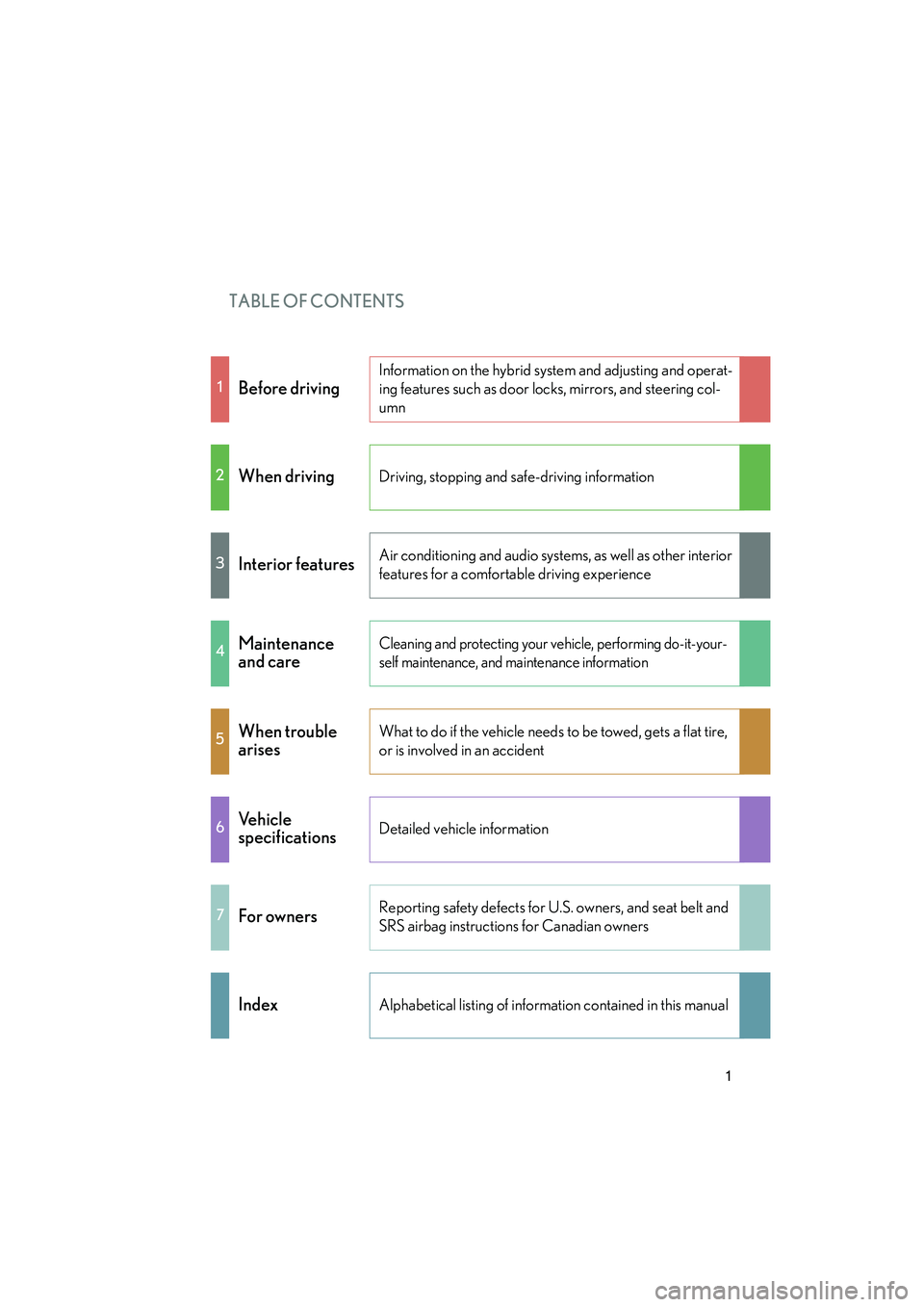
TABLE OF CONTENTS
HS250h_U_75050U
1
1Before driving
Information on the hybrid system and adjusting and operat-
ing features such as door locks, mirrors, and steering col-
umn
2When drivingDriving, stopping and safe-driving information
3Interior featuresAir conditioning and audio systems, as well as other interior
features for a comfortable driving experience
4Maintenance
and careCleaning and protecting your vehicle, performing do-it-your-
self maintenance, and maintenance information
5When trouble
arisesWhat to do if the vehicle needs to be towed, gets a flat tire,
or is involved in an accident
6Ve h i c l e
specificationsDetailed vehicle information
7For ownersReporting safety defects for U.S. owners, and seat belt and
SRS airbag instructions for Canadian owners
IndexAlphabetical listing of information contained in this manual
Page 6 of 630
1
2
3
4
5
6
7
HS250h_U_75050U
5
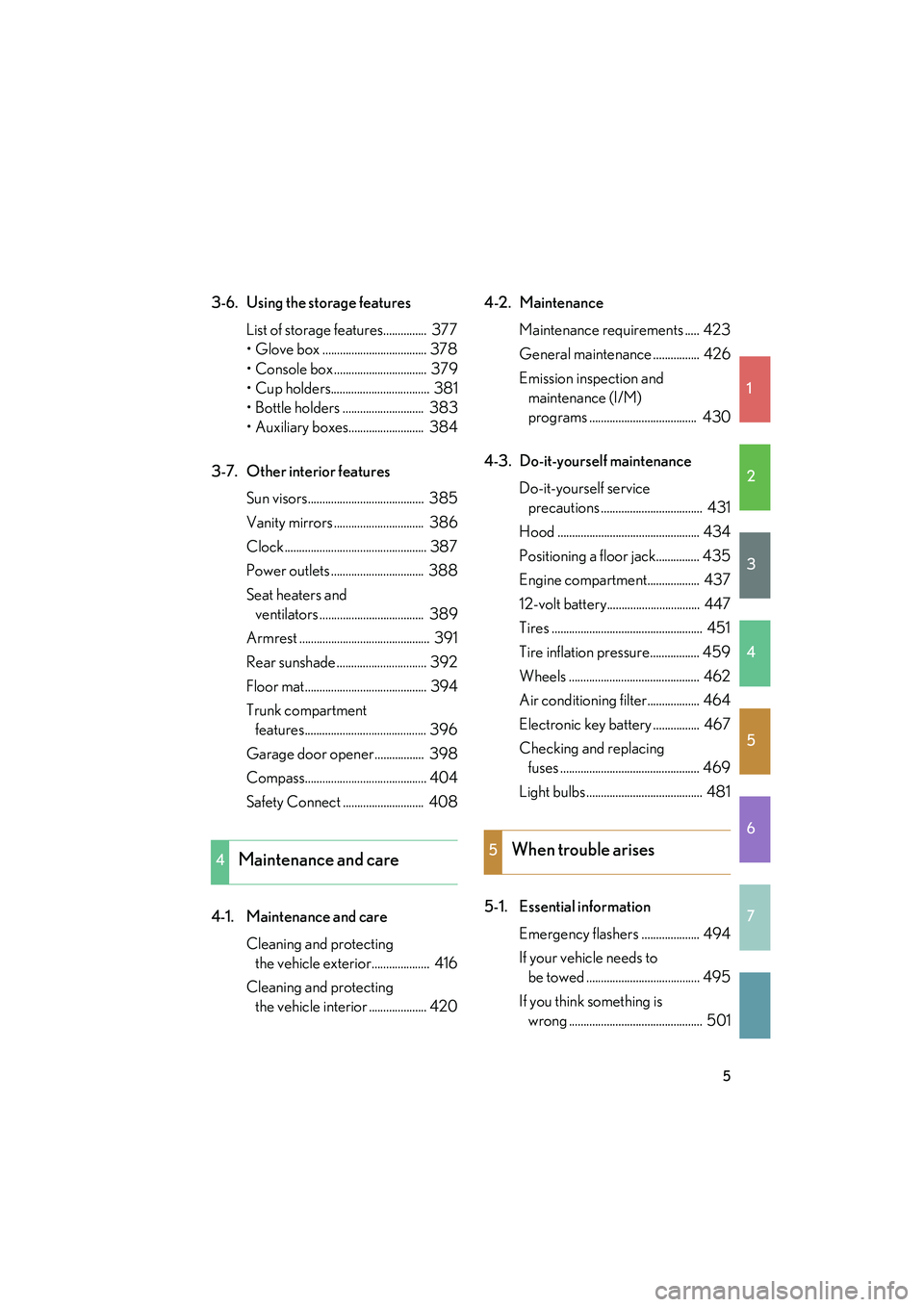
3-6. Using the storage featuresList of storage features............... 377
• Glove box .................................... 378
• Console box ................................ 379
• Cup holders.................................. 381
• Bottle holders ............................ 383
• Auxiliary boxes.......................... 384
3-7. Other interior features Sun visors........................................ 385
Vanity mirrors ............................... 386
Clock ................................................. 387
Power outlets ................................ 388
Seat heaters and ventilators .................................... 389
Armrest ............................................. 391
Rear sunshade ............................... 392
Floor mat.......................................... 394
Trunk compartment features.......................................... 396
Garage door opener................. 398
Compass.......................................... 404
Safety Connect ............................ 408
4-1. Maintenance and care Cleaning and protecting the vehicle exterior.................... 416
Cleaning and protecting the vehicle interior .................... 420 4-2. Maintenance
Maintenance requirements ..... 423
General maintenance ................ 426
Emission inspection and maintenance (I/M)
programs ..................................... 430
4-3. Do-it-yourself maintenance Do-it-yourself service precautions ................................... 431
Hood ................................................. 434
Positioning a floor jack............... 435
Engine compartment.................. 437
12-volt battery................................ 447
Tires .................................................... 451
Tire inflation pressure................. 459
Wheels ............................................. 462
Air conditioning filter.................. 464
Electronic key battery ................ 467
Checking and replacing fuses ................................................ 469
Light bulbs ........................................ 481
5-1. Essential information Emergency flashers .................... 494
If your vehicle needs to be towed ....................................... 495
If you think something is wrong .............................................. 501
4Maintenance and care5When trouble arises
Page 7 of 630
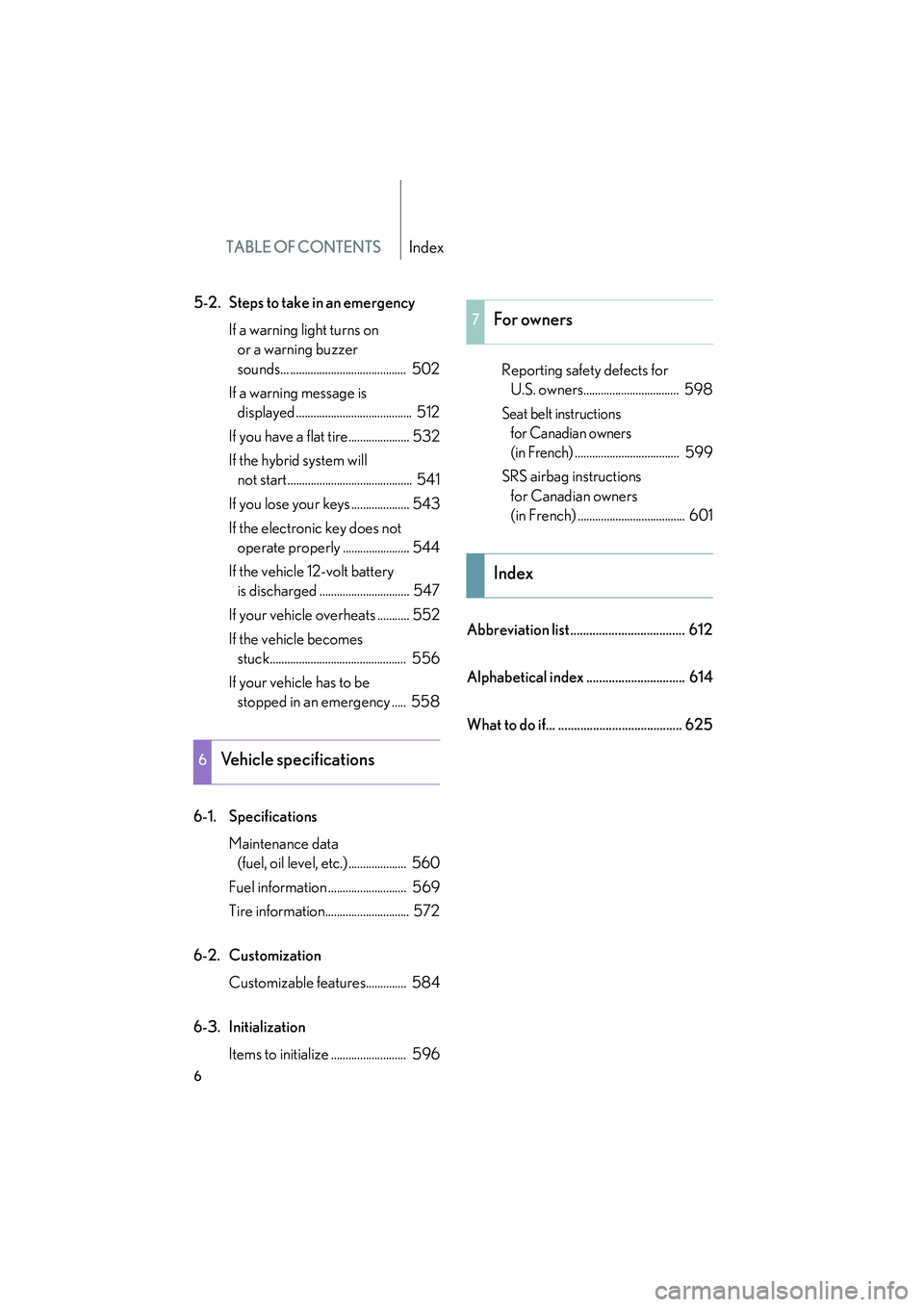
TABLE OF CONTENTSIndex
HS250h_U_75050U
6
5-2. Steps to take in an emergencyIf a warning light turns on or a warning buzzer
sounds... ........................................ 502
If a warning message is displayed ........................................ 512
If you have a flat tire..................... 532
If the hybrid system will not start........................................... 541
If you lose your keys .................... 543
If the electronic key does not operate properly ....................... 544
If the vehicle 12-volt battery is discharged ............................... 547
If your vehicle overheats ........... 552
If the vehicle becomes stuck............................................... 556
If your vehicle has to be stopped in an emergency ..... 558
6-1. Specifications Maintenance data (fuel, oil level, etc.).................... 560
Fuel information ........................... 569
Tire information............................. 572
6-2. Customization Customizable features.............. 584
6-3. Initialization Items to initialize .......................... 596 Reporting safety defects for
U.S. owners................................. 598
Seat belt instructions for Canadian owners
(in French)
.................................... 599
SRS airbag instructions for Canadian owners
(in French) ..................................... 601
Abbreviation list .................................... 612
Alphabetical index ............................... 614
What to do if... ....................................... 625
6Vehicle specifications
7For owners
Index
Page 10 of 630
HS250h_U_75050U
9
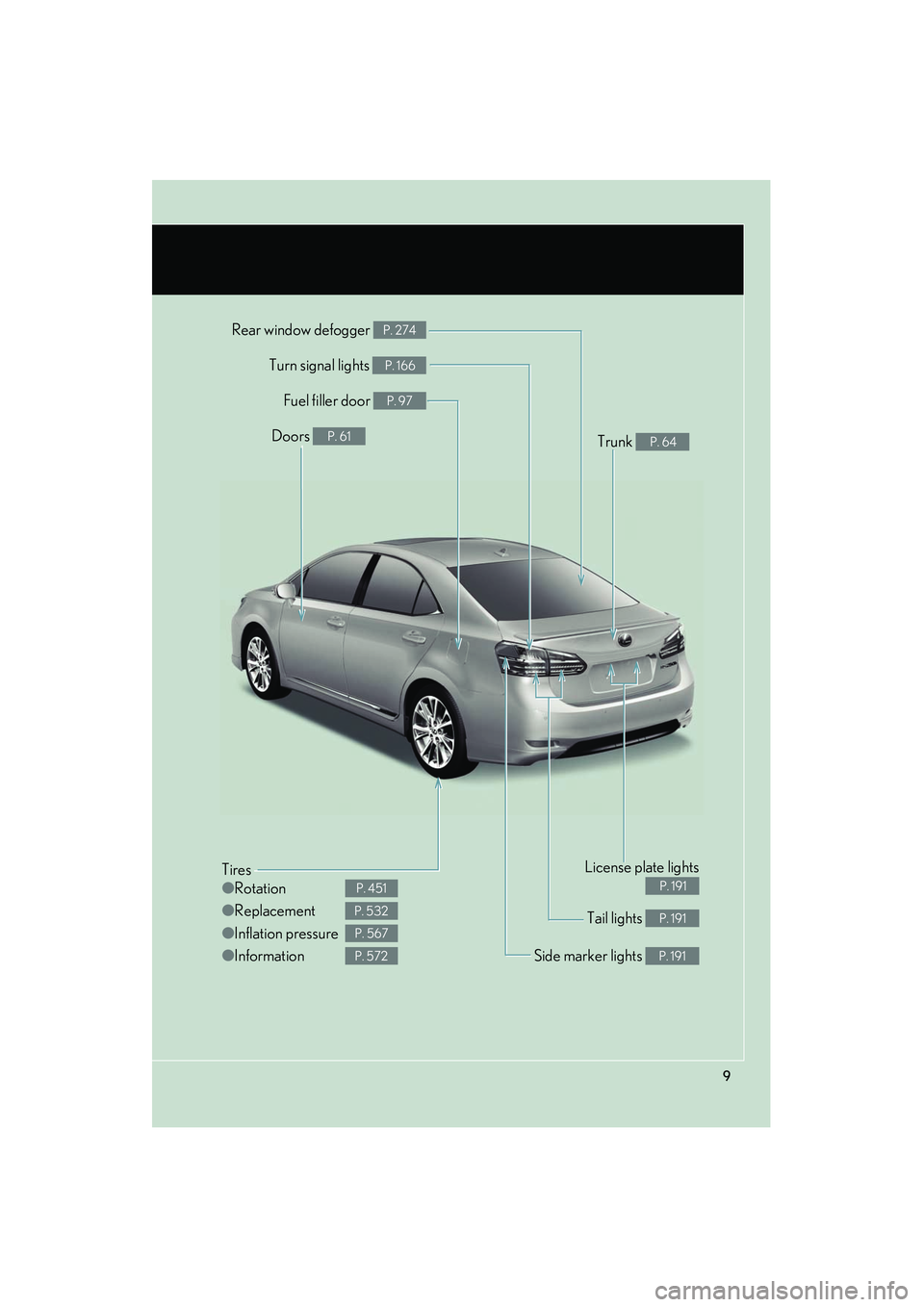
Tail lights P. 191
Rear window defogger P. 274
Tires
●Rotation
● Replacement
● Inflation pressure
● Information
P. 451
P. 532
P. 567
P. 572Side marker lights P. 191
Fuel filler door P. 97
Turn signal lights P. 166
License plate lights
P. 191
Doors P. 61Trunk P. 64
Page 11 of 630
HS250h_U_75050U
10
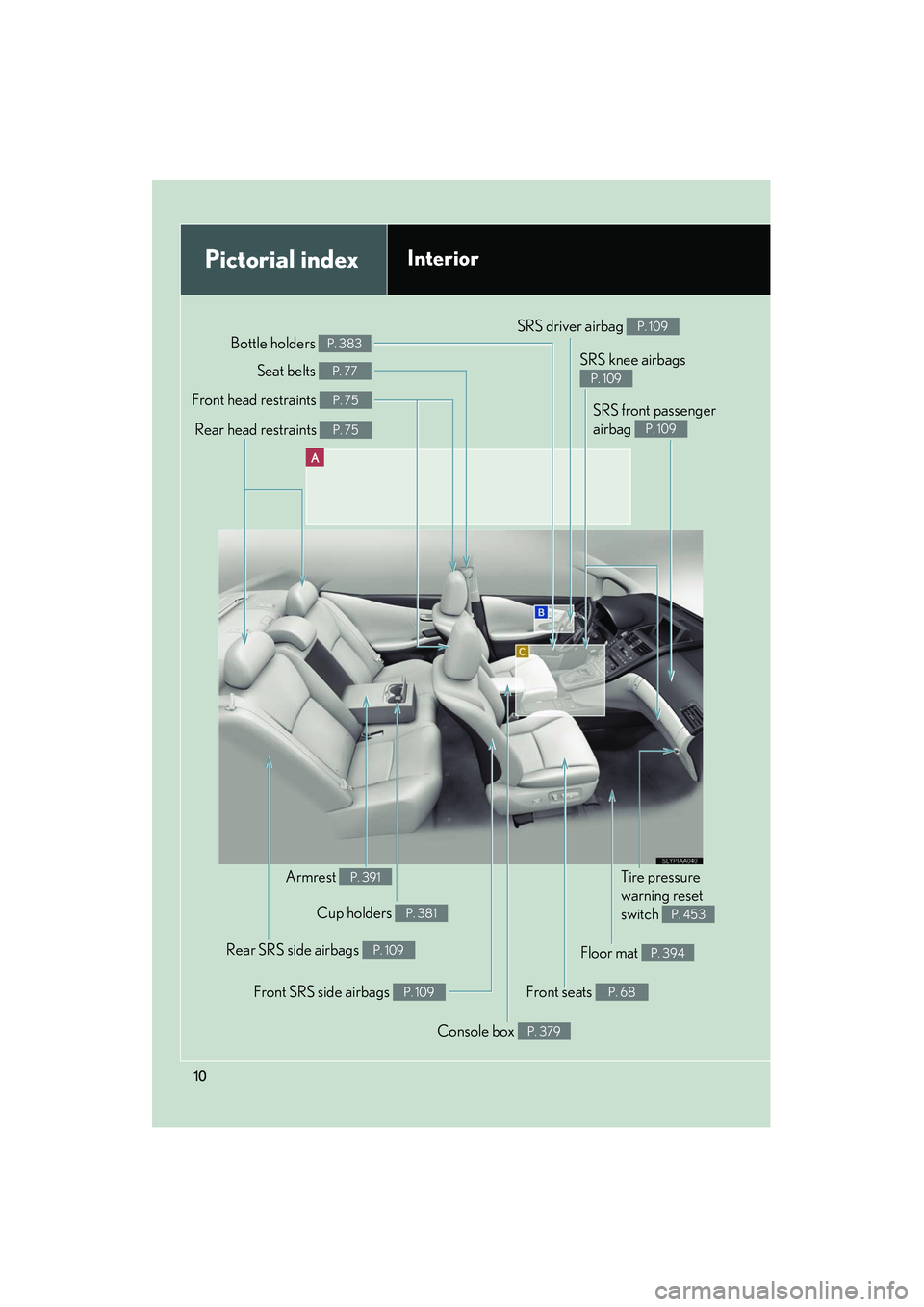
SRS driver airbag P. 109
Floor mat P. 394
Pictorial indexInterior
Front SRS side airbags P. 109
Console box P. 379
Bottle holders P. 383
Front head restraints P. 75
Seat belts P. 77
Armrest P. 391
Rear SRS side airbags P. 109
SRS front passenger
airbag
P. 109
Tire pressure
warning reset
switch
P. 453
Front seats P. 68
Cup holders P. 381
SRS knee airbags
P. 109
Rear head restraints P. 75
Page 42 of 630

41
1-1. Hybrid system
1
Before driving
HS250h_U_75050U
■Air conditioning
Use the air conditioning only when necessary. Doing so can help control
excessive gasoline consumption.
In summer: In high temperatures, use the recirculated air mode. Doing so
will help to reduce the burden on the air conditioner and reduce fuel con-
sumption as well.
In winter: Because the gasoline engine will not automatically cut out until
the gasoline engine and the interior of the vehicle are warm, it will con-
sume fuel. Also, fuel consumption can be improved by avoiding overuse of
the heater.
■ Checking tire inflation pressure
Make sure to check the tire inflation pressure frequently. Improper tire
inflation pressure can cause poor fuel consumption.
Also, as snow tires can cause large amounts of friction, their use on dry
roads can lead to poor fuel consumption. Use a tire that is appropriate for
the season.
■Luggage
Carrying heavy luggage can lead to poor fuel consumption. Avoid carry-
ing unnecessary luggage. Installing a large roof rack can also cause poor
fuel consumption.
■Warming up before driving
Since the gasoline engine starts up and cuts out automatically when cold,
warming up the engine is unnecessary. Moreover, frequently driving short
distances will cause the engine to repeatedly warm up, which can lead to
poor fuel consumption.
Page 144 of 630
143
2-1. Driving procedures
2
When driving
HS250h_U_75050U
Starting off on a steep uphillMake sure that the parking brake is set securely, and then select
shift position D.
Check that the shift position indicator shows D.
Gently depress the accelerator pedal.
Release the parking brake.
■Driving in the rain
●Drive carefully when it is raining, because visibility will be reduced, the windows
may become fogged-up, and the road will be slippery.
●Drive carefully when it starts to rain, because the road surface will be especially
slippery.
●Refrain from high speeds when driving on an expressway in the rain, because
there may be a layer of water between the tires and the road surface, preventing
the steering and brakes from operating properly.
■Breaking in your new Lexus
To extend the life of the vehicle, observing the following precautions is recom-
mended:
●For the first 186 miles (300 km):
Avoid sudden stops.
●For the first 994 miles (1600 km):
• Do not drive at extremely high speeds.
• Avoid sudden acceleration.
• Do not drive at a constant speed for extended periods.
■Drum-in-disc type parking brake system
Your vehicle has a drum-in-disc type parking brake system. This type of brake sys-
tem needs bedding-down of the brake shoes periodically or whenever the parking
brake shoes and/or drum are replaced. Have your Lexus dealer perform the bed-
ding down operation.
■Operating your vehicle in a foreign country
Comply with the relevant vehicle registration laws and confirm the availability of the
correct fuel. ( →P. 5 6 2 )
Page 147 of 630
146
2-1. Driving procedures
HS250h_U_75050U
CAUTION
●Do not shift the shift position to D while the vehicle is moving backward.
Doing so can damage the transmission and may result in a loss of vehicle control.
●Moving the shift position to N while the vehicle is moving will disengage the
hybrid system. Engine braking is not available with the hybrid system disengaged.
●During normal driving, do not turn off the hybrid system. Turning the hybrid sys-
tem off while driving will not cause loss of steering or braking control, but the
power assist to these systems will be lost. This will make it more difficult to steer
and brake, so you should pull over and stop the vehicle as soon as it is safe to do
so.
However, in the event of an emergency, such as if it becomes impossible to stop
the vehicle in the normal way: →P. 5 5 8
●Use engine braking (shift position B) to maintain a safe speed when driving down
a steep hill.
Using the brakes continuously may cause the brakes to overheat and lose effec-
tiveness. ( →P. 160)
●Do not adjust the positions of the steering wheel, the seat, or the inside or outside
rear view mirrors while driving.
Doing so may result in a loss of vehicle control that can cause accidents, resulting
in death or serious injury.
●Always check that all passengers' arms, heads or other parts of their body are not
outside the vehicle, as this may result in death or serious injury.
●Do not drive in excess of the speed limit. Even if the legal speed limit permits it, do
not drive over 85 mph (140 km/h) unless your vehicle has high-speed capability
tires. Driving over 85 mph (140 km/h) may result in tire failure, loss of control and
possible injury. Be sure to consult a tire dealer to determine whether the tires on
your vehicle are high-speed capability tires or not before driving at such speeds.
■When driving on slippery road surfaces
●Sudden braking, acceleration and steering may cause tire slippage and reduce
your ability to control the vehicle, resulting in an accident.
●Abrupt changes from shift position D to B and rapid changes in the engine speed
could cause the vehicle to skid, resulting in an accident.
Page 151 of 630
150
2-1. Driving procedures
HS250h_U_75050U
NOTICE
■When driving the vehicle
●Do not depress the accelerator and brake pedals at the same time during driving,
as this may restrain driving torque.
●Do not use the accelerator pedal or depress the accelerator and brake pedals at
the same time to hold the vehicle on a hill.
■When parking the vehicle
Be sure to firmly apply the parking brake and set the shift position to P. Failure to do
so may cause the vehicle to move or the vehicle may accelerate suddenly if the
accelerator pedal is accidentally depressed.
■Avoiding damage to vehicle parts
●Do not turn the steering wheel fully in either direction and hold it there for an
extended period of time.
Doing so may damage the power steering motor.
●When driving over bumps in the road, drive as slowly as possible to avoid damag-
ing the wheels, underside of the vehicle, etc.
■If you get a flat tire while driving
A flat or damaged tire may cause the following situations. Hold the steering wheel
firmly and gradually depress the brake pedal to slow down the vehicle.
●It may be difficult to control your vehicle.
●The vehicle will make abnormal sounds or vibrations.
●The vehicle will lean abnormally.
Information on what to do in case of a flat tire. ( →P. 5 3 2 )
Page 155 of 630
154
2-1. Driving procedures
HS250h_U_75050U
■Auto power off function
When the shift position is in P, if the vehicle is left in ACCESSORY or ON mode
with the hybrid system not operating for more than 20 minutes (ACCESSORY
mode) or one hour (ON mode), the “POWER” switch will automatically turn off.
However, this function cannot entirely prevent the 12-volt battery from discharging.
Do not leave the vehicle with the “POWER” switch in ACCESSORY or ON mode
for long periods of time when the hybrid system is not operating.
■Sounds and vibrations specific to a hybrid vehicle
→P. 2 8
■Electronic key battery depletion
→P. 5 5
■When the ambient temperature is low, such as during winter driving conditions
It may take time until the “READY” indicator to come on.
■Conditions affecting operation
→P. 5 2
■Notes for the entry function
→P. 5 3
■If the hybrid system does not start
The immobilizer system may not have been deactivated. ( →P. 101)
■When the “POWER” switch indicator flashes in amber
The system may be malfunctioning. Have the vehicle inspected by your Lexus
dealer immediately.
■If the “READY” indicator does not come on
If the “READY” indicator does not come on when you press the “POWER” switch
with the shift position in P and the brake pedal depressed, contact your Lexus
dealer immediately.
■If the hybrid system is malfunctioning
→ P. 5 1 2
■If the electronic key battery is depleted
→P. 4 6 7