trailer Lexus HS250h 2012 Owner's Manual
[x] Cancel search | Manufacturer: LEXUS, Model Year: 2012, Model line: HS250h, Model: Lexus HS250h 2012Pages: 630, PDF Size: 16.1 MB
Page 4 of 630

1
2
3
4
5
6
7
HS250h_U_75050U
3
1-8. Safety informationCorrect driving posture ............. 107
SRS airbags ..................................... 109
Front passenger occupant classification system .................... 121
Child restraint systems ............... 126
Installing child restraints ............. 130
2-1. Driving procedures Driving the vehicle ........................ 142
Power (ignition) switch ............... 152
EV drive mode ............................... 157
Hybrid transmission ..................... 160
Turn signal lever ............................ 166
Parking brake ................................. 167
Horn.................................................... 168
2-2. Instrument cluster Gauges and meters ..................... 169
Indicators and warning lights ... 173
Multi-information display ............ 177
Head-up display ............................ 183 2-3. Operating the lights and
windshield wipers
Headlight switch .............................. 191
Automatic High Beam ................ 196
Fog light switch ............................. 202
Windshield wipers and washer ........................................... 204
Headlight cleaner switch ............. 211
2-4. Using other driving systems Cruise control ................................ 212
Dynamic radar cruise control............................................. 216
LKA (Lane-Keeping Assist) .... 230
Driving assist systems................. 238
Hill-start assist control ............... 243
Pre-Collision System.................. 245
2-5. Driving information Cargo and luggage ..................... 254
Vehicle load limits........................ 257
Winter driving tips ...................... 258
Trailer towing .................................. 261
Dinghy towing ............................... 262
2When driving
Page 142 of 630
When driving2
141
HS250h_U_75050U
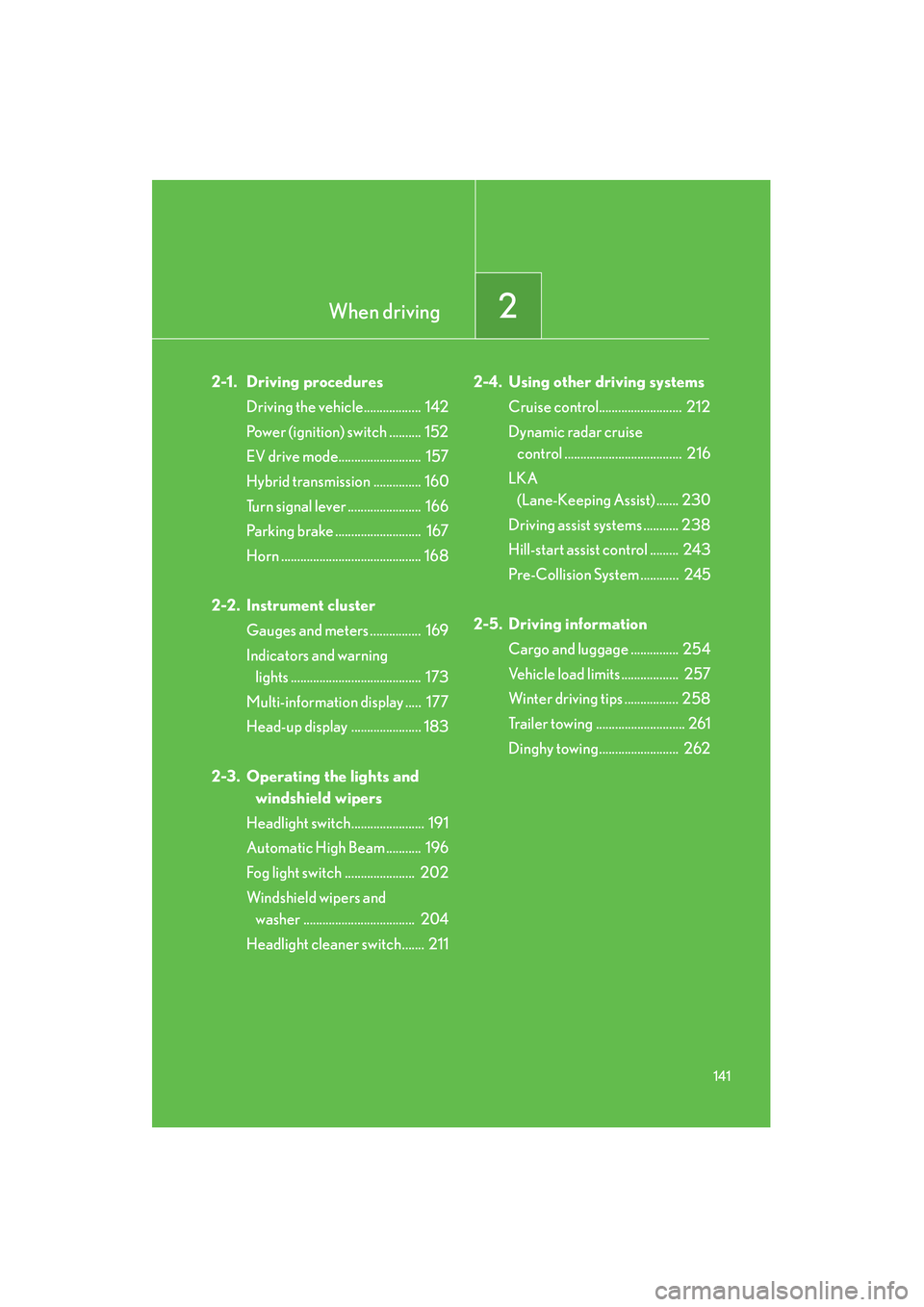
2-1. Driving proceduresDriving the vehicle.................. 142
Power (ignition) switch .......... 152
EV drive mode.......................... 157
Hybrid transmission ............... 160
Turn signal lever ....................... 166
Parking brake ........................... 167
Horn ............................................ 168
2-2. Instrument cluster Gauges and meters ................ 169
Indicators and warning lights ......................................... 173
Multi-information display ..... 177
Head-up display ...................... 183
2-3. Operating the lights and windshield wipers
Headlight switch....................... 191
Automatic High Beam ........... 196
Fog light switch ...................... 202
Windshield wipers and washer ................................... 204
Headlight cleaner switch....... 211 2-4. Using other driving systems
Cruise control.......................... 212
Dynamic radar cruise control ..................................... 216
LKA (Lane-Keeping Assist) ....... 230
Driving assist systems ........... 238
Hill-start assist control ......... 243
Pre-Collision System ............ 245
2-5. Driving information Cargo and luggage ............... 254
Vehicle load limits .................. 257
Winter driving tips ................. 258
Trailer towing ............................ 261
Dinghy towing......................... 262
Page 200 of 630
199
2-3. Operating the lights and windshield wipers
2
When driving
HS250h_U_75050U
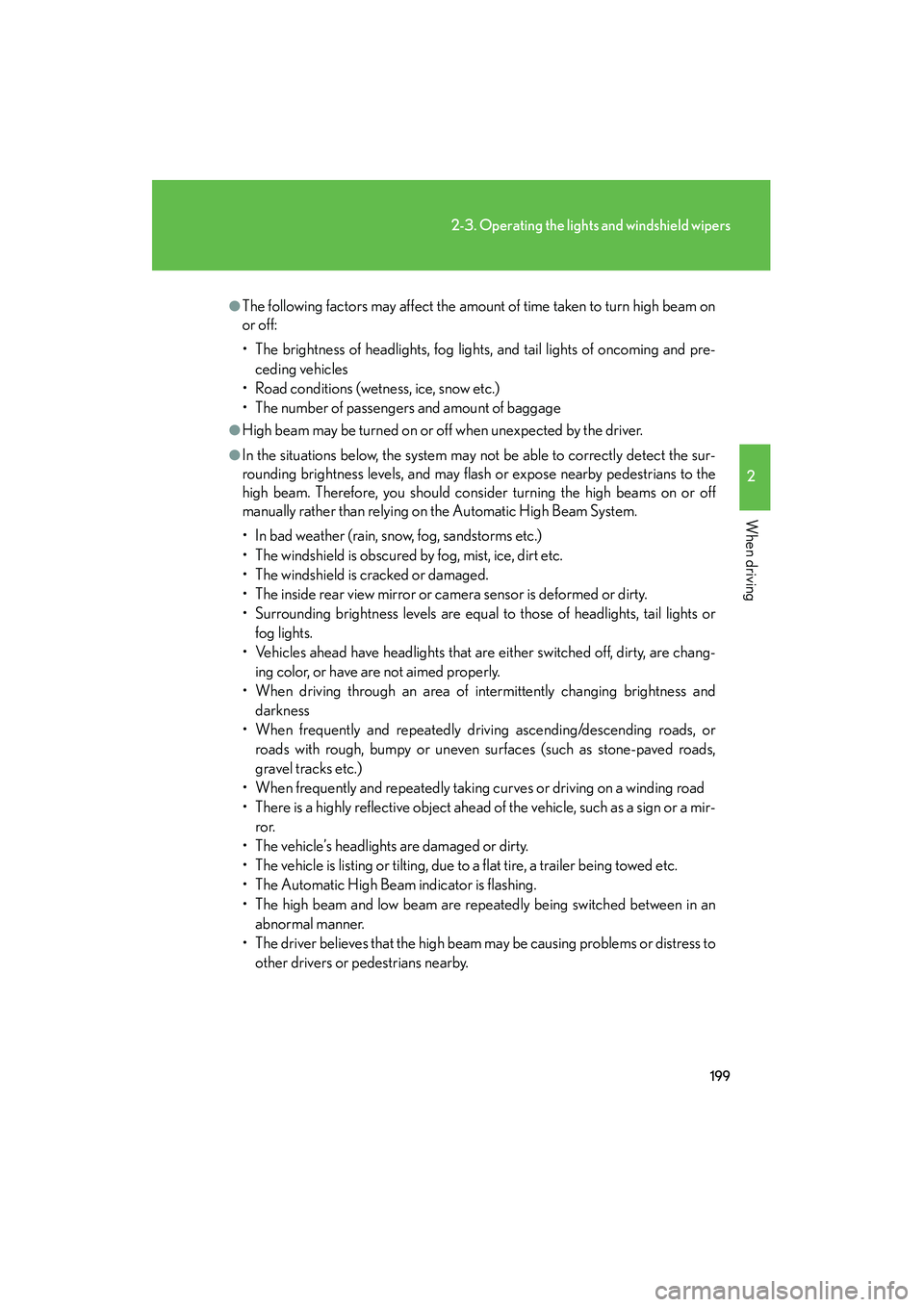
●The following factors may affect the amount of time taken to turn high beam on
or off:
• The brightness of headlights, fog lights, and tail lights of oncoming and pre-ceding vehicles
• Road conditions (wetness, ice, snow etc.)
• The number of passengers and amount of baggage
●High beam may be turned on or off when unexpected by the driver.
●In the situations below, the system may not be able to correctly detect the sur-
rounding brightness levels, and may flash or expose nearby pedestrians to the
high beam. Therefore, you should consider turning the high beams on or off
manually rather than relying on the Automatic High Beam System.
• In bad weather (rain, snow, fog, sandstorms etc.)
• The windshield is obscured by fog, mist, ice, dirt etc.
• The windshield is cracked or damaged.
• The inside rear view mirror or camera sensor is deformed or dirty.
• Surrounding brightness levels are equal to those of headlights, tail lights or fog lights.
• Vehicles ahead have headlights that are either switched off, dirty, are chang-
ing color, or have are not aimed properly.
• When driving through an area of intermittently changing brightness and darkness
• When frequently and repeatedly driving ascending/descending roads, or roads with rough, bumpy or uneven surfaces (such as stone-paved roads,
gravel tracks etc.)
• When frequently and repeatedly taking curves or driving on a winding road
• There is a highly reflective object ahead of the vehicle, such as a sign or a mir- ror.
• The vehicle’s headlights are damaged or dirty.
• The vehicle is listing or tilting, due to a flat tire, a trailer being towed etc.
• The Automatic High Beam indicator is flashing.
• The high beam and low beam are repeatedly being switched between in an abnormal manner.
• The driver believes that the high beam may be causing problems or distress to other drivers or pedestrians nearby.
Page 229 of 630
228
2-4. Using other driving systems
HS250h_U_75050U
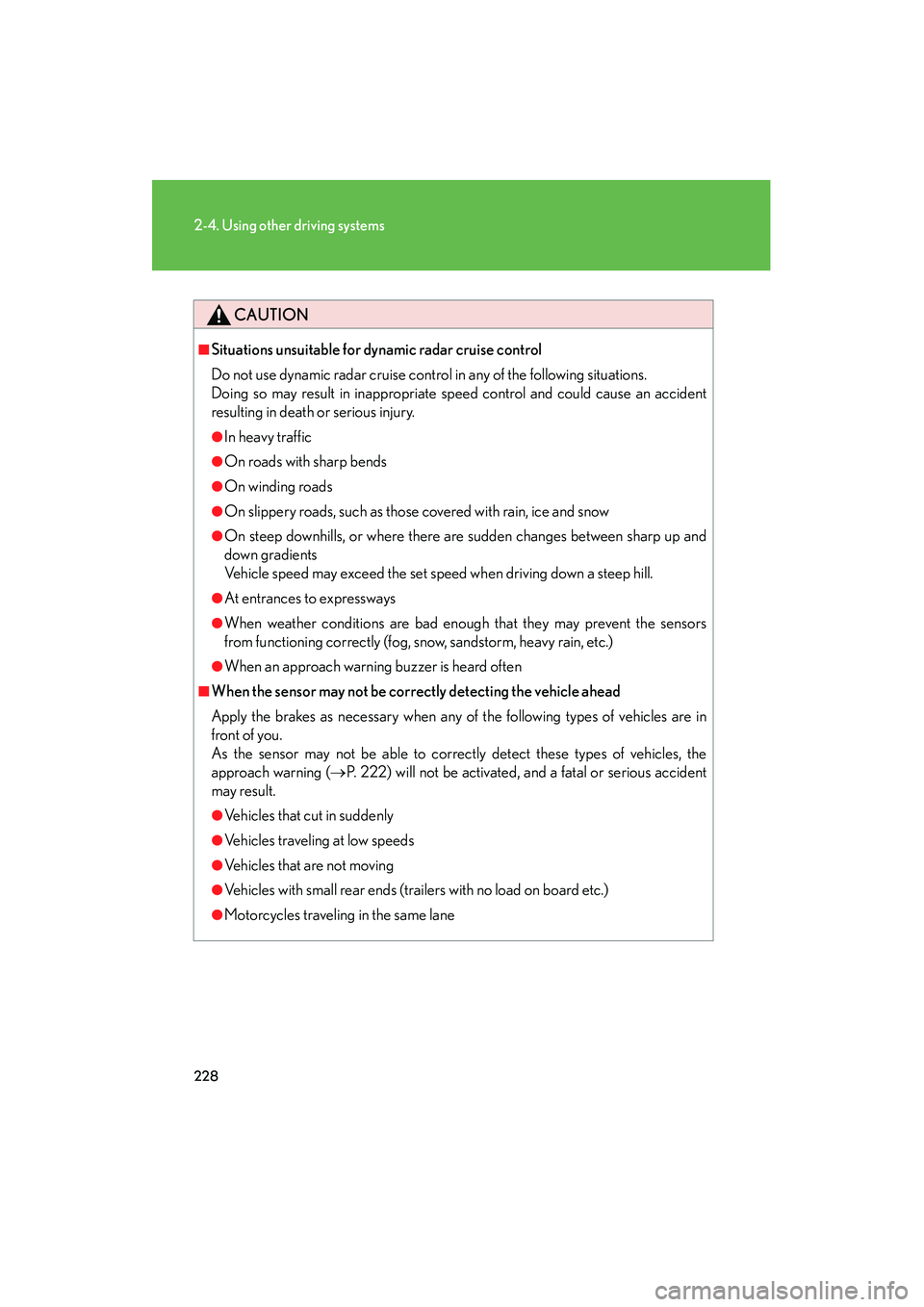
CAUTION
■Situations unsuitable for dynamic radar cruise control
Do not use dynamic radar cruise control in any of the following situations.
Doing so may result in inappropriate speed control and could cause an accident
resulting in death or serious injury.
●In heavy traffic
●On roads with sharp bends
●On winding roads
●On slippery roads, such as those covered with rain, ice and snow
●On steep downhills, or where there are sudden changes between sharp up and
down gradients
Vehicle speed may exceed the set speed when driving down a steep hill.
●At entrances to expressways
●When weather conditions are bad enough that they may prevent the sensors
from functioning correctly (fog, snow, sandstorm, heavy rain, etc.)
●When an approach warning buzzer is heard often
■When the sensor may not be correctly detecting the vehicle ahead
Apply the brakes as necessary when any of the following types of vehicles are in
front of you.
As the sensor may not be able to correctly detect these types of vehicles, the
approach warning (→P. 222) will not be activated, and a fatal or serious accident
may result.
●Vehicles that cut in suddenly
●Vehicles traveling at low speeds
●Vehicles that are not moving
●Vehicles with small rear ends (trailers with no load on board etc.)
●Motorcycles traveling in the same lane
Page 236 of 630
235
2-4. Using other driving systems
2
When driving
HS250h_U_75050U
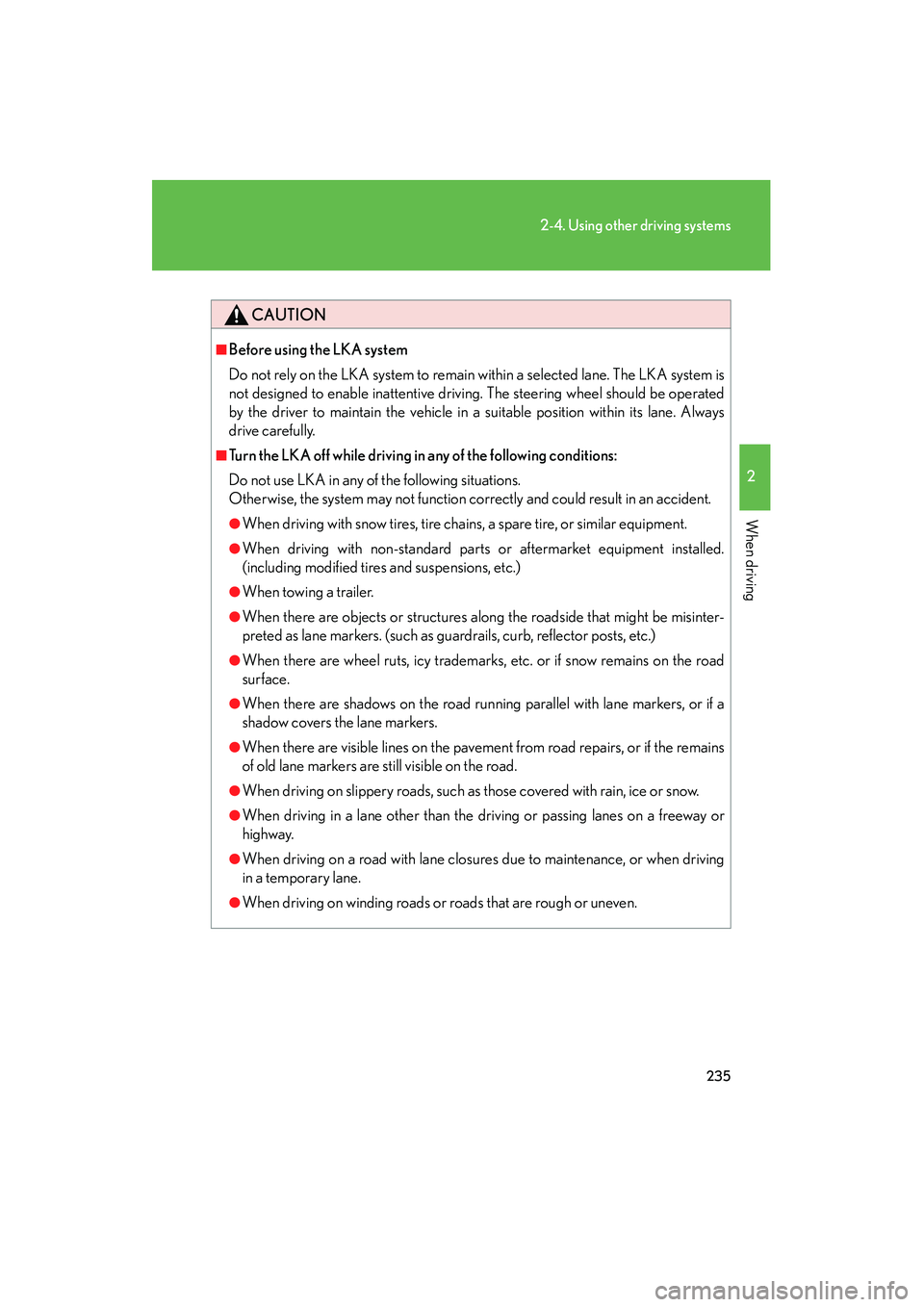
CAUTION
■Before using the LKA system
Do not rely on the LKA system to remain within a selected lane. The LKA system is
not designed to enable inattentive driving. The steering wheel should be operated
by the driver to maintain the vehicle in a suitable position within its lane. Always
drive carefully.
■Turn the LKA off while driving in any of the following conditions:
Do not use LKA in any of the following situations.
Otherwise, the system may not function correctly and could result in an accident.
●When driving with snow tires, tire chains, a spare tire, or similar equipment.
●When driving with non-standard parts or aftermarket equipment installed.
(including modified tires and suspensions, etc.)
●When towing a trailer.
●When there are objects or structures along the roadside that might be misinter-
preted as lane markers. (such as guardrails, curb, reflector posts, etc.)
●When there are wheel ruts, icy trademarks, etc. or if snow remains on the road
surface.
●When there are shadows on the road running parallel with lane markers, or if a
shadow covers the lane markers.
●When there are visible lines on the pavement from road repairs, or if the remains
of old lane markers are still visible on the road.
●When driving on slippery roads, such as those covered with rain, ice or snow.
●When driving in a lane other than the driving or passing lanes on a freeway or
highway.
●When driving on a road with lane closures due to maintenance, or when driving
in a temporary lane.
●When driving on winding roads or roads that are rough or uneven.
Page 253 of 630
252
2-4. Using other driving systems
HS250h_U_75050U
CAUTION
■When the sensor may not be correctly detecting the vehicle ahead
Apply the brakes as necessary in any of the following situations.
●When water or snow thrown up by the surrounding vehicles hinders the function-
ing of the sensor
●When your vehicle is pointing upwards (caused by a heavy load in the luggage
compartment etc.)
●Vehicles that cut in suddenly
●Vehicles with small rear ends (trailers with no load on board etc.)
●Motorcycles traveling in the same lane
■Handling the radar sensor
Observe the following to ensure the pre-collision system can function effectively:
●Keep the sensor and front grille cover clean at all times.
Clean the sensor and front grille cover with a soft cloth so you do not mark or
damage them.
●Do not subject the sensor or surrounding area to a strong impact.
If the sensor moves even slightly off position, the system may become inaccurate
or malfunction. If the sensor or surrounding area is subject to a strong impact,
always have the area inspected and adjusted by your Lexus dealer.
●Do not disassemble the sensor.
●Do not attach accessories or stickers to the sensor, grille cover or surrounding
area.
●Do not modify or paint the sensor and grille cover.
■Determining the direction the driver is facing (vehicles with driver monitor sen-
sor)
The direction the driver is facing may not be determined correctly if the following
conditions exist:
●There is an object between the driver monitor sensor and the driver’s face, such
as when the sensor is blocked.
●A part of the driver’s face is covered.
●The sensor or the driver’s face is exposed to intense light such as sunlight.
●The driving posture is improper.
Page 256 of 630
255
2-5. Driving information
2
When driving
HS250h_U_75050U(6)If your vehicle will be towing a trailer, load from your trailer will be
transferred to your vehicle. Consult this manual to determine how this
reduces the available cargo and luggage load capacity of your vehi-
cle. ( →P. 2 5 7 )
Lexus does not recommend towing a trailer with your vehicle. Your vehicle is
not designed for trailer towing.
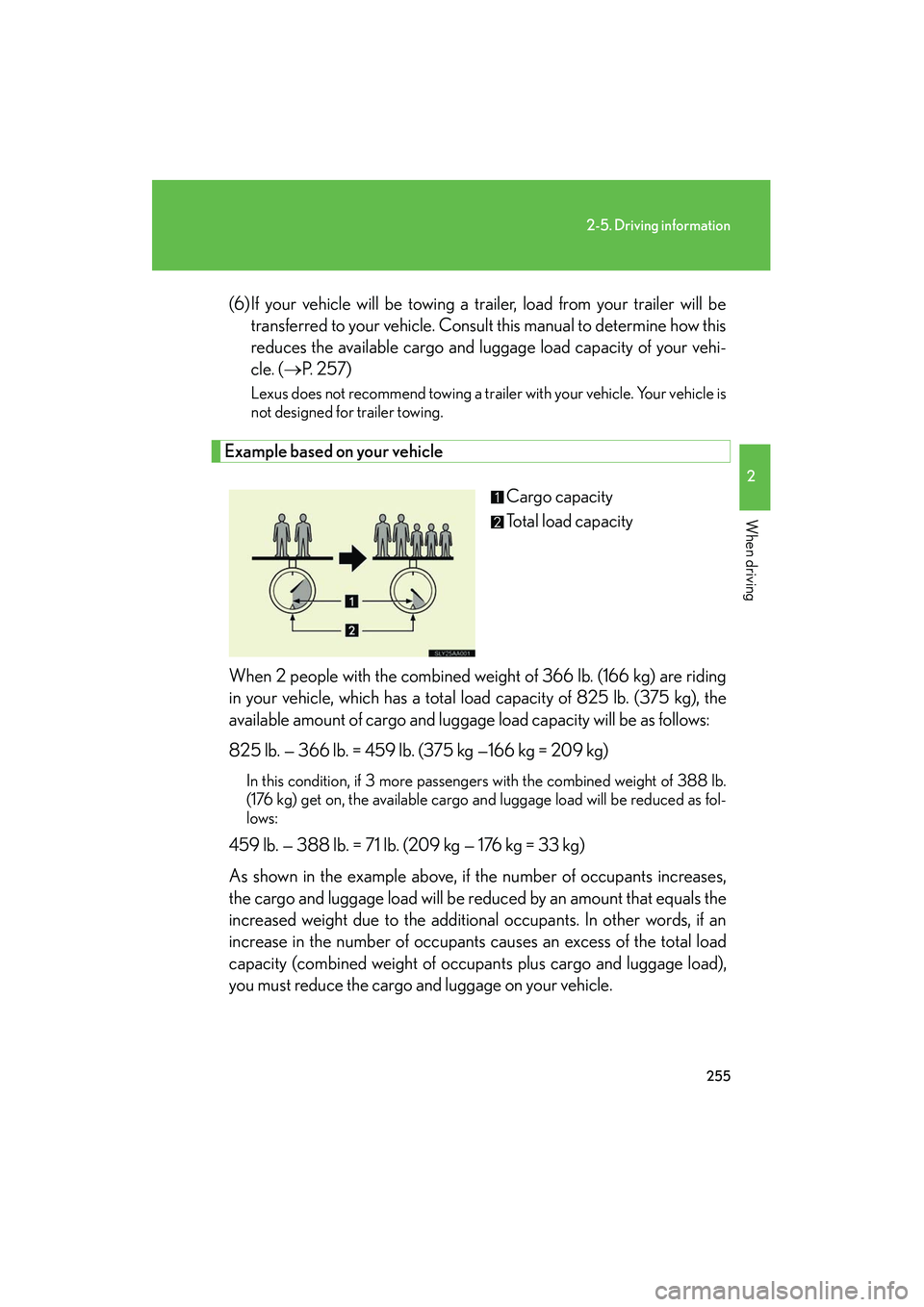
Example based on your vehicle
Cargo capacity
Total load capacity
When 2 people with the combined weight of 366 lb. (166 kg) are riding
in your vehicle, which has a total load capacity of 825 lb. (375 kg), the
available amount of cargo and luggage load capacity will be as follows:
825 lb. — 366 lb. = 459 lb. (375 kg —166 kg = 209 kg)
In this condition, if 3 more passengers with the combined weight of 388 lb.
(176 kg) get on, the available cargo and luggage load will be reduced as fol-
lows:
459 lb. — 388 lb. = 71 lb. (209 kg — 176 kg = 33 kg)
As shown in the example above, if the number of occupants increases,
the cargo and luggage load will be reduced by an amount that equals the
increased weight due to the additional occupants. In other words, if an
increase in the number of occupants causes an excess of the total load
capacity (combined weight of occupants plus cargo and luggage load),
you must reduce the cargo and luggage on your vehicle.
Page 258 of 630
257
2-5. Driving information
2
When driving
HS250h_U_75050U
Vehicle load limits
■Total load capacity and seating capacity
These details are also described on the tire and loading information label.
(→ P. 4 5 9 )
CAUTION
■Overloading the vehicle
Do not overload the vehicle.
It may not only cause damage to the tires, but also degrade steering and braking
ability, resulting in an accident.
Vehicle load limits include total load capacity, seating capacity, towing
capacity and cargo capacity.
■Total load capacity: 825 lb. (375 kg)
Total load capacity means the combined weight of occupants, cargo and
luggage.
■Seating capacity: 5 occupants (Front 2, Rear 3)
Seating capacity means the maximum number of occupants whose esti-
mated average weight is 150 lb. (68 kg) per person.
■Towing capacity
Lexus does not recommend towing a trailer with your vehicle.
■Cargo capacity
Cargo capacity may increase or decrease depending on the weight and
the number of occupants.
Page 262 of 630
261
2-5. Driving information
2
When driving
HS250h_U_75050U
Trailer towing
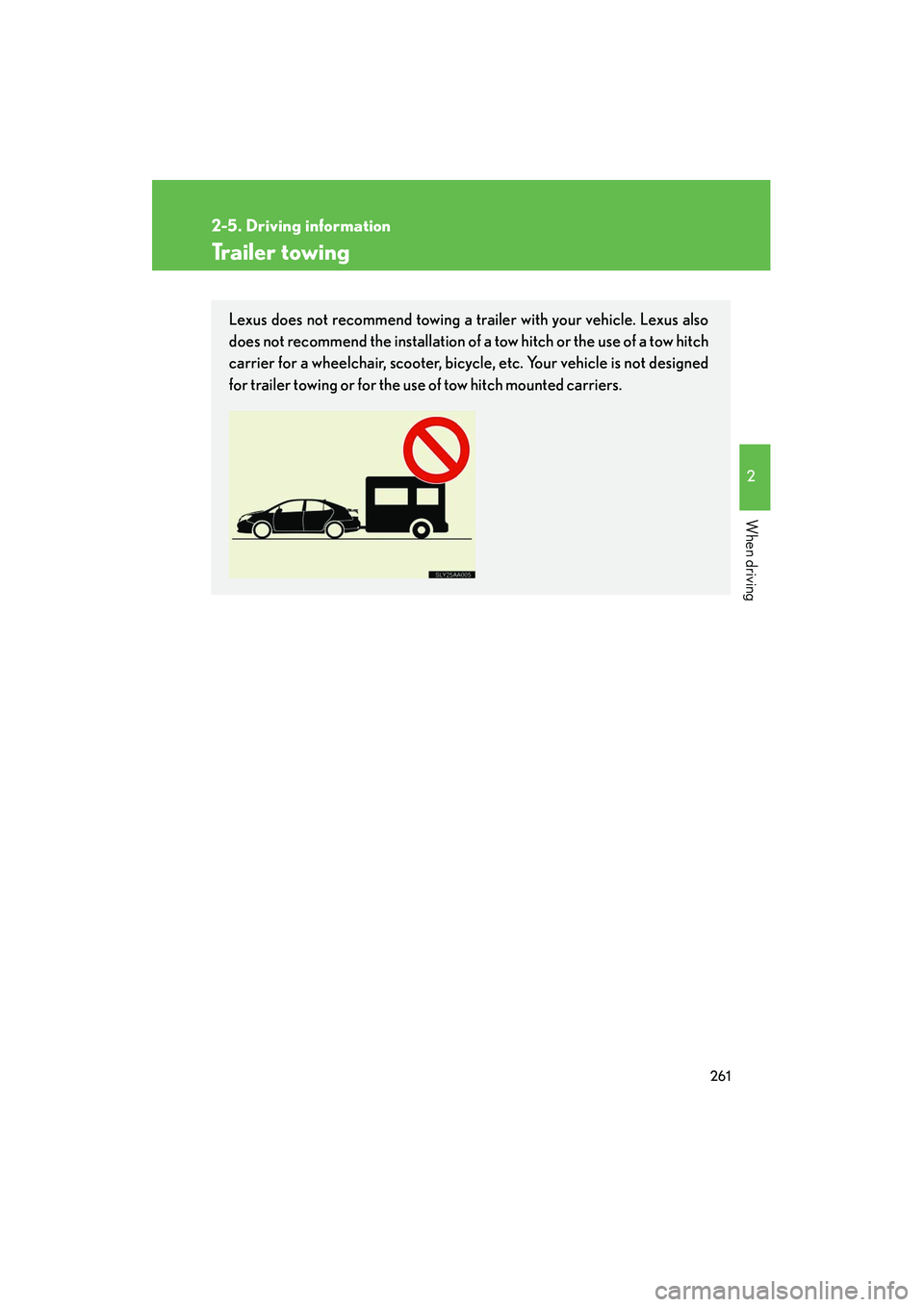
Lexus does not recommend towing a trailer with your vehicle. Lexus also
does not recommend the installation of a tow hitch or the use of a tow hitch
carrier for a wheelchair, scooter, bicycle, etc. Your vehicle is not designed
for trailer towing or for the use of tow hitch mounted carriers.
Page 623 of 630
622
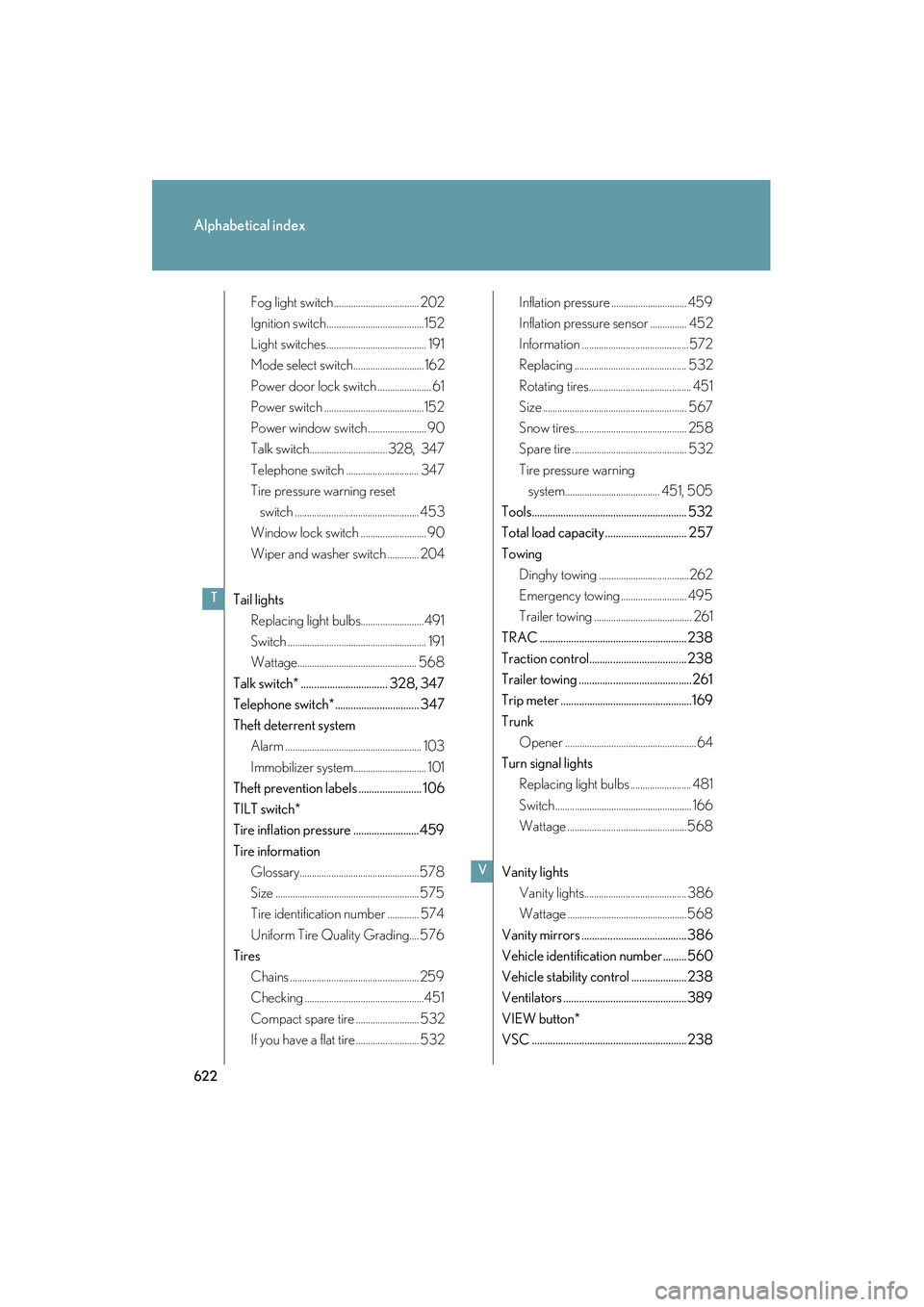
Alphabetical index
HS250h_U_75050U
Fog light switch................................... 202
Ignition switch........................................152
Light switches ......................................... 191
Mode select switch............................. 162
Power door lock switch ...................... 61
Power switch ......................................... 152
Power window switch ........................ 90
Talk switch................................328, 347
Telephone switch .............................. 347
Tire pressure warning reset switch ................................................... 453
Window lock switch ........................... 90
Wiper and washer switch ............. 204
Tail lights Replacing light bulbs..........................491
Switch ......................................................... 191
Wattage................................................. 568
Talk switch* ................................. 328, 347
Telephone switch*................................ 347
Theft deterrent system Alarm ........................................................ 103
Immobilizer system.............................. 101
Theft prevention labels ........................ 106
TILT switch*
Tire inflation pressure .........................459
Tire information Glossary.................................................578
Size ........................................................... 575
Tire identification number ............. 574
Uniform Tire Quality Grading.... 576
Tires
Chains ..................................................... 259
Checking .................................................451
Compact spare tire .......................... 532
If you have a flat tire .......................... 532 Inflation pressure ............................... 459
Inflation pressure sensor ............... 452
Information ............................................572
Replacing .............................................. 532
Rotating tires.......................................... 451
Size ........................................................... 567
Snow tires.............................................. 258
Spare tire ............................................... 532
Tire pressure warning
system....................................... 451, 505
Tools........................................................... 532
Total load capacity ............................... 257
Towing Dinghy towing .....................................262
Emergency towing ........................... 495
Trailer towing ........................................ 261
TRAC ........................................................ 238
Traction control..................................... 238
Trailer towing ...........................................261
Trip meter ..................................................169
Trunk Opener ......................................................64
Turn signal lights Replacing light bulbs ......................... 481
Switch ........................................................ 166
Wattage .................................................568
Vanity lights Vanity lights.......................................... 386
Wattage .................................................568
Vanity mirrors ........................................ 386
Vehicle identification number ......... 560
Vehicle stability control ..................... 238
Ventilators ...............................................389
VIEW button*
VSC ........................................................... 238
T
V