trunk Lexus IS F 2008 Owner's Guide
[x] Cancel search | Manufacturer: LEXUS, Model Year: 2008, Model line: IS F, Model: Lexus IS F 2008Pages: 454, PDF Size: 6.26 MB
Page 74 of 454

73
1-6. Theft deterrent system
1
Before driving
08_IS F_U_(L/O_0711)
■Items to check before locking the vehicle
To prevent unexpected triggering of the alarm and vehicle theft, make sure of the
following.
●Nobody is in the vehicle.
●The windows and moon roof are closed before the alarm is set.
●No valuables or other personal items are left in the vehicle.
■Pa n i c m o d e
■Triggering of the alarm
The alarm may be triggered in the following situations.
Stopping the alarm deactivates the alarm system.
●A person inside the vehicle opens a door, the trunk or hood.
●The battery is recharged or replaced when the vehicle is locked.
■When the battery is disconnected
Be sure to deactivate the alarm system.
If the battery is disconnected before deactivating the alarm system, the alarm may
be triggered when the battery is reconnected.When is pushed for longer than about
one second, an alarm will sound for about 60
seconds and the vehicle lights will flash to
deter any person from trying to break into or
damage your vehicle.
To stop the alarm, push any button on the
wireless remote control.
Page 96 of 454

95
1-7. Safety information
1
Before driving
08_IS F_U_(L/O_0711)
CAUTION
■Child restraint precautions
●Lexus strongly urges the use of a proper child restraint system that conforms to
the size of the child, installed on the rear seat. According to accident statistics, the
child is safer when properly restrained in the rear seat than in the front seat.
●Never install a rear-facing child restraint system on the front passenger seat even
if the “AIR BAG OFF” indicator light is illuminated. In the event of an accident, the
force of the rapid inflation of the front passenger airbag can cause death or seri-
ous injury to the child if the rear-facing child restraint system is installed on the
front passenger seat.
●A forward-facing child restraint system should allowed to be installed on the front
passenger seat only when it is unavoidable. Always move the seat as far back as
possible even if the “AIR BAG OFF” indicator light is illuminated, because the
front passenger airbag could inflate with considerable speed and force. Other-
wise, the child may be killed or seriously injured.
●Do not use the seat belt extender when installing a child restraint system on the
front or rear passenger seat. If installing a child restraint system with the seat belt
extender connected to the seat belt, the seat belt will not securely hold the child
restraint system, which could cause death or serious injury to the child or other
passengers in the event of collision.
●Do not allow the child to lean his/her head or any part of his/her body against the
door or the area of the seat, front pillar, rear pillar or roof side rail from which the
side airbags or curtain shield airbags deploy even if the child is seated in the child
restraint system. It is dangerous if the side airbags and curtain shield airbags
inflate, and the impact could cause death or serious injury to the child.
●Make sure you have complied with all installation instructions provided by the
child restraint manufacturer and that the system is properly secured. If it is not
secured properly, it may cause death or serious injury to the child in the event of a
sudden stop or accident.
■When the child restraint system is not in use
●Keep the child restraint system properly secured on the seat even if it is not in use.
Do not store the restraint unsecured in the passenger compartment.
●If it is necessary to detach the child restraint system, remove it from the vehicle or
store it securely in the trunk. This will prevent it from injuring passengers in the
event of a sudden stop or accident.
Page 109 of 454

108
2-1. Driving procedures
08_IS F_U_(L/O_0711)
CAUTION
■When starting off
To prevent the vehicle from creeping forward, keep the brake pedal firmly
depressed when shifting the shift lever.
■When driving the vehicle
●Do not drive if you are unfamiliar with the location of the brake and accelerator
pedals to avoid depressing the wrong pedal.
• Accidentally depressing the accelerator pedal instead of the brake pedal willresult in sudden acceleration that may lead to an accident that could result in
death or serious injury.
• When backing up, you may twist your body around, leading to a difficulty in operating the pedals. Make sure to operate the pedals properly.
• Make sure to keep a correct driving posture even when moving the vehicle only slightly, allowing you to depress the brake and accelerator pedals prop-
erly.
• Depress the brake pedal using your right foot. Depressing the brake pedal using your left foot may delay response in an emergency, resulting in an acci-
dent.
●Do not drive the vehicle over or stop the vehicle near flammable materials.
●Do not let the vehicle roll backwards while the shift lever is in a driving position, or
roll forward while the shift lever is in R.
Doing so may cause the engine to stall or lead to poor brake and steering perfor-
mance, resulting in an accident or damage to the vehicle.
●If the smell of exhaust is noticed inside the vehicle, open the windows and check
that the trunk is closed. Large amounts of exhaust in the vehicle can cause driver
drowsiness and an accident, resulting in death or a serious health hazard. Have
the vehicle inspected by your Lexus dealer immediately.
●Do not under any circumstances shift the shift lever to P, R or N while the vehicle
is moving.
Doing so can cause significant damage to the transmission system and may result
in a loss of vehicle control.
●Do not shift the shift lever to N while the vehicle is moving.
Doing so may cause the engine brake to not operate properly and lead to an
accident.
Page 160 of 454
159
2-4. Using other driving systems
2
When driving
08_IS F_U_(L/O_0711)
CAUTION
■Conditions under which the vehicle-to-vehicle distance control may not function
correctly
Apply the brakes as necessary in the following conditions as the radar sensor may
not be able to correctly detect vehicles ahead, and an accident may result.
●When water or snow thrown up by the surrounding vehicles hinders the function-
ing of the sensor
●When your vehicle is pointing upwards (caused by a heavy load in the trunk, etc.)
●When the road curves or when the lanes are narrow
●When steering wheel operation or your position in the lane is unstable
■To ensure the radar sensor functions correctly
Do not do the following to the sensor or grille cover as doing so may cause the sen-
sor not to function correctly and could result in an accident.
●Stick or attach anything to them
●Leave them dirty
●Disassemble, or subject them to strong shocks
●Modify or paint them
●Replace them with non-genuine parts
Page 177 of 454

176
08_IS F_U_(L/O_0711)
2-5. Driving information
Cargo and luggage
Capacity and distributionCargo capacity depends on the total weight of the occupants.
(Cargo capacity) = (Total load cap acity) — (Total weight of occupants)
Steps for Determining Correct Load Limit
(1) Locate the statement “The combined weight of occupants and cargo should never exceed XXX kg or XXX lbs.” on your vehicle’s placard.
(2) Determine the combined weight of the driver and passengers that will be riding in your vehicle.
(3)Subtract the combined weight of the driver and passengers from XXX kg or XXX lbs.
(4) The resulting figure equals the available amount of cargo and luggage load capacity.
For example, if the “XXX” amount equals 1400 lbs. and there will be
five 150 lb passengers in your vehicle, the amount of available cargo
and luggage load capacity is 650 lbs. (1400 − 750 (5 × 150) = 650
lbs.)
(5)Determine the combined weight of luggage and cargo being loaded on the vehicle. That weight may not safely exceed the available cargo
and luggage load capacity calculated in Step 4.
Take notice of the following information about storage precautions, cargo
capacity and load.
●Stow cargo and luggage in the trunk whenever possible. Be sure
all items are secured in place.
● Be careful to keep the vehicle level. Placing the weight as far for-
ward as possible helps maintain vehicle balance.
● For better fuel economy, do not carry unnecessary weight.
Page 179 of 454

178
2-5. Driving information
08_IS F_U_(L/O_0711)
CAUTION
■Things that must not be carried in the trunk
The following things may cause a fire if loaded in the trunk.
●Receptacles containing gasoline
●Aerosol cans
■Storage precautions
●Do not place items in or on the following locations:
• At the feet of the driver
• On the front passenger or rear seats (when stacking items)
• Package tray (behind the rear seatback)
• Instrument panel
•Dashboard
Items placed in the above locations could get thrown around in the event of sud-
den braking or an accident and injure the vehicle occupants.
In addition, items could block the driver’s field of vision or move during sharp
acceleration or turning. If items move about they may get under the brake or
accelerator pedals, preventing them from being depressed properly, or hit the
driver or passengers. In these situations, the driver’s control of the vehicle could
be impaired, causing an accident.
●Secure all items in the occupant compartment, as they may shift and injure some-
one during an accident or sudden braking.
■Luggage capacity and distribution
Observe the following precautions. Failure to do so will not only put load on the
tires, but also reduce steering and braking performance. This could lead to an acci-
dent resulting in serious injury or even death.
●Do not overload the vehicle.
●Do not apply load to the vehicle unevenly.
Page 186 of 454

Interior features3
185
08_IS F_U_(L/O_0711)
3-1. Using the air conditioning system and defogger ... 186
Automatic air conditioning system............. 186
Rear window and outside rear
view mirror defoggers ........ 194
3-2. Using the audio system ............................ 195
Audio system types................. 195
Using the radio......................... 198
Using the CD player ............ 205
Playing back MP3 and WMA discs.............................. 211
Optimal use of the audio system ...................................... 217
Using the AUX adapter ...... 220
Using the steering wheel audio switches ....................... 221
3-3. Using the interior lights ............................. 223
Interior lights list .................... 223
• Interior lights ........................ 225
• Personal lights ...................... 225
3-4. Using the storage features ........................ 227
List of storage features ......... 227 • Glove box .............................. 227
• Console box ......................... 228
• Overhead console.............. 229
• Cup holders .......................... 230
• Bottle holders/
door pockets ........................ 232
3-5. Other interior features ........................ 233
Sun visors ................................. 233
Vanity mirror ........................... 234
Clock ......................................... 235
Satellite switches ................... 236
Ashtrays.................................... 239
Cigarette lighter .................... 240
Power outlet ............................. 241
Seat heaters ............................ 242
Seat heaters and ventilators ............................. 244
Armrest .................................... 246
Trunk storage extension ....... 247
Coat hooks .............................. 249
Floor mat .................................. 250
Trunk features .......................... 251
Garage door opener ............ 254
Compass .................................. 259
Page 229 of 454

228
3-4. Using the storage features
08_IS F_U_(L/O_0711)
Console boxPull up the knob to release the
lock.
Slide the armrest.
Pull up the knob to release the
lock.
Lift the armrest to open.
■Glove box light
The glove box light turns on when the “ENGINE START STOP” switch is in IGNI-
TION ON mode.
■Trunk opener main switch
The trunk opener main switch is located in the glove box. ( → P. 4 1 )
CAUTION
■Caution while driving
Keep the glove box closed.
Injuries may result in the event of an accident or sudden braking.
Glove box and console box
Page 248 of 454
247
3-5. Other interior features
3
Interior features
08_IS F_U_(L/O_0711)
Trunk storage extension
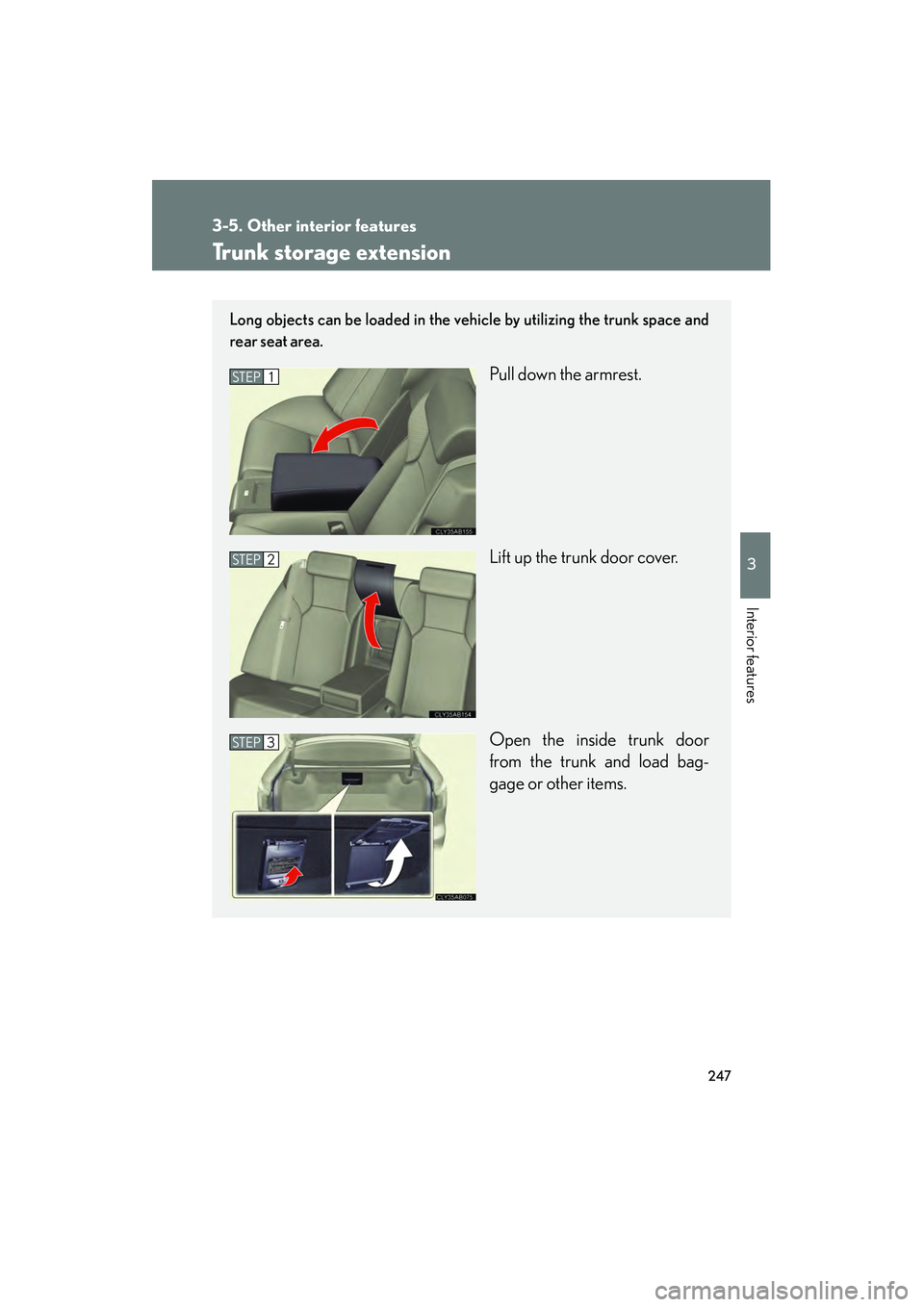
Long objects can be loaded in the vehicle by utilizing the trunk space and
rear seat area.
Pull down the armrest.
Lift up the trunk door cover.
Open the inside trunk door
from the trunk and load bag-
gage or other items.STEP1
STEP2
STEP3
Page 249 of 454
248
3-5. Other interior features
08_IS F_U_(L/O_0711)
CAUTION
■When not in use
Ensure that the inside trunk door is closed.
In the event of sudden braking, items stored in the trunk may be thrown forward into
the cabin, resulting in injury.