parking brake Lexus IS F 2010 Audio/video System / LEXUS 2010 IS F (OM53A21U) User Guide
[x] Cancel search | Manufacturer: LEXUS, Model Year: 2010, Model line: IS F, Model: Lexus IS F 2010Pages: 540, PDF Size: 16.03 MB
Page 128 of 540

128
2-1. Driving procedures
Automatic transmission
Select a shift position appropriate for the driving conditions.
■Shifting the shift lever and selecting a shift position
While the “ENGINE
START STOP” switch is
in IGNITION ON
mode, depress the brake
pedal and move the shift
lever.
*: To improve fuel efficiency and
reduce noises, set the shift lever
in the D position for normal driv-
ing.
Shift
positionFunction
PParking the vehicle/
starting the engine
RReversing
NNeutral
DNormal driving*
MM mode driving
(P. 1 3 2 )
Page 137 of 540

137
2-1. Driving procedures
2
When driving
Parking brake
■Usage in winter time
See “Winter driving tips” for parking brake usage in winter time. (P. 1 9 2 )
NOTICE
■Before driving
Fully release the parking brake.
Driving the vehicle with the parking brake set will lead to brake components over-
heating, which may affect braking performance and increase brake wear.
Sets the parking brake*
(Depressing the pedal again
releases the parking brake.)
*: Fully depress the parking
brake pedal with your left
foot while depressing the
brake pedal with your right
foot.
Canada U.S.A.
Page 151 of 540

151
2-3. Operating the lights and windshield wipers
2
When driving
AFS (Adaptive Front—lighting System)
AFS (Adaptive Front—lighting System) improves visibility at intersections
and on curves by automatically adjusting the level of the headlights
according to vehicle speed and the degree of the tire’s angle as con-
trolled by steering input.
Operates at speeds of 6 mph (10 km/h) or higher.
■Deactivating AFS
How to switch: P. 319
The “AFS OFF” indicator turns on when the AFS is deactivated.
■Daytime running light system
To make your vehicle more visible to other drivers, the headlights turn on automati-
cally (at a reduced intensity) whenever the engine is started and the parking brake
is released. Daytime running lights are not designed for use at night.
■Headlight control sensor
The sensor may not function properly if an
object is placed on the sensor, or anything
that blocks the sensor is affixed to the wind-
shield.
Doing so interferes with the sensor detecting
the level of ambient light and may cause the
automatic headlight system to malfunction.
Page 175 of 540

175
2-4. Using other driving systems
2
When driving
■Sensor detection information
●Certain vehicle conditions and the surrounding environment may affect the
ability of the sensor to correctly detect obstacles. Particular instances where this
may occur are listed below.
• There is dirt, snow or ice on the sensor.
• The sensor is frozen.
• The sensor is covered in any way.
• The vehicle is leaning considerably to one side.
• On an extremely bumpy road, on an incline, on gravel, or on grass.
• The vicinity of the vehicle is noisy due to vehicle horns, motorcycle engines,
air brakes of large vehicles, or other loud noises producing ultrasonic waves.
• There is another vehicle equipped with parking assist sensors in the vicinity.
• The sensor is coated with a sheet of spray or heavy rain.
• The vehicle is equipped with a fender pole or wireless antenna.
• A towing eyelet is installed.
• The bumper or sensor receives a strong impact.
• The vehicle is approaching a tall or curved curb.
• In harsh sunlight or intense cold weather
In addition to the examples above, there are instances in which, because of their
shapes, signs and other objects may be judged by the sensor to be closer than they
are.
●The shape of the obstacle may prevent the sensor from detecting it. Pay particu-
lar attention to the following obstacles.
• Wires, fences, ropes etc.
• Cotton, snow and other materials that absorb radio waves
• Sharply-angled objects
•Low obstacles
• Tall obstacles with upper sections projecting outwards in the direction of your
vehicle
■If the display flashes and a message is displayed
P. 4 5 1
Page 193 of 540
193
2-5. Driving information
2
When driving
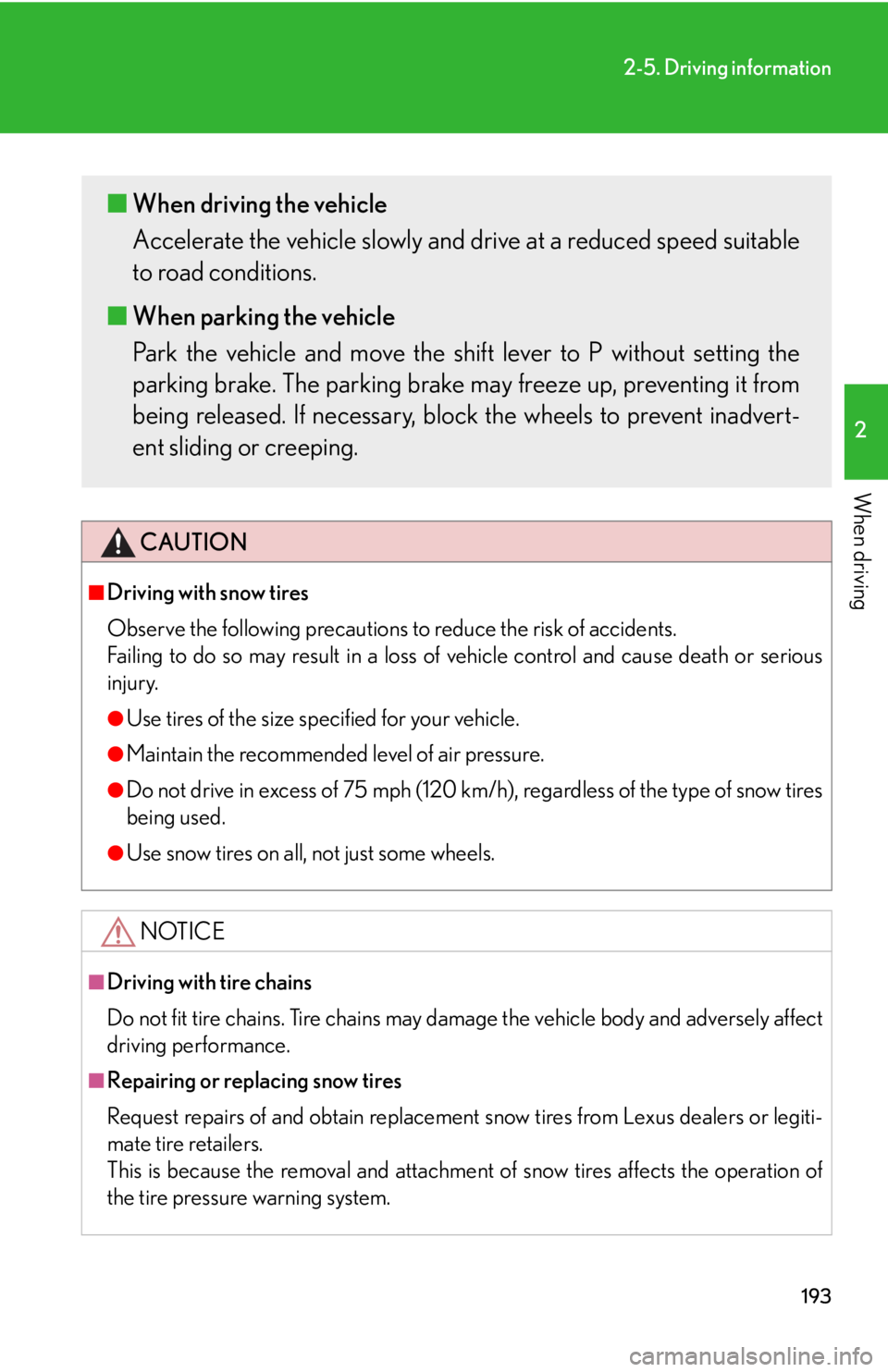
CAUTION
■Driving with snow tires
Observe the following precautions to reduce the risk of accidents.
Failing to do so may result in a loss of vehicle control and cause death or serious
injury.
●Use tires of the size specified for your vehicle.
●Maintain the recommended level of air pressure.
●Do not drive in excess of 75 mph (120 km/h), regardless of the type of snow tires
being used.
●Use snow tires on all, not just some wheels.
NOTICE
■Driving with tire chains
Do not fit tire chains. Tire chains may damage the vehicle body and adversely affect
driving performance.
■Repairing or replacing snow tires
Request repairs of and obtain replacement snow tires from Lexus dealers or legiti-
mate tire retailers.
This is because the removal and attachment of snow tires affects the operation of
the tire pressure warning system.
■When driving the vehicle
Accelerate the vehicle slowly and drive at a reduced speed suitable
to road conditions.
■When parking the vehicle
Park the vehicle and move the shift lever to P without setting the
parking brake. The parking brake may freeze up, preventing it from
being released. If necessary, block the wheels to prevent inadvert-
ent sliding or creeping.
Page 371 of 540

371
4-3. Do-it-yourself maintenance
4
Maintenance and care
CAUTION
■When raising your vehicle:
Make sure to observe the following to reduce the possibility of death or serious
injury.
●When using a floor jack, follow the instructions of the manual provided with the
jack.
●Do not use the jack that was supplied with your vehicle.
●Do not put any part of your body or get underneath the vehicle supported only by
the floor jack.
Always use automotive jack stands on a solid, flat, level surface.
●Do not start the engine while the vehicle is supported by the floor jack.
●Stop the vehicle on level firm ground, firmly set the parking brake and put the shift
lever in P.
●Make sure to set the floor jack properly at the jack point.
Raising the vehicle with an improperly positioned floor jack will damage the vehi-
cle and may cause the vehicle to fall off the floor jack.
●Do not raise the vehicle while someone is in the vehicle.
●When raising the vehicle, do not place any objects on top of or underneath the
floor jack.
●Lift up the vehicle using a floor jack such as
the one shown in the illustration.
Page 432 of 540

432
5-1. Essential information
■Emergency towing procedure
Release the parking brake.
Shift the shift lever to N.
Put the “ENGINE START STOP” switch in ACCESSORY mode (engine
off) or IGNITION ON mode (engine running).
CAUTION
■Caution while towing
●Use extreme caution when towing the vehicle.
Avoid sudden starts or erratic driving maneuvers which place excessive stress on
the emergency towing eyelet and the cables or chains. Always use caution for the
surroundings and other vehicles while towing.
●If the engine is not running, the power assist for the brakes and steering will not
function, making steering and braking more difficult.
NOTICE
■To prevent causing serious damage to the transmission
Never tow this vehicle from the rear with four wheels on the ground. This may cause
serious damage to the transmission.
STEP1
STEP2
STEP3
Page 441 of 540
5
When trouble arises
441
5-2. Steps to take in an emergency
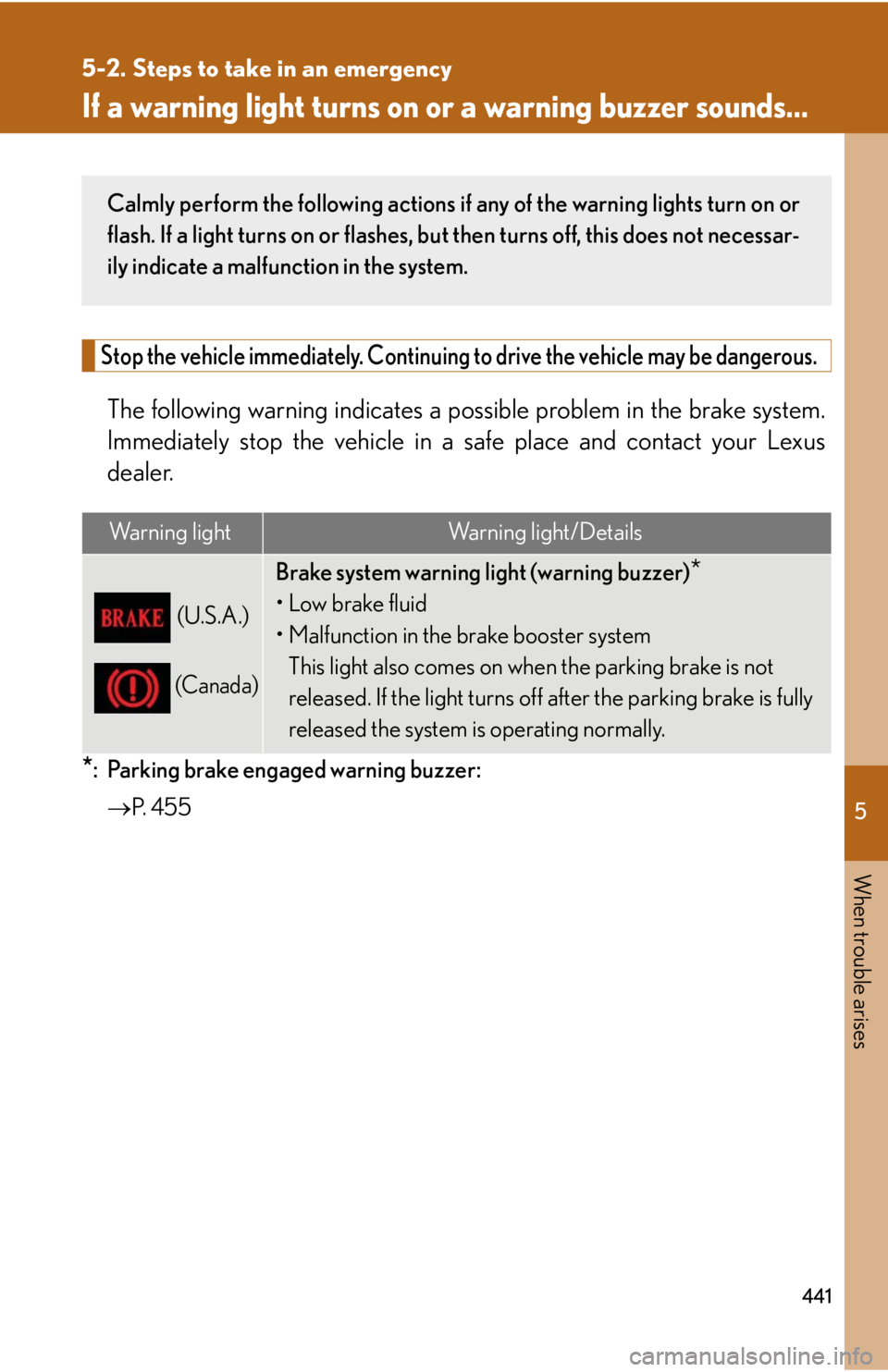
If a warning light turns on or a warning buzzer sounds...
Stop the vehicle immediately. Continuing to drive the vehicle may be dangerous.
The following warning indicates a possible problem in the brake system.
Immediately stop the vehicle in a safe place and contact your Lexus
dealer.
*: Parking brake engaged warning buzzer:
P. 4 5 5
Warning lightWarning light/Details
(U.S.A.)
(Canada)
Brake system warning light (warning buzzer)*
•Low brake fluid
• Malfunction in the brake booster system
This light also comes on when the parking brake is not
released. If the light turns off after the parking brake is fully
released the system is operating normally.
Calmly perform the following actions if any of the warning lights turn on or
flash. If a light turns on or flashes, but then turns off, this does not necessar-
ily indicate a malfunction in the system.
Page 456 of 540
456
5-2. Steps to take in an emergency
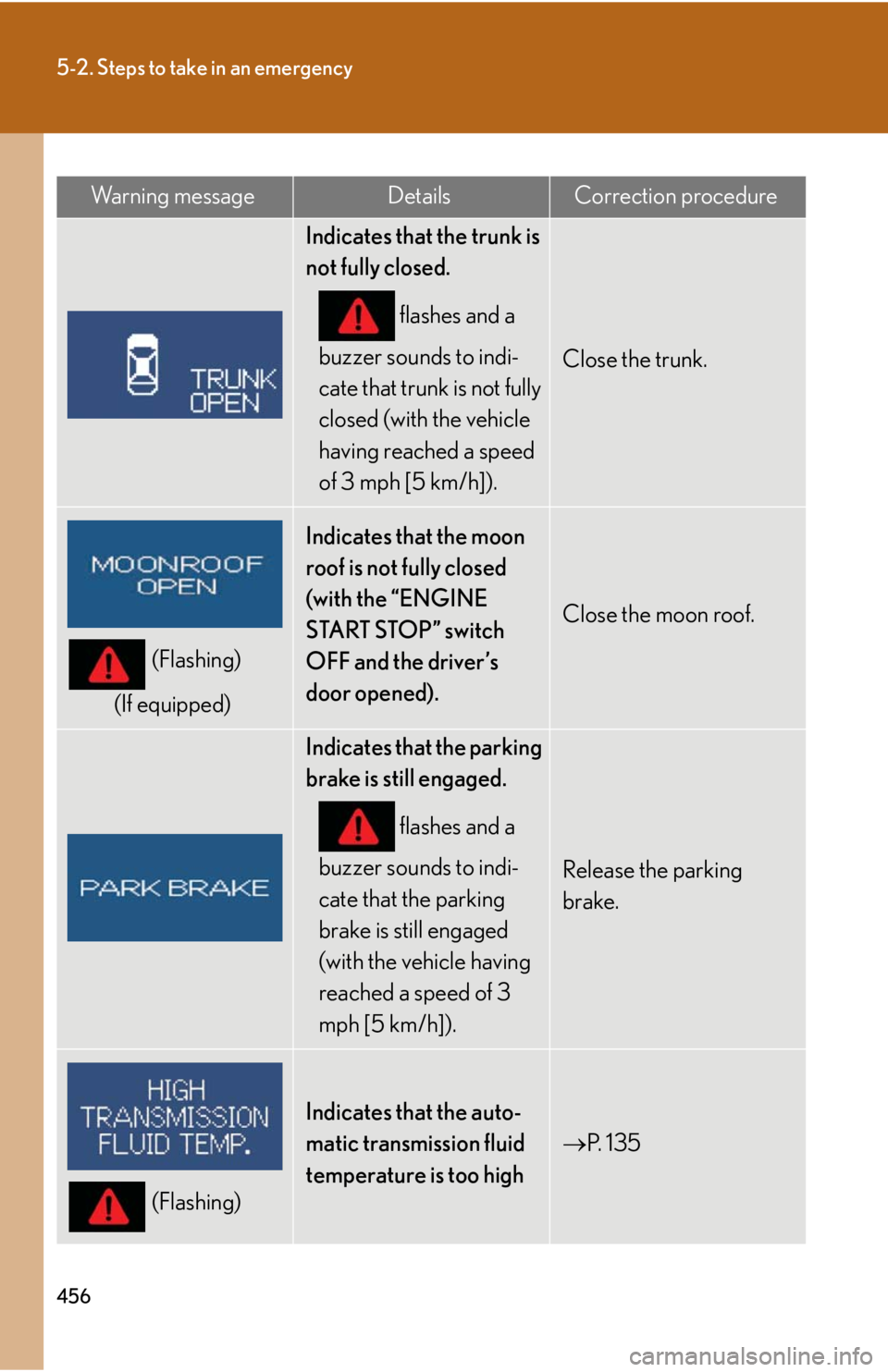
Wa r n i n g m e s s a g eDetailsCorrection procedure
Indicates that the trunk is
not fully closed.
flashes and a
buzzer sounds to indi-
cate that trunk is not fully
closed (with the vehicle
having reached a speed
of 3 mph [5 km/h]).
Close the trunk.
(Flashing)
(If equipped)
Indicates that the moon
roof is not fully closed
(with the “ENGINE
START STOP” switch
OFF and the driver’s
door opened).
Close the moon roof.
Indicates that the parking
brake is still engaged.
flashes and a
buzzer sounds to indi-
cate that the parking
brake is still engaged
(with the vehicle having
reached a speed of 3
mph [5 km/h]).
Release the parking
brake.
(Flashing)
Indicates that the auto-
matic transmission fluid
temperature is too high
P. 1 3 5
Page 465 of 540

5
When trouble arises
465
5-2. Steps to take in an emergency
If you have a flat tire
Remove the flat tire and replace it with the spare tire provided. The spare
tire can only be used on the front wheels.
■Before jacking up the vehicle
●Stop the vehicle on a hard, flat surface.
●Set the parking brake.
●Shift the shift lever to P.
●Stop the engine.
●Turn on the emergency flashers.
■Location of the spare tire, jack and tools
Tool bag
(including towing eyelet)Jack
Spare tireJack handle
Tighten Loosen