warning Lexus IS F 2011 User Guide
[x] Cancel search | Manufacturer: LEXUS, Model Year: 2011, Model line: IS F, Model: Lexus IS F 2011Pages: 529, PDF Size: 13.89 MB
Page 175 of 529
164
2-2. Instrument cluster
IS F_EE
Indicators and warning lights
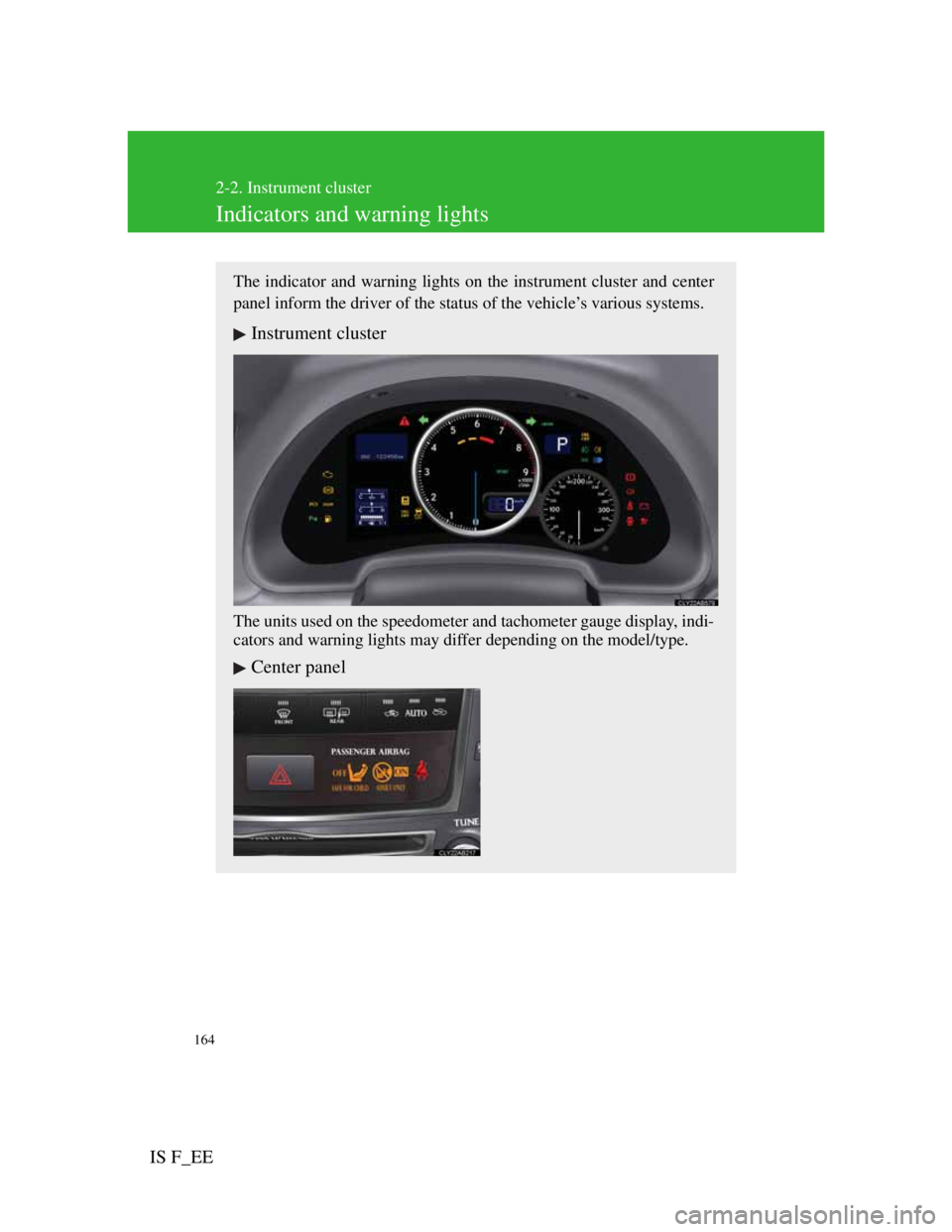
The indicator and warning lights on the instrument cluster and center
panel inform the driver of the status of the vehicle’s various systems.
Instrument cluster
The units used on the speedometer and tachometer gauge display, indi-
cators and warning lights may differ depending on the model/type.
Center panel
Page 177 of 529
166
2-2. Instrument cluster
IS F_EE
CAUTION
If a safety system warning light does not come on
Should a safety system light such as the ABS and SRS warning light not
come on when you start the engine, this could mean that these systems are
not available to help protect you in an accident, which could result in death
or serious injury. Have the vehicle inspected by any authorized Lexus dealer
or repairer, or another duly qualified and equipped professional, immedi-
ately if this occurs.
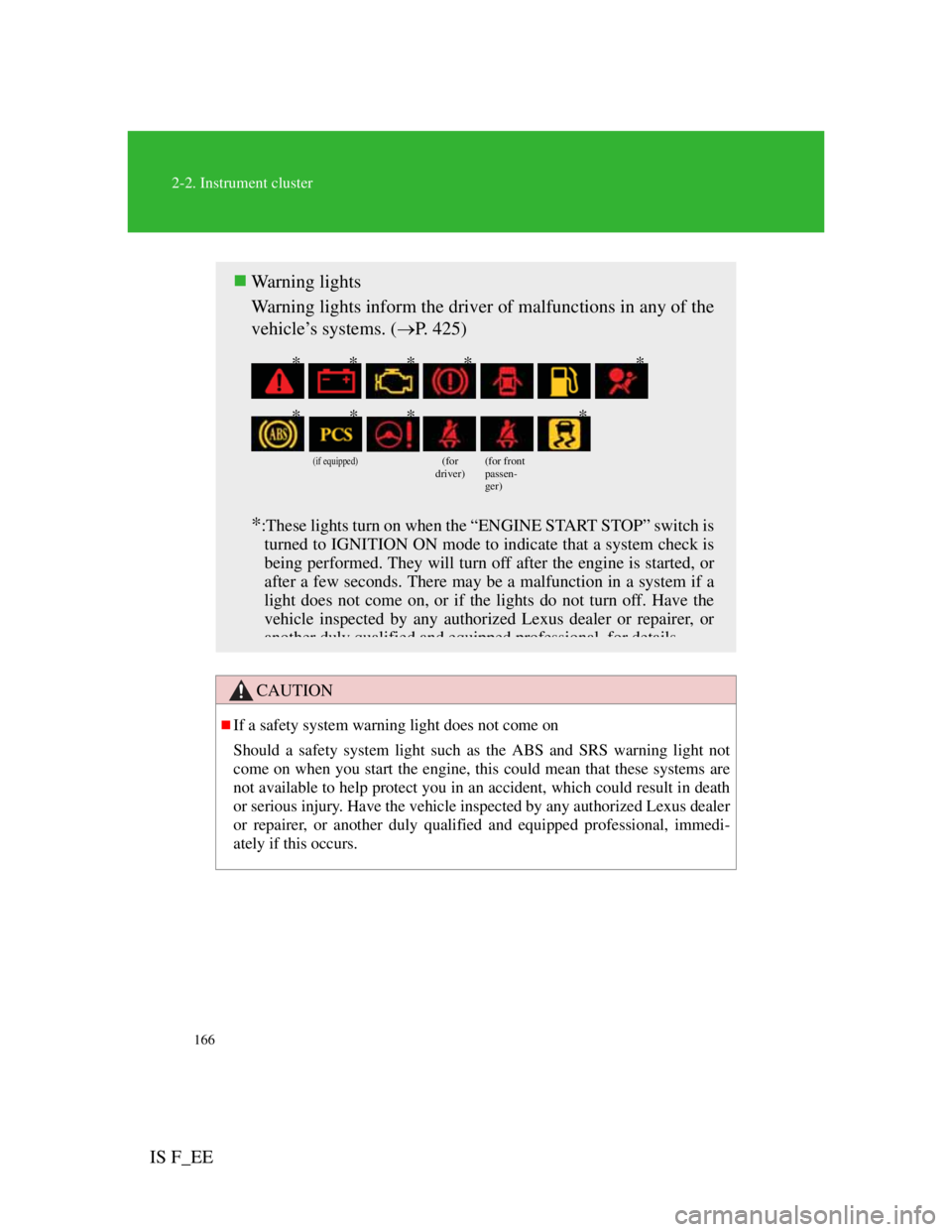
Warning lights
Warning lights inform the driver of malfunctions in any of the
vehicle’s systems. (P. 425)
*:These lights turn on when the “ENGINE START STOP” switch is
turned to IGNITION ON mode to indicate that a system check is
being performed. They will turn off after the engine is started, or
after a few seconds. There may be a malfunction in a system if a
light does not come on, or if the lights do not turn off. Have the
vehicle inspected by any authorized Lexus dealer or repairer, or
another duly qualified and equipped professional for details
(if equipped)(for
driver)(for front
passen-
ger)
*****
****
Page 178 of 529

167
2-2. Instrument cluster
2
When driving
IS F_EE
Multi-information display
The multi-information display presents the driver with a variety of
driving-related data, including the current outside air temperature.
Trip information (P.
168)
Displays driving range, fuel
consumption and other cruis-
ing-related information.
Lexus parking assist-sen-
sor display (if equipped)
(P. 199)
Automatically displayed
when using Lexus parking
assist-sensor.
Satellite switch mode dis-
play
(P. 3 3 3 )
This switch is used to config-
ure various function settings.
Dynamic radar cruise con-
trol display (if equipped)
(P.
184)
Automatically displayed
when using dynamic radar
cruise control.
Warning messages
(P. 4 3 1 )
Page 200 of 529
189
2-4. Using other driving systems
2
When driving
IS F_EE
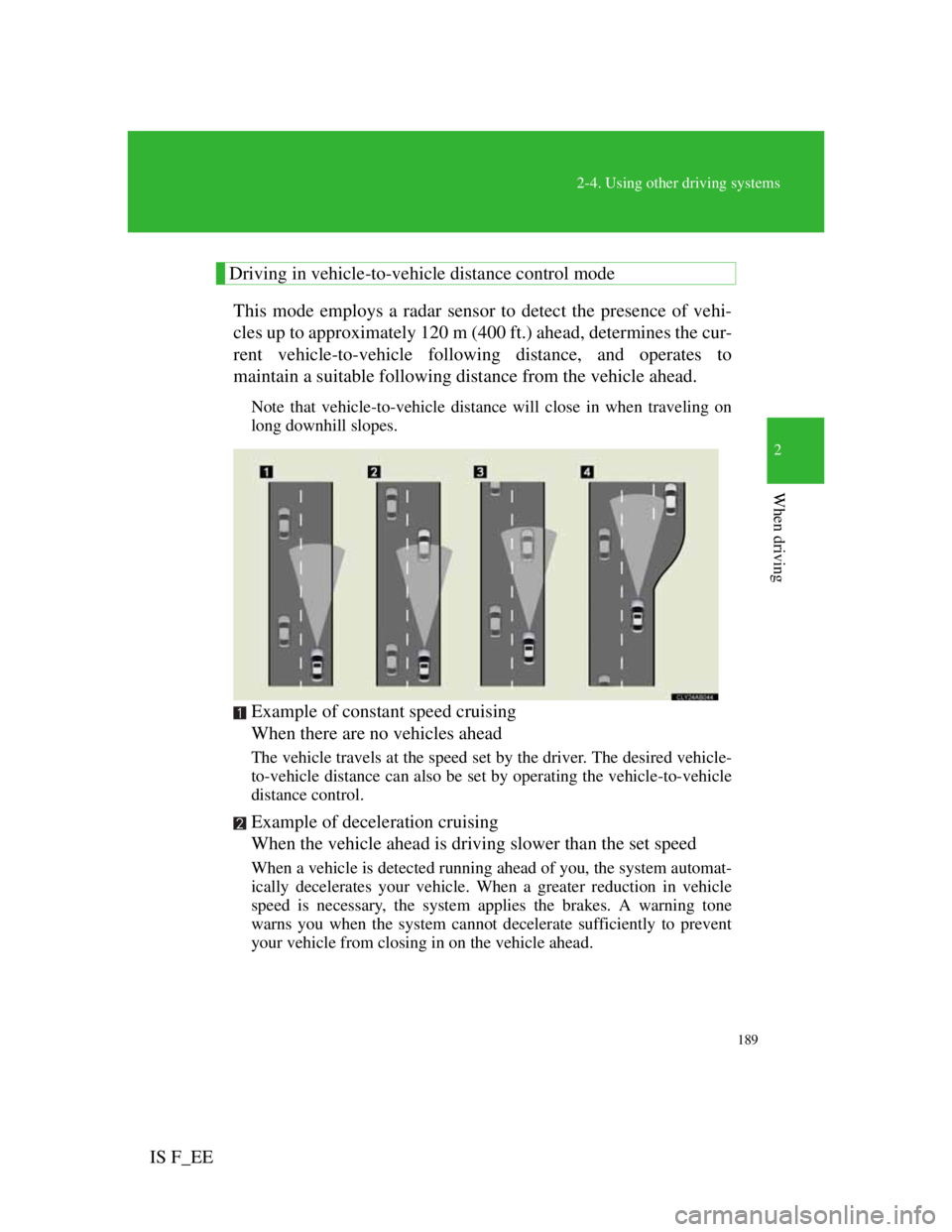
Driving in vehicle-to-vehicle distance control mode
This mode employs a radar sensor to detect the presence of vehi-
cles up to approximately 120 m (400 ft.) ahead, determines the cur-
rent vehicle-to-vehicle following distance, and operates to
maintain a suitable following distance from the vehicle ahead.
Note that vehicle-to-vehicle distance will close in when traveling on
long downhill slopes.
Example of constant speed cruising
When there are no vehicles ahead
The vehicle travels at the speed set by the driver. The desired vehicle-
to-vehicle distance can also be set by operating the vehicle-to-vehicle
distance control.
Example of deceleration cruising
When the vehicle ahead is driving slower than the set speed
When a vehicle is detected running ahead of you, the system automat-
ically decelerates your vehicle. When a greater reduction in vehicle
speed is necessary, the system applies the brakes. A warning tone
warns you when the system cannot decelerate sufficiently to prevent
your vehicle from closing in on the vehicle ahead.
Page 201 of 529

190
2-4. Using other driving systems
IS F_EEExample of follow-up cruising
When following a vehicle driving slower than the set speed
The system continues follow-up cruising while adjusting for changes
in the speed of the vehicle ahead in order to maintain the vehicle-to-
vehicle distance set by the driver.
Example of acceleration
When there are no longer any vehicles ahead driving slower than
the set speed
The system accelerates until the set speed is reached. The system then
returns to constant speed cruising.
Approach warning
When your vehicle is too close to a vehicle ahead, and sufficient
automatic deceleration via the cruise control is not possible, the
display will flash and the buzzer will sound to alert the driver. An
example of this would be if another driver cuts in front of you
while you are following a vehicle. Apply the brakes to ensure an
appropriate vehicle-to-vehicle distance.
Warnings may not occur when
In the following instances, there is a possibility that the warn-
ings will not occur:
When the speed of the vehicle ahead matches or exceeds your
vehicle speed
When the vehicle ahead is traveling at an extremely slow
speed
Immediately after the cruise control speed was set
At the instant the accelerator is applied
Page 204 of 529
193
2-4. Using other driving systems
2
When driving
IS F_EE
Automatic cancelation of constant speed control
The cruise control will stop maintaining the vehicle speed in the following
situations:
Actual vehicle speed is more than approximately 16 km/h (10 mph)
below the set vehicle speed.
At this time, the memorized set speed is not retained.
Actual vehicle speed falls below approximately 40 km/h (25 mph).
VSC is activated.
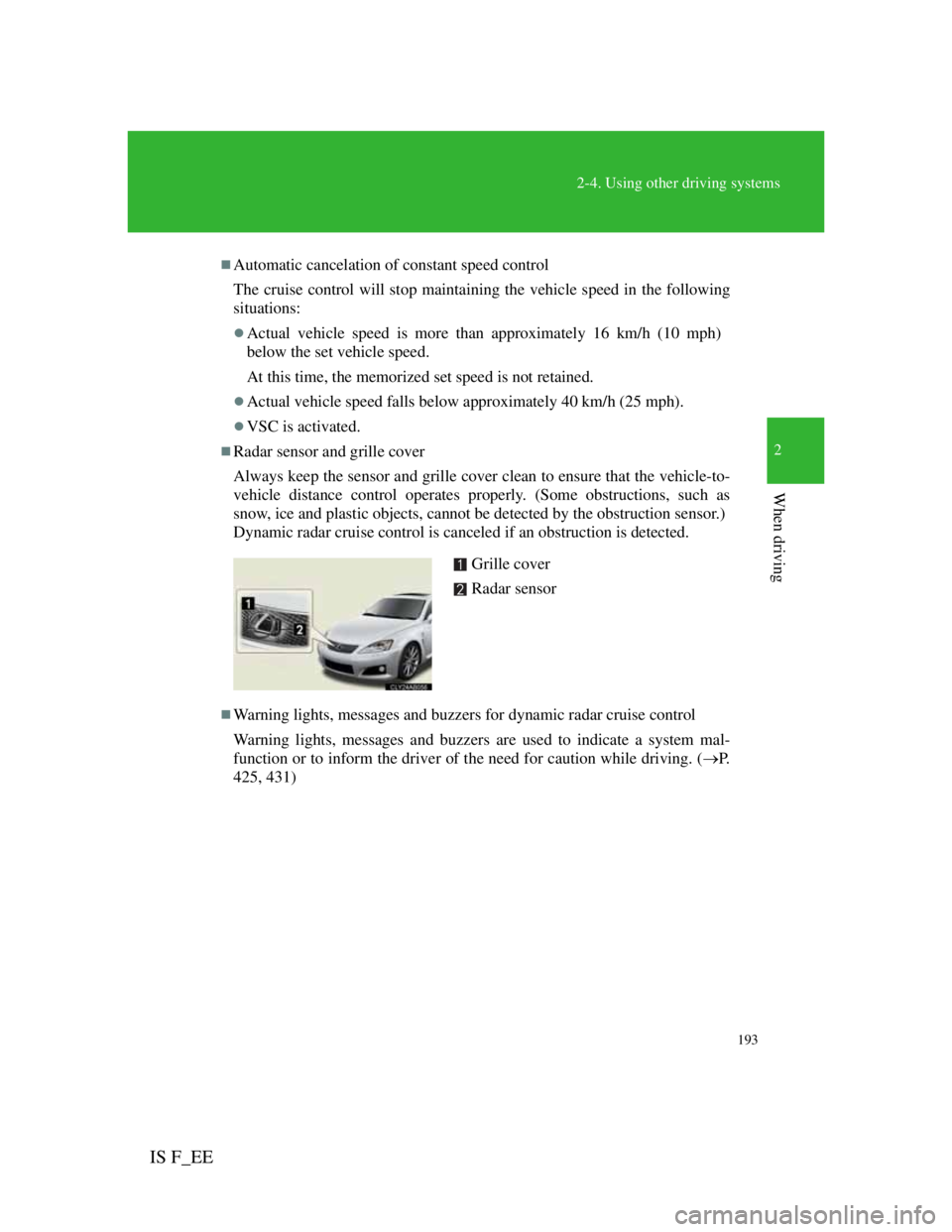
Radar sensor and grille cover
Always keep the sensor and grille cover clean to ensure that the vehicle-to-
vehicle distance control operates properly. (Some obstructions, such as
snow, ice and plastic objects, cannot be detected by the obstruction sensor.)
Dynamic radar cruise control is canceled if an obstruction is detected.
Warning lights, messages and buzzers for dynamic radar cruise control
Warning lights, messages and buzzers are used to indicate a system mal-
function or to inform the driver of the need for caution while driving. (P.
425, 431)
Grille cover
Radar sensor
Page 208 of 529
197
2-4. Using other driving systems
2
When driving
IS F_EE
CAUTION
Situations unsuitable for dynamic radar cruise control
Do not use dynamic radar cruise control in any of the following situations.
Doing so may result in inappropriate speed control and could cause an acci-
dent resulting in death or serious injury.
In heavy traffic
On roads with sharp bends
On winding roads
On slippery roads, such as those covered with rain, ice and snow
On steep downhills, or where there are sudden changes between sharp up
and down gradients
At entrances to expressways
When weather conditions are bad enough that they may prevent the sen-
sors from functioning correctly (fog, snow, sandstorm, heavy rain, etc.)
Vehicle speed may exceed the set speed when driving down a steep hill.
When an approach warning buzzer is heard often
When the sensor may not be correctly detecting the vehicle ahead
Apply the brakes as necessary when any of the following types of vehicles
are in front of you.
As the sensor may not be able to correctly detect these types of vehicles, the
approach warning (P. 190) will not be activated, and a fatal or serious
accident may result.
Vehicles that cut in suddenly
Vehicles traveling at low speeds
Vehicles that are not moving
Vehicles with small rear ends (trailers with no load on board etc.)
Motorcycles traveling in the same lane
Page 224 of 529

213
2-4. Using other driving systems
2
When driving
IS F_EE
PCS (Pre-Crash Safety system)
When the radar sensor detects possibility of a frontal collision, the pre-
crash safety system such as the brakes and seat belts are automatically
engaged to lessen impact and injuries to occupants as well as vehicle
damage.
Pre-crash seat belts
If the pre-crash sensor detects that a collision is unavoidable, the
pre-crash safety system will retract the seat belt before the collision
occurs.
The same will happen if the driver makes an emergency braking or
loses control of the vehicle. (P. 7 2 )
However, the system will not operate in the event of skidding when
the VSC system are disabled.
Pre-crash brake assist
When there is a high possibility of a frontal collision, the system
applies greater braking force in relation to how strongly the brake
pedal is depressed.
Pre-crash braking
When there is a high possibility of a frontal collision, the system
warns the driver using a warning light, warning display and buzzer.
If the system determines that a collision is unavoidable, the brakes
are automatically applied to reduce the collision speed. The pre-
hb ki f i b d d ff i h lli
: If equipped
Page 225 of 529

214
2-4. Using other driving systems
IS F_EE
Disabling the pre-crash braking
The pre-crash braking function
can be turned on and off using
the satellite switch. (P. 333)
Press “”or “” to display the
“PCS BRAKE” setting ( ).
Then, press the “ON/OFF” but-
ton in the middle of the switch
to select either “ON” or “OFF”
().
It may take approximately 3
seconds for the display to
change after the satellite switch
is operated.
The “PCS” warning light
flashes when “OFF” is selected.
Page 229 of 529

218
2-4. Using other driving systems
IS F_EE
When passing an oncoming vehicle on a right-turn (right-hand drive
countries) or left-turn (left-hand drive countries)
When your vehicle rapidly closes on the vehicle in front
When a grade separation/interchange, sign, billboard, or other structure
appears to be directly in the vehicle's line of travel.
When an overhead billboard or other metallic structure appears to be in
the vehicle’s direct line of travel due to driving on a hill.
When an extreme change in vehicle height occurs
When the axis of the radar is out of adjustment
When passing through certain toll gates
When driving on a bridge.
When the system is activated in the situations described above there is also a
possibility that the seat belts will retract quickly and the brakes will be
applied with a force greater than normal. When the seat belt is locked in the
retracted position, stop the vehicle in a safe place, release the seat belt and
refasten.
When there is a malfunction in the system
Warning lights and/or warning messages will turn on or flash. (P. 425,
431)
Situations in which the pre-crash safety system does not function properly
The system may not function effectively in situations such as the following:
On roads with sharp bends or uneven surfaces
If a vehicle suddenly moves in front of your vehicle, such as at an inter-
section
If a vehicle suddenly cuts in front of your vehicle, such as when overtak-
ing
In inclement weather such as heavy rain, fog, snow or sand storms
When your vehicle is skidding with the VSC system off
When an extreme change in vehicle height occurs
When the axis of the radar is out of adjustment
Automatic cancelation of the pre-crash safety system
When a malfunction occurs due to sensor contamination, etc. that results in
the sensors being unable to detect obstacles, the pre-crash safety system will
be automatically disabled. In this case, the system will not activate even if
there is a collision possibility.