seats Lexus IS F 2012 Owner's Guide
[x] Cancel search | Manufacturer: LEXUS, Model Year: 2012, Model line: IS F, Model: Lexus IS F 2012Pages: 578, PDF Size: 7.07 MB
Page 111 of 578

110
1-7. Safety information
IS F_U
CAUTION
■Front passenger occupant classification system precautions
●Do not recline the front passenger seatback so far that it touches a rear seat. This
may cause the “AIR BAG OFF” indicator light to be illuminated, which indicates
that the passenger’s airbags will not deploy in the event of a severe accident. If the
seatback touches the rear seat, return the seatback to a position where it does
not touch the rear seat. Keep the front passenger seatback as upright as possible
when the vehicle is moving. Reclining the seatback excessively may lessen the
effectiveness of the seat belt system.
●If an adult sits in the front passenger seat, the “AIR BAG ON” indicator light is illu-
minated. If the “AIR BAG OFF” indicator is illuminated, ask the passenger to sit
up straight, well back in the seat, feet on the floor, and with the seat belt worn cor-
rectly. If the “AIR BAG OFF” indicator still remains illuminated, either ask the pas-
senger to move to the rear seat, or if that is not possible, move the front passenger
seat fully rearward.
●When it is unavoidable to install the forward-facing child restraint system on the
front passenger seat, install the child restraint system on the front passenger seat
in the proper order. (→P. 115)
●Do not modify or remove the front seats.
●Do not kick the front passenger seat or subject it to severe impact. Otherwise,
the SRS warning light may come on to indicate a malfunction of the detection sys-
tem. In this case, contact your Lexus dealer immediately.
●Child restraint systems installed on the rear seat should not contact the front
seatbacks.
●Do not use a seat accessory, such as a cushion or seat cover, that covers the seat
cushion surface.
●Do not modify or replace the upholstery of the front seat.
Page 116 of 578
115
1
1-7. Safety information
Before driving
IS F_U
Installing child restraints
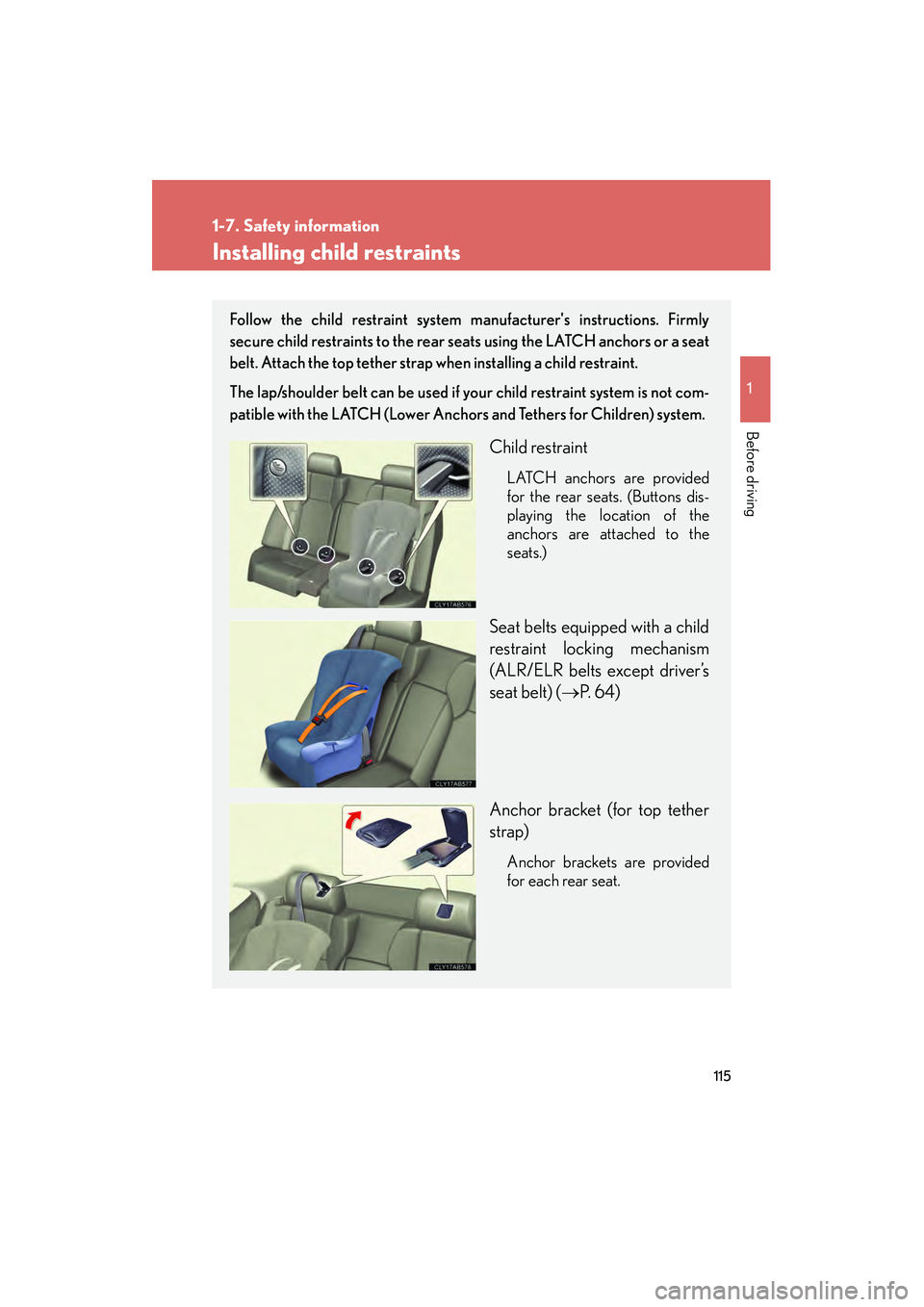
Follow the child restraint system manufacturer's instructions. Firmly
secure child restraints to the rear seats using the LATCH anchors or a seat
belt. Attach the top tether strap when installing a child restraint.
The lap/shoulder belt can be used if your child restraint system is not com-
patible with the LATCH (Lower Anchor s and Tethers for Children) system.
Child restraint
LATCH anchors are provided
for the rear seats. (Buttons dis-
playing the location of the
anchors are attached to the
seats.)
Seat belts equipped with a child
restraint locking mechanism
(ALR/ELR belts except driver’s
seat belt) (→P. 6 4 )
Anchor bracket (for top tether
strap)
Anchor brackets are provided
for each rear seat.
Page 213 of 578

212
2-5. Driving information
IS F_U
CAUTION
■Things that must not be carried in the trunk
The following things may cause a fire if loaded in the trunk.
●Receptacles containing gasoline
●Aerosol cans
■Storage precautions
Observe the following precautions.
Failing to do so may result in death or serious injury.
●Do not place cargo or luggage in or on the following locations as the item may
get under the brake or accelerator pedal and prevent pedals from being
depressed properly, block the driver's vision, or hit the driver or passengers,
causing an accident.
• At the feet of the driver
• On the front passenger or rear seats (when stacking items)
• Package tray (behind the rear seatback)
• Instrument panel
•Dashboard
●Secure all items in the occupant compartment, as they may shift and injure some-
one during sudden braking, sudden swerving or an accident.
■Luggage capacity and distribution
Observe the following precautions. Failure to do so will not only put load on the
tires, but also reduce steering and braking performance. This could lead to an acci-
dent resulting in serious injury or even death.
●Do not overload the vehicle.
●Do not apply load to the vehicle unevenly.
Page 222 of 578

221
3-1. Using the air conditioning system and defogger
3
Interior features
IS F_UPress “
∧” on to increase the temperature and “ ∨” to
decrease the temperature.
The temperature for the driver and passenger seats can be set sepa-
rately.
Adjusting the settings ■ Adjusting the temperature setting
Press “ ∧” on to increase the temperature and “∨ ” to decrease
the temperature.
The air conditioning system switches between individual and simultaneous
modes each time is pressed.
Dual mode (the indicator on is on.): The temperature for the
left-hand seat and right-hand seat can be adjusted separately. Operat-
ing the passenger's side temperature control will enter dual mode.
Simultaneous mode (the indicator on is off.): Only
(driver’s side) can be used to adjust the temperature for all seats.
■ Adjusting the fan speed
Press “ ∧” (increase) or “∨ ” (decrease) on .
Press to turn the fan off.
STEP3
Page 350 of 578
349
3-7. Other interior features
3
Interior features
IS F_U
Seat heaters
■The seat heaters can be used when
The “ENGINE START STOP” switch is in IGNITION ON mode.
■When not in use
Set the dial to “0”. The indicator light turns off.
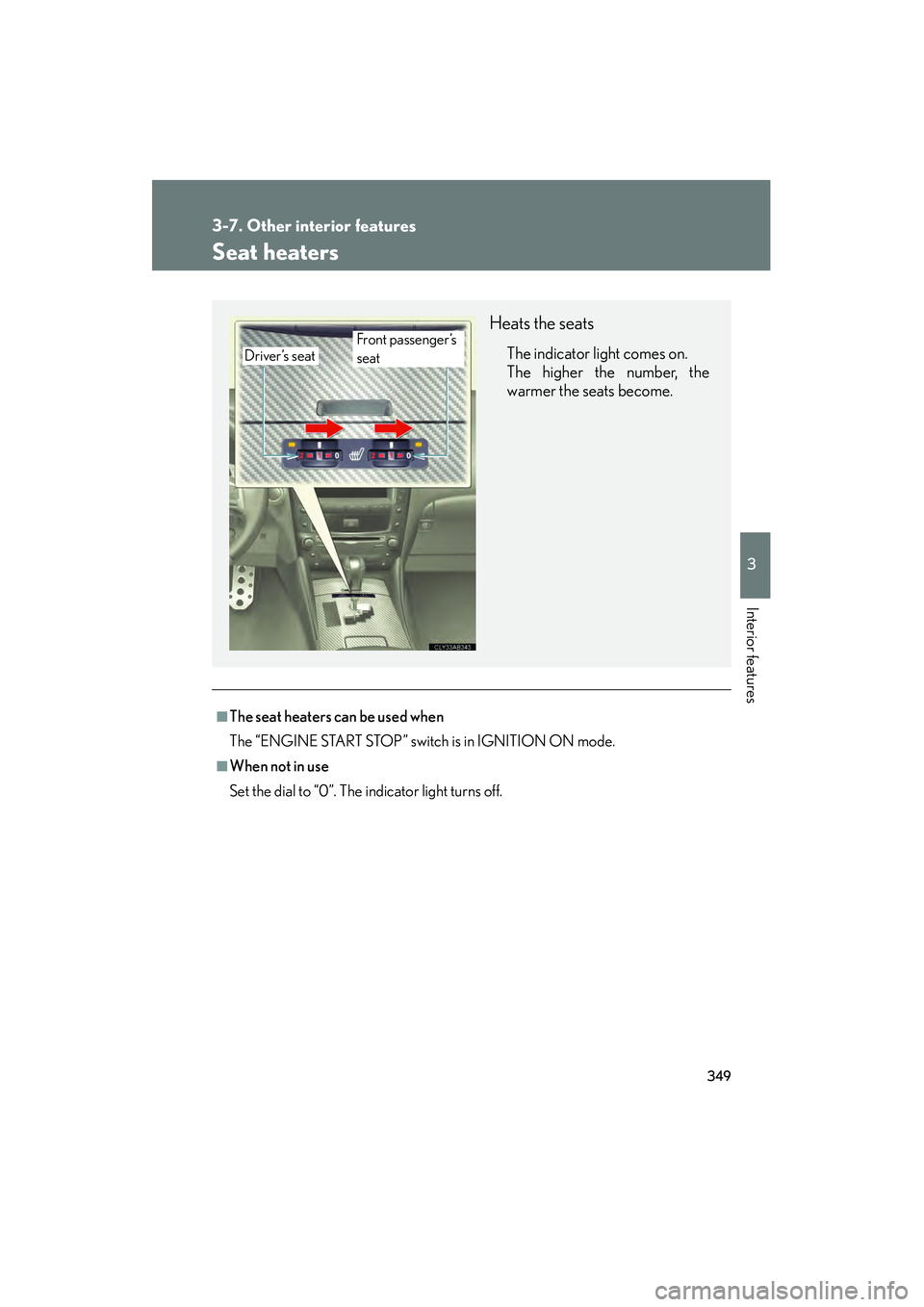
Heats the seats
The indicator light comes on.
The higher the number, the
warmer the seats become.Driver’s seat
Front passenger ’s
seat
Page 388 of 578

387
4-2. Maintenance
4
Maintenance and care
IS F_U
Vehicle interior
ItemsCheck points
Accelerator pedal• Moves smoothly (without uneven pedal effort or catching)?
Automatic transmission “Park”
mechanism• Can the vehicle be held securely on an incline with the shift lever in
P?
Brake pedal
• Moves smoothly?
• Does it have appropriate clearance and correct amount of free play?
Brakes
• Not pull to one side when applied?
• Loss of brake effectiveness?
• Spongy feeling brake pedal?
• Pedal almost touches floor?
Head restraints• Move smoothly and lock securely?
Indicators/buzzers•Function properly?
Lights
• Do all the lights come on?
• Headlights aimed correctly? (→ P. 4 4 5 )
Pa r k i n g b r a ke
• Moves smoothly?
• Can hold the vehicle securely on
an incline?
Seat belts
• Does the seat belt system operate smoothly?
• Are the belts undamaged?
Seats• Do the seat controls operate prop- erly?
Page 436 of 578
435
4-3. Do-it-yourself maintenance
4
Maintenance and care
IS F_U
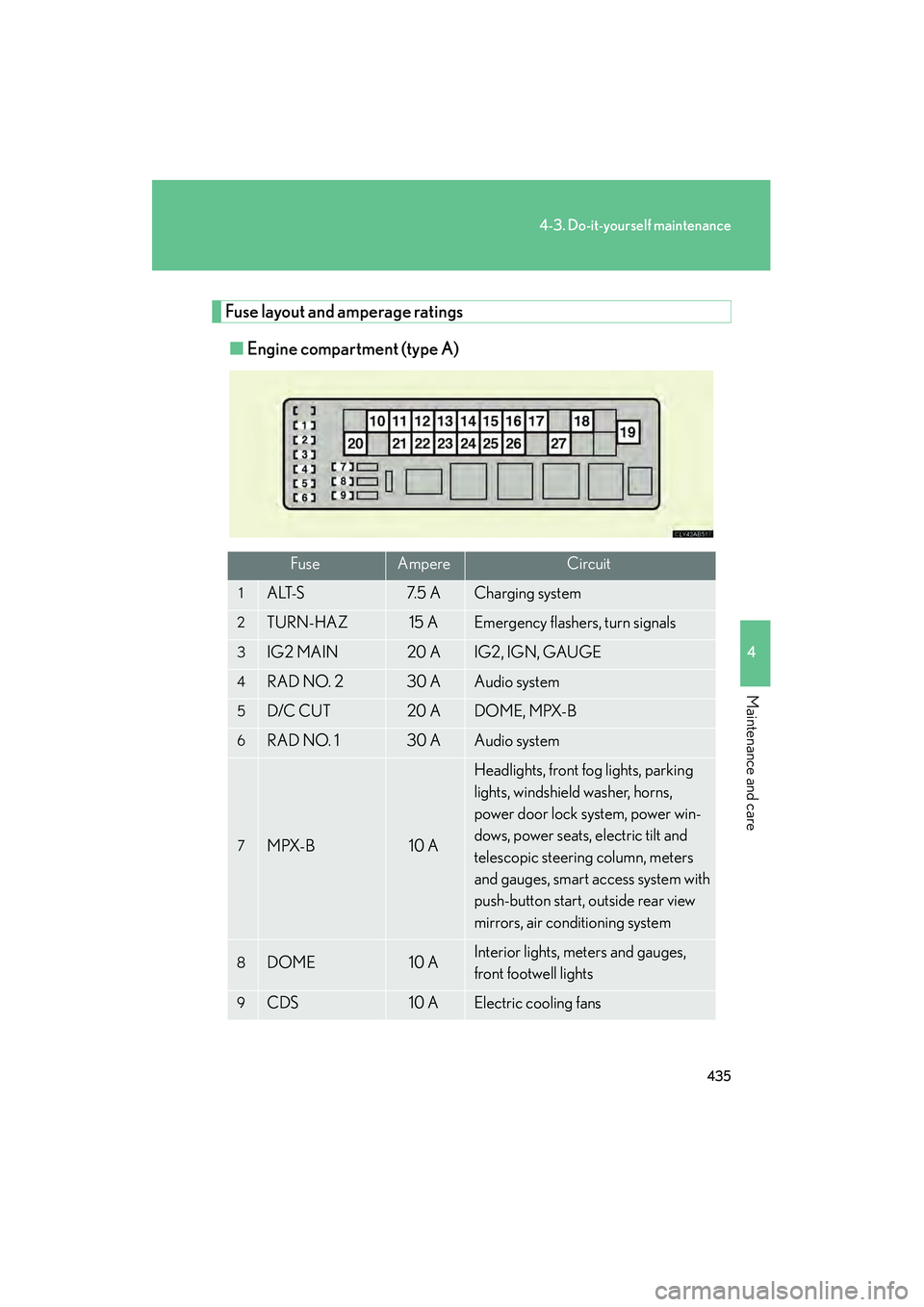
Fuse layout and amperage ratings■ Engine compartment (type A)
FuseAmpereCircuit
1ALT-S7. 5 ACharging system
2TURN-HAZ15 AEmergency flashers, turn signals
3IG2 MAIN20 AIG2, IGN, GAUGE
4RAD NO. 230 AAudio system
5D/C CUT20 ADOME, MPX-B
6RAD NO. 130 AAudio system
7MPX-B10 A
Headlights, front fog lights, parking
lights, windshield washer, horns,
power door lock system, power win-
dows, power seats, electric tilt and
telescopic steering column, meters
and gauges, smart access system with
push-button start, outside rear view
mirrors, air conditioning system
8DOME10 AInterior lights, meters and gauges,
front footwell lights
9CDS10 AElectric cooling fans
Page 444 of 578

443
4-3. Do-it-yourself maintenance
4
Maintenance and care
IS F_U
10CIG15 ACigarette lighter
11PWR OUTLET15 APo w e r o u t l e t
12RR DOOR RH20 APo w e r w i n d o w s
13FR DOOR RH20 APo w e r w i n d o w s , o u t s i d e r e a r v i e w
mirrors
14AM27. 5 ASmart access system with push-button
start
15RH-IG7. 5 A
Seat belts, intuitive parking assist,
automatic transmission, seat heaters,
windshield wiper de-icer
16FR S/HTR RH15 ASeat heaters
17ECU-IG RH10 A
Power seats, smart access system with
push-button start, outside rear view
mirrors, VDIM, air conditioning sys-
tem, pre-collision seat belt, electric tilt
and telescopic steering, power win-
dows, navigation system, headlights,
front fog lights, parking lights, license
plate lights, windshield washer
FuseAmpereCircuit
Page 532 of 578

531
6-1. Specifications
6
Vehicle specifications
IS F_U■
Temperature A, B, C
The temperature grades are A (the highest), B, and C, representing
the tire's resistance to the generation of heat and its ability to dissipate
heat when tested under controlled conditions on a specified indoor
laboratory test wheel.
Sustained high temperature can cause the material of the tire to degenerate
and reduce tire life, and excessive temperature can lead to sudden tire fail-
ure.
The grade C corresponds to a level of performance which all passenger car
tires must meet under the Federal Motor Vehicle Safety Standard No. 109.
Grades B and A represent higher levels of performance on the laboratory
test wheel than the minimum required by law.
Warning: The temperature grades for this tire are established for a tire that
is properly inflated and not overloaded.
Excessive speed, underinflation, or excessive loading, either separately or in
combination, can cause heat buildup and possible tire failure.
Glossary of tire terminology
Tire related termMeaning
Cold tire inflation pres-
sureTire pressure when the vehicle has been parked for
three hours or more, or has not been driven more
than 1 mile or 1.5 km under that condition
Maximum inflation pres-
sureThe maximum cold inflated pressure to which a tire
may be inflated, shown on the sidewall of the tire
Recommended inflation
pressureCold tire inflation pressure recommended by a man-
ufacturer.
Accessory weight
The combined weight (in excess of those standard
items which may be replaced) of transmission, power
steering, power brakes, power windows, power seats,
radio and heater, to the extent that these items are
available as factory-installed equipment (whether
installed or not)
Page 564 of 578

563
Alphabetical index
IS F_U
BrakeFluid .......................................................... 404
Parking brake ........................................148
Brake assist ............................................... 197
Care
Exterior ................................................... 378
Interior.......................................................381
Seat belts ............................................... 382
Cargo capacity ....................................... 210
Cargo hooks .......................................... 356
CD changer* ........................................... 241
CD player* ............................................... 241
Chains......................................................... 214
Child restraint system Booster seats, definition.......................111
Booster seats, installation .................. 117
Convertible seats, definition ..............111
Convertible seats, installation ......... 117
Front passenger occupant
classification system .......................106
Infant seats, definition ............................111
Infant seats, installation........................ 117
Installing CRS with lower
anchorages ...........................................116
Installing CRS with seat belts .......... 117
Installing CRS with top straps ......... 121
Child safety
Airbag precautions ............................. 101
Battery precautions............. 408, 504
Child restraint system ...........................111
Child-protectors.................................... 47
How your child should wear the seat belt ...........................................67 Installing child restraints..................... 115
Moon roof precautions...................... 82
Power window lock switch .............. 76
Power window precautions ............ 78
Removed electronic key battery
precautions....................................... 430
Seat belt comfort guide .....................65
Seat belt extender precautions......69
Seat belt precautions ..........................68
Seat heater precautions................. 350
Trunk precautions................................. 52
Child-protectors ...................................... 47
Cigarette lighter.................................... 347
Cleaning
Exterior....................................................378
Interior ...................................................... 381
Seat belts ................................................382
Clock ......................................................... 342
Coat hooks ..............................................354
Compass ..................................................365
Condenser ..............................................404
Console box ...........................................335
Cooling system Engine overheating.......................... 505
Cornering assist sensors ...................... 191
Cruise control Cruise control........................................173
Dynamic radar cruise control........ 177
Cup holders ............................................ 337
Curtain shield airbags............................ 94
Customizable features ...................... 538
C
*: For vehicles with a navigation system, refer to the “Navigation System Owner’s Manual”.