brakes Lexus IS200d 2011 s User Guide
[x] Cancel search | Manufacturer: LEXUS, Model Year: 2011, Model line: IS200d, Model: Lexus IS200d 2011Pages: 609, PDF Size: 14.63 MB
Page 228 of 609

216
2-4. Using other driving systems
IS250/220d/200d_EE
CAUTION
Conditions under which the vehicle-to-vehicle distance control may not
function correctly
Apply the brakes as necessary in the following conditions as the radar sen-
sor may not be able to correctly detect vehicles ahead, and a fatal or serious
accident may result:
When water or snow thrown up by the surrounding vehicles hinders the
functioning of the sensor
When your vehicle is pointing upwards (caused by a heavy load in the
trunk etc.)
When the road curves or when the lanes are narrow
When steering wheel operation or your position in the lane is unstable
When the vehicle ahead of you decelerates suddenly
Handling the radar sensor
Observe the following to ensure the cruise control system can function
effectively.
Otherwise, the system may not function correctly and could result in an
accident.
Keep the sensor and front grille cover clean at all times.
Clean the sensor and front grille cover with a soft cloth so you do not
mark or damage them.
Do not subject the sensor or surrounding area to a strong impact.
If the sensor moves even slightly off position, the system may malfunc-
tion. If the sensor or surrounding area is subject to a strong impact, always
have the area inspected and adjusted by any authorized Lexus dealer or
repairer, or another duly qualified and equipped professional.
Do not disassemble the sensor.
Do not attach accessories or stickers to the sensor, grille cover or sur-
rounding area.
Do not modify or paint the sensor and grille cover.
Do not replace them with non-genuine parts.
Page 234 of 609

222
2-4. Using other driving systems
IS250/220d/200d_EE
Sensor detection information
Certain vehicle conditions and the surrounding environment may affect
the ability of the sensor to correctly detect obstacles. Particular instances
where this may occur are listed below.
• There is dirt, snow or ice on the sensor.
• The sensor is frozen.
• The sensor is covered in any way.
• The vehicle is leaning considerably to one side.
• On an extremely bumpy road, on an incline, on gravel, or on grass.
• The vicinity of the vehicle is noisy due to vehicle horns, motorcycle
engines, air brakes of large vehicles, or other loud noises producing
ultrasonic waves.
• There is another vehicle equipped with parking assist sensors in the
vicinity.
• The sensor is coated with a sheet of spray or heavy rain.
• The vehicle is equipped with a fender pole or wireless antenna.
• Towing eyelets are installed.
• The bumper or sensor receives a strong impact.
• The vehicle is approaching a tall or curved curb.
• In harsh sunlight or intense cold weather.
In addition to the examples above, there are instances in which, because of
their shapes, signs and other objects may be judged by the sensor to be
closer than they are.
The shape of the obstacle may prevent the sensor from detecting it. Pay
particular attention to the following obstacles.
• Wires, fences, ropes etc.
• Cotton, snow and other materials that absorb radio waves
• Sharply-angled objects
•Low obstacles
• Tall obstacles with upper sections projecting outwards in the direction
of your vehicle
If the display flashes and a message is displayed
P. 4 7 3
Customization that can be configured at any authorized Lexus dealer or
repairer, or another duly qualified and equipped professional
Settings (e.g. buzzer volume) can be changed. (Customizable features P.
556)
Page 236 of 609
224
2-4. Using other driving systems
IS250/220d/200d_EE
Driving assist systems
To help enhance driving safety and performance, the following sys-
tems operate automatically in response to various driving situations.
Be aware, however, that these systems are supplementary and should
not be relied upon too heavily when operating the vehicle.
ABS (Anti-lock Brake System)
Helps to prevent wheel lock when the brakes are applied suddenly,
or if the brakes are applied while driving on a slippery road surface.
Brake assist
Generates an increased level of braking force after the brake pedal
is depressed, when the system detects a panic stop situation.
VSC (Vehicle Stability Control)
Helps the driver to control skidding when swerving suddenly or
turning on slippery road surfaces.
TRC (Traction Control)
Maintains drive power and prevents the rear wheels from spinning
when starting the vehicle or accelerating on slippery roads.
Hill-start assist control (vehicles with an automatic transmis-
sion)
Helps to prevent the vehicle from rolling backward when starting
on an incline or slippery slope.
EPS (Electric Power Steering)
Employs an electric motor to reduce the amount of effort needed to
turn the steering wheel.
PCS (Pre-Crash Safety System) (if equipped)
P. 230
VDIM (Vehicle Dynamics Integrated Management)
Provides integrated control of the ABS, brake assist, TRC, VSC,
hill-start assist control, and EPS systems.
Helps to maintain vehicle stability when swerving on slippery road
Page 242 of 609

230
2-4. Using other driving systems
IS250/220d/200d_EE
PCS (Pre-Crash Safety system)
When the radar sensor detects possibility of a frontal collision, the pre-
crash safety system such as the brakes and seat belts are automatically
engaged to lessen impact and injuries to occupants as well as vehicle
damage.
Pre-crash seat belts
If the pre-crash sensor detects that a collision is unavoidable, the
pre-crash safety system will retract the seat belt before the collision
occurs.
The same will happen if the driver makes an emergency braking or
loses control of the vehicle. (P. 7 6 )
However, the system will not operate in the event of skidding when
the VSC systems are disabled.
Pre-crash brake assist
When there is a high possibility of a frontal collision, the system
applies greater braking force in relation to how strongly the brake
pedal is depressed.
Pre-crash braking
When there is a high possibility of a frontal collision, the system
warns the driver using a warning light, warning display and buzzer.
If the system determines that a collision is unavoidable, the brakes
are automatically applied to reduce the collision speed. The pre-
: If equipped
Page 245 of 609

233
2-4. Using other driving systems
2
When driving
IS250/220d/200d_EE
When a billboard or other metallic structure appears to be in the vehi-
cle’s direct line of travel due to driving on a hill.
When an extreme change in vehicle height occurs
When the axis of the radar is out of adjustment
When passing through certain toll gates
When driving on a bridge.
When the system is activated in the situations described above there is also a
possibility that the seat belts will retract quickly and the brakes will be
applied with a force greater than normal. When the seat belt is locked in the
retracted position, stop the vehicle in a safe place, release the seat belt and
refasten.
Situations in which the pre-crash safety system does not function properly
The system may not function effectively in situations such as the following:
On roads with sharp bends or uneven surfaces
If a vehicle suddenly moves in front of your vehicle, such as at an inter-
section
If a vehicle suddenly cuts in front of your vehicle, such as when overtak-
ing
In inclement weather such as heavy rain, fog, snow or sand storms
When your vehicle is skidding with the VSC system off
When an extreme change in vehicle height occurs
When the axis of the radar is out of adjustment
Automatic cancelation of the pre-crash safety system
When a malfunction occurs due to sensor contamination, etc. that results in
the sensors being unable to detect obstacles, the pre-crash safety system will
be automatically disabled. In this case, the system will not activate even if
there is a collision possibility.
Page 263 of 609

249
2-5. Driving information
2
When driving
IS250/220d/200d_EEImportant points regarding turning
The wheels of the trailer will travel closer to the inside of the
curve than the wheels of the vehicle. To make allowance for this,
take the turns wider than you would normally.
Important points regarding stability
Vehicle movement resulting from uneven road surfaces and
strong crosswinds will affect handling. The vehicle may also be
rocked by passing buses or large trucks. Frequently check
behind when moving alongside such vehicles. As soon as such
vehicle movement occurs, immediately start to decelerate
smoothly by slowly applying the brakes. Always steer the vehi-
cle straight ahead while braking.
Passing other vehicles
Consider the total combined length of your vehicle and trailer
and ensure that the vehicle-to-vehicle distance is sufficient
before executing lane changes.
Transmission information
Refrain from driving in 6 (manual transmission) or 4 range in S
mode (automatic transmission) to maintain the effectiveness of
the engine brake and the charge performance of electrical com-
ponents.
If the engine overheats...
Towing a loaded trailer up a long steep incline in temperatures
exceeding 30C (85F) may result in the engine overheating. If
the engine coolant temperature gauge indicates that the engine is
overheating, turn the air conditioning off immediately, leave the
road and stop the vehicle in a safe place. (P. 525)
When parking the vehicle
Always place wheel chocks under the wheels of both the vehicle
and trailer. Firmly set the parking brake and shift the shift lever
to P for automatic transmissions, and 1 or R for manual trans-
missions.
Page 485 of 609
5
459
5-1. Essential information
When trouble arises
IS250/220d/200d_EE
If your vehicle needs to be towed
Before towing
The following may indicate a problem with your transmission.
Contact any authorized Lexus dealer or repairer, or another duly
qualified and equipped professional, before towing.
The engine is running, but the vehicle will not move.
The vehicle makes an abnormal sound.
Emergency towing
If a tow truck is not available, in an emergency your vehicle may
be temporarily towed using a cable or chain secured to the emer-
gency towing eyelet(s). This should only be attempted on hard,
surfaced roads for short distances at low speeds.
A driver must be in the vehicle to steer and operate the brakes. The
vehicle’s wheels, drive train, axles, steering and brakes must be in
good condition.
If towing is necessary, we recommend having your vehicle towed by
any authorized Lexus dealer or repairer, or another duly qualified and
equipped professional, such as a commercial towing service, using a
lift-type truck or a flat bed truck.
Use a safety chain system for all towing, and abide by all state/provin-
cial and local laws.
If towing from the rear, the vehicle's front wheels and axles must be in
good condition. (P. 463)
If they are damaged, use a towing dolly or flat bed truck.
Page 486 of 609
460
5-1. Essential information
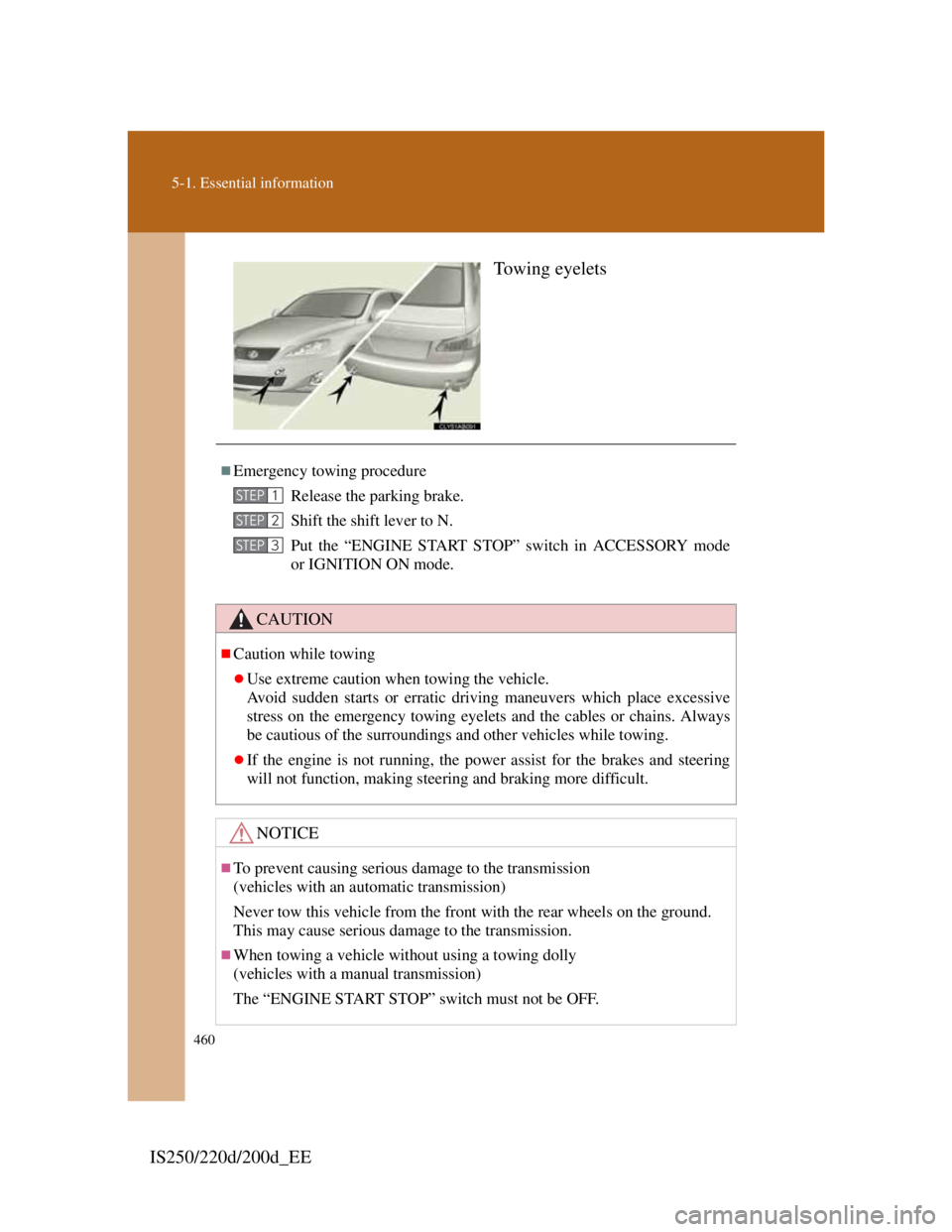
IS250/220d/200d_EETowing eyelets
Emergency towing procedure
Release the parking brake.
Shift the shift lever to N.
Put the “ENGINE START STOP” switch in ACCESSORY mode
or IGNITION ON mode.
CAUTION
Caution while towing
Use extreme caution when towing the vehicle.
Avoid sudden starts or erratic driving maneuvers which place excessive
stress on the emergency towing eyelets and the cables or chains. Always
be cautious of the surroundings and other vehicles while towing.
If the engine is not running, the power assist for the brakes and steering
will not function, making steering and braking more difficult.
NOTICE
To prevent causing serious damage to the transmission
(vehicles with an automatic transmission)
Never tow this vehicle from the front with the rear wheels on the ground.
This may cause serious damage to the transmission.
When towing a vehicle without using a towing dolly
(vehicles with a manual transmission)
The “ENGINE START STOP” switch must not be OFF.
STEP1
STEP2
STEP3
Page 506 of 609

480
5-2. Steps to take in an emergency
IS250/220d/200d_EE
(If equipped)
Indicates that Lexus
parking assist-sensor is
dirty or covered with
ice.
Clean the sensor.
(Flashing)
(If equipped)
Indicates that the
dynamic radar cruise
control sensor is dirty or
covered with ice.
Clean the sensor.
(Flashing and then
continuously on)
(Flashing)
(If equipped)
Indicates that the
dynamic radar cruise
control system is unable
to judge vehicle-to-
vehicle distance.
• Switch the driving
mode to either the nor-
mal or power mode.
• If the windshield wip-
ers are on, turn them
off or set them to
either the intermittent
or the slow mode.
(Flashing)
(If equipped)
Indicates that your vehi-
cle is nearing the vehi-
cle ahead (in dynamic
radar cruise mode).
Slow the vehicle by
applying the brakes.
Warning messageDetailsCorrection procedure
Page 507 of 609
5
481
5-2. Steps to take in an emergency
When trouble arises
IS250/220d/200d_EE
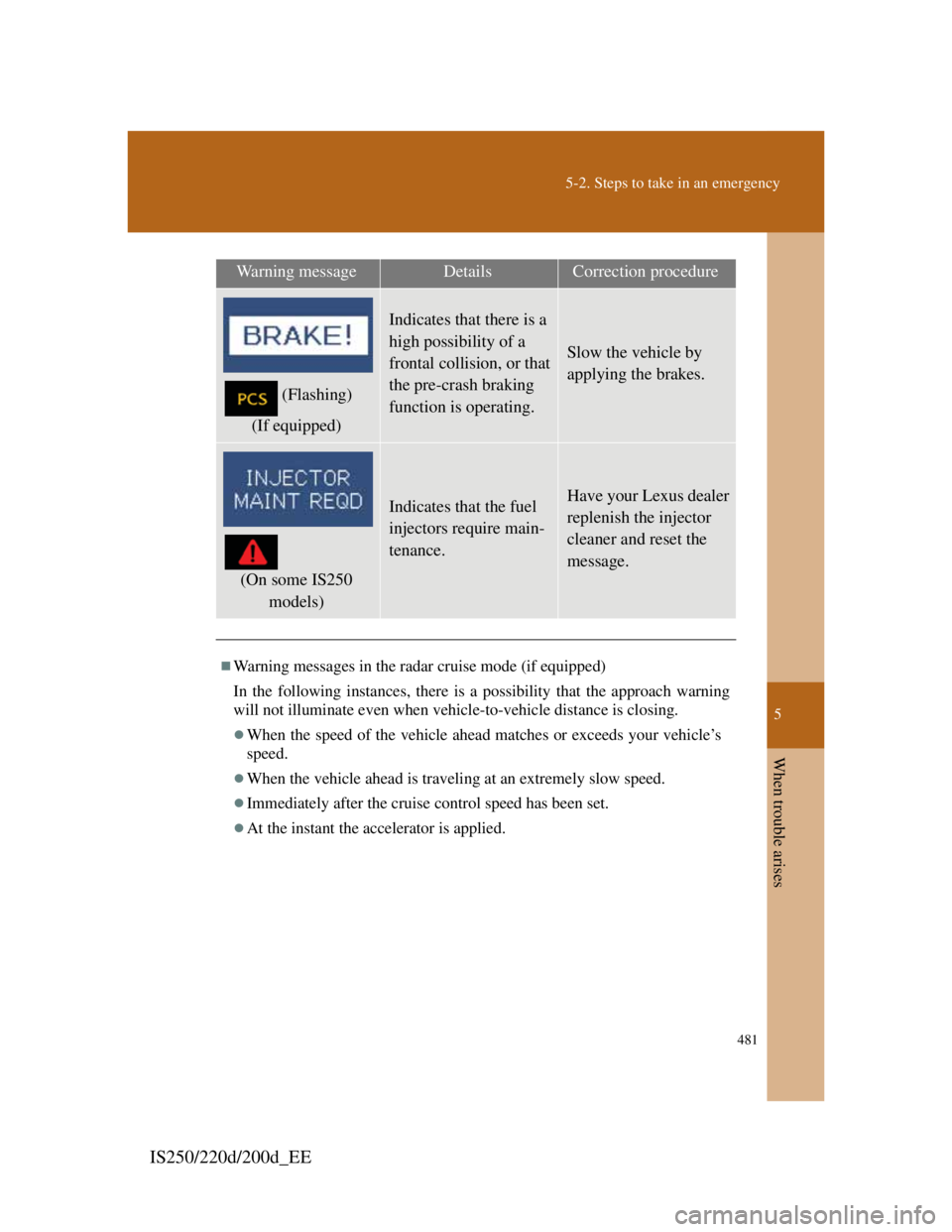
(Flashing)
(If equipped)
Indicates that there is a
high possibility of a
frontal collision, or that
the pre-crash braking
function is operating.
Slow the vehicle by
applying the brakes.
(On some IS250
models)
Indicates that the fuel
injectors require main-
tenance.Have your Lexus dealer
replenish the injector
cleaner and reset the
message.
Warning messages in the radar cruise mode (if equipped)
In the following instances, there is a possibility that the approach warning
will not illuminate even when vehicle-to-vehicle distance is closing.
When the speed of the vehicle ahead matches or exceeds your vehicle’s
speed.
When the vehicle ahead is traveling at an extremely slow speed.
Immediately after the cruise control speed has been set.
At the instant the accelerator is applied.
Warning messageDetailsCorrection procedure