tire pressure Lexus IS200d 2011 s User Guide
[x] Cancel search | Manufacturer: LEXUS, Model Year: 2011, Model line: IS200d, Model: Lexus IS200d 2011Pages: 609, PDF Size: 14.63 MB
Page 448 of 609
427
4-3. Do-it-yourself maintenance
4
Maintenance and care
IS250/220d/200d_EE
CAUTION
Proper inflation is critical to save tire performance
Keep your tires properly inflated. Otherwise, the following conditions may
occur and result in an accident causing death or serious injury.
Excessive wear
Uneven wear
Poor handling
Possibility of blowouts resulting from overheated tires
Poor sealing of the tire bead
Wheel deformation and/or tire separation
A greater possibility of tire damage from road hazards
NOTICE
When inspecting and adjusting tire pressure
Be sure to reinstall the tire valve caps.
Without the valve caps, dirt or moisture could get into the valve and cause
air leakage, which could result in an accident. If the caps have been lost,
replace them as soon as possible.
Page 520 of 609

494
5-2. Steps to take in an emergency
IS250/220d/200d_EE
The compact spare tire
The compact spare tire is identified by the label “TEMPORARY USE
ONLY” on the tire sidewall.
Use the compact spare tire temporarily only in an emergency.
Make sure to check the tire pressure of the compact spare tire. (P. 548)
If you have a flat rear tire on a road covered with snow or ice (vehicles with
a compact spare tire)
Install the compact spare tire on the front of the vehicle. Perform the follow-
ing steps and fit tire chains to the rear tires.
Replace a front tire with the compact spare tire.
Replace the flat rear tire with the tire removed from the front of the
vehicle.
Fit tire chains to the rear tires.
STEP1
STEP2
STEP3
Page 527 of 609
5
501
5-2. Steps to take in an emergency
When trouble arises
IS250/220d/200d_EE
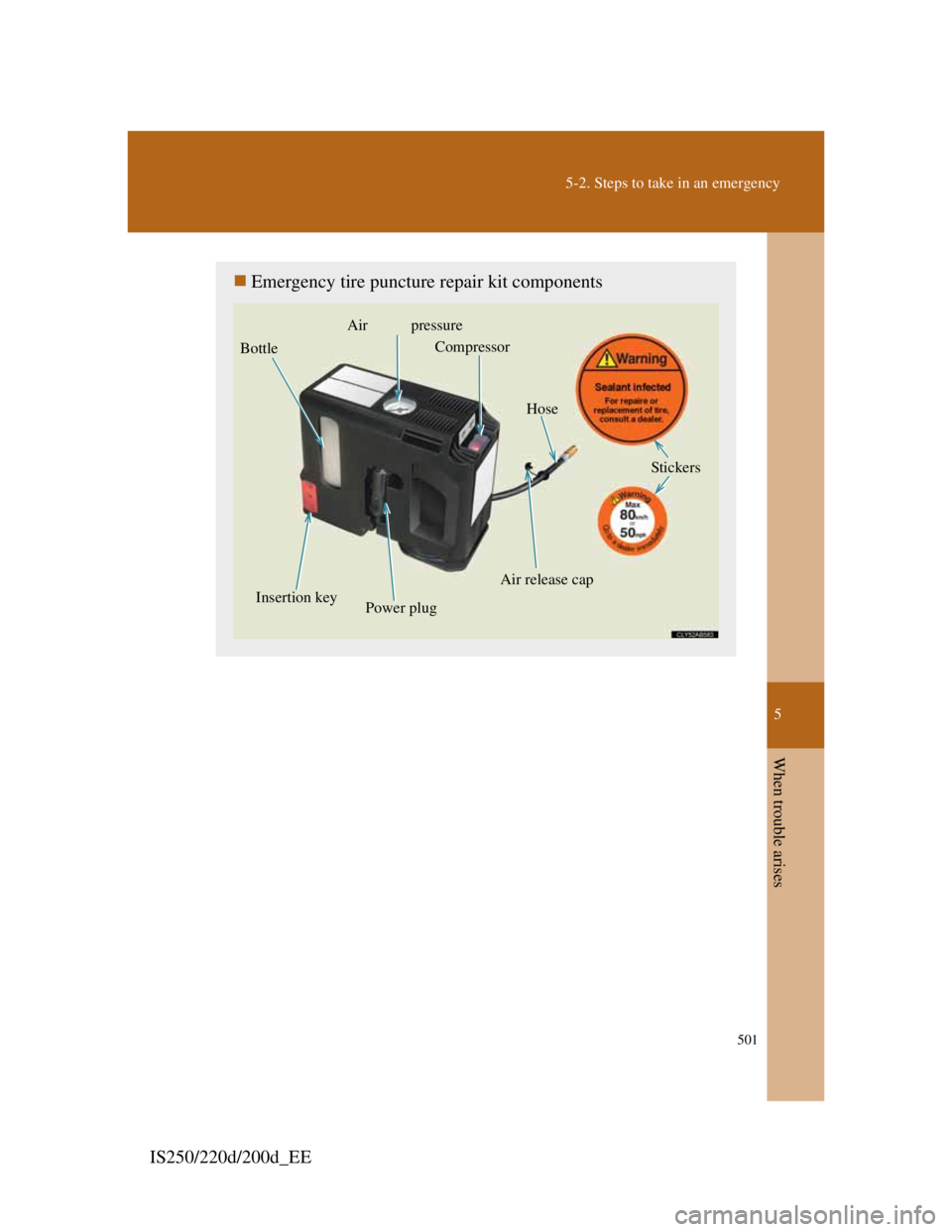
Emergency tire puncture repair kit components
BottleAir pressure
Compressor
Hose
Stickers
Air release cap
Power plug Insertion key
Page 532 of 609

506
5-2. Steps to take in an emergency
IS250/220d/200d_EECheck the specified tire infla-
tion pressure.
Tire inflation pressure is speci-
fied on the label on the driver's
side pillar as shown. (P. 548)
Start the engine.
To inject the sealant and inflate
the tire, turn the compressor
switch on.
Use the kit with the top facing
upward.
STEP8
STEP9
STEP10
Page 533 of 609
5
507
5-2. Steps to take in an emergency
When trouble arises
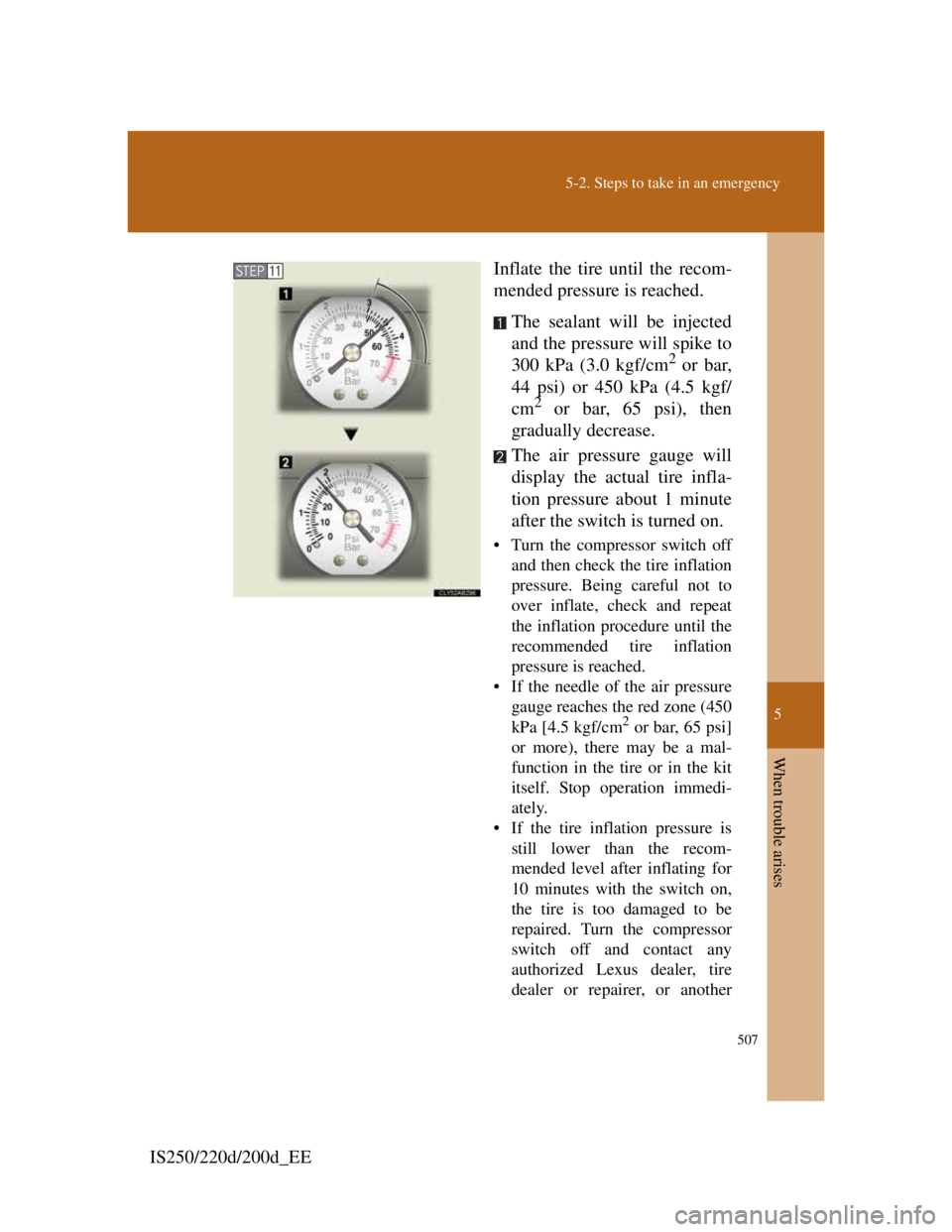
IS250/220d/200d_EEInflate the tire until the recom-
mended pressure is reached.
The sealant will be injected
and the pressure will spike to
300 kPa (3.0 kgf/cm
2 or bar,
44 psi) or 450 kPa (4.5 kgf/
cm
2 or bar, 65 psi), then
gradually decrease.
The air pressure gauge will
display the actual tire infla-
tion pressure about 1 minute
after the switch is turned on.
• Turn the compressor switch off
and then check the tire inflation
pressure. Being careful not to
over inflate, check and repeat
the inflation procedure until the
recommended tire inflation
pressure is reached.
• If the needle of the air pressure
gauge reaches the red zone (450
kPa [4.5 kgf/cm
2 or bar, 65 psi]
or more), there may be a mal-
function in the tire or in the kit
itself. Stop operation immedi-
ately.
• If the tire inflation pressure is
still lower than the recom-
mended level after inflating for
10 minutes with the switch on,
the tire is too damaged to be
repaired. Turn the compressor
switch off and contact any
authorized Lexus dealer, tire
dealer or repairer, or another
STEP 11
Page 535 of 609
5
509
5-2. Steps to take in an emergency
When trouble arises
IS250/220d/200d_EE
• If the tire inflation pressure
exceeds the recommended
level, let out some air to adjust
the tire inflation pressure. (P.
512)
Disconnect the hose from the valve on the tire and then pull
out the power plug from the power outlet socket.
To spread the liquid sealant evenly within the tire, immedi-
ately drive for about 5 km (3 miles).
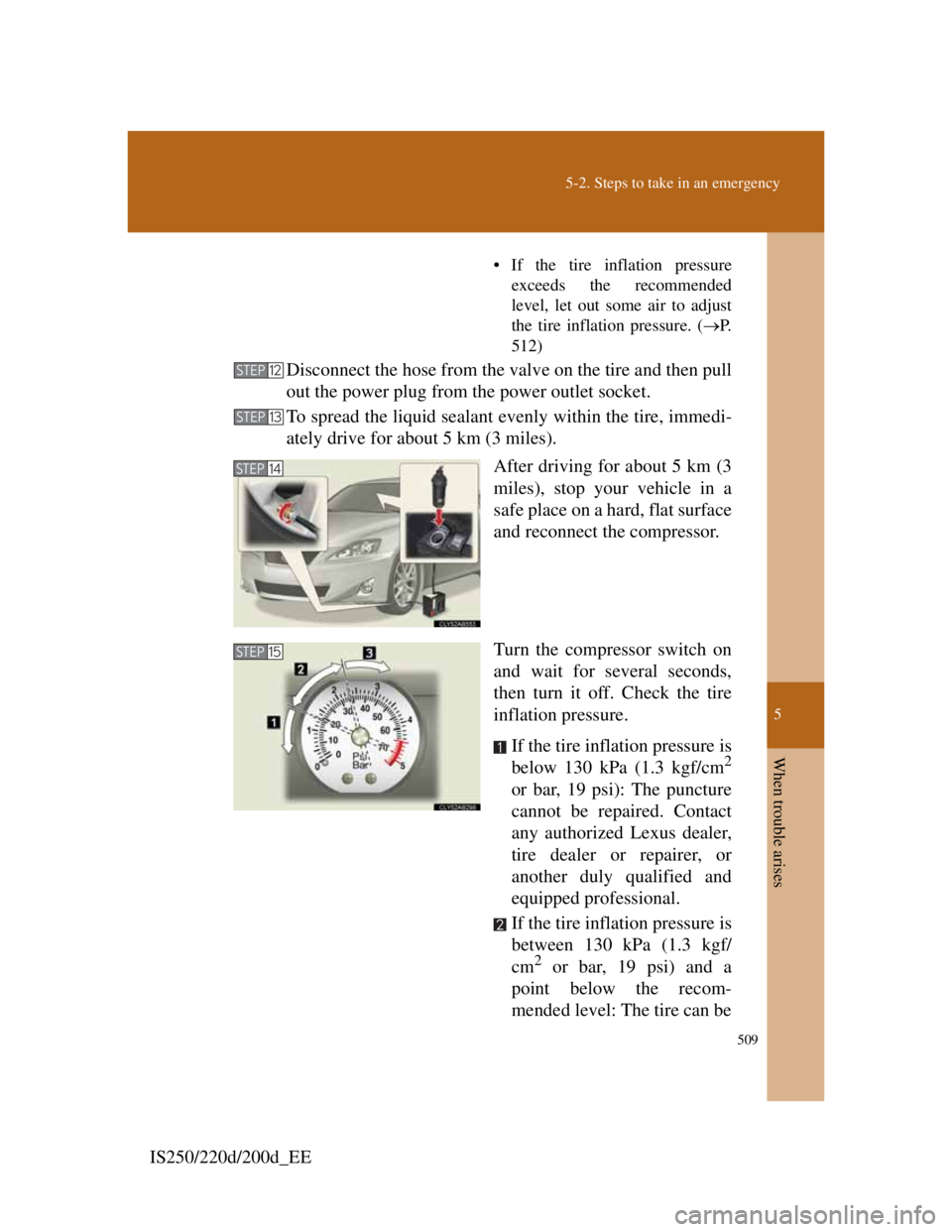
After driving for about 5 km (3
miles), stop your vehicle in a
safe place on a hard, flat surface
and reconnect the compressor.
Turn the compressor switch on
and wait for several seconds,
then turn it off. Check the tire
inflation pressure.
If the tire inflation pressure is
below 130 kPa (1.3 kgf/cm
2
or bar, 19 psi): The puncture
cannot be repaired. Contact
any authorized Lexus dealer,
tire dealer or repairer, or
another duly qualified and
equipped professional.
If the tire inflation pressure is
between 130 kPa (1.3 kgf/
cm
2 or bar, 19 psi) and a
point below the recom-
mended level: The tire can be
STEP 12
STEP 13
STEP 14
STEP 15
Page 536 of 609
510
5-2. Steps to take in an emergency
IS250/220d/200d_EErepaired. Proceed to “STEP
16”.
If the tire inflation pressure is
at the recommended level:
Proceed to “STEP 17”.
Turn the compressor switch on to inflate the tire until the
recommended tire inflation pressure is reached. Drive for
about 5 km (3 miles) and then perform “STEP 14”.
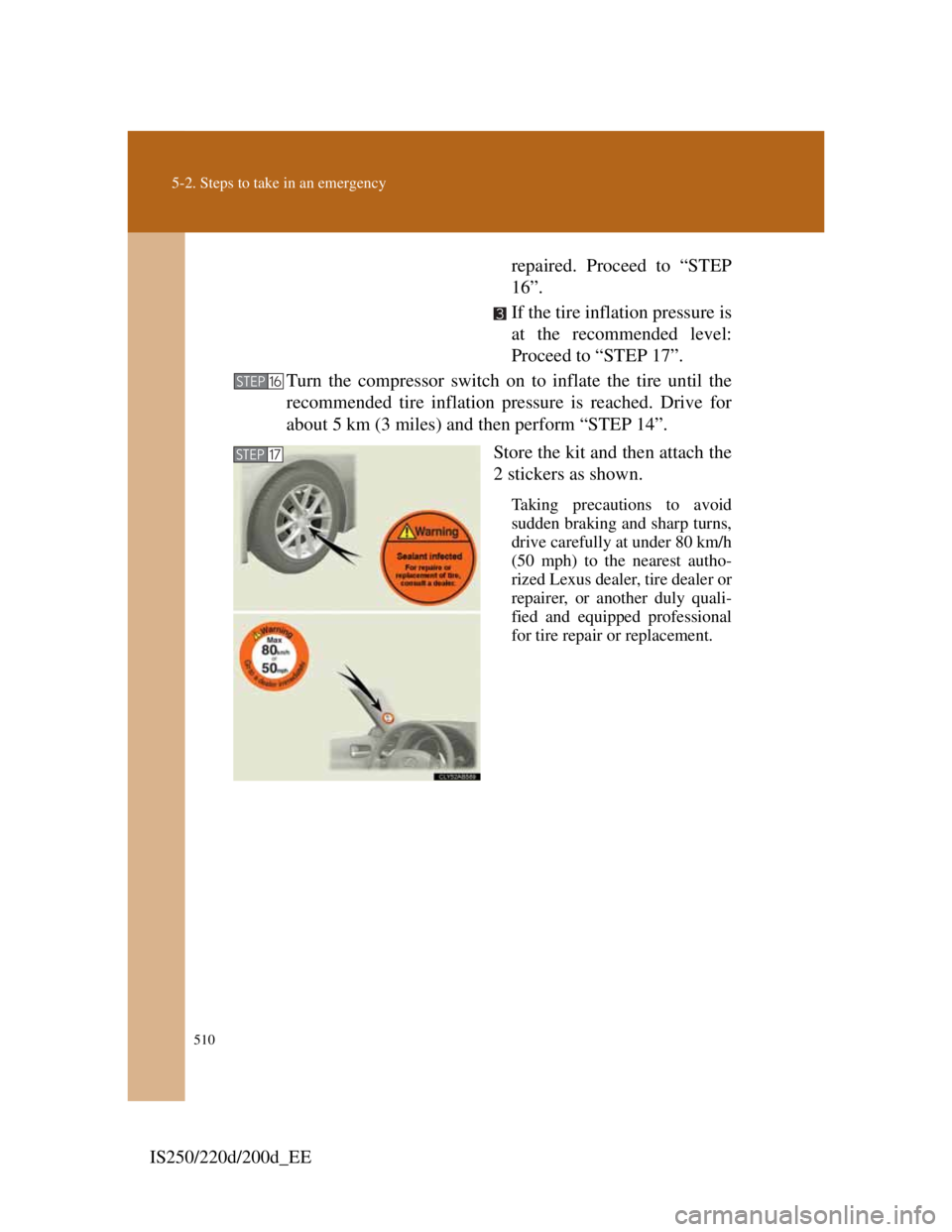
Store the kit and then attach the
2 stickers as shown.
Taking precautions to avoid
sudden braking and sharp turns,
drive carefully at under 80 km/h
(50 mph) to the nearest autho-
rized Lexus dealer, tire dealer or
repairer, or another duly quali-
fied and equipped professional
for tire repair or replacement.
STEP 16
STEP 17
Page 537 of 609

5
511
5-2. Steps to take in an emergency
When trouble arises
IS250/220d/200d_EE
In the following cases, the tire cannot be repaired with the emergency tire
puncture repair kit. Contact any authorized Lexus dealer, tire dealer or
repairer, or another duly qualified and equipped professional.
When the tire is damaged due to driving without sufficient air pressure
When the tire lost air pressure due to a crack or damage in the tire side-
wall
When the tire is visibly separated from the wheel
When the cut or damage to the tread is 4 mm (0.16 in.) long or more
When the wheel is damaged
When two or more tires have been punctured
When there is more than one hole or cut in the damaged tire
Emergency tire puncture repair kit
The sealant has a limited lifespan. The expiry date is marked on the bot-
tle. The sealant should be replaced before the expiry date. Contact any
authorized Lexus dealer, tire dealer or repairer, or another duly qualified
and equipped professional for replacement.
The sealant stored in the emergency tire puncture repair kit can be used
only once to temporarily repair a single tire. If the sealant in the bottle
and other parts of the kit have been used and need to be replaced, contact
any authorized Lexus dealer, tire dealer or repairer, or another duly qual-
ified and equipped professional.
The sealant can be used when the outside temperature is from -30C (-
22F) to 60C (140F).
The kit is exclusively designed for size and type of tires originally
installed on your vehicle. Do not use it for tires that are a different size
than the original ones, or for any other purpose.
If the sealant gets on your clothes, it may stain.
If the sealant adheres to a wheel or the surface of the vehicle body, the
stain may not be removable if it is not cleaned at once. Immediately wipe
away the sealant with a wet cloth.
During operation of the kit, a loud operation noise is produced. This does
not indicate a malfunction.
Page 538 of 609
512
5-2. Steps to take in an emergency
IS250/220d/200d_EE
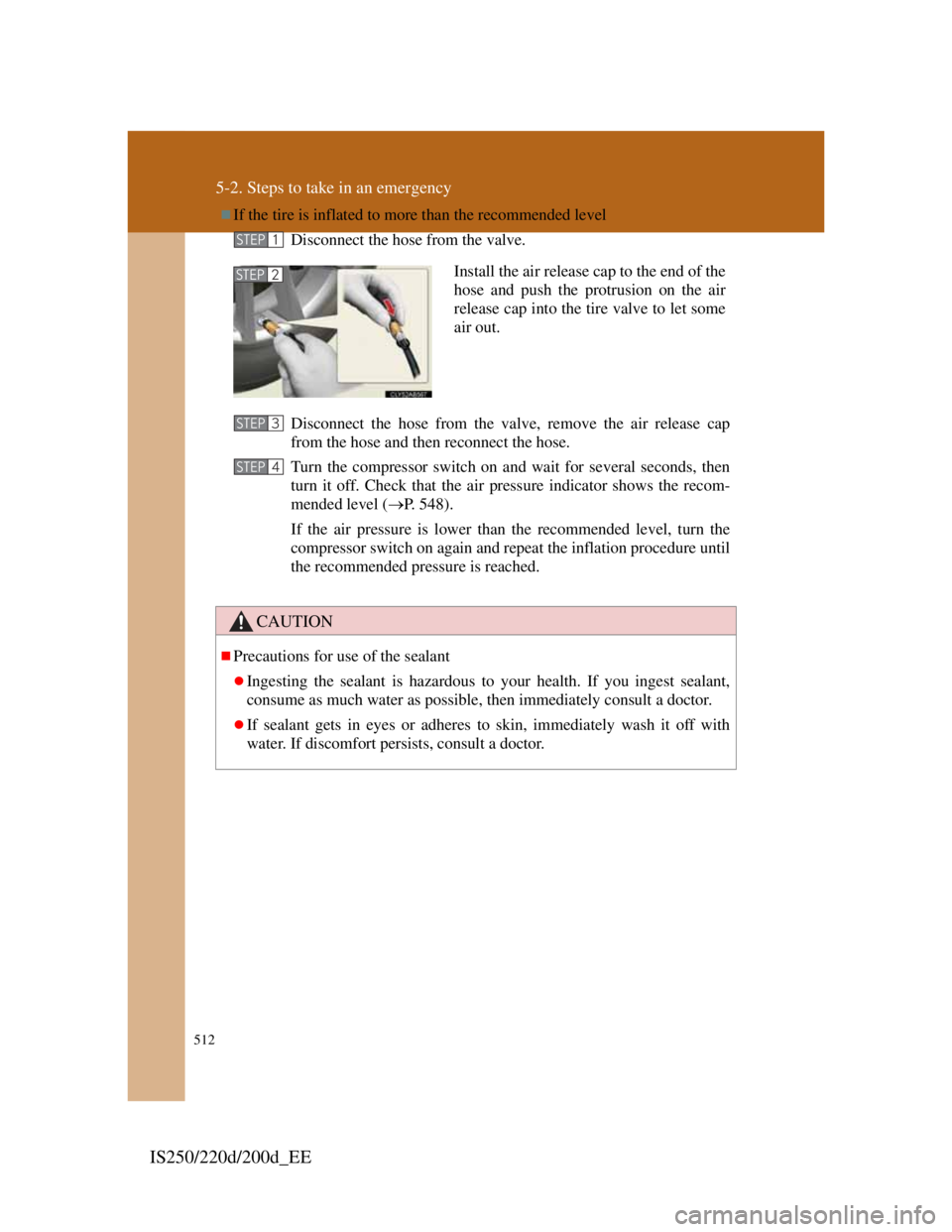
If the tire is inflated to more than the recommended level
Disconnect the hose from the valve.
Disconnect the hose from the valve, remove the air release cap
from the hose and then reconnect the hose.
Turn the compressor switch on and wait for several seconds, then
turn it off. Check that the air pressure indicator shows the recom-
mended level (P. 548).
If the air pressure is lower than the recommended level, turn the
compressor switch on again and repeat the inflation procedure until
the recommended pressure is reached.
CAUTION
Precautions for use of the sealant
Ingesting the sealant is hazardous to your health. If you ingest sealant,
consume as much water as possible, then immediately consult a doctor.
If sealant gets in eyes or adheres to skin, immediately wash it off with
water. If discomfort persists, consult a doctor.
STEP1
Install the air release cap to the end of the
hose and push the protrusion on the air
release cap into the tire valve to let some
air out.STEP2
STEP3
STEP4
Page 539 of 609
5
513
5-2. Steps to take in an emergency
When trouble arises
IS250/220d/200d_EE
CAUTION
When fixing the flat tire
Stop your vehicle in a safe and flat area.
Connect the valve and hose securely with the tire installed on the vehicle.
If the hose is not properly connected to the valve, air leakage may occur or
sealant may be sprayed out.
If the hose comes off the valve while inflating the tire, there is a risk that
the hose will move abruptly due to air pressure.
After inflation of the tire has been completed, the sealant may splatter
when the hose is disconnected or some air is let out of the tire.
Keep back from the tire while it is being repaired, as there is a chance of it
bursting while the repair operation is being performed. If you notice any
cracks or deformation of the tire, turn off the compressor switch and stop
the repair operation immediately.
The kit may overheat if operated for a long period of time. Do not operate
the compressor continuously for more than 10 minutes.
Parts of the kit become hot during operation. Be careful handling the kit
during and after operation.
Do not attach the vehicle speed warning sticker to an area other than the
one indicated. If the sticker is attached to an area where an SRS airbag is
located, such as the pad of the steering wheel, it may prevent the SRS air-
bag from operating properly.
Driving to spread the liquid sealant evenly
Drive the vehicle carefully at a low speed. Be especially careful when
turning and cornering.
If the vehicle does not drive straight or you feel a pull through the steering
wheel, stop the vehicle and check the following:
• Tire condition. The tire may have separated from the wheel.
• Tire inflation pressure. If tire inflation pressure is 130 kPa (1.3 kgf/
cm
2 or bar, 19 psi) or below, this may indicate severe tire damage.