flat tire Lexus IS200d 2011 s Owner's Guide
[x] Cancel search | Manufacturer: LEXUS, Model Year: 2011, Model line: IS200d, Model: Lexus IS200d 2011Pages: 609, PDF Size: 14.63 MB
Page 519 of 609
5
493
5-2. Steps to take in an emergency
When trouble arises
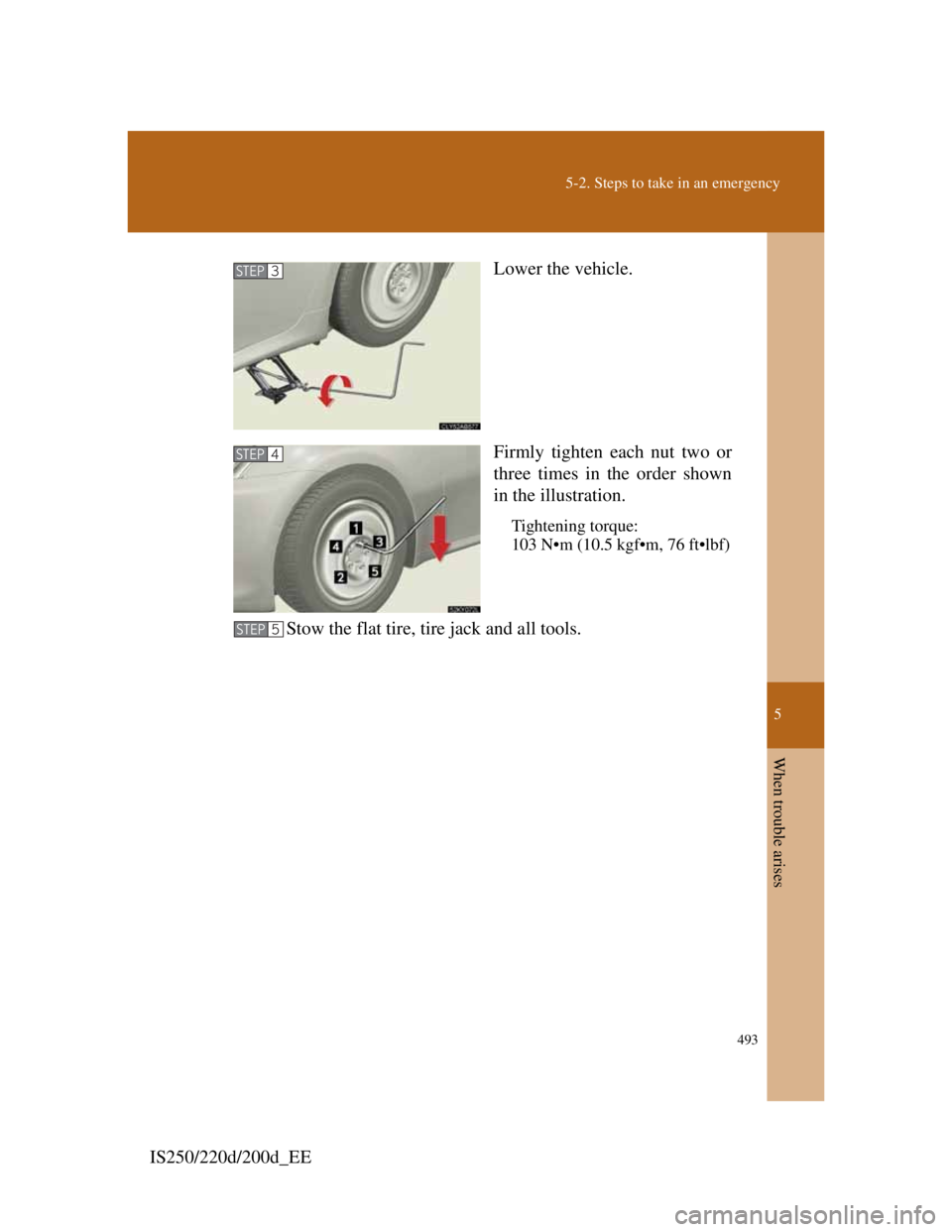
IS250/220d/200d_EELower the vehicle.
Firmly tighten each nut two or
three times in the order shown
in the illustration.
Tightening torque:
103 N•m (10.5 kgf•m, 76 ft•lbf)
Stow the flat tire, tire jack and all tools.
STEP3
STEP4
STEP5
Page 520 of 609

494
5-2. Steps to take in an emergency
IS250/220d/200d_EE
The compact spare tire
The compact spare tire is identified by the label “TEMPORARY USE
ONLY” on the tire sidewall.
Use the compact spare tire temporarily only in an emergency.
Make sure to check the tire pressure of the compact spare tire. (P. 548)
If you have a flat rear tire on a road covered with snow or ice (vehicles with
a compact spare tire)
Install the compact spare tire on the front of the vehicle. Perform the follow-
ing steps and fit tire chains to the rear tires.
Replace a front tire with the compact spare tire.
Replace the flat rear tire with the tire removed from the front of the
vehicle.
Fit tire chains to the rear tires.
STEP1
STEP2
STEP3
Page 522 of 609

496
5-2. Steps to take in an emergency
IS250/220d/200d_EE
CAUTION
Using the tire jack
Improper use of the tire jack may lead to death or serious injuries due to the
vehicle suddenly falling off the jack.
Do not use the tire jack for any purpose other than replacing tires or
installing and removing tire chains.
Only use the tire jack that comes with this vehicle for replacing a flat tire.
Do not use it on other vehicles, and do not use other tire jacks for replac-
ing tires on this vehicle.
Always check that the tire jack is securely set to the jack point.
Do not put any part of your body under the vehicle supported by a jack.
Do not start or run the engine while your vehicle is supported by the jack.
Do not raise the vehicle while someone is in it.
When raising the vehicle, do not put an object on or under the jack.
Do not raise the vehicle to a height greater than that required to replace the
tire.
Use a jack stand if it is necessary to get under the vehicle.
Take particular care when lowering the vehicle to ensure that no one work-
ing on or near the vehicle may be injured.
Replacing a flat tire
Do not attach a heavily damaged wheel ornament, as it may fly off the
wheel while the vehicle is moving.
Failure to follow these precautions could cause the wheel nuts to loosen
and the tire to fall off, resulting in death or serious injury.
• Never use oil or grease on the wheel bolts or wheel nuts.
Oil and grease may cause the wheel nuts to be excessively tightened,
leading to bolt or disc wheel damage. In addition, the oil or grease can
cause the wheel nuts to loosen and the wheel may fall off, causing a
serious accident. Remove any oil or grease from the wheel bolts or
wheel nuts.
• Have the wheel nuts tightened with a torque wrench to 103 N
•m (10.5
kgf
•m, 76 ft•lbf) as soon as possible after changing wheels.
Page 524 of 609
498
5-2. Steps to take in an emergency
IS250/220d/200d_EE
CAUTION
When the compact spare tire is attached
The vehicle speed may not be correctly detected, and the following systems
may not operate correctly:
ABS & Brake assist
VSC
TRC
EPS
VDIM
Navigation system (if equipped)
Lexus parking assist-sensor (if equipped)
Dynamic radar cruise control (if equipped)
Cruise control (if equipped)
PCS (if equipped)
NOTICE
Do not drive the vehicle with a flat tire.
Do not continue driving with a flat tire.
Driving even a short distance with a flat tire can damage the tire and the
wheel beyond repair.
Be careful when driving over bumps with the compact spare tire installed on
the vehicle.
The vehicle becomes lower when driving with the compact spare tire com-
pared to when driving with standard tires. Be careful when driving over
uneven road surfaces.
Driving with tire chains and the compact spare tire
Do not fit tire chains to the compact spare tire.
Tire chains may damage the vehicle body and adversely affect driving per-
formance.
Page 525 of 609
5
499
5-2. Steps to take in an emergency
When trouble arises
IS250/220d/200d_EE
If you have a flat tire (vehicles with an emergency tire puncture repair kit)
A puncture caused by a nail or screw passing through the tire tread can
be repaired temporarily using the emergency tire puncture repair kit.
(The kit contains a bottle of sealant. The sealant can be used only once
to temporarily repair one tire without removing the nail or screw from
the tire.) After temporarily repairing the tire with the kit, have the tire
repaired or replaced by any authorized Lexus dealer, tire dealer or
repairer, or another duly qualified and equipped professional.
Before repairing the tire
Stop the vehicle in a safe place on a hard, flat surface.
Set the parking brake.
Shift the shift lever to P (automatic transmission) or N
(manual transmission).
Stop the engine.
Turn on the emergency flashers.
Page 532 of 609

506
5-2. Steps to take in an emergency
IS250/220d/200d_EECheck the specified tire infla-
tion pressure.
Tire inflation pressure is speci-
fied on the label on the driver's
side pillar as shown. (P. 548)
Start the engine.
To inject the sealant and inflate
the tire, turn the compressor
switch on.
Use the kit with the top facing
upward.
STEP8
STEP9
STEP10
Page 533 of 609
5
507
5-2. Steps to take in an emergency
When trouble arises
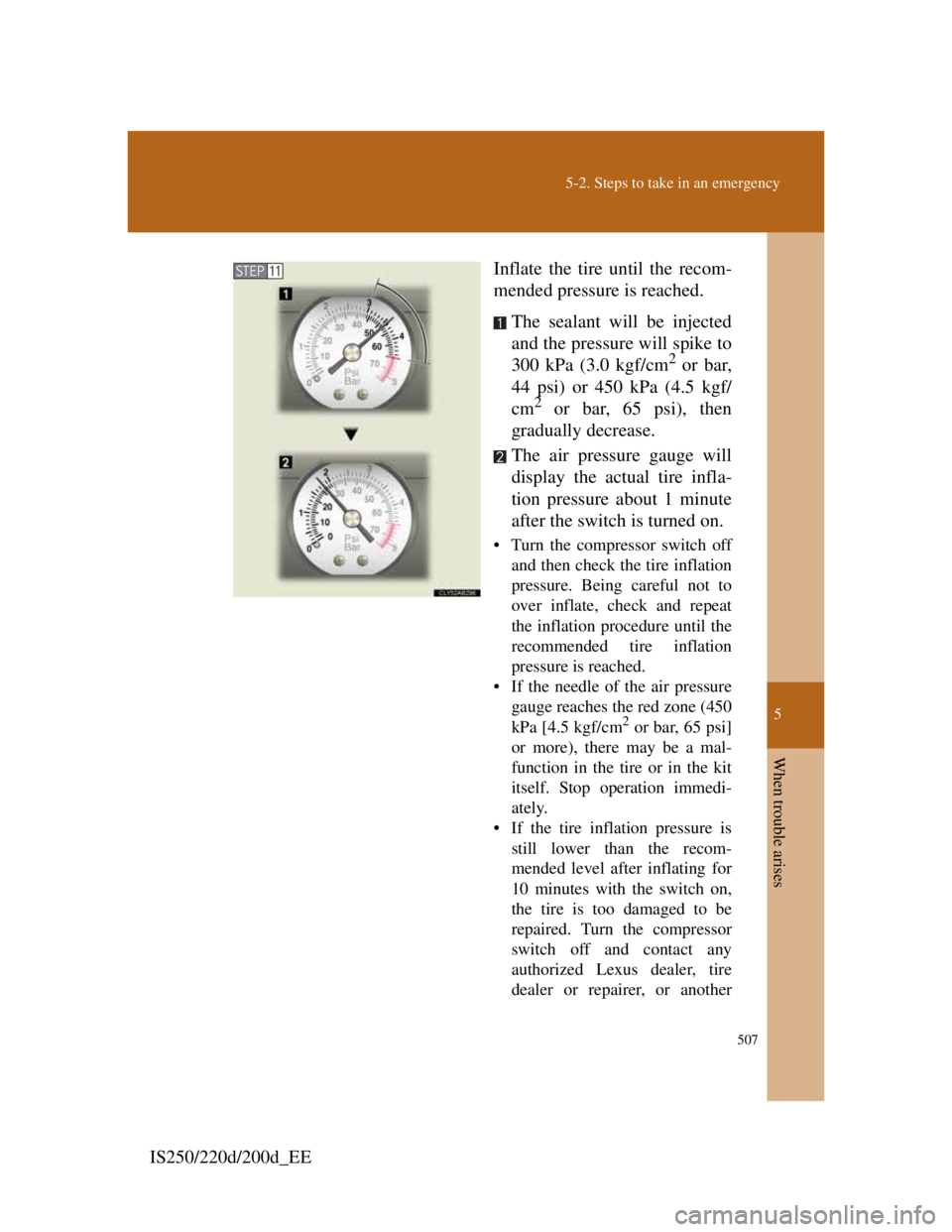
IS250/220d/200d_EEInflate the tire until the recom-
mended pressure is reached.
The sealant will be injected
and the pressure will spike to
300 kPa (3.0 kgf/cm
2 or bar,
44 psi) or 450 kPa (4.5 kgf/
cm
2 or bar, 65 psi), then
gradually decrease.
The air pressure gauge will
display the actual tire infla-
tion pressure about 1 minute
after the switch is turned on.
• Turn the compressor switch off
and then check the tire inflation
pressure. Being careful not to
over inflate, check and repeat
the inflation procedure until the
recommended tire inflation
pressure is reached.
• If the needle of the air pressure
gauge reaches the red zone (450
kPa [4.5 kgf/cm
2 or bar, 65 psi]
or more), there may be a mal-
function in the tire or in the kit
itself. Stop operation immedi-
ately.
• If the tire inflation pressure is
still lower than the recom-
mended level after inflating for
10 minutes with the switch on,
the tire is too damaged to be
repaired. Turn the compressor
switch off and contact any
authorized Lexus dealer, tire
dealer or repairer, or another
STEP 11
Page 535 of 609
5
509
5-2. Steps to take in an emergency
When trouble arises
IS250/220d/200d_EE
• If the tire inflation pressure
exceeds the recommended
level, let out some air to adjust
the tire inflation pressure. (P.
512)
Disconnect the hose from the valve on the tire and then pull
out the power plug from the power outlet socket.
To spread the liquid sealant evenly within the tire, immedi-
ately drive for about 5 km (3 miles).
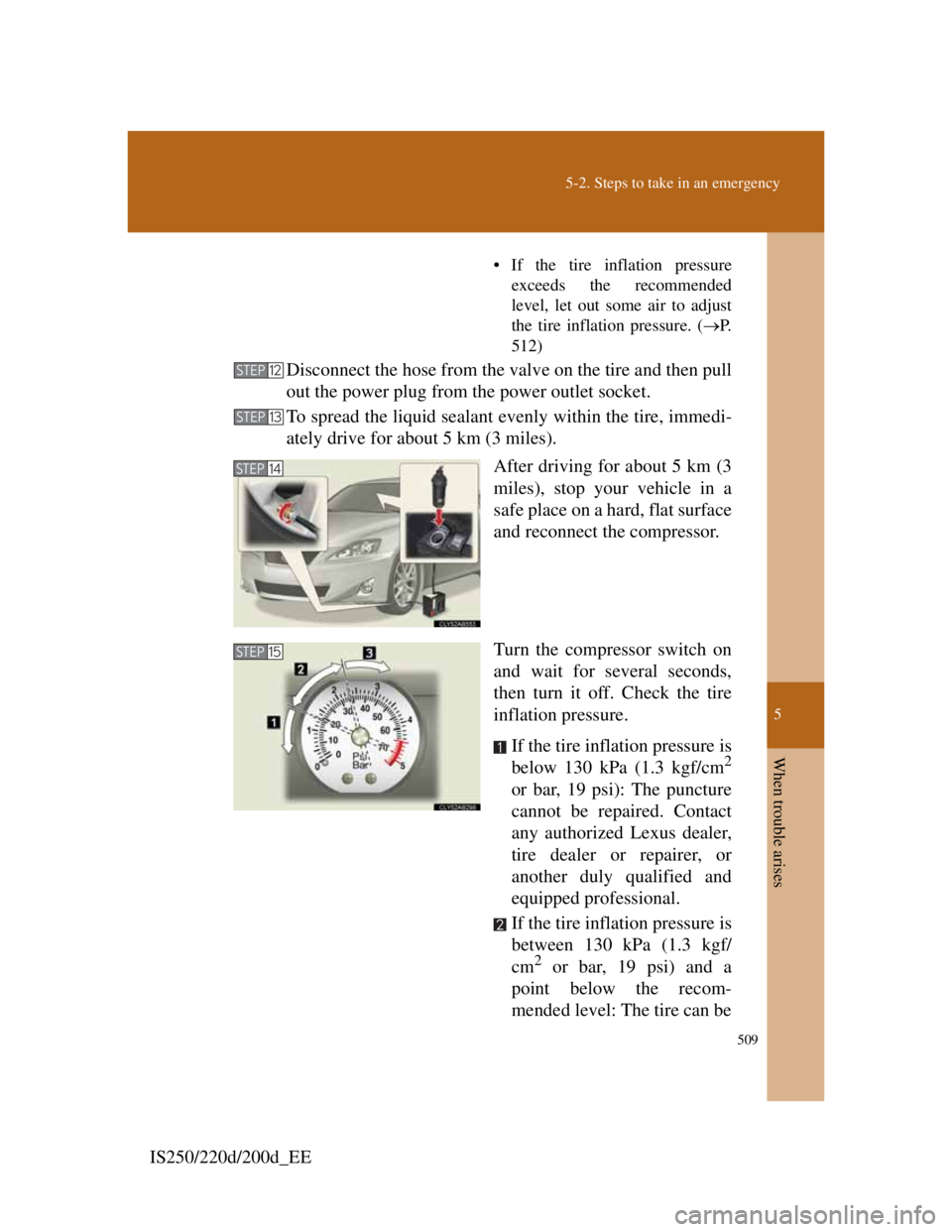
After driving for about 5 km (3
miles), stop your vehicle in a
safe place on a hard, flat surface
and reconnect the compressor.
Turn the compressor switch on
and wait for several seconds,
then turn it off. Check the tire
inflation pressure.
If the tire inflation pressure is
below 130 kPa (1.3 kgf/cm
2
or bar, 19 psi): The puncture
cannot be repaired. Contact
any authorized Lexus dealer,
tire dealer or repairer, or
another duly qualified and
equipped professional.
If the tire inflation pressure is
between 130 kPa (1.3 kgf/
cm
2 or bar, 19 psi) and a
point below the recom-
mended level: The tire can be
STEP 12
STEP 13
STEP 14
STEP 15
Page 536 of 609
510
5-2. Steps to take in an emergency
IS250/220d/200d_EErepaired. Proceed to “STEP
16”.
If the tire inflation pressure is
at the recommended level:
Proceed to “STEP 17”.
Turn the compressor switch on to inflate the tire until the
recommended tire inflation pressure is reached. Drive for
about 5 km (3 miles) and then perform “STEP 14”.
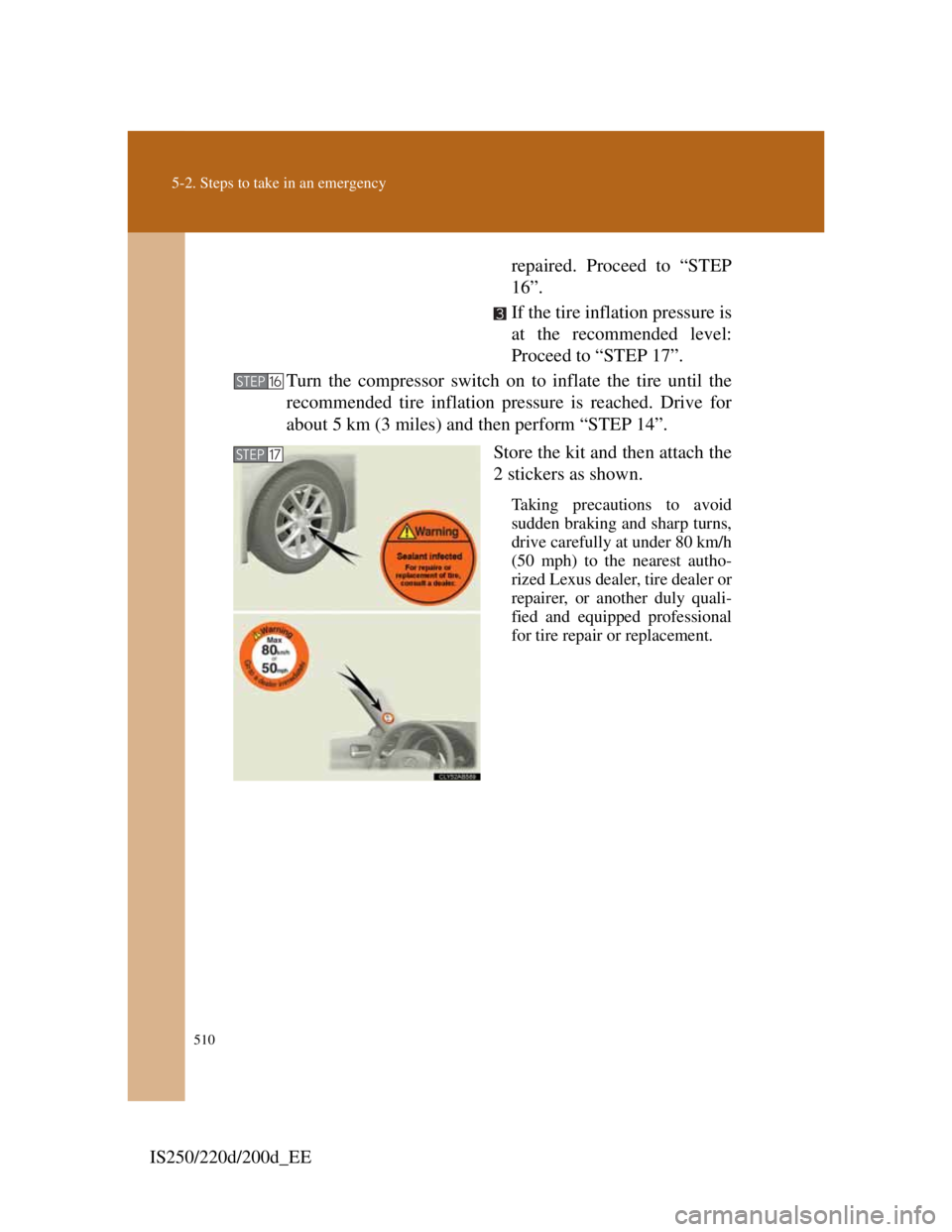
Store the kit and then attach the
2 stickers as shown.
Taking precautions to avoid
sudden braking and sharp turns,
drive carefully at under 80 km/h
(50 mph) to the nearest autho-
rized Lexus dealer, tire dealer or
repairer, or another duly quali-
fied and equipped professional
for tire repair or replacement.
STEP 16
STEP 17
Page 538 of 609
512
5-2. Steps to take in an emergency
IS250/220d/200d_EE
If the tire is inflated to more than the recommended level
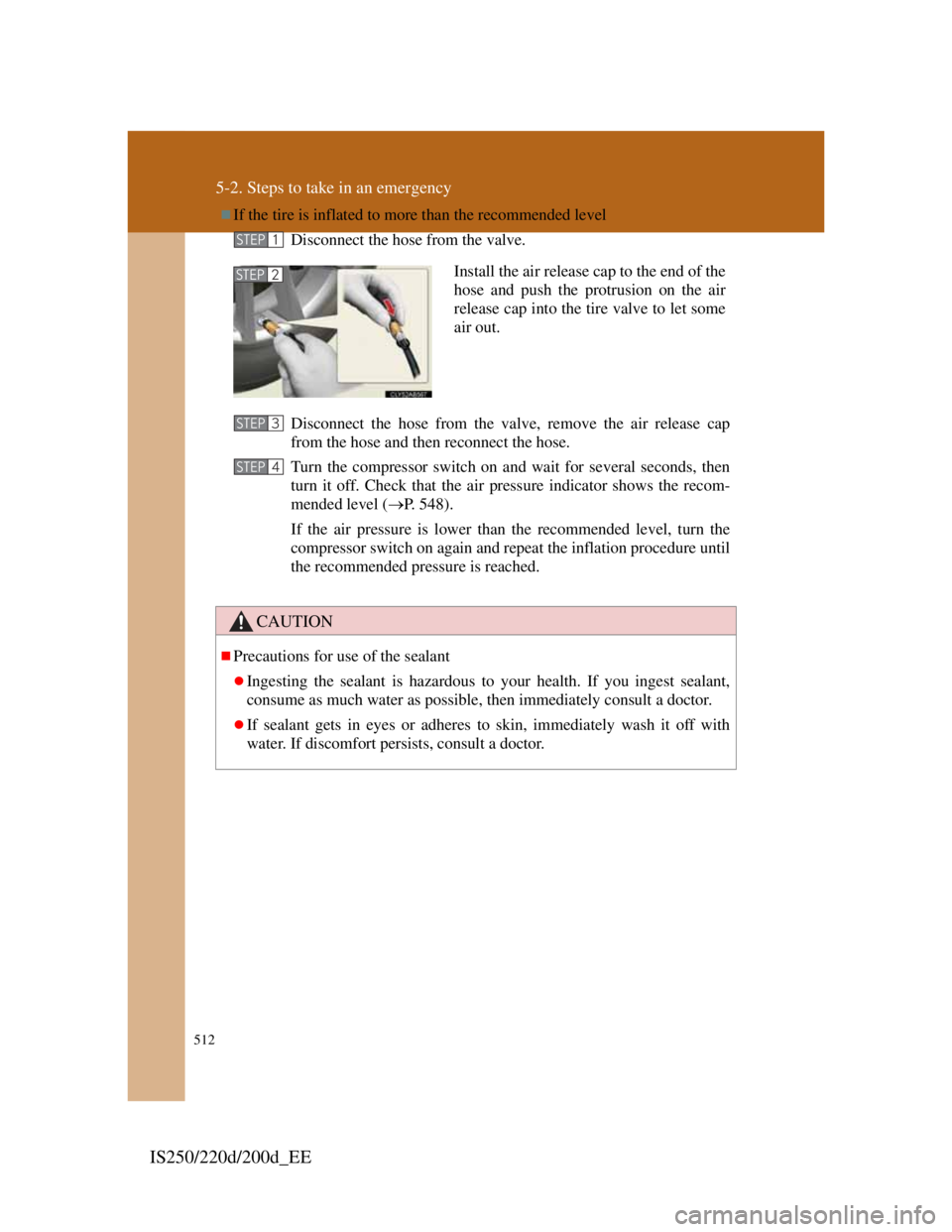
Disconnect the hose from the valve.
Disconnect the hose from the valve, remove the air release cap
from the hose and then reconnect the hose.
Turn the compressor switch on and wait for several seconds, then
turn it off. Check that the air pressure indicator shows the recom-
mended level (P. 548).
If the air pressure is lower than the recommended level, turn the
compressor switch on again and repeat the inflation procedure until
the recommended pressure is reached.
CAUTION
Precautions for use of the sealant
Ingesting the sealant is hazardous to your health. If you ingest sealant,
consume as much water as possible, then immediately consult a doctor.
If sealant gets in eyes or adheres to skin, immediately wash it off with
water. If discomfort persists, consult a doctor.
STEP1
Install the air release cap to the end of the
hose and push the protrusion on the air
release cap into the tire valve to let some
air out.STEP2
STEP3
STEP4