fuel Lexus IS200d 2011 s Owner's Guide
[x] Cancel search | Manufacturer: LEXUS, Model Year: 2011, Model line: IS200d, Model: Lexus IS200d 2011Pages: 609, PDF Size: 14.63 MB
Page 195 of 609
183
2-2. Instrument cluster
2
When driving
IS250/220d/200d_EEAverage fuel consumption
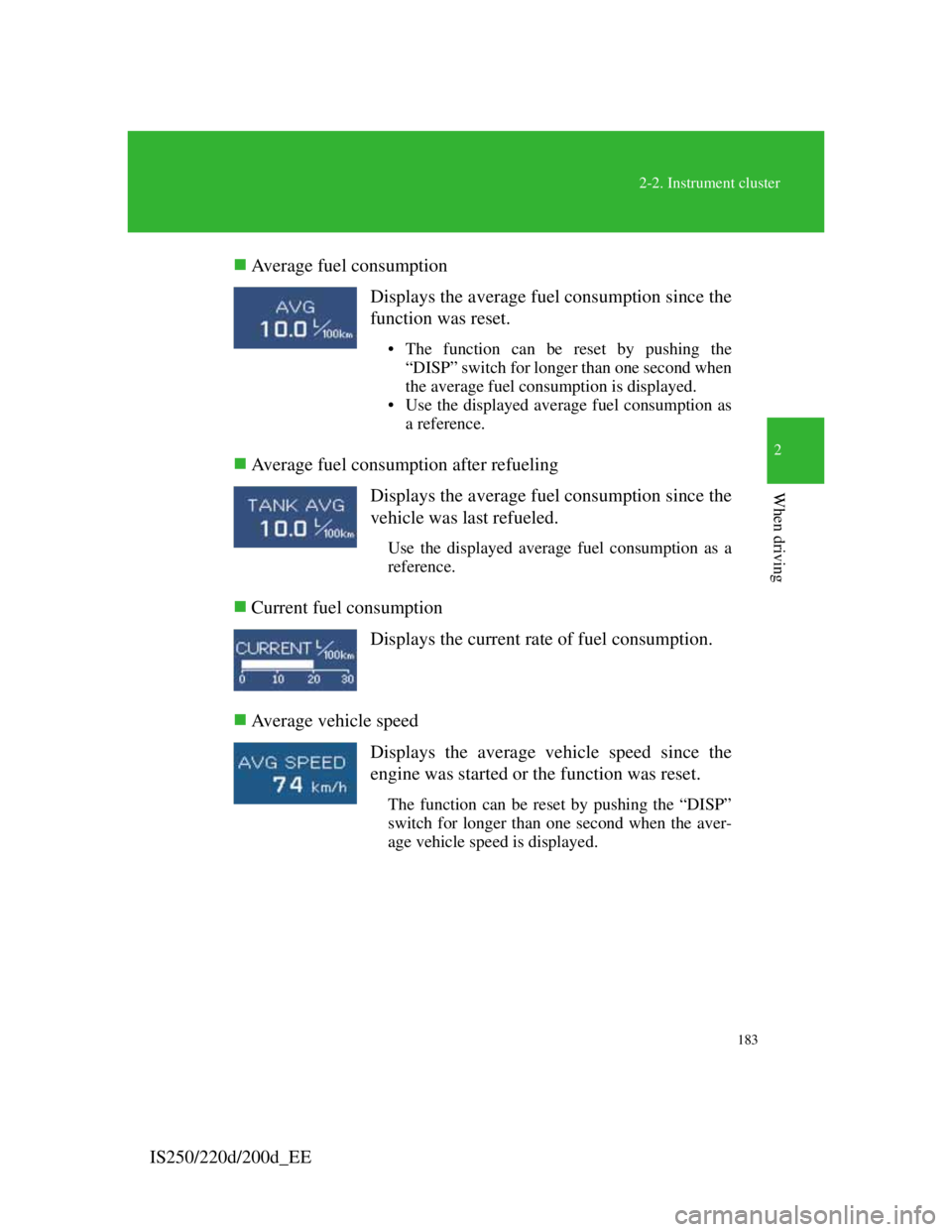
Average fuel consumption after refueling
Current fuel consumption
Average vehicle speedDisplays the average fuel consumption since the
function was reset.
• The function can be reset by pushing the
“DISP” switch for longer than one second when
the average fuel consumption is displayed.
• Use the displayed average fuel consumption as
a reference.
Displays the average fuel consumption since the
vehicle was last refueled.
Use the displayed average fuel consumption as a
reference.
Displays the current rate of fuel consumption.
Displays the average vehicle speed since the
engine was started or the function was reset.
The function can be reset by pushing the “DISP”
switch for longer than one second when the aver-
age vehicle speed is displayed.
Page 251 of 609
237
2
When driving
IS250/220d/200d_EE
2-5. Driving information
Cargo and luggage
CAUTION
Things that must not be carried in the trunk
The following things may cause a fire if loaded in the trunk.
Receptacles containing gasoline
Aerosol cans
Storage precautions
Observe the following precautions.
Failing to do so may result in death or serious injury.
Do not place cargo or luggage in or on the following locations as the item
may get under the clutch, brake or accelerator pedal and prevent the ped-
als from being depressed properly, block the driver’s vision, or hit the
driver or passengers, causing an accident.
• Driver’s feet
• Front passenger or rear seats (when stacking items)
• Package tray
• Instrument panel
• Dashboard
Secure all items in the occupant compartment, as they may shift and injure
someone during sudden braking, sudden swerving or an accident.
Take notice of the following information about storage precautions,
cargo capacity and load.
Stow cargo and luggage in the trunk whenever possible.
Be sure all items are secured in place.
Be careful to keep the vehicle level. Placing the weight as far
forward as possible helps maintain vehicle balance.
For better fuel economy, do not carry unnecessary weight.
Page 256 of 609

242
2-5. Driving information
IS250/220d/200d_EE
Trailer towing
The strain of towing a trailer will have a negative impact on the run-
ning performance, handling, fuel consumption and endurance of your
vehicle. Use the vehicle features in the correct manner and operate the
vehicle with care for safer driving and optimal comfort. Damage and/
or malfunctions that occur as a result of towing performed for com-
mercial purposes are not covered by the Lexus warranty.
Ask your local authorized Lexus dealer or repairer, or another duly
qualified and equipped professional, for further details before towing,
as there are additional legal requirements in some countries.
Weight limits
Check the allowable towing capacity, GVM (Gross Vehicle
Mass), MPAC (Maximum Permissible Axle Capacity), and
permissible draw bar load before towing. (P. 534)
Towing hitch/bracket
Lexus recommends the use of the Lexus hitch/bracket for
your vehicle. Other products of a suitable nature and compa-
rable quality may also be used.
To prevent an accident
The handling of the vehicle will feel different when towing a
trailer. Beware of the 3 most common causes of towing-
related accidents: driver error, excessive speed, and overload-
Page 277 of 609
263
3-1. Using the air conditioning system and defogger
3
Interior features
IS250/220d/200d_EE
Power heater
Power heater can be operated when
The engine is running.
Normal characteristics of power heater operation
The following cases do not indicate a malfunction.
When the power heater is turned on or off, some white smoke and a
slight odor may be emitted from the power heater exhaust that is located
under the floor.
When the power heater is being used under extremely cold conditions,
vapor may be visible from its exhaust.
When the power heater is turned off, you may hear a sound in the engine
compartment for about 2 minutes until the power heater turns off com-
pletely.
After the heater is off
We recommend not restarting the heater for 10 minutes after you turn it off.
Otherwise, a noise may be heard as the heater ignites.
When refueling your vehicle
The heater must be off.
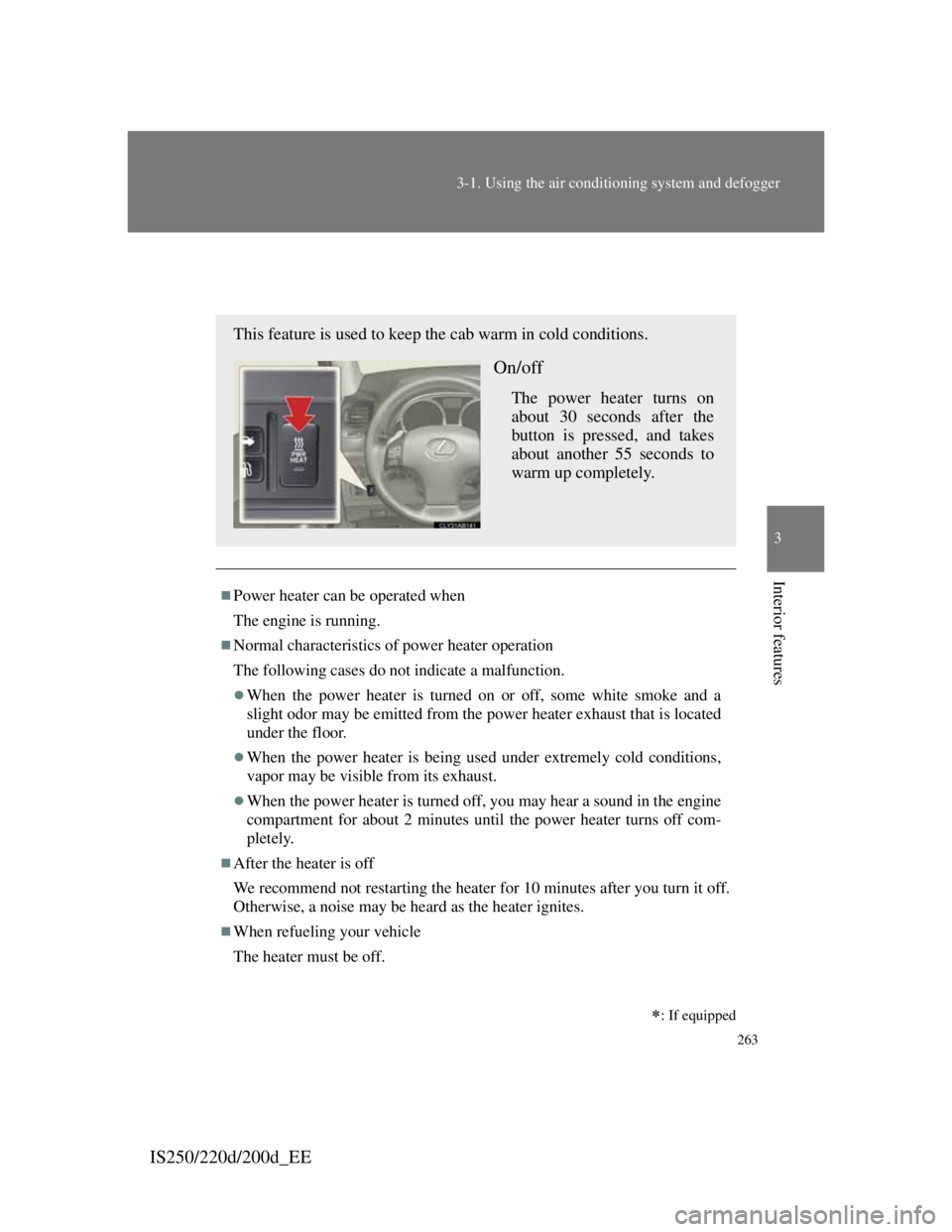
This feature is used to keep the cab warm in cold conditions.
On/off
The power heater turns on
about 30 seconds after the
button is pressed, and takes
about another 55 seconds to
warm up completely.
: If equipped
Page 278 of 609

264
3-1. Using the air conditioning system and defogger
IS250/220d/200d_EE
CAUTION
To prevent burns or damage on your vehicle
NOTICE
To prevent damage to your vehicle
Do not turn the heater on and off repeatedly in 5 minute intervals as this
can shorten the life of the heater components. If the engine must be turned
on and off repeatedly within short intervals (such as when the vehicle is
being used for delivery purposes), turn the heater off.
Do not modify or open the heater without consulting any authorized
Lexus dealer or repairer, or another duly qualified and equipped profes-
sional. This may cause a heater malfunction or even a fire.
Be careful not to splash water or spill liquid directly on the heater or on
the heater fuel pump. This may cause the heater to malfunction.
Keep the intake and exhaust pipes of the heater free from water, snow, ice,
mud, etc. If the pipes become clogged, this can cause the heater to mal-
function.
If you notice anything unusual, such as a fluid leak, smoke or poor opera-
tion, turn off the heater and have your vehicle checked by any authorized
Lexus dealer or repairer, or another duly qualified and equipped profes-
sional.
Do not touch the heater or its exhaust
pipe as they are hot. You may burn
yourself.
Keep flammable items such as fuel
away from the heater and its exhaust
pipe, as this may cause a fire.
Page 408 of 609
388
IS250/220d/200d_EE
4-1. Maintenance and care
Cleaning and protecting the vehicle exterior
Automatic car washes
Fold the mirrors back before washing the vehicle.
Brushes used in automatic car washes may scratch the vehicle surface
and harm your vehicle’s paint.
High pressure car washes
Do not allow the nozzles of the car wash to come within close proximity
of the windows.
Before car wash, check that the fuel filler door on your vehicle is closed
properly.
Touch-up paint (if equipped)
Touch-up paint may be used to cover small chips or scratches.
Apply the paint soon after the damage occurs or corrosion may set in. To
apply the touch-up paint so it is hardly noticeable the trick is to apply it only
to the bare spots. Apply only the smallest amount possible and do not paint
the surface around the scratch or chip.
Perform the following to protect the vehicle and maintain it in prime
condition.
Working from top to bottom, liberally apply water to the
vehicle body, wheel wells and underside of the vehicle to
remove any dirt and dust.
Wash the vehicle body using a sponge or soft cloth, such as
a chamois.
For hard-to-remove marks, use car wash soap and rinse
thoroughly with water.
Wipe away any water.
Wax the vehicle when the waterproof coating deteriorates.
If water does not bead on a clean surface, apply wax when the vehi-
cle body is cool.
Page 421 of 609

400
4-3. Do-it-yourself maintenance
IS250/220d/200d_EE
CAUTION
The engine compartment contains many mechanisms and fluids that may
move suddenly, become hot, or become electrically energized. To avoid death
or serious injury, observe the following precautions.
When working on the engine compartment
Keep hands, clothing, and tools away from the moving fan and engine
drive belt.
Be careful not to touch the engine, radiator, exhaust manifold, etc. right
after driving as they may be hot. Oil and other fluids may also be hot.
Do not leave anything that may burn easily, such as paper or rags, in the
engine compartment.
Do not smoke, cause sparks or expose an open flame to fuel or the battery.
Fuel and battery fumes are flammable.
Be extremely cautious when working on the battery. It contains poisonous
and corrosive sulfuric acid.
Take care because brake fluid can harm your hands or eyes and damage
painted surfaces.
If fluid gets on your hands or in your eyes, flush the affected area with
clean water immediately.
If you still experience discomfort, see a doctor.
When working near the electric cooling fan or radiator grille
Be sure the “ENGINE START STOP” switch is OFF.
With the “ENGINE START STOP” switch in IGNITION ON mode, the
electric cooling fan may automatically start to run if the air conditioning is
on and/or the coolant temperature is high. (P. 415)
CAUTION
Safety glasses
Wear safety glasses to prevent flying or falling material, fluid spray, etc.
from getting in the eyes.
Page 447 of 609
426
4-3. Do-it-yourself maintenance
IS250/220d/200d_EE
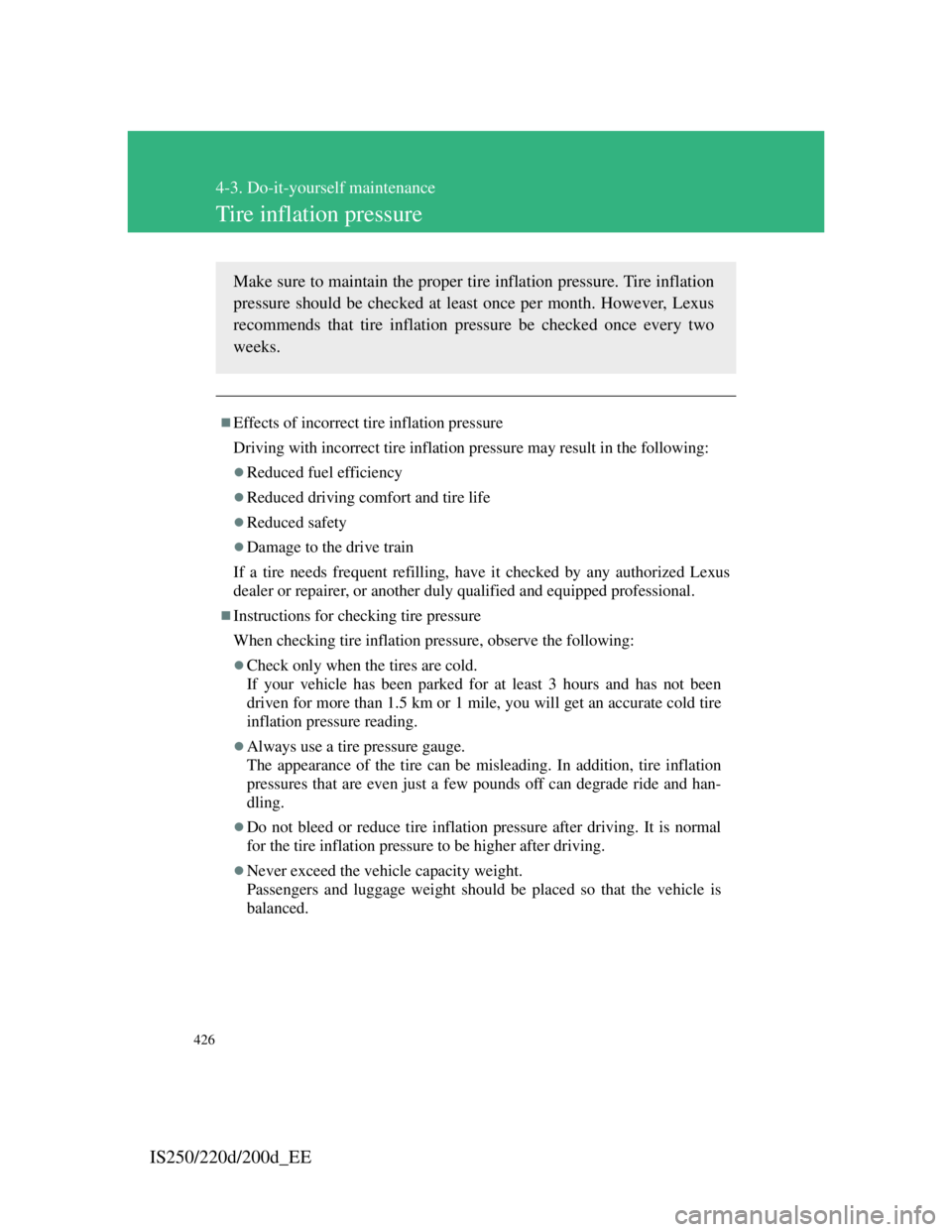
Tire inflation pressure
Effects of incorrect tire inflation pressure
Driving with incorrect tire inflation pressure may result in the following:
Reduced fuel efficiency
Reduced driving comfort and tire life
Reduced safety
Damage to the drive train
If a tire needs frequent refilling, have it checked by any authorized Lexus
dealer or repairer, or another duly qualified and equipped professional.
Instructions for checking tire pressure
When checking tire inflation pressure, observe the following:
Check only when the tires are cold.
If your vehicle has been parked for at least 3 hours and has not been
driven for more than 1.5 km or 1 mile, you will get an accurate cold tire
inflation pressure reading.
Always use a tire pressure gauge.
The appearance of the tire can be misleading. In addition, tire inflation
pressures that are even just a few pounds off can degrade ride and han-
dling.
Do not bleed or reduce tire inflation pressure after driving. It is normal
for the tire inflation pressure to be higher after driving.
Never exceed the vehicle capacity weight.
Passengers and luggage weight should be placed so that the vehicle is
balanced.
Make sure to maintain the proper tire inflation pressure. Tire inflation
pressure should be checked at least once per month. However, Lexus
recommends that tire inflation pressure be checked once every two
weeks.
Page 465 of 609
444
4-3. Do-it-yourself maintenance
IS250/220d/200d_EE
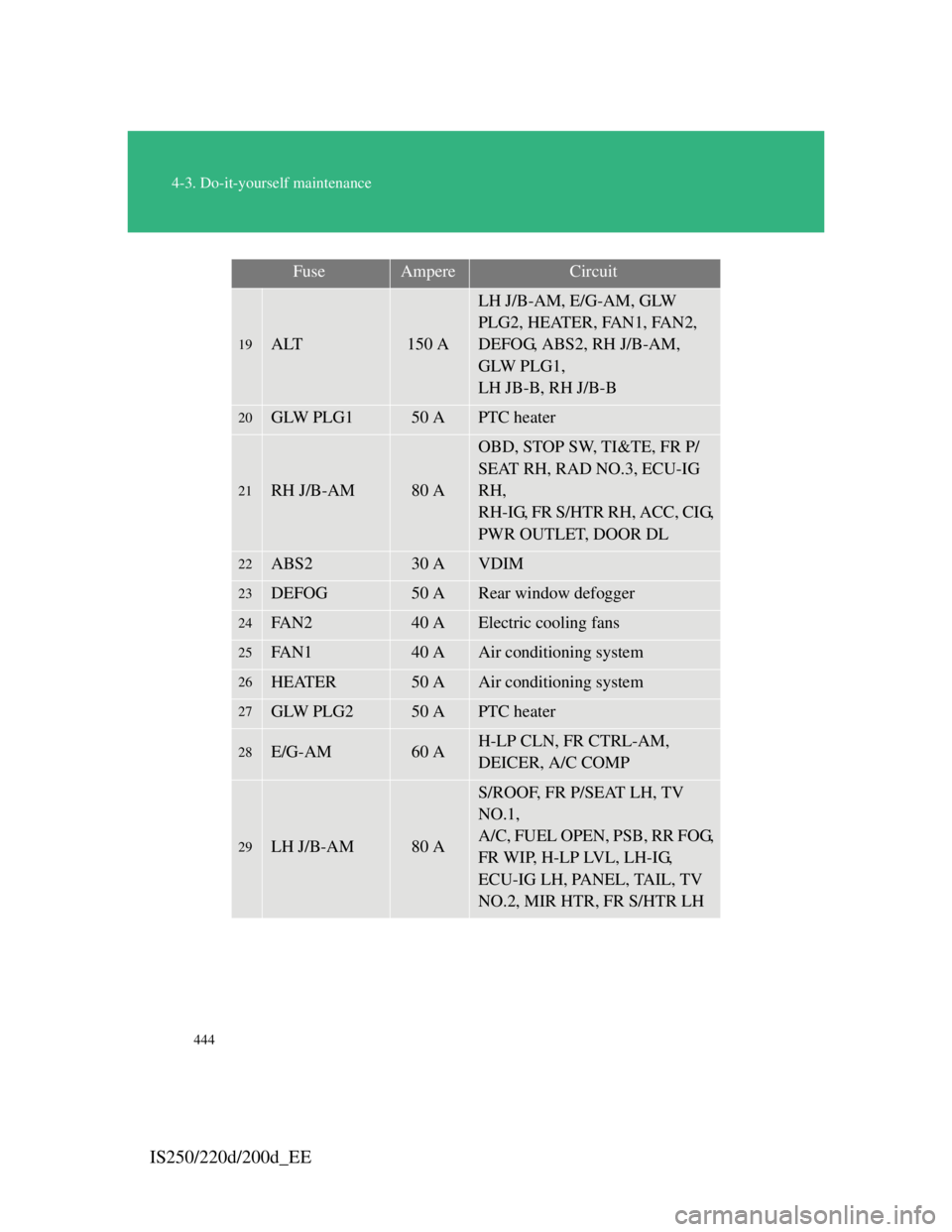
19ALT150 A
LH J/B-AM, E/G-AM, GLW
PLG2, HEATER, FAN1, FAN2,
DEFOG, ABS2, RH J/B-AM,
GLW PLG1,
LH JB-B, RH J/B-B
20GLW PLG150 APTC heater
21RH J/B-AM80 A
OBD, STOP SW, TI&TE, FR P/
SEAT RH, RAD NO.3, ECU-IG
RH,
RH-IG, FR S/HTR RH, ACC, CIG,
PWR OUTLET, DOOR DL
22ABS230 AVDIM
23DEFOG50 ARear window defogger
24FA N 240 AElectric cooling fans
25FA N 140 AAir conditioning system
26HEATER50 AAir conditioning system
27GLW PLG250 APTC heater
28E/G-AM60 AH-LP CLN, FR CTRL-AM,
DEICER, A/C COMP
29LH J/B-AM80 A
S/ROOF, FR P/SEAT LH, TV
NO.1,
A/C, FUEL OPEN, PSB, RR FOG,
FR WIP, H-LP LVL, LH-IG,
ECU-IG LH, PANEL, TAIL, TV
NO.2, MIR HTR, FR S/HTR LH
FuseAmpereCircuit
Page 467 of 609
446
4-3. Do-it-yourself maintenance
IS250/220d/200d_EE
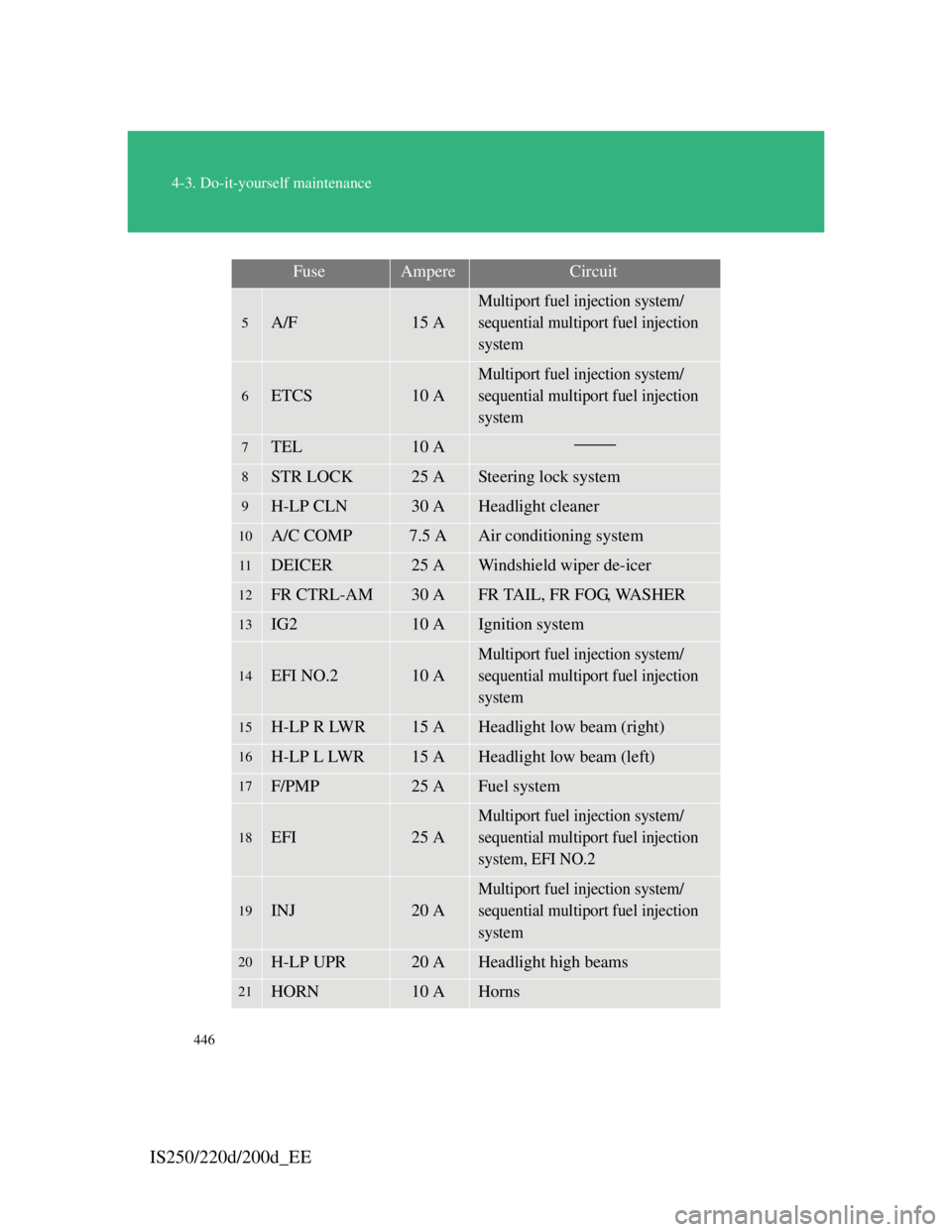
5A/F15 A
Multiport fuel injection system/
sequential multiport fuel injection
system
6ETCS10 A
Multiport fuel injection system/
sequential multiport fuel injection
system
7TEL10 A
8STR LOCK25 ASteering lock system
9H-LP CLN30 AHeadlight cleaner
10A/C COMP7.5 AAir conditioning system
11DEICER25 AWindshield wiper de-icer
12FR CTRL-AM30 AFR TAIL, FR FOG, WASHER
13IG210 AIgnition system
14EFI NO.210 A
Multiport fuel injection system/
sequential multiport fuel injection
system
15H-LP R LWR15 AHeadlight low beam (right)
16H-LP L LWR15 AHeadlight low beam (left)
17F/PMP25 AFuel system
18EFI25 A
Multiport fuel injection system/
sequential multiport fuel injection
system, EFI NO.2
19INJ20 A
Multiport fuel injection system/
sequential multiport fuel injection
system
20H-LP UPR20 AHeadlight high beams
21HORN10 AHorns
FuseAmpereCircuit