inflation pressure Lexus IS220d 2011 User Guide
[x] Cancel search | Manufacturer: LEXUS, Model Year: 2011, Model line: IS220d, Model: Lexus IS220d 2011Pages: 609, PDF Size: 14.63 MB
Page 533 of 609

5
507
5-2. Steps to take in an emergency
When trouble arises
IS250/220d/200d_EEInflate the tire until the recom-
mended pressure is reached.
The sealant will be injected
and the pressure will spike to
300 kPa (3.0 kgf/cm
2 or bar,
44 psi) or 450 kPa (4.5 kgf/
cm
2 or bar, 65 psi), then
gradually decrease.
The air pressure gauge will
display the actual tire infla-
tion pressure about 1 minute
after the switch is turned on.
• Turn the compressor switch off
and then check the tire inflation
pressure. Being careful not to
over inflate, check and repeat
the inflation procedure until the
recommended tire inflation
pressure is reached.
• If the needle of the air pressure
gauge reaches the red zone (450
kPa [4.5 kgf/cm
2 or bar, 65 psi]
or more), there may be a mal-
function in the tire or in the kit
itself. Stop operation immedi-
ately.
• If the tire inflation pressure is
still lower than the recom-
mended level after inflating for
10 minutes with the switch on,
the tire is too damaged to be
repaired. Turn the compressor
switch off and contact any
authorized Lexus dealer, tire
dealer or repairer, or another
STEP 11
Page 535 of 609

5
509
5-2. Steps to take in an emergency
When trouble arises
IS250/220d/200d_EE
• If the tire inflation pressure
exceeds the recommended
level, let out some air to adjust
the tire inflation pressure. (P.
512)
Disconnect the hose from the valve on the tire and then pull
out the power plug from the power outlet socket.
To spread the liquid sealant evenly within the tire, immedi-
ately drive for about 5 km (3 miles).
After driving for about 5 km (3
miles), stop your vehicle in a
safe place on a hard, flat surface
and reconnect the compressor.
Turn the compressor switch on
and wait for several seconds,
then turn it off. Check the tire
inflation pressure.
If the tire inflation pressure is
below 130 kPa (1.3 kgf/cm
2
or bar, 19 psi): The puncture
cannot be repaired. Contact
any authorized Lexus dealer,
tire dealer or repairer, or
another duly qualified and
equipped professional.
If the tire inflation pressure is
between 130 kPa (1.3 kgf/
cm
2 or bar, 19 psi) and a
point below the recom-
mended level: The tire can be
STEP 12
STEP 13
STEP 14
STEP 15
Page 536 of 609

510
5-2. Steps to take in an emergency
IS250/220d/200d_EErepaired. Proceed to “STEP
16”.
If the tire inflation pressure is
at the recommended level:
Proceed to “STEP 17”.
Turn the compressor switch on to inflate the tire until the
recommended tire inflation pressure is reached. Drive for
about 5 km (3 miles) and then perform “STEP 14”.
Store the kit and then attach the
2 stickers as shown.
Taking precautions to avoid
sudden braking and sharp turns,
drive carefully at under 80 km/h
(50 mph) to the nearest autho-
rized Lexus dealer, tire dealer or
repairer, or another duly quali-
fied and equipped professional
for tire repair or replacement.
STEP 16
STEP 17
Page 538 of 609

512
5-2. Steps to take in an emergency
IS250/220d/200d_EE
If the tire is inflated to more than the recommended level
Disconnect the hose from the valve.
Disconnect the hose from the valve, remove the air release cap
from the hose and then reconnect the hose.
Turn the compressor switch on and wait for several seconds, then
turn it off. Check that the air pressure indicator shows the recom-
mended level (P. 548).
If the air pressure is lower than the recommended level, turn the
compressor switch on again and repeat the inflation procedure until
the recommended pressure is reached.
CAUTION
Precautions for use of the sealant
Ingesting the sealant is hazardous to your health. If you ingest sealant,
consume as much water as possible, then immediately consult a doctor.
If sealant gets in eyes or adheres to skin, immediately wash it off with
water. If discomfort persists, consult a doctor.
STEP1
Install the air release cap to the end of the
hose and push the protrusion on the air
release cap into the tire valve to let some
air out.STEP2
STEP3
STEP4
Page 539 of 609
5
513
5-2. Steps to take in an emergency
When trouble arises
IS250/220d/200d_EE
CAUTION
When fixing the flat tire
Stop your vehicle in a safe and flat area.
Connect the valve and hose securely with the tire installed on the vehicle.
If the hose is not properly connected to the valve, air leakage may occur or
sealant may be sprayed out.
If the hose comes off the valve while inflating the tire, there is a risk that
the hose will move abruptly due to air pressure.
After inflation of the tire has been completed, the sealant may splatter
when the hose is disconnected or some air is let out of the tire.
Keep back from the tire while it is being repaired, as there is a chance of it
bursting while the repair operation is being performed. If you notice any
cracks or deformation of the tire, turn off the compressor switch and stop
the repair operation immediately.
The kit may overheat if operated for a long period of time. Do not operate
the compressor continuously for more than 10 minutes.
Parts of the kit become hot during operation. Be careful handling the kit
during and after operation.
Do not attach the vehicle speed warning sticker to an area other than the
one indicated. If the sticker is attached to an area where an SRS airbag is
located, such as the pad of the steering wheel, it may prevent the SRS air-
bag from operating properly.
Driving to spread the liquid sealant evenly
Drive the vehicle carefully at a low speed. Be especially careful when
turning and cornering.
If the vehicle does not drive straight or you feel a pull through the steering
wheel, stop the vehicle and check the following:
• Tire condition. The tire may have separated from the wheel.
• Tire inflation pressure. If tire inflation pressure is 130 kPa (1.3 kgf/
cm
2 or bar, 19 psi) or below, this may indicate severe tire damage.
Page 578 of 609
548
6-1. Specifications
IS250/220d/200d_EE
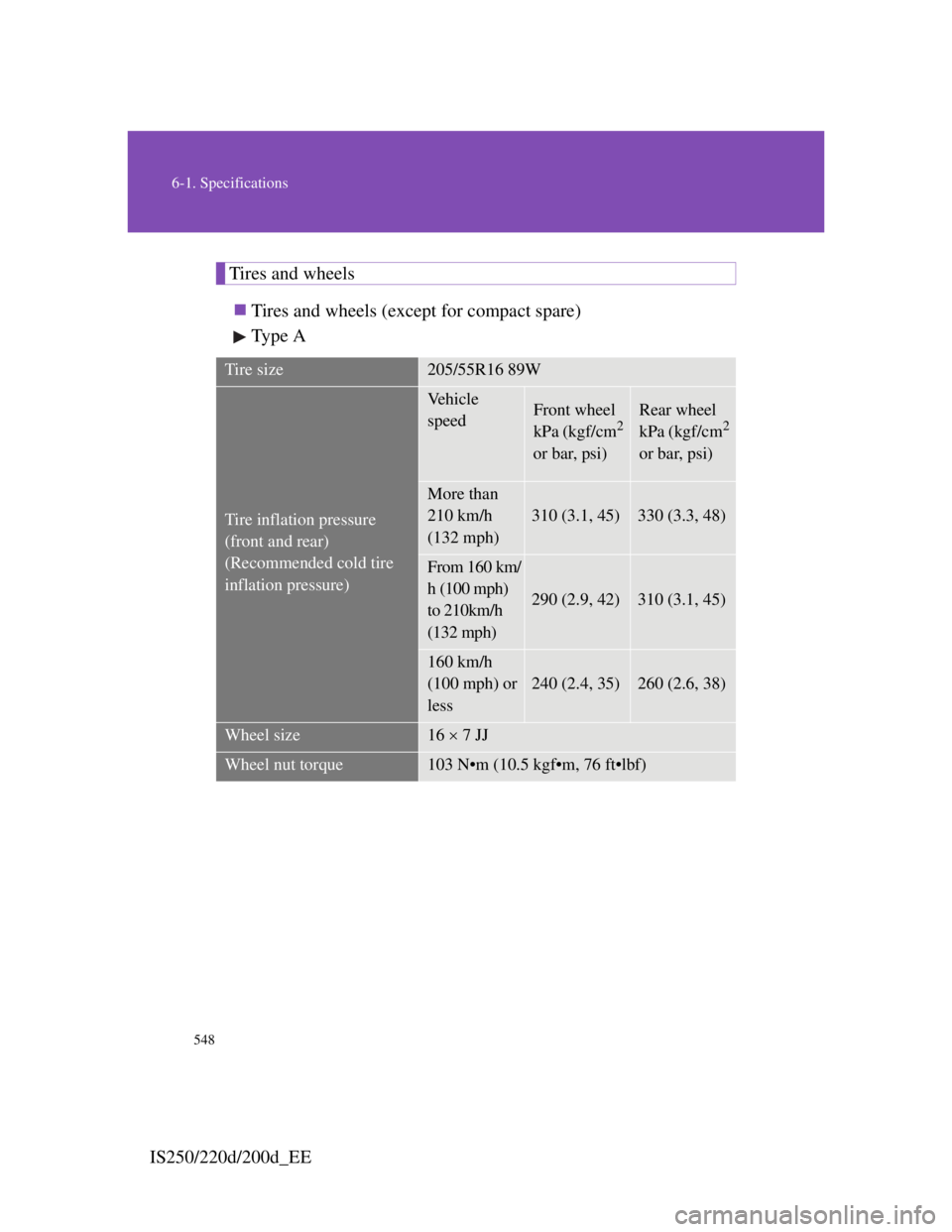
Tires and wheels
Tires and wheels (except for compact spare)
Ty p e A
Tire size205/55R16 89W
Tire inflation pressure
(front and rear)
(Recommended cold tire
inflation pressure)
Vehicle
speedFront wheel
kPa (kgf/cm2
or bar, psi)
Rear wheel
kPa (kgf/cm2
or bar, psi)
More than
210 km/h
(132 mph)
310 (3.1, 45)330 (3.3, 48)
From 160 km/
h (100 mph)
to 210km/h
(132 mph)
290 (2.9, 42)310 (3.1, 45)
160 km/h
(100 mph) or
less
240 (2.4, 35)260 (2.6, 38)
Wheel size16 7 JJ
Wheel nut torque103 N•m (10.5 kgf•m, 76 ft•lbf)
Page 579 of 609
549
6-1. Specifications
6
Vehicle specifica-
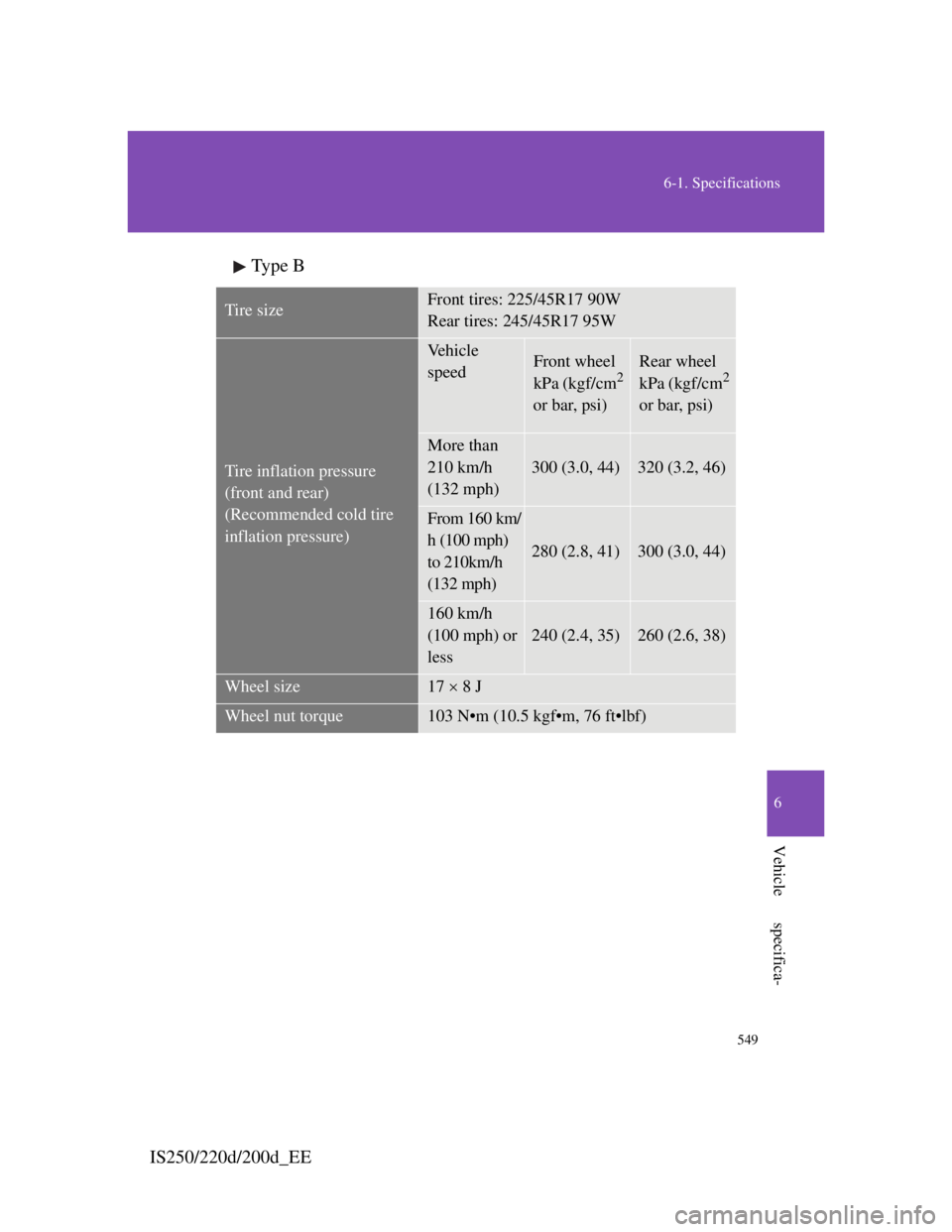
IS250/220d/200d_EETy p e B
Tire sizeFront tires: 225/45R17 90W
Rear tires: 245/45R17 95W
Tire inflation pressure
(front and rear)
(Recommended cold tire
inflation pressure)
Vehicle
speedFront wheel
kPa (kgf/cm2
or bar, psi)
Rear wheel
kPa (kgf/cm2
or bar, psi)
More than
210 km/h
(132 mph)
300 (3.0, 44)320 (3.2, 46)
From 160 km/
h (100 mph)
to 210km/h
(132 mph)
280 (2.8, 41)300 (3.0, 44)
160 km/h
(100 mph) or
less
240 (2.4, 35)260 (2.6, 38)
Wheel size17 8 J
Wheel nut torque103 N•m (10.5 kgf•m, 76 ft•lbf)
Page 580 of 609
550
6-1. Specifications
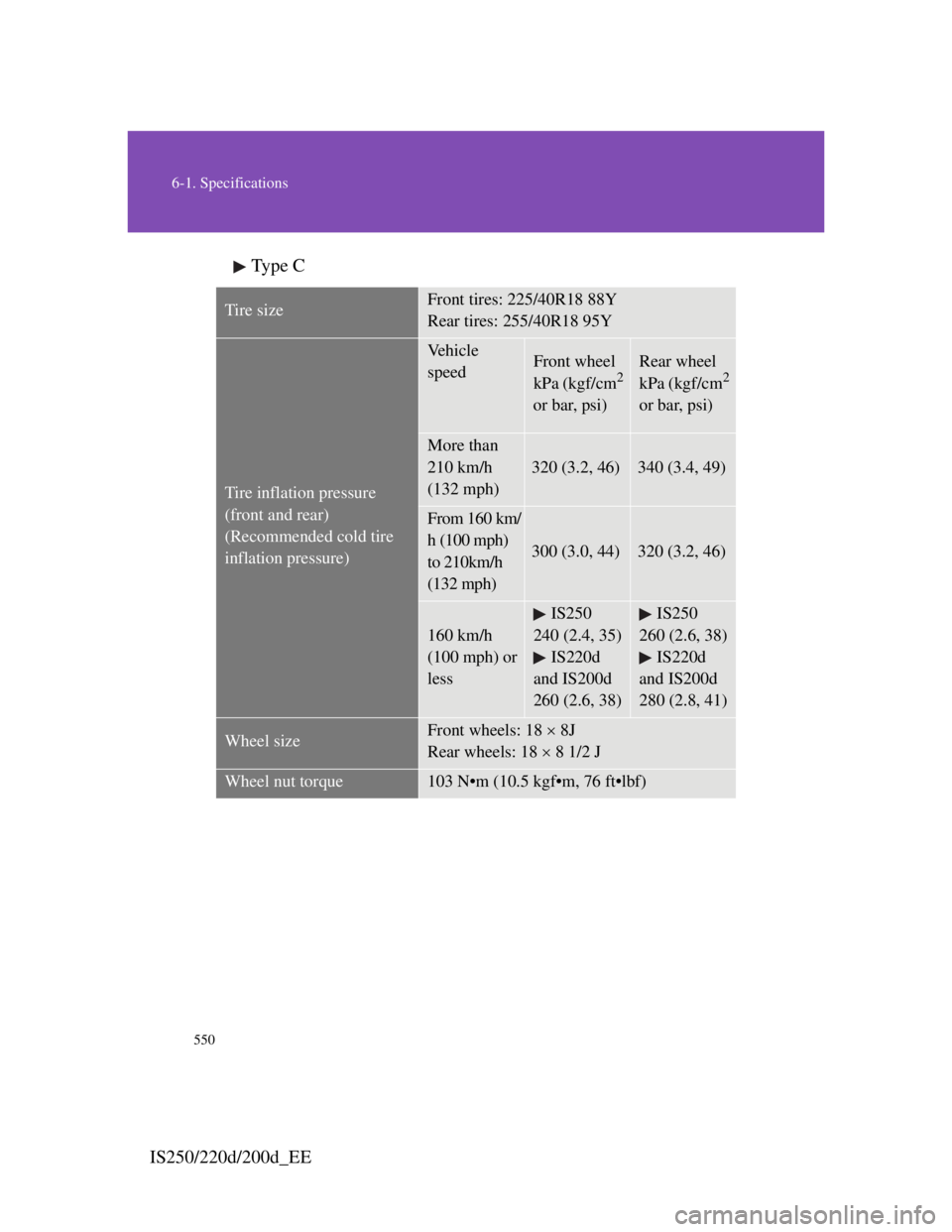
IS250/220d/200d_EETy p e C
Tire sizeFront tires: 225/40R18 88Y
Rear tires: 255/40R18 95Y
Tire inflation pressure
(front and rear)
(Recommended cold tire
inflation pressure)
Vehicle
speedFront wheel
kPa (kgf/cm2
or bar, psi)
Rear wheel
kPa (kgf/cm2
or bar, psi)
More than
210 km/h
(132 mph)
320 (3.2, 46)340 (3.4, 49)
From 160 km/
h (100 mph)
to 210km/h
(132 mph)
300 (3.0, 44)320 (3.2, 46)
160 km/h
(100 mph) or
less
IS250
240 (2.4, 35)
IS220d
and IS200d
260 (2.6, 38)IS250
260 (2.6, 38)
IS220d
and IS200d
280 (2.8, 41)
Wheel sizeFront wheels: 18 8J
Rear wheels: 18 8 1/2 J
Wheel nut torque103 N•m (10.5 kgf•m, 76 ft•lbf)
Page 581 of 609
551
6-1. Specifications
6
Vehicle specifica-
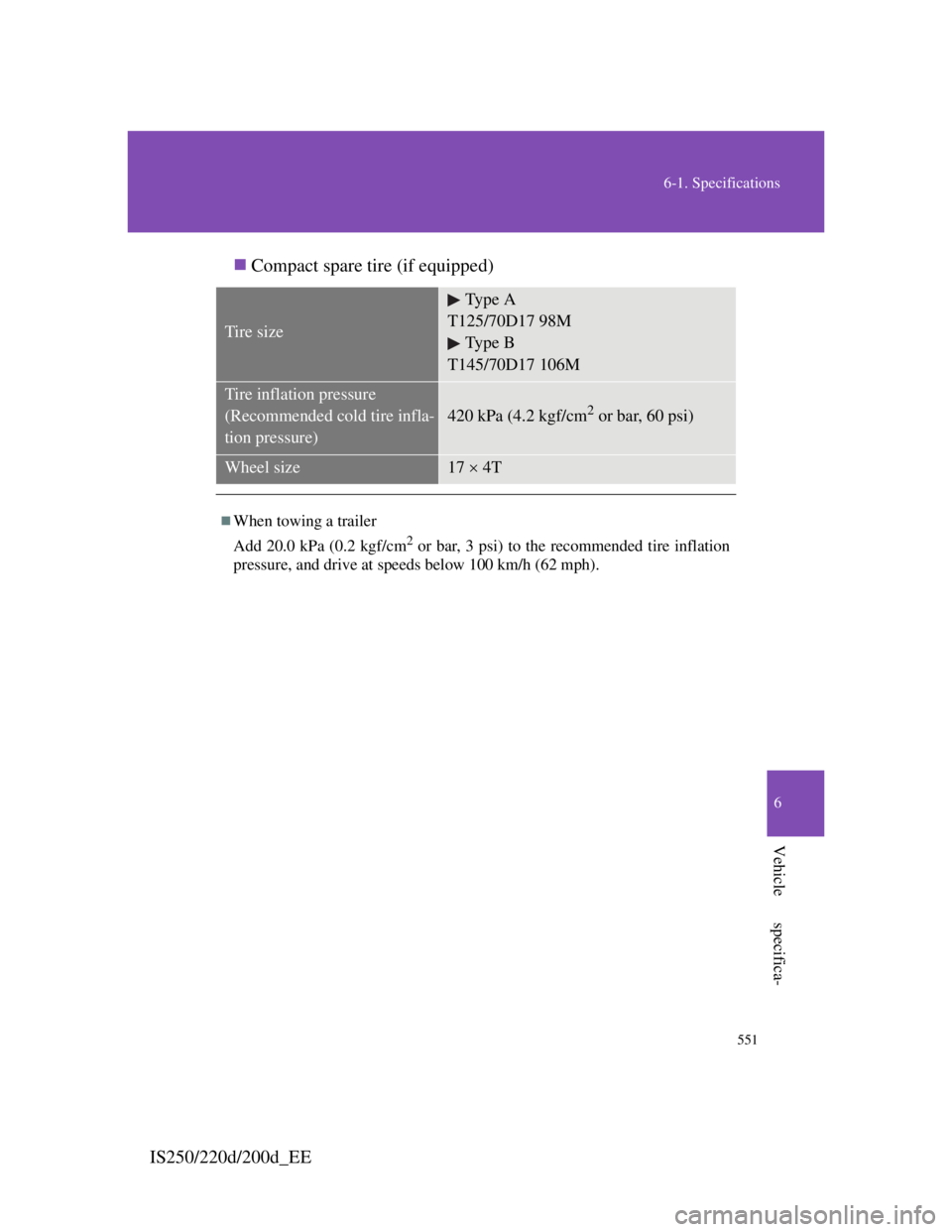
IS250/220d/200d_EECompact spare tire (if equipped)
Tire size
Ty p e A
T125/70D17 98M
Ty p e B
T145/70D17 106M
Tire inflation pressure
(Recommended cold tire infla-
tion pressure)
420 kPa (4.2 kgf/cm2 or bar, 60 psi)
Wheel size17 4T
When towing a trailer
Add 20.0 kPa (0.2 kgf/cm
2 or bar, 3 psi) to the recommended tire inflation
pressure, and drive at speeds below 100 km/h (62 mph).
Page 603 of 609

570
Alphabetical index
IS250/220d/200d_EE
Service reminder indicators ......177
Shift lever
Automatic transmission ........161
If the shift lever cannot
be shifted from P ................517
Manual transmission.............168
Shift lever light..........................351
Shift lock system .......................517
Shopping bag hooks ..................384
Side airbags ...............................110
Side mirror
Adjusting and folding .............84
Mirror position memory .........66
Side turn signal lights
Wattage .................................552
Smart entry & start system
Entry function .........................37
Starting the engine ................158
Spare tire
Inflation pressure ..................548
Storage location ....................487
Spark plug .................................544
Specifications ............................534
Speedometer
Speed indicator .....................171
Speedometer .........................171Steering wheel
Audio switches* .................. 307
Steering wheel position
memory ............................... 66
Manual adjustment ................ 79
Power adjustment .................. 80
Storage feature.......................... 355
Stuck
If your vehicle becomes stuck ...
532
Sun visors ................................. 362
Sunshade
Rear...................................... 378
Roof ....................................... 90
Switch
Airbag manual ON/OFF ...... 140
ECT switch .......................... 162
Emergency flasher switch.... 458
Engine switch ...................... 156
Fog light switch ................... 190
Hazard light switch .............. 458
Ignition switch ..................... 156
Light switches ...................... 186
Power door lock switch ......... 58
Power window switch............ 85
Satellite switches ................. 365
Transmission shift switches . 165
Window lock switch.............. 85
Wiper and washer ................ 191