air Lexus IS220d 2011 Service Manual
[x] Cancel search | Manufacturer: LEXUS, Model Year: 2011, Model line: IS220d, Model: Lexus IS220d 2011Pages: 609, PDF Size: 14.63 MB
Page 129 of 609
121
1
1-7. Safety information
Before driving
IS250/220d/200d_EE
Child restraint systems
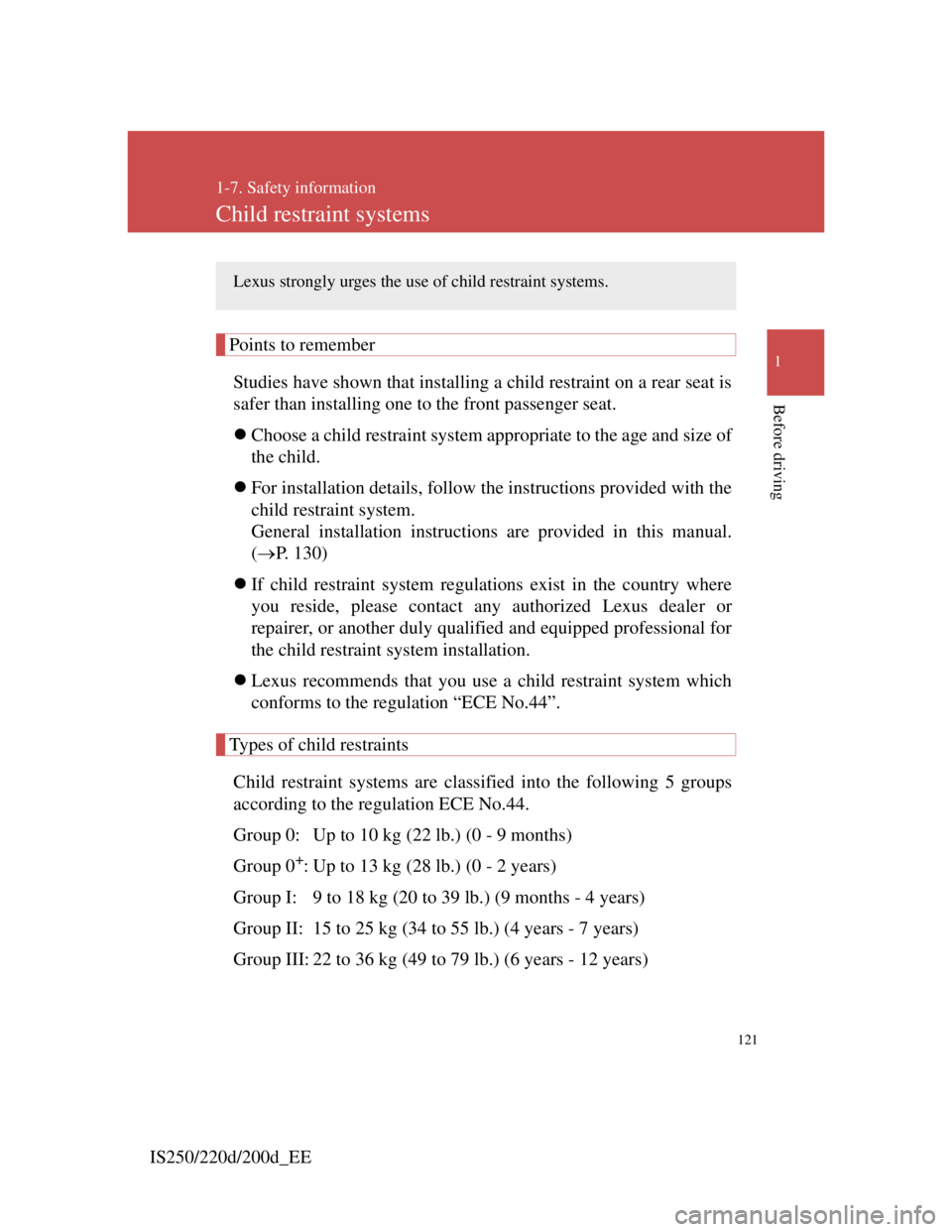
Points to remember
Studies have shown that installing a child restraint on a rear seat is
safer than installing one to the front passenger seat.
Choose a child restraint system appropriate to the age and size of
the child.
For installation details, follow the instructions provided with the
child restraint system.
General installation instructions are provided in this manual.
(P. 130)
If child restraint system regulations exist in the country where
you reside, please contact any authorized Lexus dealer or
repairer, or another duly qualified and equipped professional for
the child restraint system installation.
Lexus recommends that you use a child restraint system which
conforms to the regulation “ECE No.44”.
Types of child restraints
Child restraint systems are classified into the following 5 groups
according to the regulation ECE No.44.
Group 0: Up to 10 kg (22 lb.) (0 - 9 months)
Group 0
+: Up to 13 kg (28 lb.) (0 - 2 years)
Group I: 9 to 18 kg (20 to 39 lb.) (9 months - 4 years)
Group II: 15 to 25 kg (34 to 55 lb.) (4 years - 7 years)
Group III: 22 to 36 kg (49 to 79 lb.) (6 years - 12 years)
Lexus strongly urges the use of child restraint systems.
Page 132 of 609

124
1-7. Safety information
IS250/220d/200d_EE
Child restraint system suitability for various seating positions
Provided information in the table shows your child restraint system
suitability for various seating positions.
Front passenger seat
Rear seat
Airbag manual on-off
switch
On
OffOutboardCenter
0
Up to 10 kg (22 lb.)
(0 - 9 months)X
Never putL1 L1 U
0
+
Up to 13 kg (28 lb.)
(0 - 2 years)X
Never putL1 L1 U
I
9 to 18 kg
(20 to 39 lb.)
(9 months - 4 years)L2 L2 U
II, III
15 to 36 kg
(34 to 79 lb.)
(4 - 12 years)L3 L3 U
Mass groupsSeating posi-
Page 137 of 609

129
1
1-7. Safety information
Before driving
IS250/220d/200d_EE
CAUTION
Child restraint precautions
Never use a rear-facing child restraint system on the front passenger seat
when the airbag manual on-off switch is on. (P. 140)
In the event of an accident, the force of the rapid inflation of the front pas-
senger airbag can cause death or serious injury to the child.
A forward-facing child restraint system may be installed on the front pas-
senger seat only when it is unavoidable. Always move the seat as far back
as possible, because the front passenger airbag could inflate with consid-
erable speed and force. Otherwise, the child may be killed or seriously
injured.
Do not allow the child to lean his/her head or any part of his/her body
against the door or the area of the seat, front pillar, rear pillar or roof side
rail from which the side airbags or curtain shield airbags deploy even if
the child is seated in the child restraint system. It is dangerous if the side
airbags and curtain shield airbags inflate, and the impact could cause
death or serious injury to the child.
Make sure you have complied with all installation instructions provided
by the child restraint manufacturer and that the system is properly
secured. If it is not secured properly, it may cause death or serious injury
to the child in the event of a sudden stop, sudden swerve or an accident.
When children are in the vehicle
Do not allow children to play with the seat belt. If the seat belt becomes
twisted around a child’s neck, it may lead to choking or other serious inju-
ries that could result in death.
If this occurs and the buckle cannot be unfastened, scissors should be used
to cut the belt.
When the child restraint system is not in use
Keep the child restraint system properly secured on the seat even if it is
not in use. Do not store the restraint unsecured in the passenger compart-
ment.
If it is necessary to detach the child restraint system, remove it from the
vehicle or store it securely in the trunk. This will prevent it from injuring
passengers in the event of a sudden stop, sudden swerve or accident.
Page 143 of 609

135
1-7. Safety information
1
Before driving
IS250/220d/200d_EEOpen the anchor bracket cover,
latch the hook onto the anchor
bracket and tighten the top
strap.
Make sure the top strap is
securely latched.
STEP2
When restraining a child restraint system
You need a locking clip to restraint the child restraint system. Follow the
instructions provided by the manufacturer of the system. If your child
restraint system does not provide a locking clip, you can purchase the fol-
lowing item from any authorized Lexus dealer or repairer, or another duly
qualified and equipped professional.
Locking clip for child restraint system
(Part No. 73119-22010)
Page 144 of 609

136
1-7. Safety information
IS250/220d/200d_EE
CAUTION
When installing a child restraint system
Follow the directions given in the child restraint system installation manual
and fix the child restraint system securely in place.
If the child restraint system is not correctly fixed in place, the child or other
passengers may be injured or even killed in the event of sudden braking,
sudden swerving or an accident.
If the driver's seat interferes with the
child restraint system and prevents it
from being attached correctly, attach
the child restraint system to the right-
hand rear seat (left-hand drive vehicles)
or the left-hand rear seat (right-hand
drive vehicles).
When installing a forward facing or
junior child seat on the front passenger
seat, move the seat as far back as possi-
ble.
Failing to do so may result in death or
serious injury if the airbags deploy
(inflate).
Page 145 of 609

137
1-7. Safety information
1
Before driving
IS250/220d/200d_EE
CAUTION
When installing a child restraint system
Never use a rear-facing child restraint
system on the front passenger seat
when the airbag manual on-off switch
is on.
(P. 140)
The force of the rapid inflation of the
front passenger airbag can cause death
or serious injury to children in the
event of an accident.
For Russia
Except for Russia: A warning label on
the passenger side instrument panel
reminds you not to install a rear-facing
child restraint system on the front pas-
senger seat.
For Russia: There is a sticker on the
passenger side of the instrument panel
and a label on both sides of the passen-
ger side sun visor, both indicating it is
forbidden to attach a rear-facing child
restraint system to the front passenger
seat.
Details of the label on the passenger
side sun visor are shown in the illustra-
tions below The label includes infor-
Page 146 of 609

138
1-7. Safety information
IS250/220d/200d_EE
CAUTION
When installing a child restraint system
For Russia
If child restraint system regulations exist in the country where you reside,
please contact any authorized Lexus dealer or repairer, or another duly
qualified and equipped professional for the child restraint system installa-
tion.
When a junior seat is installed, always ensure that the shoulder belt is
positioned across the center of the child's shoulder. The belt should be
kept away from the child's neck, but not so that it could fall off the child's
shoulder. Failing to do so may result in death or serious injury in the event
of sudden braking, sudden swerving or an accident.
Do not allow children to play with the seat belt. If the seat belt becomes
twisted around a child’s neck, choking or other serious injuries may result
in death.
If this occurs and the buckle cannot be unfastened, scissors should be used
to cut the belt.
Page 148 of 609

140
1-7. Safety information
IS250/220d/200d_EE
Airbag manual on/off system
Deactivating the front passenger airbags
This system deactivates the front passenger airbag, front passenger
knee airbag and front passenger side airbag.
Only deactivate the airbags when using a child restraint system on the
front passenger seat.
“PASSENGER AIRBAG”
indicator
This indicator turns on when
the airbag system is on.
(Only when the “ENGINE
START STOP” switch is in
IGNITION ON mode.)
Airbag manual on-off
switch
Page 149 of 609

141
1-7. Safety information
1
Before driving
IS250/220d/200d_EEInsert the mechanical key into
the cylinder and rotate to the
“OFF” position.
The “OFF” indicator turns on.
(Only when the “ENGINE
START STOP” switch is in
IGNITION ON mode.)
“PASSENGER AIRBAG” indicator information
If any of the following problems occurs, it is possible that there is a mal-
function in the system. Have the vehicle inspected by any authorized Lexus
dealer or repairer, or another duly qualified and equipped professional.
Neither “ON” nor “OFF” comes on.
The indicator does not change when the airbag manual on-off switch is
switched to “ON” or “OFF”.
CAUTION
When installing a child restraint system
For safety reasons, always install the child restraint system in a rear seat. In
the event that the rear seat cannot be used, the front seat can be used as long
as the airbag manual on-off system is set to off.
If the airbag manual on-off system is left on, the strong impact of the airbag
deployment (inflation) may cause serious injury or even death.
When a child restraint system is not installed on the front passenger seat
Ensure that the airbag manual on-off system is set to on.
If it is left off, the airbag may not deploy in the event of an accident, which
may result in serious injury or even death.
Page 154 of 609
145
2-1. Driving procedures
2
When driving
IS250/220d/200d_EE
Drum-in-disc type parking brake system
Your vehicle has a drum-in-disc type parking brake system. This type of
brake system needs bedding-down of the brake shoes periodically or when-
ever the parking brake shoes and/or drum are replaced. Have any authorized
Lexus dealer or repairer, or another duly qualified and equipped profes-
sional, perform the bedding down operation.
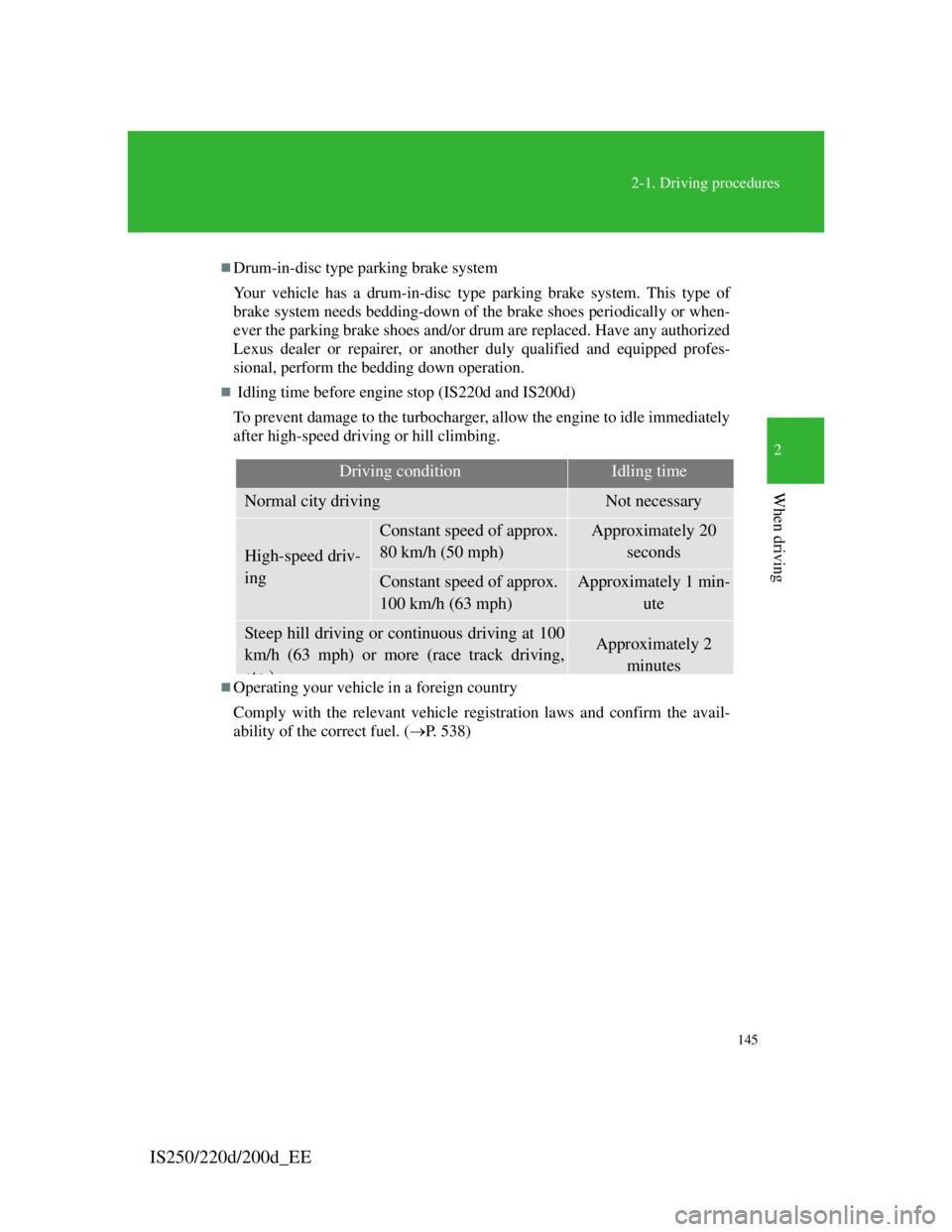
Idling time before engine stop (IS220d and IS200d)
To prevent damage to the turbocharger, allow the engine to idle immediately
after high-speed driving or hill climbing.
Operating your vehicle in a foreign country
Comply with the relevant vehicle registration laws and confirm the avail-
ability of the correct fuel. (P. 5 3 8 )
Driving conditionIdling time
Normal city drivingNot necessary
High-speed driv-
ing
Constant speed of approx.
80 km/h (50 mph)Approximately 20
seconds
Constant speed of approx.
100 km/h (63 mph)Approximately 1 min-
ute
Steep hill driving or continuous driving at 100
km/h (63 mph) or more (race track driving,
etc )Approximately 2
minutes