air condition Lexus IS220d 2012 User Guide
[x] Cancel search | Manufacturer: LEXUS, Model Year: 2012, Model line: IS220d, Model: Lexus IS220d 2012Pages: 609, PDF Size: 14.63 MB
Page 154 of 609

145
2-1. Driving procedures
2
When driving
IS250/220d/200d_EE
Drum-in-disc type parking brake system
Your vehicle has a drum-in-disc type parking brake system. This type of
brake system needs bedding-down of the brake shoes periodically or when-
ever the parking brake shoes and/or drum are replaced. Have any authorized
Lexus dealer or repairer, or another duly qualified and equipped profes-
sional, perform the bedding down operation.
Idling time before engine stop (IS220d and IS200d)
To prevent damage to the turbocharger, allow the engine to idle immediately
after high-speed driving or hill climbing.
Operating your vehicle in a foreign country
Comply with the relevant vehicle registration laws and confirm the avail-
ability of the correct fuel. (P. 5 3 8 )
Driving conditionIdling time
Normal city drivingNot necessary
High-speed driv-
ing
Constant speed of approx.
80 km/h (50 mph)Approximately 20
seconds
Constant speed of approx.
100 km/h (63 mph)Approximately 1 min-
ute
Steep hill driving or continuous driving at 100
km/h (63 mph) or more (race track driving,
etc )Approximately 2
minutes
Page 164 of 609

155
2-1. Driving procedures
2
When driving
IS250/220d/200d_EE
NOTICE
If you get a flat tire while driving
A flat or damaged tire may cause the following situations. Hold the steering
wheel firmly and gradually press the brake pedal to slow down the vehicle.
It may be difficult to control your vehicle.
The vehicle will make abnormal sounds.
The vehicle will behave abnormally.
Information on what to do in case of a flat tire (P. 485, 497)
When encountering flooded roads
Do not drive on a road that has flooded after heavy rain etc. Doing so may
cause the following serious damage to the vehicle.
Engine stalling
Short in electrical components
Engine damage caused by water immersion
In the event that you drive on a flooded road and the vehicle is flooded, be
sure to have any authorized Lexus dealer or repairer, or another duly quali-
fied and equipped professional check the following.
Brake function
Changes in quantity and quality of oil and fluid used for the engine, trans-
mission, differential, etc.
Lubricant condition for the propeller shaft, bearings and suspension joints
(where possible) and the function of all joints, bearings, etc.
Page 168 of 609
159
2-1. Driving procedures
2
When driving
IS250/220d/200d_EE
If the engine does not start
The engine immobilizer system may not have been deactivated. (P. 9 6 )
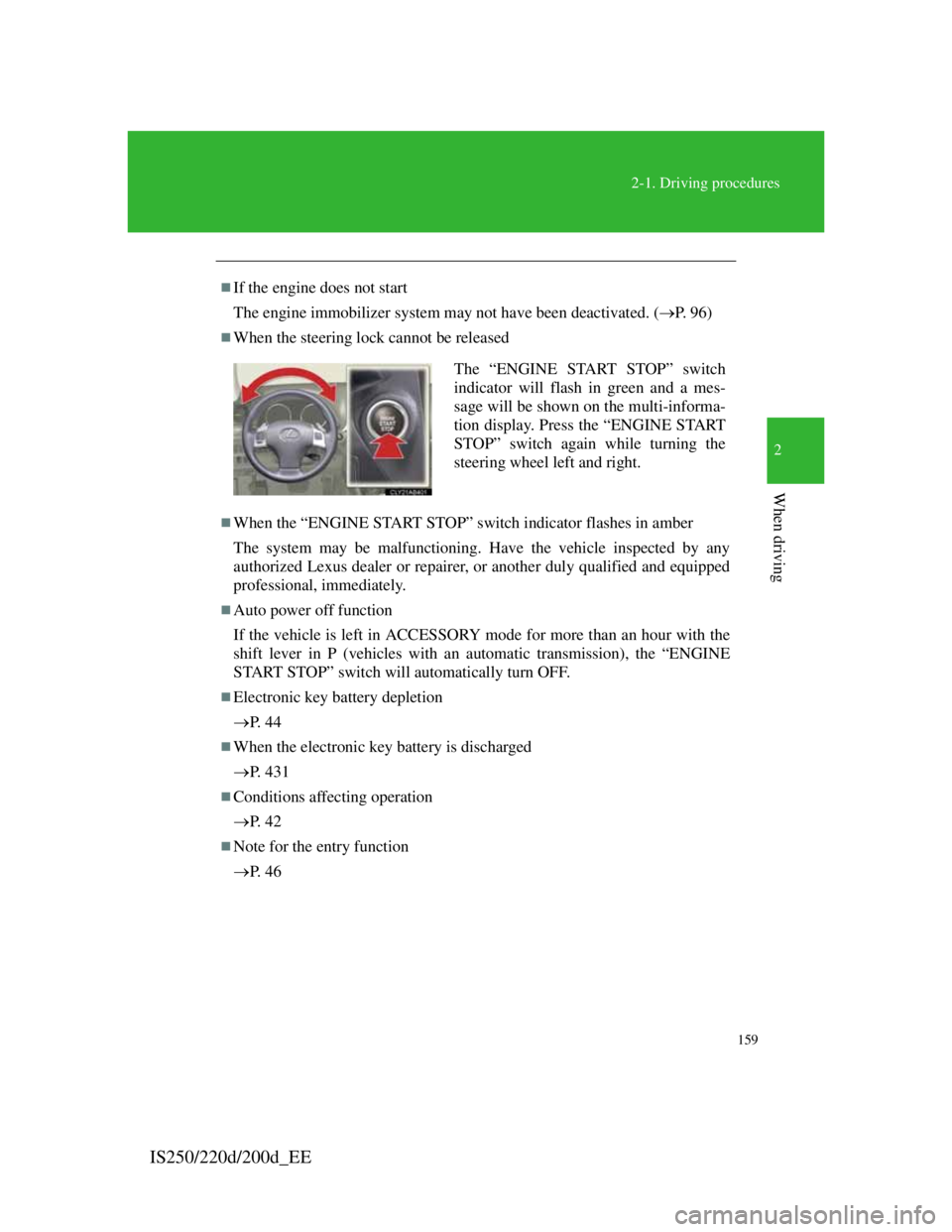
When the steering lock cannot be released
When the “ENGINE START STOP” switch indicator flashes in amber
The system may be malfunctioning. Have the vehicle inspected by any
authorized Lexus dealer or repairer, or another duly qualified and equipped
professional, immediately.
Auto power off function
If the vehicle is left in ACCESSORY mode for more than an hour with the
shift lever in P (vehicles with an automatic transmission), the “ENGINE
START STOP” switch will automatically turn OFF.
Electronic key battery depletion
P. 4 4
When the electronic key battery is discharged
P. 4 3 1
Conditions affecting operation
P. 4 2
Note for the entry function
P. 4 6
The “ENGINE START STOP” switch
indicator will flash in green and a mes-
sage will be shown on the multi-informa-
tion display. Press the “ENGINE START
STOP” switch again while turning the
steering wheel left and right.
Page 176 of 609

167
2-1. Driving procedures
2
When driving
IS250/220d/200d_EE
If does not come on even after shifting the shift lever to S
This may indicate a malfunction in the automatic transmission system. Have
the vehicle inspected by any authorized Lexus dealer or repairer, or another
duly qualified and equipped professional, immediately.
(In this situation, the vehicle will operate as if the shift lever is in D.)
AI-SHIFT
The AI-SHIFT automatically shifts the gear to the suitable position accord-
ing to the driver performance and driving conditions.
The AI-SHIFT automatically operates when the shift lever is in the D posi-
tion. However, operating the “-” paddle shift switch will restrict the func-
tion’s operation. (Shifting the shift lever to the S position cancels the
function.)
CAUTION
When driving on slippery road surfaces
Be careful of downshifting and sudden acceleration, as this could result in
the vehicle skidding to the side or spinning.
Page 201 of 609

189
2-3. Operating the lights and windshield wipers
2
When driving
IS250/220d/200d_EE
Automatic light off system
This system is active when the “ENGINE START STOP” switch is in IGNI-
TION ON mode and the headlight lever is in any position other than
.
When the light switch is in : The headlights turn off automatically
if the “ENGINE START STOP” switch is switched to ACCESSORY
mode or turned OFF.
When the light switch is in “AUTO”: The headlights and tail lights turn
off automatically if the “ENGINE START STOP” switch is switched to
ACCESSORY mode or turned OFF and the driver's door is opened.
Even if a door other than the driver's door is opened, the automatic light
off system will not operate.
To turn the lights on again, switch to IGNITION ON mode, or turn the light
switch off once and then back to
or .
Light reminder buzzer
A buzzer sounds when the “ENGINE START STOP” switch is turned OFF
or switched to ACCESSORY mode and the driver's door is opened while the
lights are turned on.
Automatic headlight leveling system (vehicles with discharge headlights)
The level of the headlights is automatically adjusted according to the num-
ber of passengers and the loading condition of the vehicle to ensure that the
headlights do not interfere with other road users.
Customization that can be configured at any authorized Lexus dealer or
repairer, or another duly qualified and equipped professional
Settings of the light sensor sensitivity can be changed.
(Customizable features P. 556)
NOTICE
To prevent battery discharge
Do not leave the lights on longer than necessary when the engine is not run-
ning.
Page 228 of 609

216
2-4. Using other driving systems
IS250/220d/200d_EE
CAUTION
Conditions under which the vehicle-to-vehicle distance control may not
function correctly
Apply the brakes as necessary in the following conditions as the radar sen-
sor may not be able to correctly detect vehicles ahead, and a fatal or serious
accident may result:
When water or snow thrown up by the surrounding vehicles hinders the
functioning of the sensor
When your vehicle is pointing upwards (caused by a heavy load in the
trunk etc.)
When the road curves or when the lanes are narrow
When steering wheel operation or your position in the lane is unstable
When the vehicle ahead of you decelerates suddenly
Handling the radar sensor
Observe the following to ensure the cruise control system can function
effectively.
Otherwise, the system may not function correctly and could result in an
accident.
Keep the sensor and front grille cover clean at all times.
Clean the sensor and front grille cover with a soft cloth so you do not
mark or damage them.
Do not subject the sensor or surrounding area to a strong impact.
If the sensor moves even slightly off position, the system may malfunc-
tion. If the sensor or surrounding area is subject to a strong impact, always
have the area inspected and adjusted by any authorized Lexus dealer or
repairer, or another duly qualified and equipped professional.
Do not disassemble the sensor.
Do not attach accessories or stickers to the sensor, grille cover or sur-
rounding area.
Do not modify or paint the sensor and grille cover.
Do not replace them with non-genuine parts.
Page 234 of 609

222
2-4. Using other driving systems
IS250/220d/200d_EE
Sensor detection information
Certain vehicle conditions and the surrounding environment may affect
the ability of the sensor to correctly detect obstacles. Particular instances
where this may occur are listed below.
• There is dirt, snow or ice on the sensor.
• The sensor is frozen.
• The sensor is covered in any way.
• The vehicle is leaning considerably to one side.
• On an extremely bumpy road, on an incline, on gravel, or on grass.
• The vicinity of the vehicle is noisy due to vehicle horns, motorcycle
engines, air brakes of large vehicles, or other loud noises producing
ultrasonic waves.
• There is another vehicle equipped with parking assist sensors in the
vicinity.
• The sensor is coated with a sheet of spray or heavy rain.
• The vehicle is equipped with a fender pole or wireless antenna.
• Towing eyelets are installed.
• The bumper or sensor receives a strong impact.
• The vehicle is approaching a tall or curved curb.
• In harsh sunlight or intense cold weather.
In addition to the examples above, there are instances in which, because of
their shapes, signs and other objects may be judged by the sensor to be
closer than they are.
The shape of the obstacle may prevent the sensor from detecting it. Pay
particular attention to the following obstacles.
• Wires, fences, ropes etc.
• Cotton, snow and other materials that absorb radio waves
• Sharply-angled objects
•Low obstacles
• Tall obstacles with upper sections projecting outwards in the direction
of your vehicle
If the display flashes and a message is displayed
P. 4 7 3
Customization that can be configured at any authorized Lexus dealer or
repairer, or another duly qualified and equipped professional
Settings (e.g. buzzer volume) can be changed. (Customizable features P.
556)
Page 239 of 609

227
2-4. Using other driving systems
2
When driving
IS250/220d/200d_EE
Sounds and vibrations caused by the ABS, brake assist, VSC, TRC and hill-
start assist control systems
A sound may be heard from the engine compartment if the brake pedal is
depressed repeatedly when the engine is started or just after the vehicle
begins to move. This sound does not indicate that a malfunction has
occurred in any of these systems.
Any of the following conditions may occur when the above systems are
operating. None of these indicates that a malfunction has occurred.
• Vibrations may be felt through the vehicle body and steering.
• A motor sound may be heard after the vehicle comes to a stop.
• The brake pedal may pulsate slightly when the ABS is activated.
• The brake pedal may move down slightly after the ABS is activated.
Hill-start assist control is operational when
The shift lever is in the D or S position.
The brake pedal is not depressed.
The vehicle rolls backward.
EPS operation sound
When the steering wheel operates, a motor sound (whirring sound) may be
heard. This does not indicate a malfunction.
Reduced effectiveness of EPS
The effectiveness of EPS is reduced to prevent the system from overheating
when there is frequent steering input over an extended period of time. The
steering wheel may feel heavy as a result. Should this occur, refrain from
excessive steering input or stop the vehicle and turn the engine OFF. The
system should return to normal within 10 minutes.
If the slip indicator comes on
It may indicate a malfunction in the VSC, TRC or hill start assist control
function. Contact any authorized Lexus dealer or repairer, or another duly
qualified and equipped professional.
Page 253 of 609
239
2-5. Driving information
2
When driving
IS250/220d/200d_EE
Winter driving tips
Carry out the necessary preparations and inspections before driving
the vehicle in winter. Always drive the vehicle in a manner appropriate
to the prevailing weather conditions.
Pre-winter preparations
Use fluids that are appropriate to the prevailing outside
temperatures.
• Engine oil
• Engine coolant
• Washer fluid
Have a service technician inspect the level and specific
gravity of battery electrolyte.
Have the vehicle fitted with four snow tires or purchase a
set of tire chains for the rear tires.
Ensure that all tires are the specified size and the same brand, and
that chains match the size of the tires.
Before driving the vehicle
Perform the following according to the driving conditions.
Do not try to forcibly open a window or move a wiper that
is frozen. Pour warm water over the frozen area to melt the
ice. Wipe away the water immediately to prevent it from
freezing.
To ensure proper operation of the climate control system
fan, remove any snow that has accumulated on the air inlet
vents in front of the windshield.
Remove any ice that has accumulated on the vehicle chas-
sis.
Page 263 of 609

249
2-5. Driving information
2
When driving
IS250/220d/200d_EEImportant points regarding turning
The wheels of the trailer will travel closer to the inside of the
curve than the wheels of the vehicle. To make allowance for this,
take the turns wider than you would normally.
Important points regarding stability
Vehicle movement resulting from uneven road surfaces and
strong crosswinds will affect handling. The vehicle may also be
rocked by passing buses or large trucks. Frequently check
behind when moving alongside such vehicles. As soon as such
vehicle movement occurs, immediately start to decelerate
smoothly by slowly applying the brakes. Always steer the vehi-
cle straight ahead while braking.
Passing other vehicles
Consider the total combined length of your vehicle and trailer
and ensure that the vehicle-to-vehicle distance is sufficient
before executing lane changes.
Transmission information
Refrain from driving in 6 (manual transmission) or 4 range in S
mode (automatic transmission) to maintain the effectiveness of
the engine brake and the charge performance of electrical com-
ponents.
If the engine overheats...
Towing a loaded trailer up a long steep incline in temperatures
exceeding 30C (85F) may result in the engine overheating. If
the engine coolant temperature gauge indicates that the engine is
overheating, turn the air conditioning off immediately, leave the
road and stop the vehicle in a safe place. (P. 525)
When parking the vehicle
Always place wheel chocks under the wheels of both the vehicle
and trailer. Firmly set the parking brake and shift the shift lever
to P for automatic transmissions, and 1 or R for manual trans-
missions.