brake Lexus IS220d 2012 Owner's Guide
[x] Cancel search | Manufacturer: LEXUS, Model Year: 2012, Model line: IS220d, Model: Lexus IS220d 2012Pages: 609, PDF Size: 14.63 MB
Page 166 of 609
157
2-1. Driving procedures
2
When driving
IS250/220d/200d_EE
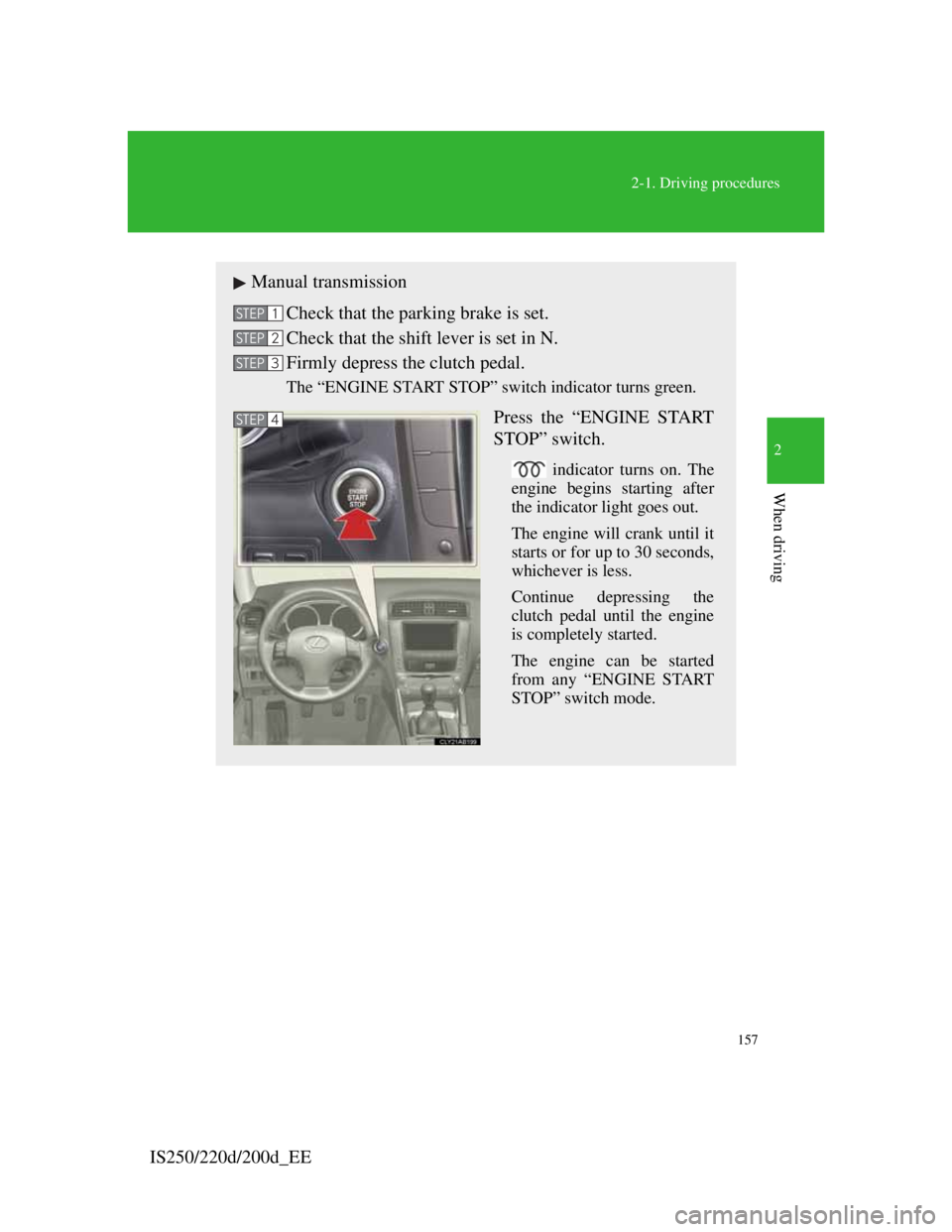
Manual transmission
Check that the parking brake is set.
Check that the shift lever is set in N.
Firmly depress the clutch pedal.
The “ENGINE START STOP” switch indicator turns green.
Press the “ENGINE START
STOP” switch.
indicator turns on. The
engine begins starting after
the indicator light goes out.
The engine will crank until it
starts or for up to 30 seconds,
whichever is less.
Continue depressing the
clutch pedal until the engine
is completely started.
The engine can be started
from any “ENGINE START
STOP” switch mode.
STEP1
STEP2
STEP3
STEP4
Page 167 of 609
158
2-1. Driving procedures
IS250/220d/200d_EE
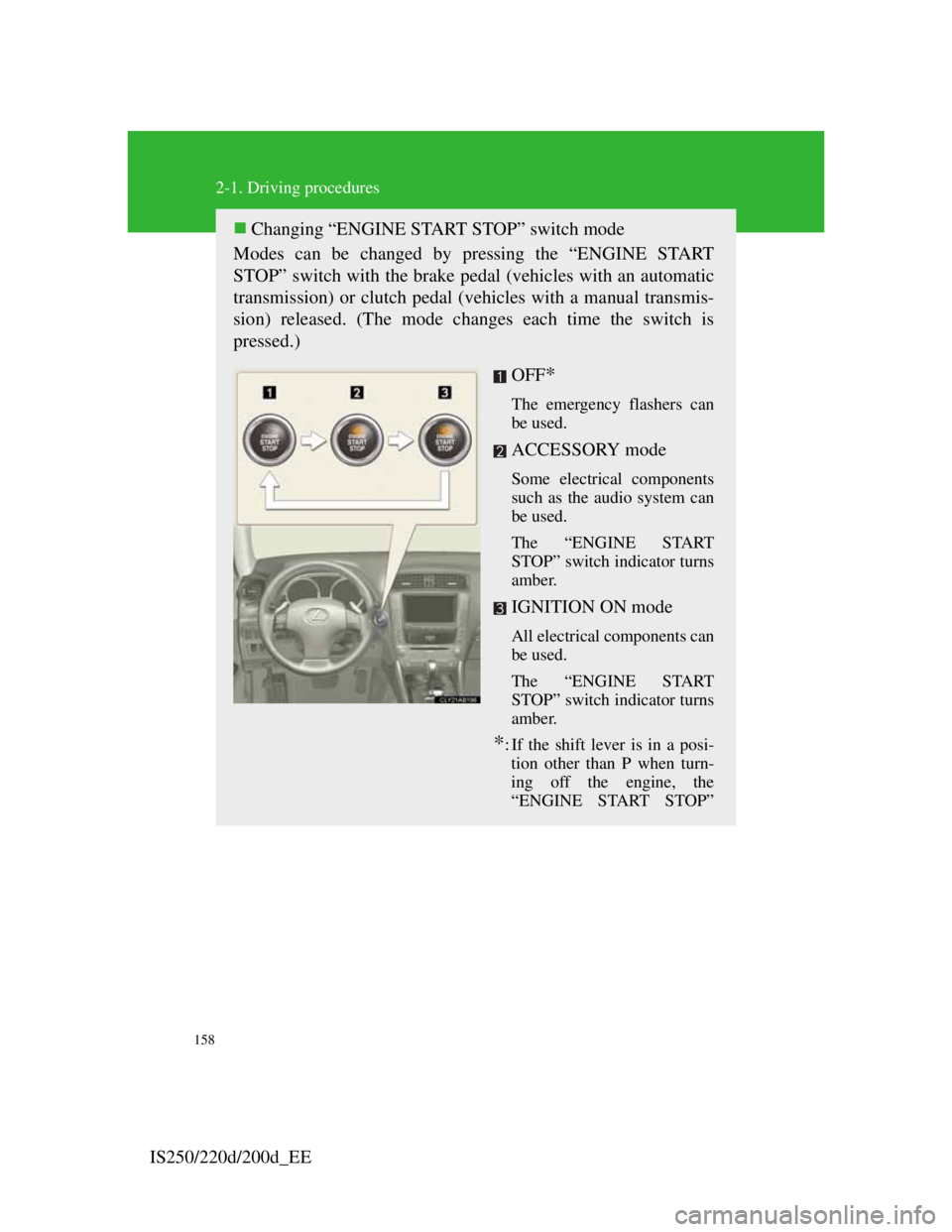
Changing “ENGINE START STOP” switch mode
Modes can be changed by pressing the “ENGINE START
STOP” switch with the brake pedal (vehicles with an automatic
transmission) or clutch pedal (vehicles with a manual transmis-
sion) released. (The mode changes each time the switch is
pressed.)
OFF
*
The emergency flashers can
be used.
ACCESSORY mode
Some electrical components
such as the audio system can
be used.
The “ENGINE START
STOP” switch indicator turns
amber.
IGNITION ON mode
All electrical components can
be used.
The “ENGINE START
STOP” switch indicator turns
amber.
*: If the shift lever is in a posi-
tion other than P when turn-
ing off the engine, the
“ENGINE START STOP”
Page 169 of 609
160
2-1. Driving procedures
IS250/220d/200d_EE
CAUTION
When starting the engine
Always start the engine while sitting in the driver's seat. Do not press the
accelerator while starting the engine under any circumstances.
Doing so may cause an accident resulting in death or serious injury.
Stopping the engine in an emergency
If you want to stop the engine in an emergency while driving the vehicle,
push and hold the “ENGINE START STOP” switch for more than 3 sec-
onds.
However, do not touch the “ENGINE START STOP” switch while driving
except in an emergency. Turning the engine off while driving will not cause
loss of steering or braking control, but the power assist to these systems will
be lost. This will make it more difficult to steer and brake, so you should
pull over and stop the vehicle as soon as it is safe to do so.
NOTICE
To prevent battery discharge
Do not leave the “ENGINE START STOP” switch in ACCESSORY or
IGNITION ON mode for long periods without the engine running.
When starting the engine
Do not race a cold engine.
If the engine becomes difficult to start or stalls frequently, have the engine
checked immediately.
Page 170 of 609
161
2-1. Driving procedures
2
When driving
IS250/220d/200d_EE
Automatic transmission
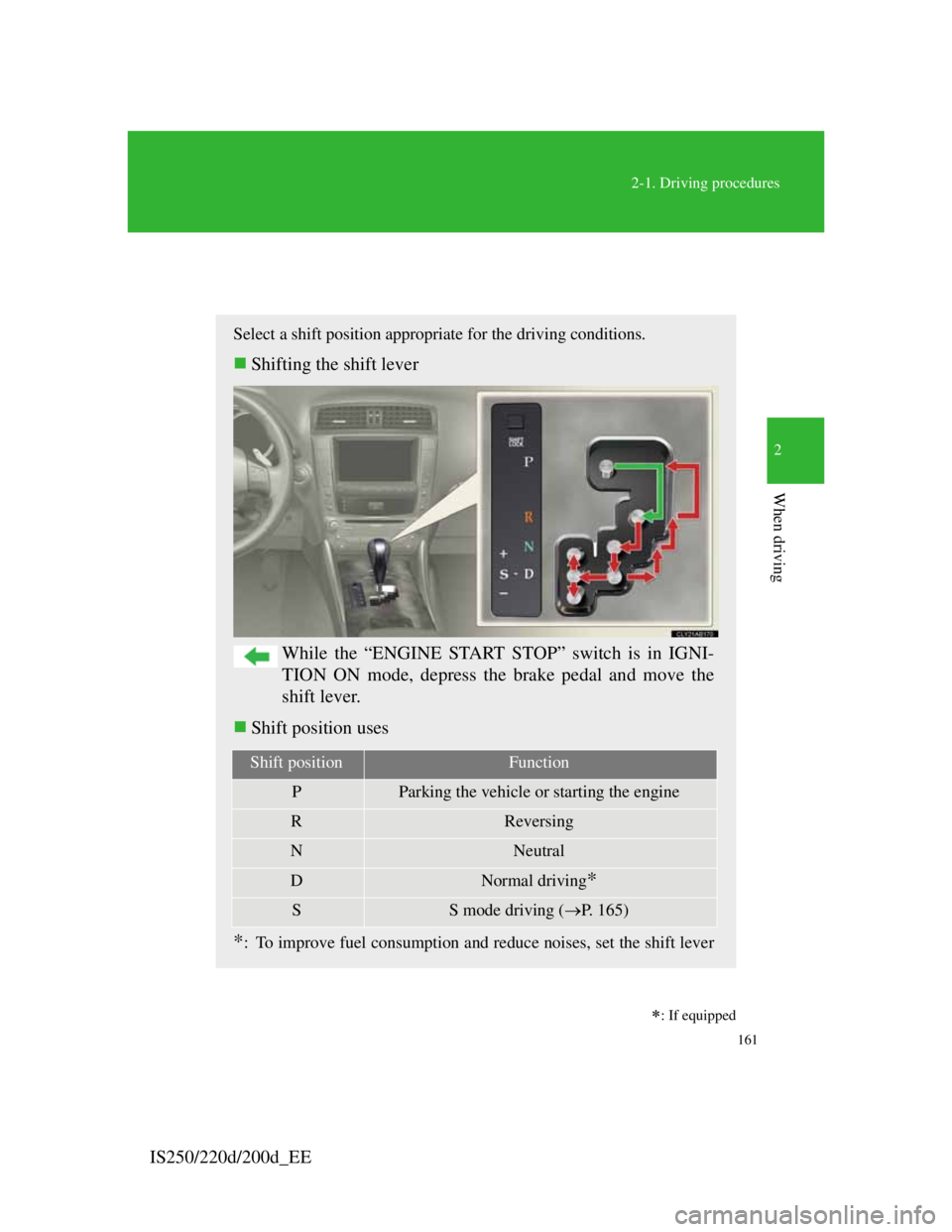
Select a shift position appropriate for the driving conditions.
Shifting the shift lever
While the “ENGINE START STOP” switch is in IGNI-
TION ON mode, depress the brake pedal and move the
shift lever.
Shift position uses
*: To improve fuel consumption and reduce noises, set the shift lever
Shift positionFunction
PParking the vehicle or starting the engine
RReversing
NNeutral
DNormal driving*
SS mode driving (P. 165)
: If equipped
Page 180 of 609
171
2-1. Driving procedures
2
When driving
IS250/220d/200d_EE
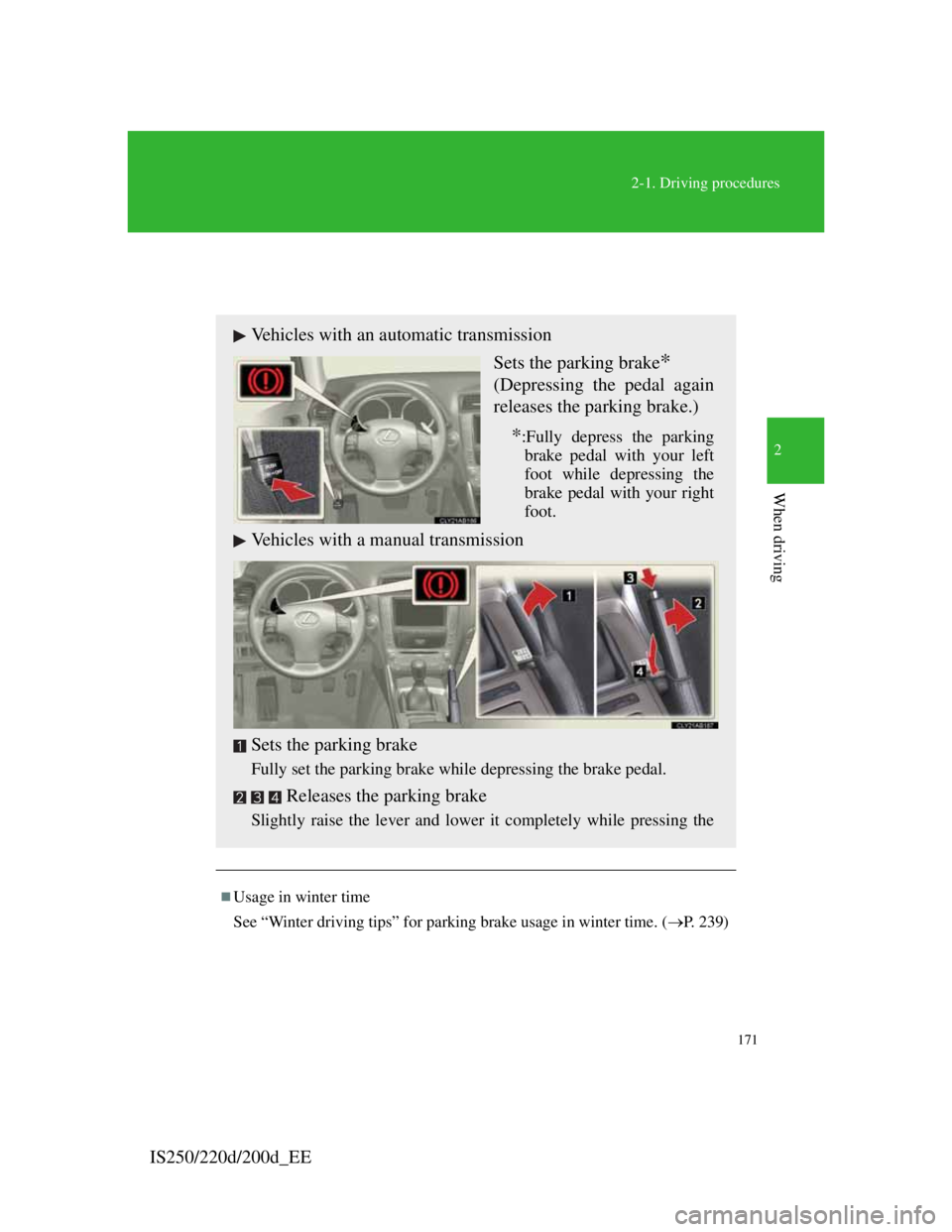
Parking brake
Usage in winter time
See “Winter driving tips” for parking brake usage in winter time. (P. 2 3 9 )
Vehicles with an automatic transmission
Sets the parking brake
*
(Depressing the pedal again
releases the parking brake.)
*:Fully depress the parking
brake pedal with your left
foot while depressing the
brake pedal with your right
foot.
Vehicles with a manual transmission
Sets the parking brake
Fully set the parking brake while depressing the brake pedal.
Releases the parking brake
Slightly raise the lever and lower it completely while pressing the
Page 181 of 609

172
2-1. Driving procedures
IS250/220d/200d_EE
NOTICE
Before driving
Fully release the parking brake.
Driving the vehicle with the parking brake set will lead to brake components
overheating, which may affect braking performance and increase brake
wear.
Page 211 of 609
199
2-4. Using other driving systems
2
When driving
IS250/220d/200d_EE
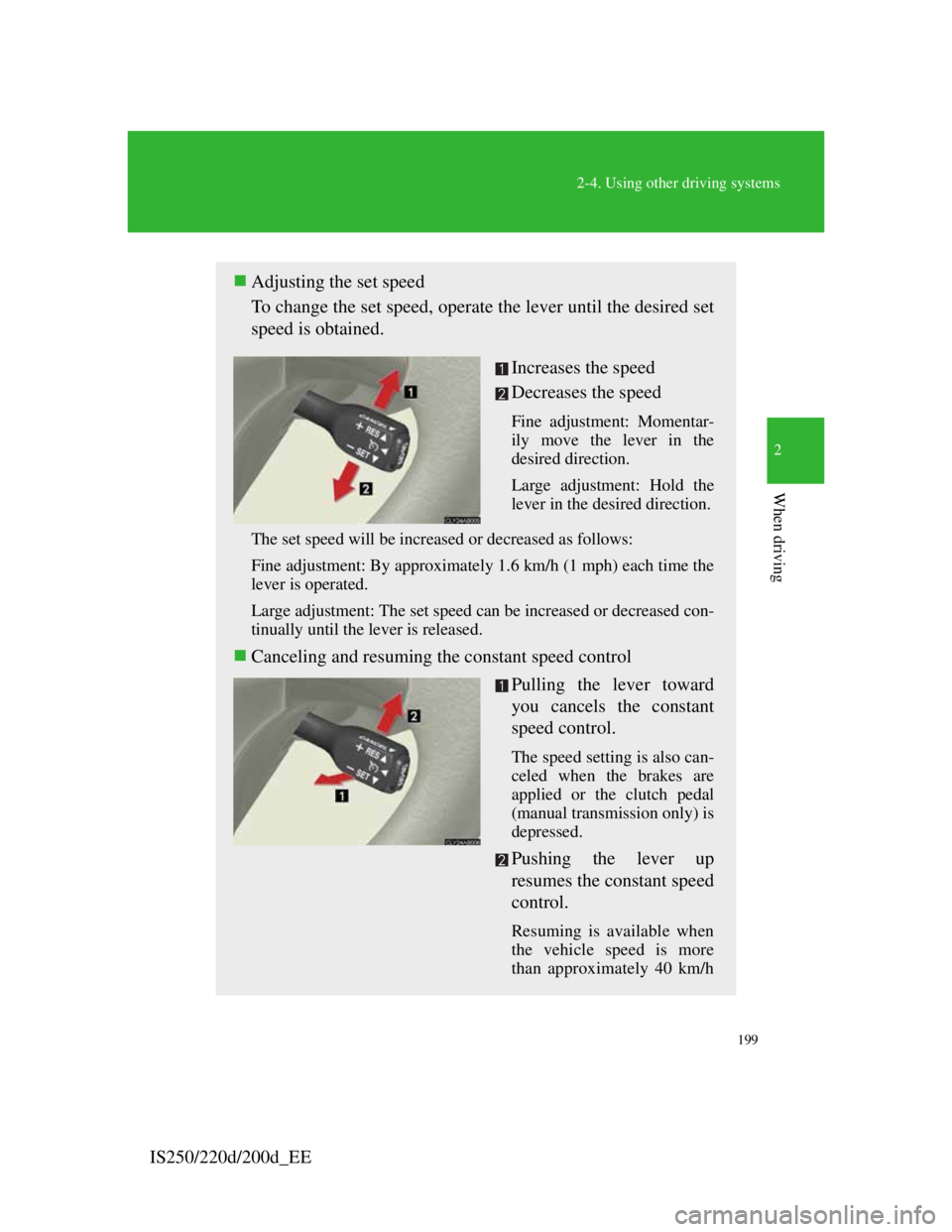
Adjusting the set speed
To change the set speed, operate the lever until the desired set
speed is obtained.
Increases the speed
Decreases the speed
Fine adjustment: Momentar-
ily move the lever in the
desired direction.
Large adjustment: Hold the
lever in the desired direction.
The set speed will be increased or decreased as follows:
Fine adjustment: By approximately 1.6 km/h (1 mph) each time the
lever is operated.
Large adjustment: The set speed can be increased or decreased con-
tinually until the lever is released.
Canceling and resuming the constant speed control
Pulling the lever toward
you cancels the constant
speed control.
The speed setting is also can-
celed when the brakes are
applied or the clutch pedal
(manual transmission only) is
depressed.
Pushing the lever up
resumes the constant speed
control.
Resuming is available when
the vehicle speed is more
than approximately 40 km/h
Page 218 of 609
206
2-4. Using other driving systems
IS250/220d/200d_EE
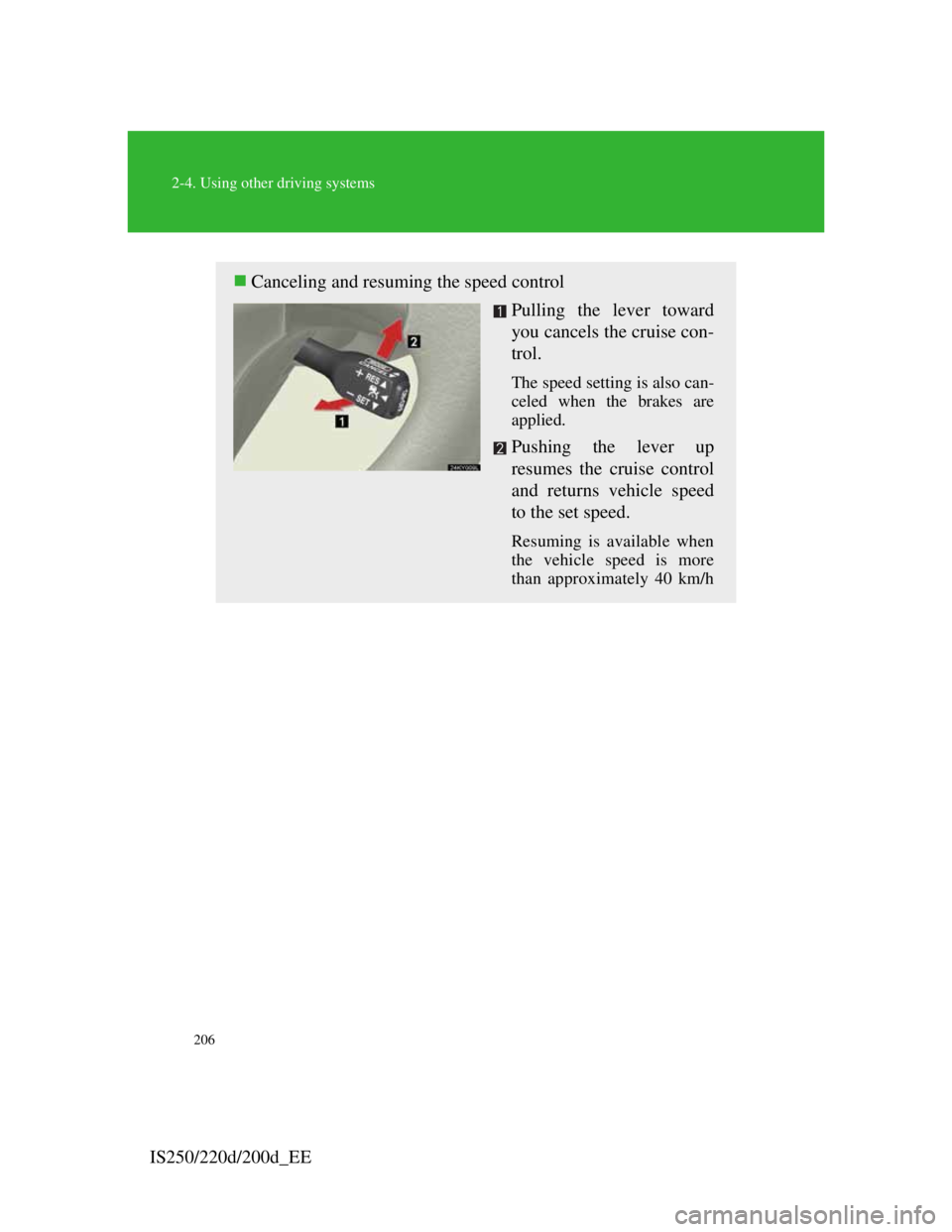
Canceling and resuming the speed control
Pulling the lever toward
you cancels the cruise con-
trol.
The speed setting is also can-
celed when the brakes are
applied.
Pushing the lever up
resumes the cruise control
and returns vehicle speed
to the set speed.
Resuming is available when
the vehicle speed is more
than approximately 40 km/h
Page 219 of 609
207
2-4. Using other driving systems
2
When driving
IS250/220d/200d_EE
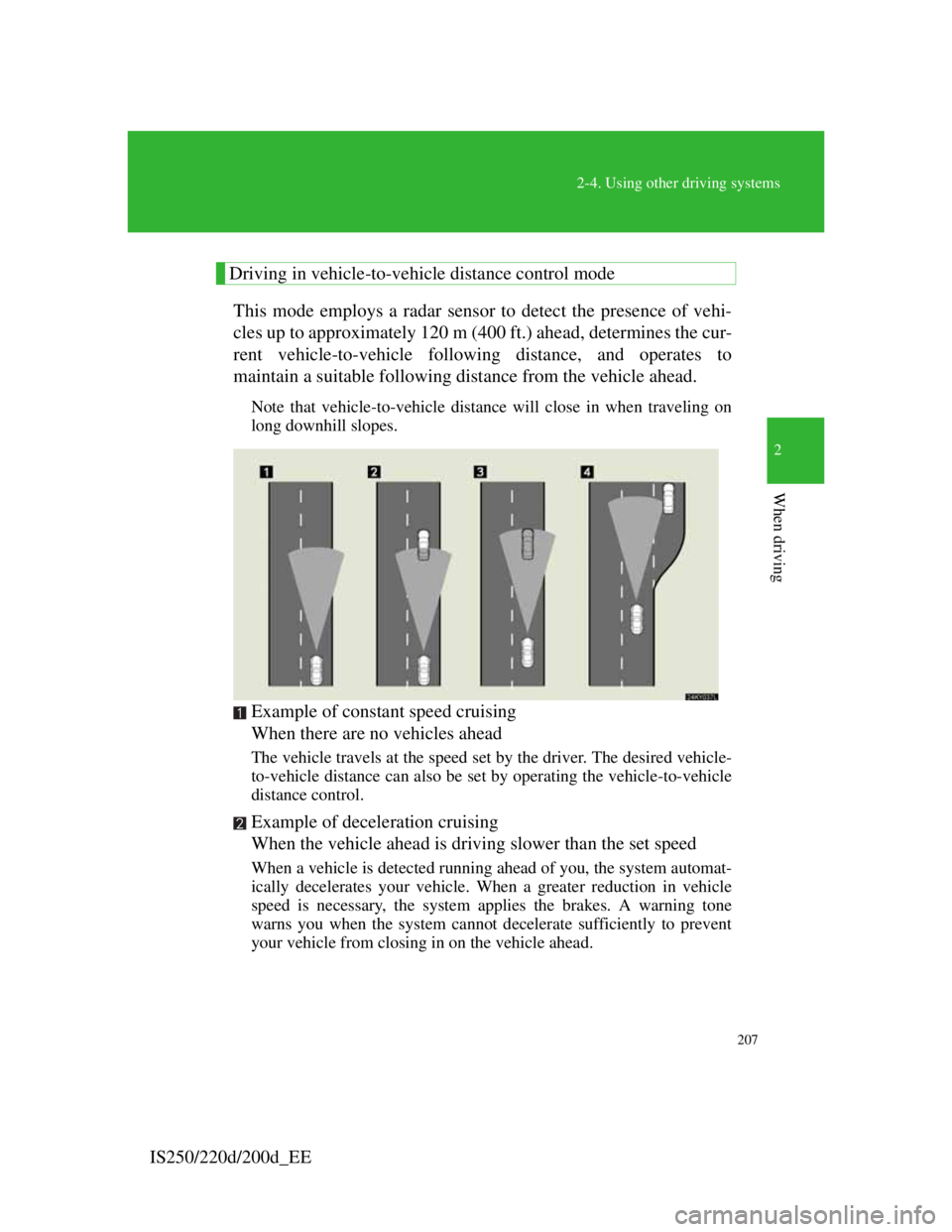
Driving in vehicle-to-vehicle distance control mode
This mode employs a radar sensor to detect the presence of vehi-
cles up to approximately 120 m (400 ft.) ahead, determines the cur-
rent vehicle-to-vehicle following distance, and operates to
maintain a suitable following distance from the vehicle ahead.
Note that vehicle-to-vehicle distance will close in when traveling on
long downhill slopes.
Example of constant speed cruising
When there are no vehicles ahead
The vehicle travels at the speed set by the driver. The desired vehicle-
to-vehicle distance can also be set by operating the vehicle-to-vehicle
distance control.
Example of deceleration cruising
When the vehicle ahead is driving slower than the set speed
When a vehicle is detected running ahead of you, the system automat-
ically decelerates your vehicle. When a greater reduction in vehicle
speed is necessary, the system applies the brakes. A warning tone
warns you when the system cannot decelerate sufficiently to prevent
your vehicle from closing in on the vehicle ahead.
Page 220 of 609

208
2-4. Using other driving systems
IS250/220d/200d_EEExample of follow-up cruising
When following a vehicle driving slower than the set speed
The system continues follow-up cruising while adjusting for changes
in the speed of the vehicle ahead in order to maintain the vehicle-to-
vehicle distance set by the driver.
Example of acceleration
When there are no longer any vehicles ahead driving slower than
the set speed
The system accelerates until the set speed is reached. The system then
returns to constant speed cruising.
Approach warning
When your vehicle is too close to a vehicle ahead, and sufficient
automatic deceleration via the cruise control is not possible, the
display will flash and the buzzer will sound to alert the driver. An
example of this would be if another driver cuts in front of you
while you are following a vehicle. Apply the brakes to ensure an
appropriate vehicle-to-vehicle distance.
Warnings may not occur when
In the following instances, there is a possibility that the warn-
ings will not occur:
When the speed of the vehicle ahead matches or exceeds your
vehicle speed
When the vehicle ahead is traveling at an extremely slow
speed
Immediately after the cruise control speed was set
At the instant the accelerator is applied