trailer Lexus IS220d 2012 Owner's Manual
[x] Cancel search | Manufacturer: LEXUS, Model Year: 2012, Model line: IS220d, Model: Lexus IS220d 2012Pages: 609, PDF Size: 14.63 MB
Page 3 of 609

1
2
3
4
5
6
IS250/220d/200d_EE
3
2-1. Driving procedures
Driving the vehicle ............. 142
Engine (ignition) switch ..... 153
Automatic transmission...... 158
Manual transmission .......... 165
Turn signal lever ................ 167
Parking brake ..................... 168
Horn ................................... 170
2-2. Instrument cluster
Gauges and meters ............. 171
Indicators and warning lights ....
177
Multi-information display .. 181
2-3. Operating the lights and
windshield wipers
Headlight switch ................ 186
Fog light switch.................. 190
Windshield wipers and
washer .............................. 191
Headlight cleaner switch .... 1972-4. Using other driving systems
Cruise control ..................... 198
Dynamic radar cruise
control .............................. 202
Lexus parking assist-sensor 217
Driving assist systems ........ 223
PCS (Pre-Crash Safety
system) ............................. 229
2-5. Driving information
Cargo and luggage ............. 237
Winter driving tips ............. 239
Trailer towing..................... 242
3-1. Using the air conditioning
system and defogger
Automatic air
conditioning system ......... 254
Power heater....................... 262
Rear window and outside
rear view mirror
defoggers .......................... 264
Windshield wiper de-icer ... 265
2When driving
3Interior features
Page 150 of 609

2When driving
141
2-1. Driving procedures
Driving the vehicle........... 142
Engine (ignition) switch... 153
Automatic transmission ... 158
Manual transmission ........ 165
Turn signal lever .............. 167
Parking brake ................... 168
Horn ................................. 170
2-2. Instrument cluster
Gauges and meters ........... 171
Indicators and warning
lights .............................. 177
Multi-information display 1812-3. Operating the lights and wind-
shield wipers
Headlight switch .............. 186
Fog light switch ............... 190
Windshield wipers and
washer ............................ 191
Headlight cleaner switch . 197
2-4. Using other driving
systems
Cruise control .................. 198
Dynamic radar cruise
control ............................ 202
Lexus parking
assist-sensor ................... 217
Driving assist systems ..... 223
PCS (Pre-Crash Safety
system)........................... 229
2-5. Driving information
Cargo and luggage ........... 237
Winter driving tips ........... 239
Trailer towing .................. 242
Page 153 of 609

144
2-1. Driving procedures
IS250/220d/200d_EE
Starting off on a hill (vehicles with an automatic transmission)
Hill-start assist control will operate. (P. 223)
Driving in the rain
Drive carefully when it is raining, because visibility will be reduced, the
windows may become fogged-up, and the road will be slippery.
Drive carefully when it starts to rain, because the road surface will be
especially slippery.
Refrain from high speeds when driving on an expressway in the rain,
because there may be a layer of water between the tires and the road sur-
face, preventing the steering and brakes from operating properly.
Engine speed while driving
In the following conditions, the engine speed may become high while driv-
ing. This is due to automatic up-shifting control or down-shifting implemen-
tation to meet driving conditions. It does not indicate sudden acceleration.
The vehicle is judged to be driving uphill or downhill
When the accelerator pedal is released
Breaking in your new Lexus
To extend the life of the vehicle, the following precautions are recom-
mended to observe:
For the first 300 km (186 miles):
Avoid sudden stops.
For the first 800 km (500 miles):
Do not tow a trailer.
For the first 1000 km (621 miles):
• Do not drive at extremely high speeds.
• Avoid sudden acceleration.
• Do not drive continuously in the low gears.
• Do not drive at a constant speed for extended periods.
Page 213 of 609

201
2-4. Using other driving systems
2
When driving
IS250/220d/200d_EE
CAUTION
To avoid operating the cruise control by mistake
Switch the cruise control off using the “ON-OFF” button when not in use.
Situations unsuitable for cruise control
Do not use cruise control in any of the following situations.
Doing so may result in loss of control and could cause an accident resulting
in death or serious injury.
In heavy traffic
On roads with sharp bends
On winding roads
On slippery roads, such as those covered with rain, ice or snow
On steep hills
Vehicle speed may exceed the set speed when driving down a steep hill.
When your vehicle is towing a trailer or during emergency towing
Page 227 of 609
215
2-4. Using other driving systems
2
When driving
IS250/220d/200d_EE
CAUTION
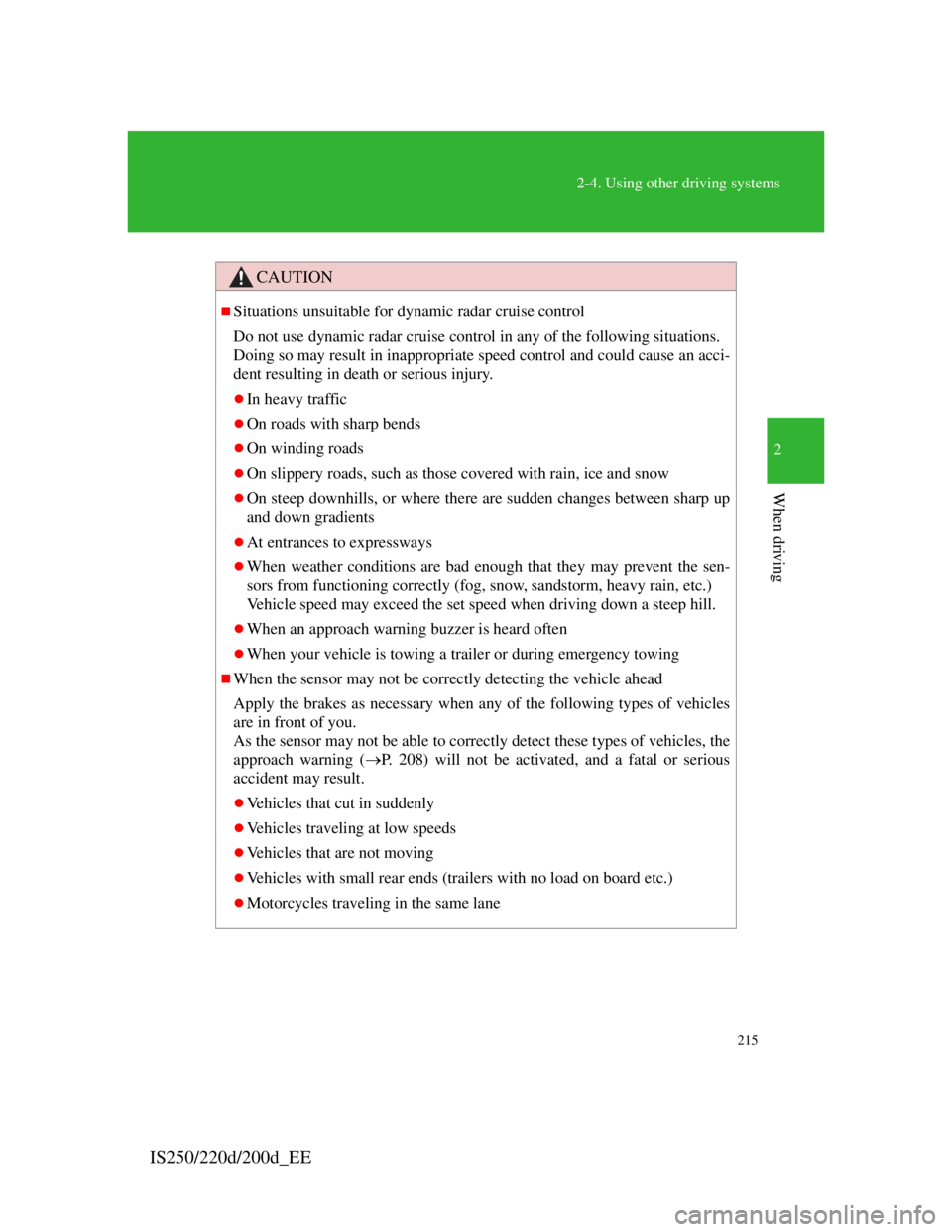
Situations unsuitable for dynamic radar cruise control
Do not use dynamic radar cruise control in any of the following situations.
Doing so may result in inappropriate speed control and could cause an acci-
dent resulting in death or serious injury.
In heavy traffic
On roads with sharp bends
On winding roads
On slippery roads, such as those covered with rain, ice and snow
On steep downhills, or where there are sudden changes between sharp up
and down gradients
At entrances to expressways
When weather conditions are bad enough that they may prevent the sen-
sors from functioning correctly (fog, snow, sandstorm, heavy rain, etc.)
Vehicle speed may exceed the set speed when driving down a steep hill.
When an approach warning buzzer is heard often
When your vehicle is towing a trailer or during emergency towing
When the sensor may not be correctly detecting the vehicle ahead
Apply the brakes as necessary when any of the following types of vehicles
are in front of you.
As the sensor may not be able to correctly detect these types of vehicles, the
approach warning (P. 208) will not be activated, and a fatal or serious
accident may result.
Vehicles that cut in suddenly
Vehicles traveling at low speeds
Vehicles that are not moving
Vehicles with small rear ends (trailers with no load on board etc.)
Motorcycles traveling in the same lane
Page 256 of 609
242
2-5. Driving information
IS250/220d/200d_EE
Trailer towing
The strain of towing a trailer will have a negative impact on the run-
ning performance, handling, fuel consumption and endurance of your
vehicle. Use the vehicle features in the correct manner and operate the
vehicle with care for safer driving and optimal comfort. Damage and/
or malfunctions that occur as a result of towing performed for com-
mercial purposes are not covered by the Lexus warranty.
Ask your local authorized Lexus dealer or repairer, or another duly
qualified and equipped professional, for further details before towing,
as there are additional legal requirements in some countries.
Weight limits
Check the allowable towing capacity, GVM (Gross Vehicle
Mass), MPAC (Maximum Permissible Axle Capacity), and
permissible draw bar load before towing. (P. 534)
Towing hitch/bracket
Lexus recommends the use of the Lexus hitch/bracket for
your vehicle. Other products of a suitable nature and compa-
rable quality may also be used.
To prevent an accident
The handling of the vehicle will feel different when towing a
trailer. Beware of the 3 most common causes of towing-
related accidents: driver error, excessive speed, and overload-
Page 257 of 609
243
2-5. Driving information
2
When driving
IS250/220d/200d_EE
Important points regarding trailer loads
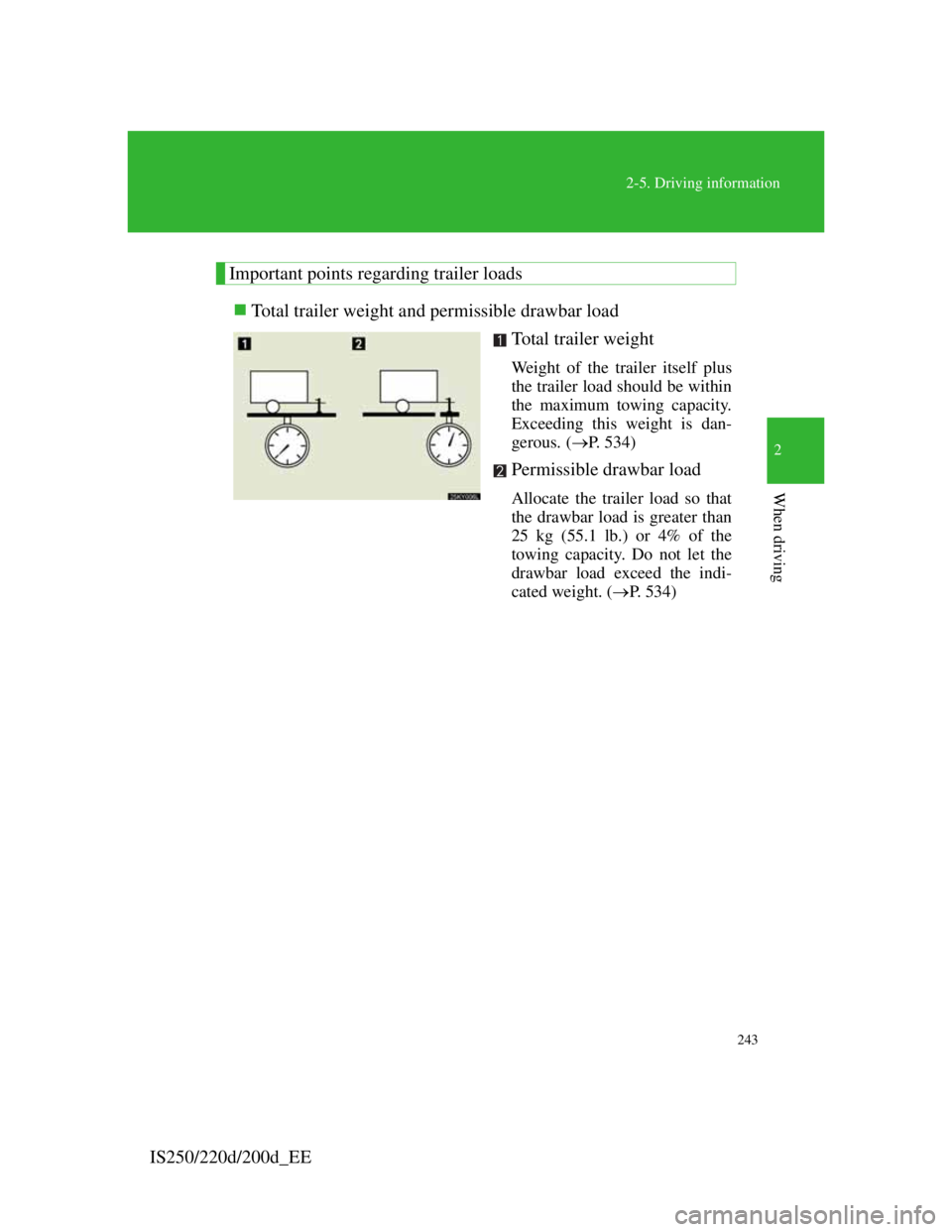
Total trailer weight and permissible drawbar load
Total trailer weight
Weight of the trailer itself plus
the trailer load should be within
the maximum towing capacity.
Exceeding this weight is dan-
gerous.
(P. 534)
Permissible drawbar load
Allocate the trailer load so that
the drawbar load is greater than
25 kg (55.1 lb.) or 4% of the
towing capacity. Do not let the
drawbar load exceed the indi-
cated weight. (P. 534)
Page 258 of 609
244
2-5. Driving information
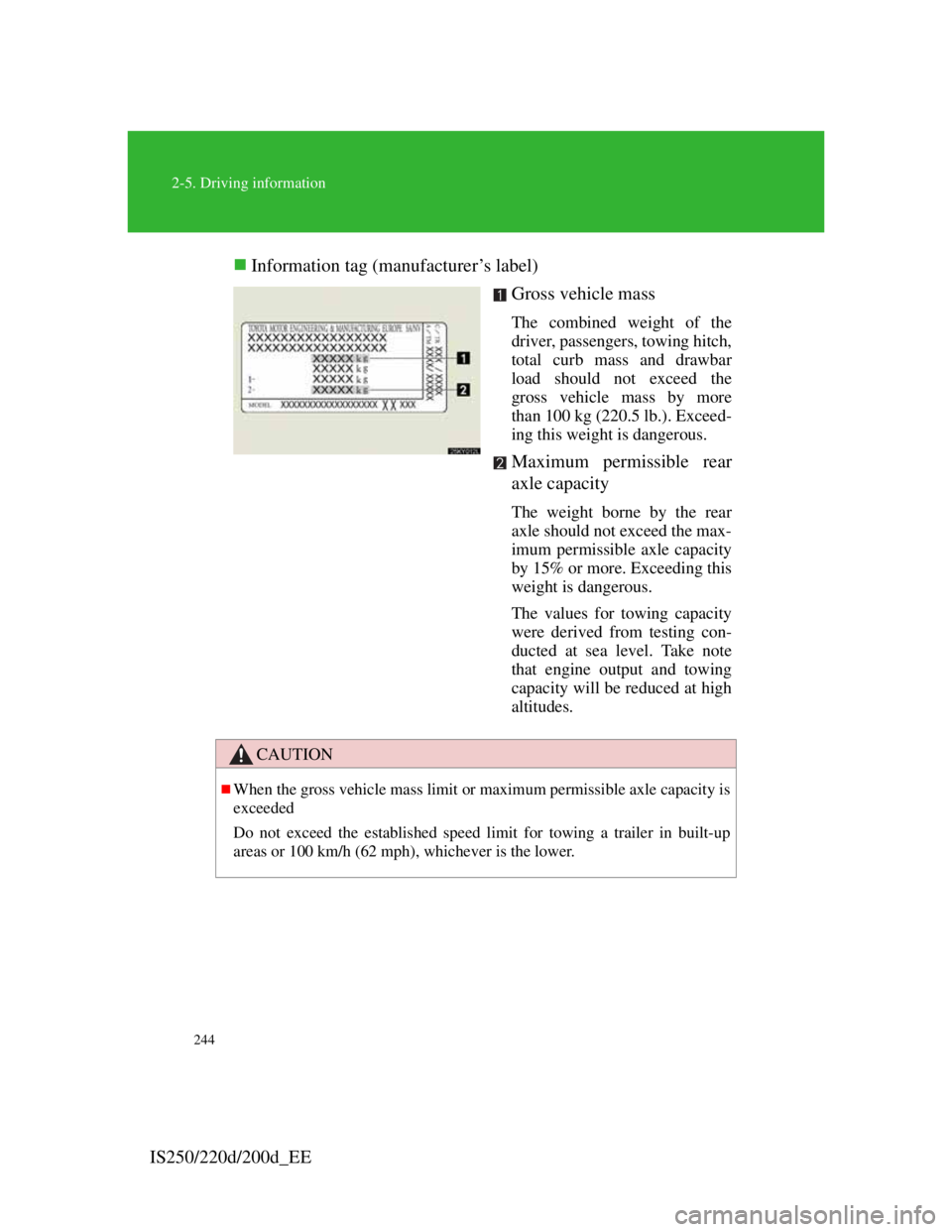
IS250/220d/200d_EEInformation tag (manufacturer’s label)
Gross vehicle mass
The combined weight of the
driver, passengers, towing hitch,
total curb mass and drawbar
load should not exceed the
gross vehicle mass by more
than 100 kg (220.5 lb.). Exceed-
ing this weight is dangerous.
Maximum permissible rear
axle capacity
The weight borne by the rear
axle should not exceed the max-
imum permissible axle capacity
by 15% or more. Exceeding this
weight is dangerous.
The values for towing capacity
were derived from testing con-
ducted at sea level. Take note
that engine output and towing
capacity will be reduced at high
altitudes.
CAUTION
When the gross vehicle mass limit or maximum permissible axle capacity is
exceeded
Do not exceed the established speed limit for towing a trailer in built-up
areas or 100 km/h (62 mph), whichever is the lower.
Page 260 of 609
246
2-5. Driving information
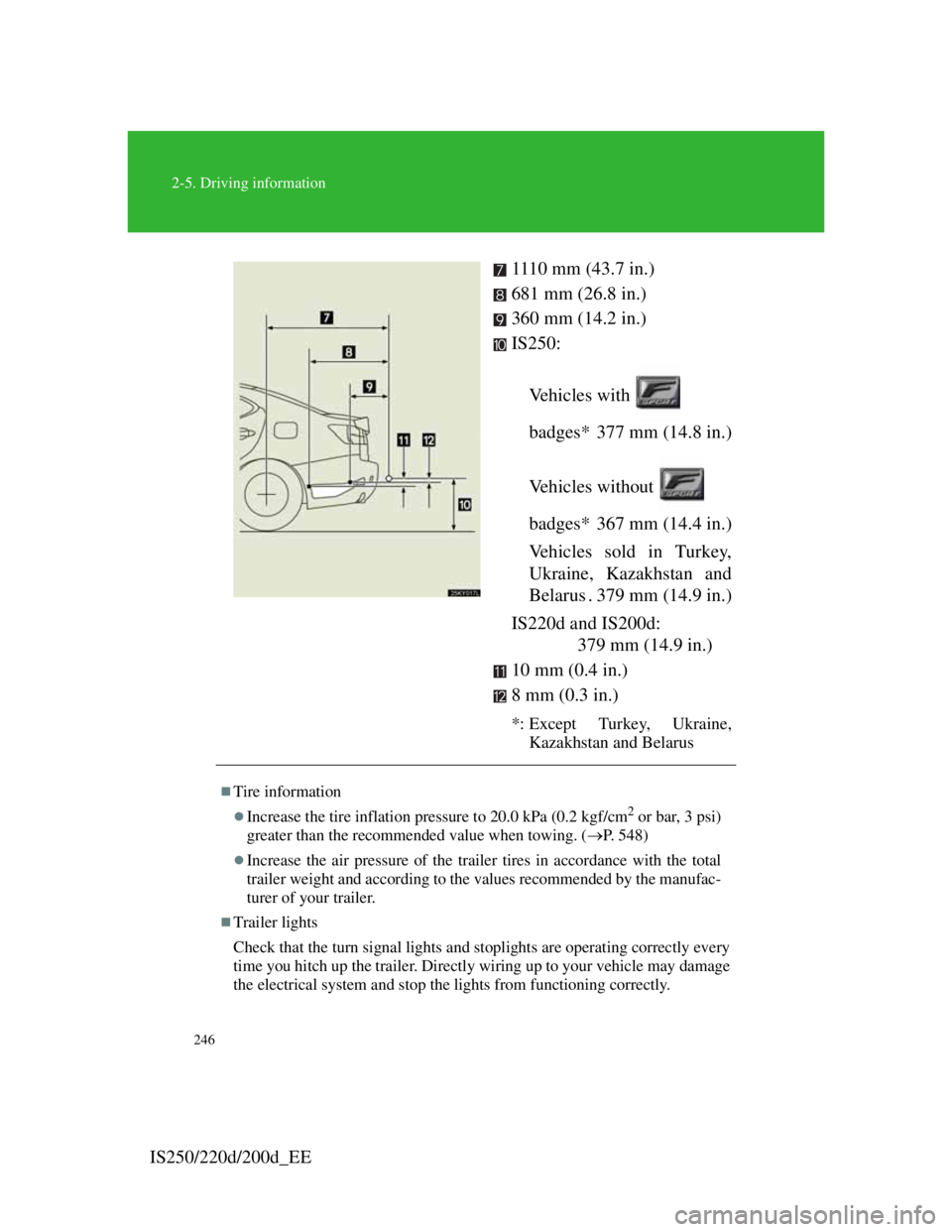
IS250/220d/200d_EE1110 mm (43.7 in.)
681 mm (26.8 in.)
360 mm (14.2 in.)
IS250:
Vehicles with
badges* 377 mm (14.8 in.)
Vehicles without
badges* 367 mm (14.4 in.)
Vehicles sold in Turkey,
Ukraine, Kazakhstan and
Belarus . 379 mm (14.9 in.)
IS220d and IS200d:
379 mm (14.9 in.)
10 mm (0.4 in.)
8 mm (0.3 in.)
*: Except Turkey, Ukraine,
Kazakhstan and Belarus
Tire information
Increase the tire inflation pressure to 20.0 kPa (0.2 kgf/cm2 or bar, 3 psi)
greater than the recommended value when towing. (P. 548)
Increase the air pressure of the trailer tires in accordance with the total
trailer weight and according to the values recommended by the manufac-
turer of your trailer.
Trailer lights
Check that the turn signal lights and stoplights are operating correctly every
time you hitch up the trailer. Directly wiring up to your vehicle may damage
the electrical system and stop the lights from functioning correctly.
Page 261 of 609
247
2-5. Driving information
2
When driving
IS250/220d/200d_EE
Break-in schedule
Lexus recommends that vehicles fitted with new power train components
should not be used for towing trailers for the first 800 km (500 miles).
Maintenance
Maintenance must be performed more frequently when using the vehicle
for towing due to the greater weight burden placed on the vehicle com-
pared to normal driving.
Retighten all bolts securing the hitching ball and bracket after towing for
approximately 1000 km (600 miles).
Safety checks before towing
Check that the maximum load limit for the towing hitch/bracket hitch
ball is not exceeded. Bear in mind that the coupling weight of the trailer
will add to the load exerted on the vehicle. Also make sure that you will
not be towing a load that exceeds the maximum permissible axle capac-
ity.
Ensure that the trailer load is secure.
Supplementary outside rear view mirrors should be added to the vehicle
if the traffic behind cannot be clearly seen with standard mirrors. Adjust
the extending arms of these mirrors on both sides of the vehicle so that
they always provide maximum visibility of the road behind.
NOTICE
When the rear bumper strengthening material is aluminum
Ensure the steel bracket part does not come directly in contact with that
area.
When steel and aluminum come into contact, there is a reaction similar to
corrosion, which will weaken the section concerned which may result in
damage. Apply a rust inhibitor to parts that will come in contact when
attaching a steel bracket.
When installing a towing harness to the vehicle
To prevent inoperative stop lights and damage to the vehicle stop light wir-
ing, take care when connecting a trailer harness to the vehicle. A relay with
a separate power source must be added to limit the current draw on the vehi-
cle stop light wiring.