parking brake Lexus IS250 2006 Opening, closing and locking the doors and trunk / LEXUS 2006 IS350/250 THROUGH APRIL 2006 PROD. (OM53508U) User Guide
[x] Cancel search | Manufacturer: LEXUS, Model Year: 2006, Model line: IS250, Model: Lexus IS250 2006Pages: 433, PDF Size: 10.9 MB
Page 104 of 433
86
2-1. Driving procedures
CAUTION
■When shifting the shift lever
With automatic transmission vehicles, be careful not to shift the shift lever with the
accelerator pedal depressed.
This may lead to unexpected rapid acceleration of the vehicle that may cause an
accident and result in death or serious injury.
■When the vehicle is stopped
●Do not race the engine.
If the vehicle is in any gear other than P (vehicles with an automatic transmission
only) or N the vehicle may accelerate suddenly and unexpectedly, and may cause
an accident.
●Do not leave the vehicle with the engine running for a long time.
If such a situation cannot be avoided, park the vehicle in an open space and
check that exhaust fumes do no t enter the vehicle interior.
●With automatic transmission vehicles, always keep a foot on the brake pedal
while the engine is running to prevent an accident caused by the vehicle moving.
■When the vehicle is parked
●Do not leave glasses, cigarette lighters, spray cans, or soft drink cans in the vehi-
cle when it is in the sun.
Failure to do so may result in the following.
• Gas may leak from a cigarette lighter or spray can, and may lead to a fire.
• The temperature inside the vehicle may cause the plastic lenses and plastic material of eye glasses to deform or crack.
• Soft drink cans may fracture, causing the contents to spray over the interior of
the vehicle, and may also cause a short circuit in the vehicle's electrical com-
ponents.
●Always apply the parking brake, shift the shift lever to P (vehicles with an auto-
matic transmission only), stop the engine and lock the vehicle.
Do not leave the vehicle unattend ed while the engine is running.
●Do not touch the exhaust pipe while the engine is running or immediately after
turning the engine off.
Doing so may cause burns.
●Do not leave the engine running in an area with snow build up, or where snow is
expected to fall.
Exhaust gases may enter the vehicle and cause gas poisoning.
Page 105 of 433
87
2-1. Driving procedures
2
When driving
CAUTION
■When taking a nap in the vehicle
Always turn the engine off.
Otherwise, you may accidentally move the shift lever or press the accelerator
pedal, which could cause an accident or fire due to abnormal engine overheating.
Additionally, if the vehicle is parked in a poorly ventilated area, exhaust fumes may
enter the vehicle and cause gas poisoning.
■When braking the vehicle
●When the brakes are wet, drive more cautiously.
Braking distance increases when the brakes are wet, and may cause one side of
the vehicle to brake differently than the other side. Also the parking brake may
not securely hold the vehicle.
●If the power brake assist function does not operate, do not follow other vehicles
closely and avoid downhills or sharp turns that require making.
In this case, braking is still possible, but it will require more force on the pedal than
usual. Braking distance may also increase.
●Do not pump the brake pedal if the engine stalls.
Each push on the pedal uses up your reserved brake fluid pressure.
●The brake system consists of 2 individual hydraulic systems: if one of the systems
fails, the other will still operate. In this case, the brake pedal should be depressed
more firmly than usual and braking distance becomes longer.
Do not drive your vehicle with only a single brake system. Have your brakes fixed
immediately.
■If the vehicle becomes stuc k or bogged (AWD models)
Do not spin the wheels recklessly when any of the tires is up in the air, or stuck in
sand or mud, etc. This may damage the drive system components or propel the
vehicle forward (or in another direction) and cause an accident.
Page 106 of 433
88
2-1. Driving procedures
NOTICE
■While driving the vehicle
With automatic transmission vehicles, do not use the accelerator pedal or depress
accelerator and brake pedals together to hold the vehicle on a hill.
■When parking the vehicle
With automatic transmission vehicles, always put the shift lever in P. Failure to do so
may cause the vehicle to move or the vehicle may accelerate suddenly if the accel-
erator pedal is accidentally depressed.
■Avoiding damage to vehicle parts
●Do not turn the steering wheel fully in either direction and hold it there for a long
time.
Doing so may damage the power steering motor.
●When driving over bumps in the road, drive as slowly as possible to avoid damag-
ing the wheels, underside of the vehicle, etc.
■If you hear a squealing or scraping noise (brake pad wear limit indicators)
Have your Lexus dealer check and replac e the brake pads as soon as possible.
The rotor damage can result if the pads are not replaced when needed.
Front brake only: Moderate levels of the brake pad and disc wear allow enhanced
front braking power. As a result, the disc s may wear more quickly than conventional
brake discs. Therefore, when replacing the brake pads, Lexus recommends that you
also have the thickness of the discs measured.
It is dangerous to drive the vehicle when the wear limits of the brake pads and/or
that of the brake discs are exceeded.
■If you get a flat tire while driving
A flat or damaged tire may cause the following situations. Hold the steering wheel
firmly and gradually press the brak e pedal to slow down the vehicle.
●It may be difficult to control your vehicle.
●The vehicle will make abnormal sounds.
●The vehicle will behave abnormally.
Replace a flat tire with a new one. ( P. 3 5 0 )
Page 107 of 433
89
2-1. Driving procedures
2
When driving
Starting the engine
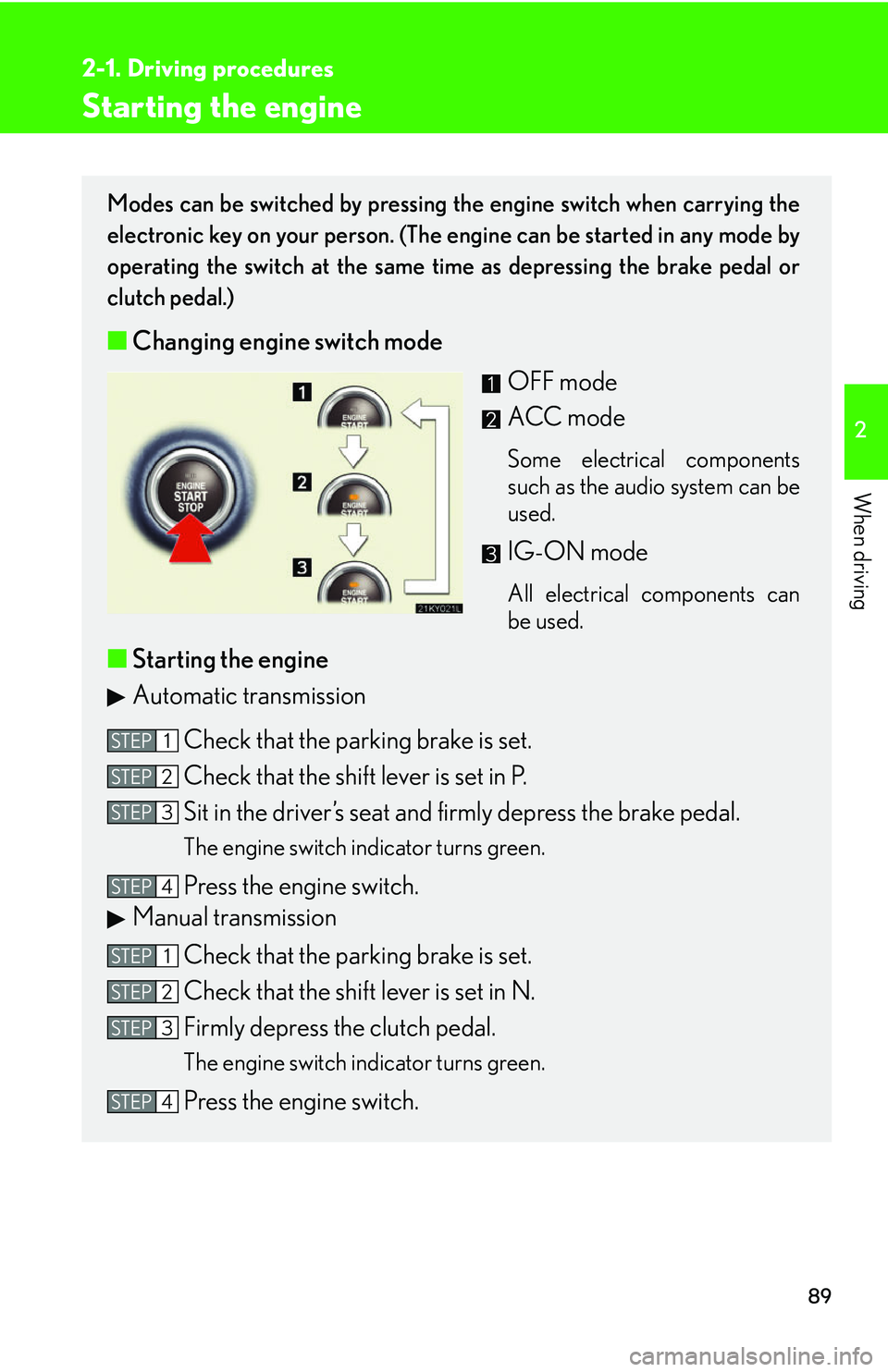
Modes can be switched by pressing the engine switch when carrying the
electronic key on your person. (The engine can be started in any mode by
operating the switch at the same time as depressing the brake pedal or
clutch pedal.)
■ Changing engine switch mode
OFF mode
ACC mode
Some electrical components
such as the audio system can be
used.
IG-ON mode
All electrical components can
be used.
■Starting the engine
Automatic transmission
Check that the parking brake is set.
Check that the shift lever is set in P.
Sit in the driver’s seat and firmly depress the brake pedal.
The engine switch indicator turns green.
Press the engine switch.
Manual transmission
Check that the parking brake is set.
Check that the shift lever is set in N.
Firmly depress the clutch pedal.
The engine switch indicator turns green.
Press the engine switch.
STEP1
STEP2
STEP3
STEP4
STEP1
STEP2
STEP3
STEP4
Page 117 of 433
99
2-1. Driving procedures
2
When driving
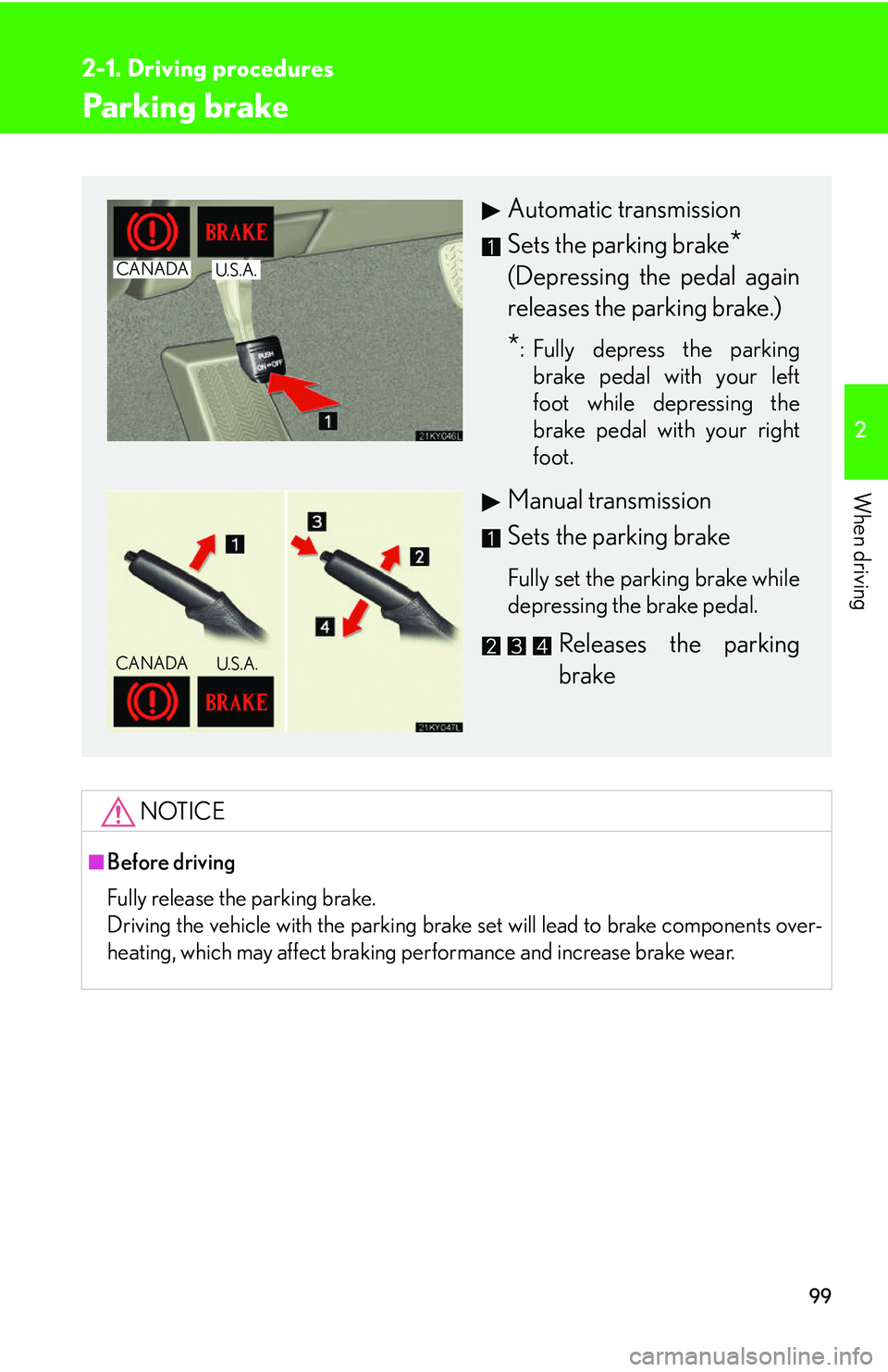
Parking brake
NOTICE
■Before driving
Fully release the parking brake.
Driving the vehicle with the parking brake set will lead to brake components over-
heating, which may affect braking performance and increase brake wear.
Automatic transmission
Sets the parking brake
*
(Depressing the pedal again
releases the parking brake.)
*: Fully depress the parking brake pedal with your left
foot while depressing the
brake pedal with your right
foot.
Manual transmission
Sets
the parking brake
Fully set the parking brake while
depressing the brake pedal.
Releases the parking
brake
CANADA U.S.A.
CANADA U.S.A.
Page 132 of 433
114
2-3. Operating the lights and windshield wipers
AFS (vehicles with discharge headlights)AFS (Adaptive Front Lighting System) im proves visibility at intersections
and on curves by automatically adjusting the level of the headlights
according to vehicle speed and the degree of the tire angle that are con-
trolled by steering input.
Operates at speeds of 6 mph (10 km/h) or higher.
■ Deactivating AFS
How to switch: P. 214
The indicator turns on when the AFS is deactivated.
■Daytime running light system
To make your vehicle more visible to other drivers, the headlights turn on automati-
cally (at a reduced intensity) whenever the engine is started and the parking brake
is released. Daytime running lights are not designed for use at night.
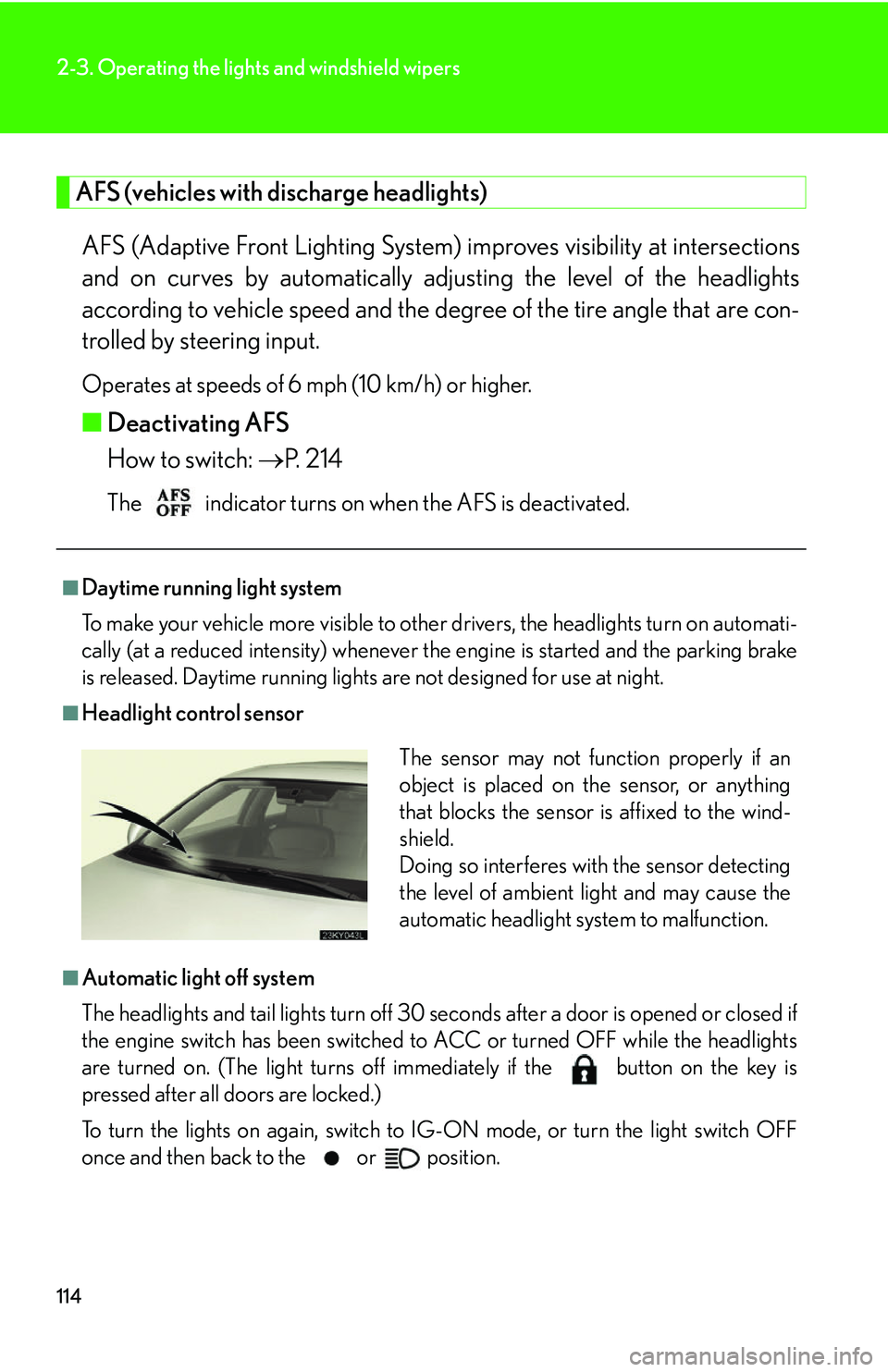
■Headlight control sensor
■Automatic light off system
The headlights and tail lights turn off 30 seconds after a door is opened or closed if
the engine switch has been switched to ACC or turned OFF while the headlights
are turned on. (The light turns off i mmediately if the button on the key is
pressed after all doors are locked.)
To turn the lights on again, switch to IG-ON mode, or turn the light switch OFF
once and then back to the or position.
The sensor may not function properly if an
object is placed on the sensor, or anything
that blocks the sensor is affixed to the wind-
shield.
Doing so interferes with the sensor detecting
the level of ambient light and may cause the
automatic headlight system to malfunction.
Page 155 of 433
137
2-4. Using other driving systems
2
When driving
■Sensor detection information
●Certain vehicle conditions and the surrounding environment may affect the
ability of the sensor to correctly detect obstacles. Particular instances where this
may occur are listed below.
• There is dirt, snow or ice on the sensor.
• The sensor is frozen.
• The sensor is covered in any way.
• The vehicle is leaning considerably to one side.
• On an extremely bumpy road, on an incline, on gravel, or on grass.
• The vicinity of the vehicle is noisy due to vehicle horns, motorcycle engines,
air brakes of large vehicles, or other loud noises producing ultrasonic waves.
• There is another vehicle equipped with parking assist sensors in the vicinity.
• The sensor is coated with a sheet of spray or heavy rain
• The vehicle is equipped with a fender pole or wireless antenna.
• Towing eyelets are installed.
• The bumper or sensor receives a strong impact.
• The vehicle is approaching a tall or curved curb.
• In addition to the examples above, th ere are instances in which, because of
their shapes, signs and other objects may be judged by the sensor to be
closer than they are.
●The shape of the obstacle may prevent th e sensor from detecting it. Pay particu-
lar attention to the following obstacles.
• Wires, fences, ropes etc.
• Cotton, snow and other materials that absorb radio waves
• Sharply-angled objects
•Low obstacles
• Tall obstacles with upper sections projec ting outwards in the direction of your
vehicle
■When the display flashes and a message is displayed
P. 3 3 4
■Certification (Canada only)
This ISM device compiles with Canadian ICES-001.
■Customization
Settings (e.g. buzzer volume) can be changed. ( P. 3 9 5 )
Page 170 of 433
152
2-5. Driving information
■Before driving the vehicle
Perform the following according to the driving conditions.
● Do not try to forcibly open a w indow or move a wiper that is fro-
zen. Pour warm water over the frozen area to melt the ice. Wipe
away the water immediately to prevent it from freezing.
● To ensure proper operation of the climate control system fan,
remove any snow that has accumu lated on the air inlet vents in
front of the windshield.
● Remove any ice that has accumul ated on the vehicle chassis.
● Periodically check for and remove any excess ice or snow that
may have accumulated in the wheel well or on the brakes.
■ When driving the vehicle
Accelerate the vehicle slowly and drive at a reduced speed suitable to
road conditions.
■When parking the vehicle
Park the vehicle and move the shift lever to P (automatic transmis-
sion) or R (manual transmission) without setting the parking brake.
The parking brake may freeze up, preventing it from being released.
Page 176 of 433
158
2-5. Driving information
Dinghy towing (vehicles with a manual transmission)
Towing your vehicle with 4 wheels on the groundTo prevent damage to your vehicle, perform the following procedures
before towing. Shift the shift lever to neutral.
Switch to ACC mode. ( P. 8 9 )
Ensure that the audio system and other powered devices have been
turned OFF.
Release the parking brake.
After towing, leave the engine in idle for at least 3 minutes before driv-
ing the vehicle.
■Necessary equipment and accessories
Specialized equipment and accessories are required for dinghy towing. Contact
the service branch of the motor home manufacturer regarding recommended
equipment.
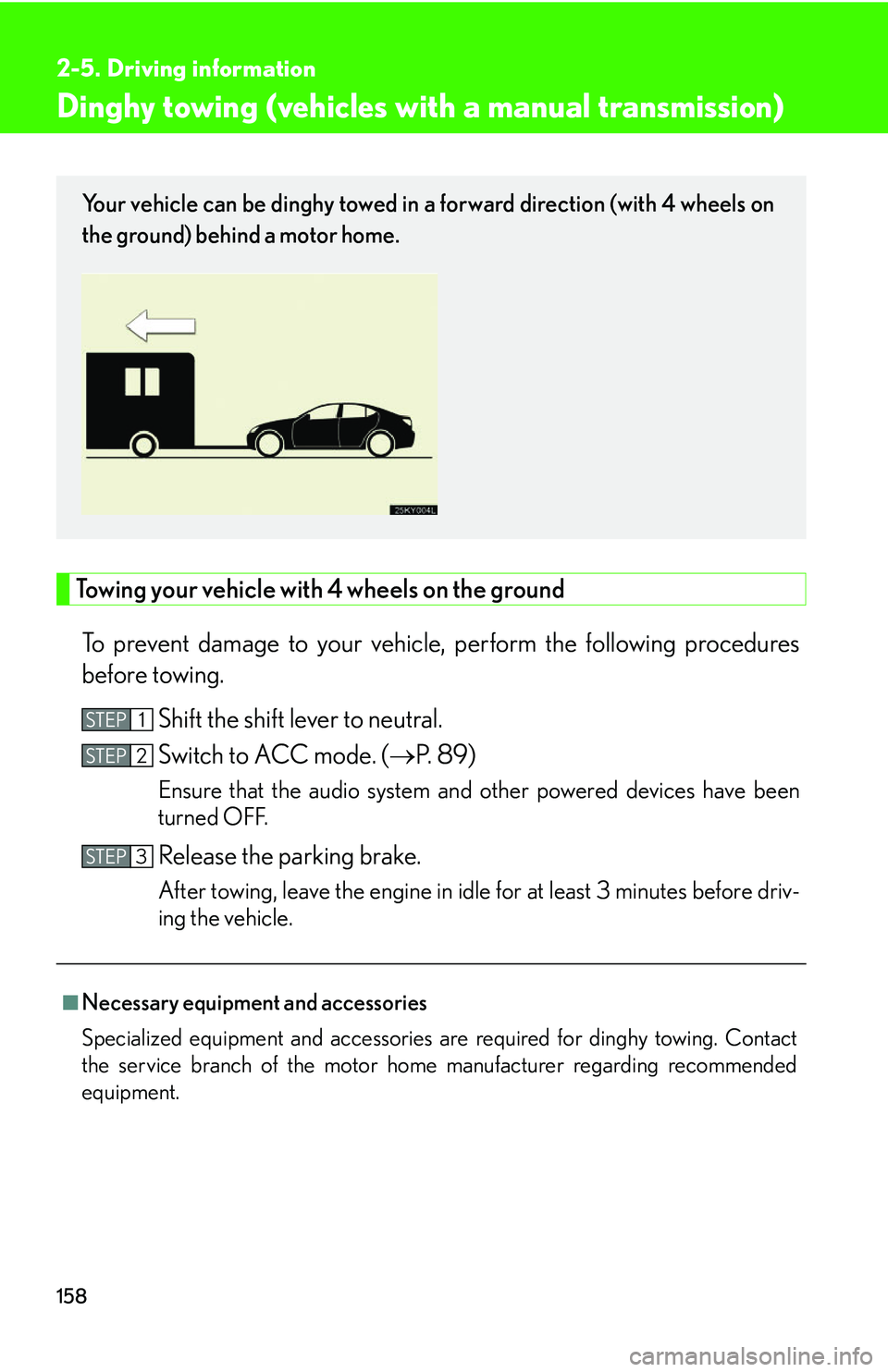
Your vehicle can be dinghy towed in a forward direction (with 4 wheels on
the ground) behind a motor home.
STEP1
STEP2
STEP3
Page 278 of 433
260
4-3. Do-it-yourself maintenance
CAUTION
■When raising your vehicle:
Make sure to observe the following to reduce the possibility of death or serious
injury.
●Do not put any part of your body or get underneath the vehicle supported only by
the jack.
Always use automotive jack stands or a solid, level, surface.
●Do not start the engine while the vehicle is supported by the jack.
●Stop the vehicle on level firm ground, firmly set the parking brake and put the shift
lever in P (automatic) or R (manual).
●Make sure to set the jack properly at the jack point.
Raising the vehicle with an improperly positioned jack will damage the vehicle
and may cause the vehicle to fall off the jack.
●Do not raise the vehicle while someone is in the vehicle.
●When raising the vehicle, do not place any objects on top of or underneath the
jack.