light Lexus IS250 2010 Owner's Manual
[x] Cancel search | Manufacturer: LEXUS, Model Year: 2010, Model line: IS250, Model: Lexus IS250 2010Pages: 578, PDF Size: 30.78 MB
Page 496 of 578
5
When trouble arises
495
5-2. Steps to take in an emergency
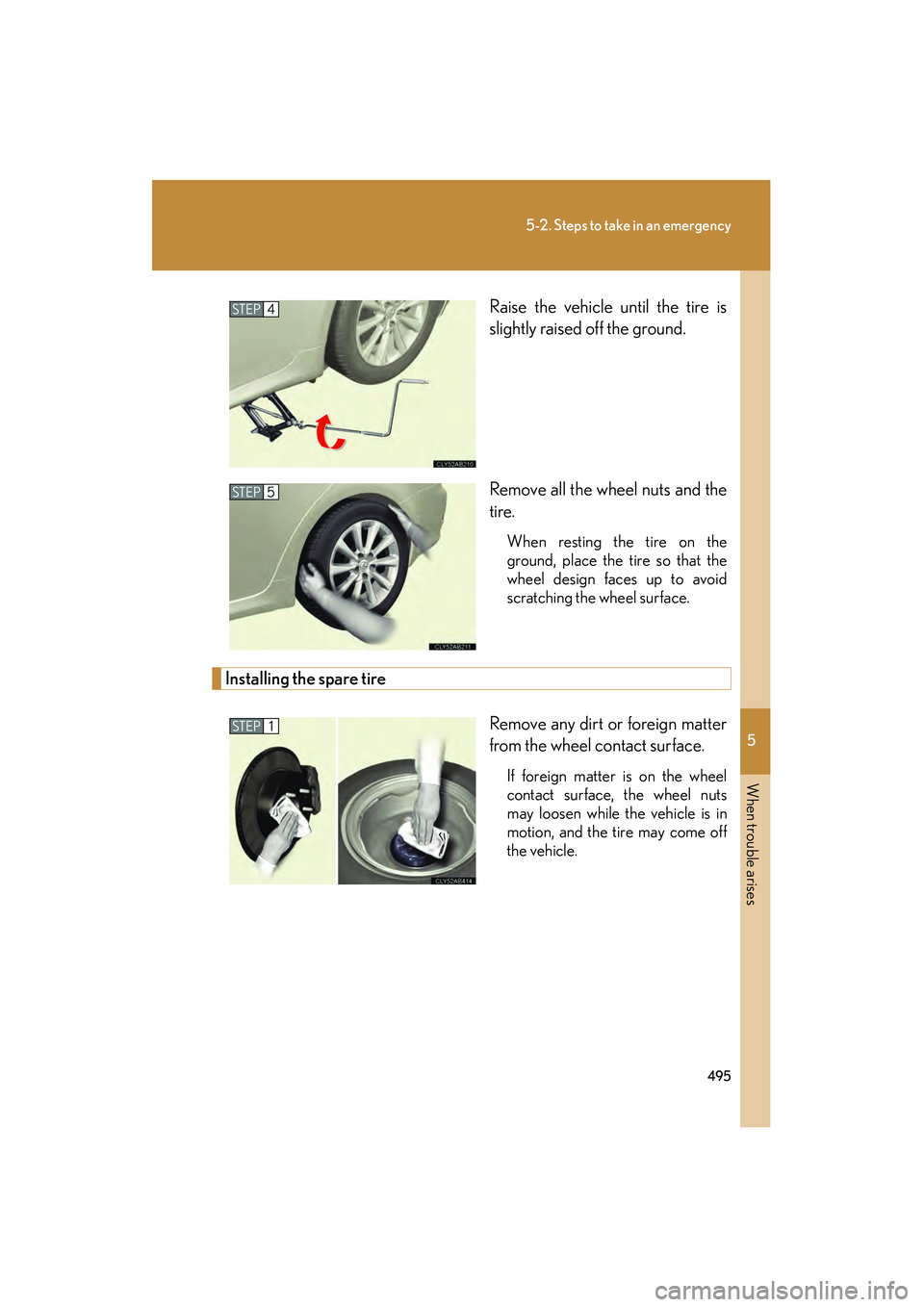
IS350/250_URaise the vehicle until the tire is
slightly raised off the ground.
Remove all the wheel nuts and the
tire.
When resting the tire on the
ground, place the tire so that the
wheel design faces up to avoid
scratching the wheel surface.
Installing the spare tire
Remove any dirt or foreign matter
from the wheel contact surface.
If foreign matter is on the wheel
contact surface, the wheel nuts
may loosen while the vehicle is in
motion, and the tire may come off
the vehicle.
STEP4
STEP5
STEP1
Page 498 of 578
5
When trouble arises
497
5-2. Steps to take in an emergency
IS350/250_U
■The compact spare tire
●The compact spare tire is identified by the label “TEMPORARY USE ONLY”
on the tire sidewall.
Use the compact spare tire temporarily only in an emergency.
●Make sure to check the tire pressure of the compact spare tire. (→P. 5 2 8 )
■When using the compact spare tire
As the compact spare tire is not equipped with the tire pressure warning valve and
transmitter, low inflation pressure of the spare tire will not be indicated. Also, if you
replace the compact spare tire after the tire pressure warning light comes on, the
light remains on.
■If you have a flat rear tire on a road covered with snow or ice
Install the compact spare tire on the front of the vehicle. Perform the following steps
and fit tire chains to the rear tires.
Replace a front tire with the compact spare tire.
Replace the flat rear tire with the tire removed from the front of the vehi-
cle.
Fit tire chains to the rear tires.
■After completing the tire change
The tire pressure warning system must be reset. ( →P. 4 1 6 )
STEP1
STEP2
STEP3
Page 502 of 578
5
When trouble arises
501
5-2. Steps to take in an emergency
IS350/250_U
If the engine will not start
If the engine will not start even though correct starting procedures are
being followed (
→P. 134), consider each of the following points.
■The engine will not start even when the starter motor operates
normally.
One of the following may be the cause of the problem.
●There may not be sufficient fuel in the vehicle’s tank.
Refuel the vehicle.
● The engine may be flooded.
Try to restart the engine once more following correct starting
procedures. ( →P. 1 3 4 )
● There may be a malfunction in the engine immobilizer system.
(→ P. 8 6 )
■ The starter motor turns over slowly, the interior lights and head-
lights are dim, or the horn does not sound or sounds at a low vol-
ume.
One of the following may be the cause of the problem.
● The battery may be discharged. ( →P. 509)
● The battery terminal connections may be loose or corroded.
■ The starter motor does not turn ov er, the interior lights and head-
lights do not turn on, or the horn does not sound.
One of the following may be the cause of the problem.
● One or both of the battery terminals may be disconnected.
● The battery may be discharged. ( →P. 509)
● There may be a malfunction in the steering lock system.
Contact your Lexus dealer if the problem cannot be repaired, or if
repair procedures are unknown.
Page 510 of 578

5
When trouble arises
509
5-2. Steps to take in an emergency
IS350/250_U
If the vehicle battery is discharged
The following procedures may be used to start the engine if the vehicle’s
battery is discharged.
You can call your Lexus dealer or a qualified repair shop.
If you have a set of jumper (or booster) cables and a second vehicle
with a 12-volt battery, you can jump start your Lexus following the steps
below.
Remove the engine compartment covers. ( →P. 4 0 2 )
Connecting the jumper cables.
Positive (+) battery terminal on your vehicle
Positive (+) battery terminal on the second vehicle
Negative (-) battery terminal on the second vehicle
Connect the jumper cable to ground on your vehicle as shown in the
illustration. Start the engine of the second vehicle. Increase the engine
speed slightly and maintain at that level for approximately 5
minutes to recharge the battery of your vehicle.
Open and close any of the doors with the “ENGINE START
STOP” switch OFF.
STEP1
STEP2
STEP3
STEP4
Page 511 of 578
510
5-2. Steps to take in an emergency
IS350/250_U
■Avoiding a discharged battery
●Turn off the headlights and the audio system while the engine is off.
●Turn off any unnecessary electrical components when the vehicle is running at a
low speed for an extended period, such as in heavy traffic, etc.
CAUTION
■Avoiding battery fires or explosions
Observe the following precautions to prevent accidentally igniting the flammable
gas that may be emitted from the battery.
●Make sure the jumper cable is connected to the correct terminal and that it is not
unintentionally in contact with any part other than the intended terminal.
●Do not allow the jumper cables to come into contact with the “+” and “-” termi-
nals.
●Do not allow open flame or use matches, cigarette lighters or smoke near the
battery.
Maintain the engine speed of the second vehicle and turn the
“ENGINE START STOP” switch to IGNITION ON mode,
then start the vehicle’s engine.
Once the vehicle’s engine has started, remove the jumper
cables in the exact reverse order in which they were con-
nected.
Once the engine starts, have the vehicle checked at your Lexus dealer
as soon as possible.STEP5
STEP6
Page 526 of 578
525
6-1. Specifications
6
Vehicle specifications
IS350/250_U
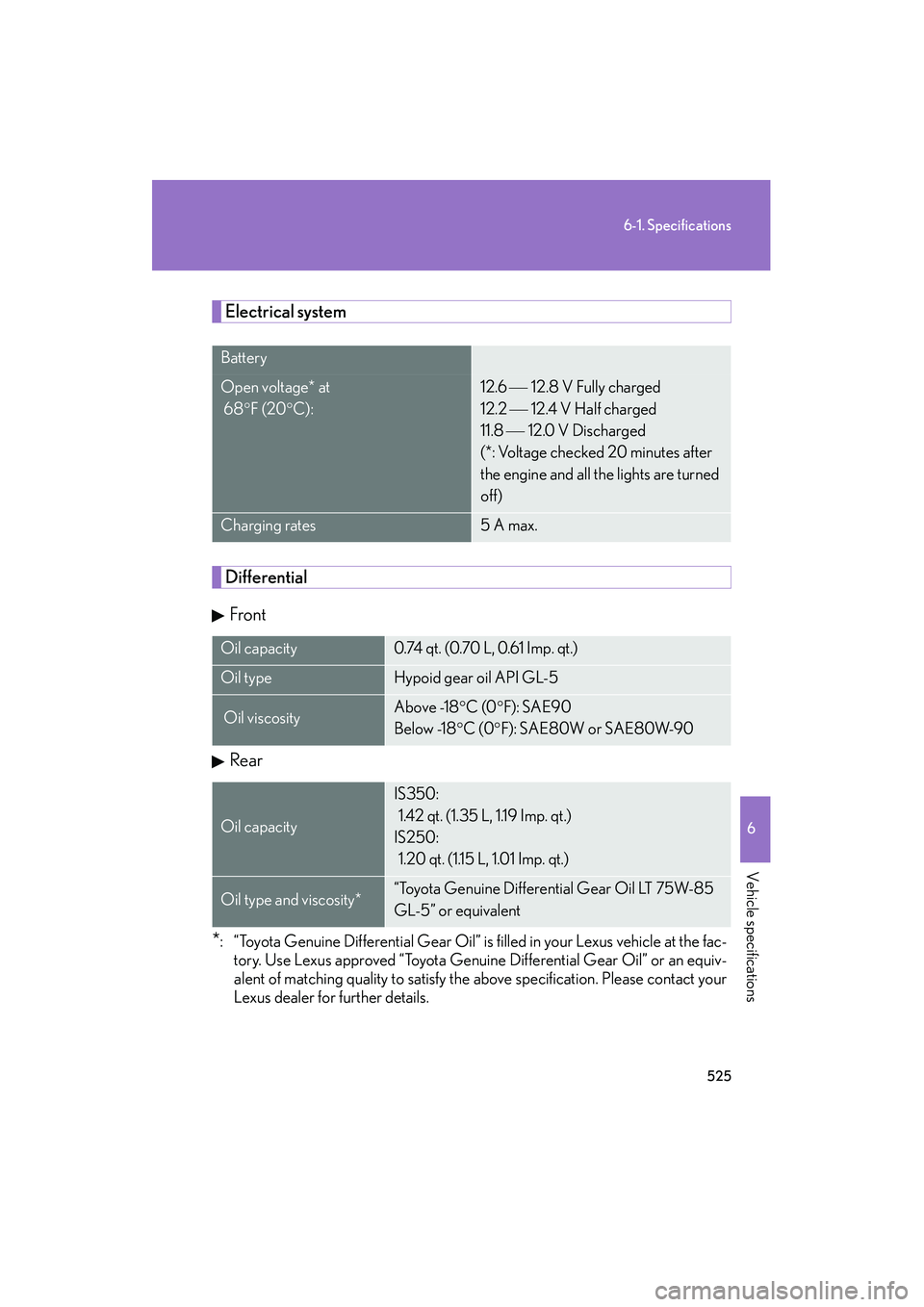
Electrical system
DifferentialFront
Rear
*: “Toyota Genuine Differential Gear Oil” is filled in your Lexus vehicle at the fac- tory. Use Lexus approved “Toyota Genuine Differential Gear Oil” or an equiv-
alent of matching quality to satisfy the above specification. Please contact your
Lexus dealer for further details.
Battery
Open voltage* at
68 °F (20 °C):12.6 12.8 V Fully charged
12.2
12.4 V Half charged
11.8
12.0 V Discharged
(*: Voltage checked 20 minutes after
the engine and all the lights are turned
off)
Charging rates5 A max.
Oil capacity0.74 qt. (0.70 L, 0.61 Imp. qt.)
Oil typeHypoid gear oil API GL-5
Oil viscosityAbove -18 °C (0 °F): SAE90
Below -18° C (0°F): SAE80W or SAE80W-90
Oil capacity
IS350:
1.42 qt. (1.35 L, 1.19 Imp. qt.)
IS250:
1.20 qt. (1.15 L, 1.01 Imp. qt.)
Oil type and viscosity*“Toyota Genuine Differential Gear Oil LT 75W-85
GL-5” or equivalent
Page 534 of 578
533
6-1. Specifications
6
Vehicle specifications
IS350/250_U
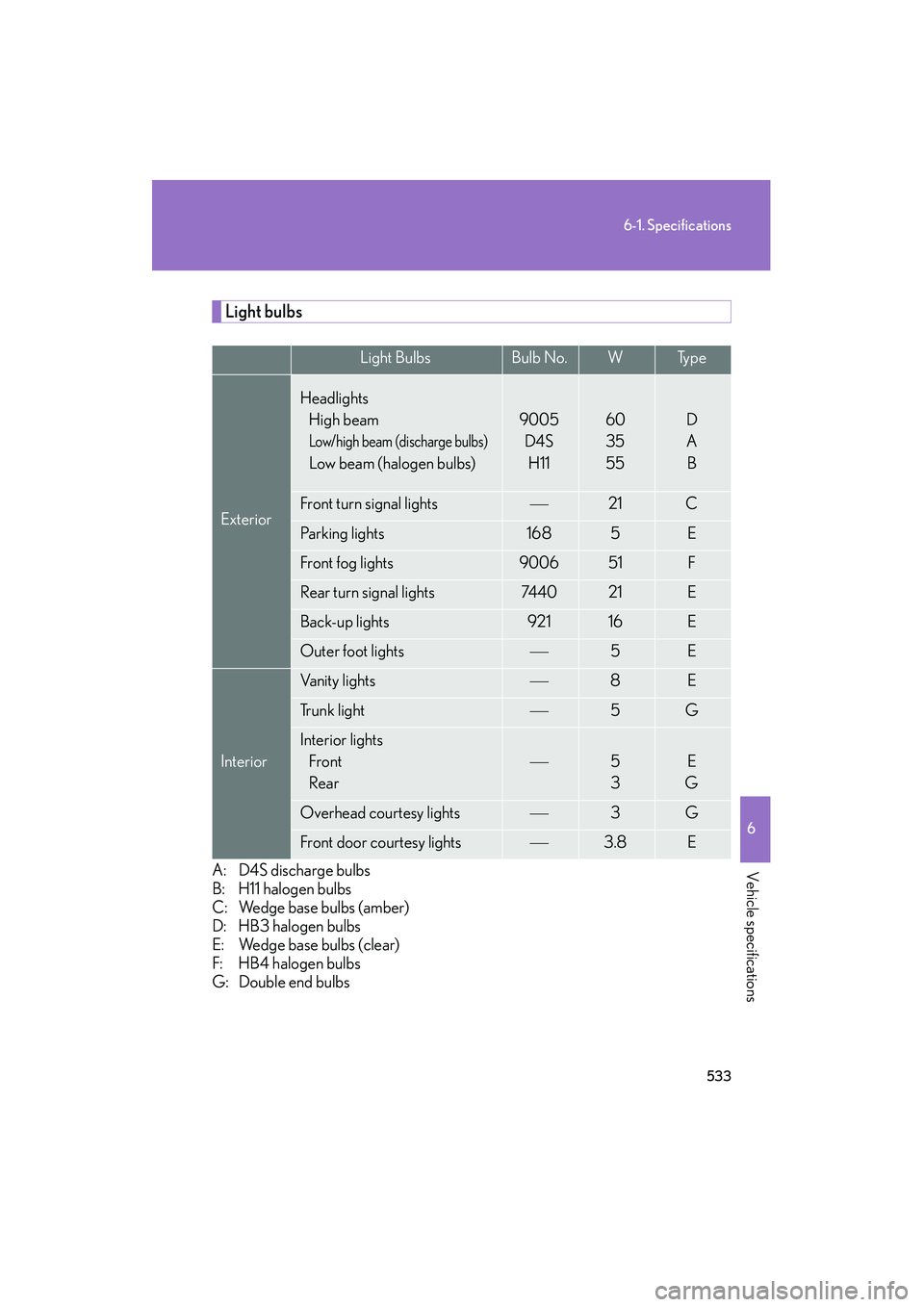
Light bulbs
A: D4S discharge bulbs
B: H11 halogen bulbs
C: Wedge base bulbs (amber)
D: HB3 halogen bulbs
E: Wedge base bulbs (clear)
F: HB4 halogen bulbs
G: Double end bulbs
Light BulbsBulb No.WTy p e
Exterior
HeadlightsHigh beam
Low/high beam (discharge bulbs)
Low beam (halogen bulbs)
9005D4S
H116035
55D
A
B
Front turn signal lights21C
Parking lights1685E
Front fog lights900651F
Rear turn signal lights74 4 021E
Back-up lights92116E
Outer foot lights5E
Interior
Vanity lights8E
Tr u n k l i g h t5G
Interior lights Front
Rear
53E
G
Overhead courtesy lights3G
Front door courtesy lights3.8E
Page 535 of 578
534
6-1. Specifications
IS350/250_U
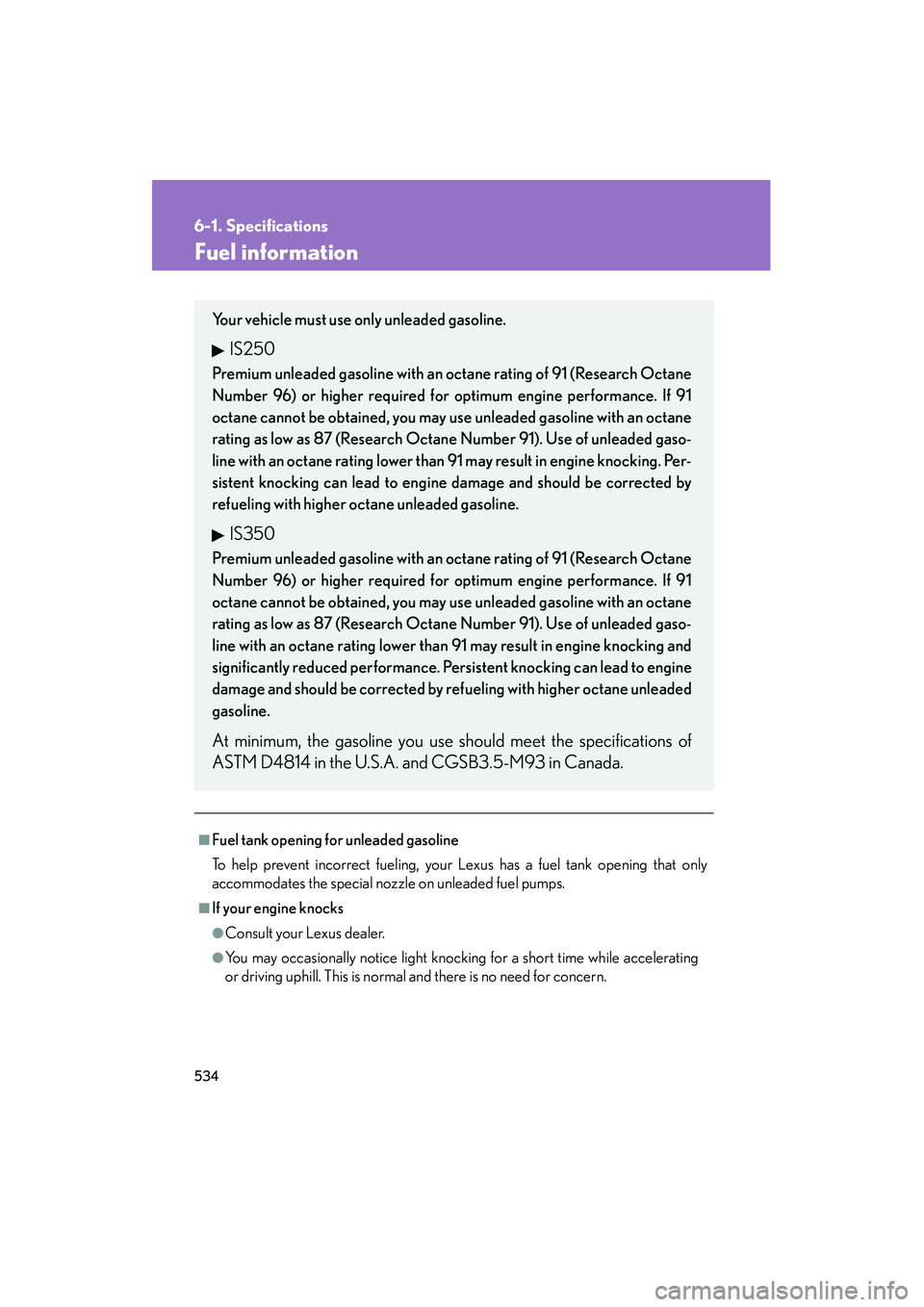
Fuel information
■Fuel tank opening for unleaded gasoline
To help prevent incorrect fueling, your Lexus has a fuel tank opening that only
accommodates the special nozzle on unleaded fuel pumps.
■If your engine knocks
●Consult your Lexus dealer.
●You may occasionally notice light knocking for a short time while accelerating
or driving uphill. This is normal and there is no need for concern.
Your vehicle must use only unleaded gasoline.
IS250
Premium unleaded gasoline with an octane rating of 91 (Research Octane
Number 96) or higher required for optimum engine performance. If 91
octane cannot be obtained, you may use unleaded gasoline with an octane
rating as low as 87 (Research Octane Number 91). Use of unleaded gaso-
line with an octane rating lower than 91 may result in engine knocking. Per-
sistent knocking can lead to engine damage and should be corrected by
refueling with higher octane unleaded gasoline.
IS350
Premium unleaded gasoline with an oc tane rating of 91 (Research Octane
Number 96) or higher required for optimum engine performance. If 91
octane cannot be obtained, you may use unleaded gasoline with an octane
rating as low as 87 (Research Octane Number 91). Use of unleaded gaso-
line with an octane rating lower than 91 may result in engine knocking and
significantly reduced performance. Persistent knocking can lead to engine
damage and should be corrected by refueling with higher octane unleaded
gasoline.
At minimum, the gasoline you use should meet the specifications of
ASTM D4814 in the U.S.A. and CGSB3.5-M93 in Canada.
Page 547 of 578

546
6-1. Specifications
IS350/250_U
Tire related termMeaning
Intended outboard side-
wall
(a) The sidewall that contains a whitewall, bears
white lettering, or bears manufacturer, brand,
and/or model name molding that is higher or
deeper than the same molding on the other side-
wall of the tire, or
(b) The outward facing sidewall of an asymmetrical tire that has a particular side that must always
face outward when mounted on a vehicle
Light truck (LT) tire
A tire designated by its manufacturer as primarily
intended for use on lightweight trucks or multipur-
pose passenger vehicles
Load ratingThe maximum load that a tire is rated to carry for a
given inflation pressure
Maximum load ratingThe load rating for a tire at the maximum permissible
inflation pressure for that tire
Maximum permissible
inflation pressureThe maximum cold inflation pressure to which a tire
may be inflated
Measuring rimThe rim on which a tire is fitted for physical dimension
requirements
Open spliceAny parting at any junction of tread, sidewall, or
innerliner that extends to cord material
Outer diameterThe overall diameter of an inflated new tire
Overall width
The linear distance between the exteriors of the side-
walls of an inflated tire, including elevations due to
labeling, decorations, or protective bands or ribs
Passenger car tire
A tire intended for use on passenger cars, multipur-
pose passenger vehicles, and trucks, that have a
gross vehicle weight rating (GVWR) of 10000 lb. or
less.
PlyA layer of rubber-coated parallel cords
Page 553 of 578

552
6-2. Customization
IS350/250_U
ItemFunctionDefault settingCustomizedsetting
Power win-
dows
(
→P. 76 )
Linked door key opera-
tionOpen and close
Off
Open only
Close only
Wireless remote control
linked operationOffOpen only
Moon roof
(
→P. 7 9 )
Linked door key opera-
tionOpen and close
Off
Open only
Close only
Linked operation of com-
ponents when door key is
used
Slide onlyTilt only
Wireless remote control
linked operationOffOpen only
Linked operation of com-
ponents when wireless
remote control is used
Slide onlyTilt only
Automatic
light control
system
(
→P. 1 6 5 )
Light sensor sensitivityLevel 3Level 1 to 5
Ti m e e l a p s e d b e f o r e
headlights automatically
turn off after doors are
closed
30 seconds
0 seconds
60 seconds
90 seconds
Lights
(
→P. 166)
Daytime running light sys-
tem (U.S.A. only)OnOff