Gas Lexus IS250 2011 User Guide
[x] Cancel search | Manufacturer: LEXUS, Model Year: 2011, Model line: IS250, Model: Lexus IS250 2011Pages: 578, PDF Size: 31.12 MB
Page 371 of 578
370
4-1. Maintenance and care
IS350/250_U
NOTICE
■To prevent paint deterioration and corrosion on the body and components (alu-
minum wheels etc.)
●Wash the vehicle immediately in the following cases:
• After driving near the sea coast
• After driving on salted roads
• If you see coal tar or tree sap on the paint surface
• If you see dead insects, insect droppings or bird droppings on the paint
• After driving in an area contaminated with soot, oily smoke, mine dust, iron
powder or chemical substances
• If the vehicle becomes heavily soiled in dust or mud
• If liquids such as benzene and gasoline are spilled on the paint surface
●If the paint is chipped or scratched, have it repaired immediately.
●To prevent the wheels from corroding, remove any dirt and store in a place with
low humidity when storing the wheels.
■Cleaning the exterior lights
●Wash carefully. Do not use organic substances or scrub with a hard brush.
This may damage the surfaces of the lights.
●Do not apply wax on the surfaces of the lights.
Wax may cause damage to the lenses.
■To prevent damage to the windshield wiper arms
When lifting the wiper arms away from the windshield, pull the driver side wiper
arm upward first, and repeat for the passenger side. When returning the wipers to
their original position, do so from the passenger side first.
■When using an automatic car wash (vehicles with rain-sensing windshield wipers
only)
Set the wiper switch to the off position.
If the wiper switch is in “AUTO”, the wipers may operate and the wiper blades may
be damaged.
Page 374 of 578
373
4-1. Maintenance and care
4
Maintenance and care
IS350/250_U
NOTICE
■Cleaning detergents
●Do not use organic substances such as benzene or gasoline, acidic or alkaline
solutions, dye, bleach or other detergent. Doing so may discolor the vehicle inte-
rior or cause streaks or damage to painted surfaces.
●Do not use polish wax or polish cleaner. The instrument panel's or other interior
part’s painted surface may be damaged.
■Preventing damage to leather surfaces
Observe the following precautions to avoid damage to and deterioration of leather
surfaces.
●Remove any dust or dirt on leather surfaces immediately.
●Do not expose the vehicle to direct sunlight for extended periods of time. Park
the vehicle in the shade, especially during summer.
●Do not place items made of vinyl, plastic, or that contain wax on the upholstery, as
they may stick to the leather surface if the vehicle interior heats up significantly.
■Water on the floor
Do not wash the vehicle floor with water.
Vehicle systems such as the audio system may be damaged if water comes into
contact with electrical components under the floor of the vehicle, and may also
cause the body to rust.
■Cleaning the inside of the rear window
●Be careful not to scratch or damage the heater wires or antenna.
●Do not use glass cleaner to clean the rear window, as this may cause damage to
the rear window defogger heater wires or antenna. Use a cloth dampened with
lukewarm water to gently wipe the window clean. Wipe the window in strokes
running parallel to the heater wires or antenna.
Page 398 of 578
397
4-3. Do-it-yourself maintenance
4
Maintenance and care
IS350/250_U■
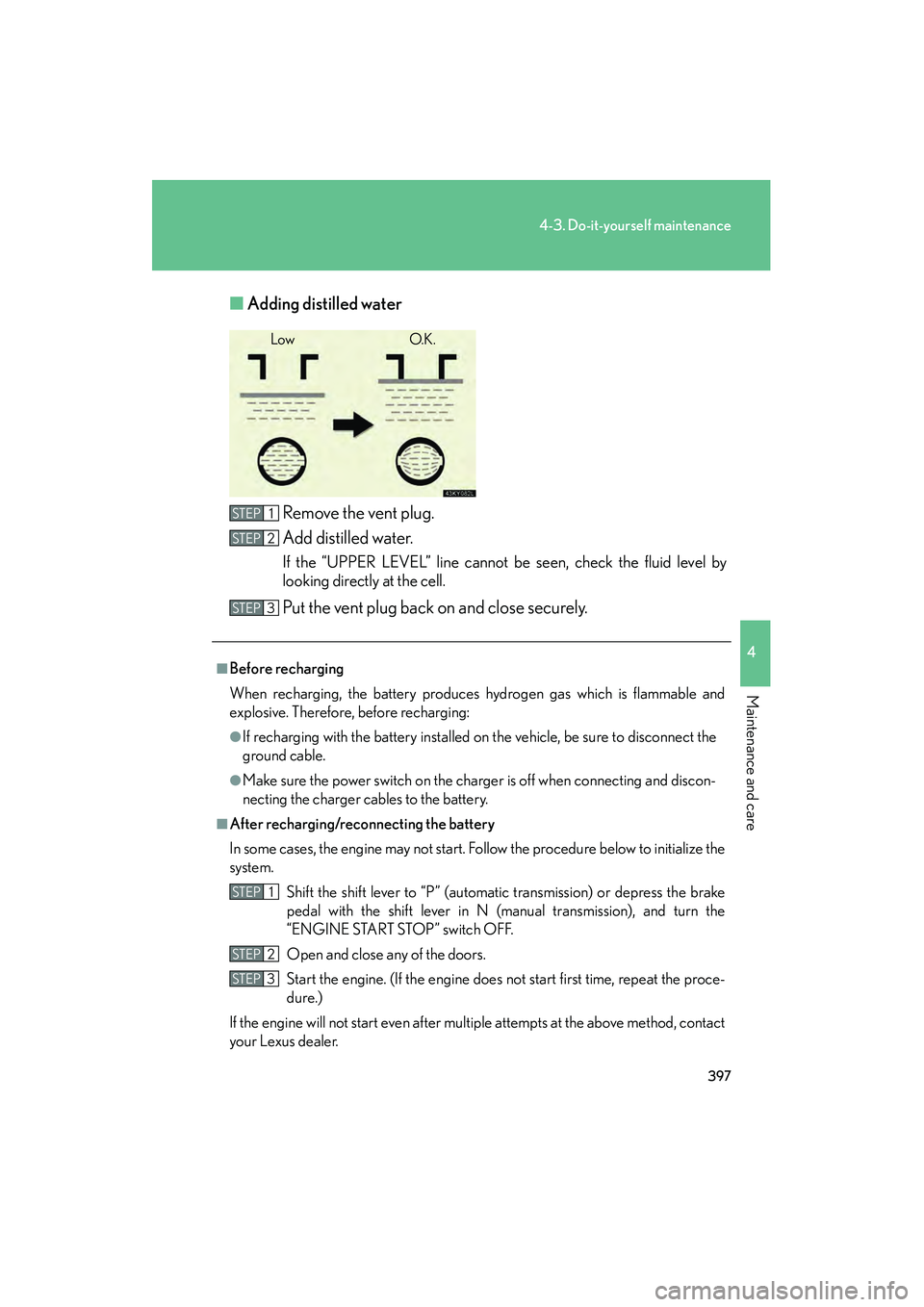
Adding distilled water
Remove the vent plug.
Add distilled water.
If the “UPPER LEVEL” line cannot be seen, check the fluid level by
looking directly at the cell.
Put the vent plug back on and close securely.
Low O.K.
■Before recharging
When recharging, the battery produces hydrogen gas which is flammable and
explosive. Therefore, before recharging:
●If recharging with the battery installed on the vehicle, be sure to disconnect the
ground cable.
●Make sure the power switch on the charger is off when connecting and discon-
necting the charger cables to the battery.
■After recharging/reconnecting the battery
In some cases, the engine may not start. Follow the procedure below to initialize the
system.
Shift the shift lever to “P” (automatic transmission) or depress the brake
pedal with the shift lever in N (manual transmission), and turn the
“ENGINE START STOP” switch OFF.
Open and close any of the doors.
Start the engine. (If the engine does not start first time, repeat the proce-
dure.)
If the engine will not start even after multiple attempts at the above method, contact
your Lexus dealer.
STEP1
STEP2
STEP3
STEP1
STEP2
STEP3
Page 399 of 578
398
4-3. Do-it-yourself maintenance
IS350/250_U
CAUTION
■Chemicals in the battery
A battery contains poisonous and corrosive sulfuric acid and may produce hydro-
gen gas which is flammable and explosive. To reduce the risk of death or serious
injury, take the following precautions while working on or near the battery:
●Do not cause sparks by touching the battery terminals with tools.
●Do not smoke or light a match near the battery.
●Avoid contact with eyes, skin and clothes.
●Never inhale or swallow electrolyte.
●Wear protective safety glasses when working near the battery.
●Keep children away from the battery.
■Where to safely charge the battery
Always charge the battery in an open area. Do not charge the battery in a garage or
closed room where there is not sufficient ventilation.
■How to recharge the battery
Only perform a slow charge (5 A or less). The battery may explode if charged at a
quicker rate.
■Emergency measures regarding electrolyte
●If electrolyte gets in your eyes
Flush your eyes with clean water for at least 15 minutes and get immediate medi-
cal attention. If possible, continue to apply water with a sponge or cloth while
traveling to the nearest medical facility.
●If electrolyte gets on your skin
Wash the affected area thoroughly. If you feel pain or burning, get medical atten-
tion immediately.
●If electrolyte gets on your clothes
It can soak through clothing on to your skin. Immediately take off the clothing and
follow the procedure above if necessary.
●If you accidentally swallow electrolyte
Drink a large quantity of water or milk. Follow with milk of magnesia, beaten raw
egg or vegetable oil. Get emergency medical attention immediately.
Page 438 of 578

437
4-3. Do-it-yourself maintenance
4
Maintenance and care
IS350/250_U
Headlight aim
■Removing the engine compartment cover
→ P. 388
■ Vertical movement adjusting bolts
Adjustment bolt A
Adjustment bolt B
■ Before checking the headlight aim
Make sure the vehicle has a full tank of gas and the area around
the headlight is not deformed.
Park the vehicle on level ground.
Sit in the driver’s seat.
Bounce the vehicle several times.
STEP1
STEP2
STEP3
STEP4
Page 500 of 578
5
When trouble arises
499
5-2. Steps to take in an emergency
IS350/250_U
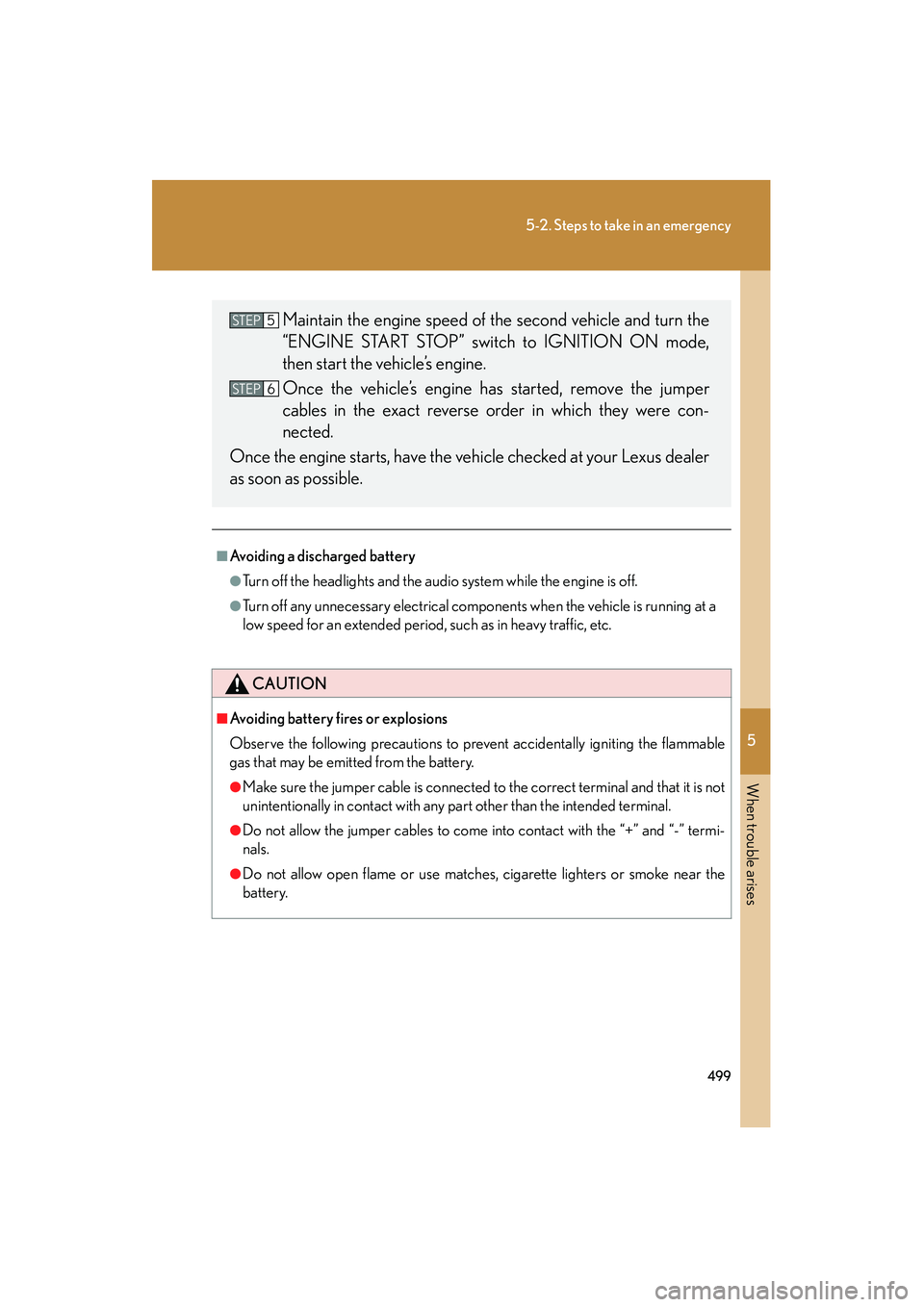
■Avoiding a discharged battery
●Turn off the headlights and the audio system while the engine is off.
●Turn off any unnecessary electrical components when the vehicle is running at a
low speed for an extended period, such as in heavy traffic, etc.
CAUTION
■Avoiding battery fires or explosions
Observe the following precautions to prevent accidentally igniting the flammable
gas that may be emitted from the battery.
●Make sure the jumper cable is connected to the correct terminal and that it is not
unintentionally in contact with any part other than the intended terminal.
●Do not allow the jumper cables to come into contact with the “+” and “-” termi-
nals.
●Do not allow open flame or use matches, cigarette lighters or smoke near the
battery.
Maintain the engine speed of the second vehicle and turn the
“ENGINE START STOP” switch to IGNITION ON mode,
then start the vehicle’s engine.
Once the vehicle’s engine has started, remove the jumper
cables in the exact reverse order in which they were con-
nected.
Once the engine starts, have the vehicle checked at your Lexus dealer
as soon as possible.STEP5
STEP6
Page 512 of 578
511
6-1. Specifications
6
Vehicle specifications
IS350/250_U
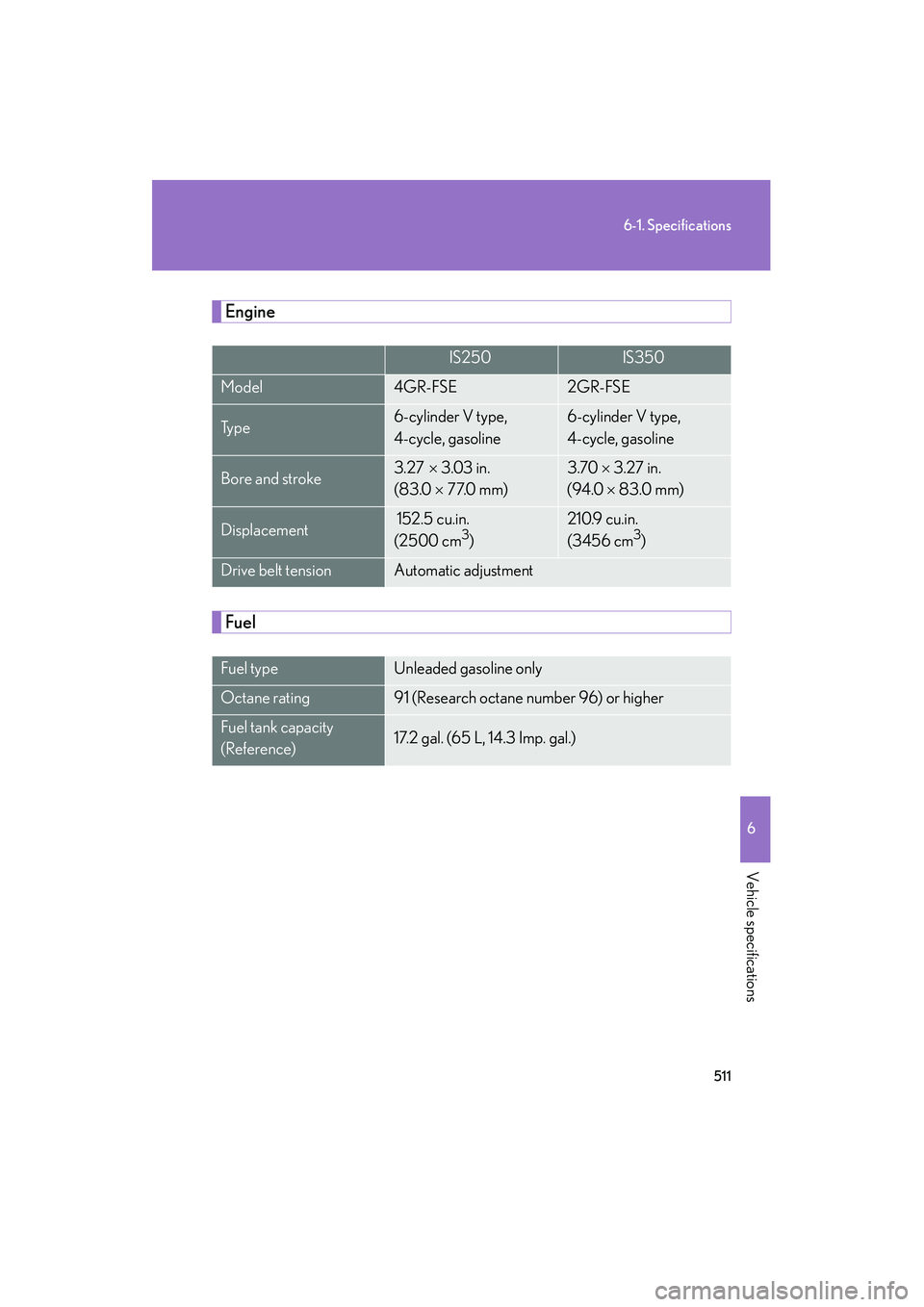
Engine
Fuel
IS250IS350
Model4GR-FSE2GR-FSE
Ty p e6-cylinder V type,
4-cycle, gasoline6-cylinder V type,
4-cycle, gasoline
Bore and stroke3.27 × 3.03 in.
(83.0 × 77.0 mm)3.70 × 3.27 in.
(94.0 × 83.0 mm)
Displacement 152.5 cu.in.
(2500 cm3)
210.9 cu.in.
(3456 cm3)
Drive belt tensionAutomatic adjustment
Fuel typeUnleaded gasoline only
Octane rating91 (Research octane number 96) or higher
Fuel tank capacity
(Reference)17.2 gal. (65 L, 14.3 Imp. gal.)
Page 526 of 578
525
6-1. Specifications
6
Vehicle specifications
IS350/250_U
Fuel information
■Fuel tank opening for unleaded gasoline
To help prevent incorrect fueling, your Lexus has a fuel tank opening that only
accommodates the special nozzle on unleaded fuel pumps.
■If your engine knocks
●Consult your Lexus dealer.
●You may occasionally notice light knocking for a short time while accelerating
or driving uphill. This is normal and there is no need for concern.
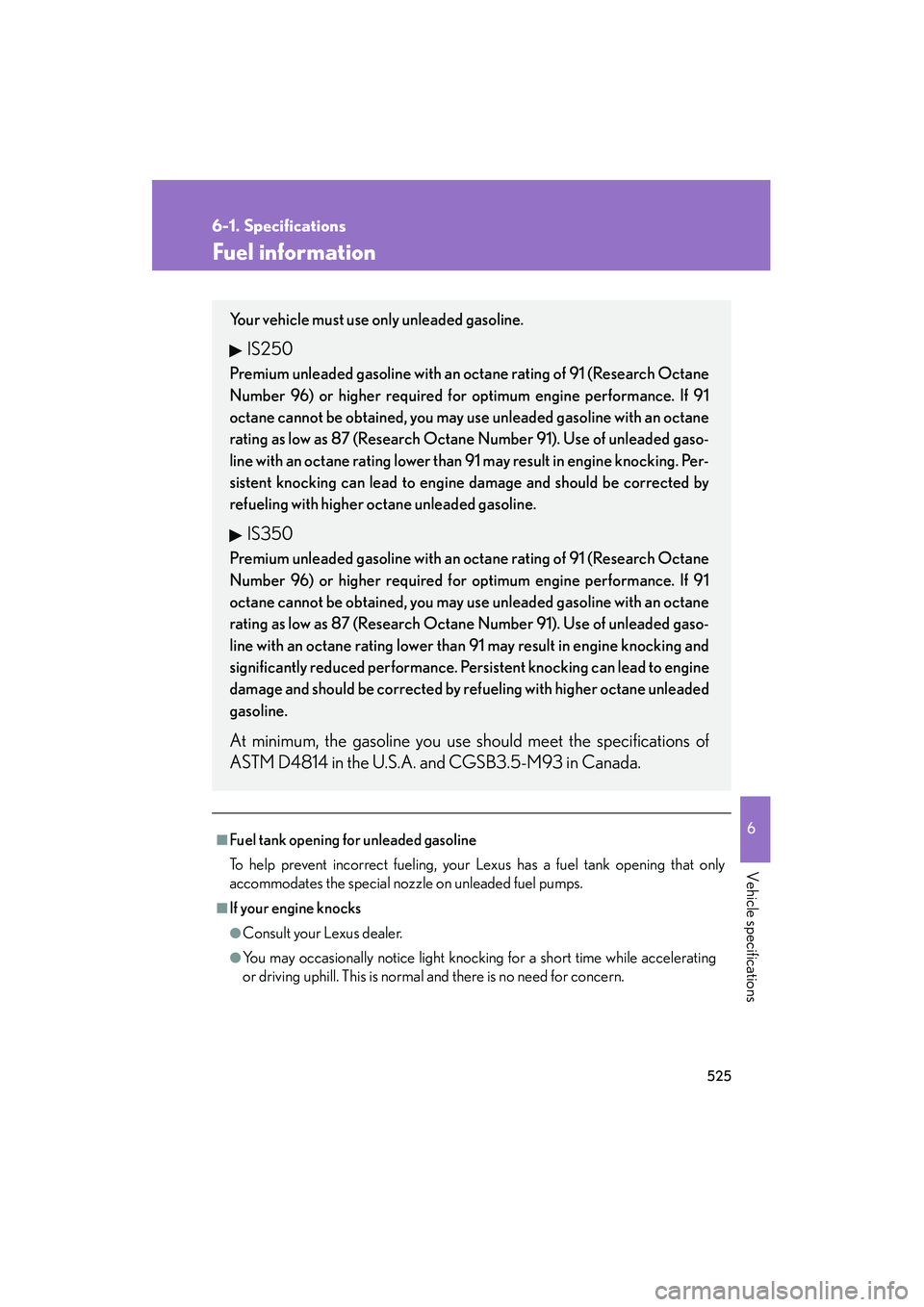
Your vehicle must use only unleaded gasoline.
IS250
Premium unleaded gasoline with an octane rating of 91 (Research Octane
Number 96) or higher required for optimum engine performance. If 91
octane cannot be obtained, you may use unleaded gasoline with an octane
rating as low as 87 (Research Octane Number 91). Use of unleaded gaso-
line with an octane rating lower than 91 may result in engine knocking. Per-
sistent knocking can lead to engine damage and should be corrected by
refueling with higher octane unleaded gasoline.
IS350
Premium unleaded gasoline with an oc tane rating of 91 (Research Octane
Number 96) or higher required for optimum engine performance. If 91
octane cannot be obtained, you may use unleaded gasoline with an octane
rating as low as 87 (Research Octane Number 91). Use of unleaded gaso-
line with an octane rating lower than 91 may result in engine knocking and
significantly reduced performance. Persistent knocking can lead to engine
damage and should be corrected by refueling with higher octane unleaded
gasoline.
At minimum, the gasoline you use should meet the specifications of
ASTM D4814 in the U.S.A. and CGSB3.5-M93 in Canada.
Page 527 of 578
526
6-1. Specifications
IS350/250_U
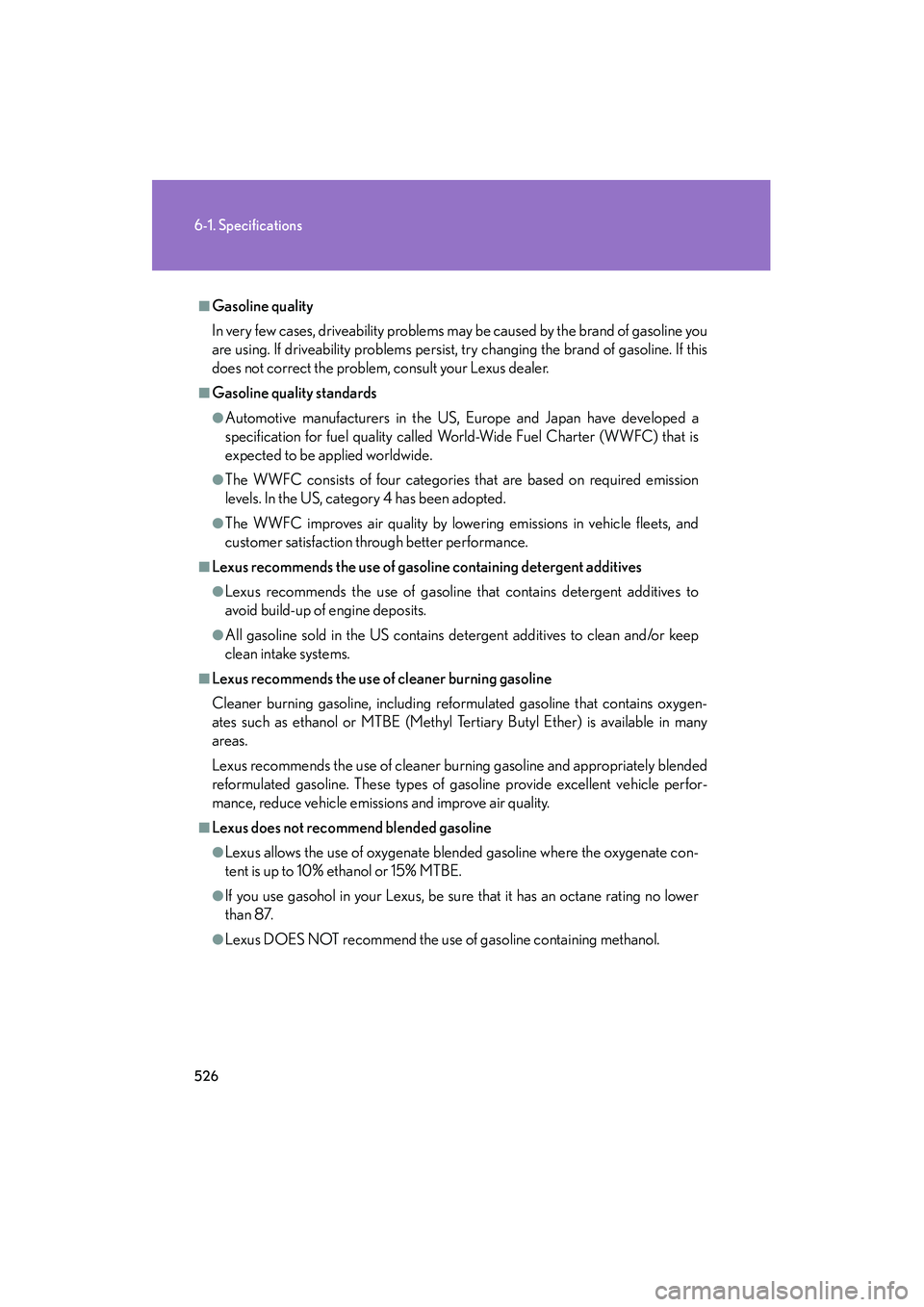
■Gasoline quality
In very few cases, driveability problems may be caused by the brand of gasoline you
are using. If driveability problems persist, try changing the brand of gasoline. If this
does not correct the problem, consult your Lexus dealer.
■Gasoline quality standards
●Automotive manufacturers in the US, Europe and Japan have developed a
specification for fuel quality called World-Wide Fuel Charter (WWFC) that is
expected to be applied worldwide.
●The WWFC consists of four categories that are based on required emission
levels. In the US, category 4 has been adopted.
●The WWFC improves air quality by lowering emissions in vehicle fleets, and
customer satisfaction through better performance.
■Lexus recommends the use of gasoline containing detergent additives
●Lexus recommends the use of gasoline that contains detergent additives to
avoid build-up of engine deposits.
●All gasoline sold in the US contains detergent additives to clean and/or keep
clean intake systems.
■Lexus recommends the use of cleaner burning gasoline
Cleaner burning gasoline, including reformulated gasoline that contains oxygen-
ates such as ethanol or MTBE (Methyl Tertiary Butyl Ether) is available in many
areas.
Lexus recommends the use of cleaner burning gasoline and appropriately blended
reformulated gasoline. These types of gasoline provide excellent vehicle perfor-
mance, reduce vehicle emissions and improve air quality.
■Lexus does not recommend blended gasoline
●Lexus allows the use of oxygenate blended gasoline where the oxygenate con-
tent is up to 10% ethanol or 15% MTBE.
●If you use gasohol in your Lexus, be sure that it has an octane rating no lower
than 87.
●Lexus DOES NOT recommend the use of gasoline containing methanol.
Page 528 of 578

527
6-1. Specifications
6
Vehicle specifications
IS350/250_U
■Lexus does not recommend gasoline containing MMT
Some gasoline contains octane enhancing additive called MMT (Methylcyclopen-
tadienyl Manganese Tricarbonyl).
Lexus DOES NOT recommend the use of gasoline that contains MMT. If fuel con-
taining MMT is used, your emission control system may be adversely affected.
The malfunction indicator lamp on the instrument cluster may come on. If this hap-
pens, contact your Lexus dealer for service.
NOTICE
■Notice on fuel quality
●Do not use improper fuels. If improper fuels are used the engine will be damaged.
●Do not use leaded gasoline.
Leaded gasoline can cause damage to your vehicle’s three-way catalytic convert-
ers causing the emission control system to malfunction.
●Do not use gasohol other than that stated here.
Other gasohol may cause fuel system damage or vehicle performance problems.
●IS250: Use of unleaded gasoline with an octane rating lower than 91 may result
in engine knocking. Persistent knocking can lead to engine damage and should
be corrected by refueling with higher octane unleaded gasoline.
●IS350: Use of unleaded gasoline with an octane rating lower than 91 may result
in engine knocking and significantly reduced performance. Persistent knocking
can lead to engine damage and should be corrected by refueling with higher
octane unleaded gasoline.
■Fuel-related poor driveability
If after using a different type of fuel, poor driveability is encountered (poor hot start-
ing, vaporization, engine knocking, etc.), discontinue the use of that type of fuel.
■When refueling with gasohol
Take care not to spill gasohol. It can damage your vehicle's paint.