steering lock Lexus IS250 2011 User Guide
[x] Cancel search | Manufacturer: LEXUS, Model Year: 2011, Model line: IS250, Model: Lexus IS250 2011Pages: 578, PDF Size: 31.12 MB
Page 59 of 578
58
1-3. Adjustable components (seats, mirrors, steering wheel)
IS350/250_U
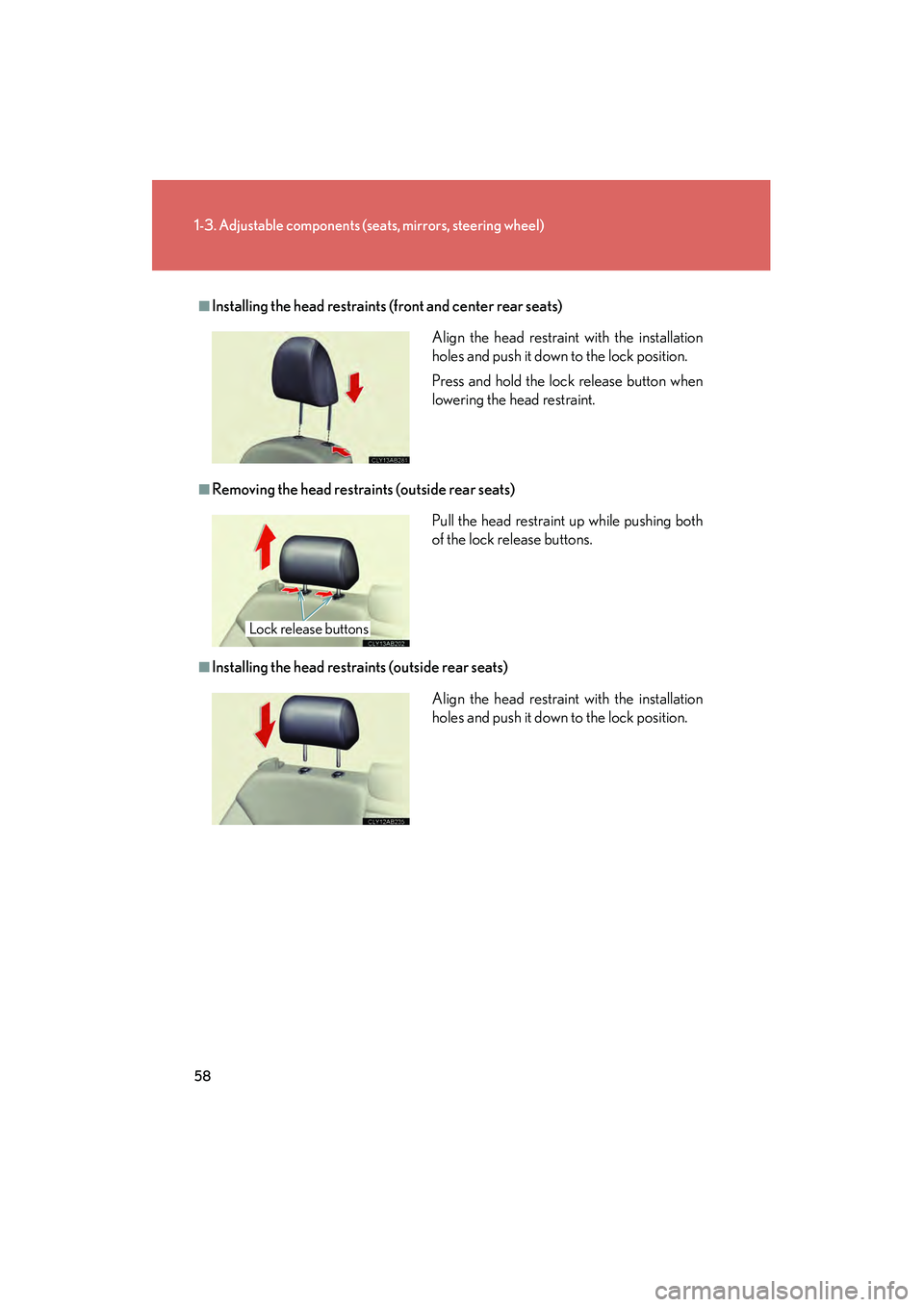
■Installing the head restraints (front and center rear seats)
■Removing the head restraints (outside rear seats)
■Installing the head restraints (outside rear seats) Align the head restraint with the installation
holes and push it down to the lock position.
Press and hold the lock release button when
lowering the head restraint.
Pull the head restraint up while pushing both
of the lock release buttons.
Lock release buttons
Align the head restraint with the installation
holes and push it down to the lock position.
Page 60 of 578
59
1-3. Adjustable components (seats, mirrors, steering wheel)
1
Before driving
IS350/250_U
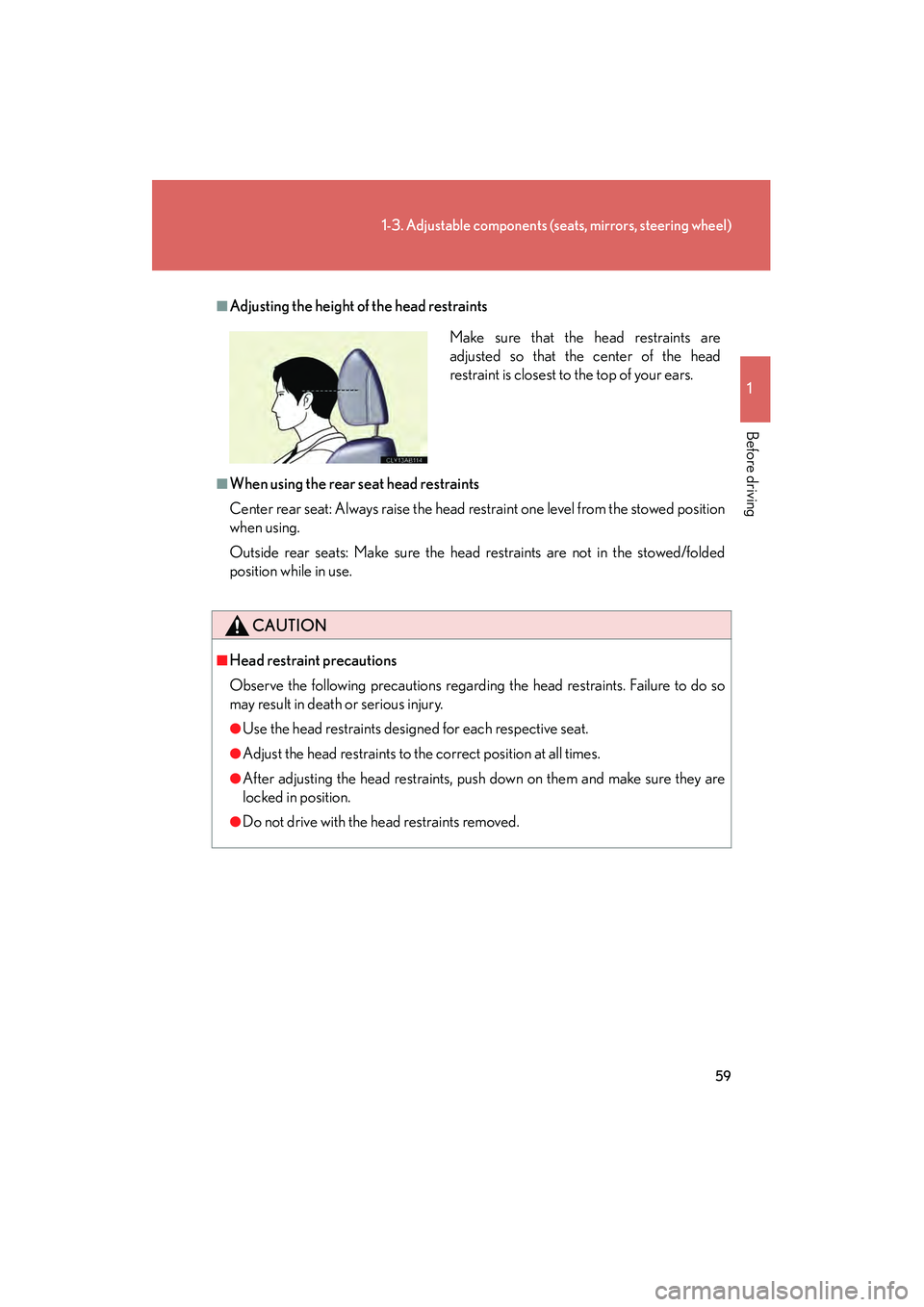
■Adjusting the height of the head restraints
■When using the rear seat head restraints
Center rear seat: Always raise the head restraint one level from the stowed position
when using.
Outside rear seats: Make sure the head restraints are not in the stowed/folded
position while in use.
CAUTION
■Head restraint precautions
Observe the following precautions regarding the head restraints. Failure to do so
may result in death or serious injury.
●Use the head restraints designed for each respective seat.
●Adjust the head restraints to the correct position at all times.
●After adjusting the head restraints, push down on them and make sure they are
locked in position.
●Do not drive with the head restraints removed.
Make sure that the head restraints are
adjusted so that the center of the head
restraint is closest to the top of your ears.
Page 63 of 578
62
1-3. Adjustable components (seats, mirrors, steering wheel)
IS350/250_U
■Emergency locking retractor (ELR)
The retractor will lock the belt during a sudden stop or on impact. It may also lock if
you lean forward or pull out the belt too quickly. Allow the belt to fully retract, and
then slowly extend the belt. If the belt ca nnot be pulled out of the retractor, firmly
pull the belt and release it. You will then be able to smoothly pull the belt out of the
retractor.
■Automatic locking retractor (ALR)
When a passenger's shoulder belt is completely extended and then retracted even
slightly, the belt is locked in that position and cannot be extended. This feature is
used to hold the child restraint system (CRS) firmly. To free the belt again, fully
retract the belt and then pull the belt out once more. ( →P. 113)
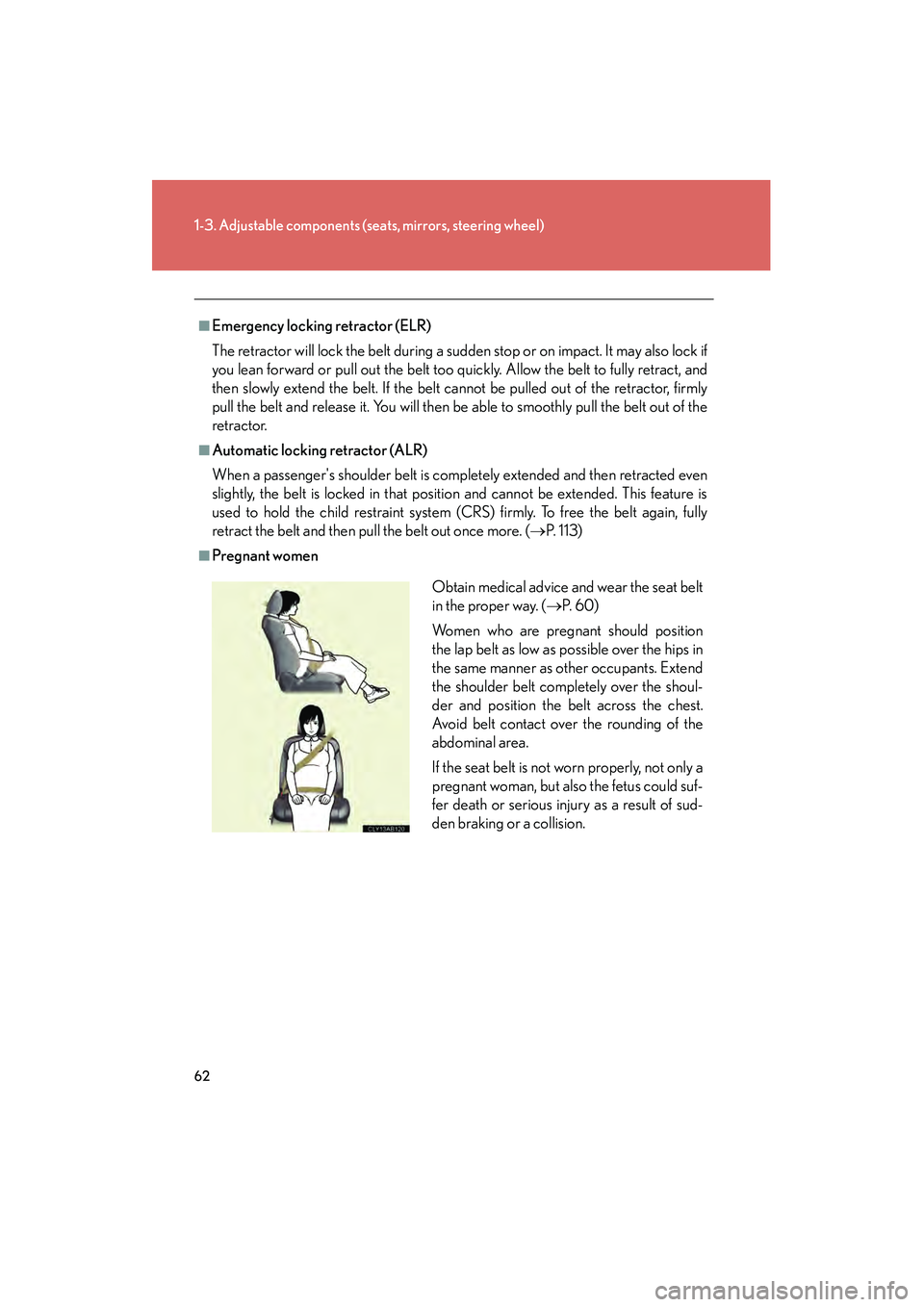
■Pregnant women
Obtain medical advice and wear the seat belt
in the proper way. (→P. 60)
Women who are pregnant should position
the lap belt as low as possible over the hips in
the same manner as other occupants. Extend
the shoulder belt completely over the shoul-
der and position the belt across the chest.
Avoid belt contact over the rounding of the
abdominal area.
If the seat belt is not worn properly, not only a
pregnant woman, but also the fetus could suf-
fer death or serious injury as a result of sud-
den braking or a collision.
Page 66 of 578
65
1-3. Adjustable components (seats, mirrors, steering wheel)
1
Before driving
IS350/250_U
CAUTION
■Child restraint lock function belt precaution
Do not allow children to play with the child restraint lock function belt. If the belt
becomes twisted around a child’s neck, it will not be possible to pull the belt out
leading to choking or other serious injuries that could result in death. If this occurs
and the buckle cannot be unfastened, scissors should be used to cut the belt.
■Seat belt damage and wear
Inappropriate handling of the pretensioner may prevent it from operating properly
resulting in death or serious injury.
●Do not damage the seat belts by allowing the belt, plate, or buckle to be jammed
in the door.
●Inspect the seat belt system periodically. Check for cuts, fraying, and loose parts.
Do not use a damaged seat belt until it is replaced. Damaged seat belts cannot
protect an occupant from death or serious injury.
●Ensure that the belt and tab are locked and the belt is not twisted.
If the seat belt does not function correctly, immediately contact your Lexus
dealer.
●Replace the seat assembly, including the belts, if your vehicle has been involved in
a serious accident, even if there's no obvious damage.
●Do not attempt to install, remove, modify, disassemble or dispose of the seat belts.
Have any necessary repairs carried out by your Lexus dealer.
■Using a seat belt extender
●Do not wear the seat belt extender if you can fasten the seat belt without the
extender.
●Do not use the seat belt extender when installing a child restraint system because
the belt will not securely hold the chil d restraint system, increasing the risk of
death or serious injury in the event of an accident.
●The personalized extender may not be safe on another vehicle, when used by
another person, or at a different seating position other than the one originally
intended.
Page 68 of 578
67
1
1-3. Adjustable components (seats, mirrors, steering wheel)
Before driving
IS350/250_U
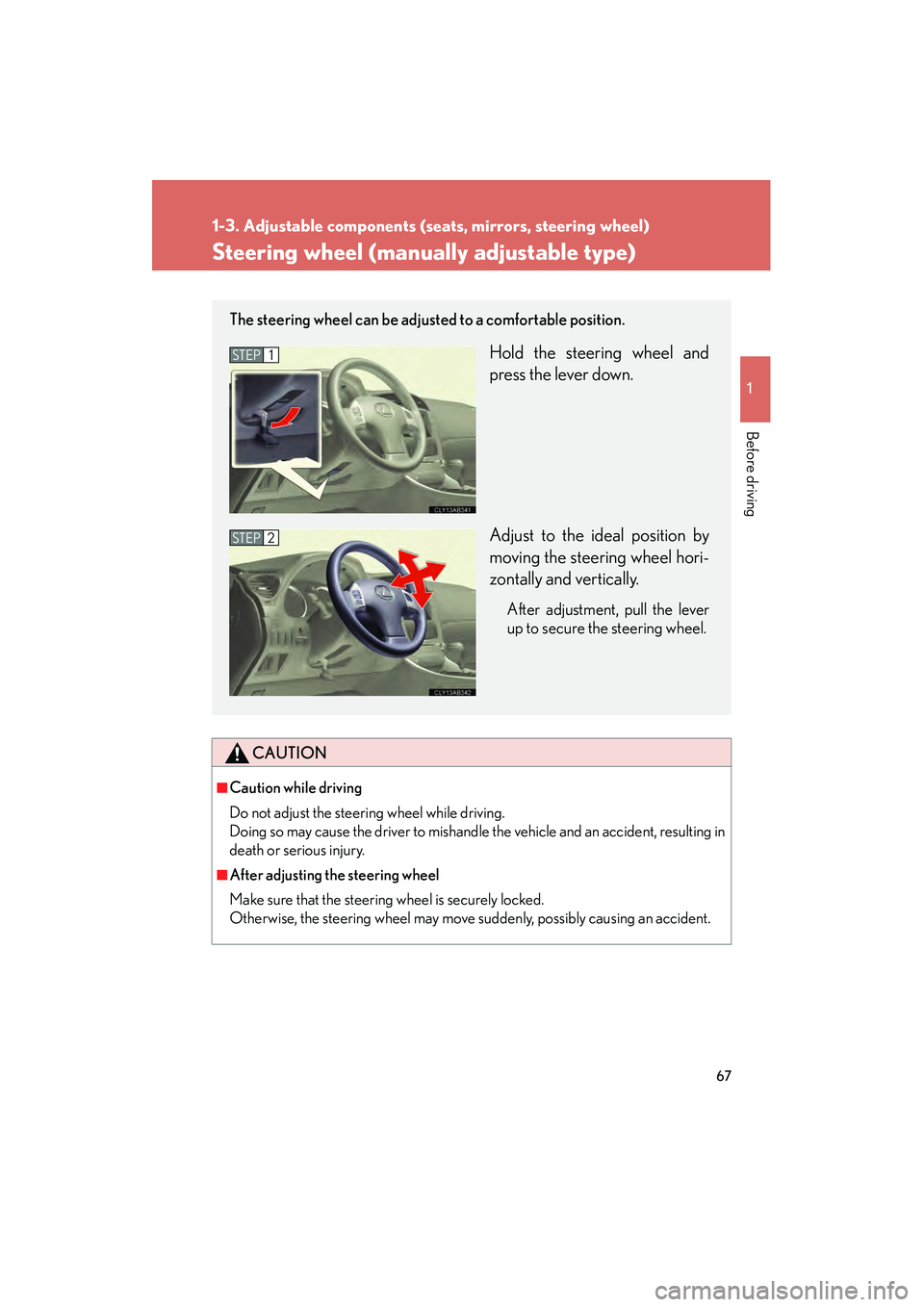
Steering wheel (manually adjustable type)
CAUTION
■Caution while driving
Do not adjust the steering wheel while driving.
Doing so may cause the driver to mishandle the vehicle and an accident, resulting in
death or serious injury.
■After adjusting the steering wheel
Make sure that the steering wheel is securely locked.
Otherwise, the steering wheel may move suddenly, possibly causing an accident.
The steering wheel can be adjusted to a comfortable position.
Hold the steering wheel and
press the lever down.
Adjust to the ideal position by
moving the steering wheel hori-
zontally and vertically.
After adjustment, pull the lever
up to secure the steering wheel.
STEP1
STEP2
Page 92 of 578
91
1
Before driving
IS350/250_U
1-7. Safety information
Correct driving posture
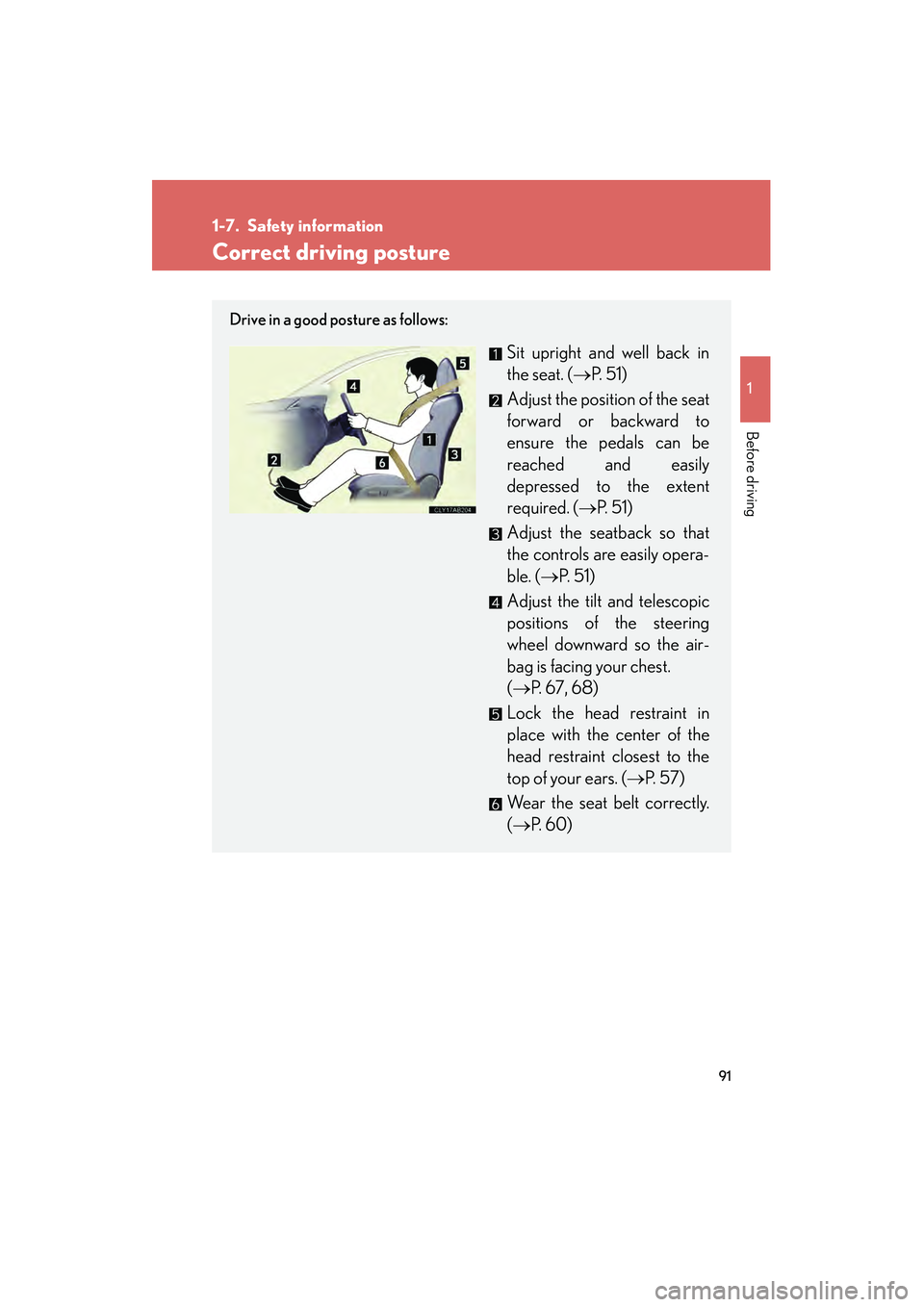
Drive in a good posture as follows:
Sit upright and well back in
the seat. (→P. 5 1 )
Adjust the position of the seat
forward or backward to
ensure the pedals can be
reached and easily
depressed to the extent
required. ( →P. 5 1 )
Adjust the seatback so that
the controls are easily opera-
ble. ( →P. 5 1 )
Adjust the tilt and telescopic
positions of the steering
wheel downward so the air-
bag is facing your chest.
(→ P. 6 7 , 6 8 )
Lock the head restraint in
place with the center of the
head restraint closest to the
top of your ears. ( →P. 5 7 )
Wear the seat belt correctly.
(→ P. 6 0 )
Page 138 of 578
137
2-1. Driving procedures
2
When driving
IS350/250_U
■If the engine does not start
The engine immobilizer system may not have been deactivated. (→P. 8 5 )
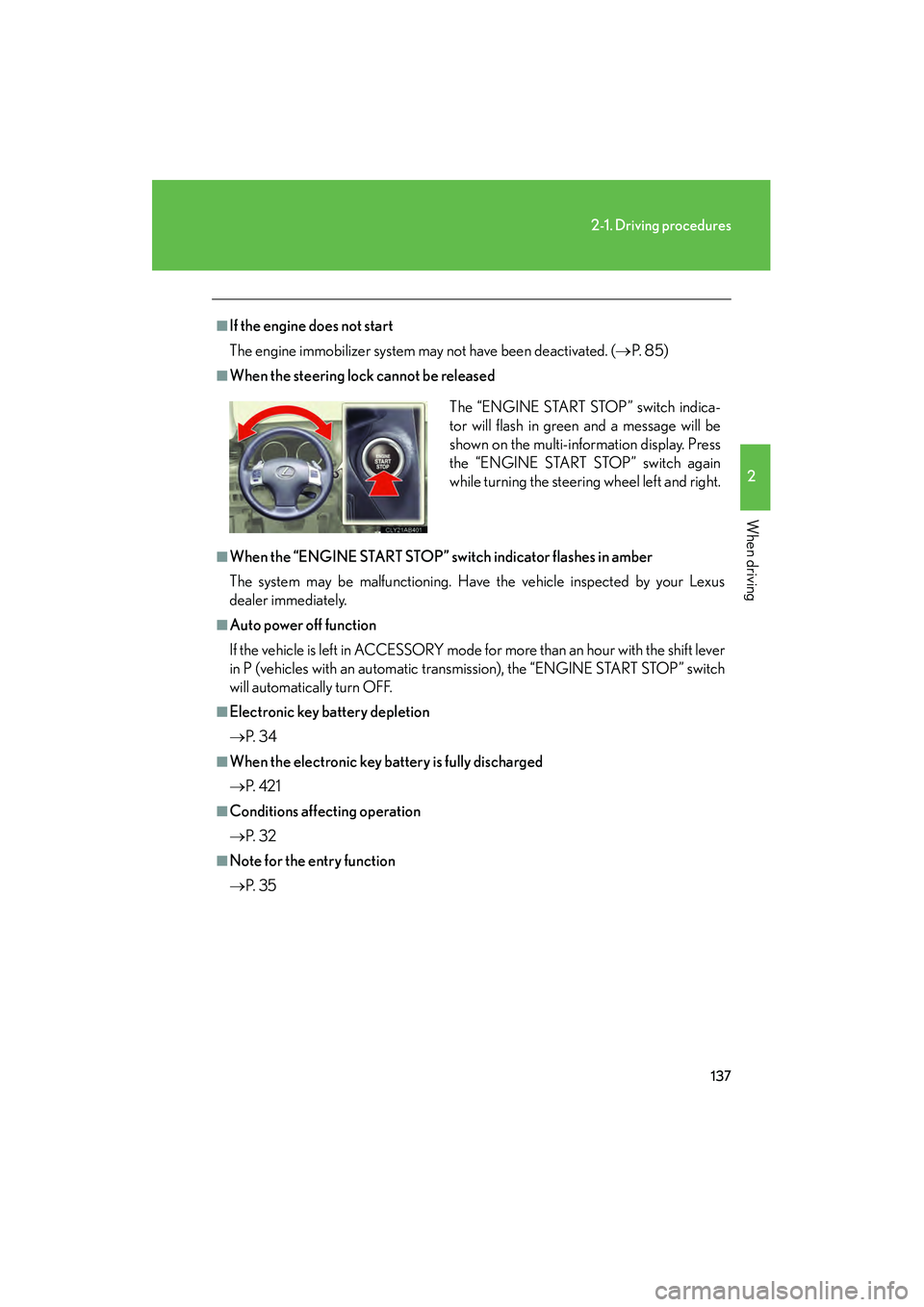
■When the steering lock cannot be released
■When the “ENGINE START STOP” switch indicator flashes in amber
The system may be malfunctioning. Have the vehicle inspected by your Lexus
dealer immediately.
■Auto power off function
If the vehicle is left in ACCESSORY mode for more than an hour with the shift lever
in P (vehicles with an automatic transmission), the “ENGINE START STOP” switch
will automatically turn OFF.
■Electronic key battery depletion
→P. 3 4
■When the electronic key battery is fully discharged
→P. 4 2 1
■Conditions affecting operation
→P. 3 2
■Note for the entry function
→P. 3 5 The “ENGINE START STOP” switch indica-
tor will flash in green and a message will be
shown on the multi-information display. Press
the “ENGINE START STOP” switch again
while turning the steering wheel left and right.
Page 151 of 578
150
2-1. Driving procedures
IS350/250_U
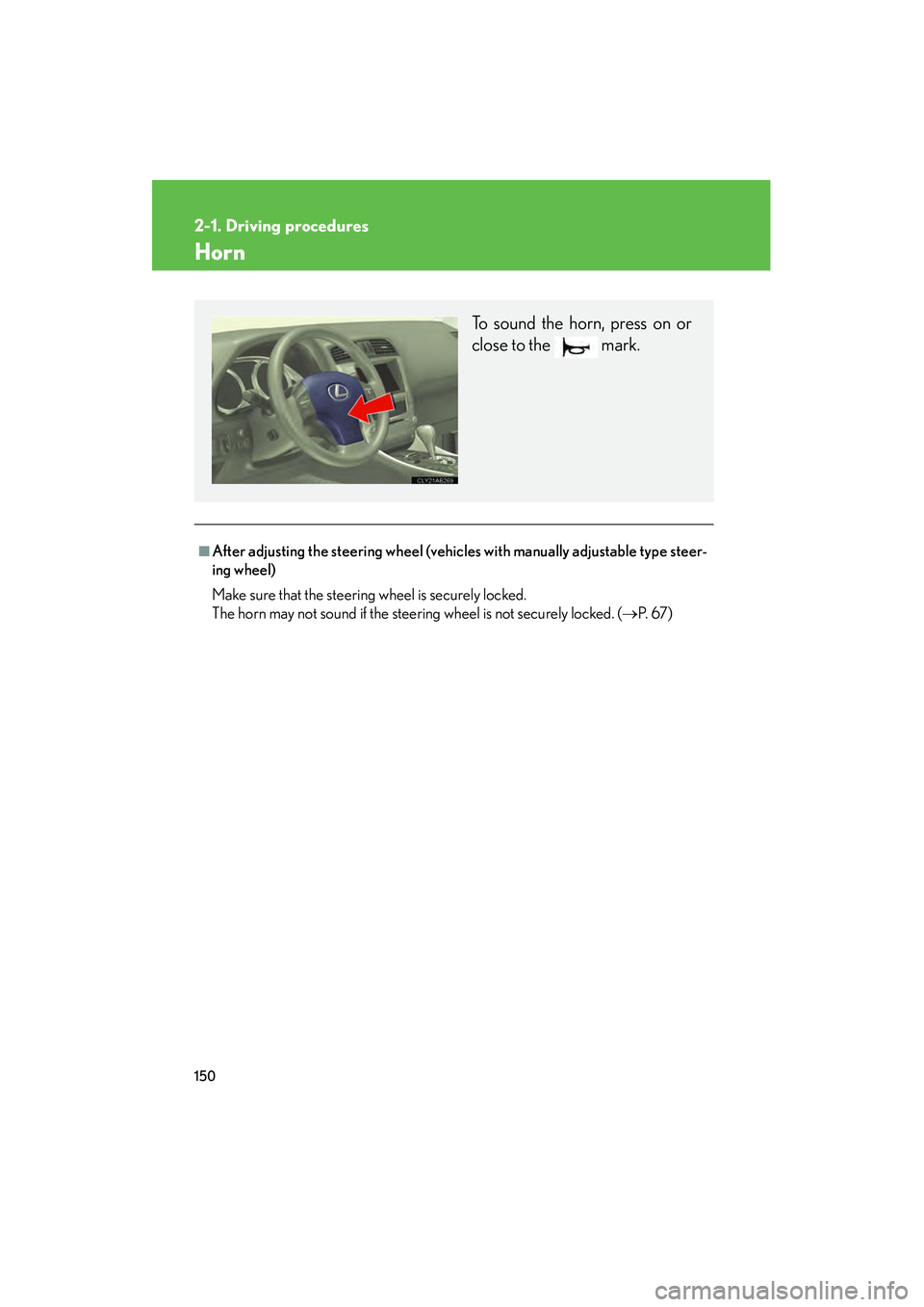
Horn
■After adjusting the steering wheel (vehicles with manually adjustable type steer-
ing wheel)
Make sure that the steering wheel is securely locked.
The horn may not sound if the steering wheel is not securely locked. (→P. 6 7 )
To sound the horn, press on or
close to the mark.
Page 186 of 578
185
2-4. Using other driving systems
2
When driving
IS350/250_U
Driving assist systems
To help enhance driving safety and performance, the following systems
operate automatically in response to various driving situations. Be aware,
however, that these systems are supplementary and should not be relied
upon too heavily when operating the vehicle.
■ ABS (Anti-lock Brake System)
Helps to prevent wheel lock when the brakes are applied suddenly, or if
the brakes are applied while driving on a slippery road surface.
■Brake assist
Generates an increased level of braking force after the brake pedal is
depressed, when the system detects a panic stop situation.
■VSC (Vehicle Stability Control)
Helps the driver to control skidding when swerving suddenly or turning on
slippery road surfaces.
■TRAC (Traction Control)
Maintains drive power and prevents the rear wheels (2WD models) or all
wheels (AWD models) from spinning wh en starting the vehicle or acceler-
ating on slippery roads.
■ Hill-start assist control (vehicles with an automatic transmission)
Helps to prevent the vehicle from rolling backward when starting on an
incline or slippery slope.
■EPS (Electric Power Steering)
Employs an electric motor to reduce the amount of effort needed to turn
the steering wheel.
Page 194 of 578
193
2-5. Driving information
2
When driving
IS350/250_U
CAUTION
■Things that must not be carried in the trunk
The following things may cause a fire if loaded in the trunk.
●Receptacles containing gasoline
●Aerosol cans
■Storage precautions
Observe the following precautions.
Failing to do so may result in death or serious injury.
●Do not place cargo or luggage in or on the following locations as the item may
get under the clutch, brake or accelerator pedal and prevent the pedals from
being depressed properly, block the driver's vision, or hit the driver or passen-
gers, causing an accident.
• The feet of the driver
• The front passenger or rear seats (when stacking items)
• The package tray
• The instrument panel
•The dashboard
●Secure all items in the occupant compartment, as they may shift and injure some-
one during sudden braking, sudden swerving or an accident.
■Capacity and distribution
●Do not exceed the maximum axle weight rating or the total vehicle weight rating.
●Even if the total load of occupant's weight and the cargo load is less than the total
load capacity, do not apply the load unevenly. Improper loading may cause dete-
rioration of steering or braking control which may cause death or serious injury.