CD Load Lexus IS250 2011 Owner's Guide
[x] Cancel search | Manufacturer: LEXUS, Model Year: 2011, Model line: IS250, Model: Lexus IS250 2011Pages: 578, PDF Size: 31.12 MB
Page 413 of 578
412
4-3. Do-it-yourself maintenance
IS350/250_U
Tire inflation pressure
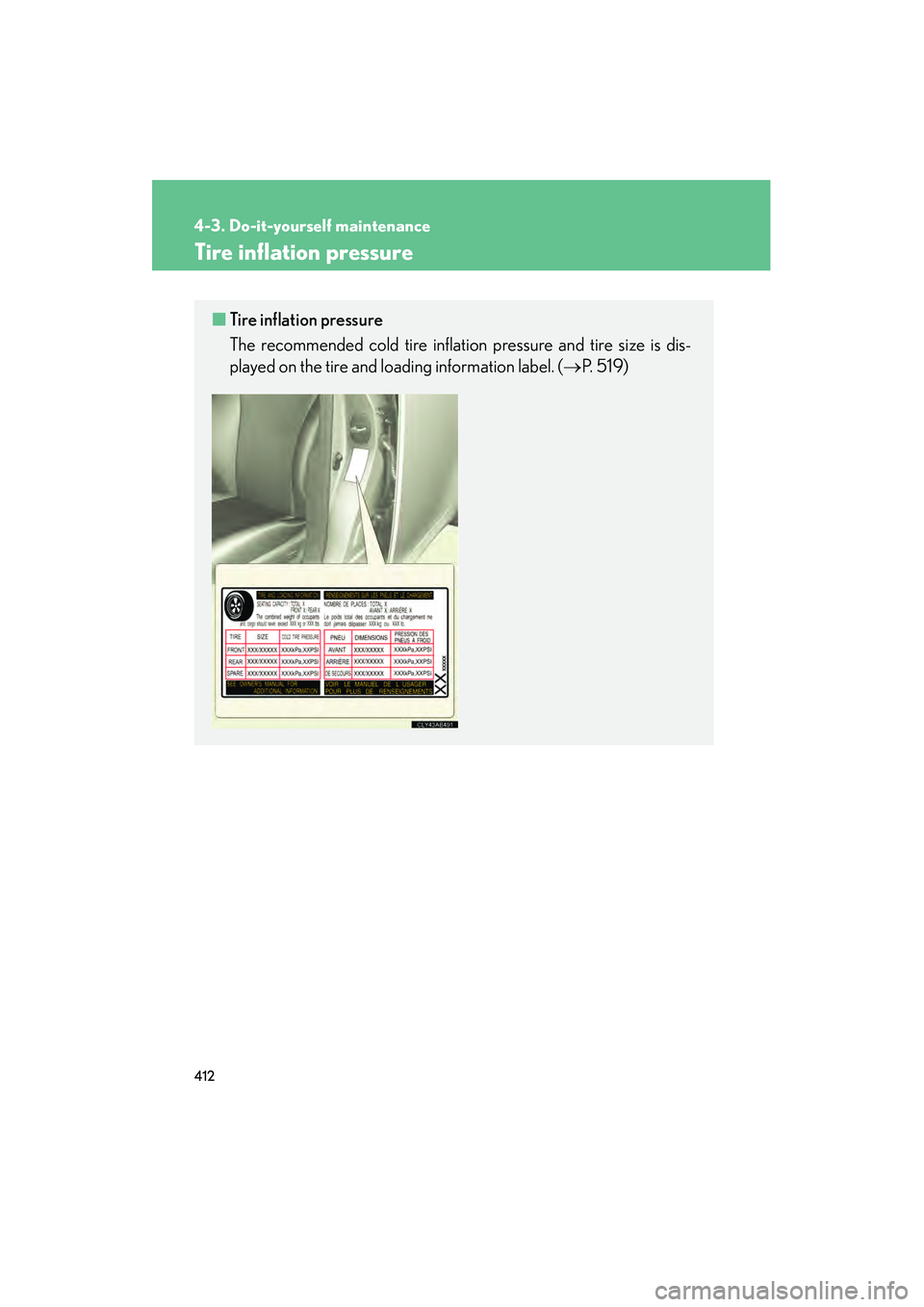
■Tire inflation pressure
The recommended cold tire inflation pressure and tire size is dis-
played on the tire and loading information label. ( →P. 5 1 9 )
Page 417 of 578
416
4-3. Do-it-yourself maintenance
IS350/250_U
Wheels
■When replacing wheels
The wheels of your Lexus are equipped with tire pressure warning valves and trans-
mitters that allow the tire pressure warning system to provide advanced warning in
the event of a loss in tire inflation pressure. Whenever wheels are replaced, the tire
pressure warning valves and transmitters must be installed. (→P. 4 0 2 )
If a wheel is bent, cracked or heavily corroded, it should be replaced. Oth-
erwise, the tire may separate from the wheel or cause loss of handling con-
trol.
■Wheel selection
When replacing wheels, care should be taken to ensure that they
are equivalent to those removed in load capacity, diameter, rim
width, and inset
*.
Replacement wheels are available at your Lexus dealer.
*: Conventionally referred to as “offset”.
Lexus does not recommend using:
● Wheels of different sizes or types
● Used wheels
● Bent wheels that have been straightened
■ Aluminum wheel precautions
● Use only Lexus wheel nuts and wrenches designed for use with
your aluminum wheels.
● When rotating, repairing or changing your tires, check that the
wheel nuts are still tight after driving 1000 miles (1600 km).
● Be careful not to damage the aluminum wheels when using tire
chains.
● Use only Lexus genuine balance weights or equivalent and a
plastic or rubber hammer when balancing your wheels.
Page 437 of 578
436
4-3. Do-it-yourself maintenance
IS350/250_U
■After a fuse is replaced
●If the lights do not turn on even after the fuse has been replaced, a bulb may
need replacement. (→P. 4 3 9 )
●If the replaced fuse blows again, have the vehicle inspected by your Lexus
dealer.
■If there is an overload in the circuits
The fuses are designed to blow, protecting the wiring harness from damage.
CAUTION
■To prevent system breakdowns and vehicle fire
Observe the following precautions.
Failing to do so may cause damage, and possibly a fire or injury.
●Never use a fuse of a higher amperage rating than indicated, or use any other
object in place of a fuse.
●Always use a genuine Lexus fuse or equivalent.
Never replace a fuse with a wire, even as a temporary fix.
This can cause extensive damage or even fire.
●Do not modify the fuses or the fuse box.
NOTICE
■Before replacing fuses
Have the cause of electrical overload determined and repaired by your Lexus
dealer.
Page 469 of 578

468
5-2. Steps to take in an emergency
IS350/250_U
CAUTION
■Maintenance of the tires
Each tire, including the spare (if provided), should be checked monthly when cold
and inflated to the inflation pressure recommended by the vehicle manufacturer on
the vehicle placard or tire inflation pressure label (tire and load information label).
(If your vehicle has tires of a different size than the size indicated on the vehicle
placard or tire inflation pressure label [tire and load information label], you should
determine the proper tire inflation pressure for those tires.)
As an added safety feature, your vehicle has been equipped with a tire pressure
monitoring system (TPMS-tire pressure warning system) that illuminates a low tire
pressure telltale (tire pressure warning light) when one or more of your tires is sig-
nificantly under-inflated. Accordingly, when the low tire pressure telltale (tire pres-
sure warning light) illuminates, you should stop and check your tires as soon as
possible, and inflate them to the proper pressure. Driving on a significantly under-
inflated tire causes the tire to overheat and can lead to tire failure. Under-inflation
also reduces fuel efficiency and tire tread life, and may affect the vehicle's handling
and stopping ability.
Please note that the TPMS (tire pressure warning system) is not a substitute for
proper tire maintenance, and it is the driver's responsibility to maintain correct tire
pressure, even if under-inflation has not reached the level to trigger illumination of
the TPMS low tire pressure telltale (tire pressure warning light).
Your vehicle has also been equipped with a TPMS (tire pressure warning system)
malfunction indicator to indicate when the system is not operating properly. The
TPMS (tire pressure warning system) malfunction indicator is combined with the
low tire pressure telltale (tire pressure warning light). When the system detects a
malfunction, the telltale will flash for approximately one minute and then remain
continuously illuminated. This sequence will continue upon subsequent vehicle
start-ups as long as the malfunction exists. When the malfunction indicator is illumi-
nated, the system may not be able to detect or signal low tire pressure as intended.
TPMS (tire pressure warning system) malfunctions may occur for a variety of rea-
sons, including the installation of replacement or alternate tires or wheels on the
vehicle that prevent the TPMS (tire pressure warning system) from functioning
properly. Always check the TPMS (tire pressure warning system) malfunction tell-
tale after replacing one or more tires or wheels on your vehicle to ensure that the
replacement or alternate tires and wheels allow the TPMS (tire pressure warning
system) to continue to function properly.
Page 514 of 578
513
6-1. Specifications
6
Vehicle specifications
IS350/250_U
The 0W portion of the oil viscosity rating indicates the characteristic of the oil
which allows cold startability. Oils with a lower value before the W allow for eas-
ier starting of the engine in cold weather.
The 20 in 0W-20 indicates the oil viscosity when the oil is at its operating tem-
perature. An oil with a higher viscosity may be better suited if the vehicle is oper-
ated at high speeds, or under extreme load conditions.
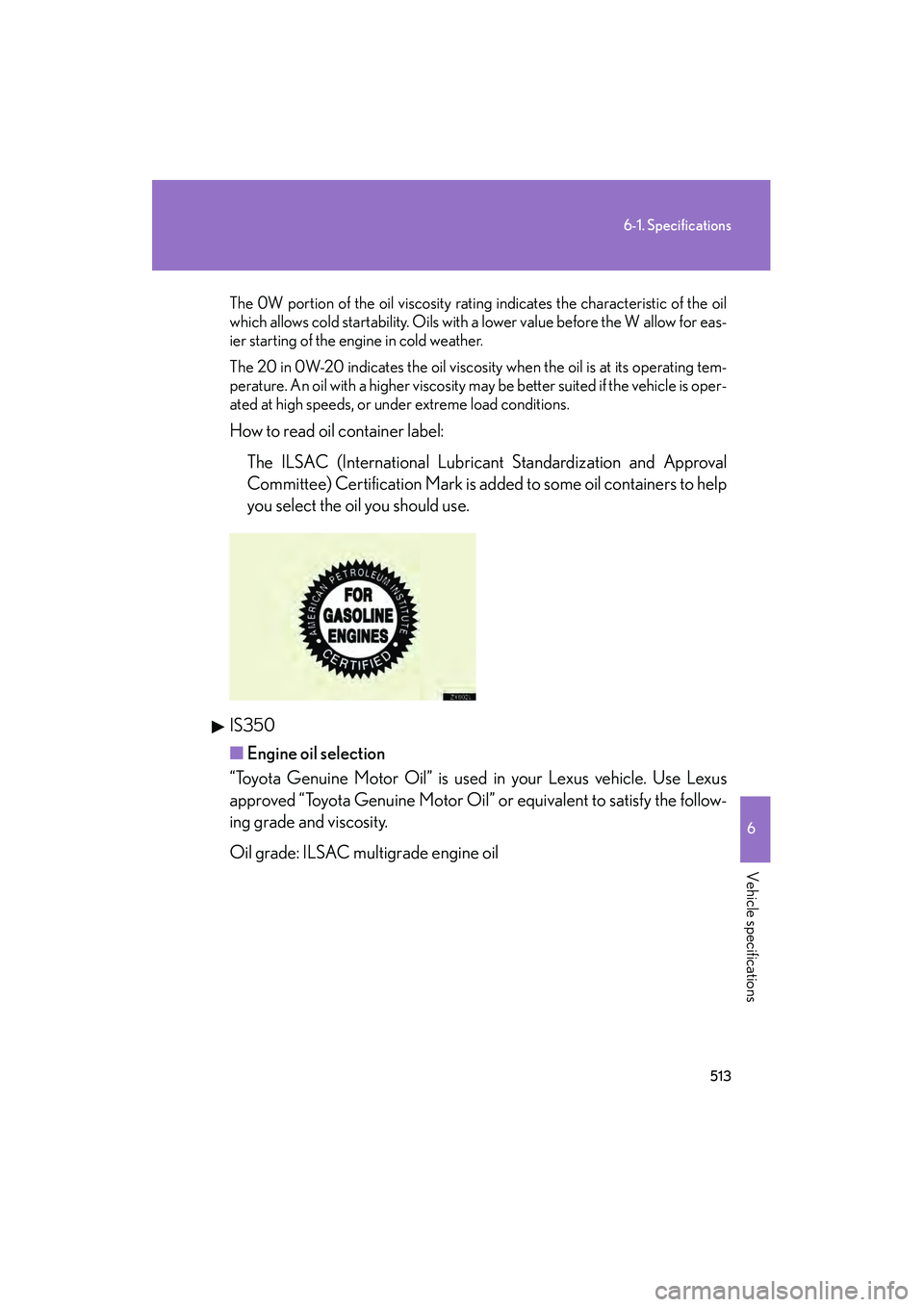
How to read oil container label:The ILSAC (International Lubricant Standardization and Approval
Committee) Certification Mark is added to some oil containers to help
you select the oil you should use.
IS350
■ Engine oil selection
“Toyota Genuine Motor Oil” is used in your Lexus vehicle. Use Lexus
approved “Toyota Genuine Motor Oil” or equivalent to satisfy the follow-
ing grade and viscosity.
Oil grade: ILSAC multigrade engine oil
Page 515 of 578
514
6-1. Specifications
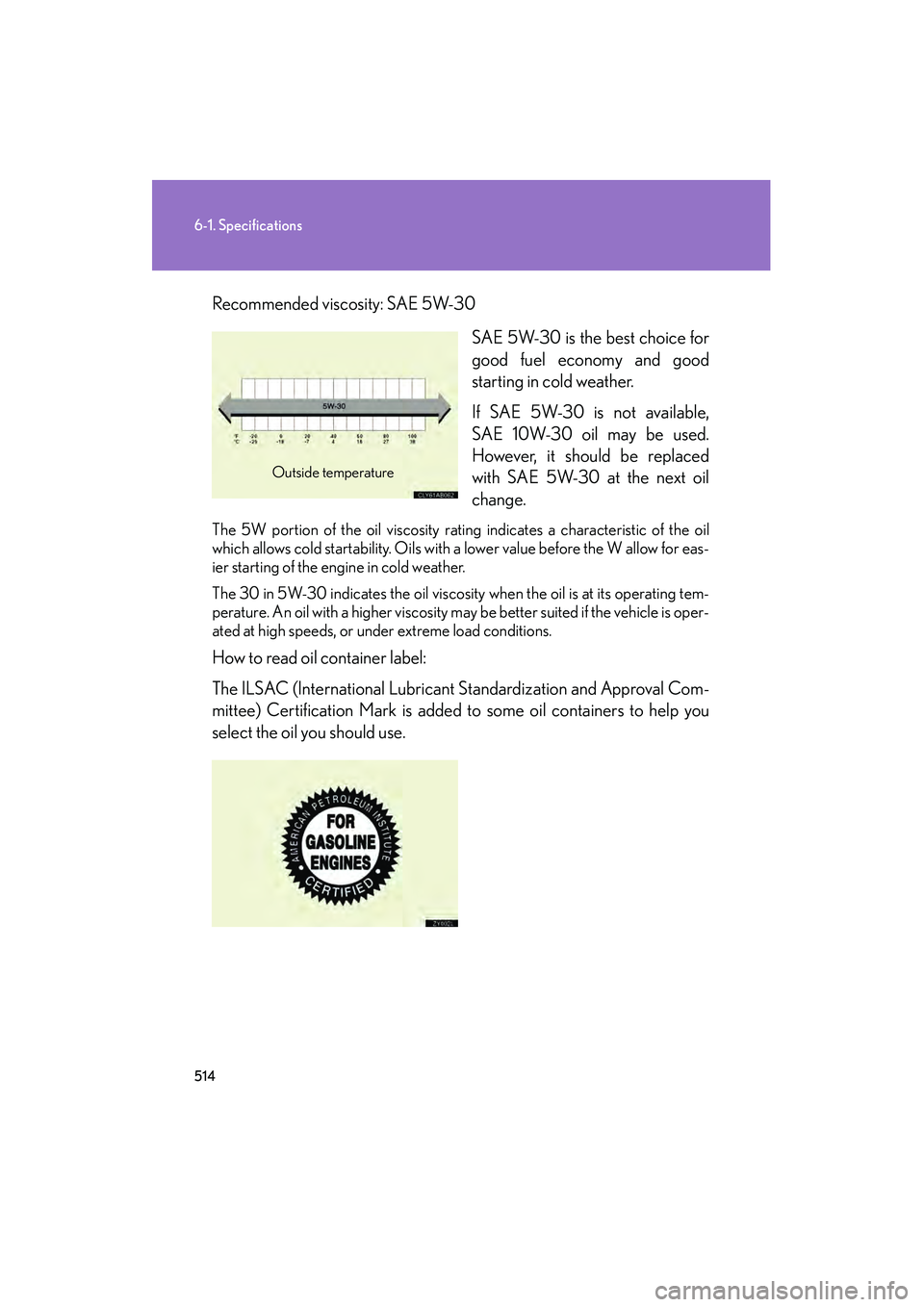
IS350/250_URecommended viscosity: SAE 5W-30
SAE 5W-30 is the best choice for
good fuel economy and good
starting in cold weather.
If SAE 5W-30 is not available,
SAE 10W-30 oil may be used.
However, it should be replaced
with SAE 5W-30 at the next oil
change.
The 5W portion of the oil viscosity rating indicates a characteristic of the oil
which allows cold startability. Oils with a lower value before the W allow for eas-
ier starting of the engine in cold weather.
The 30 in 5W-30 indicates the oil viscosity when the oil is at its operating tem-
perature. An oil with a higher viscosity may be better suited if the vehicle is oper-
ated at high speeds, or under extreme load conditions.
How to read oil container label:
The ILSAC (International Lubricant Standardization and Approval Com-
mittee) Certification Mark is added to some oil containers to help you
select the oil you should use.
Outside temperature
Page 530 of 578
529
6-1. Specifications
6
Vehicle specifications
IS350/250_U
Radial tires or bias-ply tires
A radial tire has “RADIAL” on the sidewall. A tire not marked “RADIAL” is
a bias-ply tire.
TUBELESS or TUBE TYPE
A tubeless tire does not have a tube and air is directly filled in the tire. A
tube type tire has a tube inside the tire and the tube maintains the air pres-
sure.
Load limit at maximum cold tire inflation pressure ( →P. 4 0 7 )
Maximum cold tire inflation pressure ( →P. 5 1 9 )
This means the pressure to which a tire may be inflated.
Uniform tire quality grading
For details, see “Uniform tire quality grading” that follows.
Summer tire or all season tire (→ P. 4 0 7 )
An all season tire has “M+S” on the sidewall. A tire not marked “M+S” is a
summer tire.
“TEMPORARY USE ONLY” (→ P. 485)
A compact spare tire is identified by the phrase “TEMPORARY USE
ONLY” molded into its sidewall. This tire is designed for temporary
emergency use only.
Page 531 of 578

530
6-1. Specifications
IS350/250_U
Typical DOT and tire iden tification number (TIN)
DOT symbol
*
Tire Identification Number (TIN)
Tire manufacturer's identifica-
tion mark
Tire size code
Manufacturer's optional tire
type code (3 or 4 letters)
Manufacturing week
Manufacturing year
*: The DOT symbol certifies thatthe tire conforms to applicable
Federal Motor Vehicle Safety
Standards.
Tire size
■ Typical tire size information
The illustration indicates typical
tire size.
Ti r e u s e
(P = Passenger car,
T = Temporary use)
Section width (millimeters)
Aspect ratio
(tire height to section width)
Tire construction code
(R = Radial, D = Diagonal)
Wheel diameter (inches)
Load index (2 or 3 digits)
Speed symbol
(alphabet with one letter)
Page 534 of 578

533
6-1. Specifications
6
Vehicle specifications
IS350/250_U■
Temperature A, B, C
The temperature grades are A (the highest), B, and C, representing
the tire's resistance to the generation of heat and its ability to dissipate
heat when tested under controlled conditions on a specified indoor
laboratory test wheel.
Sustained high temperature can cause the material of the tire to degenerate
and reduce tire life, and excessive temperature can lead to sudden tire fail-
ure.
The grade C corresponds to a level of performance which all passenger car
tires must meet under the Federal Motor Vehicle Safety Standard No. 109.
Grades B and A represent higher levels of performance on the laboratory
test wheel than the minimum required by law.
Warning: The temperature grades for this tire are established for a tire that
is properly inflated and not overloaded.
Excessive speed, underinflation, or excessive loading, either separately or in
combination, can cause heat buildup and possible tire failure.
Glossary of tire terminology
Tire related termMeaning
Accessory weight
The combined weight (in excess of those standard
items which may be replaced) of automatic transmis-
sion, power steering, power brakes, power windows,
power seats, radio and heater, to the extent that these
items are available as factory-installed equipment
(whether installed or not)
Cold tire inflation pres-
sureTire pressure when the vehicle has been parked for
three hours or more, or has not been driven more
than 1 mile or 1.5 km under that condition
Curb weight
The weight of a motor vehicle with standard equip-
ment, including the maximum capacity of fuel, oil and
coolant, and if so equipped, air conditioning and
additional weight optional engine
Page 535 of 578

534
6-1. Specifications
IS350/250_U
Maximum inflation pres-
sureThe maximum cold inflated pressure to which a tire
may be inflated, shown on the sidewall of the tire
Maximum loaded vehicle
weight
The sum of:
(a) Curb weight
(b) Accessory weight
(c) Vehicle capacity weight
(d) Production options weight
Normal occupant weight150 lb. (68 kg) times the number of occupants speci-
fied in the second column of Table 1
* that follows
Production options
weight
The combined weight of installed regular production
options weighing over 5 lb. (2.3 kg) in excess of the
standard items which they replace, not previously
considered in curb weight or accessory weight,
including heavy duty brakes, ride levelers, roof rack,
heavy duty battery, and special trim
Vehicle capacity weight
(Total load capacity)The rated cargo and luggage load plus 150 lb. (68
kg) times the vehicle's designated seating capacity
Occupant distributionDistribution of occupants in a vehicle as specified in
the third column of Table 1
* below
Recommended inflation
pressureCold tire inflation pressure recommended by a man-
ufacturer.
RimA metal support for a tire or a tire and tube assembly
upon which the tire beads are seated
Rim diameter
(Wheel diameter)Nominal diameter of the bead seat
Rim size designationRim diameter and width
Rim type designationThe industry manufacturer's designation for a rim by
style or code
Tire related termMeaning