ect Lexus IS250 2011 Owner's Manual
[x] Cancel search | Manufacturer: LEXUS, Model Year: 2011, Model line: IS250, Model: Lexus IS250 2011Pages: 578, PDF Size: 31.12 MB
Page 480 of 578
5
When trouble arises
479
5-2. Steps to take in an emergency
IS350/250_U
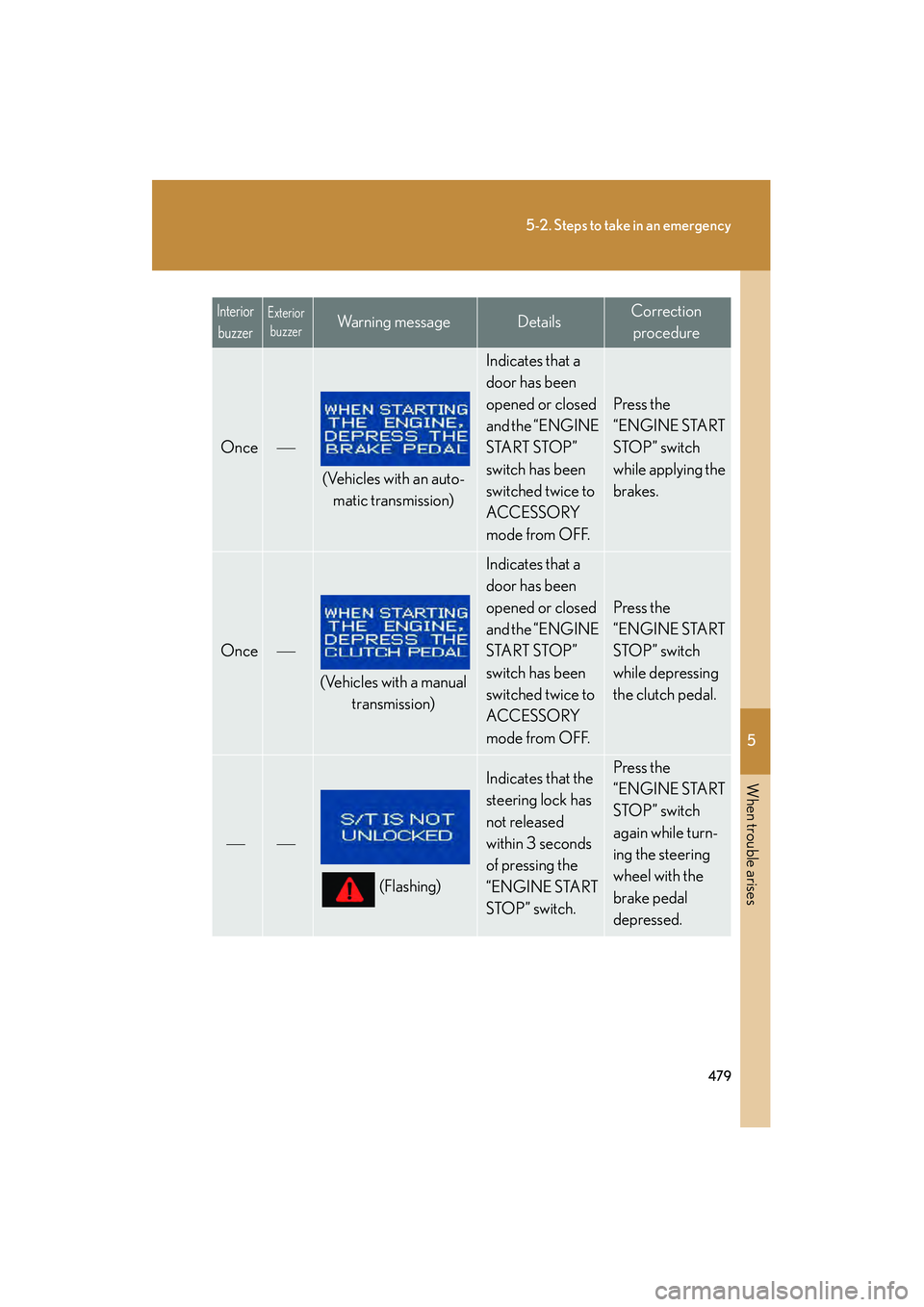
Once
(Vehicles with an auto-matic transmission)
Indicates that a
door has been
opened or closed
and the “ENGINE
START STOP”
switch has been
switched twice to
ACCESSO RY
mode from OFF.
Press the
“ENGINE START
STOP” switch
while applying the
brakes.
Once
(Vehicles with a manual
transmission)
Indicates that a
door has been
opened or closed
and the “ENGINE
START STOP”
switch has been
switched twice to
ACCESSO RY
mode from OFF.
Press the
“ENGINE START
STOP” switch
while depressing
the clutch pedal.
(Flashing)
Indicates that the
steering lock has
not released
within 3 seconds
of pressing the
“ENGINE START
STOP” switch.Press the
“ENGINE START
STOP” switch
again while turn-
ing the steering
wheel with the
brake pedal
depressed.
InteriorbuzzerExterior buzzerWa r n i n g m e s s a g eDetailsCorrection
procedure
Page 481 of 578
480
5-2. Steps to take in an emergency
IS350/250_U
*: If the engine does not start when the electronic key is inside the vehicle, theelectronic key battery may be depleted or there may be difficulties receiving the
signal from the key. ( →P. 3 2 )
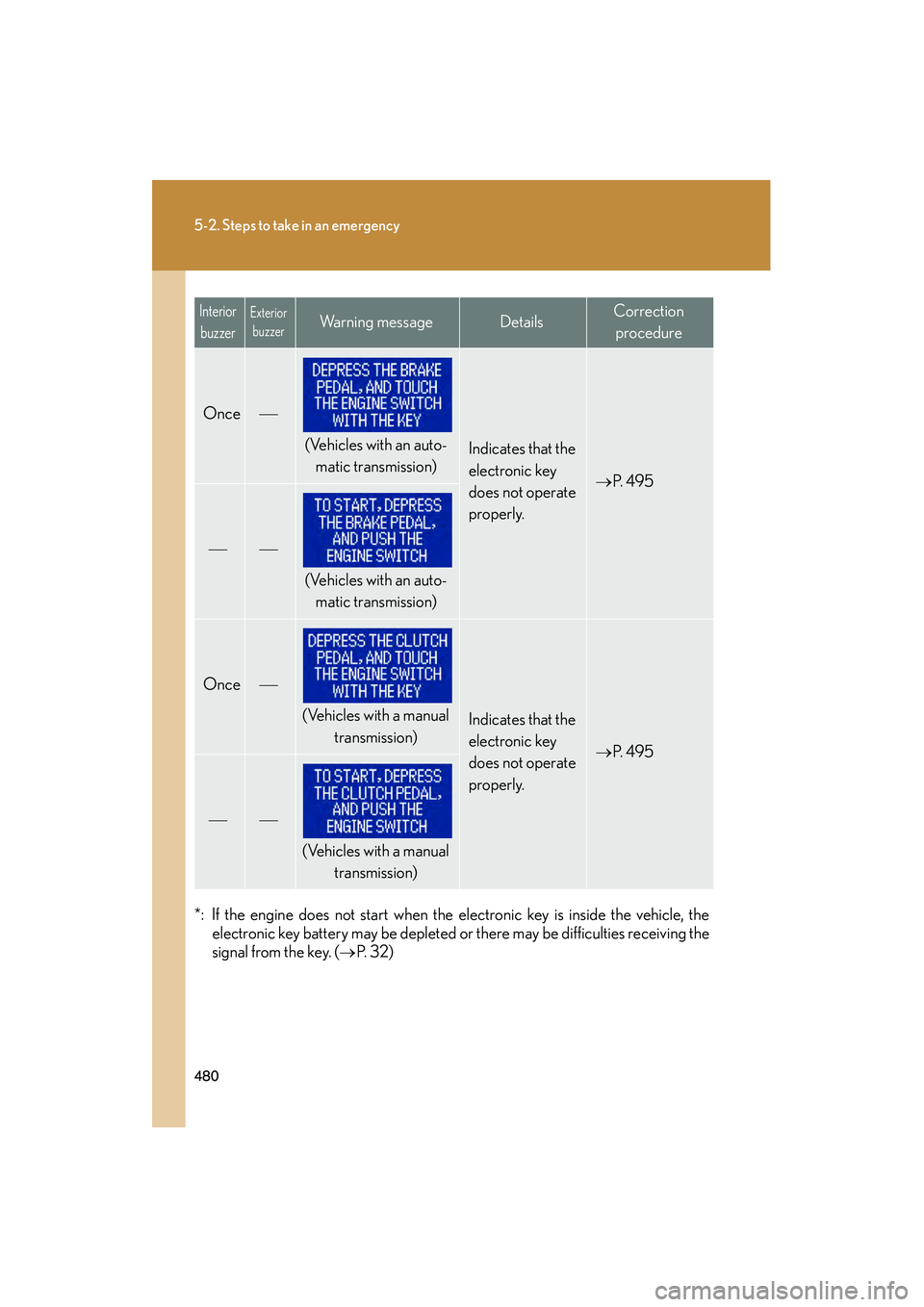
Once
(Vehicles with an auto-
matic transmission)Indicates that the
electronic key
does not operate
properly.
→ P. 4 9 5
(Vehicles with an auto-
matic transmission)
Once
(Vehicles with a manual
transmission)Indicates that the
electronic key
does not operate
properly.
→P. 4 9 5
(Vehicles with a manual
transmission)
InteriorbuzzerExterior buzzerWarning messageDetailsCorrection
procedure
Page 487 of 578
486
5-2. Steps to take in an emergency
IS350/250_U
■When using the compact spare tire
As the compact spare tire is not equipped with the tire pressure warning valve and
transmitter, low inflation pressure of the spare tire will not be indicated. Also, if you
replace the compact spare tire after the tire pressure warning light comes on, the
light remains on.
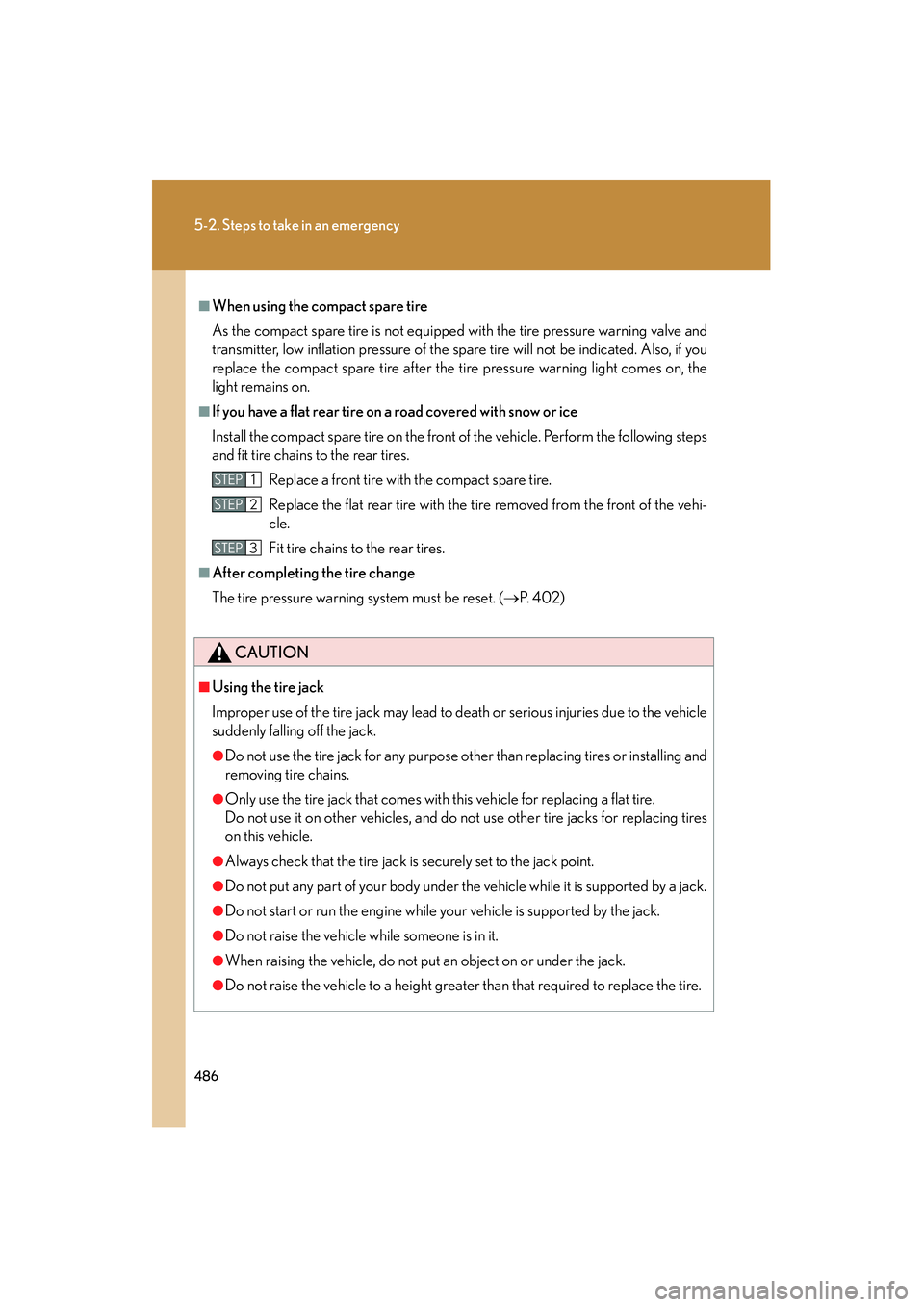
■If you have a flat rear tire on a road covered with snow or ice
Install the compact spare tire on the front of the vehicle. Perform the following steps
and fit tire chains to the rear tires.Replace a front tire with the compact spare tire.
Replace the flat rear tire with the tire removed from the front of the vehi-
cle.
Fit tire chains to the rear tires.
■After completing the tire change
The tire pressure warning system must be reset. ( →P. 4 0 2 )
CAUTION
■Using the tire jack
Improper use of the tire jack may lead to death or serious injuries due to the vehicle
suddenly falling off the jack.
●Do not use the tire jack for any purpose other than replacing tires or installing and
removing tire chains.
●Only use the tire jack that comes with this vehicle for replacing a flat tire.
Do not use it on other vehicles, and do not use other tire jacks for replacing tires
on this vehicle.
●Always check that the tire jack is securely set to the jack point.
●Do not put any part of your body under the vehicle while it is supported by a jack.
●Do not start or run the engine while your vehicle is supported by the jack.
●Do not raise the vehicle while someone is in it.
●When raising the vehicle, do not put an object on or under the jack.
●Do not raise the vehicle to a height greater than that required to replace the tire.
STEP1
STEP2
STEP3
Page 488 of 578
5
When trouble arises
487
5-2. Steps to take in an emergency
IS350/250_U
CAUTION
●Use a jack stand if it is necessary to get under the vehicle.
Take particular care when lowering the vehicle to ensure that no one working on or
near the vehicle may be injured.
■Replacing a flat tire
Observe the following precautions to reduce the risk of death or serious injury.
●Never use oil or grease on the wheel bolts or wheel nuts.
Oil and grease may cause the wheel nuts to be excessively tightened, leading to
bolt or disc wheel damage. In addition, the oil or grease can cause the wheel nuts
to loosen and the wheel may fall off, causing a serious accident. Remove any oil or
grease from the wheel bolts or wheel nuts.
●Have the wheel nuts tightened with a torque wrench to 76 ft•lbf (103 N•m, 10.5
kgf•m) as soon as possible after changing wheels.
Failure to follow these precautions could cause the nuts to loosen and the wheels
may fall off, which could lead to an accident causing death or serious injury.
■When using the spare tire
●Remember that your compact spare tire is specifically designed for use with your
vehicle. Do not use your compact spare tire on another vehicle.
●Do not use two compact spare tires simultaneously.
●Replace the compact spare tire with a standard tire as soon as possible.
●Avoid sudden acceleration, deceleration and braking, as well as sharp cornering.
■Speed limit when using the spare tire
Do not drive at speeds in excess of 50 mph (80 km/h) when a compact spare tire is
installed on the vehicle.
The compact spare tire is not designed for driving at high speeds. Failing to observe
this precaution may lead to an accident causing death or serious injury.
■When the spare tire is attached
The vehicle speed may not be correctly detected, and the following systems may
not operate correctly:
●ABS & brake assist
●VSC
●TRAC
Page 489 of 578

488
5-2. Steps to take in an emergency
IS350/250_U
CAUTION
●EPS
●VDIM
●Navigation system (if equipped)
●Intuitive parking assist (if equipped)
●Cruise control
Also, not only can the following system not be utilized fully, it may actually negatively
effect the drive-train components:
●AWD system (if equipped)
NOTICE
■Do not drive the vehicle with a flat tire.
Do not continue driving with a flat tire.
Driving even a short distance with a flat tire can damage the tire and the wheel
beyond repair.
■Be careful when driving over bumps with the compact spare tire installed on the
vehicle.
The vehicle becomes lower when driving with the compact spare tire compared to
when driving with standard tires. Be careful when driving over uneven road sur-
faces.
■Driving with tire chains and the compact spare tire
Do not fit tire chains to the compact spare tire.
Tire chains may damage the vehicle body and adversely affect driving performance.
■When replacing the tires
When removing or fitting the wheels, tires or the tire pressure warning valve and
transmitter, contact your Lexus dealer as the tire pressure warning valve and trans-
mitter may be damaged if not handled correctly.
■To avoid damage to the tire pressu re warning valves and transmitters
When a tire is repaired with liquid sealants, the tire pressure warning valve and
transmitter may not operate properly. If a liquid sealant is used, contact your Lexus
dealer or other qualified service shop as soon as possible. Make sure to replace the
tire pressure warning valve and transmitter when replacing the tire. ( →P. 4 0 2 )
Page 490 of 578
5
When trouble arises
489
5-2. Steps to take in an emergency
IS350/250_U
If the engine will not start
If the engine will not start even though correct starting procedures are
being followed (
→P. 134), consider each of the following points.
■The engine will not start even when the starter motor operates
normally.
One of the following may be the cause of the problem.
●There may not be sufficient fuel in the vehicle’s tank.
Refuel the vehicle.
● The engine may be flooded.
Try to restart the engine once more following correct starting
procedures. ( →P. 1 3 4 )
● There may be a malfunction in the engine immobilizer system.
(→ P. 8 5 )
■ The starter motor turns over slowly, the interior lights and head-
lights are dim, or the horn does not sound or sounds at a low vol-
ume.
One of the following may be the cause of the problem.
● The battery may be discharged. ( →P. 4 9 8 )
● The battery terminal connections may be loose or corroded.
■ The starter motor does not turn ov er, the interior lights and head-
lights do not turn on, or the horn does not sound.
One of the following may be the cause of the problem.
● One or both of the battery terminals may be disconnected.
● The battery may be discharged. ( →P. 4 9 8 )
● There may be a malfunction in the steering lock system.
Contact your Lexus dealer if the problem cannot be repaired, or if
repair procedures are unknown.
Page 492 of 578
5
When trouble arises
491
5-2. Steps to take in an emergency
IS350/250_U
If the shift lever cannot be shifted from P∗
If the shift lever cannot be shifted with your foot on the brake, there may be
a problem with the shift lock system (a system to prevent accidental opera-
tion of the shift lever). Have the vehicle inspected by your Lexus dealer
immediately.
The following steps may be used as an emergency measure to ensure that
the shift lever can be shifted.
Set the parking brake.
Turn the “ENGINE START STOP” switch to ACCESSORY
mode.
Depress the brake pedal.
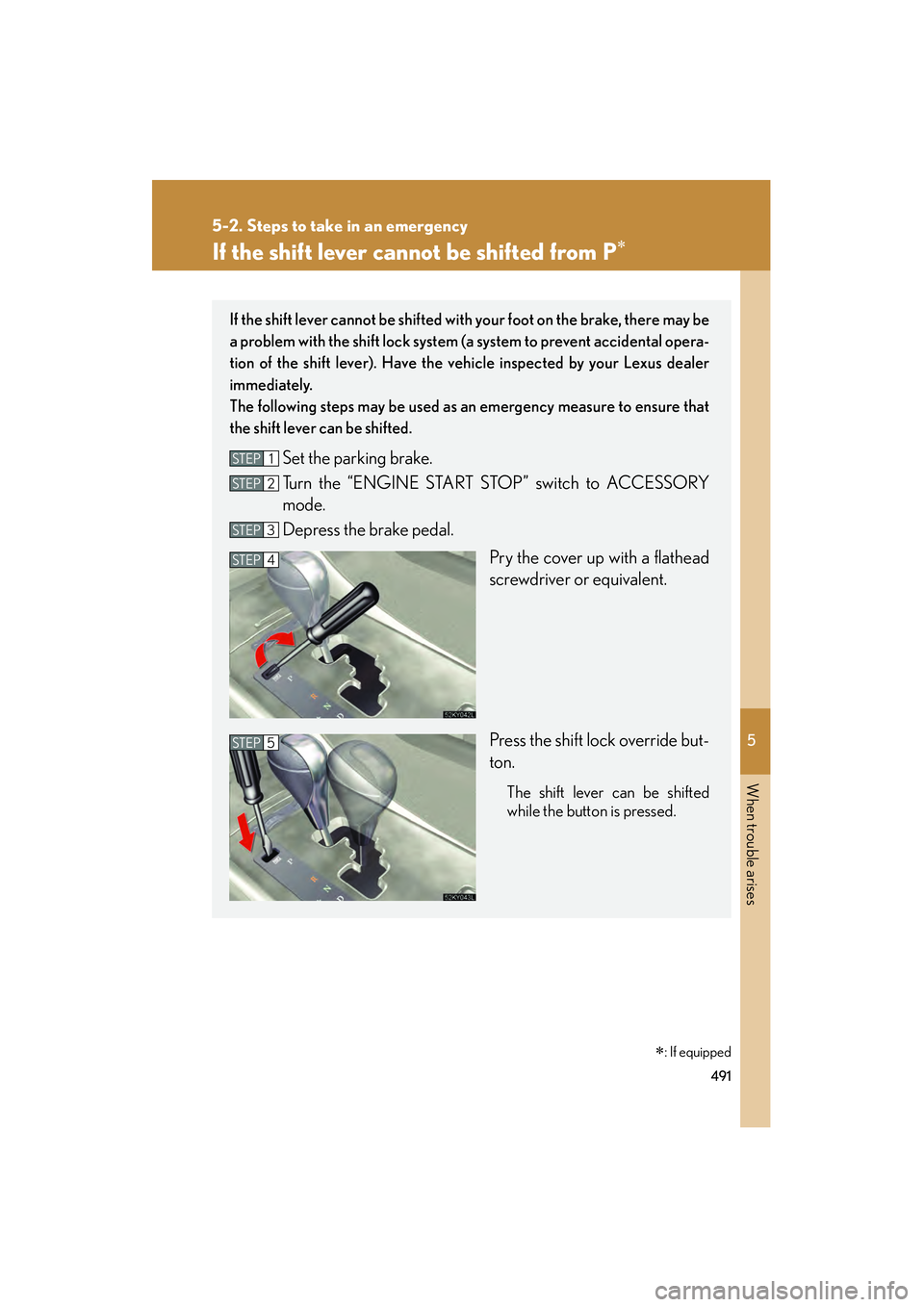
Pry the cover up with a flathead
screwdriver or equivalent.
Press the shift lock override but-
ton.
The shift lever can be shifted
while the button is pressed.
STEP1
STEP2
STEP3
STEP4
STEP5
∗: If equipped
Page 494 of 578
5
When trouble arises
493
5-2. Steps to take in an emergency
IS350/250_U
If the electronic key does not operate properly
Locking and unlocking the doors, unlocking the trunk and key linked functions
Use the mechanical key built in to the electronic keys to operate the
doors. (→P. 2 5 )
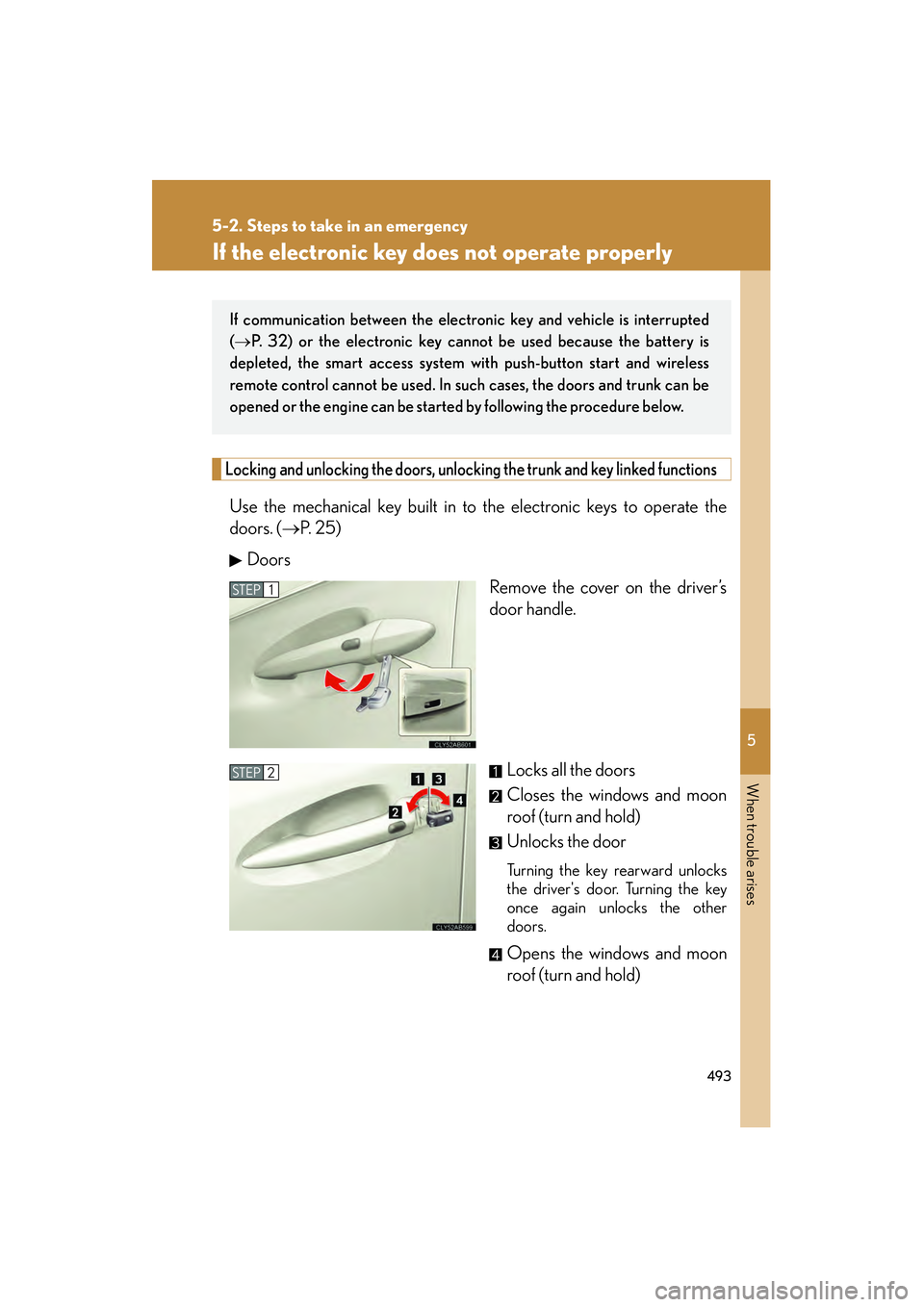
Doors Remove the cover on the driver’s
door handle.
Locks all the doors
Closes the windows and moon
roof (turn and hold)
Unlocks the door
Turning the key rearward unlocks
the driver's door. Turning the key
once again unlocks the other
doors.
Opens the windows and moon
roof (turn and hold)
If communication between the electronic key and vehicle is interrupted
(→ P. 32) or the electronic key cann ot be used because the battery is
depleted, the smart access system with push-button start and wireless
remote control cannot be used. In such cases, the doors and trunk can be
opened or the engine can be started by following the procedure below.
STEP1
STEP2
Page 496 of 578
5
When trouble arises
495
5-2. Steps to take in an emergency
IS350/250_U
Changing “ENGINE START STOP” switch modes and starting the engine
Automatic transmissionShift the shift lever to P and apply the brakes.
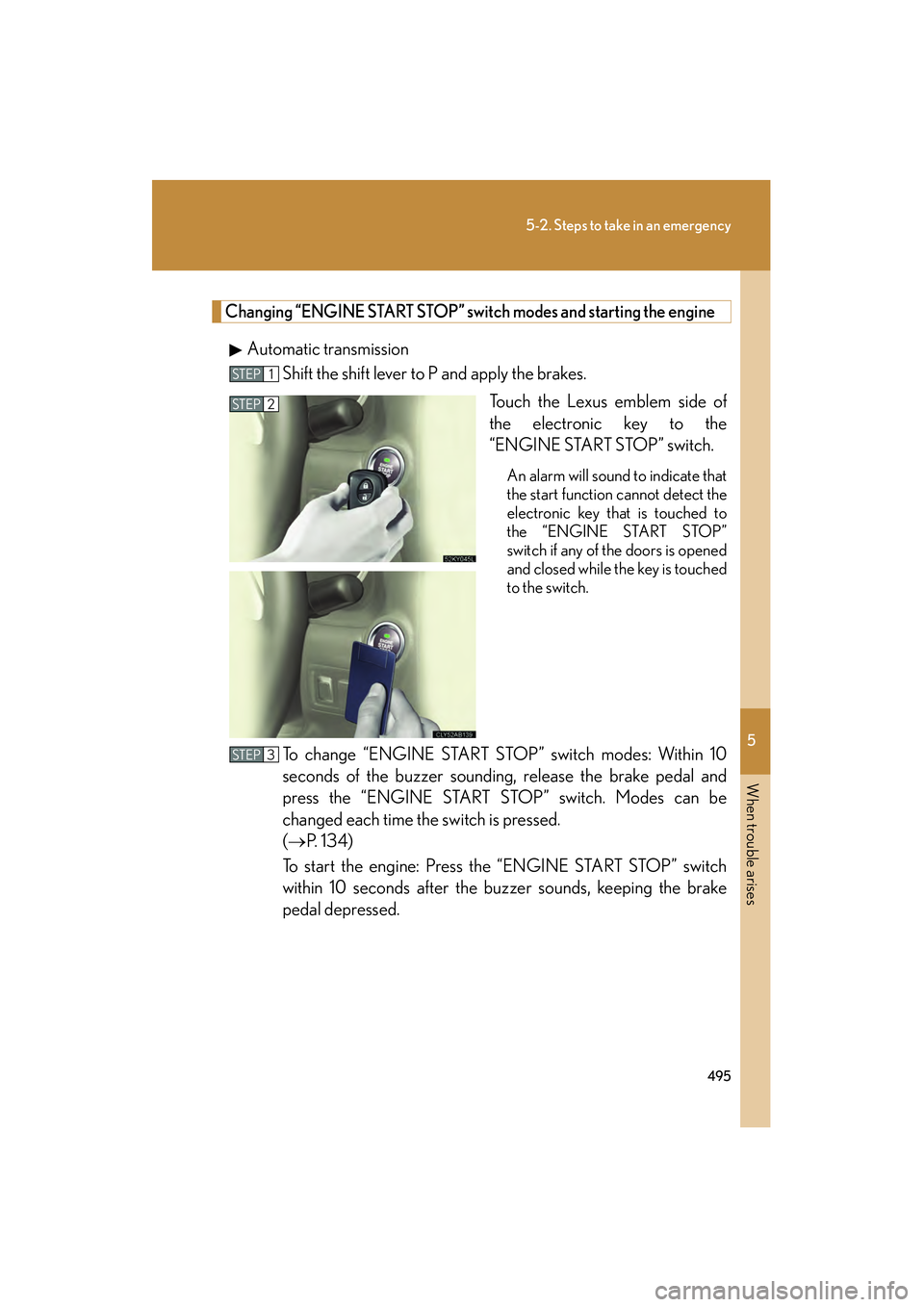
Touch the Lexus emblem side of
the electronic key to the
“ENGINE START STOP” switch.
An alarm will sound to indicate that
the start function cannot detect the
electronic key that is touched to
the “ENGINE START STOP”
switch if any of the doors is opened
and closed while the key is touched
to the switch.
To change “ENGINE START STOP” switch modes: Within 10
seconds of the buzzer sounding, release the brake pedal and
press the “ENGINE START STOP” switch. Modes can be
changed each time the switch is pressed.
(→P. 1 3 4 )
To start the engine: Press the “ENGINE START STOP” switch
within 10 seconds after the buzzer sounds, keeping the brake
pedal depressed.
STEP1
STEP2
STEP3
Page 497 of 578
496
5-2. Steps to take in an emergency
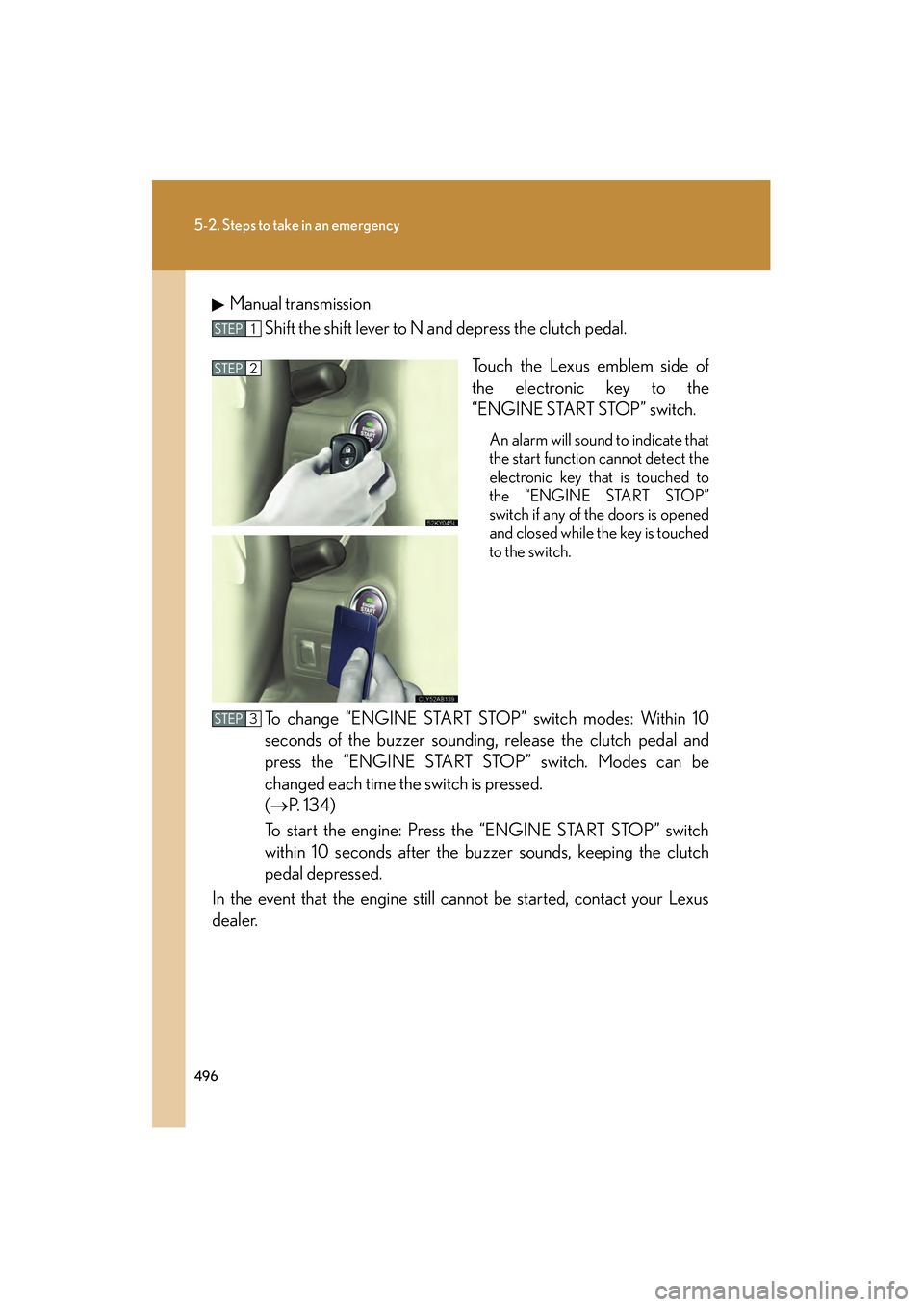
IS350/250_UManual transmission
Shift the shift lever to N and depress the clutch pedal.
Touch the Lexus emblem side of
the electronic key to the
“ENGINE START STOP” switch.
An alarm will sound to indicate that
the start function cannot detect the
electronic key that is touched to
the “ENGINE START STOP”
switch if any of the doors is opened
and closed while the key is touched
to the switch.
To change “ENGINE START ST OP” switch modes: Within 10
seconds of the buzzer sounding, release the clutch pedal and
press the “ENGINE START STOP” switch. Modes can be
changed each time the switch is pressed.
(→ P. 1 3 4 )
To start the engine: Press the “ENGINE START STOP” switch
within 10 seconds after the buzzer sounds, keeping the clutch
pedal depressed.
In the event that the engine still cannot be started, contact your Lexus
dealer.
STEP1
STEP2
STEP3