fuel Lexus IS250 2011 Owner's Guide
[x] Cancel search | Manufacturer: LEXUS, Model Year: 2011, Model line: IS250, Model: Lexus IS250 2011Pages: 578, PDF Size: 31.12 MB
Page 464 of 578
5
When trouble arises
463
5-2. Steps to take in an emergency
IS350/250_U
Follow the correction procedures.After taking the specified steps to co rrect the suspected problem, check
that the warning light turns off.
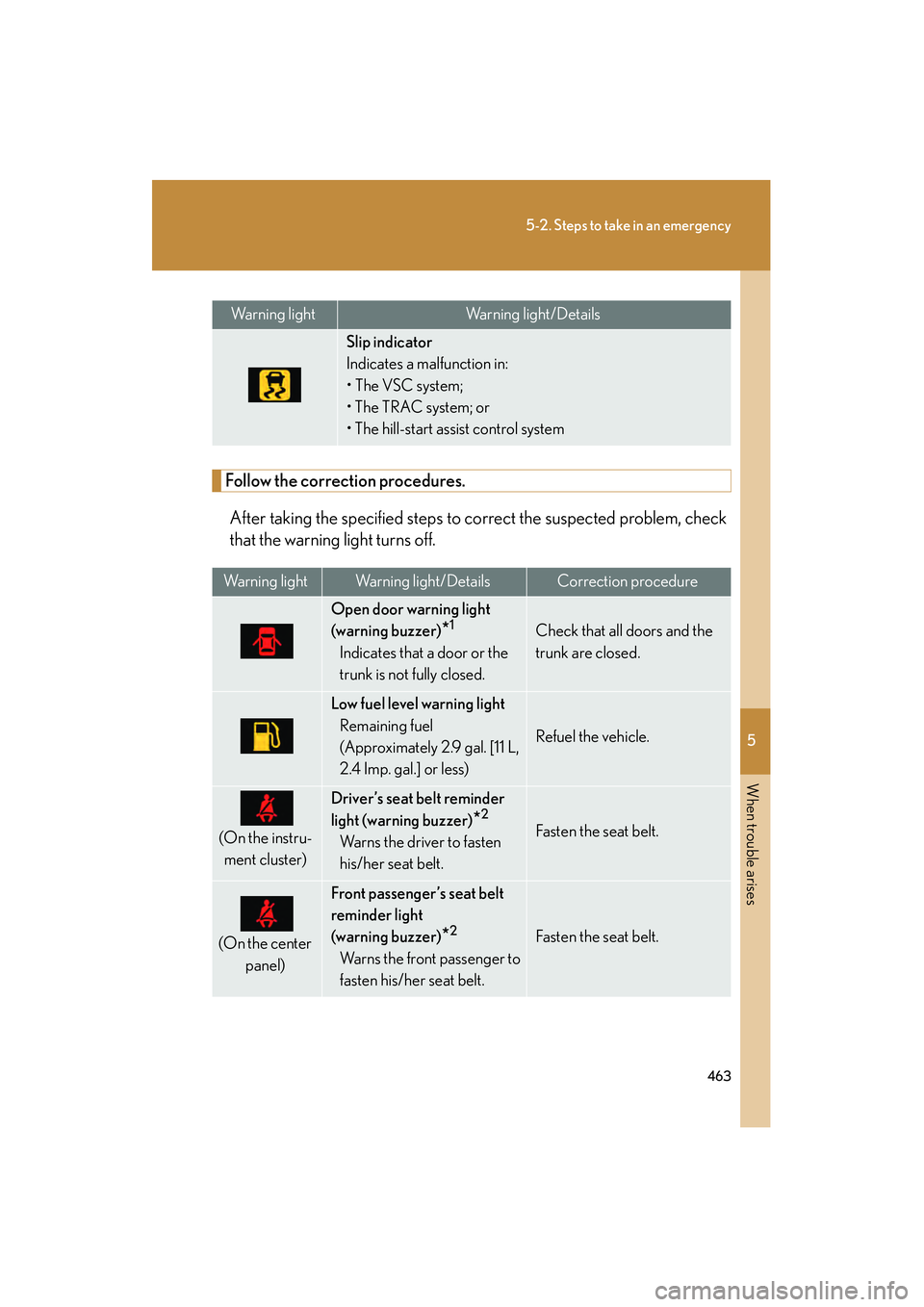
Warning lightWarning light/Details
Slip indicator
Indicates a malfunction in:
• The VSC system;
• The TRAC system; or
• The hill-start assist control system
Warning lightWarning light/DetailsCorrection procedure
Open door warning light
(warning buzzer)
*1
Indicates that a door or the
trunk is not fully closed.
Check that all doors and the
trunk are closed.
Low fuel level warning light
Remaining fuel
(Approximately 2.9 gal. [11 L,
2.4 Imp. gal.] or less)
Refuel the vehicle.
(On the instru-ment cluster)
Driver’s seat belt reminder
light (warning buzzer)
*2
Warns the driver to fasten
his/her seat belt.Fasten the seat belt.
(On the center
panel)
Front passenger’s seat belt
reminder light
(warning buzzer)
*2
Warns the front passenger to
fasten his/her seat belt.
Fasten the seat belt.
Page 466 of 578

5
When trouble arises
465
5-2. Steps to take in an emergency
IS350/250_U
■If the malfunction indicator lamp comes on while driving
First check the following:
●Is the fuel tank empty?
If it is, fill the fuel tank immediately.
●Is the fuel tank cap loose?
If it is, tighten it securely.
The lamp will go off after taking several driving trips.
If the lamp does not go off even after several trips, contact your Lexus dealer as
soon as possible.
■Electric power steering warning light
When the battery is low or when the voltage drops temporarily, the electric power
steering warning light may come on.
■Front passenger detection sensor and pass enger seat belt reminder and warning
buzzer
●If luggage is placed on the front passenger seat, the front passenger detection
sensor may cause the warning light to flash and the warning buzzer to sound,
even if a passenger is not sitting in the seat.
●If a cushion is placed on the seat, the sensor may not detect a passenger, and the
warning light may not operate properly.
■When the tire pressure warning light comes on
Check the tire inflation pressure and adjust to the appropriate level. Pressing the
satellite switch does not turn off the tire pressure warning light.
■The tire pressure warning light may turn on due to natural causes
The tire pressure warning light may turn on due to natural causes such as natural air
leaks or tire inflation pressure changes caused by temperature. In this case, adjust-
ing the tire inflation pressure will turn off the warning light (after a few minutes).
■When a tire is replaced with a spare tire
The compact spare tire is not equipped with the tire pressure warning valve and
transmitter. If a tire goes flat, the tire pressure warning light will not turn off even
though the flat tire is replaced with the spare tire. Replace the spare tire with the
repaired tire and adjust the proper tire inflation pressure. The tire pressure warning
light will turn off after a few minutes.
Page 469 of 578

468
5-2. Steps to take in an emergency
IS350/250_U
CAUTION
■Maintenance of the tires
Each tire, including the spare (if provided), should be checked monthly when cold
and inflated to the inflation pressure recommended by the vehicle manufacturer on
the vehicle placard or tire inflation pressure label (tire and load information label).
(If your vehicle has tires of a different size than the size indicated on the vehicle
placard or tire inflation pressure label [tire and load information label], you should
determine the proper tire inflation pressure for those tires.)
As an added safety feature, your vehicle has been equipped with a tire pressure
monitoring system (TPMS-tire pressure warning system) that illuminates a low tire
pressure telltale (tire pressure warning light) when one or more of your tires is sig-
nificantly under-inflated. Accordingly, when the low tire pressure telltale (tire pres-
sure warning light) illuminates, you should stop and check your tires as soon as
possible, and inflate them to the proper pressure. Driving on a significantly under-
inflated tire causes the tire to overheat and can lead to tire failure. Under-inflation
also reduces fuel efficiency and tire tread life, and may affect the vehicle's handling
and stopping ability.
Please note that the TPMS (tire pressure warning system) is not a substitute for
proper tire maintenance, and it is the driver's responsibility to maintain correct tire
pressure, even if under-inflation has not reached the level to trigger illumination of
the TPMS low tire pressure telltale (tire pressure warning light).
Your vehicle has also been equipped with a TPMS (tire pressure warning system)
malfunction indicator to indicate when the system is not operating properly. The
TPMS (tire pressure warning system) malfunction indicator is combined with the
low tire pressure telltale (tire pressure warning light). When the system detects a
malfunction, the telltale will flash for approximately one minute and then remain
continuously illuminated. This sequence will continue upon subsequent vehicle
start-ups as long as the malfunction exists. When the malfunction indicator is illumi-
nated, the system may not be able to detect or signal low tire pressure as intended.
TPMS (tire pressure warning system) malfunctions may occur for a variety of rea-
sons, including the installation of replacement or alternate tires or wheels on the
vehicle that prevent the TPMS (tire pressure warning system) from functioning
properly. Always check the TPMS (tire pressure warning system) malfunction tell-
tale after replacing one or more tires or wheels on your vehicle to ensure that the
replacement or alternate tires and wheels allow the TPMS (tire pressure warning
system) to continue to function properly.
Page 490 of 578
5
When trouble arises
489
5-2. Steps to take in an emergency
IS350/250_U
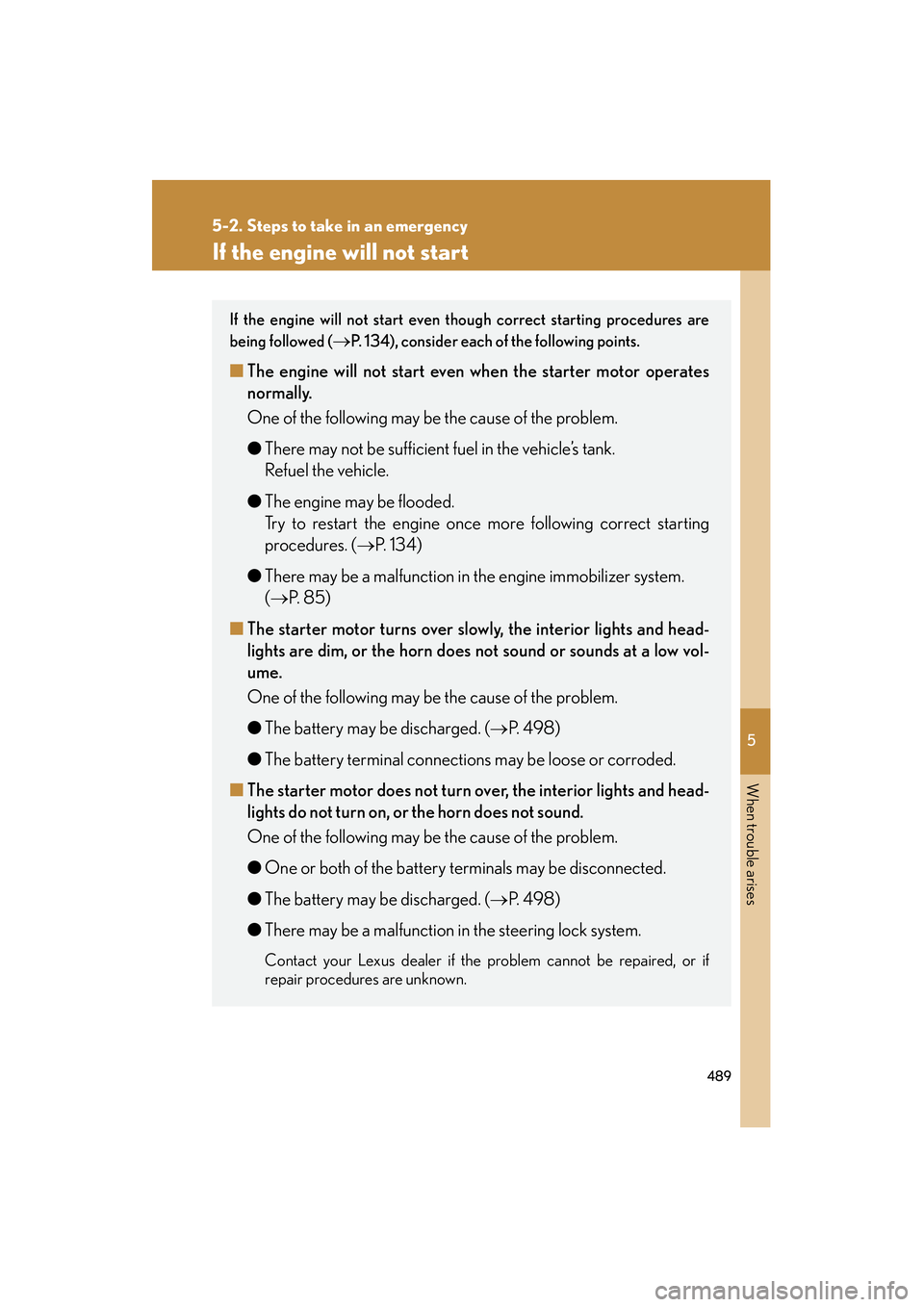
If the engine will not start
If the engine will not start even though correct starting procedures are
being followed (
→P. 134), consider each of the following points.
■The engine will not start even when the starter motor operates
normally.
One of the following may be the cause of the problem.
●There may not be sufficient fuel in the vehicle’s tank.
Refuel the vehicle.
● The engine may be flooded.
Try to restart the engine once more following correct starting
procedures. ( →P. 1 3 4 )
● There may be a malfunction in the engine immobilizer system.
(→ P. 8 5 )
■ The starter motor turns over slowly, the interior lights and head-
lights are dim, or the horn does not sound or sounds at a low vol-
ume.
One of the following may be the cause of the problem.
● The battery may be discharged. ( →P. 4 9 8 )
● The battery terminal connections may be loose or corroded.
■ The starter motor does not turn ov er, the interior lights and head-
lights do not turn on, or the horn does not sound.
One of the following may be the cause of the problem.
● One or both of the battery terminals may be disconnected.
● The battery may be discharged. ( →P. 4 9 8 )
● There may be a malfunction in the steering lock system.
Contact your Lexus dealer if the problem cannot be repaired, or if
repair procedures are unknown.
Page 508 of 578
Vehicle specifications6
507
IS350/250_U
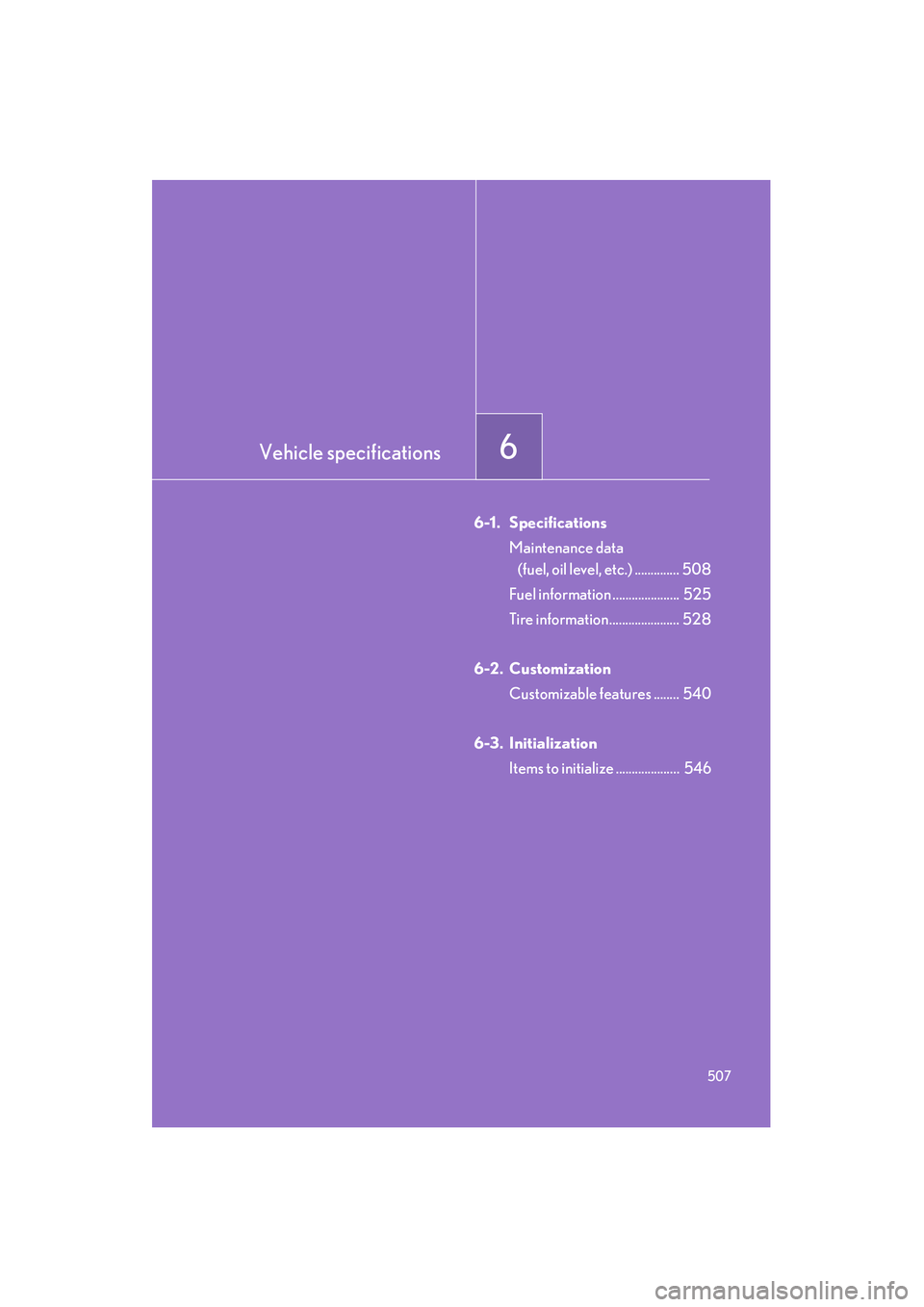
6-1. SpecificationsMaintenance data (fuel, oil level, etc.) .............. 508
Fuel information ..................... 525
Tire information...................... 528
6-2. Customization Customizable features ........ 540
6-3. Initialization Items to initialize .................... 546
Page 509 of 578
508
IS350/250_U
6-1. Specifications
Maintenance data (fuel, oil level, etc.)
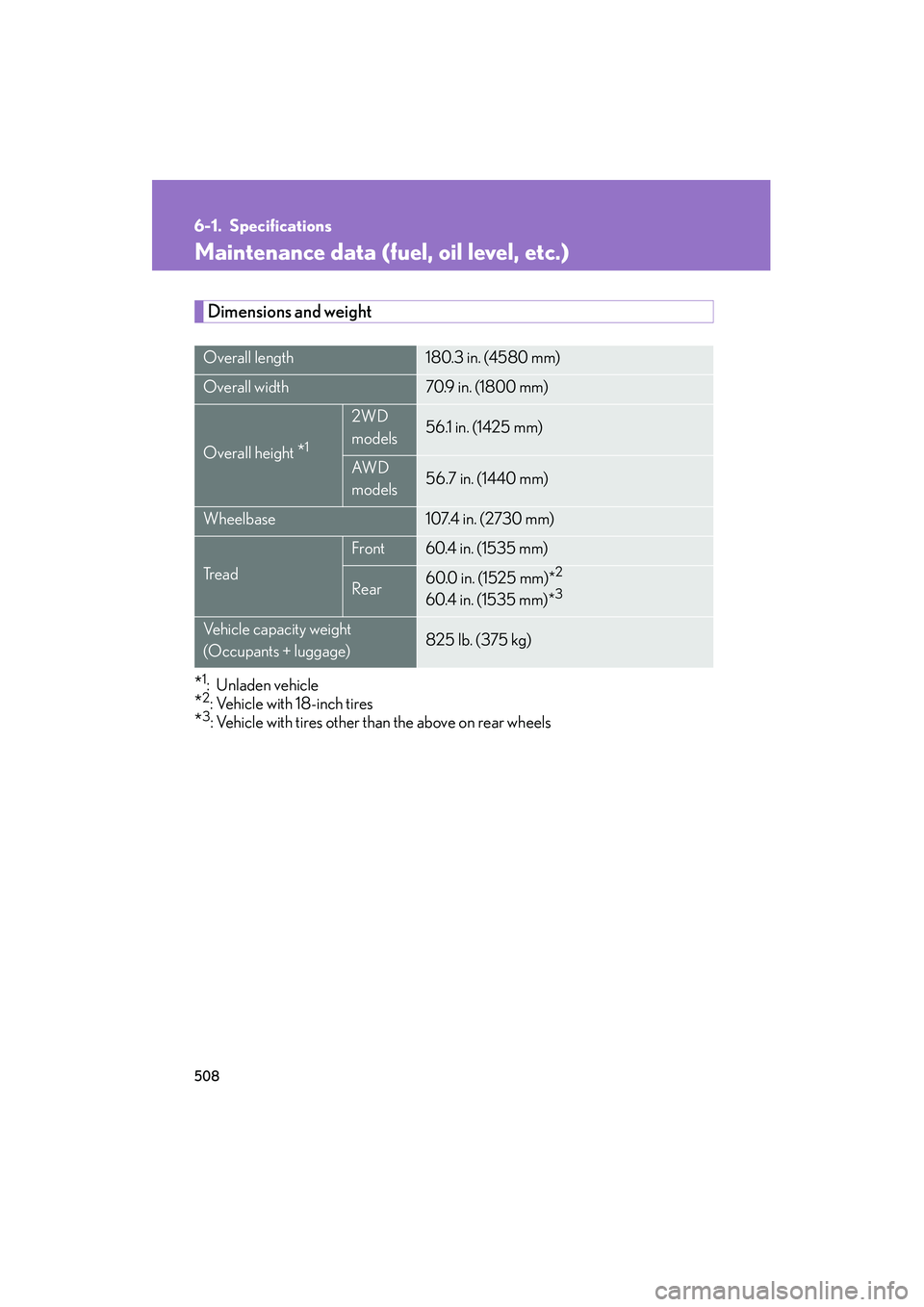
Dimensions and weight
*1: Unladen vehicle
*2: Vehicle with 18-inch tires
*3: Vehicle with tires other than the above on rear wheels
Overall length180.3 in. (4580 mm)
Overall width70.9 in. (1800 mm)
Overall height *1
2WD
models56.1 in. (1425 mm)
AW D
models56.7 in. (1440 mm)
Wheelbase107.4 in. (2730 mm)
Tr e a d
Front60.4 in. (1535 mm)
Rear60.0 in. (1525 mm)*2
60.4 in. (1535 mm)*3
Vehicle capacity weight
(Occupants + luggage)825 lb. (375 kg)
Page 512 of 578
511
6-1. Specifications
6
Vehicle specifications
IS350/250_U
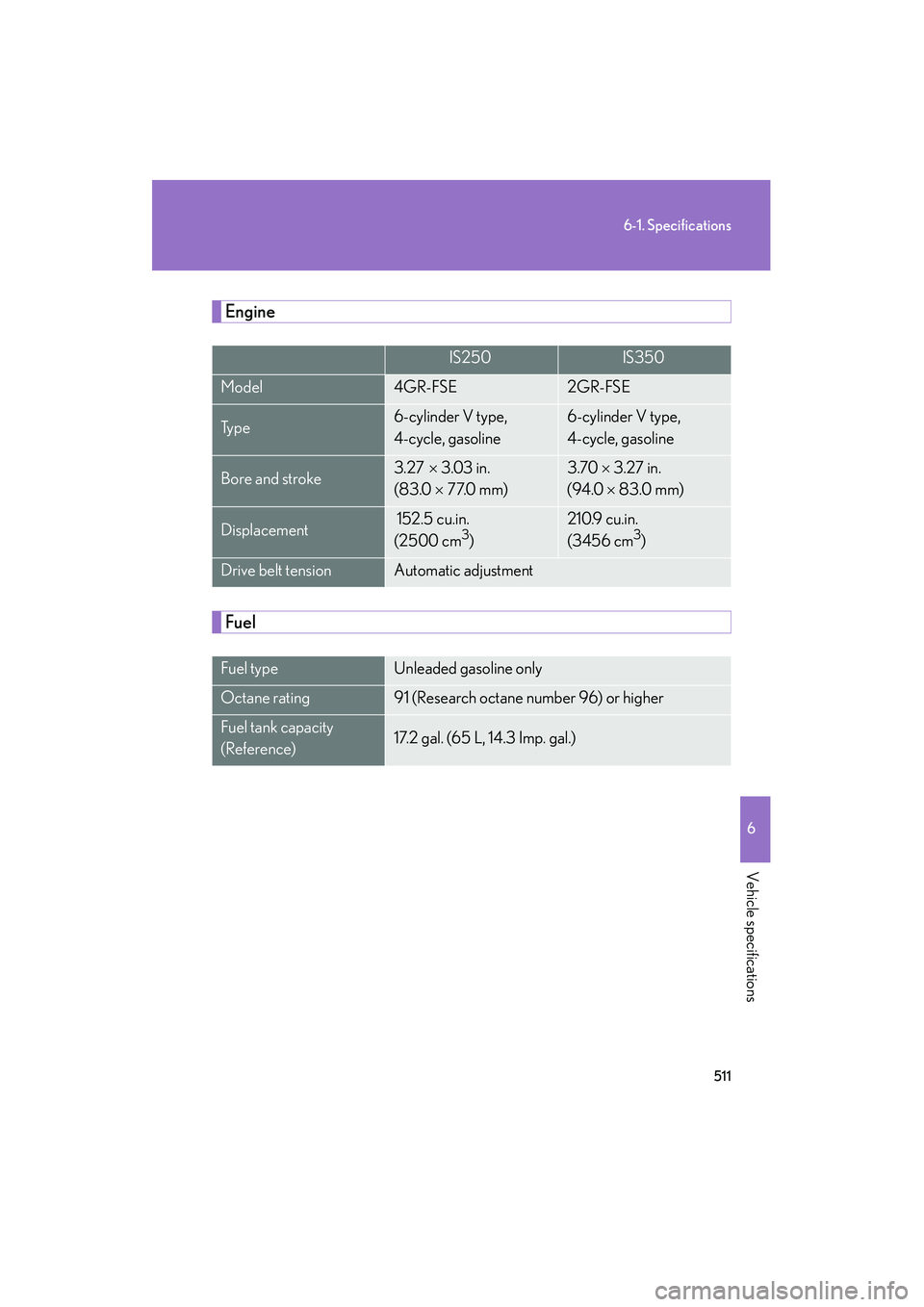
Engine
Fuel
IS250IS350
Model4GR-FSE2GR-FSE
Ty p e6-cylinder V type,
4-cycle, gasoline6-cylinder V type,
4-cycle, gasoline
Bore and stroke3.27 × 3.03 in.
(83.0 × 77.0 mm)3.70 × 3.27 in.
(94.0 × 83.0 mm)
Displacement 152.5 cu.in.
(2500 cm3)
210.9 cu.in.
(3456 cm3)
Drive belt tensionAutomatic adjustment
Fuel typeUnleaded gasoline only
Octane rating91 (Research octane number 96) or higher
Fuel tank capacity
(Reference)17.2 gal. (65 L, 14.3 Imp. gal.)
Page 513 of 578
512
6-1. Specifications
IS350/250_U
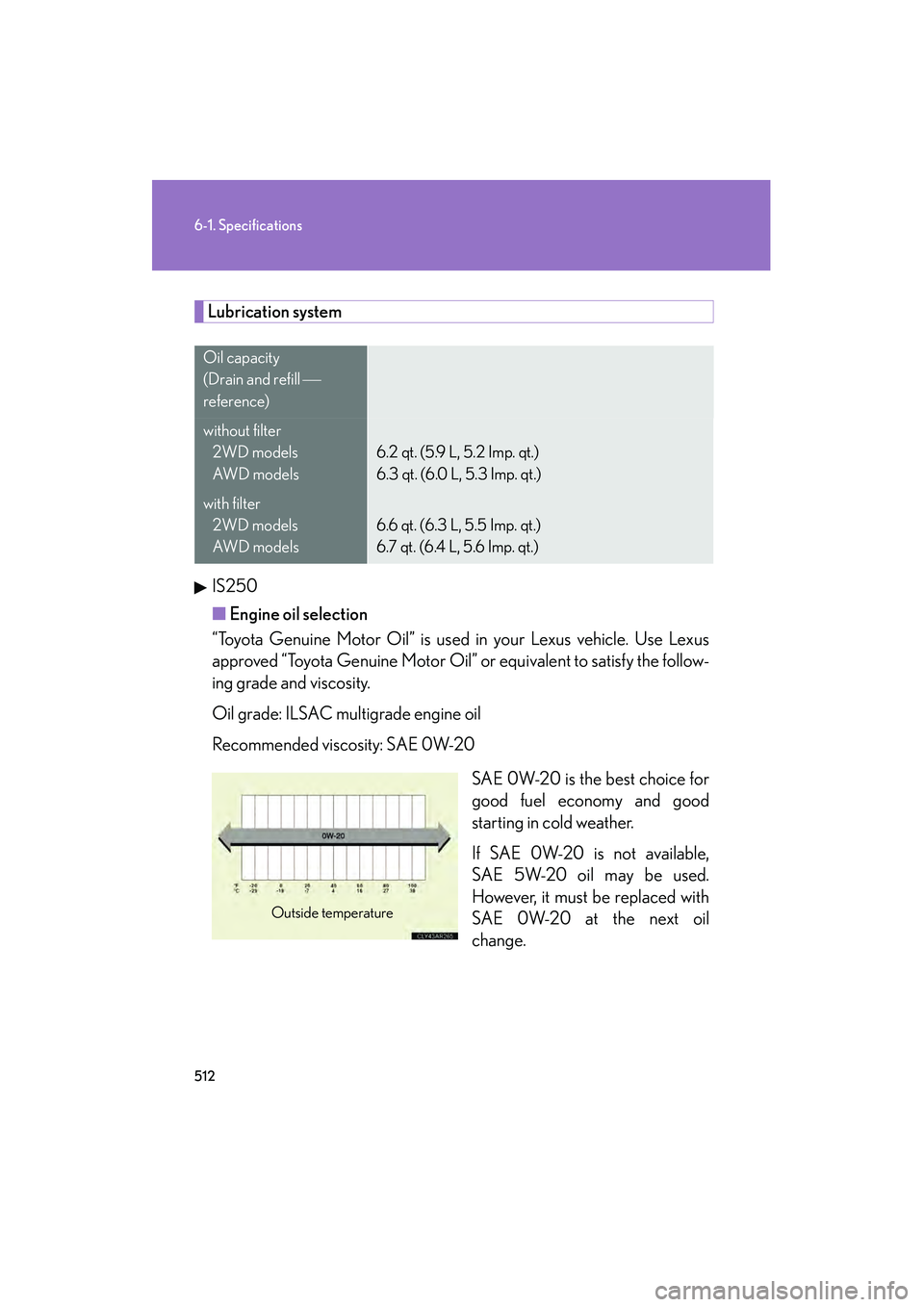
Lubrication system
IS250
■ Engine oil selection
“Toyota Genuine Motor Oil” is used in your Lexus vehicle. Use Lexus
approved “Toyota Genuine Motor Oil” or equivalent to satisfy the follow-
ing grade and viscosity.
Oil grade: ILSAC multigrade engine oil
Recommended viscosity: SAE 0W-20
SAE 0W-20 is the best choice for
good fuel economy and good
starting in cold weather.
If SAE 0W-20 is not available,
SAE 5W-20 oil may be used.
However, it must be replaced with
SAE 0W-20 at the next oil
change.
Oil capacity
(Drain and refill
reference)
without filter
2WD models
AWD models
6.2 qt. (5.9 L, 5.2 Imp. qt.)
6.3 qt. (6.0 L, 5.3 Imp. qt.)
with filter
2WD models
AWD models
6.6 qt. (6.3 L, 5.5 Imp. qt.)
6.7 qt. (6.4 L, 5.6 Imp. qt.)
Outside temperature
Page 515 of 578
514
6-1. Specifications
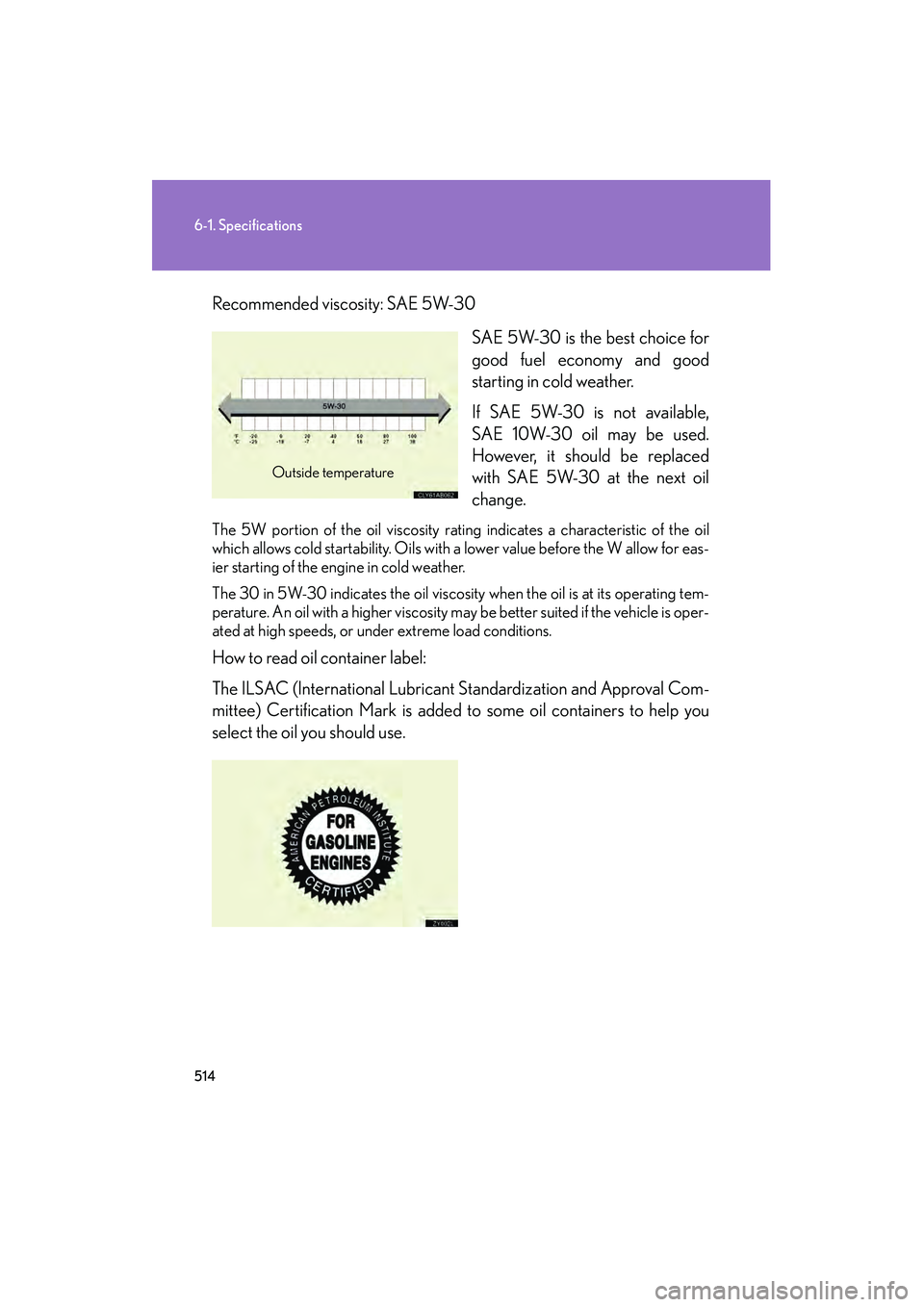
IS350/250_URecommended viscosity: SAE 5W-30
SAE 5W-30 is the best choice for
good fuel economy and good
starting in cold weather.
If SAE 5W-30 is not available,
SAE 10W-30 oil may be used.
However, it should be replaced
with SAE 5W-30 at the next oil
change.
The 5W portion of the oil viscosity rating indicates a characteristic of the oil
which allows cold startability. Oils with a lower value before the W allow for eas-
ier starting of the engine in cold weather.
The 30 in 5W-30 indicates the oil viscosity when the oil is at its operating tem-
perature. An oil with a higher viscosity may be better suited if the vehicle is oper-
ated at high speeds, or under extreme load conditions.
How to read oil container label:
The ILSAC (International Lubricant Standardization and Approval Com-
mittee) Certification Mark is added to some oil containers to help you
select the oil you should use.
Outside temperature
Page 526 of 578
525
6-1. Specifications
6
Vehicle specifications
IS350/250_U
Fuel information
■Fuel tank opening for unleaded gasoline
To help prevent incorrect fueling, your Lexus has a fuel tank opening that only
accommodates the special nozzle on unleaded fuel pumps.
■If your engine knocks
●Consult your Lexus dealer.
●You may occasionally notice light knocking for a short time while accelerating
or driving uphill. This is normal and there is no need for concern.
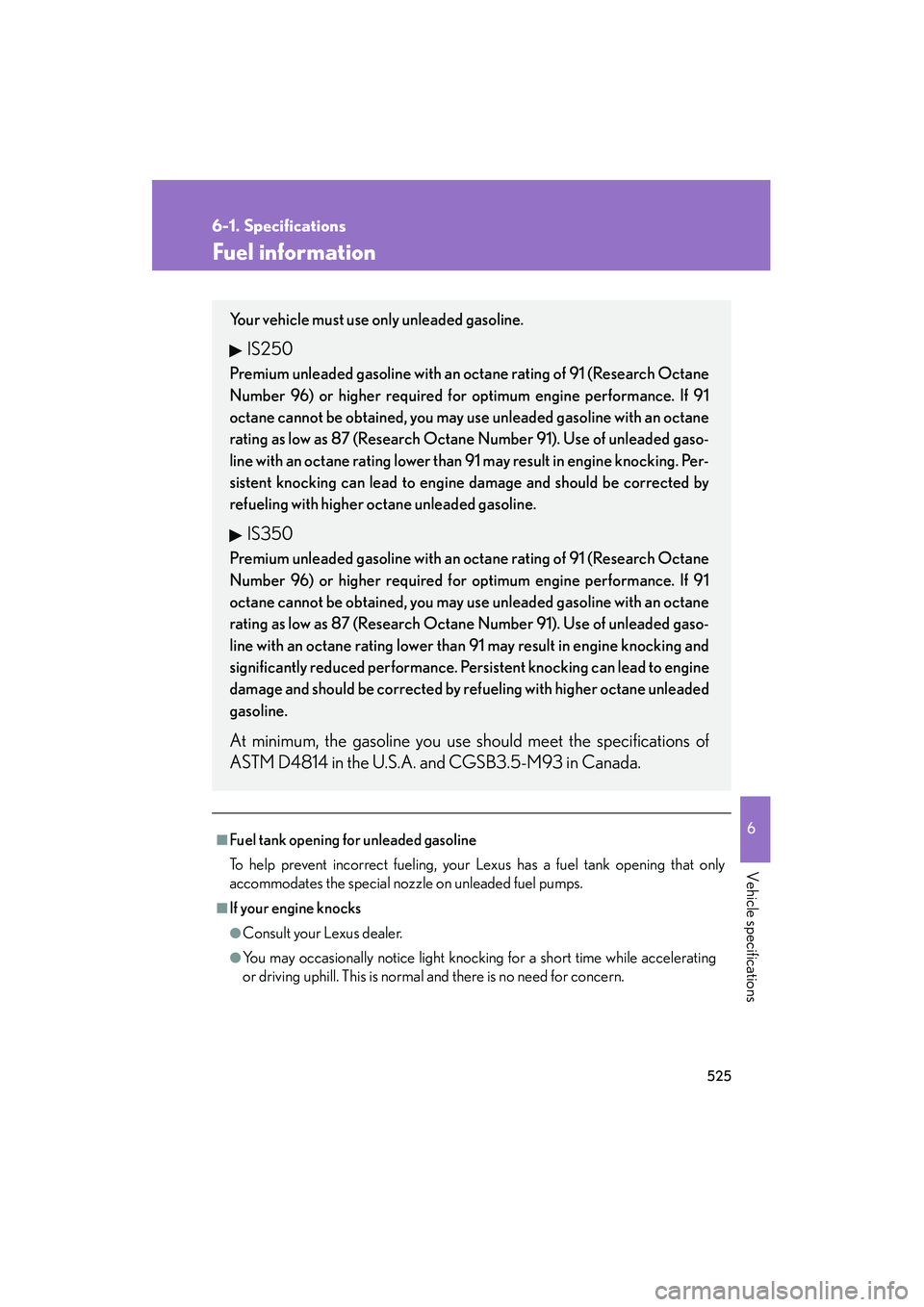
Your vehicle must use only unleaded gasoline.
IS250
Premium unleaded gasoline with an octane rating of 91 (Research Octane
Number 96) or higher required for optimum engine performance. If 91
octane cannot be obtained, you may use unleaded gasoline with an octane
rating as low as 87 (Research Octane Number 91). Use of unleaded gaso-
line with an octane rating lower than 91 may result in engine knocking. Per-
sistent knocking can lead to engine damage and should be corrected by
refueling with higher octane unleaded gasoline.
IS350
Premium unleaded gasoline with an oc tane rating of 91 (Research Octane
Number 96) or higher required for optimum engine performance. If 91
octane cannot be obtained, you may use unleaded gasoline with an octane
rating as low as 87 (Research Octane Number 91). Use of unleaded gaso-
line with an octane rating lower than 91 may result in engine knocking and
significantly reduced performance. Persistent knocking can lead to engine
damage and should be corrected by refueling with higher octane unleaded
gasoline.
At minimum, the gasoline you use should meet the specifications of
ASTM D4814 in the U.S.A. and CGSB3.5-M93 in Canada.