Brake Lexus IS250 2011 Workshop Manual
[x] Cancel search | Manufacturer: LEXUS, Model Year: 2011, Model line: IS250, Model: Lexus IS250 2011Pages: 578, PDF Size: 31.12 MB
Page 468 of 578
5
When trouble arises
467
5-2. Steps to take in an emergency
IS350/250_U
CAUTION
■When the electric power steering warning light comes on
The steering wheel may become extremely heavy.
If the steering wheel becomes heavier than usual when operating, firmly hold and
operate it using more force than usual.
■If the tire pressure warning light comes on
Be sure to observe the following precautions. Failure to do so could cause loss of
vehicle control and result in death or serious injury.
●Stop your vehicle in a safe place as soon as possible. Adjust the tire inflation pres-
sure immediately.
●If the tire pressure warning light comes on even after tire inflation pressure adjust-
ment, it is probable that you have a flat tire. Check the tires. If the tire is flat,
change to the spare tire and have the flat tire repaired by the nearest Lexus
dealer.
●Avoid abrupt maneuvering and braking. If the vehicle tires deteriorate, you could
lose control of the steering wheel or the brakes.
■If a blowout or sudden air leakage should occur
The tire pressure warning system may not activate immediately.
Page 475 of 578
474
5-2. Steps to take in an emergency
IS350/250_U
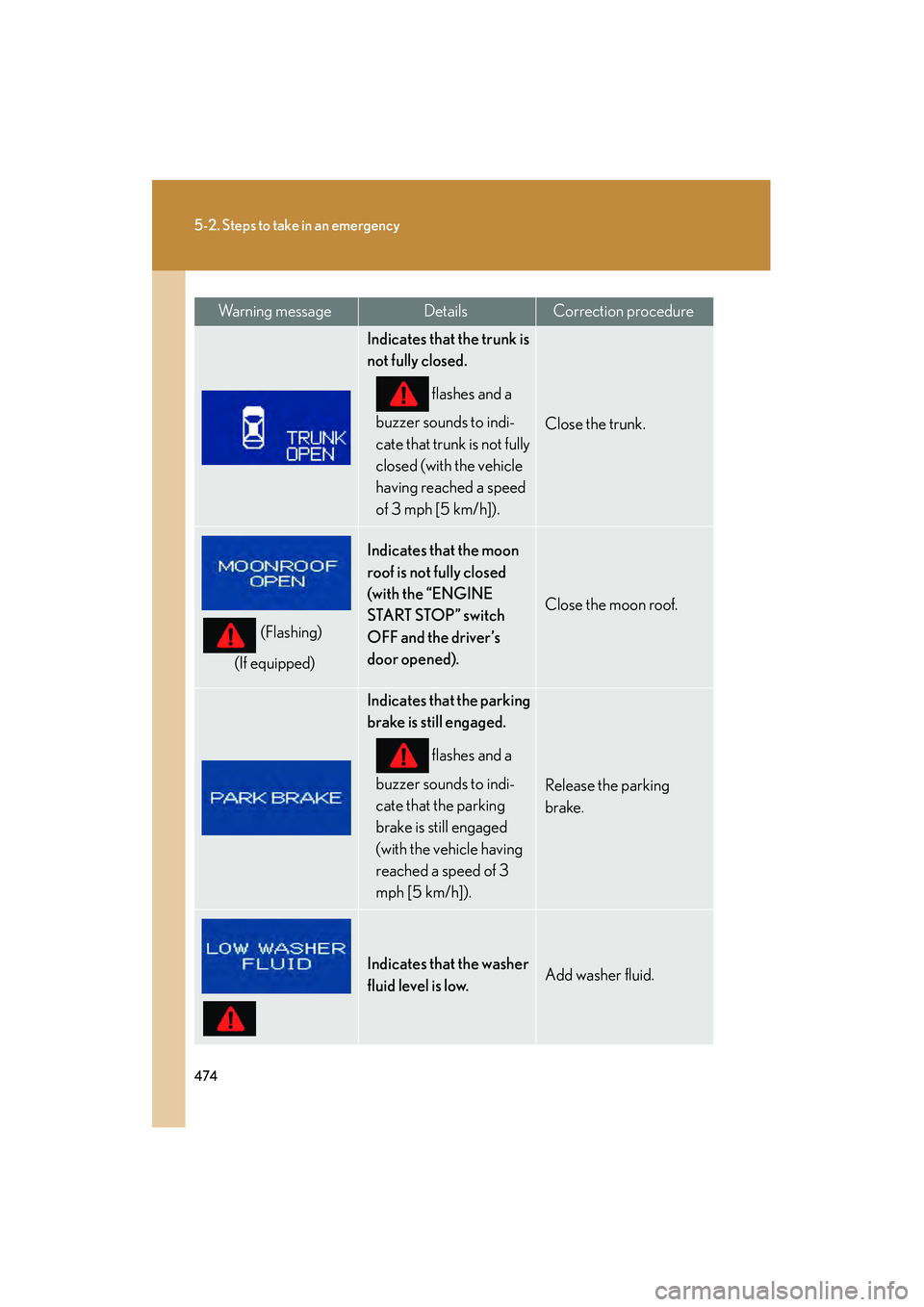
Indicates that the trunk is
not fully closed. flashes and a
buzzer sounds to indi-
cate that trunk is not fully
closed (with the vehicle
having reached a speed
of 3 mph [5 km/h]).
Close the trunk.
(Flashing)
(If equipped)
Indicates that the moon
roof is not fully closed
(with the “ENGINE
START STOP” switch
OFF and the driver’s
door opened).
Close the moon roof.
Indicates that the parking
brake is still engaged.
flashes and a
buzzer sounds to indi-
cate that the parking
brake is still engaged
(with the vehicle having
reached a speed of 3
mph [5 km/h]).
Release the parking
brake.
Indicates that the washer
fluid level is low.Add washer fluid.
Wa r n i n g m e s s a g eDetailsCorrection procedure
Page 480 of 578
5
When trouble arises
479
5-2. Steps to take in an emergency
IS350/250_U
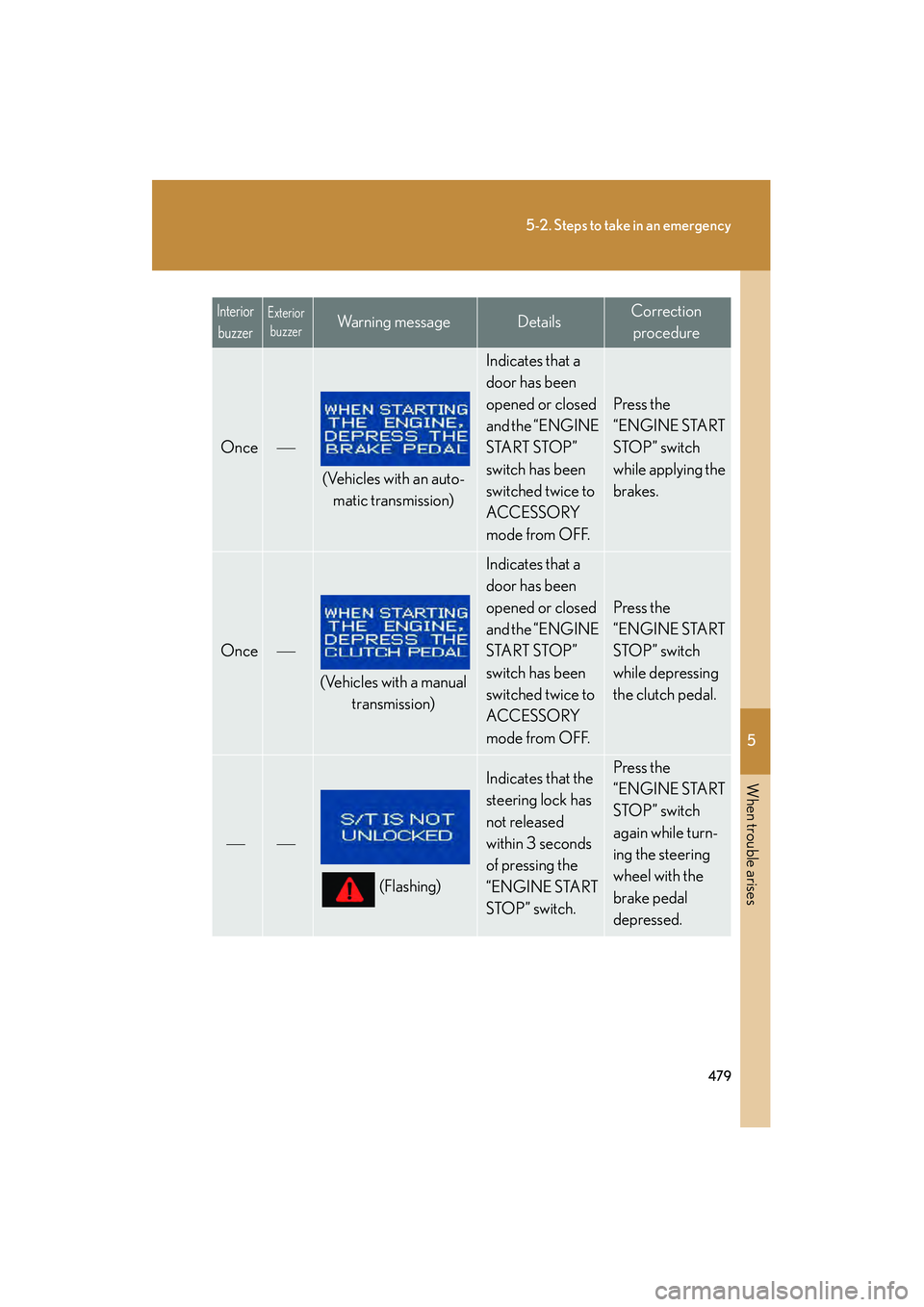
Once
(Vehicles with an auto-matic transmission)
Indicates that a
door has been
opened or closed
and the “ENGINE
START STOP”
switch has been
switched twice to
ACCESSO RY
mode from OFF.
Press the
“ENGINE START
STOP” switch
while applying the
brakes.
Once
(Vehicles with a manual
transmission)
Indicates that a
door has been
opened or closed
and the “ENGINE
START STOP”
switch has been
switched twice to
ACCESSO RY
mode from OFF.
Press the
“ENGINE START
STOP” switch
while depressing
the clutch pedal.
(Flashing)
Indicates that the
steering lock has
not released
within 3 seconds
of pressing the
“ENGINE START
STOP” switch.Press the
“ENGINE START
STOP” switch
again while turn-
ing the steering
wheel with the
brake pedal
depressed.
InteriorbuzzerExterior buzzerWa r n i n g m e s s a g eDetailsCorrection
procedure
Page 482 of 578
5
When trouble arises
481
5-2. Steps to take in an emergency
IS350/250_U
If you have a flat tire
Remove the flat tire and replace it with the spare provided.
■Before jacking up the vehicle
●Stop the vehicle on a hard, flat surface.
● Set the parking brake.
● Shift the shift lever to P (vehicles with an automatic transmission)
or R (vehicles with a manual transmission).
● Stop the engine.
● Turn on the emergency flashers.
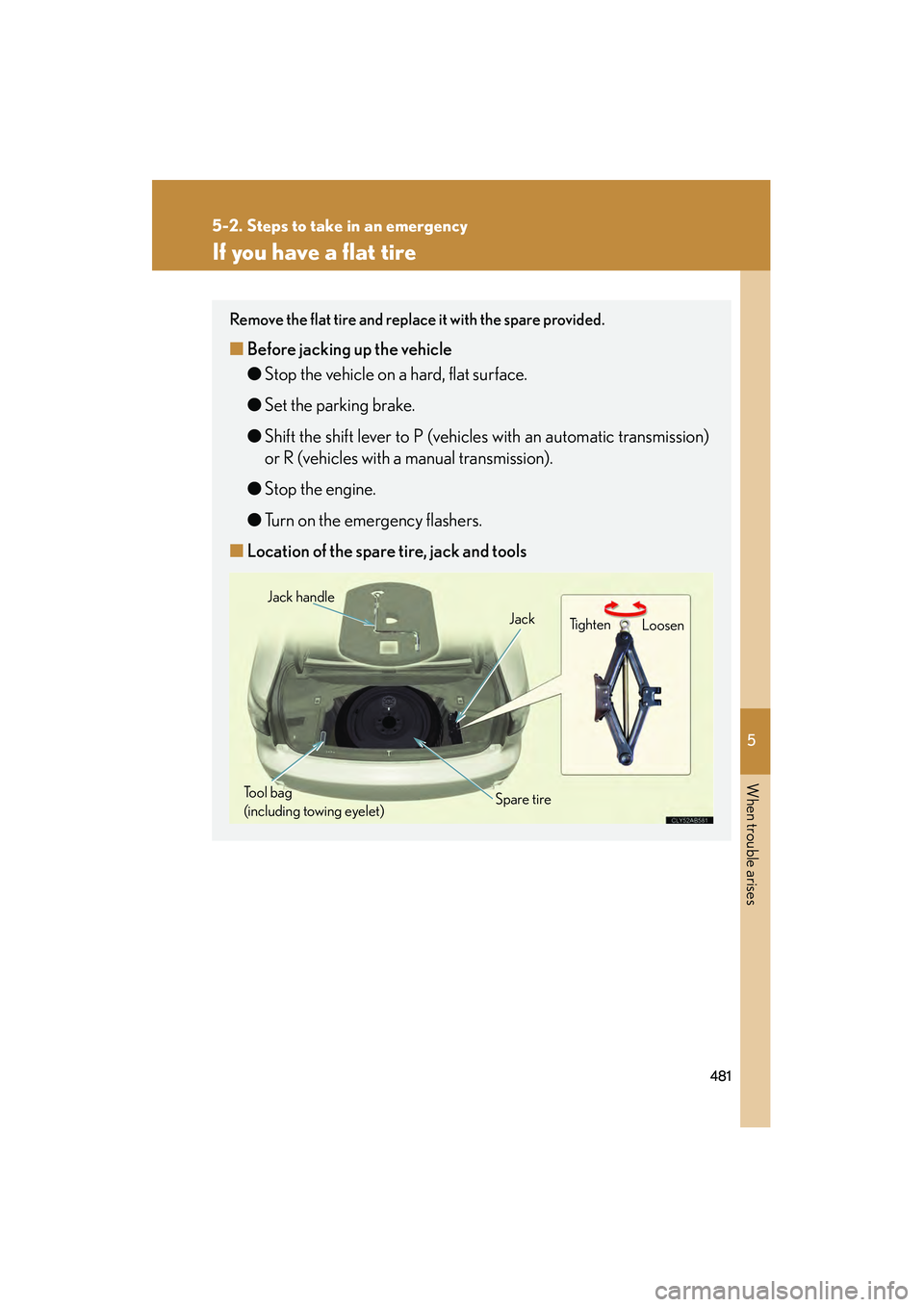
■ Location of the spare tire, jack and tools
Tool bag
(including towing eyelet) Jack
Jack handle
Spare tire
Ti g h t e nLoosen
Page 488 of 578
5
When trouble arises
487
5-2. Steps to take in an emergency
IS350/250_U
CAUTION
●Use a jack stand if it is necessary to get under the vehicle.
Take particular care when lowering the vehicle to ensure that no one working on or
near the vehicle may be injured.
■Replacing a flat tire
Observe the following precautions to reduce the risk of death or serious injury.
●Never use oil or grease on the wheel bolts or wheel nuts.
Oil and grease may cause the wheel nuts to be excessively tightened, leading to
bolt or disc wheel damage. In addition, the oil or grease can cause the wheel nuts
to loosen and the wheel may fall off, causing a serious accident. Remove any oil or
grease from the wheel bolts or wheel nuts.
●Have the wheel nuts tightened with a torque wrench to 76 ft•lbf (103 N•m, 10.5
kgf•m) as soon as possible after changing wheels.
Failure to follow these precautions could cause the nuts to loosen and the wheels
may fall off, which could lead to an accident causing death or serious injury.
■When using the spare tire
●Remember that your compact spare tire is specifically designed for use with your
vehicle. Do not use your compact spare tire on another vehicle.
●Do not use two compact spare tires simultaneously.
●Replace the compact spare tire with a standard tire as soon as possible.
●Avoid sudden acceleration, deceleration and braking, as well as sharp cornering.
■Speed limit when using the spare tire
Do not drive at speeds in excess of 50 mph (80 km/h) when a compact spare tire is
installed on the vehicle.
The compact spare tire is not designed for driving at high speeds. Failing to observe
this precaution may lead to an accident causing death or serious injury.
■When the spare tire is attached
The vehicle speed may not be correctly detected, and the following systems may
not operate correctly:
●ABS & brake assist
●VSC
●TRAC
Page 491 of 578
490
5-2. Steps to take in an emergency
IS350/250_U
Emergency start function
When the engine does not start, the following steps can be used as an
interim measure to start the engine if the “ENGINE START STOP” switch
is functioning normally.Vehicles with an automatic transmission Set the parking brake.
Put the shift lever in P.
Set the “ENGINE START STOP” switch to ACCESSORY mode.
Press and hold the “ENGINE START STOP” switch for about 15
seconds while depressing the brake pedal firmly.
Vehicles with a manual transmission Set the parking brake.
Put the shift lever in N.
Set the “ENGINE START STOP” switch to the ACCESSORY
mode.
Push and hold the “ENGINE ST ART STOP” switch for about 15
seconds while depressing the brake pedal and clutch pedal firmly.
Even if the engine can be started using the above steps, the system may
be malfunctioning. Have the vehicle checked by your Lexus dealer.
STEP1
STEP2
STEP3
STEP4
STEP1
STEP2
STEP3
STEP4
Page 492 of 578
5
When trouble arises
491
5-2. Steps to take in an emergency
IS350/250_U
If the shift lever cannot be shifted from P∗
If the shift lever cannot be shifted with your foot on the brake, there may be
a problem with the shift lock system (a system to prevent accidental opera-
tion of the shift lever). Have the vehicle inspected by your Lexus dealer
immediately.
The following steps may be used as an emergency measure to ensure that
the shift lever can be shifted.
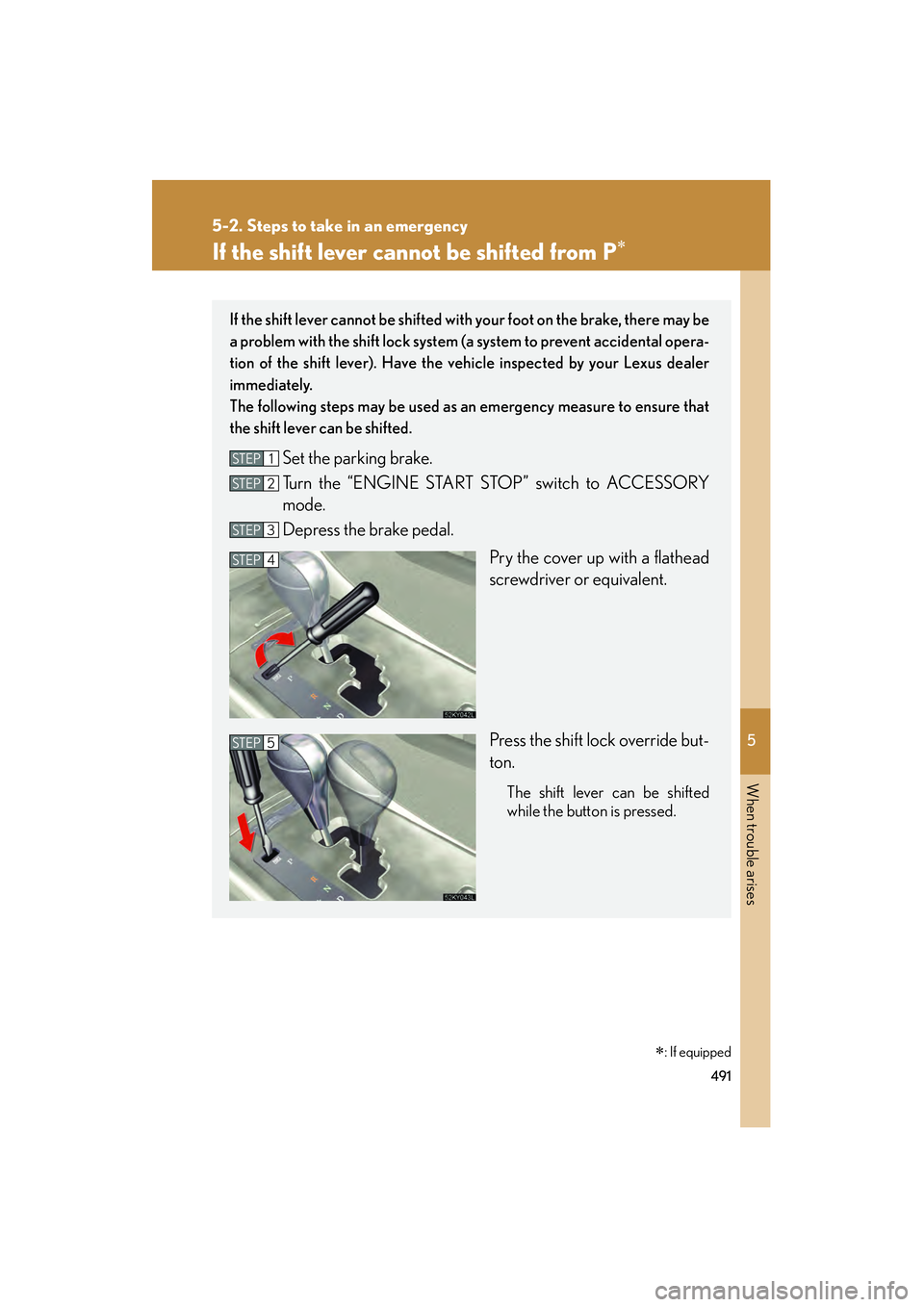
Set the parking brake.
Turn the “ENGINE START STOP” switch to ACCESSORY
mode.
Depress the brake pedal.
Pry the cover up with a flathead
screwdriver or equivalent.
Press the shift lock override but-
ton.
The shift lever can be shifted
while the button is pressed.
STEP1
STEP2
STEP3
STEP4
STEP5
∗: If equipped
Page 496 of 578
5
When trouble arises
495
5-2. Steps to take in an emergency
IS350/250_U
Changing “ENGINE START STOP” switch modes and starting the engine
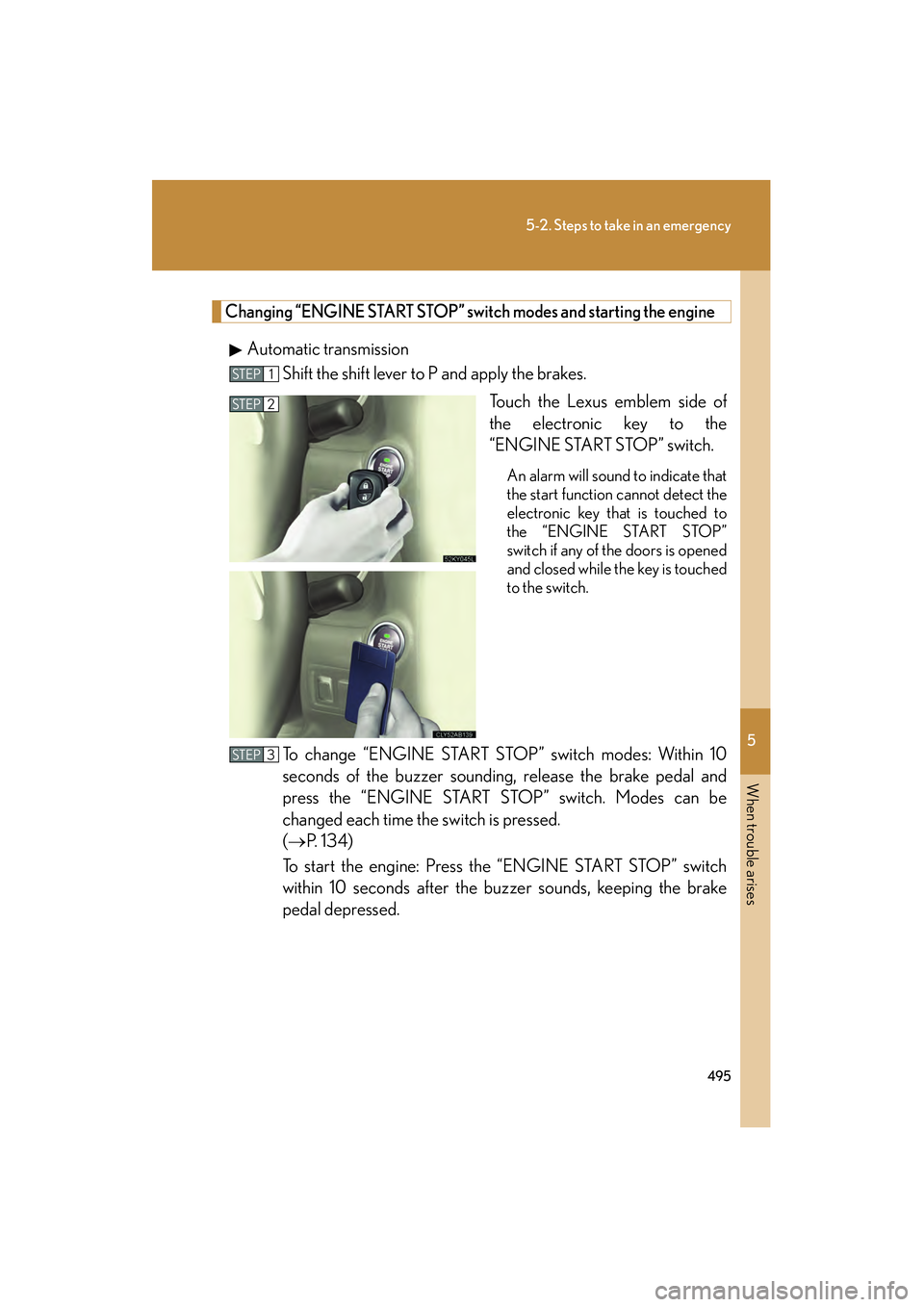
Automatic transmissionShift the shift lever to P and apply the brakes.
Touch the Lexus emblem side of
the electronic key to the
“ENGINE START STOP” switch.
An alarm will sound to indicate that
the start function cannot detect the
electronic key that is touched to
the “ENGINE START STOP”
switch if any of the doors is opened
and closed while the key is touched
to the switch.
To change “ENGINE START STOP” switch modes: Within 10
seconds of the buzzer sounding, release the brake pedal and
press the “ENGINE START STOP” switch. Modes can be
changed each time the switch is pressed.
(→P. 1 3 4 )
To start the engine: Press the “ENGINE START STOP” switch
within 10 seconds after the buzzer sounds, keeping the brake
pedal depressed.
STEP1
STEP2
STEP3
Page 505 of 578
504
5-2. Steps to take in an emergency
IS350/250_U
If the vehicle becomes stuck
CAUTION
■When attempting to free a stuck vehicle
If you choose to rock the vehicle back and forth to free it, make sure the surround-
ing area is clear, to avoid striking other vehicles, objects or persons. The vehicle
may also lunge forward or lunge back suddenly as it becomes free. Use extreme
caution.
■When shifting the shift lever
With automatic transmission vehicles, be careful not to shift the shift lever with the
accelerator pedal depressed.
This may lead to unexpected rapid acceleration of the vehicle that may cause an
accident and result in death or serious injury.
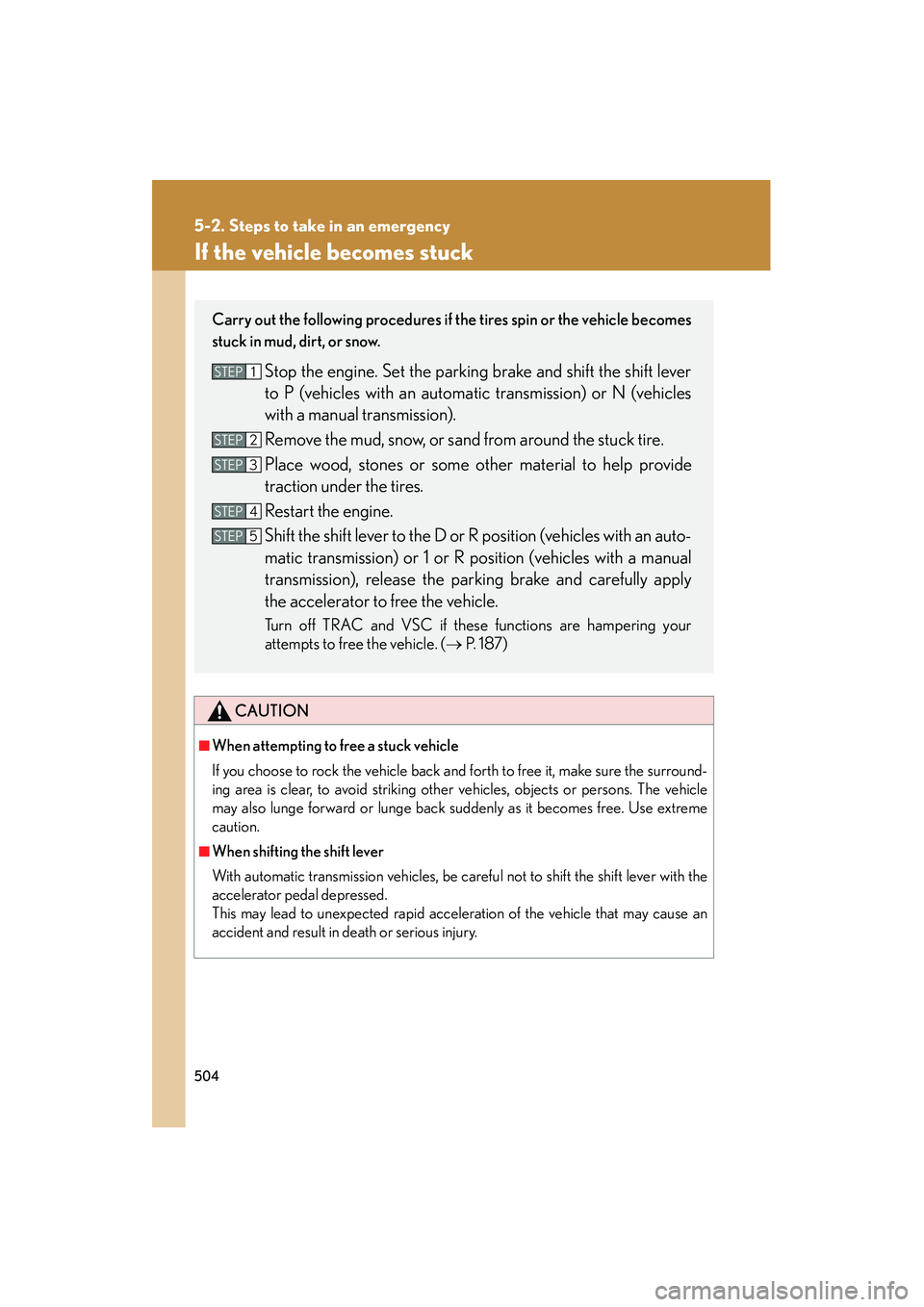
Carry out the following procedures if the tires spin or the vehicle becomes
stuck in mud, dirt, or snow.
Stop the engine. Set the parking brake and shift the shift lever
to P (vehicles with an automatic transmission) or N (vehicles
with a manual transmission).
Remove the mud, snow, or sand from around the stuck tire.
Place wood, stones or some other material to help provide
traction under the tires.
Restart the engine.
Shift the shift lever to the D or R position (vehicles with an auto-
matic transmission) or 1 or R position (vehicles with a manual
transmission), release the parking brake and carefully apply
the accelerator to free the vehicle.
Turn off TRAC and VSC if these functions are hampering your
attempts to free the vehicle. (→ P. 1 8 7 )
STEP1
STEP2
STEP3
STEP4
STEP5
Page 507 of 578
506
5-2. Steps to take in an emergency
IS350/250_U
If your vehicle has to be stopped in an emergency
CAUTION
■If the engine has to be turned off while driving
Power assist for the brakes and steering wheel will be lost, making the brake pedal
harder to depress and the steering wheel heavier to turn. Decelerate as much as
possible before turning off the engine.
Only in an emergency, such as if it becomes impossible to stop the vehicle
in the normal way, stop the vehicle using the following procedure:
Steadily step on the brake pedal with both feet and firmly
depress it.
Do not pump the brake pedal repeatedly as this will increase the
effort required to slow the vehicle.
Shift the shift lever to N.
If the shift lever is shifted to N After slowing down, stop the vehicle in a safe place by the road.
Stop the engine.
If the shift lever cannot be shifted to N Keep depressing the brake pedal with both feet to reduce vehi-
cle speed as much as possible.
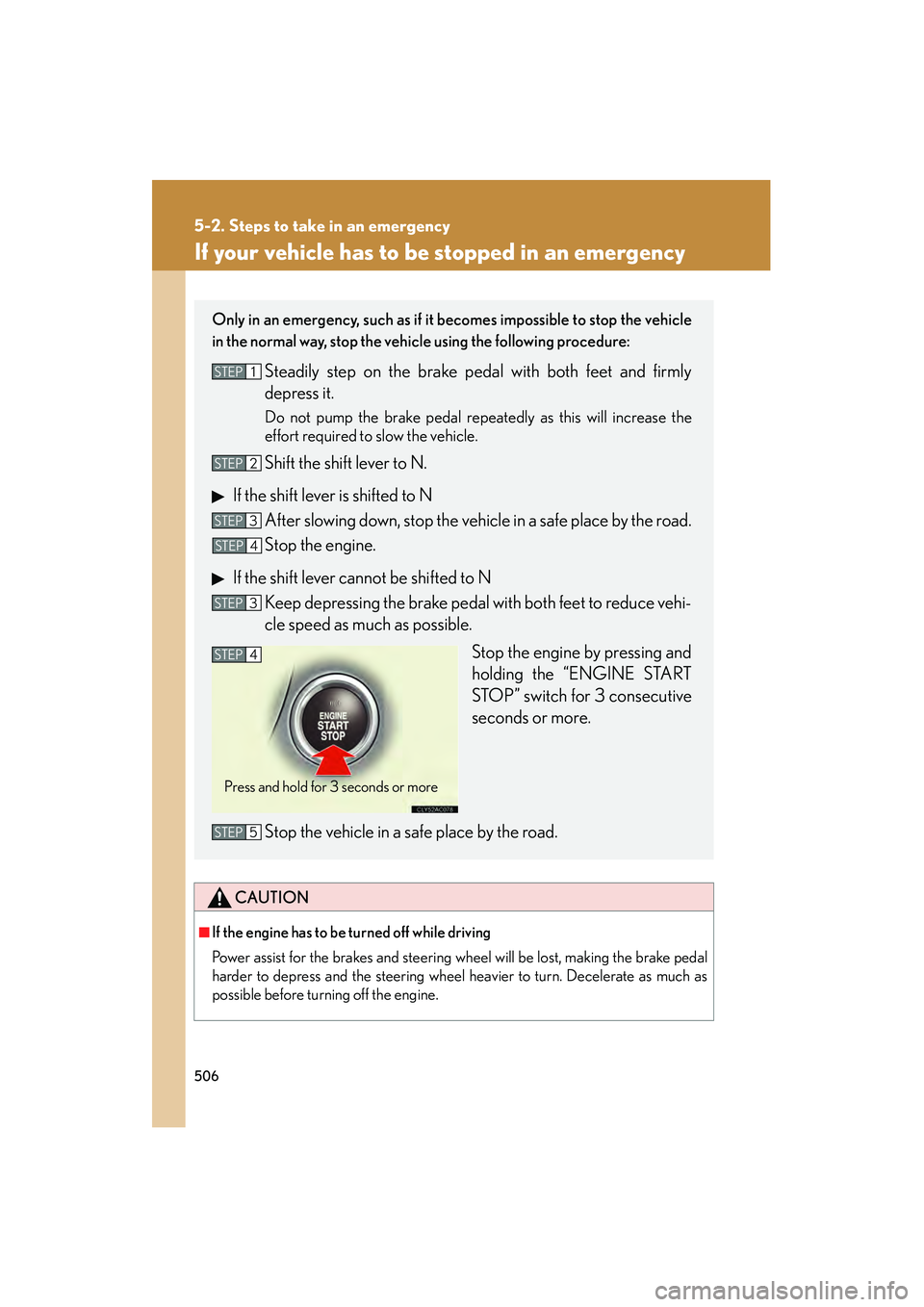
Stop the engine by pressing and
holding the “ENGINE START
STOP” switch for 3 consecutive
seconds or more.
Stop the vehicle in a safe place by the road.
STEP1
STEP2
STEP3
STEP4
STEP3
Press and hold for 3 seconds or more
STEP4
STEP5