Tire warning Lexus IS250 2012 Owner's Guide
[x] Cancel search | Manufacturer: LEXUS, Model Year: 2012, Model line: IS250, Model: Lexus IS250 2012Pages: 594, PDF Size: 7.2 MB
Page 475 of 594
474
5-2. Steps to take in an emergency
IS350/250_U
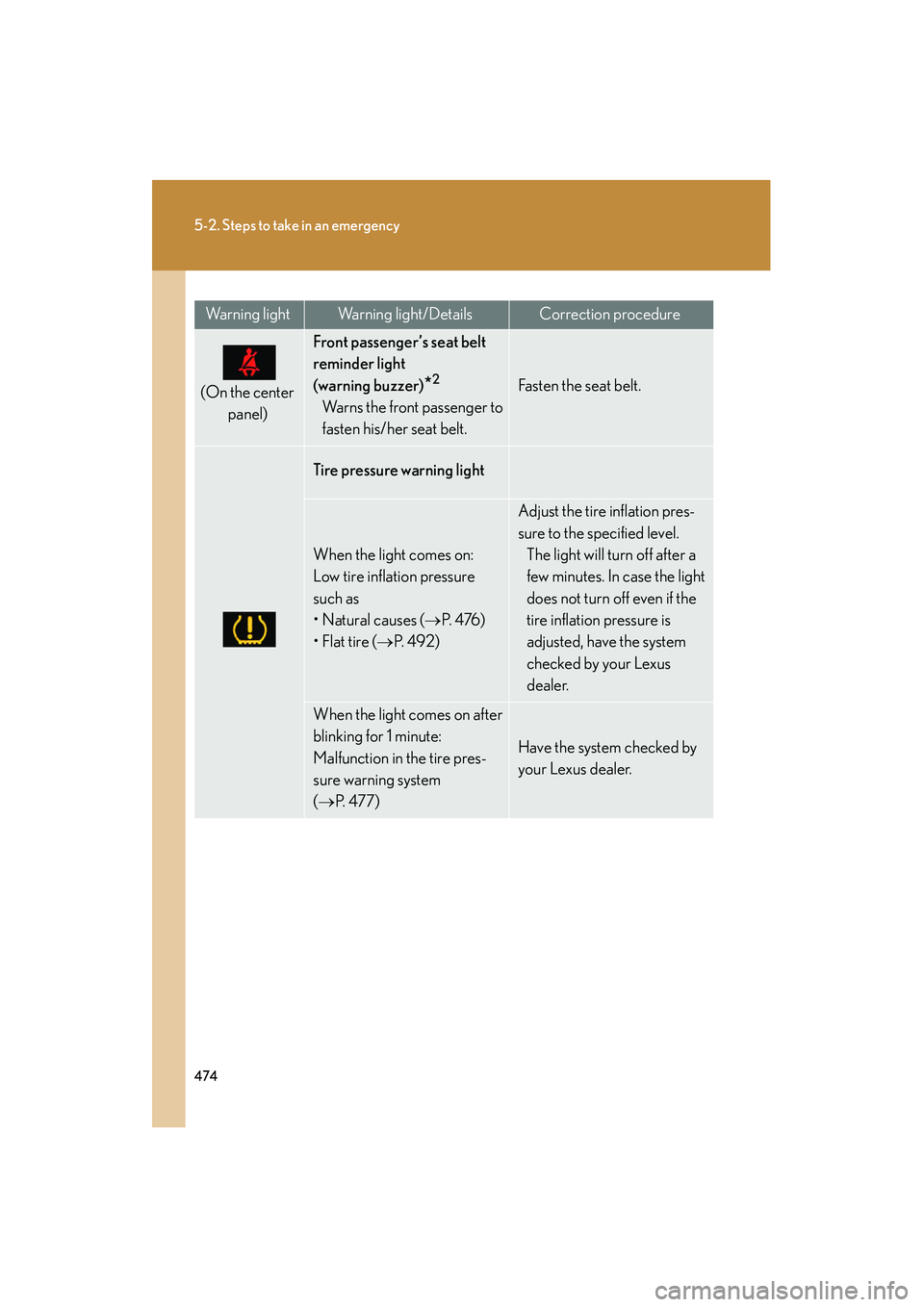
Warning lightWarning light/DetailsCorrection procedure
(On the center panel)
Front passenger’s seat belt
reminder light
(warning buzzer)
*2
Warns the front passenger to
fasten his/her seat belt.
Fasten the seat belt.
Tire pressure warning light
When the light comes on:
Low tire inflation pressure
such as
• Natural causes (→ P. 4 76 )
• Flat tire ( →P. 4 9 2 )
Adjust the tire inflation pres-
sure to the specified level.
The light will turn off after a
few minutes. In case the light
does not turn off even if the
tire inflation pressure is
adjusted, have the system
checked by your Lexus
dealer.
When the light comes on after
blinking for 1 minute:
Malfunction in the tire pres-
sure warning system
(→ P. 4 7 7 )
Have the system checked by
your Lexus dealer.
Page 477 of 594
476
5-2. Steps to take in an emergency
IS350/250_U
■If the malfunction indicator lamp comes on while driving
First check the following:
●Is the fuel tank empty?
If it is, fill the fuel tank immediately.
●Is the fuel tank cap loose?
If it is, tighten it securely.
The lamp will go off after taking several driving trips.
If the lamp does not go off even after several trips, contact your Lexus dealer as
soon as possible.
■Electric power steering warning light
When the battery is low or when the voltage drops temporarily, the electric power
steering warning light may come on.
■Front passenger detection sensor and passenger seat belt reminder and warning
buzzer
●If luggage is placed on the front passenger seat, the front passenger detection
sensor may cause the warning light to flash and the warning buzzer to sound,
even if a passenger is not sitting in the seat.
●If a cushion is placed on the seat, the sensor may not detect a passenger, and the
warning light may not operate properly.
■When the tire pressure warning light comes on
Check the tire inflation pressure and adjust to the appropriate level. Pressing the
satellite switch does not turn off the tire pressure warning light.
■The tire pressure warning light ma y turn on due to natural causes
The tire pressure warning light may turn on due to natural causes such as natural air
leaks or tire inflation pressure changes caused by temperature. In this case, adjust-
ing the tire inflation pressure will turn off the warning light (after a few minutes).
■When a tire is replaced with a spare tire
The compact spare tire is not equipped with the tire pressure warning valve and
transmitter. If a tire goes flat, the tire pressure warning light will not turn off even
though the flat tire is replaced with the spare tire. Replace the spare tire with the
repaired tire and adjust the proper tire inflation pressure. The tire pressure warning
light will turn off after a few minutes.
Page 478 of 594

5
When trouble arises
477
5-2. Steps to take in an emergency
IS350/250_U
■If the tire pressure warning system is inoperative
The tire pressure warning system will be disabled in the following conditions:
(When the condition becomes normal, the system will work properly.)
●If tires not equipped with tire pressure warning valves and transmitters are used
●If the ID code on the tire pressure warning valves and transmitters is not regis-
tered in the tire pressure warning computer
●If a different set of tires has been selected using the satellite switch
●If the tire inflation pressure is 73 psi (500 kPa, 5.1 kgf/cm2 or bar) or higher
The tire pressure warning system may be disabled in the following conditions:
(When the condition becomes normal, the system will work properly.)
●If electronic devices or facilities using similar radio wave frequencies are nearby
●If a radio set at similar frequencies is in use in the vehicle
●If there is a lot of snow or ice on the vehicle, in particular around the wheels or
wheel housings
●If non-genuine Lexus wheels are used (Even if you use Lexus wheels, the tire
pressure warning system may not work properly with some types of tires.)
●If tire chains are used
■If the tire pressure warning light freque ntly comes on after blinking for 1 minute
If the tire pressure warning light frequently comes on after blinking for 1 minute
when the “ENGINE START STOP” switch is turned to IGNITION ON mode, have
it checked by your Lexus dealer.
■Customization that can be configured at Lexus dealer
The vehicle speed linked seat belt reminder buzzer can be disabled.
(Customizable features →P. 553)
Page 479 of 594
478
5-2. Steps to take in an emergency
IS350/250_U
CAUTION
■When the electric power steering warning light comes on
The steering wheel may become extremely heavy.
If the steering wheel becomes heavier than usual when operating, firmly hold and
operate it using more force than usual.
■If the tire pressure warning light comes on
Be sure to observe the following precautions. Failure to do so could cause loss of
vehicle control and result in death or serious injury.
●Stop your vehicle in a safe place as soon as possible. Adjust the tire inflation pres-
sure immediately.
●If the tire pressure warning light comes on even after tire inflation pressure adjust-
ment, it is probable that you have a flat tire. Check the tires. If the tire is flat,
change to the spare tire and have the flat tire repaired by the nearest Lexus
dealer.
●Avoid abrupt maneuvering and braking. If the vehicle tires deteriorate, you could
lose control of the steering wheel or the brakes.
■If a blowout or sudden air leakage should occur
The tire pressure warning system may not activate immediately.
Page 480 of 594

5
When trouble arises
479
5-2. Steps to take in an emergency
IS350/250_U
CAUTION
■Maintenance of the tires
Each tire, including the spare (if provided), should be checked monthly when cold
and inflated to the inflation pressure recommended by the vehicle manufacturer on
the vehicle placard or tire inflation pressure label (tire and load information label).
(If your vehicle has tires of a different size than the size indicated on the vehicle
placard or tire inflation pressure label [tire and load information label], you should
determine the proper tire inflation pressure for those tires.)
As an added safety feature, your vehicle has been equipped with a tire pressure
monitoring system (TPMS-tire pressure warning system) that illuminates a low tire
pressure telltale (tire pressure warning light) when one or more of your tires is sig-
nificantly under-inflated. Accordingly, when the low tire pressure telltale (tire pres-
sure warning light) illuminates, you should stop and check your tires as soon as
possible, and inflate them to the proper pressure. Driving on a significantly under-
inflated tire causes the tire to overheat and can lead to tire failure. Under-inflation
also reduces fuel efficiency and tire tread life, and may affect the vehicle's handling
and stopping ability.
Please note that the TPMS (tire pressure warning system) is not a substitute for
proper tire maintenance, and it is the driver's responsibility to maintain correct tire
pressure, even if under-inflation has not reached the level to trigger illumination of
the TPMS low tire pressure telltale (tire pressure warning light).
Your vehicle has also been equipped with a TPMS (tire pressure warning system)
malfunction indicator to indicate when the system is not operating properly. The
TPMS (tire pressure warning system) malfunction indicator is combined with the
low tire pressure telltale (tire pressure warning light). When the system detects a
malfunction, the telltale will flash for approximately one minute and then remain
continuously illuminated. This sequence will continue upon subsequent vehicle
start-ups as long as the malfunction exists. When the malfunction indicator is illumi-
nated, the system may not be able to detect or signal low tire pressure as intended.
TPMS (tire pressure warning system) malfunctions may occur for a variety of rea-
sons, including the installation of replacement or alternate tires or wheels on the
vehicle that prevent the TPMS (tire pressure warning system) from functioning
properly. Always check the TPMS (tire pressure warning system) malfunction tell-
tale after replacing one or more tires or wheels on your vehicle to ensure that the
replacement or alternate tires and wheels allow the TPMS (tire pressure warning
system) to continue to function properly.
Page 498 of 594

5
When trouble arises
497
5-2. Steps to take in an emergency
IS350/250_U
■When using the compact spare tire
As the compact spare tire is not equipped with the tire pressure warning valve and
transmitter, low inflation pressure of the spare tire will not be indicated. Also, if you
replace the compact spare tire after the tire pressure warning light comes on, the
light remains on.
■If you have a flat rear tire on a road covered with snow or ice
Install the compact spare tire on the front of the vehicle. Perform the following steps
and fit tire chains to the rear tires.Replace a front tire with the compact spare tire.
Replace the flat rear tire with the tire removed from the front of the vehi-
cle.
Fit tire chains to the rear tires.
■After completing the tire change
The tire pressure warning system must be reset. ( →P. 4 1 4 )
CAUTION
■Using the tire jack
Improper use of the tire jack may lead to death or serious injuries due to the vehicle
suddenly falling off the jack.
●Do not use the tire jack for any purpose other than replacing tires or installing and
removing tire chains.
●Only use the tire jack that comes with this vehicle for replacing a flat tire.
Do not use it on other vehicles, and do not use other tire jacks for replacing tires
on this vehicle.
●Always check that the tire jack is securely set to the jack point.
●Do not put any part of your body under the vehicle while it is supported by a jack.
●Do not start or run the engine while your vehicle is supported by the jack.
●Do not raise the vehicle while someone is in it.
●When raising the vehicle, do not put an object on or under the jack.
●Do not raise the vehicle to a height greater than that required to replace the tire.
STEP1
STEP2
STEP3
Page 501 of 594
500
5-2. Steps to take in an emergency
IS350/250_U
NOTICE
■Do not drive the vehicle with a flat tire.
Do not continue driving with a flat tire.
Driving even a short distance with a flat tire can damage the tire and the wheel
beyond repair.
■Be careful when driving over bumps with the compact spare tire installed on the
vehicle.
The vehicle becomes lower when driving with the compact spare tire compared to
when driving with standard tires. Be careful when driving over uneven road sur-
faces.
■Driving with tire chains and the compact spare tire
Do not fit tire chains to the compact spare tire.
Tire chains may damage the vehicle body and adversely affect driving performance.
■When replacing the tires
When removing or fitting the wheels, tires or the tire pressure warning valve and
transmitter, contact your Lexus dealer as the tire pressure warning valve and trans-
mitter may be damaged if not handled correctly.
■To avoid damage to the tire pressure warning valves and transmitters
When a tire is repaired with liquid sealants, the tire pressure warning valve and
transmitter may not operate properly. If a liquid sealant is used, contact your Lexus
dealer or other qualified service shop as soon as possible. Make sure to replace the
tire pressure warning valve and transmitter when replacing the tire. ( →P. 414)
Page 546 of 594
545
6-1. Specifications
6
Vehicle specifications
IS350/250_U■
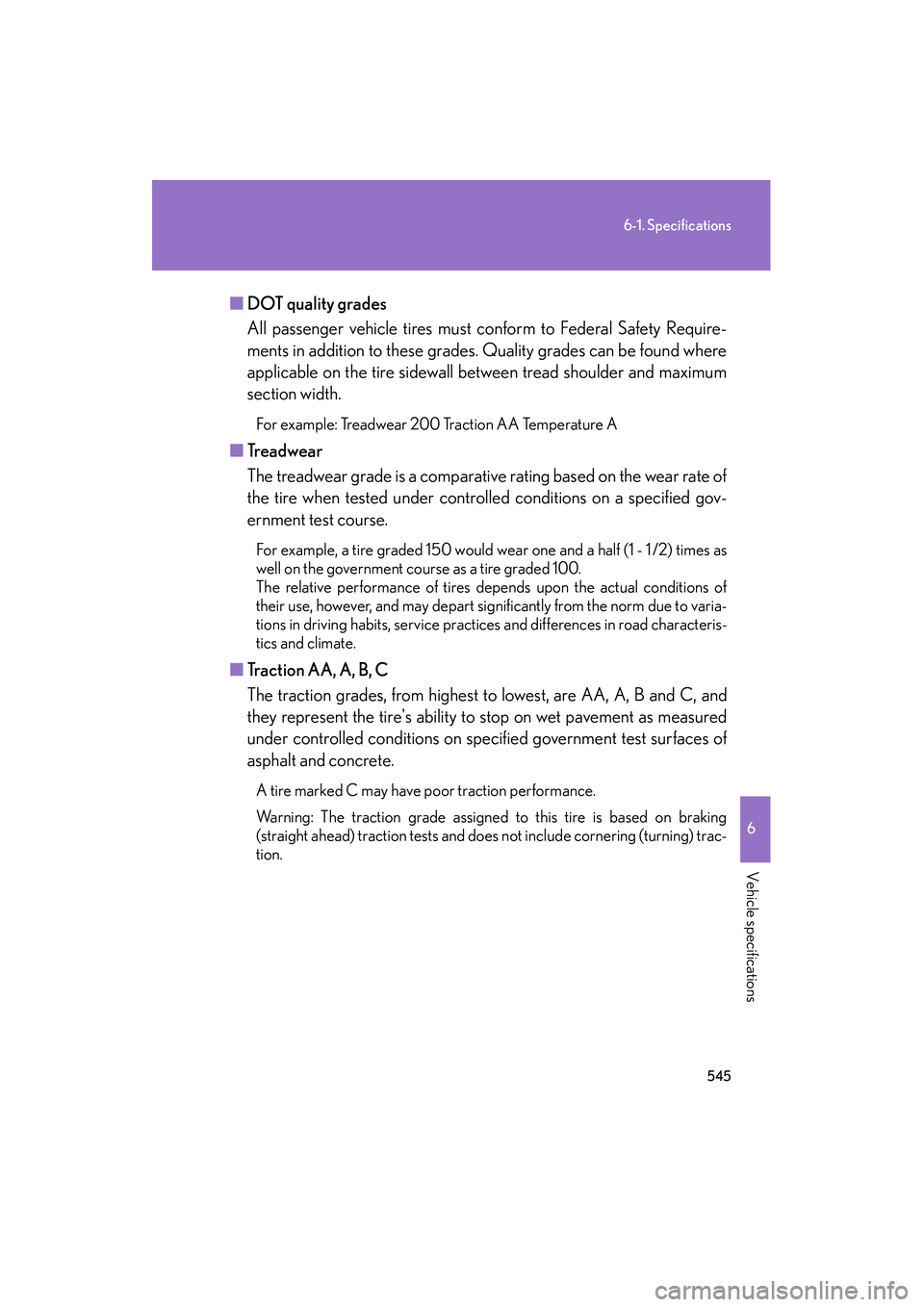
DOT quality grades
All passenger vehicle tires must conform to Federal Safety Require-
ments in addition to these grades. Quality grades can be found where
applicable on the tire sidewall between tread shoulder and maximum
section width.
For example: Treadwear 200 Traction AA Temperature A
■Treadwear
The treadwear grade is a comparative rating based on the wear rate of
the tire when tested under controlled conditions on a specified gov-
ernment test course.
For example, a tire graded 150 would wear one and a half (1 - 1 /2) times as
well on the government course as a tire graded 100.
The relative performance of tires depends upon the actual conditions of
their use, however, and may depart sign ificantly from the norm due to varia-
tions in driving habits, service practices and differences in road characteris-
tics and climate.
■ Traction AA, A, B, C
The traction grades, from highest to lowest, are AA, A, B and C, and
they represent the tire's ability to stop on wet pavement as measured
under controlled conditions on specified government test surfaces of
asphalt and concrete.
A tire marked C may have poor traction performance.
Warning: The traction grade assigned to this tire is based on braking
(straight ahead) traction tests and does not include cornering (turning) trac-
tion.
Page 547 of 594

546
6-1. Specifications
IS350/250_U■
Temperature A, B, C
The temperature grades are A (the highest), B, and C, representing
the tire's resistance to the generation of heat and its ability to dissipate
heat when tested under controlled conditions on a specified indoor
laboratory test wheel.
Sustained high temperature can cause the material of the tire to degenerate
and reduce tire life, and excessive temperature can lead to sudden tire fail-
ure.
The grade C corresponds to a level of performance which all passenger car
tires must meet under the Federal Motor Vehicle Safety Standard No. 109.
Grades B and A represent higher levels of performance on the laboratory
test wheel than the minimum required by law.
Warning: The temperature grades for this tire are established for a tire that
is properly inflated and not overloaded.
Excessive speed, underinflation, or excessive loading, either separately or in
combination, can cause heat buildup and possible tire failure.
Glossary of tire terminology
Tire related termMeaning
Accessory weight
The combined weight (in excess of those standard
items which may be replaced) of automatic transmis-
sion, power steering, power brakes, power windows,
power seats, radio and heater, to the extent that these
items are available as factory-installed equipment
(whether installed or not)
Cold tire inflation pres-
sureTire pressure when the vehicle has been parked for
three hours or more, or has not been driven more
than 1 mile or 1.5 km under that condition
Curb weight
The weight of a motor vehicle with standard equip-
ment, including the maximum capacity of fuel, oil and
coolant, and if so equipped, air conditioning and
additional weight optional engine
Page 560 of 594
559
6
Vehicle specifications
IS350/250_U
6-3. Initialization
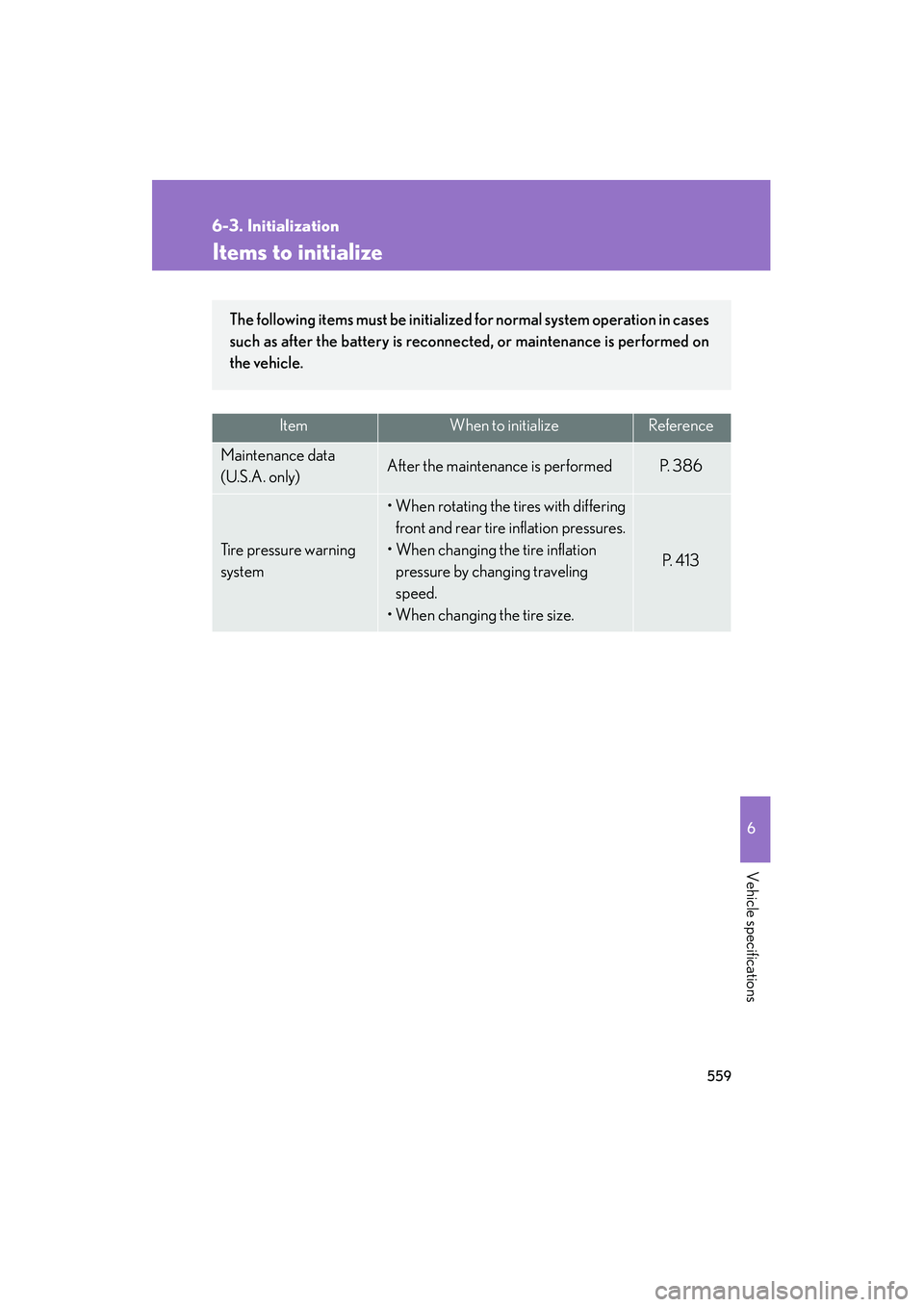
Items to initialize
ItemWhen to initializeReference
Maintenance data
(U.S.A. only)After the maintenance is performedP. 3 8 6
Tire pressure warning
system
• When rotating the tires with differing front and rear tire inflation pressures.
• When changing the tire inflation pressure by changing traveling
speed.
• When changing the tire size.
P. 4 1 3
The following items must be initialized for normal system operation in cases
such as after the battery is reconnected, or maintenance is performed on
the vehicle.