BELTS Lexus IS250 2012 Owner's Manual
[x] Cancel search | Manufacturer: LEXUS, Model Year: 2012, Model line: IS250, Model: Lexus IS250 2012Pages: 594, PDF Size: 7.2 MB
Page 3 of 594
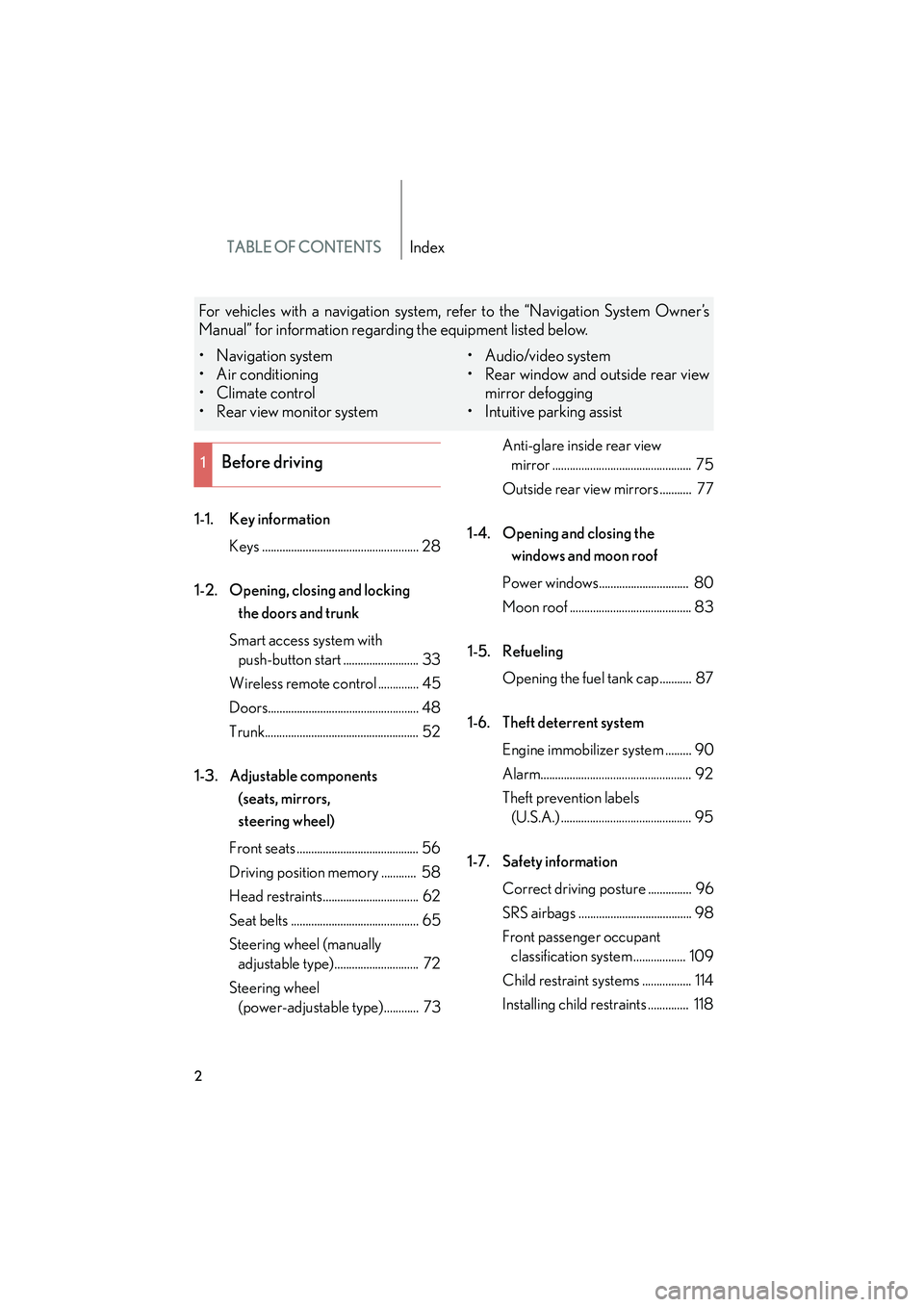
TABLE OF CONTENTSIndex
2
IS350/250_U
1-1. Key informationKeys ...................................................... 28
1-2. Opening, closing and locking the doors and trunk
Smart access system with push-button start .......................... 33
Wireless remote control .............. 45
Doors.................................................... 48
Trunk..................................................... 52
1-3. Adjustable components (seats, mirrors,
steering wheel)
Front seats .......................................... 56
Driving position memory ............ 58
Head restraints................................. 62
Seat belts ............................................ 65
Steering wheel (manually adjustable type)............................. 72
Steering wheel (power-adjustable type)............ 73 Anti-glare inside rear view
mirror ................................................ 75
Outside rear view mirrors ........... 77
1-4. Opening and closing the windows and moon roof
Power windows............................... 80
Moon roof .......................................... 83
1-5. Refueling Opening the fuel tank cap........... 87
1-6. Theft deterrent system Engine immobilizer system ......... 90
Alarm.................................................... 92
Theft prevention labels (U.S.A.) ............................................. 95
1-7. Safety information Correct driving posture ............... 96
SRS airbags ....................................... 98
Front passenger occupant classification system .................. 109
Child restraint systems ................. 114
Installing child restraints .............. 118
1Before driving
For vehicles with a navigation system, refer to the “Navigation System Owner’s
Manual” for information regarding the equipment listed below.
• Navigation system
• Air conditioning
•Climate control
• Rear view monitor system • Audio/video system
• Rear window and outside rear view
mirror defogging
• Intuitive parking assist
Page 11 of 594
IS350/250_U
10
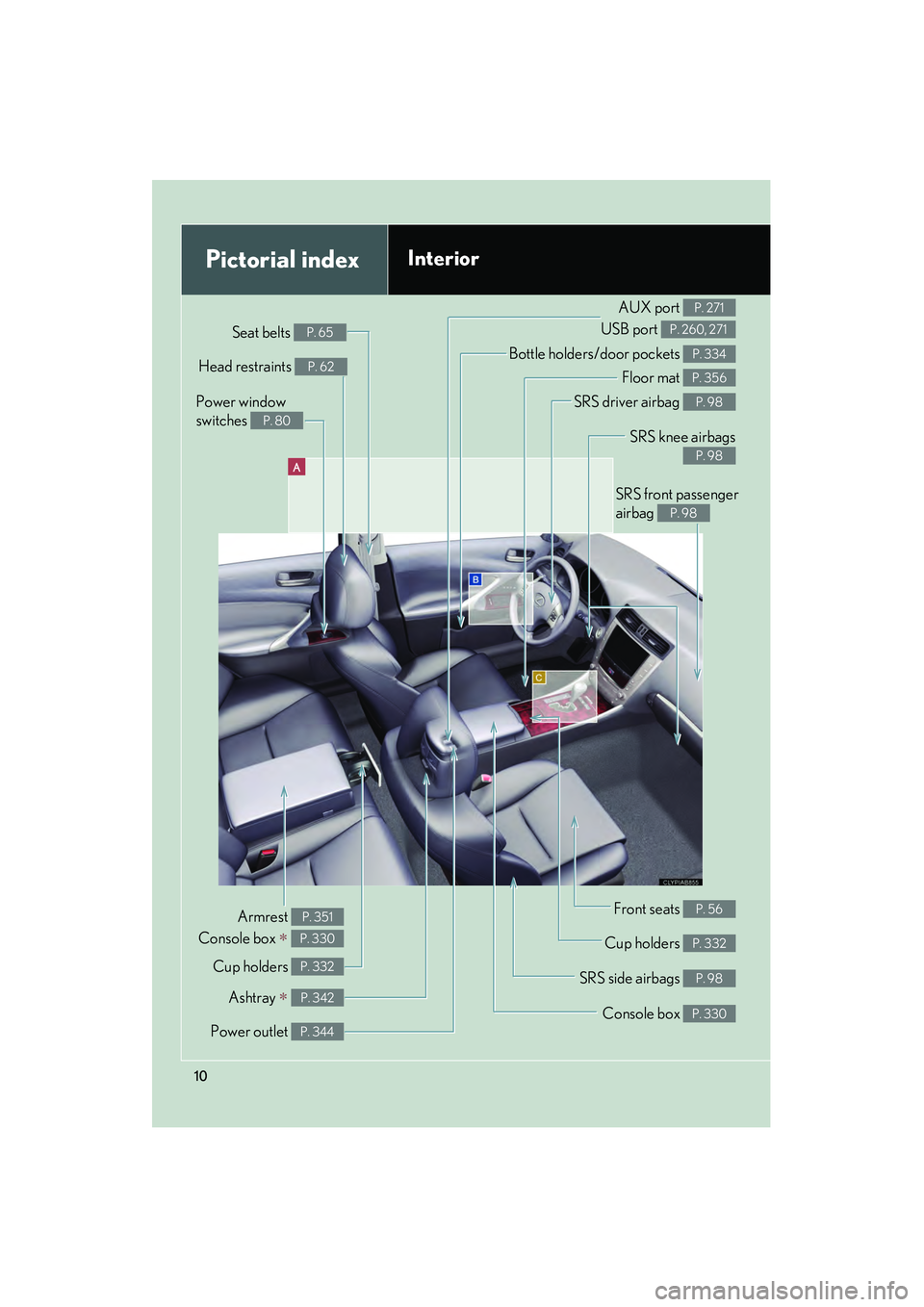
A
Power window
switches
P. 80
Pictorial indexInterior
Seat belts P. 65
SRS front passenger
airbag
P. 98
SRS knee airbags
P. 98
SRS driver airbag P. 98
Floor mat P. 356
Bottle holders/door pockets P. 334Head restraints P. 62
Front seats P. 56
Cup holders P. 332
SRS side airbags P. 98
Console box P. 330
Power outlet P. 344
Ashtray ∗ P. 342
Cup holders P. 332
Armrest
Console box
∗
P. 351
P. 330
AUX port
USB port P. 271
P. 260, 271
Page 23 of 594

IS350/250_U
22
●Event data recorder
Your vehicle has computers that monitor and control certain aspects of your vehi-
cle. These computers assist in driving and maintaining optimal vehicle performance.
Besides storing data useful for troubleshooting, there is an event data recorder
(EDR) that records data in a crash or near crash event.
The SRS airbag sensor assembly contains the EDR. In a crash or near crash event,
this device may record the following information:
• Engine speed
• Whether the brake pedal was depressed or not
• Vehicle speed
• To what extent the accelerator pedal was depressed
• The transmission shift position
• Whether the driver and front passenger wore seat belts or not
• Driver’s seat position
• SRS airbag deployment data
• SRS airbag system diagnostic data
• Front passenger’s occupant classification
The information above is intended to be used for the purpose of improving vehicle
safety performance. Unlike general data recorders, the EDR does not record sound
data such as conversation between passengers.
Page 28 of 594
Before driving1
27
IS350/250_U
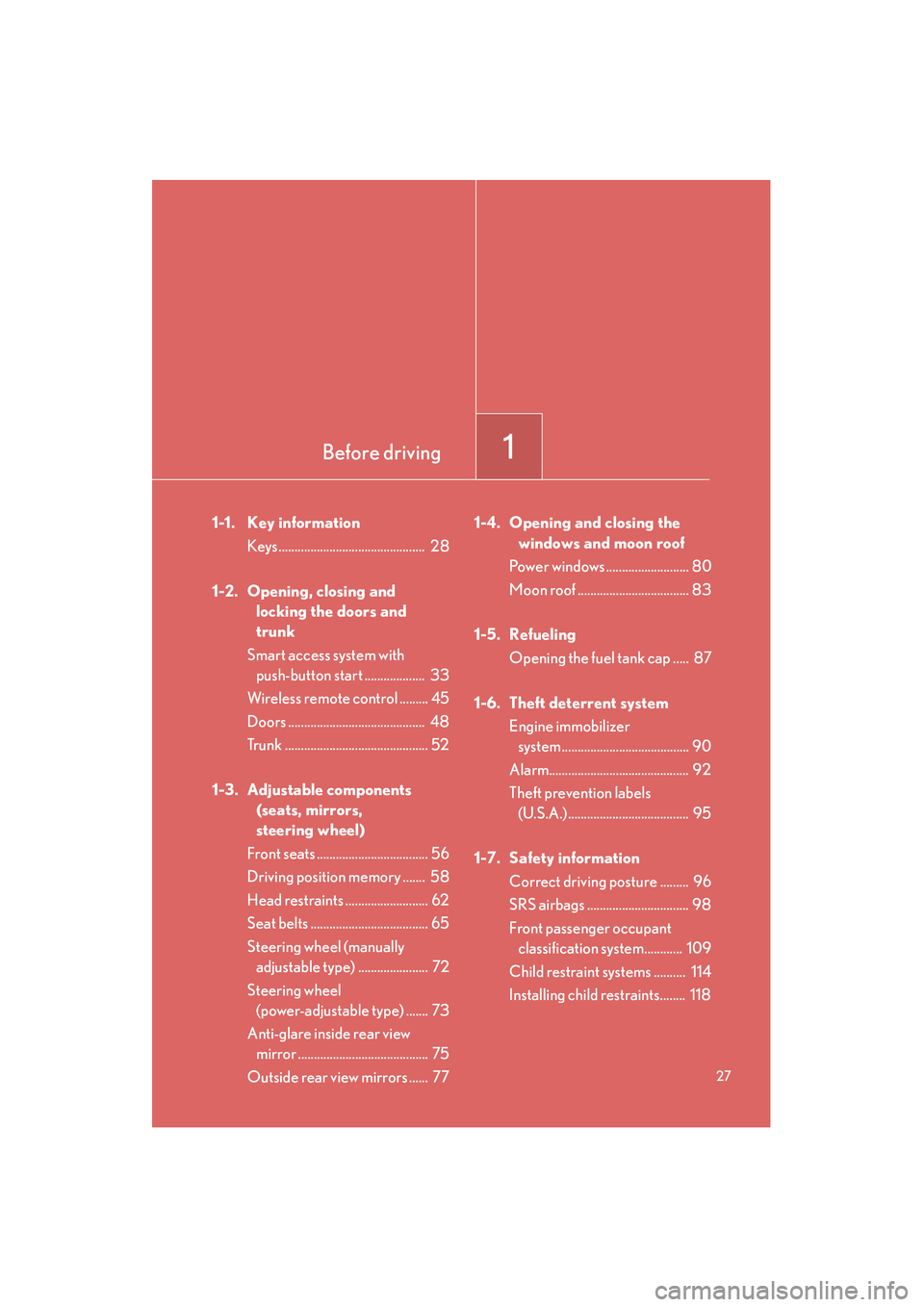
1-1. Key informationKeys .............................................. 28
1-2. Opening, closing and locking the doors and
trunk
Smart access system with push-button start ................... 33
Wireless remote control ......... 45
Doors ........................................... 48
Trunk ............................................. 52
1-3. Adjustable components (seats, mirrors,
steering wheel)
Front seats ................................... 56
Driving position memory ....... 58
Head restraints .......................... 62
Seat belts ..................................... 65
Steering wheel (manually adjustable type) ...................... 72
Steering wheel (power-adjustable type) ....... 73
Anti-glare inside rear view mirror ......................................... 75
Outside rear view mirrors ...... 77 1-4. Opening and closing the
windows and moon roof
Power windows .......................... 80
Moon roof ................................... 83
1-5. Refueling Opening the fuel tank cap ..... 87
1-6. Theft deterrent system Engine immobilizer system ........................................ 90
Alarm............................................ 92
Theft prevention labels (U.S.A.)...................................... 95
1-7. Safety information Correct driving posture ......... 96
SRS airbags ................................ 98
Front passenger occupant classification system............ 109
Child restraint systems .......... 114
Installing child restraints........ 118
Page 66 of 594
65
1
1-3. Adjustable components (seats, mirrors, steering wheel)
Before driving
IS350/250_U
Seat belts
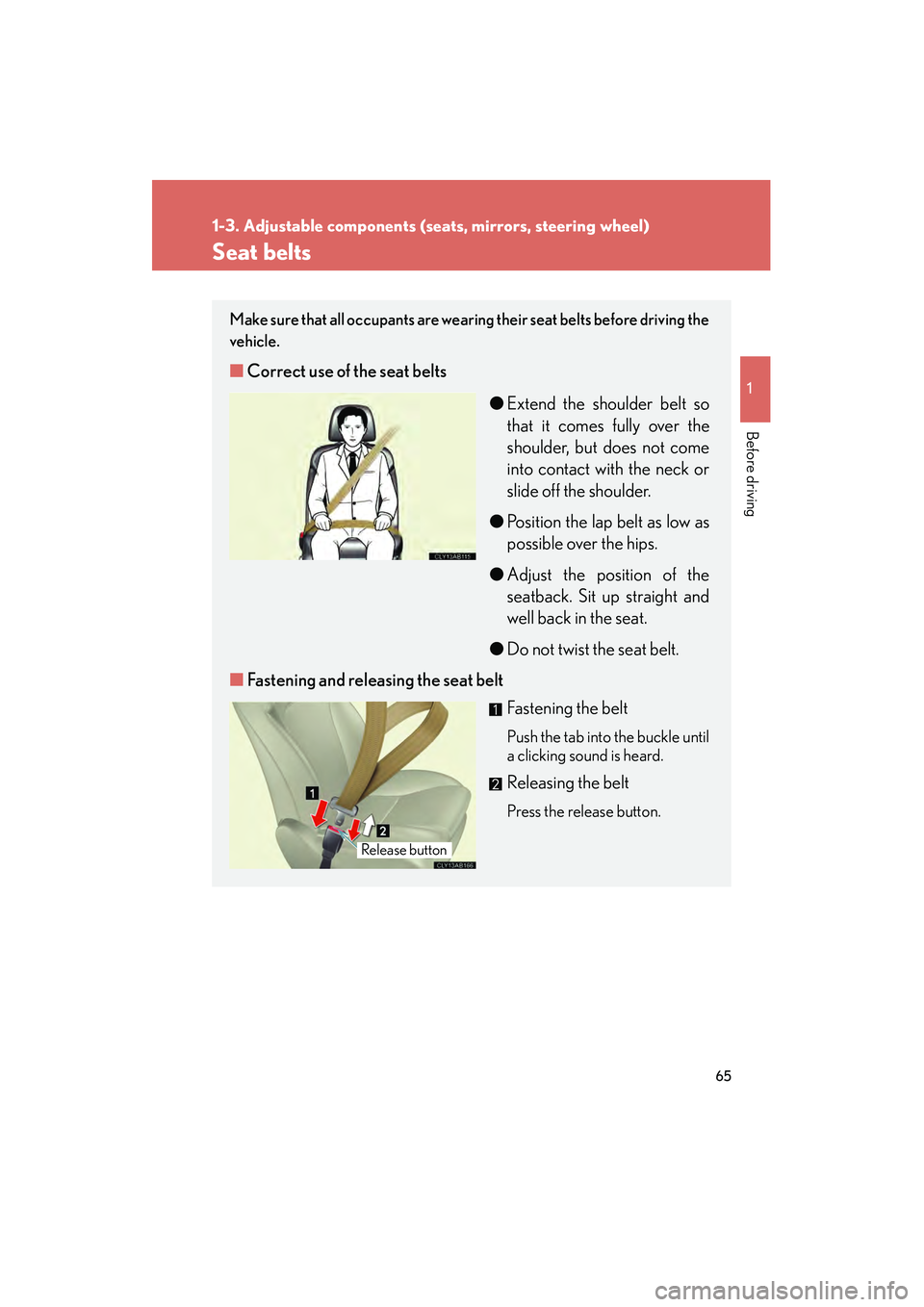
Make sure that all occupants are wearing their seat belts before driving the
vehicle.
■Correct use of the seat belts
●Extend the shoulder belt so
that it comes fully over the
shoulder, but does not come
into contact with the neck or
slide off the shoulder.
● Position the lap belt as low as
possible over the hips.
● Adjust the position of the
seatback. Sit up straight and
well back in the seat.
● Do not twist the seat belt.
■ Fastening and releasing the seat belt
Fastening the belt
Push the tab into the buckle until
a clicking sound is heard.
Releasing the belt
Press the release button.
Release button
Page 69 of 594
68
1-3. Adjustable components (seats, mirrors, steering wheel)
IS350/250_U
■People suffering illness
Obtain medical advice and wear the seat belt in the proper way.
■Child seat belt usage
The seat belts of your vehicle are principally designed for persons of adult size.
●Use a child restraint system appropriate for the child, until the child becomes
large enough to properly wear the vehicle's seat belt. ( →P. 114)
●When the child becomes large enough to properly wear the vehicle's seat belt,
follow the instructions on P. 65 regarding seat belt usage.
■Replacing the belt after the pr etensioner has been activated
If the vehicle is involved in multiple collisions, the pretensioner will activate for the
first collision, but will not activate for the second or subsequent collisions.
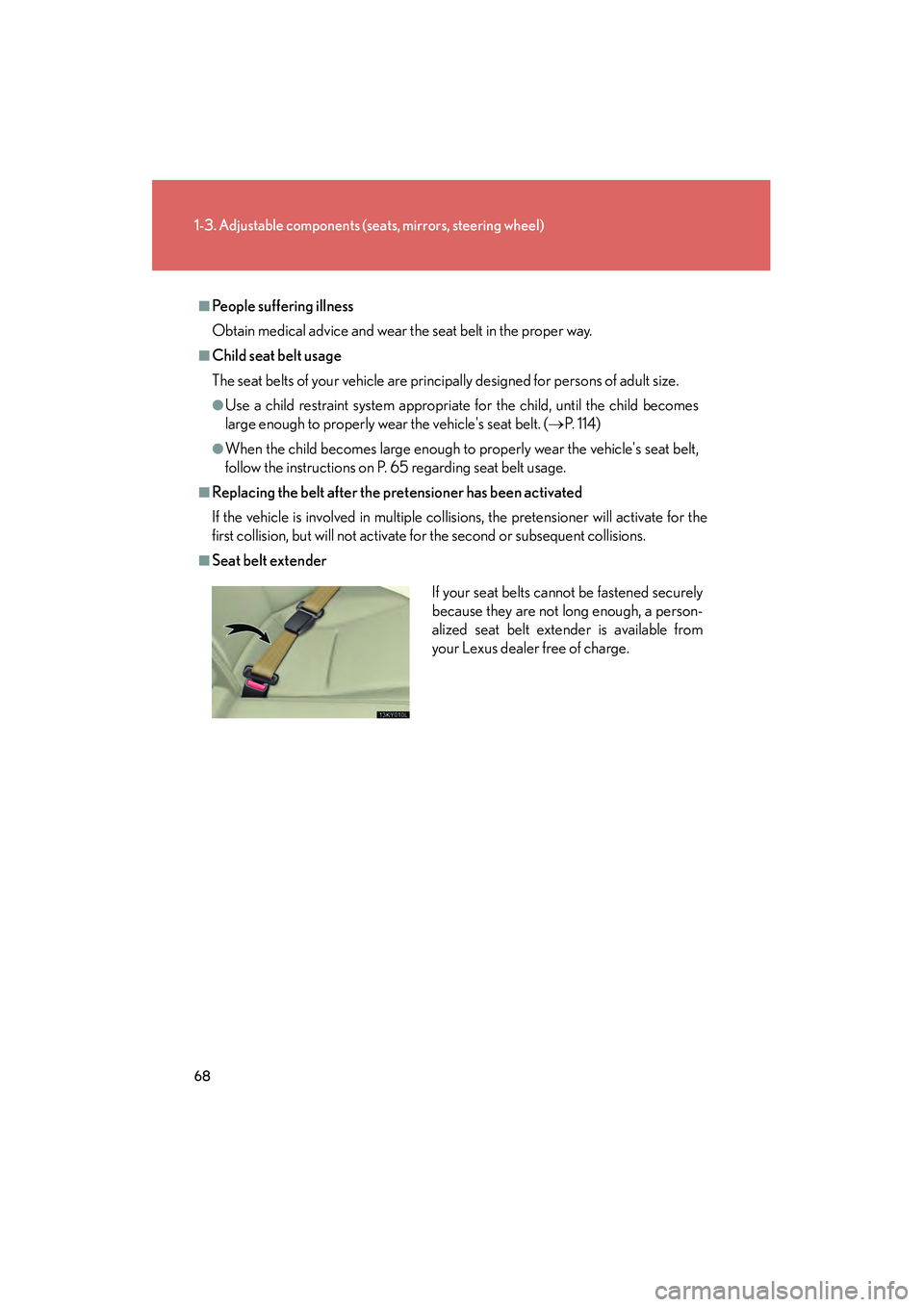
■Seat belt extender
If your seat belts cannot be fastened securely
because they are not long enough, a person-
alized seat belt extender is available from
your Lexus dealer free of charge.
Page 71 of 594
70
1-3. Adjustable components (seats, mirrors, steering wheel)
IS350/250_U
CAUTION
■Seat belt pretensioners
●Do not place anything, such as a cushion, on the front passenger’s seat. Doing so
will disperse the passenger’s weight, which prevents the sensor from detecting
the passenger’s weight properly. As a result, the seat belt pretensioner for the
front passenger’s seat may not activate in the event of a collision.
●If the pretensioner has activated, the SRS warning light will come on. In that case,
the seat belt cannot be used again and must be replaced at your Lexus dealer.
■Seat belt damage and wear
Inappropriate handling of the pretensioner may prevent it from operating properly
resulting in death or serious injury.
●Do not damage the seat belts by allowing the belt, plate, or buckle to be jammed
in the door.
●Inspect the seat belt system periodically. Check for cuts, fraying, and loose parts.
Do not use a damaged seat belt until it is replaced. Damaged seat belts cannot
protect an occupant from death or serious injury.
●Ensure that the belt and tab are locked and the belt is not twisted.
If the seat belt does not function correctly, immediately contact your Lexus
dealer.
●Replace the seat assembly, including the belts, if your vehicle has been involved in
a serious accident, even if there's no obvious damage.
●Do not attempt to install, remove, modify, disassemble or dispose of the seat belts.
Have any necessary repairs carried out by your Lexus dealer.
■Using a seat belt extender
●Do not wear the seat belt extender if you can fasten the seat belt without the
extender.
●Do not use the seat belt extender when installing a child restraint system because
the belt will not securely hold the child restraint system, increasing the risk of
death or serious injury in the event of an accident.
●The personalized extender may not be safe on another vehicle, when used by
another person, or at a different seatin g position other than the one originally
intended.
Page 99 of 594
98
1-7. Safety information
IS350/250_U
SRS airbags
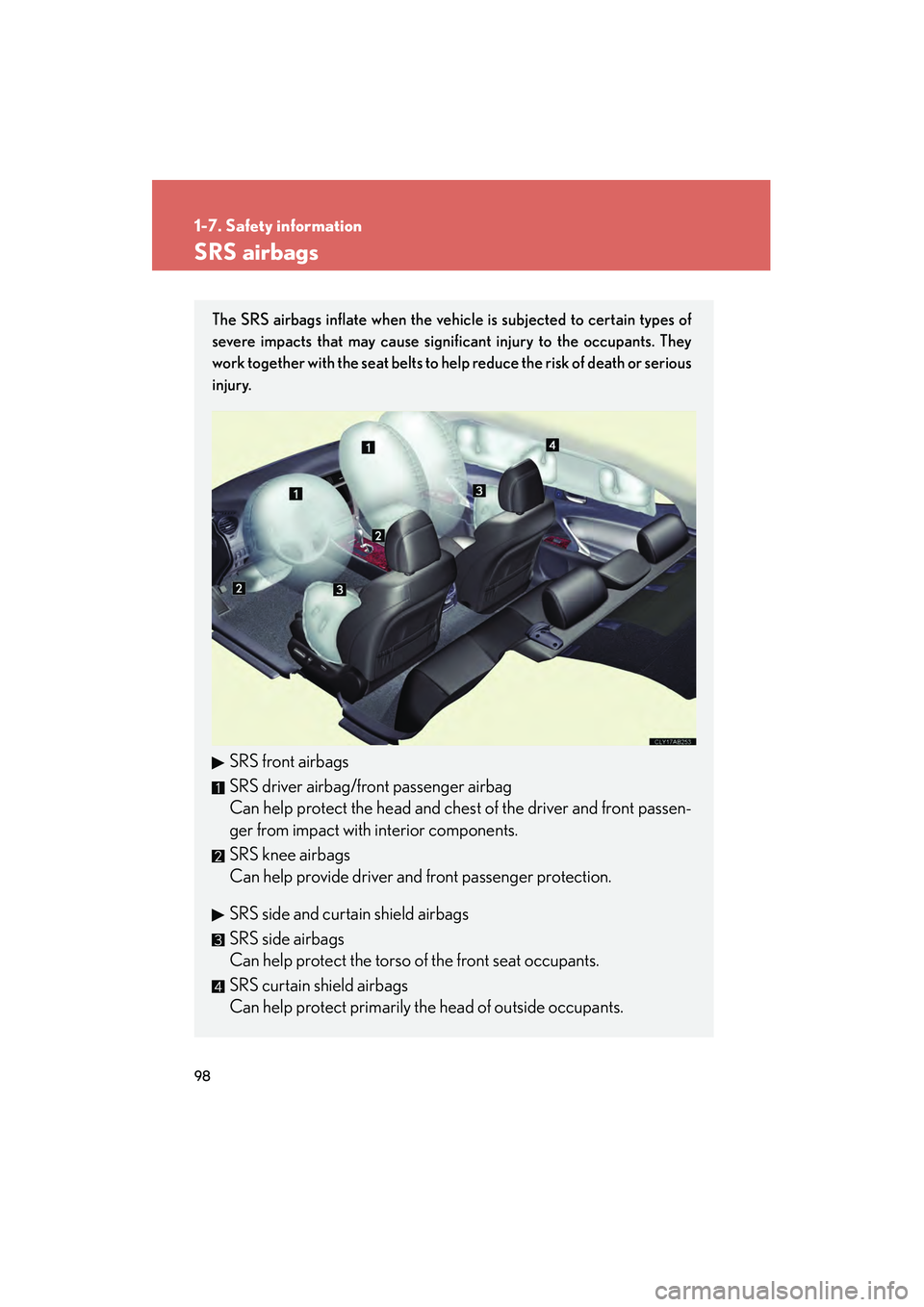
The SRS airbags inflate when the vehicle is subjected to certain types of
severe impacts that may cause significant injury to the occupants. They
work together with the seat belts to help reduce the risk of death or serious
injury.
SRS front airbags
SRS driver airbag/front passenger airbag
Can help protect the head and chest of the driver and front passen-
ger from impact with interior components.
SRS knee airbags
Can help provide driver and front passenger protection.
SRS side and curtain shield airbags
SRS side airbags
Can help protect the torso of the front seat occupants.
SRS curtain shield airbags
Can help protect primarily the head of outside occupants.
Page 105 of 594

104
1-7. Safety information
IS350/250_U
CAUTION
■SRS airbag precautions
Observe the following precautions regarding the airbags.
Failure to do so may cause death or serious injury.
●The driver and all passengers in the vehicle must wear their seat belts properly.
The SRS airbags are supplemental devices to be used with the seat belts.
●The SRS driver airbag deploys with considerable force, and can cause death or
serious injury especially if the driver is very close to the airbag. The National
Highway Traffic Safety Administration (“NHTSA”) advises:
Since the risk zone for driver airbag is the first 2 - 3 in. (50 - 75 mm) of inflation,
placing yourself 10 in. (250 mm) from your driver airbag provides you with a
clear margin of safety. This distance is measured from the center of the steering
wheel to your breastbone. If you sit less than 10 in. (250 mm) away now, you can
change your driving position in several ways:
• Move your seat to the rear as far as you can while still reaching the pedalscomfortably.
• Slightly recline the back of the seat. Although vehicle designs vary, many drivers can achieve the 10 in. (250 mm)
distance, even with the driver seat all the way forward, simply by reclining the
back of the seat somewhat. If reclining the back of your seat makes it hard to
see the road, raise yourself by using a firm, non-slippery cushion, or raise the
seat if your vehicle has that feature.
• If your steering wheel is adjustable, tilt it downward. This points the airbag toward your chest instead of your head and neck.
The seat should be adjusted as recommended by NHTSA above, while still main-
taining control of the foot pedals, steering wheel, and your view of the instrument
panel controls.
Page 119 of 594

118
1-7. Safety information
IS350/250_U
Installing child restraints
Follow the child restraint system manufacturer's instructions. Firmly
secure child restraints to the rear seats using the LATCH anchors or a seat
belt. Attach the top tether strap when installing a child restraint.
The lap/shoulder belt can be used if your child restraint system is not com-
patible with the LATCH (Lower Anchor s and Tethers for Children) system.
Child restraint LATCH anchors
LATCH anchors are provided
for the outside rear seats. (But-
tons displaying the location of
the anchors are attached to the
seats.)
Seat belts equipped with a child
restraint locking mechanism
(ALR/ELR belts except driver’s
seat belt) (→P. 6 5 )
Anchor bracket (for top tether
strap)
Anchor brackets are provided
for all rear seats.