steering Lexus IS250 2014 User Guide
[x] Cancel search | Manufacturer: LEXUS, Model Year: 2014, Model line: IS250, Model: Lexus IS250 2014Pages: 588, PDF Size: 98.77 MB
Page 46 of 588
461-1. For safe use
IS250_EE(OM53C51E)
CAUTION
■SRS airbag precautions
●Do not strike or apply significant levels of force to the area of the SRS airbag compo-
nents.
Doing so can cause the SRS airbags to malfunction.
●Do not touch any of the component parts immediately after the SRS airbags have
deployed (inflated) as they may be hot.
●If breathing becomes difficult after the SRS airbags have deployed, open a door or
window to allow fresh air in, or leave the vehicle if it is safe to do so. Wash off any resi-
due as soon as possible to prevent skin irritation.
●If the areas where the SRS airbags are stored, such as the steering wheel pad and
front and rear pillar garnishes are damaged or cracked, have them replaced by any
authorized Lexus dealer or repairer, or another duly qualified and equipped profes-
sional.
■Modification and disposal of SRS airbag system components
Do not dispose of your vehicle or perform any of the following modifications without
consulting any authorized Lexus dealer or repairer, or another duly qualified and
equipped professional. The SRS airbags may malfunction or deploy (inflate) acciden-
tally, causing death or serious injury.
●Installation, removal, disassembly and repair of the SRS airbags
●Repairs, modifications, removal or replacement of the steering wheel, instrument
panel, dashboard, seats or seat upholstery, front, side and rear pillars or roof side rails
●Repairs or modifications of the front fender, front bumper, or side of the occupant
compartment
●Installation of a grille guard (bull bars, kangaroo bar, etc.), snow plows, winches
●Modifications to the vehicle’s suspension system
●Installation of electronic devices such as mobile two-way radios (RF-transmitter) and
CD players
●Modifications to your vehicle for a person with a physical disability
Page 47 of 588
471-1. For safe use
1
For safety and security
IS250_EE(OM53C51E)
■If the SRS airbags deploy (inflate)
●Bruising and slight abrasions may result from contact with a deploying (inflating) SRS
airbag.
●A loud noise and white powder will be emitted.
●Parts of the airbag module (steering wheel hub, airbag cover and inflator) as well as the
front seats, parts of the front and rear pillars, and roof side rails, may be hot for several
minutes. The airbag itself may also be hot.
●The windshield may crack.
■SRS airbag deployment conditions (SRS front airbags)
●The SRS front airbags will deploy in the event of an impact that exceeds the set thresh-
old level (the level of force corresponding to an approximately 20 - 30 km/h [12 - 18
mph] frontal collision with a fixed wall that does not move or deform).
However, this threshold velocity will be considerably higher in the following situations:
• If the vehicle strikes an object, such as a parked vehicle or sign pole, which can move
or deform on impact
• If the vehicle is involved in an underride collision, such as a collision in which the
front of the vehicle “underrides”, or goes under, the bed of a truck
●Depending on the type of collision, it is possible that only the seat belt pretensioners will
activate.
■SRS airbag deployment conditions (SRS side and curtain shield airbags)
●The SRS side and curtain shield airbags will deploy in the event of an impact that
exceeds the set threshold level (the level of force corresponding to the impact force
produced by an approximately 1500 kg [3300 lb.] vehicle colliding with the vehicle
cabin from a direction perpendicular to the vehicle orientation at an approximate
speed of 20 - 30 km/h [12 - 18 mph]).
●The SRS curtain shield airbags may also deploy in the event of a severe frontal collision.
Page 50 of 588
501-1. For safe use
IS250_EE(OM53C51E)
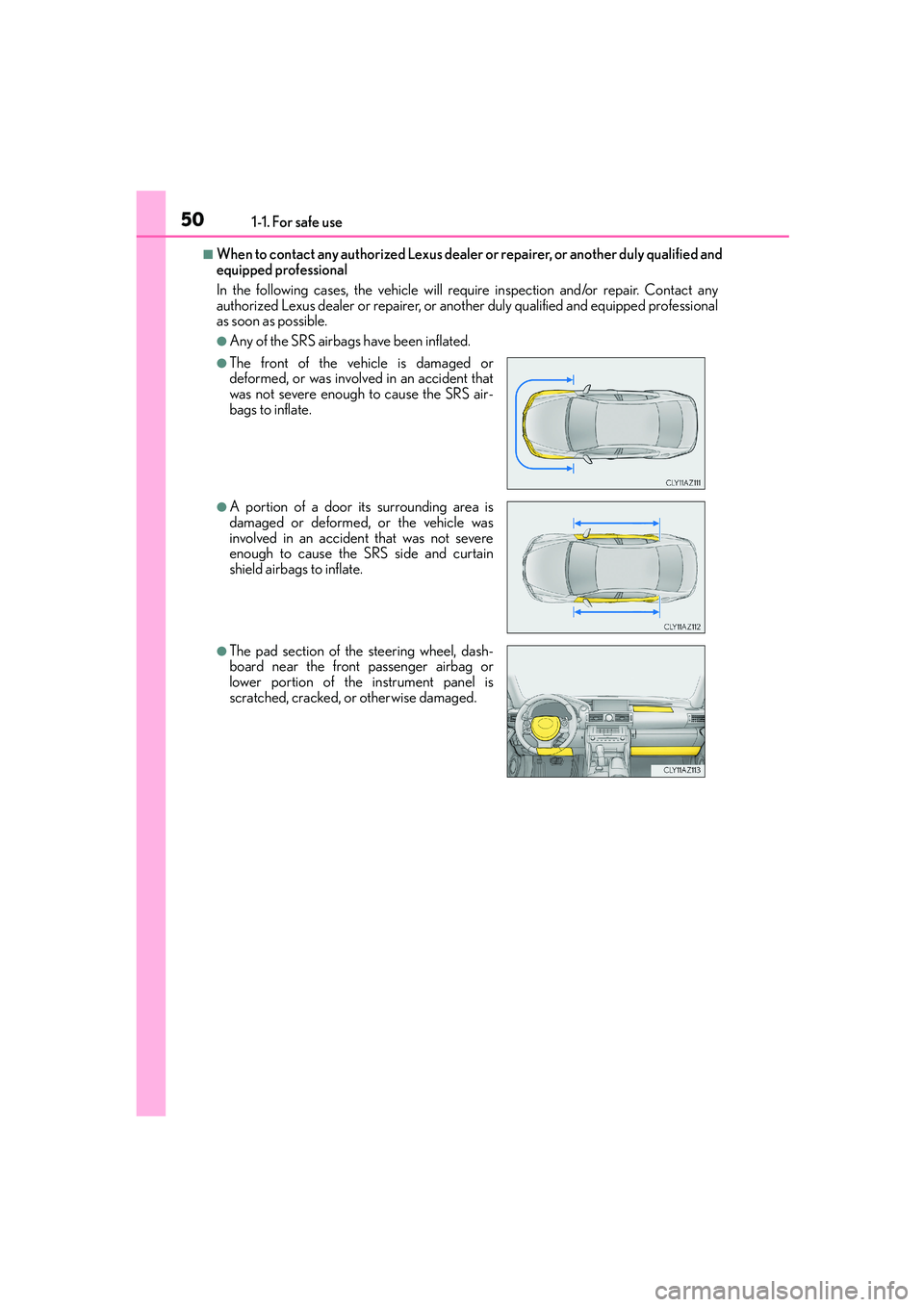
■When to contact any authorized Lexus dealer or repairer, or another duly qualified and
equipped professional
In the following cases, the vehicle will require inspection and/or repair. Contact any
authorized Lexus dealer or repairer, or another duly qualified and equipped professional
as soon as possible.
●Any of the SRS airbags have been inflated.
●The front of the vehicle is damaged or
deformed, or was involved in an accident that
was not severe enough to cause the SRS air-
bags to inflate.
●A portion of a door its surrounding area is
damaged or deformed, or the vehicle was
involved in an accident that was not severe
enough to cause the SRS side and curtain
shield airbags to inflate.
●The pad section of the steering wheel, dash-
board near the front passenger airbag or
lower portion of the instrument panel is
scratched, cracked, or otherwise damaged.
Page 91 of 588

912. Instrument cluster
2
Instrument cluster
IS250_EE(OM53C51E)
Warning lights inform the driver of malfunctions in the indicated vehicle systems.
*1: These lights turn on when the engine switch is turned to IGNITION ON mode to
indicate that a system check is being performed. They will turn off after the engine is
on, or after a few seconds. There may be a malfunction in a system if the lights do not
come on, or turn off. Have the vehicle inspected by any authorized Lexus dealer or
repairer, or another duly qualified and equipped professional.
*2: The light flashes to indicate a malfunction.
*3: This light illuminates on the center panel.
Wa r n i n g l i g h t s
*1Brake system warning light
(→P. 4 76 )*1 Automatic headlight level-
ing system warning light
(→P. 477)
*1Charging system warning
light (→P. 4 76 )Open door warning light
(→P. 4 7 8 )
*1Malfunction indicator
lamp (→P. 4 76 )Low fuel level warning light
(→P. 4 7 8 )
*1SRS warning light
(→P. 4 76 )Driver’s and front passen-
ger’s seat belt reminder light
(→P. 4 7 8 )
*1ABS warning light
(→P. 477)*3Rear passengers’ seat belt
reminder lights (→P. 4 7 8 )
*1Electric power steering sys-
tem warning light
(→P. 477)*1Master warning light
(→P. 4 7 8 )
*1, 2
(if equipped)
Pre-crash safety system
warning light (→P. 477)
*1
(if equipped)
Tire pressure warning light
(→P. 4 7 8 )
*1Slip indicator
(→P. 477)
Page 111 of 588
111
3
Operation of
each component
IS250_EE(OM53C51E)
3-1. Key information
Keys .................................................... 112
3-2. Opening, closing and
locking the doors and trunk
Doors .................................................118
Trunk ................................................. 125
Smart entry & start system...... 130
3-3. Adjusting the seats
Front seats....................................... 147
Rear seats........................................149
Driving position memory........... 151
Head restraints ............................ 156
3-4. Adjusting the steering
wheel and mirrors
Steering wheel ............................. 159
Inside rear view mirror................ 161
Outside rear view mirrors ....... 163
3-5. Opening, closing the
windows and moon roof
Power windows ............................. 167
Moon roof .......................................170
Page 148 of 588
1483-3. Adjusting the seats
IS250_EE(OM53C51E)
■Power easy access system (if equipped)
The driver’s seat and steering wheel move in accordance with engine switch mode and
the driver’s seat belt condition. (→P. 151)
■When adjusting the seat
●Take care when adjusting the seat so that the head restraint does not touch the ceiling.
●Vehicles with folding type rear seats: When folding down a rear seatback, if it interferes
with a front seatback, adjust the front seat position so that the seats no longer interfere
with each other. However, if adjusting the front seat position causes the correct driving
posture to not be maintained, return the rear seatback to its original position. (→P. 1 4 9 )
CAUTION
■When adjusting the seat position
●Take care when adjusting the seat position to ensure that other passengers are not
injured by the moving seat.
●Do not put your hands under the seat or near the moving parts to avoid injury.
Fingers or hands may become jammed in the seat mechanism.
●Make sure to leave enough space around the feet so they do not get stuck.
■Seat adjustment
To reduce the risk of sliding under the lap belt during a collision, do not recline the seat
more than necessary.
If the seat is too reclined, the lap belt may slide past the hips and apply restraint forces
directly to the abdomen, or your neck may contact the shoulder belt, increasing the risk
of death or serious injury in the event of an accident.
Adjustments should not be made while driving as the seat may unexpectedly move and
cause the driver to lose control of the vehicle.
Page 151 of 588
1513-3. Adjusting the seats
3
Operation of each component
IS250_EE(OM53C51E)
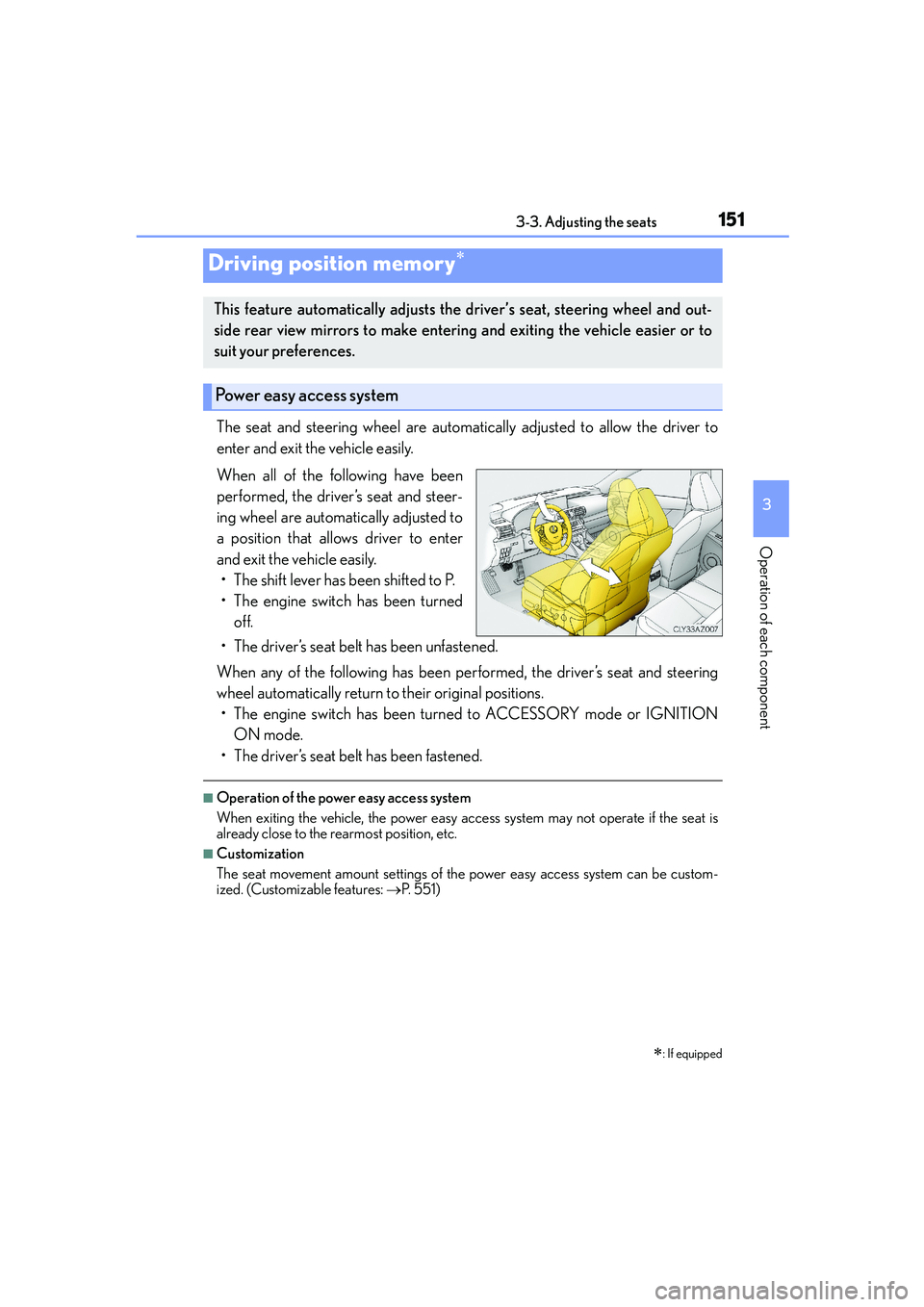
The seat and steering wheel are automatically adjusted to allow the driver to
enter and exit the vehicle easily.
When all of the following have been
performed, the driver’s seat and steer-
ing wheel are automatically adjusted to
a position that allows driver to enter
and exit the vehicle easily.
• The shift lever has been shifted to P.
• The engine switch has been turned
off.
• The driver’s seat belt has been unfastened.
When any of the following has been performed, the driver’s seat and steering
wheel automatically return to their original positions.
• The engine switch has been turned to ACCESSORY mode or IGNITION
ON mode.
• The driver’s seat belt has been fastened.
■Operation of the power easy access system
When exiting the vehicle, the power easy access system may not operate if the seat is
already close to the rearmost position, etc.
■Customization
The seat movement amount settings of the power easy access system can be custom-
ized. (Customizable features: →P. 551)
Driving position memory∗
∗
: If equipped
This feature automatically adjusts the driver’s seat, steering wheel and out-
side rear view mirrors to make entering and exiting the vehicle easier or to
suit your preferences.
Power easy access system
Page 152 of 588
1523-3. Adjusting the seats
IS250_EE(OM53C51E)
Your preferred driving position (the position of the driver’s seat, steering wheel
and outside rear view mirrors) can be recorded and recalled by pressing a but-
ton.
Three different driving positions can be recorded into memory.
■Recording procedure
Check that the shift lever is in P.
Turn the engine switch to IGNITION ON mode.
Adjust the driver’s seat, steering wheel, and outside rear view mirrors to the
desired positions.
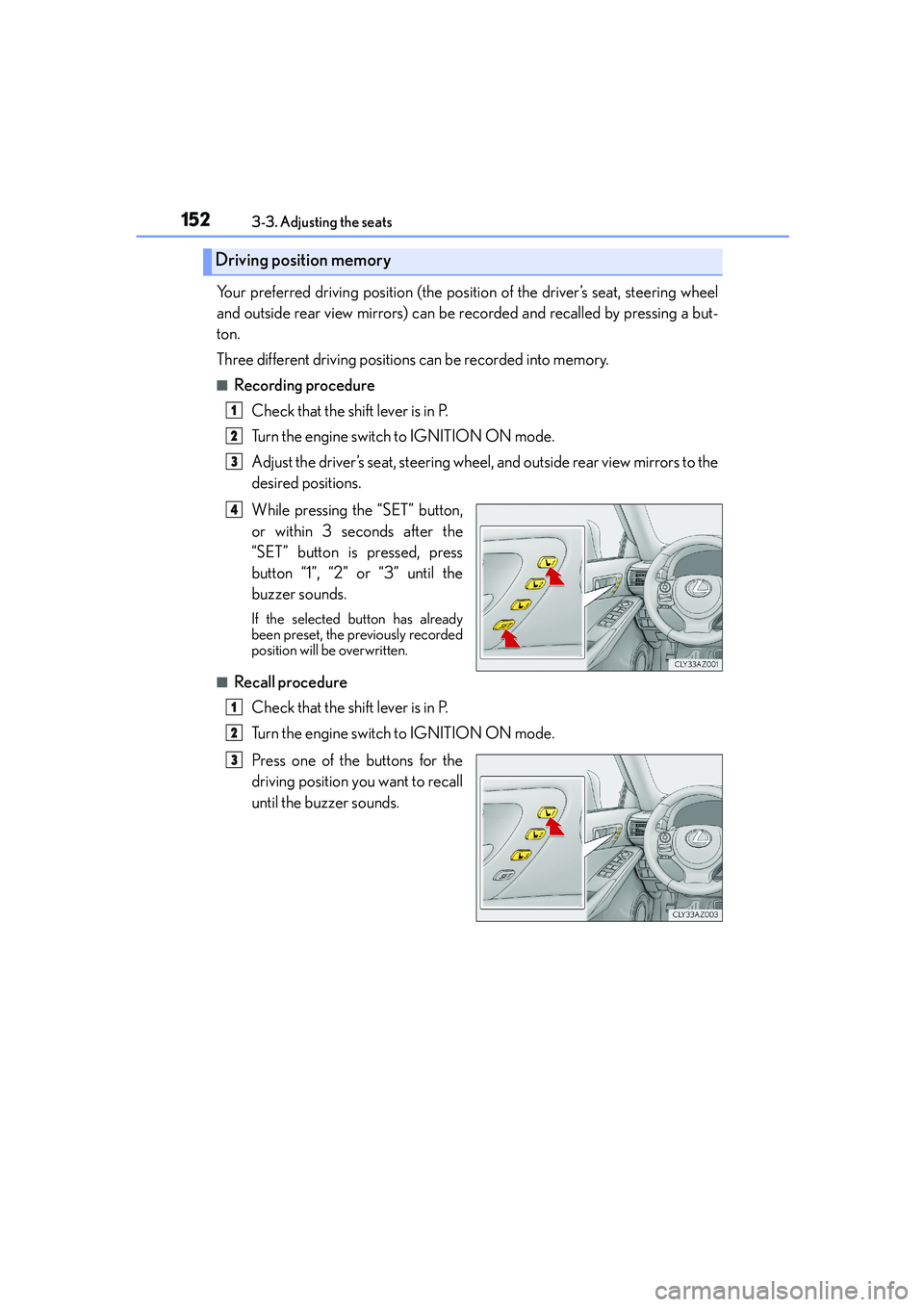
While pressing the “SET” button,
or within 3 seconds after the
“SET” button is pressed, press
button “1”, “2” or “3” until the
buzzer sounds.
If the selected button has already
been preset, the previously recorded
position will be overwritten.
■Recall procedure
Check that the shift lever is in P.
Turn the engine switch to IGNITION ON mode.
Press one of the buttons for the
driving position you want to recall
until the buzzer sounds.
Driving position memory
1
2
3
4
1
2
3
Page 153 of 588
1533-3. Adjusting the seats
3
Operation of each component
IS250_EE(OM53C51E)
■To stop the position recall operation part-way through
Perform any of the following operations:
●Press the “SET” button.
●Press button “1”, “2” or “3”.
●Operate any of the seat adjustment switches (only cancels seat position recall).
●Operate the tilt and telescopic steering control switch (only cancels steering wheel
position recall).
■Seat positions that can be memorized (→P. 1 4 7 )
The adjusted positions other than the position adjusted by lumbar support switch can be
memorized.
■Operating the driving position memory after turning the engine switch off
Recorded seat positions can be activated up to 180 seconds after the driver’s door is
opened and another 60 seconds after it is closed again. Recorded steering wheel posi-
tion can be activated by pressing the engine switch.
■In order to correctly use the driving position memory function
If a seat position is already in the furthest possible position and the seat is operated in the
same direction, the recorded position may be slightly different when it is recalled.
Page 154 of 588
1543-3. Adjusting the seats
IS250_EE(OM53C51E)
Each electronic key (including a card key) can be registered to recall your pre-
ferred driving position.
■Registering procedure
Record your driving position to button “1”, “2” or “3” before performing the
following:
Carry only the key you want to register, and then close the driver’s door. If 2 or
more keys are in the vehicle, the driving position cannot be recorded properly.
Check that the shift lever is in P.
Turn the engine switch to IGNITION ON mode.
Recall the driving position that you want to record.
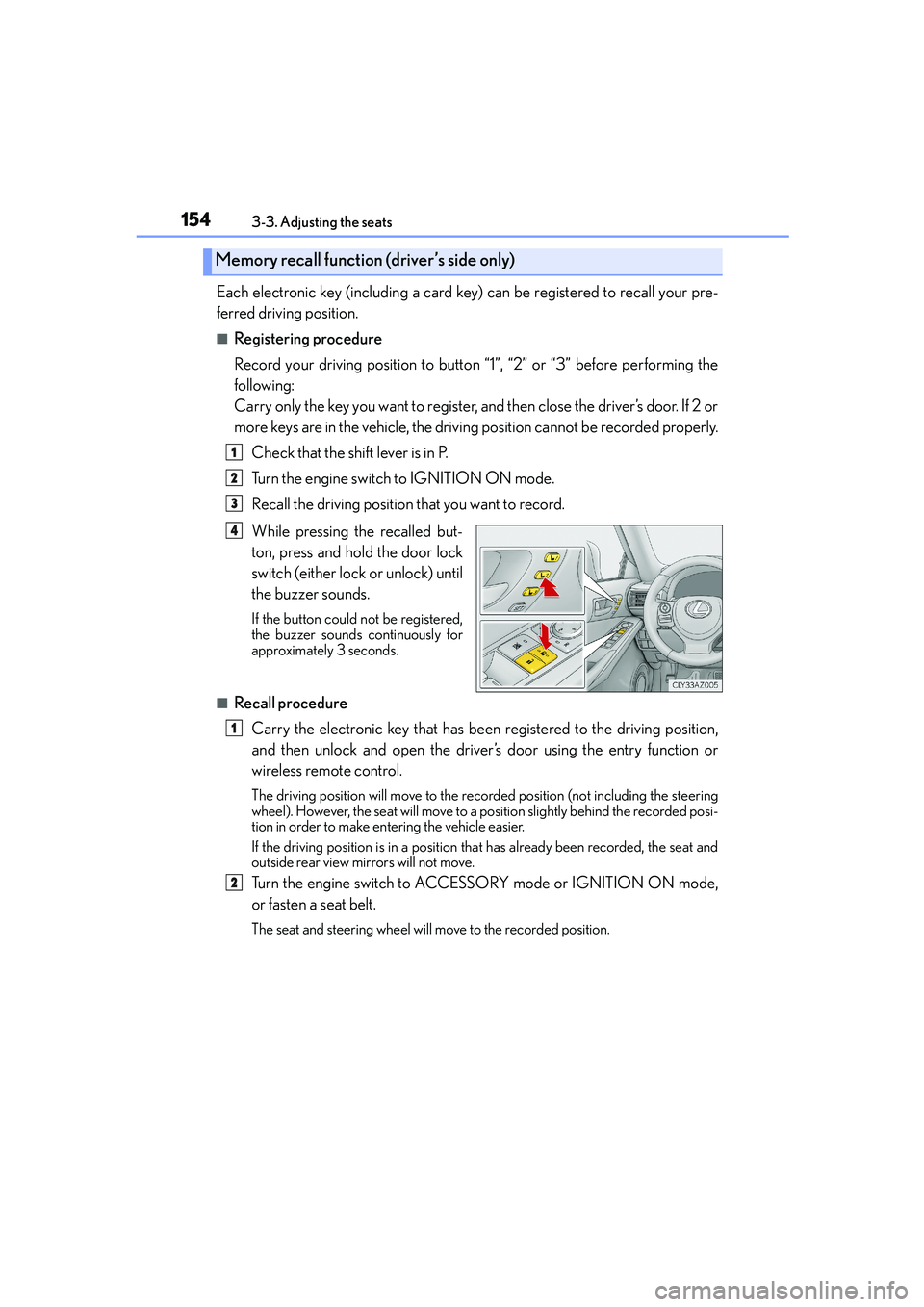
While pressing the recalled but-
ton, press and hold the door lock
switch (either lock or unlock) until
the buzzer sounds.
If the button could not be registered,
the buzzer sounds continuously for
approximately 3 seconds.
■Recall procedure
Carry the electronic key that has been registered to the driving position,
and then unlock and open the driver’s door using the entry function or
wireless remote control.
The driving position will move to the recorded position (not including the steering
wheel). However, the seat will move to a position slightly behind the recorded posi-
tion in order to make entering the vehicle easier.
If the driving position is in a position that has already been recorded, the seat and
outside rear view mirrors will not move.
Turn the engine switch to ACCESSORY mode or IGNITION ON mode,
or fasten a seat belt.
The seat and steering wheel will move to the recorded position.
Memory recall function (driver’s side only)
1
2
3
4
1
2