Brakes Lexus IS250 2014 Owner's Guide
[x] Cancel search | Manufacturer: LEXUS, Model Year: 2014, Model line: IS250, Model: Lexus IS250 2014Pages: 588, PDF Size: 98.77 MB
Page 480 of 588

4808-2. Steps to take in an emergency
IS250_EE(OM53C51E)
■If the tire pressure warning light frequently comes on after blinking for 1 minute (if
equipped)
If the tire pressure warning light frequently comes on after blinking for 1 minute when the
engine switch is turned to IGNITION ON mode, have it checked by any authorized
Lexus dealer or repairer, or another duly qualified and equipped professional.
■Warning buzzer
In some cases, the buzzer may not be heard due to being in a noisy location or audio
sound.
CAUTION
■If both the ABS and the brake system warning lights remain on
Stop your vehicle in a safe place immediately and contact any authorized Lexus dealer
or repairer, or another duly qualified and equipped professional. The vehicle will
become extremely unstable during braking, and the ABS system may fail, which could
cause an accident resulting in death or serious injury.
■When the electric power steering system warning light comes on
The steering wheel may become extremely heavy.
If the steering wheel becomes heavier than usual when operating, hold firmly and oper-
ate using more force than usual.
■If the tire pressure warning light comes on (if equipped)
Be sure to observe the following precautions. Failure to do so could cause a loss of
vehicle control and result in death or serious injury.
XVehicles with a compact spare tire
●Stop your vehicle in a safe place as soon as possible. Adjust the tire inflation pressure
immediately.
●If the tire pressure warning light comes on even after tire inflation pressure adjust-
ment, it is probable that you have a flat tire. Check the tires. If a tire is flat, change it
with the spare tire and have the flat tire repaired by the nearest authorized Lexus
dealer or repairer, or another duly qualified and equipped professional.
●Avoid abrupt maneuvering and braking. If the vehicle tires deteriorate, you could lose
control of the steering wheel or the brakes.
XVehicles with an emergency tire puncture repair kit
●Stop your vehicle in a safe place as soon as possible. Adjust the tire inflation pressure
immediately.
●If the tire pressure warning light comes on even after tire inflation pressure adjust-
ment, it is probable that you have a flat tire. Check the tires. If a tire is flat, repair the
flat tire by using emergency tire puncture repair kit.
●Avoid abrupt maneuvering and braking. If the vehicle tires deteriorate, you could lose
control of the steering wheel or the brakes.
■If a blowout or sudden air leakage should occur
The tire pressure warning system may not activate immediately.
Page 483 of 588

4838-2. Steps to take in an emergency
8
When trouble arises
IS250_EE(OM53C51E)
Warning message and warning buzzer list
Wa r n i n g m e s s a g eDetails/Actions
(If equipped)
Indicates that:
• There is a high possibility of a frontal collision; or
• The pre-crash braking function is operating
A buzzer also sounds.
→Slow the vehicle by applying the brakes.
Indicates that the engine was stopped with the shift lever
not in P
A buzzer also sounds.
→Shift the shift lever to P.
Indicates that the engine was stopped while driving
A buzzer also sounds.
→Stop the vehicle in a safe place such as the shoulder
of a road.
(If equipped)
Indicates that your vehicle is nearing the vehicle ahead
(in vehicle-to-vehicle distance mode)
A buzzer also sounds.
→Slow the vehicle by applying the brakes.
(If equipped)
Alerts the driver that the vehicle has deviated from the
lane (while the LDA [Lane Departure Alert] system is
operating)
The lane line on the side the vehicle has deviated from
flashes in yellow.
The warning buzzer sounds continuously.
→Check around the vehicle and back to inside of the
lane lines.
(Flashes)
(Flashes)
(Flashes)
Page 502 of 588

5028-2. Steps to take in an emergency
IS250_EE(OM53C51E)
CAUTION
■Replacing a flat tire
●Do not touch the disc wheels or the area around the brakes immediately after the
vehicle has been driven.
After the vehicle has been driven the disc wheels and the area around the brakes will
be extremely hot. Touching these areas with hands, feet or other body parts while
changing a tire, etc. may result in burns.
●Failure to follow these precautions could cause the wheel nuts to loosen and the tire
to fall off, resulting in death or serious injury.
• Never use oil or grease on the wheel bolts or wheel nuts.
Oil and grease may cause the wheel nuts to be excessively tightened, leading to
bolt or disc wheel damage. In addition, the oil or grease can cause the wheel nuts
to loosen and the wheel may fall off, causing a serious accident. Remove any oil or
grease from the wheel bolts or wheel nuts.
• Have the wheel nuts tightened with a torque wrench to 103 N•m (10.5 kgf•m,
76 ft•lbf) as soon as possible after changing wheels.
• Do not attach a heavily damaged wheel ornament, as it may fly off the wheel while
the vehicle is moving.
• When installing a tire, only use wheel nuts that have been specifically designed for
that wheel.
• If there are any cracks or deformations in the bolt screws, nut threads or bolt holes
of the wheel, have the vehicle inspected by any authorized Lexus dealer or
repairer, or another duly qualified and equipped professional.
Page 519 of 588
5198-2. Steps to take in an emergency
8
When trouble arises
IS250_EE(OM53C51E)
CAUTION
■When fixing the flat tire
●Stop your vehicle in a safe and flat area.
●Do not touch the wheels or the area around the brakes immediately after the vehicle
has been driven.
After the vehicle has been driven, the wheels and the area around the brakes may be
extremely hot. Touching these areas with hands, feet or other body parts may result in
burns.
●Connect the valve and hose securely with the tire installed on the vehicle.
●If the hose is not properly connected to the valve, air leakage may occur or sealant
may be sprayed out.
●If the hose comes off the valve while inflating the tire, there is a risk that the hose will
move abruptly due to air pressure.
●After inflation of the tire has completed, the sealant may splatter when the hose is dis-
connected or some air is let out of the tire.
●Follow the operation procedure to repair the tire. If the procedure is not followed, the
sealant may spray out.
●Keep back from the tire while it is being repaired, as there is a chance of it bursting
while the repair operation is being performed. If you notice any cracks or deforma-
tion of the tire, turn off the compressor switch and stop the repair operation immedi-
ately.
●The kit may overheat if operated for a long period of time. Do not operate the com-
pressor continuously for more than 10 minutes.
●Parts of the kit become hot during operation. Be careful handling the kit during and
after operation.
●Do not attach the vehicle speed warning sticker to an area other than the one indi-
cated. If the sticker is attached to an area where an SRS airbag is located, such as the
pad of the steering wheel, it may prevent the SRS air bag from operating properly.
■Driving to spread the liquid sealant evenly
●Drive the vehicle carefully at a low speed. Be especially careful when turning and cor-
nering.
●If the vehicle does not drive straight or you feel a pull through the steering wheel, stop
the vehicle and check the following:
• Tire condition. The tire may have separated from the wheel.
• Tire inflation pressure. If tire inflation pressure is 130 kPa (1.3 kgf/cm
2 or bar, 19 psi)
or below, this may indicate severe tire damage.
Page 545 of 588
545
9 9-1. Specifications
Vehicle specifications
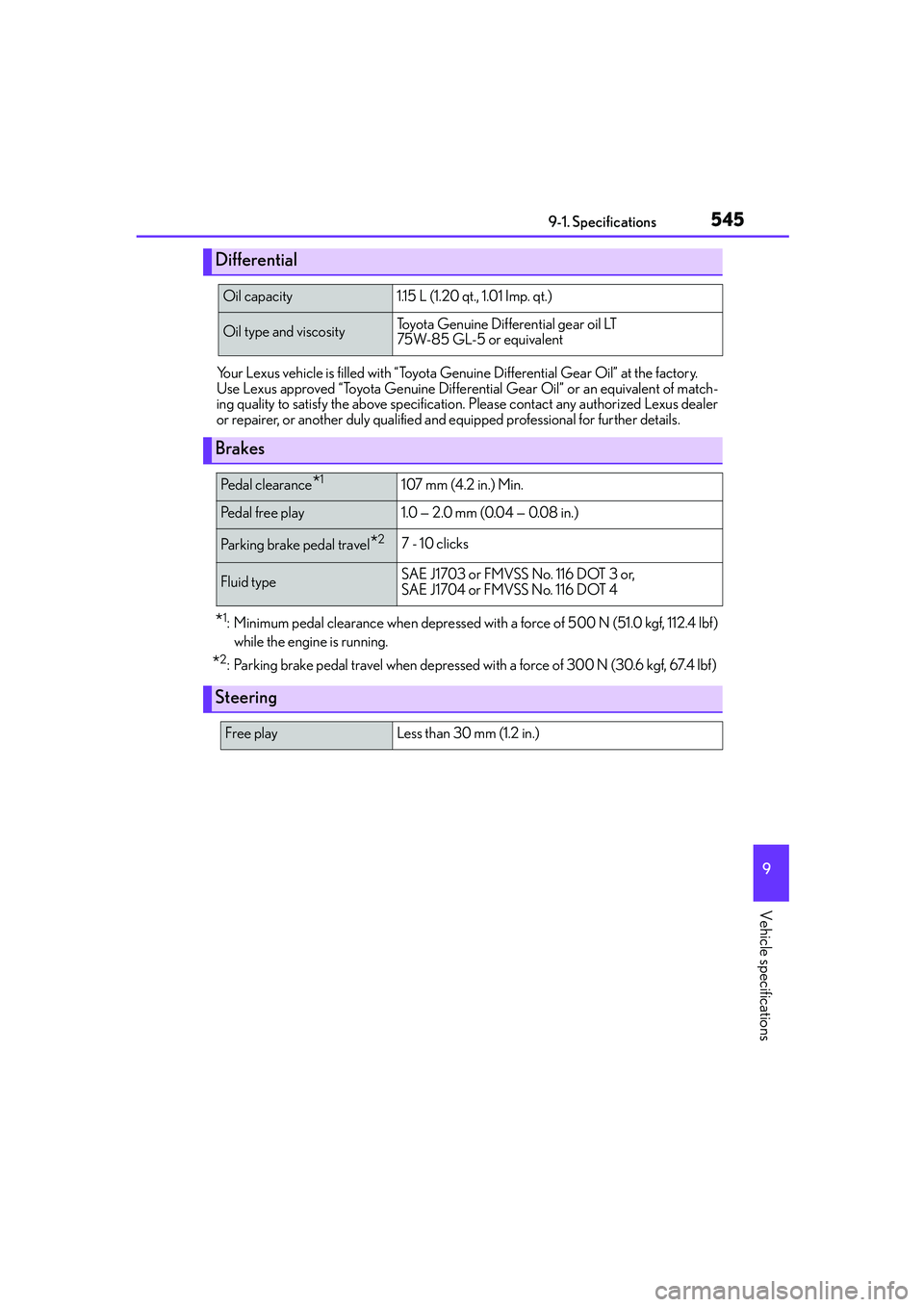
IS250_EE(OM53C51E)Your Lexus vehicle is filled with “Toyota Genuine Differential Gear Oil” at the factory.
Use Lexus approved “Toyota Genuine Differential Gear Oil” or an equivalent of match-
ing quality to satisfy the above specification. Please contact any authorized Lexus dealer
or repairer, or another duly qualified and equipped professional for further details.
*1: Minimum pedal clearance when depressed with a force of 500 N (51.0 kgf, 112.4 lbf)
while the engine is running.
*2: Parking brake pedal travel when depressed with a force of 300 N (30.6 kgf, 67.4 lbf)
Differential
Oil capacity1.15 L (1.20 qt., 1.01 Imp. qt.)
Oil type and viscosityToyota Genuine Differential gear oil LT
75W-85 GL-5 or equivalent
Brakes
Pe d a l c l e a r a n c e*1107 mm (4.2 in.) Min.
Pedal free play1.0 — 2.0 mm (0.04 — 0.08 in.)
Parking brake pedal travel*27 - 10 clicks
Fluid typeSAE J1703 or FMVSS No. 116 DOT 3 or,
SAE J1704 or FMVSS No. 116 DOT 4
Steering
Free playLess than 30 mm (1.2 in.)