trailer Lexus IS250 2014 Owner's Manual
[x] Cancel search | Manufacturer: LEXUS, Model Year: 2014, Model line: IS250, Model: Lexus IS250 2014Pages: 588, PDF Size: 98.77 MB
Page 3 of 588
3
1
9 8
7
6 4 3
2
IS250_EE(OM53C51E)
5
3-4. Adjusting the steering
wheel and mirrors
Steering wheel ............................. 159
Inside rear view mirror ................ 161
Outside rear view mirrors ....... 163
3-5. Opening, closing the
windows and moon roof
Power windows .............................167
Moon roof ...................................... 170
4-1. Before driving
Driving the vehicle ....................... 176
Cargo and luggage .................... 183
Trailer towing................................. 184
4-2. Driving procedures
Engine (ignition) switch ............ 192
Automatic transmission .............197
Turn signal lever ..........................203
Parking brake.............................. 205
4-3. Operating the lights and
wipers
Headlight switch .........................206
Automatic High Beam .............209
Fog light switch............................. 213
Windshield wipers and
washer........................................... 2154-4. Refueling
Opening the fuel tank cap....... 221
4-5. Using the driving support
systems
Cruise control ............................. 225
Dynamic radar cruise
control.......................................... 229
LDA
(Lane Departure Alert) ..........241
Lexus parking
assist-sensor ...............................247
Rear view monitor system ...... 254
Driving mode select
switch ........................................... 263
Driving assist systems ............... 265
PCS (Pre-Crash Safety
system)...........................................271
BSM (Blind Spot Monitor) ..... 278
•The Blind Spot Monitor
function.....................................283
• The Rear Crossing Traffic
Alert function .........................285
4-6. Driving tips
Winter driving tips .................... 288
4Driving
Page 87 of 588

871-2. Theft deterrent system
1
For safety and security
IS250_EE(OM53C51E)
■Canceling and automatic re-enabling of the intrusion sensor and tilt sensor
●The alarm will still be set even when the intrusion sensor and tilt sensor are canceled.
●After the intrusion sensor and tilt sensor are canceled, pressing the engine switch or
unlocking the doors using the entry function or wireless remote control will re-enable
the intrusion sensor and tilt sensor.
●The intrusion sensor and tilt sensor will automatically be re-enabled when the alarm
system is deactivated.
■Intrusion sensor detection considerations
The sensor may trigger the alarm in the following situations:
●Places with extreme vibrations or noises, or situations in which the vehicle is subject to
repeated impacts or vibrations:
• When parked in a parking garage
• When the vehicle is transported on a ferry, trailer, train, etc.
• When ice adhering to the vehicle is removed
• When the vehicle is in an automatic or high-pressure car wash
• When in a hail or lightning storm
●A window or the moon roof is open.
In this case, the sensor may detect the follow-
ing:
• Wind or the movement of objects such as
leaves and insects inside the vehicle
• Ultrasonic waves emitted from devices
such as the intrusion sensors of other vehi-
cles
• The movement of people outside the vehi-
cle
●Unstable items, such as dangling accessories
or clothes hanging on the coat hooks, are in
the vehicle.
Page 88 of 588

881-2. Theft deterrent system
IS250_EE(OM53C51E)
■Tilt sensor detection considerations (if equipped)
The sensor may trigger the alarm in the following situations:
●The vehicle is transported by a ferry, trailer, train, etc.
●The vehicle is parked in a parking garage.
●The vehicle is inside a car wash that moves the vehicle.
●Any of the tires loses air pressure.
●The vehicle is jacked up.
●An earthquake occurs or the road caves in.
NOTICE
■To ensure the intrusion sensor function correctly
●Installing accessories other than genuine Lexus parts or leaving objects between the
driver’s seat and front passenger’s seat may reduce the detection performance.
●To ensure that the sensors operate properly,
do not touch or cover them.
●Do not spray air fresheners or other products
directly into the sensor holes.
Page 175 of 588
175
4Driving
IS250_EE(OM53C51E)
4-1. Before driving
Driving the vehicle ....................... 176
Cargo and luggage .................... 183
Trailer towing................................. 184
4-2. Driving procedures
Engine (ignition) switch ............ 192
Automatic transmission.............197
Turn signal lever ..........................203
Parking brake.............................. 205
4-3. Operating the lights and
wipers
Headlight switch .........................206
Automatic High Beam .............209
Fog light switch............................. 213
Windshield wipers and
washer........................................... 215
4-4. Refueling
Opening the fuel tank cap....... 2214-5. Using the driving support
systems
Cruise control ............................. 225
Dynamic radar cruise
control ......................................... 229
LDA
(Lane Departure Alert) .......... 241
Lexus parking
assist-sensor...............................247
Rear view monitor system ...... 254
Driving mode select
switch ........................................... 263
Driving assist systems............... 265
PCS (Pre-Crash Safety
system) .......................................... 271
BSM (Blind Spot Monitor) ..... 278
•The Blind Spot Monitor
function .................................... 283
• The Rear Crossing Traffic
Alert function.........................285
4-6. Driving tips
Winter driving tips .....................288
Page 177 of 588
1774-1. Before driving
4
Driving
IS250_EE(OM53C51E)
■When starting off on an uphill
The hill-start assist control will activate. (→P. 2 6 5 )
■Driving in the rain
●Drive carefully when it is raining, because visibility will be reduced, the windows may
become fogged-up, and the road will be slippery.
●Drive carefully when it starts to rain, because the road surface will be especially slip-
pery.
●Refrain from high speeds when driving on an expressway in the rain, because there may
be a layer of water between the tires and the road surface, preventing the steering and
brakes from operating properly.
■Engine speed while driving
In the following conditions, the engine speed may become high while driving. This is due
to automatic up-shifting control or down-shifting implementation to meet driving condi-
tions. It does not indicate sudden acceleration.
●The vehicle is judged to be driving uphill or downhill
●When the accelerator pedal is released
●When the brake pedal is depressed while sport mode is selected
■Breaking in your new Lexus
To extend the life of the vehicle, observing the following precautions is recommended:
●For the first 300 km (186 miles):
Avoid sudden stops.
●For the first 800 km (500 miles):
Do not tow a trailer.
●For the first 1000 km (621 miles):
• Do not drive at extremely high speeds.
• Avoid sudden acceleration.
• Do not drive continuously in low gears.
• Do not drive at a constant speed for extended periods.
■Drum-in-disc type parking brake system
Your vehicle has a drum-in-disc type parking brake system. This type of brake system
needs bedding-down of the brake shoes periodically or whenever the parking brake
shoes and/or drum are replaced. Have any authorized Lexus dealer or repairer, or
another duly qualified and equipped professional, perform the bedding down operation.
■Operating your vehicle in a foreign country
Comply with the relevant vehicle registration laws and confirm the availability of the cor-
rect fuel. (→P. 5 4 0 )
Page 184 of 588
1844-1. Before driving
IS250_EE(OM53C51E)
◆We i g h t l i m i t s
Check the allowable towing capacity, GVM (Gross Vehicle Mass), MPAC
(Maximum Permissible Axle Capacity), and permissible draw bar load before
towing. (→P. 5 3 8 )
◆To w i n g h i t c h / b r a c k e t
Lexus recommends the use of the Lexus hitch/bracket for your vehicle. Other
products of a suitable nature and comparable quality may also be used.
◆To prevent an accident
The handling of the vehicle will feel different when towing a trailer. Beware of
the 3 most common causes of towing-related accidents: driver error, exces-
sive speed, and overloading.
Trailer towing (vehicles with a towing package)
The strain of towing a trailer will have a negative impact on the running perfor-
mance, handling, fuel consumption and endurance of your vehicle. Use the
vehicle features in the correct manner and operate the vehicle with care for
safer driving and optimal comfort. Damage and/or malfunctions that occur as
a result of towing performed for commercial purposes are not covered by the
Lexus warranty.
Ask your local authorized Lexus dealer or repairer, or another duly qualified
and equipped professional for further details before towing, as there are addi-
tional legal requirements in some countries.
Page 185 of 588
1854-1. Before driving
4
Driving
IS250_EE(OM53C51E)
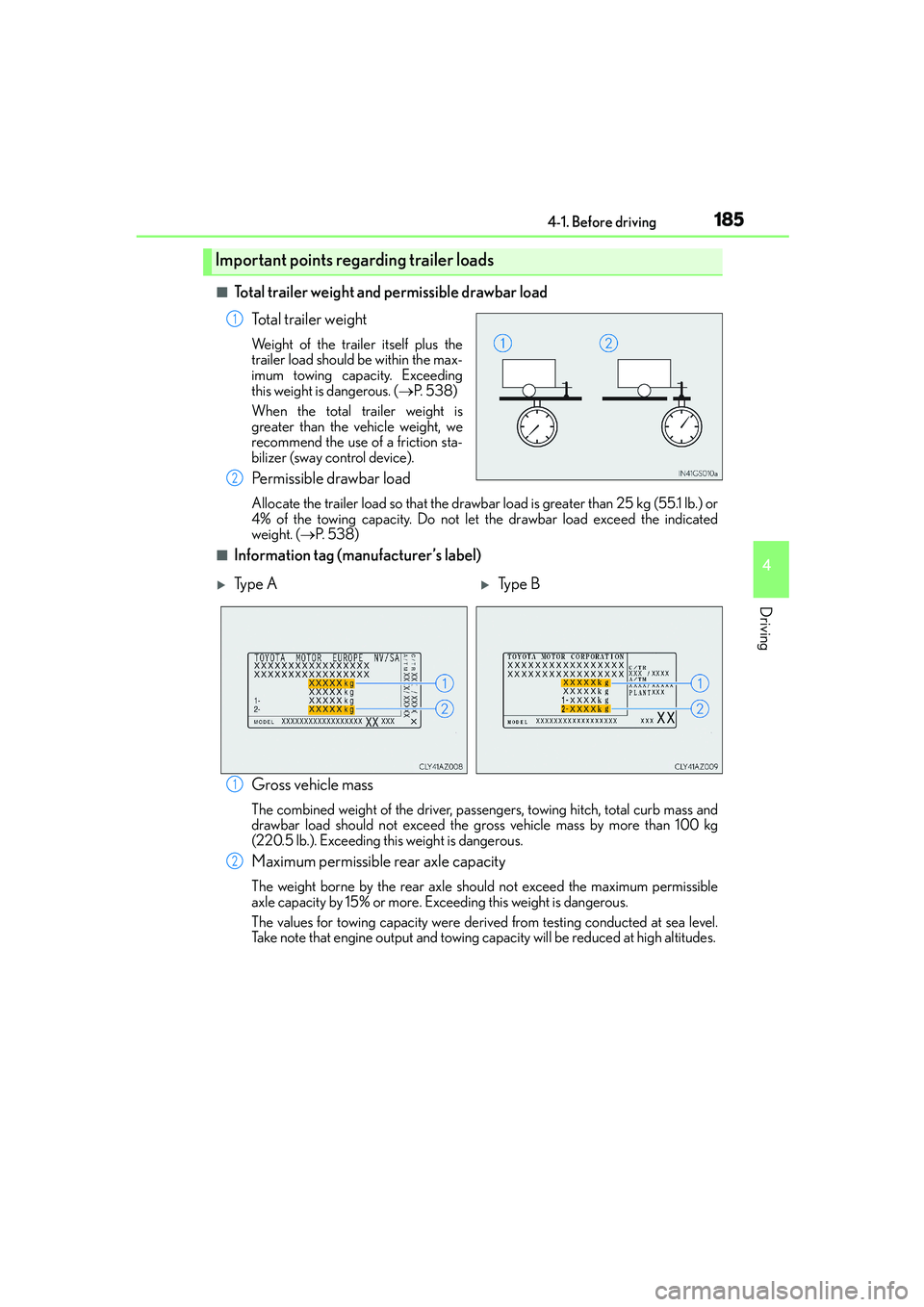
■Total trailer weight and permissible drawbar load
Total trailer weight
Weight of the trailer itself plus the
trailer load should be within the max-
imum towing capacity. Exceeding
this weight is dangerous. (→P. 5 3 8 )
When the total trailer weight is
greater than the vehicle weight, we
recommend the use of a friction sta-
bilizer (sway control device).
Permissible drawbar load
Allocate the trailer load so that the drawbar load is greater than 25 kg (55.1 lb.) or
4% of the towing capacity. Do not let the drawbar load exceed the indicated
weight. (→P. 5 3 8 )
■Information tag (manufacturer’s label)
Gross vehicle mass
The combined weight of the driver, passengers, towing hitch, total curb mass and
drawbar load should not exceed the gross vehicle mass by more than 100 kg
(220.5 lb.). Exceeding this weight is dangerous.
Maximum permissible rear axle capacity
The weight borne by the rear axle should not exceed the maximum permissible
axle capacity by 15% or more. Exceeding this weight is dangerous.
The values for towing capacity were derived from testing conducted at sea level.
Take note that engine output and towing capacity will be reduced at high altitudes.
Important points regarding trailer loads
1
2
XTy p e AXTy p e B
1
2
Page 186 of 588

1864-1. Before driving
IS250_EE(OM53C51E)
CAUTION
■When the gross vehicle mass limit or maximum permissible axle capacity is exceeded
Do not exceed the established speed limit for towing a trailer in built-up areas or 100
km/h (62 mph), whichever is the lower.
Page 188 of 588
1884-1. Before driving
IS250_EE(OM53C51E)
■Tire information
●Increase the tire inflation pressure to 20.0 kPa (0.2 kgf/cm2 or bar, 3 psi) greater than
the recommended value when towing. (→P. 5 4 6 )
●Increase the air pressure of the trailer tires in accordance with the total trailer weight
and according to the values recommended by the manufacturer of your trailer.
■Break-in schedule
Lexus recommends that vehicles fitted with new power train components should not be
used for towing trailers for the first 800 km (500 miles).
■Safety checks before towing
●Check that the maximum load limit for the towing hitch/bracket hitch ball is not
exceeded. Bear in mind that the coupling weight of the trailer will add to the load
exerted on the vehicle. Also make sure that you will not be towing a load that exceeds
the maximum permissible axle capacity.
●Ensure that the trailer load is secure.
●Supplementary outside rear view mirrors should be added to the vehicle if the traffic
behind cannot be clearly seen with standard mirrors. Adjust the extending arms of
these mirrors on both sides of the vehicle so that they always provide maximum visibility
of the road behind.
■Maintenance
●Maintenance must be performed more frequently when using the vehicle for towing
due to the greater weight burden placed on the vehicle compared to normal driving.
●Retighten all bolts securing the hitching ball and bracket after towing for approximately
1000 km (600 miles).
NOTICE
■When the rear bumper strengthening material is aluminum
Ensure the steel bracket part does not come directly in contact with that area.
When steel and aluminum come into contact, there is a reaction similar to corrosion,
which will weaken the section concerned and may result in damage. Apply a rust inhib-
itor to parts that will come in contact when attaching a steel bracket.
Page 189 of 588

1894-1. Before driving
4
Driving
IS250_EE(OM53C51E)
Your vehicle will handle differently when towing a trailer. In order to avoid acci-
dent, death or serious injury, keep the following in mind when towing:
■Checking connections between trailer and lights
Stop the vehicle and check the operation of the connection between the
trailer and lights after driving for a brief period as well as before starting off.
■Practicing driving with a coupled trailer
●Get the feel for turning, stopping and reversing with the trailer coupled by
practicing in an area with no or light traffic.
●When reversing with a coupled trailer, hold the section of the steering
wheel nearest to you and rotate clockwise to turn the trailer left or counter-
clockwise to turn it right. Always rotate a little at a time to prevent steering
error. Have someone guide you when reversing to lessen the risk of an
accident.
■Increasing vehicle-to-vehicle distance
At a speed of 10 km/h (6 mph), the distance to the vehicle running ahead of
you should be equivalent to or greater than the combined length of your vehi-
cle and trailer. Avoid sudden braking that may cause skidding. Otherwise, the
vehicle may spin out of control. This is especially true when driving on wet or
slippery road surfaces.
■Sudden acceleration/steering input/cornering
Executing sharp turns when towing may result in the trailer colliding with your
vehicle. Decelerate well in advance when approaching turns and take them
slowly and carefully to avoid sudden braking.
■Important points regarding turning
The wheels of the trailer will travel closer to the inside of the curve than the
wheels of the vehicle. To make allowance for this, take the turns wider than you
would normally do.
Guidance