air conditioning Lexus IS250 2015 Owner's Guide
[x] Cancel search | Manufacturer: LEXUS, Model Year: 2015, Model line: IS250, Model: Lexus IS250 2015Pages: 586, PDF Size: 8.66 MB
Page 368 of 586
3676-1. Using the air conditioning system
6
Interior features
IS350/250_U (OM53C50U)
●The heated steering wheel can be used when the engine switch is in IGNITION ON
mode.
●The heated steering wheel will automatically turn off after about 30 minutes.
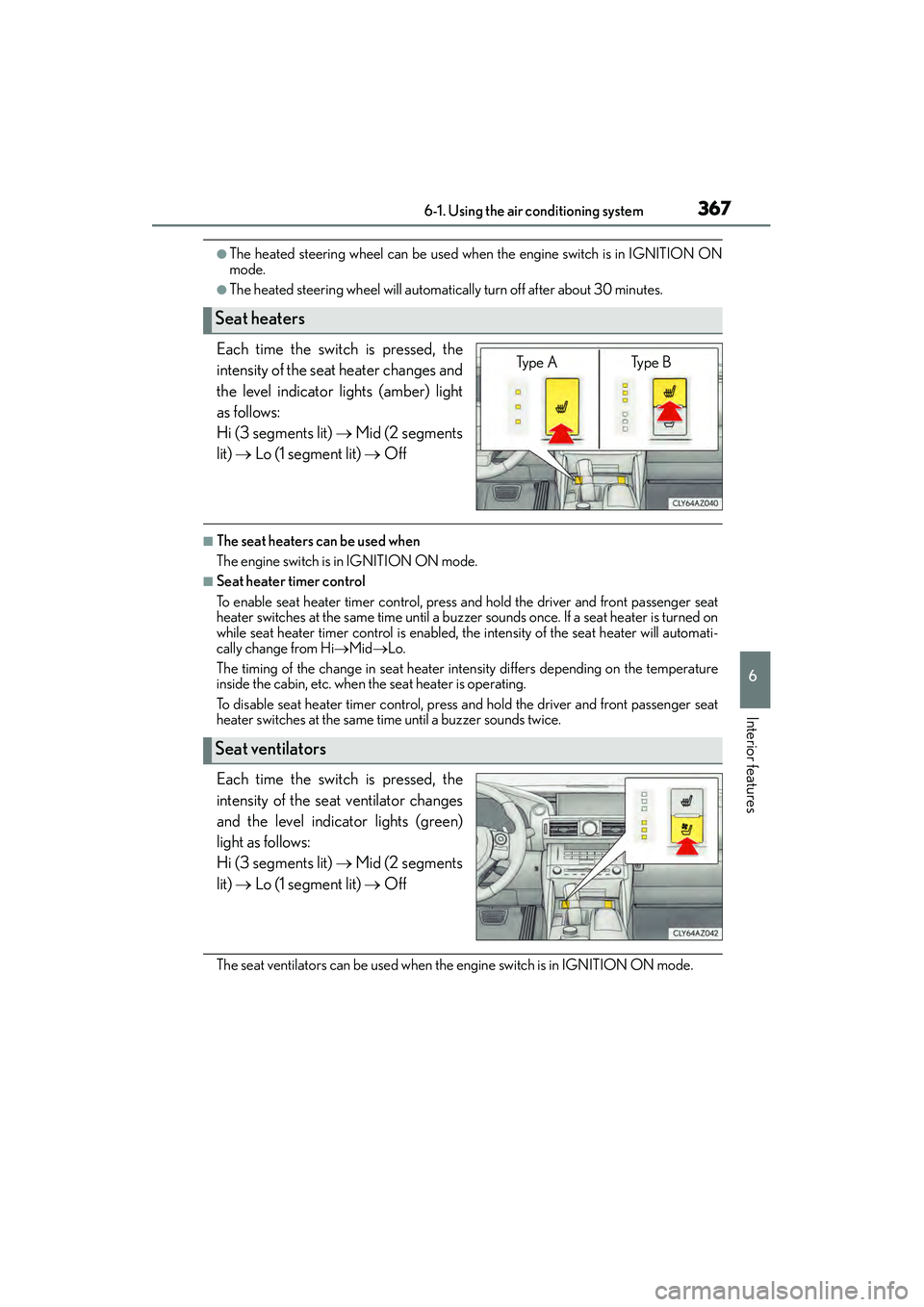
Each time the switch is pressed, the
intensity of the seat heater changes and
the level indicator lights (amber) light
as follows:
Hi (3 segments lit) → Mid (2 segments
lit) → Lo (1 segment lit) → Off
■The seat heaters can be used when
The engine switch is in IGNITION ON mode.
■Seat heater timer control
To enable seat heater timer control, press and hold the driver and front passenger seat
heater switches at the same time until a buzzer sounds once. If a seat heater is turned on
while seat heater timer control is enabled, the intensity of the seat heater will automati-
cally change from Hi →Mid →Lo.
The timing of the change in seat heater intensity differs depending on the temperature
inside the cabin, etc. when the seat heater is operating.
To disable seat heater timer control, press and hold the driver and front passenger seat
heater switches at the same time until a buzzer sounds twice.
Each time the switch is pressed, the
intensity of the seat ventilator changes
and the level indicator lights (green)
light as follows:
Hi (3 segments lit) → Mid (2 segments
lit) → Lo (1 segment lit) → Off
The seat ventilators can be used when the engine switch is in IGNITION ON mode.
Seat heaters
Ty p e A Ty p e B
Seat ventilators
Page 396 of 586
395
Maintenance and care7
IS350/250_U (OM53C50U)
7-1. Maintenance and careCleaning and protecting the vehicle exterior................. 396
Cleaning and protecting the vehicle interior .................. 399
7-2. Maintenance Maintenance requirements.............................402
General maintenance..............405
Emission inspection and maintenance (I/M)
programs ................................... 408
7-3. Do-it-yourself maintenance Do-it-yourself service precautions................................409
Hood .................................................. 411
Positioning a floor jack ...............412
Engine compartment ................ 413
Tires.................................................. 423
Tire inflation pressure ............... 432
Wheels ........................................... 435
Air conditioning filter ............... 437
Electronic key battery .............. 439
Checking and replacing fuses................................................441
Light bulbs..................................... 444
Page 411 of 586
4107-3. Do-it-yourself maintenance
IS350/250_U (OM53C50U)
CAUTION
The engine compartment contains many mechan isms and fluids that may move suddenly,
become hot, or become electrically energize d. To avoid death or serious injury, observe
the following precautions.
■When working on the engine compartment
●Keep hands, clothing and tools away from the moving fan and engine drive belt.
●Be careful not to touch the engine, radiator, exhaust manifold, etc. right after driving
as they may be hot. Oil and other fluids may also be hot.
●Do not leave anything that may burn easily, such as paper and rags, in the engine
compartment.
●Do not smoke, cause sparks or expose an open flame to fuel or the battery. Fuel and
battery fumes are flammable.
●Be extremely cautious when working on the battery. It contains poisonous and corro-
sive sulfuric acid.
■When working near the electric cooling fans or radiator grille
Be sure the engine switch is off.
With the engine switch in IGNITION ON mode, the electric cooling fans may auto-
matically start to run if the air conditioning is on and/or the coolant temperature is high.
( → P. 4 1 8 )
■Safety glasses
Wear safety glasses to prevent flying or falling material, fluid spray, etc. from getting in
your eyes.
NOTICE
■If you remove the air cleaner filter
Driving with the air cleaner filter removed may cause excessive engine wear due to dirt
in the air.
Page 438 of 586
4377-3. Do-it-yourself maintenance
7
Maintenance and care
IS350/250_U (OM53C50U)
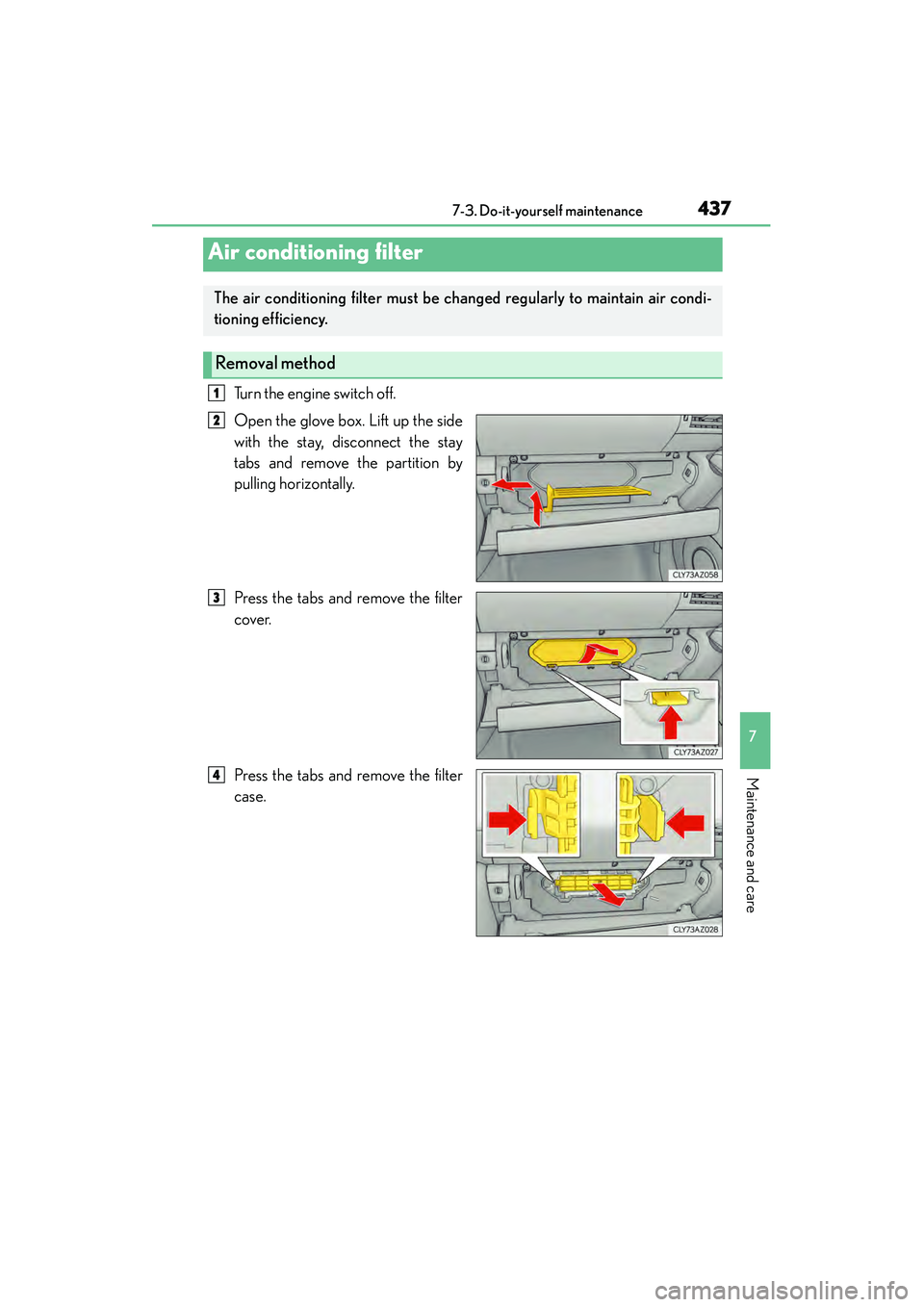
Turn the engine switch off.
Open the glove box. Lift up the side
with the stay, disconnect the stay
tabs and remove the partition by
pulling horizontally.
Press the tabs and remove the filter
cover.
Press the tabs and remove the filter
case.
Air conditioning filter
The air conditioning filter must be changed regularly to maintain air condi-
tioning efficiency.
Removal method
1
2
3
4
Page 439 of 586
4387-3. Do-it-yourself maintenance
IS350/250_U (OM53C50U)
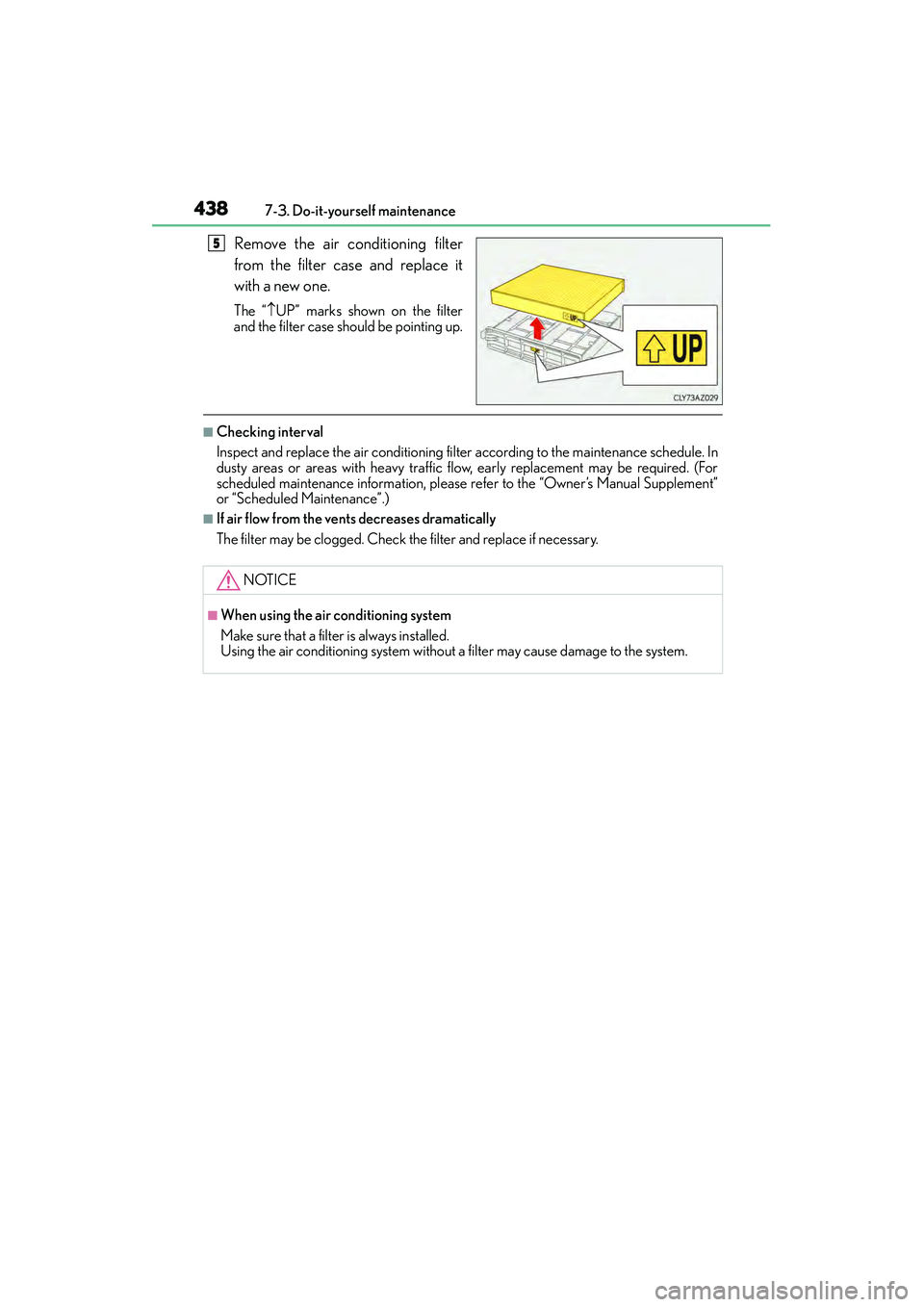
Remove the air conditioning filter
from the filter case and replace it
with a new one.
The “ ↑UP” marks shown on the filter
and the filter case sh ould be pointing up.
■Checking interval
Inspect and replace the air conditioning filter according to the maintenance schedule. In
dusty areas or areas with heavy traffic flow, early replacement may be required. (For
scheduled maintenance information, please refer to the “Owner’s Manual Supplement”
or “Scheduled Maintenance”.)
■If air flow from the vents decreases dramatically
The filter may be clogged. Check the filter and replace if necessary.
5
NOTICE
■When using the air conditioning system
Make sure that a filter is always installed.
Using the air conditioning system without a filter may cause damage to the system.
Page 465 of 586
4648-2. Steps to take in an emergency
IS350/250_U (OM53C50U)
●Fluid leaks under the vehicle.
(Water dripping from the air conditioning after use is normal.)
●Flat-looking tires or uneven tire wear
●Engine coolant temperature gauge needle continually points higher than nor-
mal.
●Changes in exhaust sound
●Excessive tire squeal when cornering
●Strange noises related to the suspension system
●Pinging or other noises related to the engine
●Engine missing, stumbling or running roughly
●Appreciable loss of power
●Vehicle pulls heavily to one side when braking
●Vehicle pulls heavily to one side when driving on a level road
●Loss of brake effectiveness, spongy feeling, pedal almost touches the floor
If you think something is wrong
If you notice any of the following symptoms, your vehicle probably needs
adjustment or repair. Contact your Lexus dealer as soon as possible.
Visible symptoms
Audible symptoms
Operational symptoms
Page 481 of 586

4808-2. Steps to take in an emergency
IS350/250_U (OM53C50U)
*: Refer to the separate “Scheduled Maintenance” or “Owner’s Manual Supplement”for the maintenance interval applicable to your vehicle.
(U.S.A. only)
Indicates that all maintenance is required to correspond
to the driven distance on the maintenance schedule*.
Comes on approximately 5000 miles (8000 km) after
the maintenance data has been reset.
(The indicator will not work properly unless the mainte-
nance data has been reset.)
→ Perform the necessary maintenance. Please reset
the maintenance data after the maintenance is per-
formed ( →P. 4 0 3 )
(If equipped)
Indicates that the Automatic High Beam switch is
pressed while the headlights are in low beam.
→ Turn the high beam on and press the Automatic
High Beam switch again.
(If equipped)
Indicates that, since the VSC (Vehicle Stability Control)
system was turned off, the pre-collision brake system
operation is stopped
→Tu r n t h e V S C o n . ( →P. 2 4 2 )
(If equipped)
Indicates that the PCS (Pre-Collision System) is not cur-
rently functional because the grille cover or the sensor is
dirty
→ Check the grille cover and the sensor and clean
them if they are dirty.
Indicates that operation of large electricity consuming
systems such as the air conditioning system are sus-
pended
→Stop using unnecessary electric components to
reduce electricity consumption. Wait a while until
the electric power supply is restored.
(If equipped)
Indicates that the LDA (Lane Departure Alert) system
cannot be used because the vehicle speed is lower than
approximately 32 mph (50 km/h)
→Drive the vehicle at 32 mph (50 km/h) or higher.
Wa r n i n g m e s s a g eDetails/Actions
(Flashes)
Page 507 of 586
5068-2. Steps to take in an emergency
IS350/250_U (OM53C50U)
●The needle of the engine coolant temperature gauge (→P. 8 1 ) e n t e r s t h e r e d
zone or a loss of engine power is experienced. (For example, the vehicle
speed does not increase.)
●Steam comes out from under the hood.
Stop the vehicle in a safe place and turn off the air conditioning system, and
then stop the engine.
If you see steam:
Carefully lift the hood after the steam subsides.
If you do not see steam:
Carefully lift the hood.
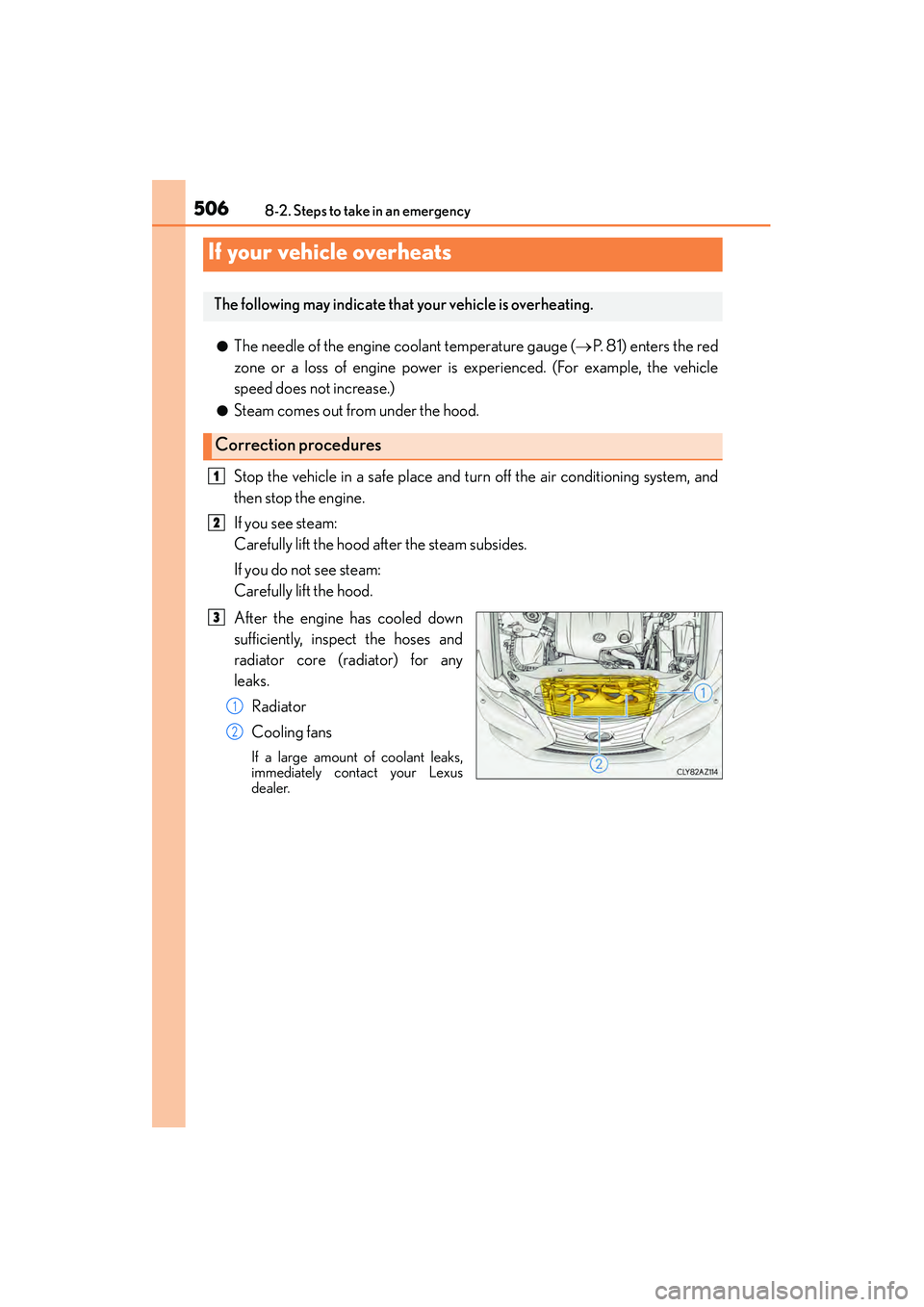
After the engine has cooled down
sufficiently, inspect the hoses and
radiator core (radiator) for any
leaks.
Radiator
Cooling fans
If a large amount of coolant leaks,
immediately contact your Lexus
dealer.
If your vehicle overheats
The following may indicate that your vehicle is overheating.
Correction procedures
1
2
3
1
2
Page 508 of 586
5078-2. Steps to take in an emergency
8
When trouble arises
IS350/250_U (OM53C50U)
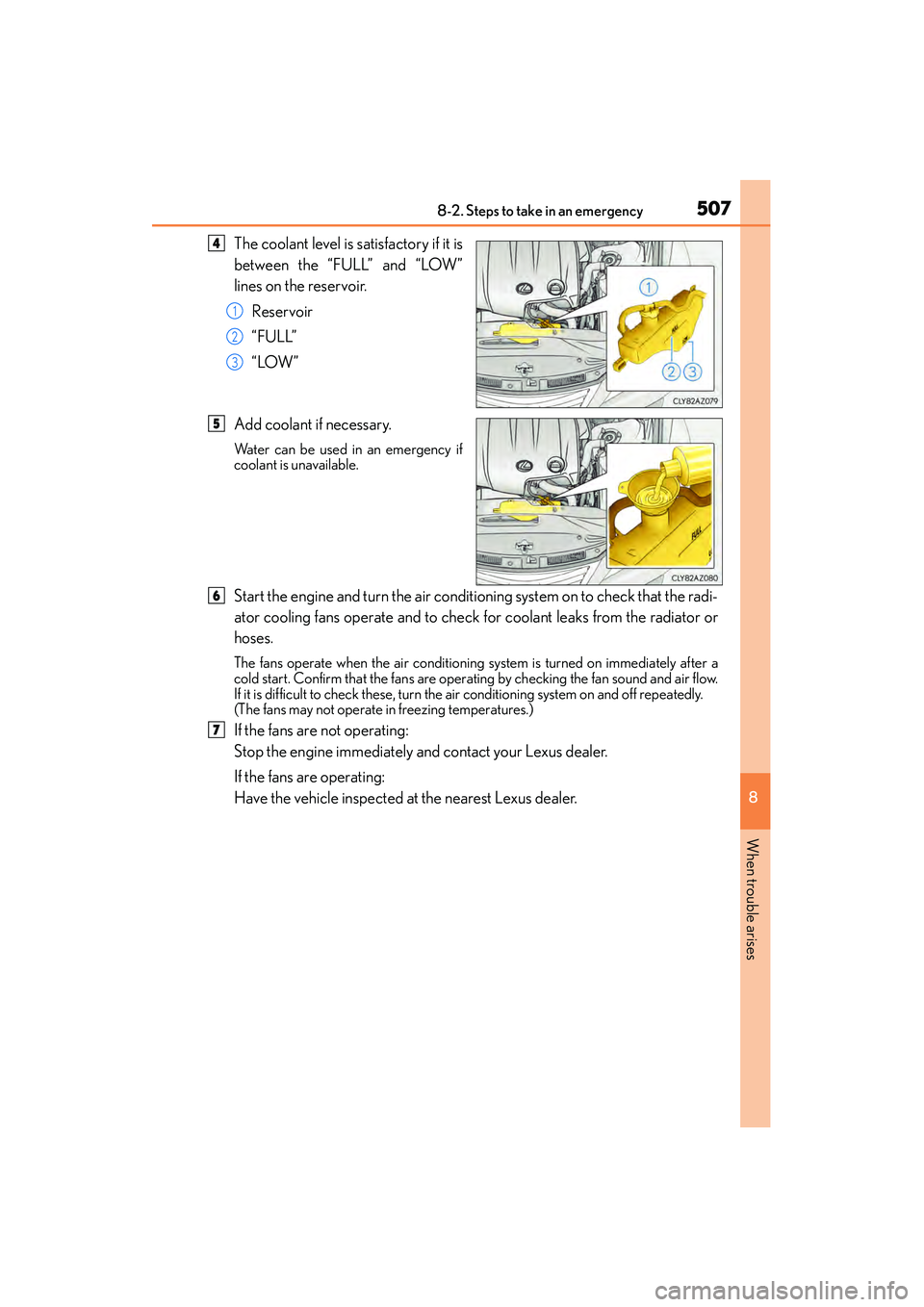
The coolant level is satisfactory if it is
between the “FULL” and “LOW”
lines on the reservoir.Reservoir
“FULL”
“LOW”
Add coolant if necessary.
Water can be used in an emergency if
coolant is unavailable.
Start the engine and turn the air conditioning system on to check that the radi-
ator cooling fans operate and to check for coolant leaks from the radiator or
hoses.
The fans operate when the air conditioning system is turned on immediately after a
cold start. Confirm that the fans are operating by checking the fan sound and air flow.
If it is difficult to check these, turn the air conditioning system on and off repeatedly.
(The fans may not operate in freezing temperatures.)
If the fans are not operating:
Stop the engine immediately and contact your Lexus dealer.
If the fans are operating:
Have the vehicle inspected at the nearest Lexus dealer.
4
1
2
3
5
6
7
Page 533 of 586
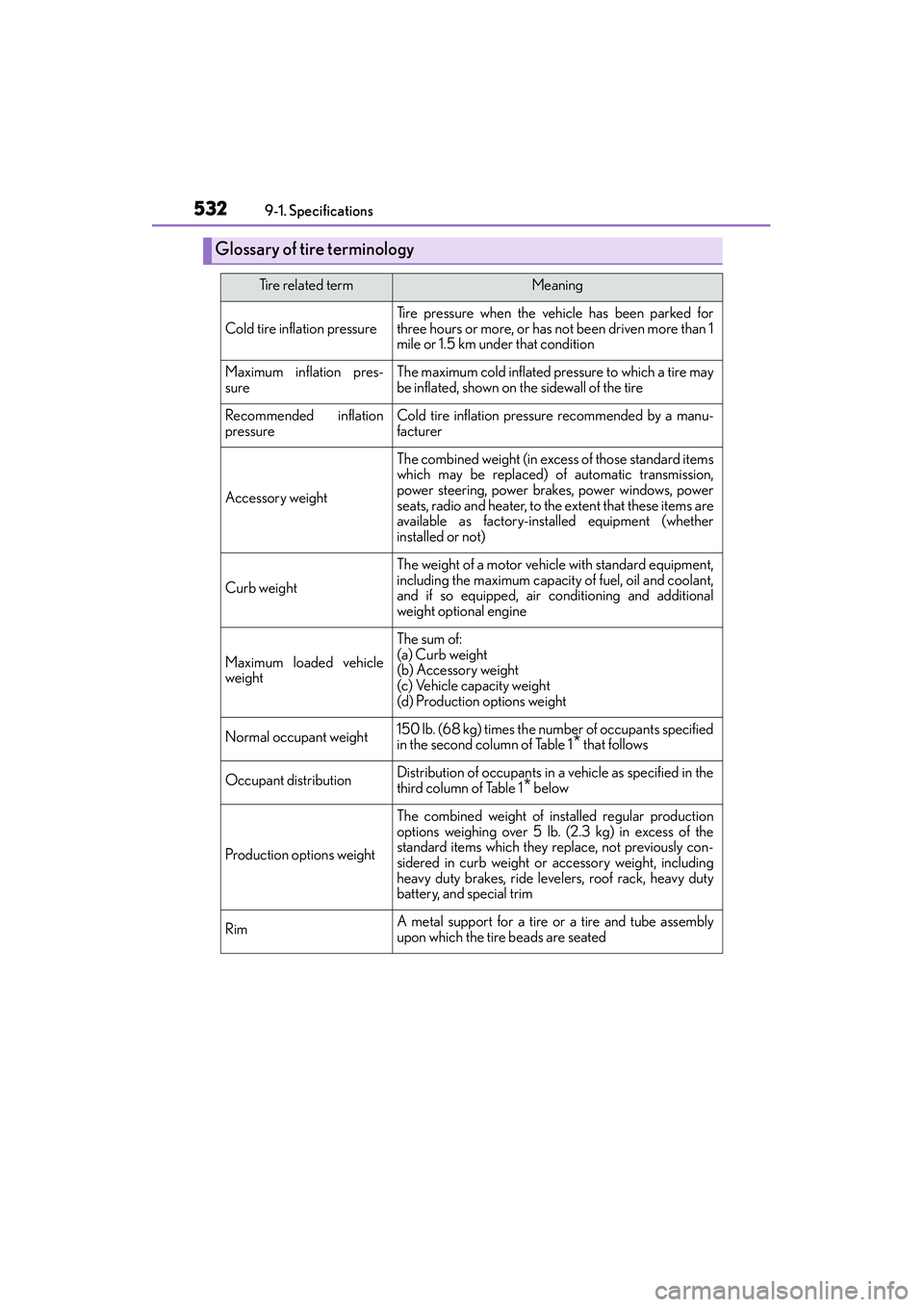
5329-1. Specifications
IS350/250_U (OM53C50U)
Glossary of tire terminology
Tire related termMeaning
Cold tire inflation pressureTire pressure when the vehicle has been parked for
three hours or more, or has not been driven more than 1
mile or 1.5 km under that condition
Maximum inflation pres-
sureThe maximum cold inflated pressure to which a tire may
be inflated, shown on the sidewall of the tire
Recommended inflation
pressureCold tire inflation pressure recommended by a manu-
facturer
Accessory weight
The combined weight (in excess of those standard items
which may be replaced) of automatic transmission,
power steering, power brakes, power windows, power
seats, radio and heater, to the extent that these items are
available as factory-installed equipment (whether
installed or not)
Curb weight
The weight of a motor vehicle with standard equipment,
including the maximum capacity of fuel, oil and coolant,
and if so equipped, air conditioning and additional
weight optional engine
Maximum loaded vehicle
weight
The sum of:
(a) Curb weight
(b) Accessory weight
(c) Vehicle capacity weight
(d) Production options weight
Normal occupant weight150 lb. (68 kg) times the number of occupants specified
in the second column of Table 1* that follows
Occupant distributionDistribution of occupants in a vehicle as specified in the
third column of Table 1
* below
Production options weight
The combined weight of in stalled regular production
options weighing over 5 lb. (2.3 kg) in excess of the
standard items which they replace, not previously con-
sidered in curb weight or accessory weight, including
heavy duty brakes, ride levelers, roof rack, heavy duty
battery, and special trim
RimA metal support for a tire or a tire and tube assembly
upon which the tire beads are seated