flat tire LEXUS IS250 2016 Owner's Guide
[x] Cancel search | Manufacturer: LEXUS, Model Year: 2016, Model line: IS250, Model: LEXUS IS250 2016Pages: 542, PDF Size: 9.65 MB
Page 407 of 542
410
5-2. Steps to take in an emergency
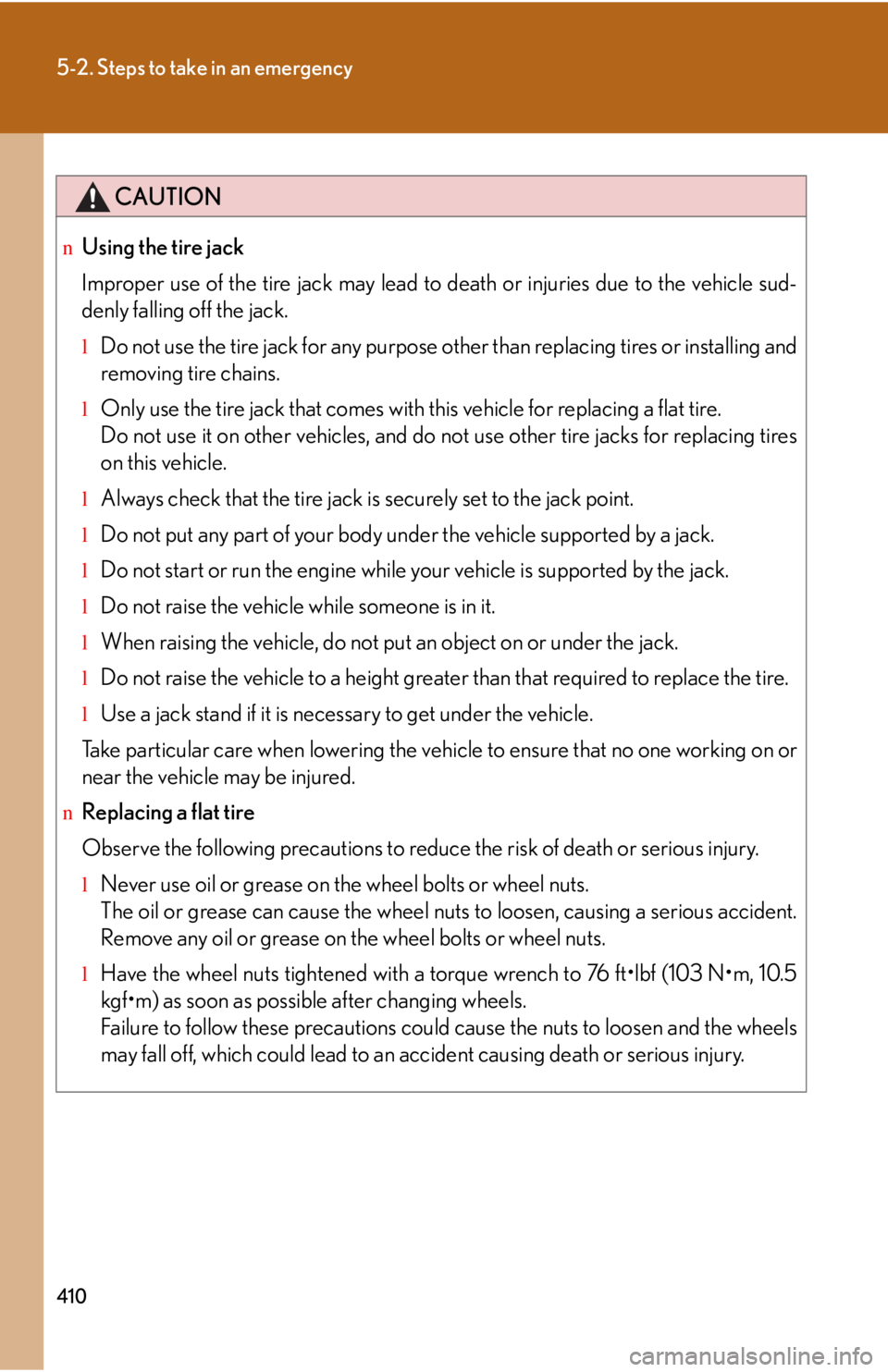
CAUTION
nUsing the tire jack
Improper use of the tire jack may lead to death or injuries due to the vehicle sud-
denly falling off the jack.
lDo not use the tire jack for any purpose other than replacing tires or installing and
removing tire chains.
lOnly use the tire jack that comes with this vehicle for replacing a flat tire.
Do not use it on other vehicles, and do not use other tire jacks for replacing tires
on this vehicle.
lAlways check that the tire jack is securely set to the jack point.
lDo not put any part of your body under the vehicle supported by a jack.
lDo not start or run the engine while your vehicle is supported by the jack.
lDo not raise the vehicle while someone is in it.
lWhen raising the vehicle, do not put an object on or under the jack.
lDo not raise the vehicle to a height greater than that required to replace the tire.
lUse a jack stand if it is necessary to get under the vehicle.
Take particular care when lowering the vehicle to ensure that no one working on or
near the vehicle may be injured.
nReplacing a flat tire
Observe the following precautions to reduce the risk of death or serious injury.
lNever use oil or grease on the wheel bolts or wheel nuts.
The oil or grease can cause the wheel nuts to loosen, causing a serious accident.
Remove any oil or grease on the wheel bolts or wheel nuts.
lHave the wheel nuts tightened with a torque wrench to 76 ft
Page 409 of 542
412
5-2. Steps to take in an emergency
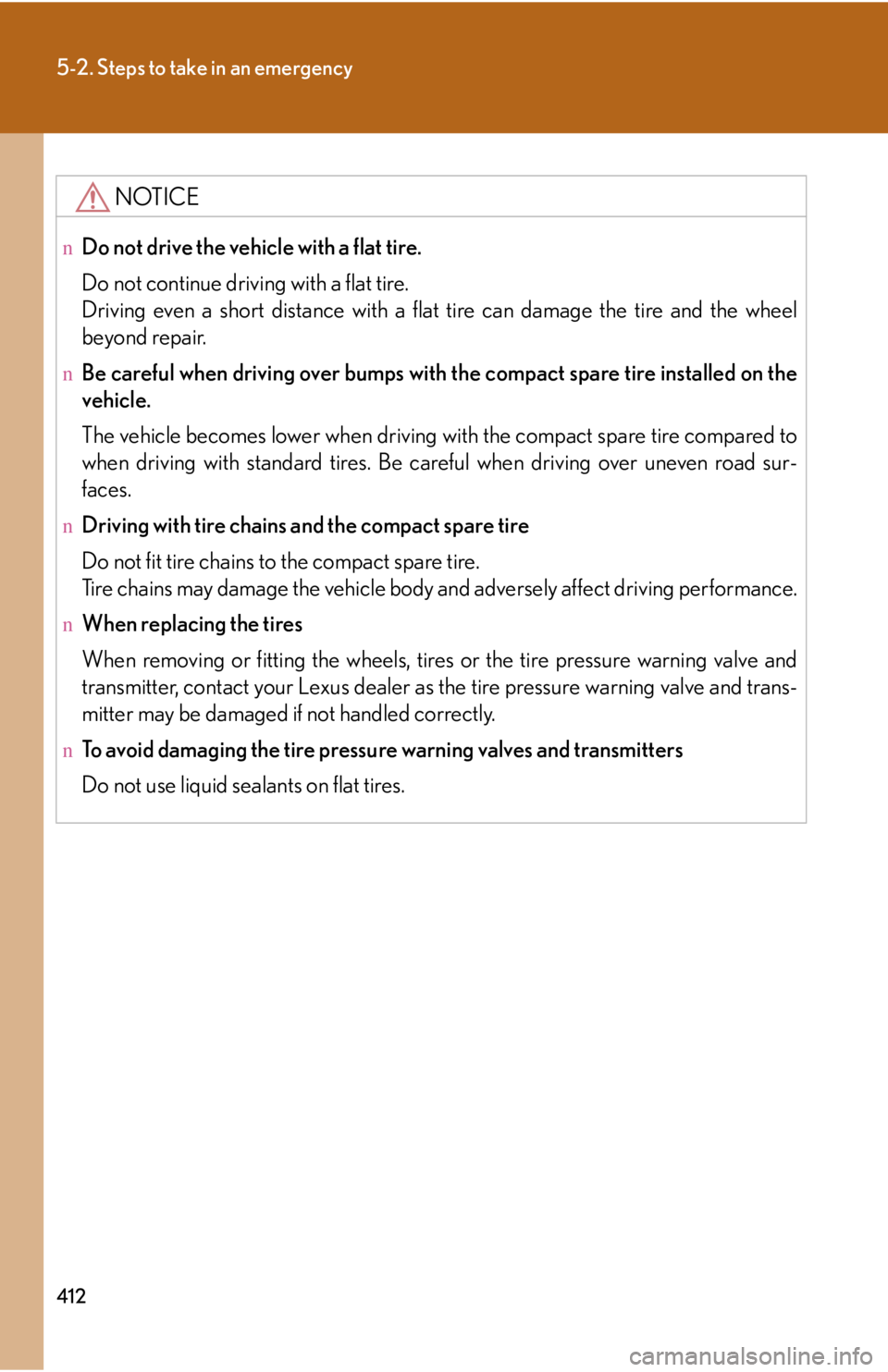
NOTICE
nDo not drive the vehicle with a flat tire.
Do not continue driving with a flat tire.
Driving even a short distance with a flat tire can damage the tire and the wheel
beyond repair.
nBe careful when driving over bumps with the compact spare tire installed on the
vehicle.
The vehicle becomes lower when driving with the compact spare tire compared to
when driving with standard tires. Be careful when driving over uneven road sur-
faces.
nDriving with tire chains and the compact spare tire
Do not fit tire chains to the compact spare tire.
Tire chains may damage the vehicle body and adversely affect driving performance.
nWhen replacing the tires
When removing or fitting the wheels, tires or the tire pressure warning valve and
transmitter, contact your Lexus dealer as the tire pressure warning valve and trans-
mitter may be damaged if not handled correctly.
nTo avoid damaging the tire pressure warning valves and transmitters
Do not use liquid sealants on flat tires.
Page 435 of 542
439
6-1. Specifications
6
Vehicle specifications
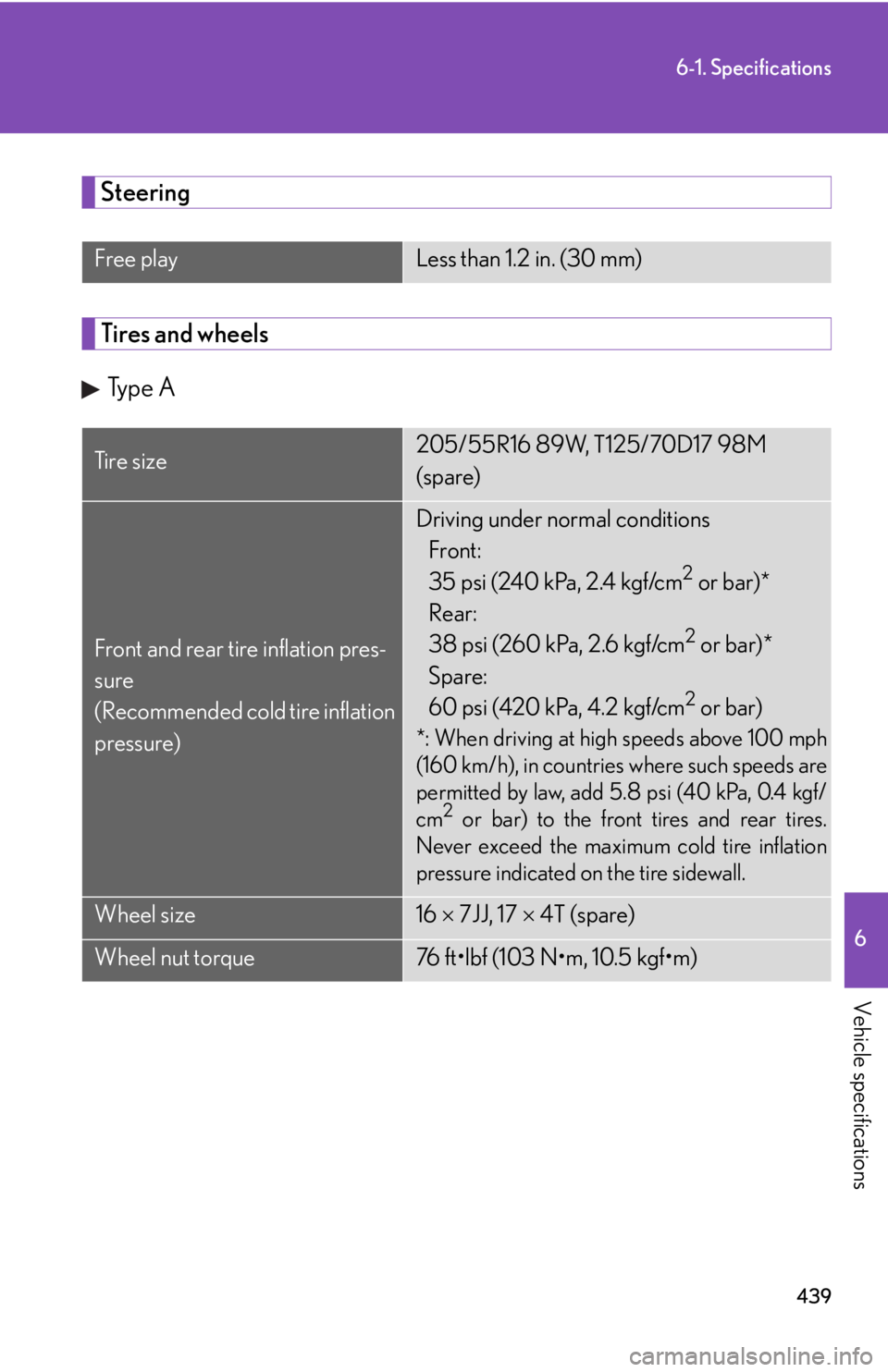
Steering
Tires and wheels
Type A
Free playLess than 1.2 in. (30 mm)
Ti r e s i z e205/55R16 89W, T125/70D17 98M
(spare)
Front and rear tire inflation pres-
sure
(Recommended cold tire inflation
pressure)
Driving under normal conditions
Front:
35 psi (240 kPa, 2.4 kgf/cm2 or bar)*
Rear:
38 psi (260 kPa, 2.6 kgf/cm2 or bar)*
Spare:
60 psi (420 kPa, 4.2 kgf/cm2 or bar)
*: When driving at high speeds above 100 mph
(160 km/h), in countries where such speeds are
permitted by law, add 5.8 psi (40 kPa, 0.4 kgf/
cm2 or bar) to the front tires and rear tires.
Never exceed the maximum cold tire inflation
pressure indicated on the tire sidewall.
Wheel size16 × 7JJ, 17 × 4T (spare)
Wheel nut torque76 ft
Page 436 of 542
440
6-1. Specifications
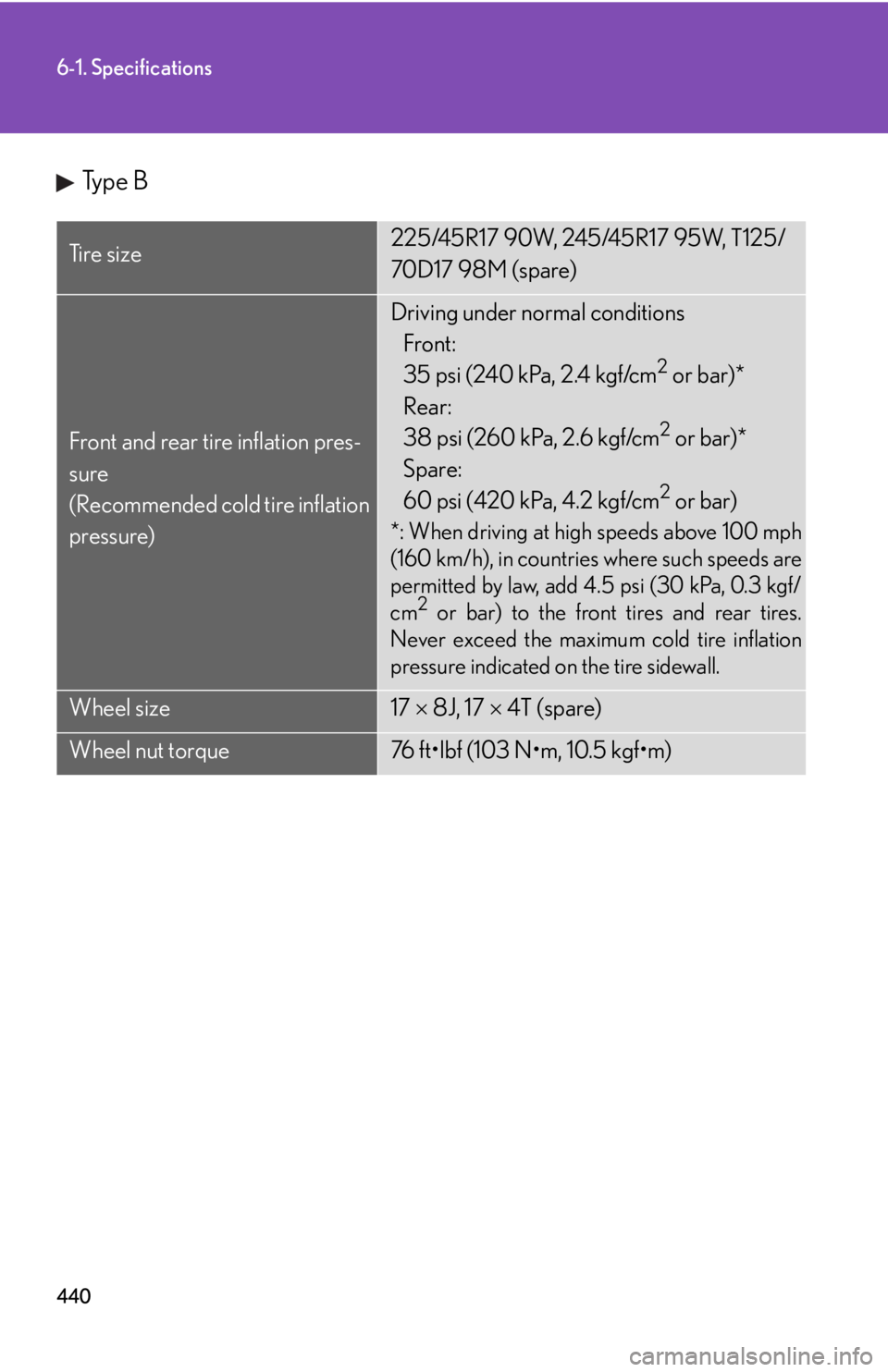
Ty p e B
Ti r e s i z e225/45R17 90W, 245/45R17 95W, T125/
70D17 98M (spare)
Front and rear tire inflation pres-
sure
(Recommended cold tire inflation
pressure)
Driving under normal conditions
Front:
35 psi (240 kPa, 2.4 kgf/cm2 or bar)*
Rear:
38 psi (260 kPa, 2.6 kgf/cm2 or bar)*
Spare:
60 psi (420 kPa, 4.2 kgf/cm2 or bar)
*: When driving at high speeds above 100 mph
(160 km/h), in countries where such speeds are
permitted by law, add 4.5 psi (30 kPa, 0.3 kgf/
cm2 or bar) to the front tires and rear tires.
Never exceed the maximum cold tire inflation
pressure indicated on the tire sidewall.
Wheel size17 × 8J, 17 × 4T (spare)
Wheel nut torque76 ft
Page 437 of 542
441
6-1. Specifications
6
Vehicle specifications
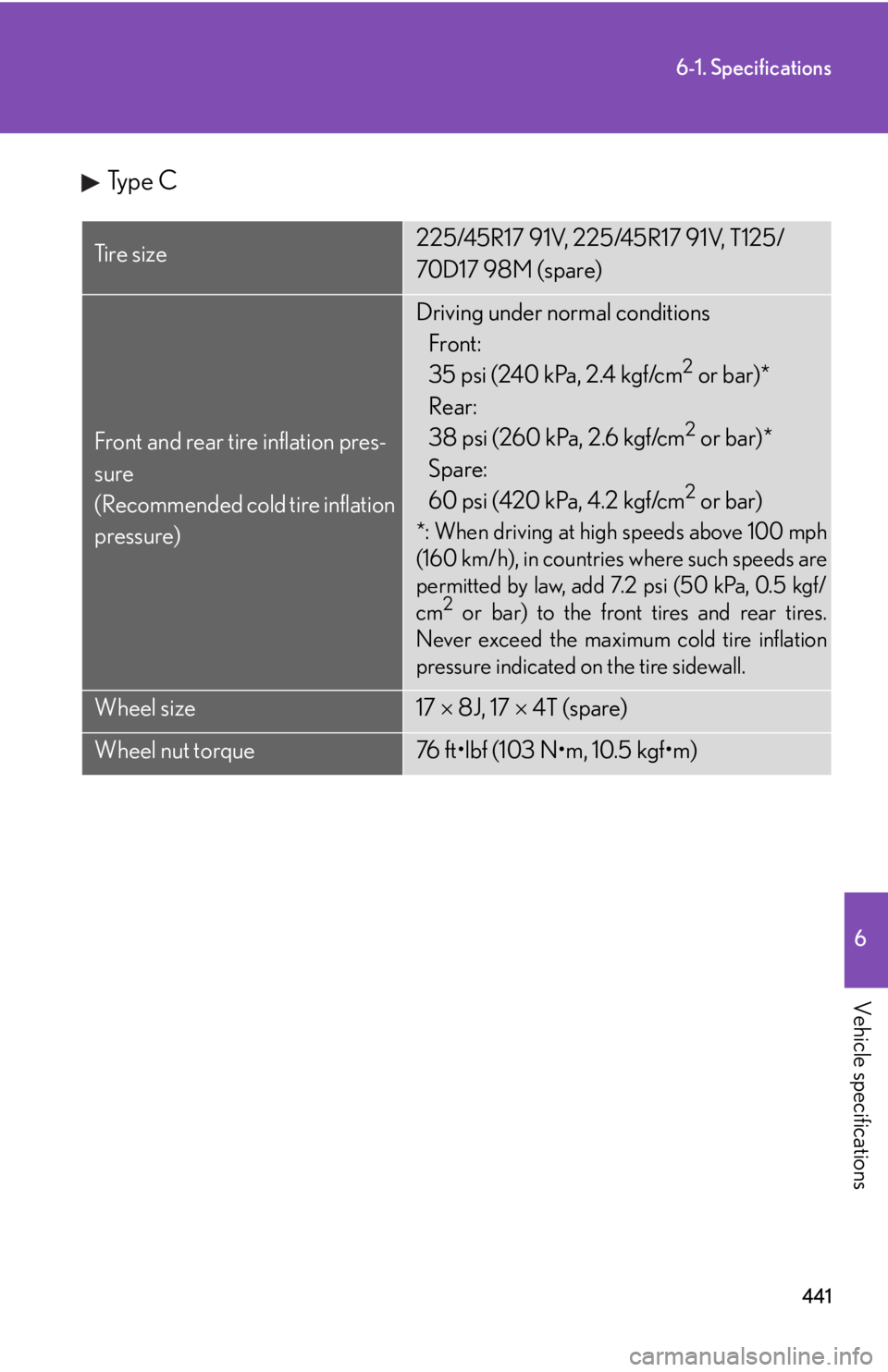
Type C
Ti r e s i z e225/45R17 91V, 225/45R17 91V, T125/
70D17 98M (spare)
Front and rear tire inflation pres-
sure
(Recommended cold tire inflation
pressure)
Driving under normal conditions
Front:
35 psi (240 kPa, 2.4 kgf/cm2 or bar)*
Rear:
38 psi (260 kPa, 2.6 kgf/cm2 or bar)*
Spare:
60 psi (420 kPa, 4.2 kgf/cm2 or bar)
*: When driving at high speeds above 100 mph
(160 km/h), in countries where such speeds are
permitted by law, add 7.2 psi (50 kPa, 0.5 kgf/
cm2 or bar) to the front tires and rear tires.
Never exceed the maximum cold tire inflation
pressure indicated on the tire sidewall.
Wheel size17 × 8J, 17 × 4T (spare)
Wheel nut torque76 ft
Page 438 of 542
442
6-1. Specifications
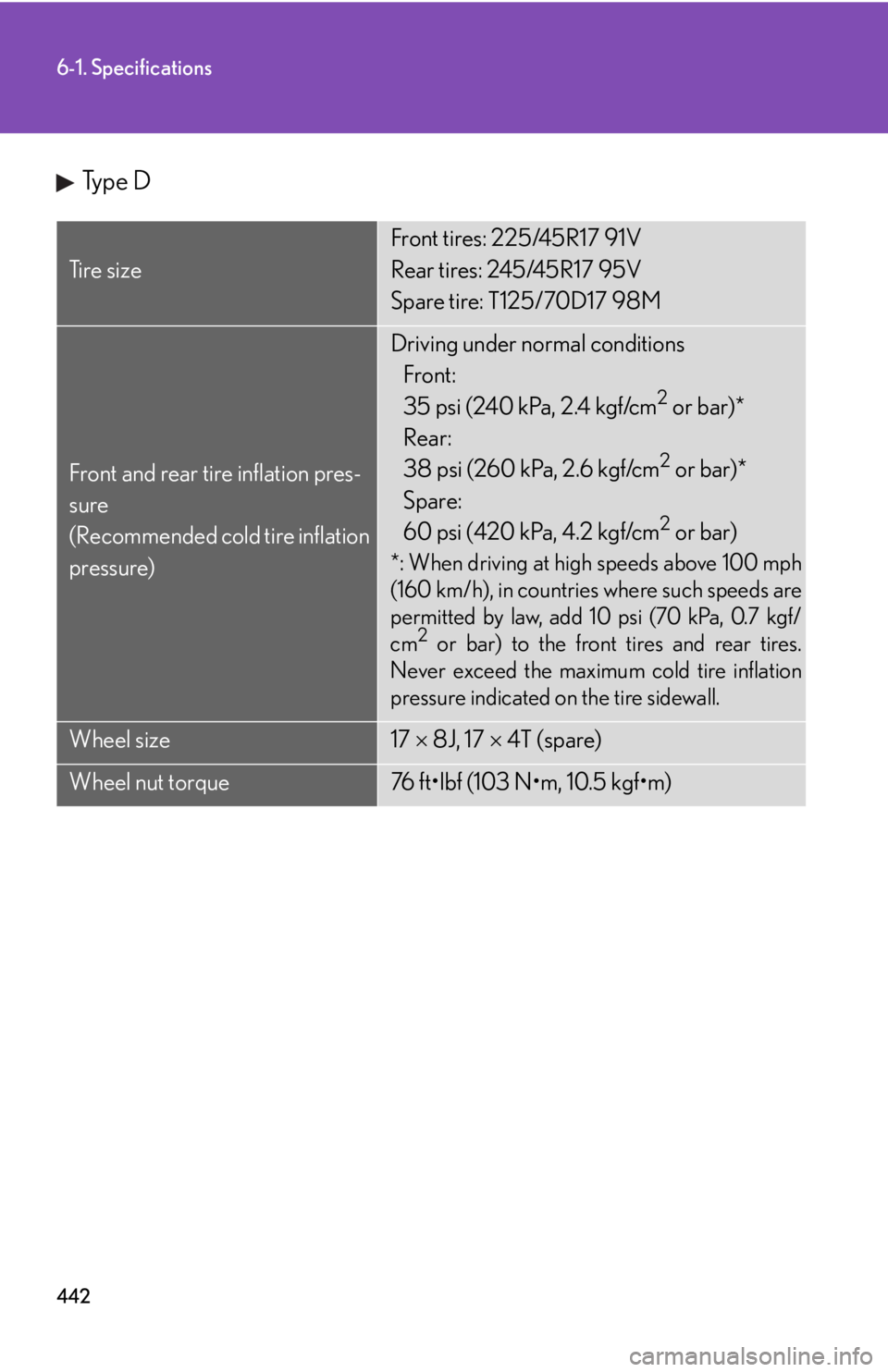
Ty p e D
Ti r e s i z e
Front tires: 225/45R17 91V
Rear tires: 245/45R17 95V
Spare tire: T125/70D17 98M
Front and rear tire inflation pres-
sure
(Recommended cold tire inflation
pressure)
Driving under normal conditions
Front:
35 psi (240 kPa, 2.4 kgf/cm2 or bar)*
Rear:
38 psi (260 kPa, 2.6 kgf/cm2 or bar)*
Spare:
60 psi (420 kPa, 4.2 kgf/cm2 or bar)
*: When driving at high speeds above 100 mph
(160 km/h), in countries where such speeds are
permitted by law, add 10 psi (70 kPa, 0.7 kgf/
cm2 or bar) to the front tires and rear tires.
Never exceed the maximum cold tire inflation
pressure indicated on the tire sidewall.
Wheel size17 × 8J, 17 × 4T (spare)
Wheel nut torque76 ft
Page 439 of 542
443
6-1. Specifications
6
Vehicle specifications
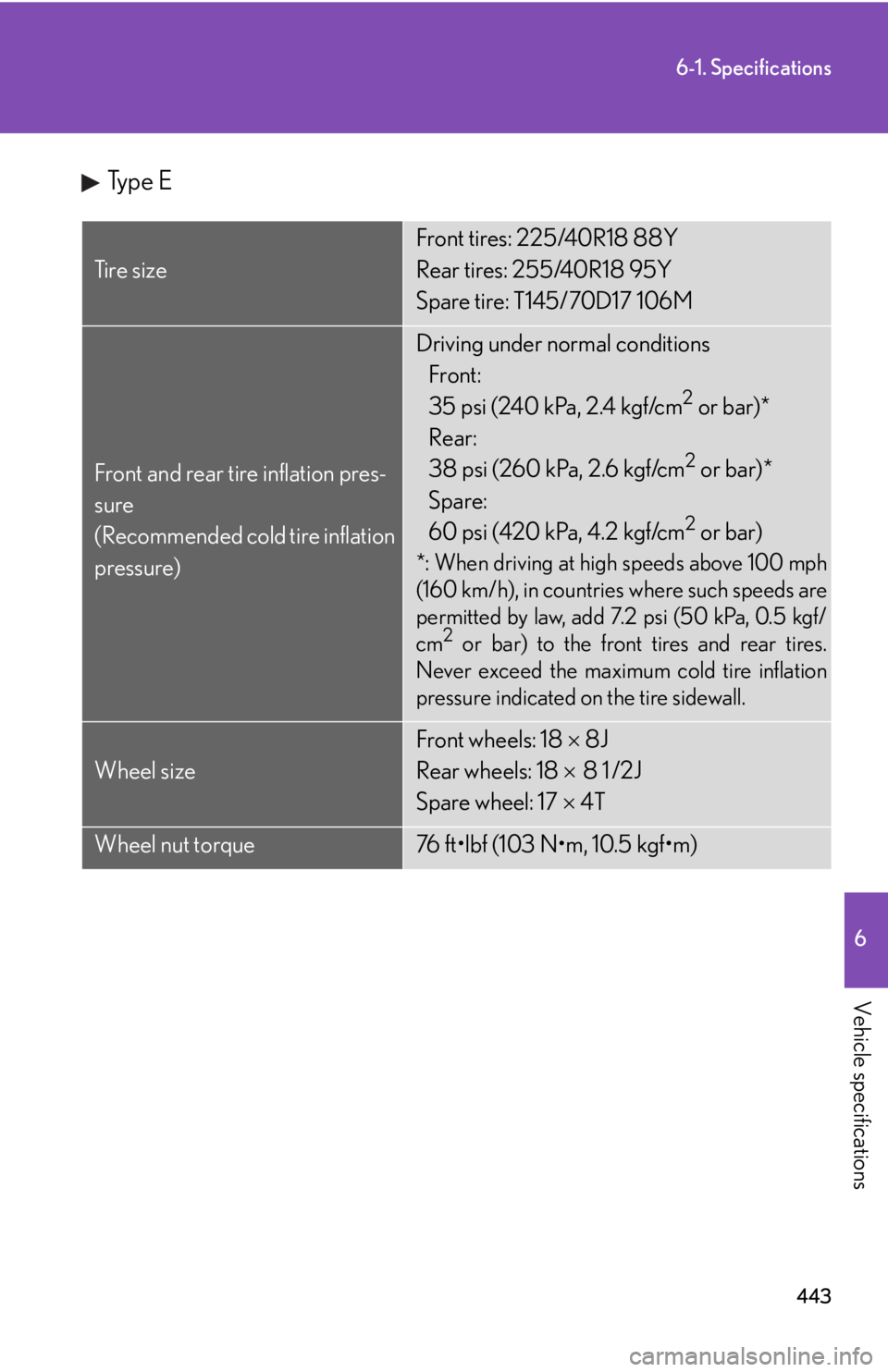
Type E
Ti r e s i z e
Front tires: 225/40R18 88Y
Rear tires: 255/40R18 95Y
Spare tire: T145/70D17 106M
Front and rear tire inflation pres-
sure
(Recommended cold tire inflation
pressure)
Driving under normal conditions
Front:
35 psi (240 kPa, 2.4 kgf/cm2 or bar)*
Rear:
38 psi (260 kPa, 2.6 kgf/cm2 or bar)*
Spare:
60 psi (420 kPa, 4.2 kgf/cm2 or bar)
*: When driving at high speeds above 100 mph
(160 km/h), in countries where such speeds are
permitted by law, add 7.2 psi (50 kPa, 0.5 kgf/
cm2 or bar) to the front tires and rear tires.
Never exceed the maximum cold tire inflation
pressure indicated on the tire sidewall.
Wheel size
Front wheels: 18 × 8J
Rear wheels: 18 × 8 1 /2J
Spare wheel: 17 × 4T
Wheel nut torque76 ft
Page 440 of 542
444
6-1. Specifications
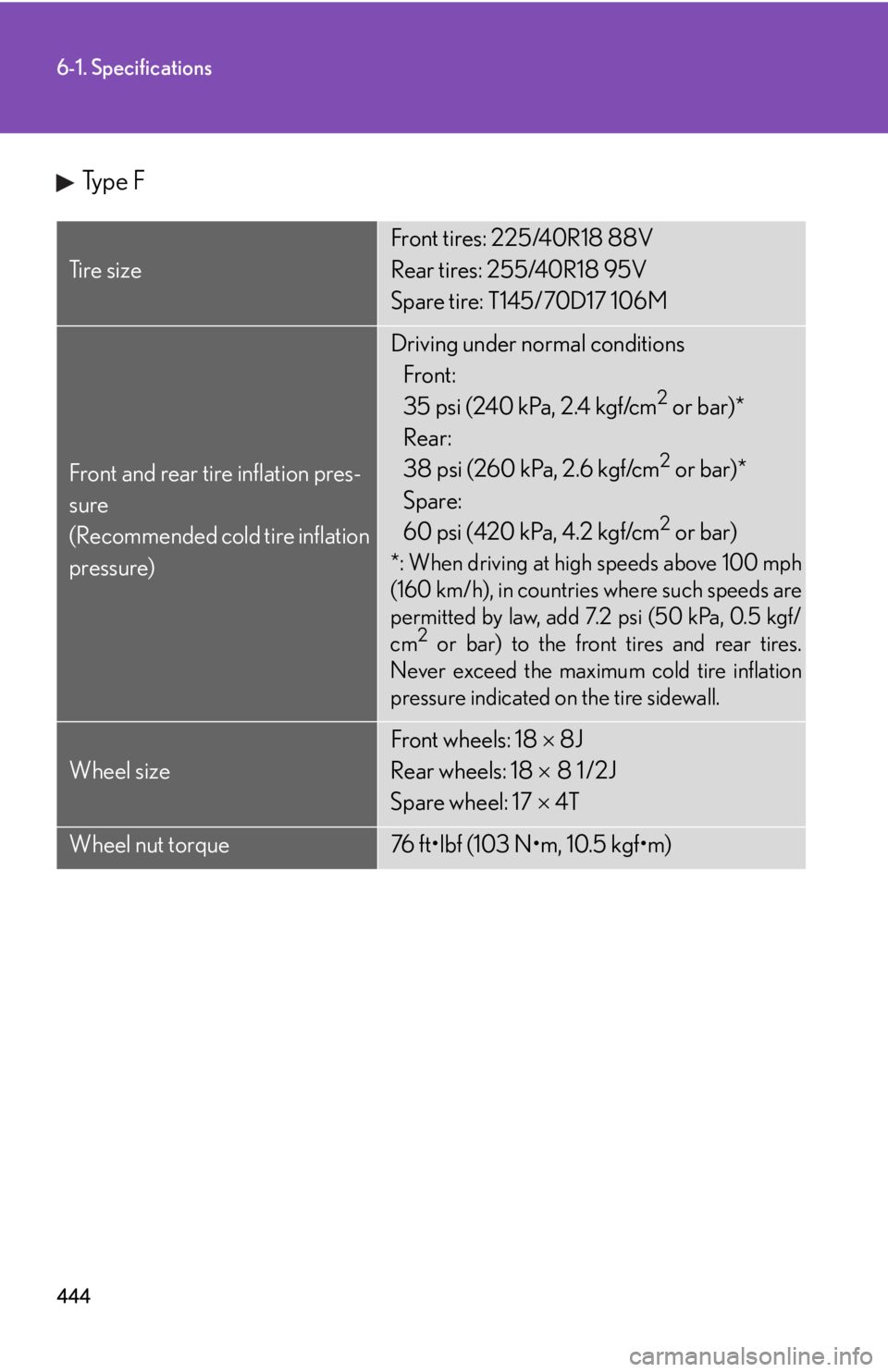
Ty p e F
Ti r e s i z e
Front tires: 225/40R18 88V
Rear tires: 255/40R18 95V
Spare tire: T145/70D17 106M
Front and rear tire inflation pres-
sure
(Recommended cold tire inflation
pressure)
Driving under normal conditions
Front:
35 psi (240 kPa, 2.4 kgf/cm2 or bar)*
Rear:
38 psi (260 kPa, 2.6 kgf/cm2 or bar)*
Spare:
60 psi (420 kPa, 4.2 kgf/cm2 or bar)
*: When driving at high speeds above 100 mph
(160 km/h), in countries where such speeds are
permitted by law, add 7.2 psi (50 kPa, 0.5 kgf/
cm2 or bar) to the front tires and rear tires.
Never exceed the maximum cold tire inflation
pressure indicated on the tire sidewall.
Wheel size
Front wheels: 18 × 8J
Rear wheels: 18 × 8 1 /2J
Spare wheel: 17 × 4T
Wheel nut torque76 ft
Page 446 of 542
450
6-1. Specifications
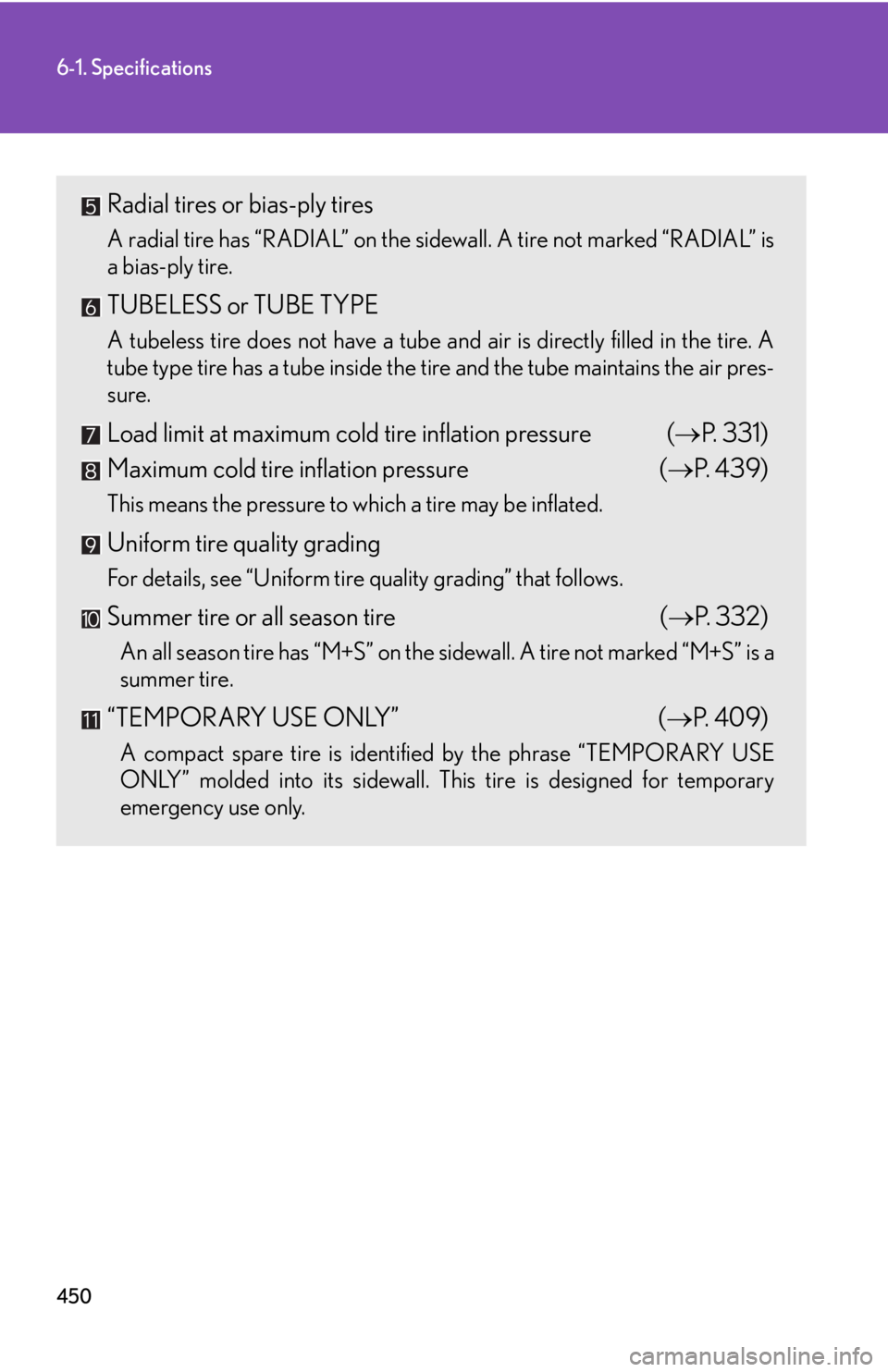
Radial tires or bias-ply tires
A radial tire has “RADIAL” on the sidewall. A tire not marked “RADIAL” is
a bias-ply tire.
TUBELESS or TUBE TYPE
A tubeless tire does not have a tube and air is directly filled in the tire. A
tube type tire has a tube inside the tire and the tube maintains the air pres-
sure.
Load limit at maximum cold tire inflation pressure (→P. 3 3 1 )
Maximum cold tire inflation pressure (→P. 4 3 9 )
This means the pressure to which a tire may be inflated.
Uniform tire quality grading
For details, see “Uniform tire quality grading” that follows.
Summer tire or all season tire (→P. 3 3 2 )
An all season tire has “M+S” on the sidewall. A tire not marked “M+S” is a
summer tire.
“TEMPORARY USE ONLY” (→P. 4 0 9 )
A compact spare tire is identified by the phrase “TEMPORARY USE
ONLY” molded into its sidewall. This tire is designed for temporary
emergency use only.
Page 450 of 542
454
6-1. Specifications
nTemperature A, B, C
The temperature grades are A (the highest), B, and C, representing
the tire's resistance to the generation of heat and its ability to dissipate
heat when tested under controlled conditions on a specified indoor
laboratory test wheel.
Sustained high temperature can cause the material of the tire to degenerate
and reduce tire life, and excessive temperature can lead to sudden tire fail-
ure.
The grade C corresponds to a level of performance which all passenger car
tires must meet under the Federal Motor Vehicle Safety Standard No. 109.
Grades B and A represent higher levels of performance on the laboratory
test wheel than the minimum required by law.
Warning: The temperature grades for this tire are established for a tire that
is properly inflated and not overloaded.
Excessive speed, underinflation, or excessive loading, either separately or in
combination, can cause heat buildup and possible tire failure.
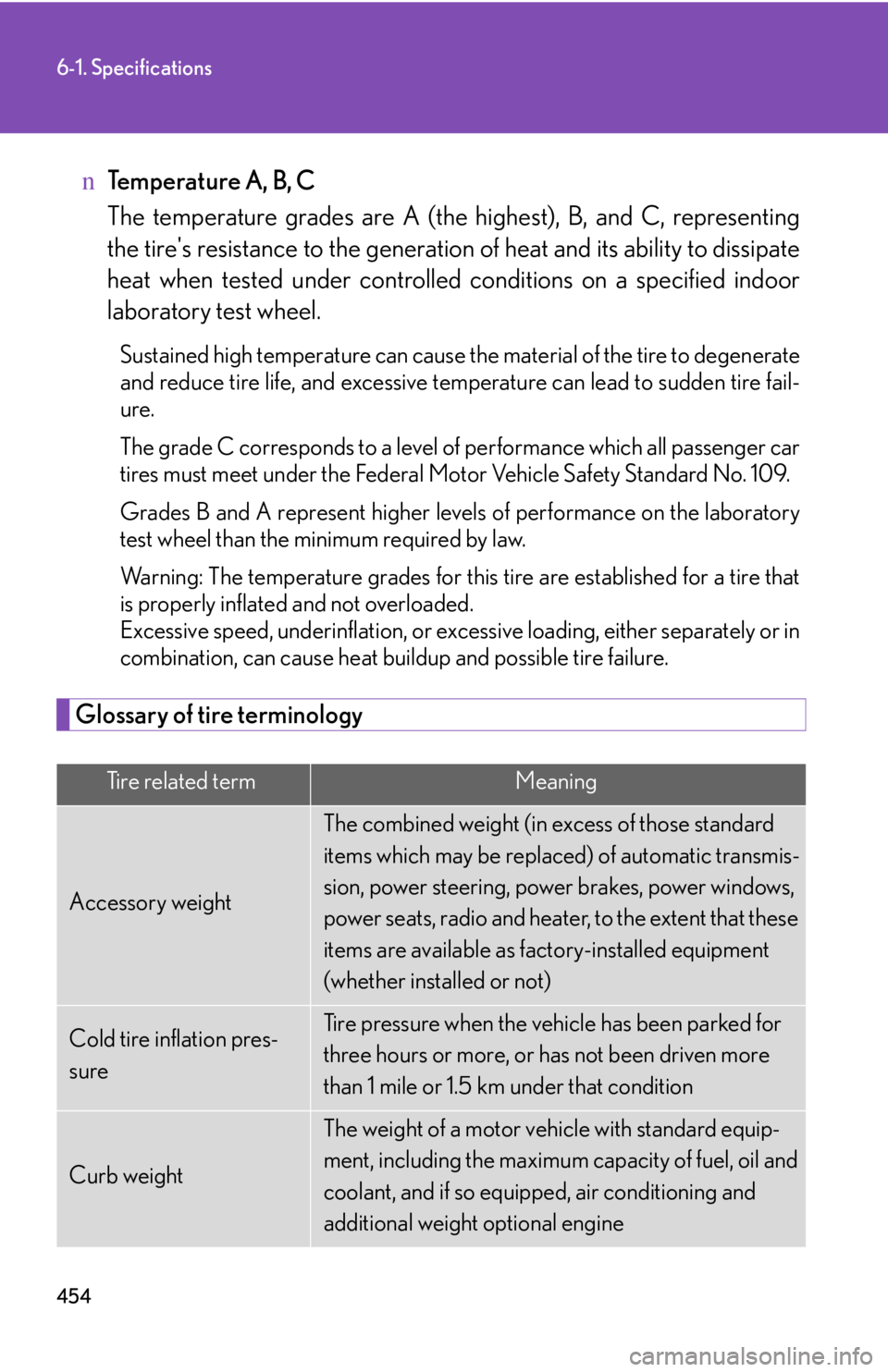
Glossary of tire terminology
Tire related termMeaning
Accessory weight
The combined weight (in excess of those standard
items which may be replaced) of automatic transmis-
sion, power steering, power brakes, power windows,
power seats, radio and heater, to the extent that these
items are available as factory-installed equipment
(whether installed or not)
Cold tire inflation pres-
sure
Tire pressure when the vehicle has been parked for
three hours or more, or has not been driven more
than 1 mile or 1.5 km under that condition
Curb weight
The weight of a motor vehicle with standard equip-
ment, including the maximum capacity of fuel, oil and
coolant, and if so equipped, air conditioning and
additional weight optional engine