transmission LEXUS IS250 2016 Owner's Guide
[x] Cancel search | Manufacturer: LEXUS, Model Year: 2016, Model line: IS250, Model: LEXUS IS250 2016Pages: 542, PDF Size: 9.65 MB
Page 191 of 542
191
2-4. Using other driving systems
2
When driving
CAUTION
nTRAC may not operate effectively when
Directional control and power may not be achievable while driving on slippery road
surfaces, even if the TRAC system is operating.
Do not drive the vehicle in conditions where stability and power may be lost.
nIf hill-start assist control does not operate effectively
(vehicles with an automatic transmission)
The hill-start assist control may not operate effectively on steep inclines and roads
covered in ice.
nWhen the VSC is activated
The slip indicator light flashes and a warning buzzer sounds. Always drive carefully.
Reckless driving may cause an accident. Exercise particular care when the indica-
tor light flashes and a buzzer sounds.
nWhen TRAC and VSC are off
Be especially careful and drive at a speed appropriate to the road conditions. As
there are systems to ensure vehicle stability and driving force, do not turn off TRAC
and VSC unless necessary.
nReplacing tires
Make sure that all tires are of the same size, brand, tread pattern and total load
capacity. In addition, make sure that the tires are inflated to the recommended tire
pressure level.
The ABS and VSC systems will not function correctly if different tires are fitted on
the vehicle.
Contact your Lexus dealer for further information when replacing tires or wheels.
nHandling of tires and suspension
Using tires with any kind of problem or modifying the suspension will affect the driv-
ing assist systems, and may cause the system to malfunction.
Page 201 of 542
201
2-5. Driving information
2
When driving
Selecting snow chains
Snow chains can be mounted on 16- and 17-inch tires. They cannot be
mounted on 18-inch tires. Use the correct snow chain size when mount-
ing the snow chains. Chain size is regulated for each tire sizes.
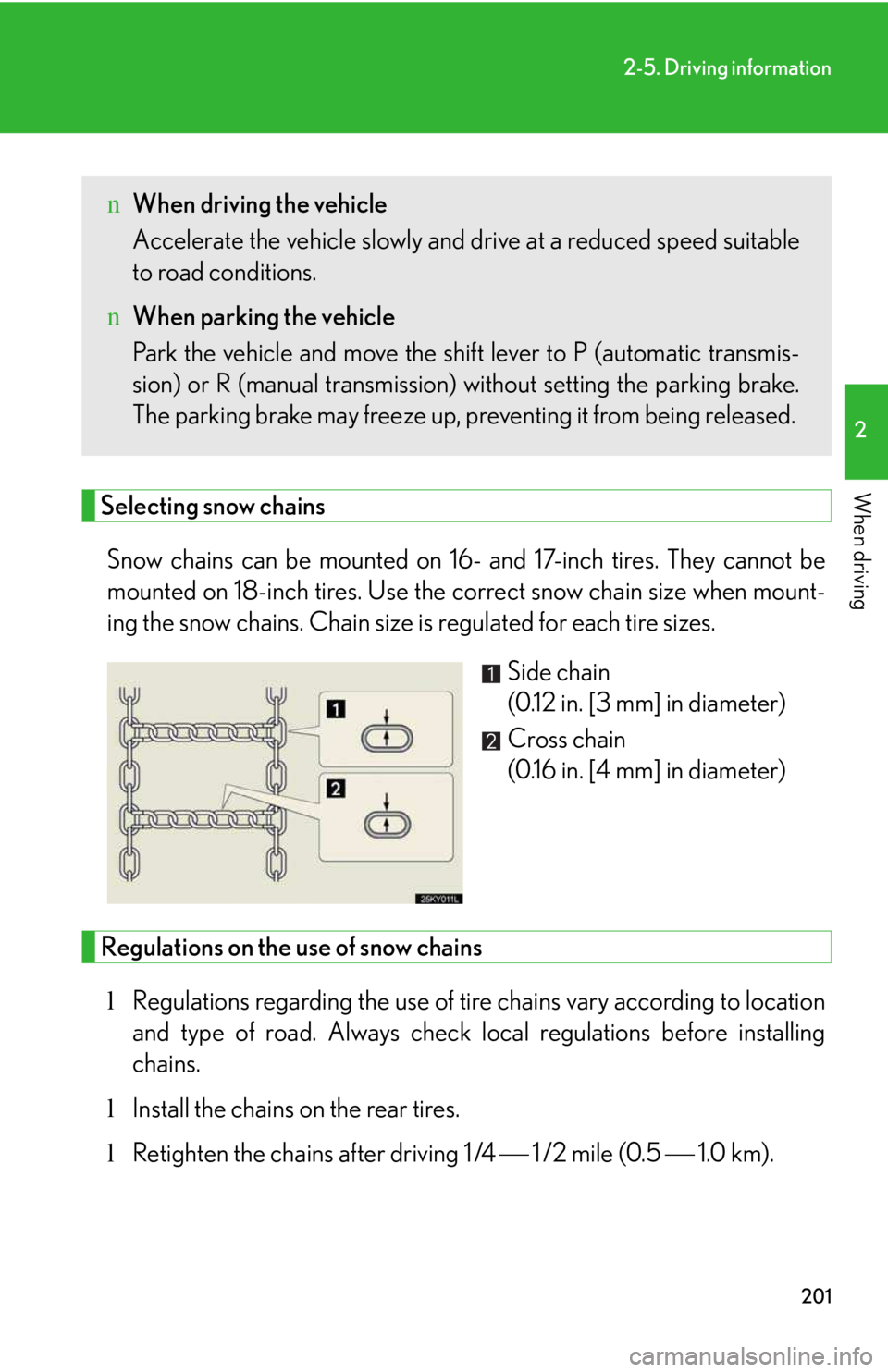
Side chain
(0.12 in. [3 mm] in diameter)
Cross chain
(0.16 in. [4 mm] in diameter)
Regulations on the use of snow chains
lRegulations regarding the use of tire chains vary according to location
and type of road. Always check local regulations before installing
chains.
lInstall the chains on the rear tires.
lRetighten the chains after driving 1 /4 ⎯ 1 /2 mile (0.5 ⎯ 1.0 km).
nWhen driving the vehicle
Accelerate the vehicle slowly and drive at a reduced speed suitable
to road conditions.
nWhen parking the vehicle
Park the vehicle and move the shift lever to P (automatic transmis-
sion) or R (manual transmission) without setting the parking brake.
The parking brake may freeze up, preventing it from being released.
Page 205 of 542
205
2-5. Driving information
2
When driving Dinghy towing (vehicles with an automatic transmission)
NOTICE
nTo avoid serious damage to your vehicle
Do not tow your vehicle with four wheels on the ground.
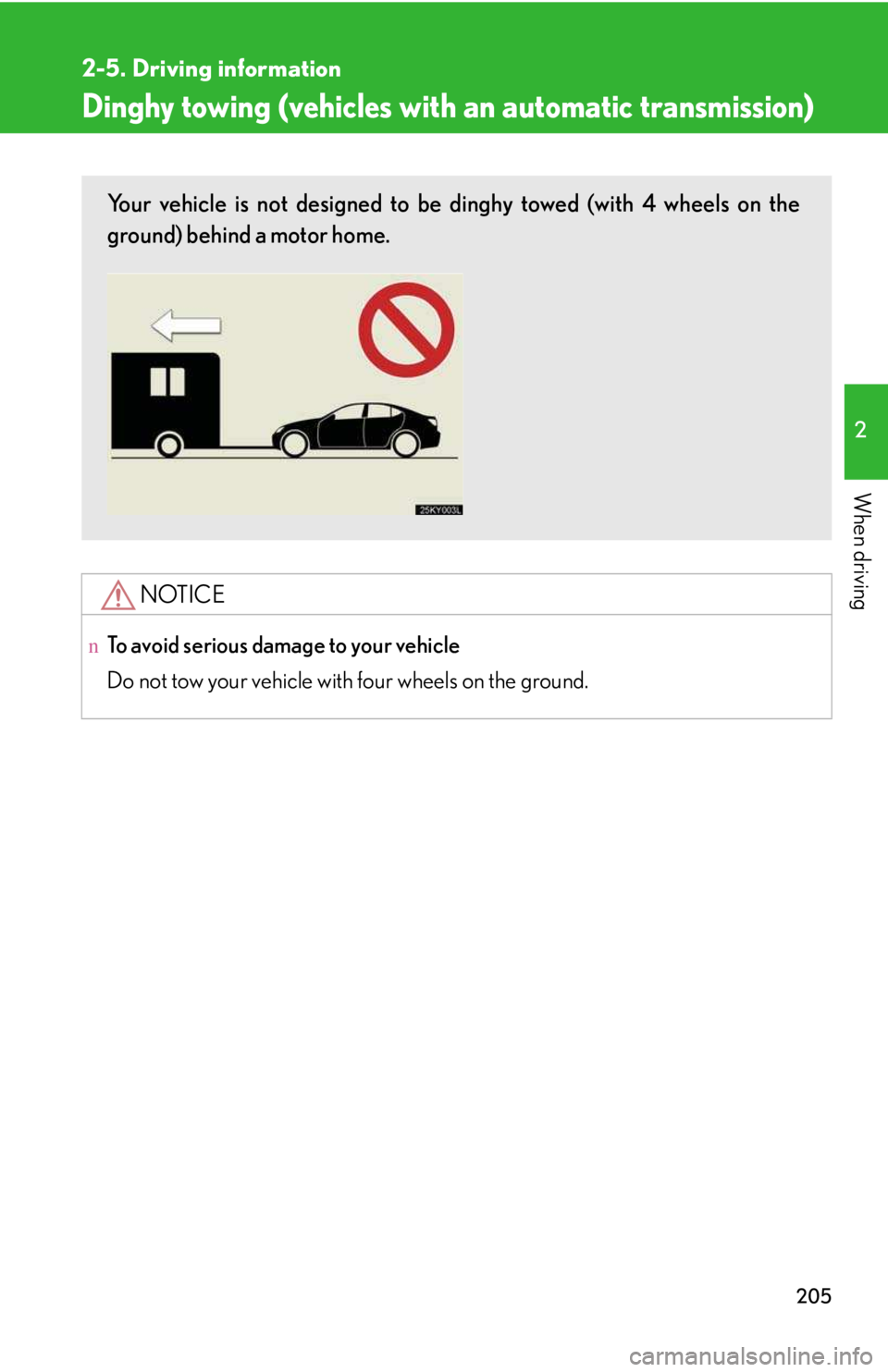
Your vehicle is not designed to be dinghy towed (with 4 wheels on the
ground) behind a motor home.
Page 206 of 542
206
2-5. Driving information
Dinghy towing (vehicles with a manual transmission)
Towing your vehicle with 4 wheels on the ground
To prevent damage to your vehicle, perform the following procedures
before towing.
Shift the shift lever to neutral.
Switch to ACCESSORY mode. (→P. 1 2 8 )
Ensure that the audio system and other powered devices have been
turned off.
Release the parking brake.
After towing, leave the engine in idle for at least 3 minutes before driv-
ing the vehicle.
nNecessary equipment and accessories
Specialized equipment and accessories are required for dinghy towing. Contact
the service branch of the motor home manufacturer regarding recommended
equipment.
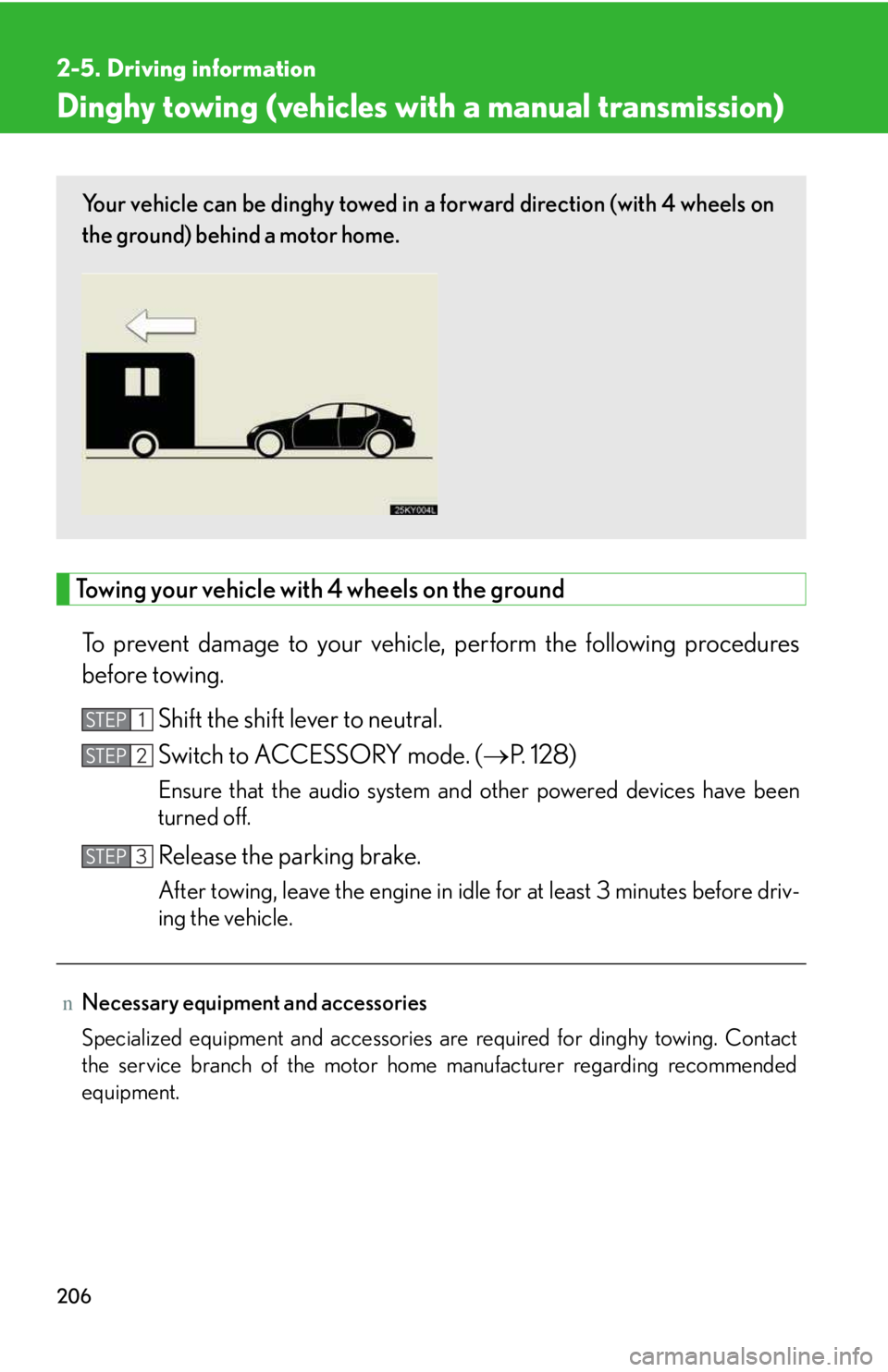
Your vehicle can be dinghy towed in a forward direction (with 4 wheels on
the ground) behind a motor home.
STEP1
STEP2
STEP3
Page 265 of 542
266
3-5. Other interior features
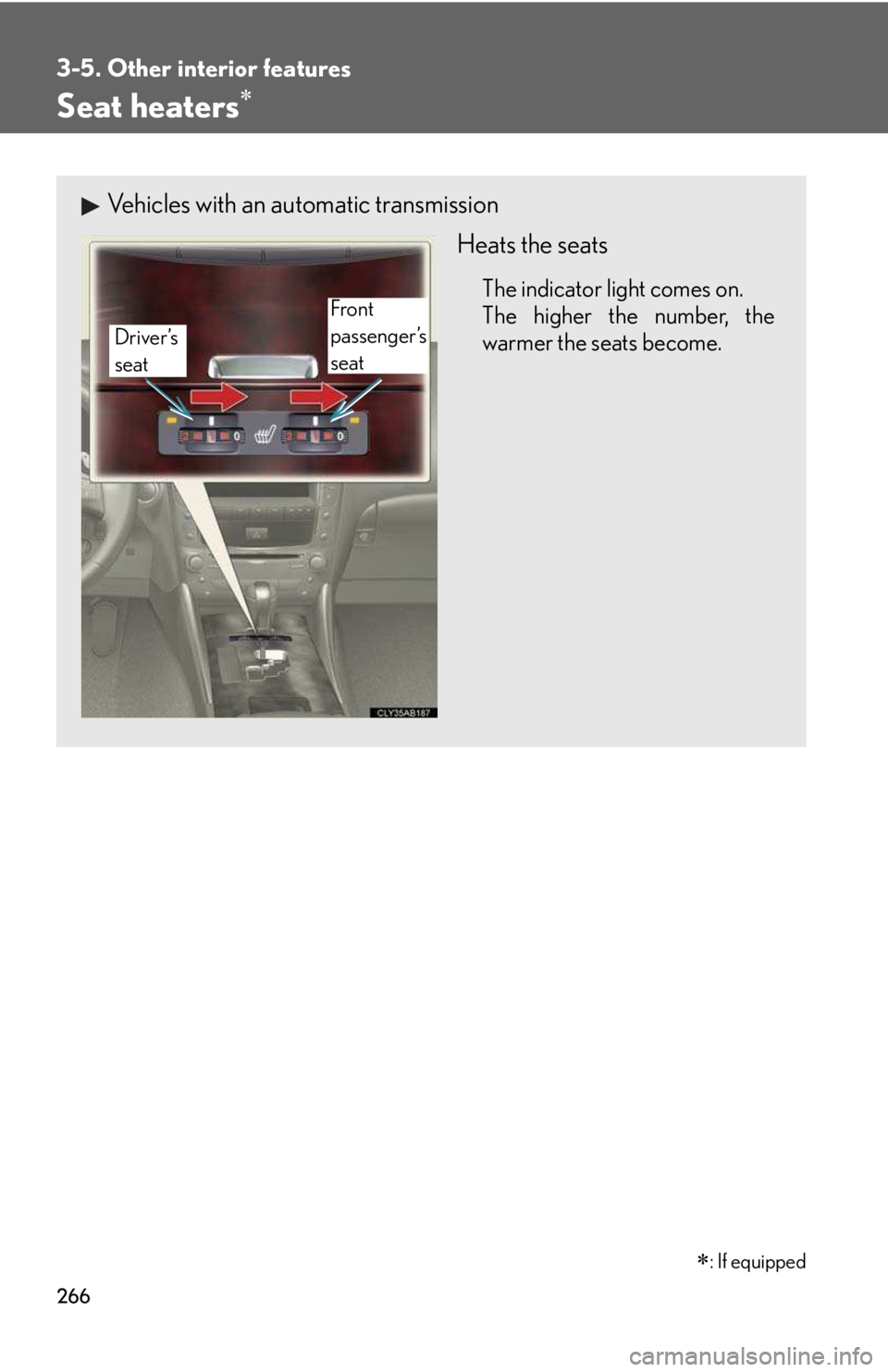
Seat heaters∗
Vehicles with an automatic transmission
Heats the seats
The indicator light comes on.
The higher the number, the
warmer the seats become.Driver’s
seat
Front
passenger’s
seat
∗: If equipped
Page 266 of 542
267
3-5. Other interior features
3
Interior features
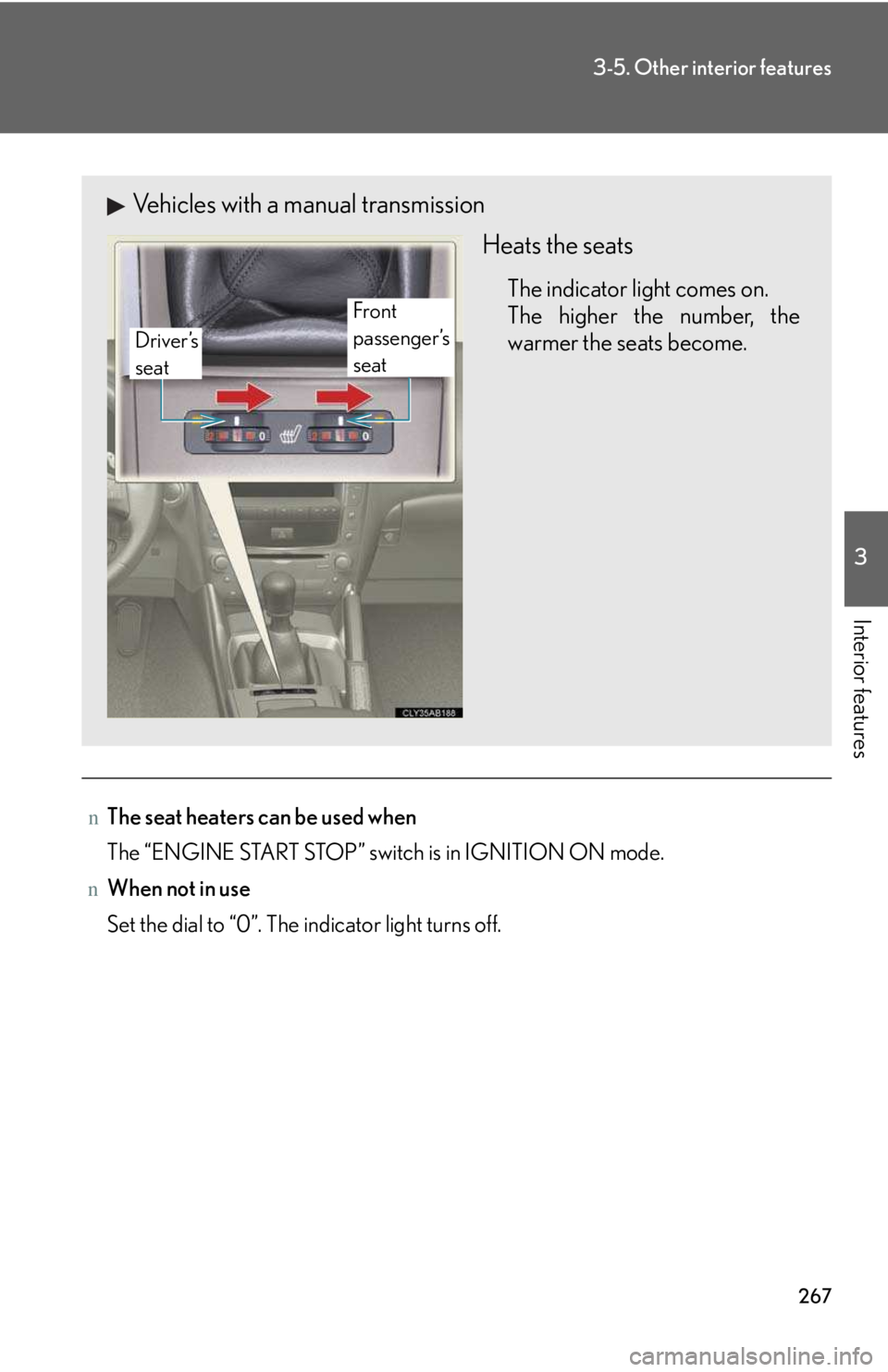
nThe seat heaters can be used when
The “ENGINE START STOP” switch is in IGNITION ON mode.
nWhen not in use
Set the dial to “0”. The indicator light turns off.
Vehicles with a manual transmission
Heats the seats
The indicator light comes on.
The higher the number, the
warmer the seats become.
Front
passenger’s
seat
Driver’s
seat
Page 268 of 542
269
3-5. Other interior features
3
Interior features
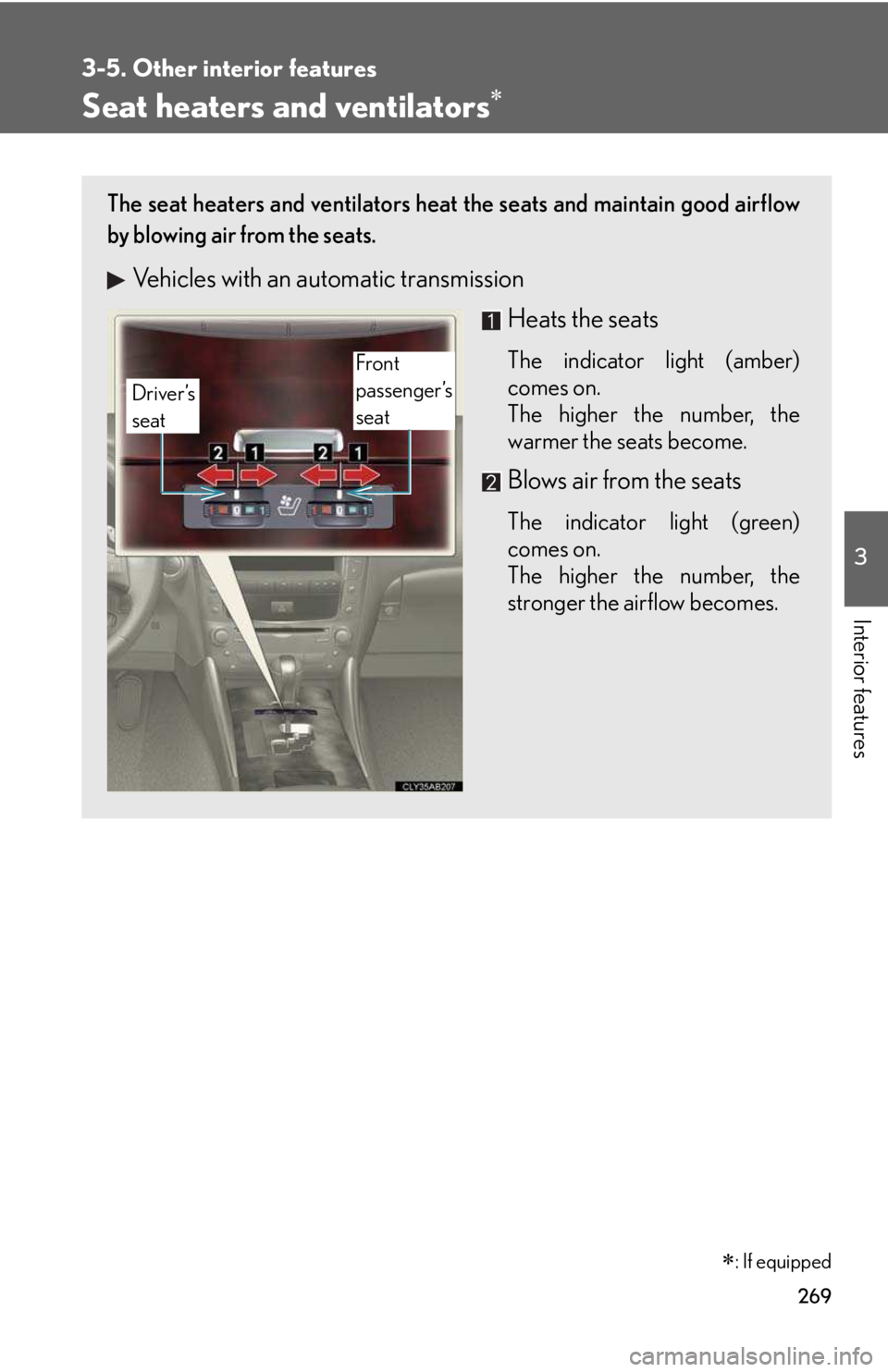
Seat heaters and ventilators∗
The seat heaters and ventilators heat the seats and maintain good airflow
by blowing air from the seats.
Vehicles with an automatic transmission
Heats the seats
The indicator light (amber)
comes on.
The higher the number, the
warmer the seats become.
Blows air from the seats
The indicator light (green)
comes on.
The higher the number, the
stronger the airflow becomes.
Front
passenger’s
seat
Driver’s
seat
∗: If equipped
Page 269 of 542
270
3-5. Other interior features
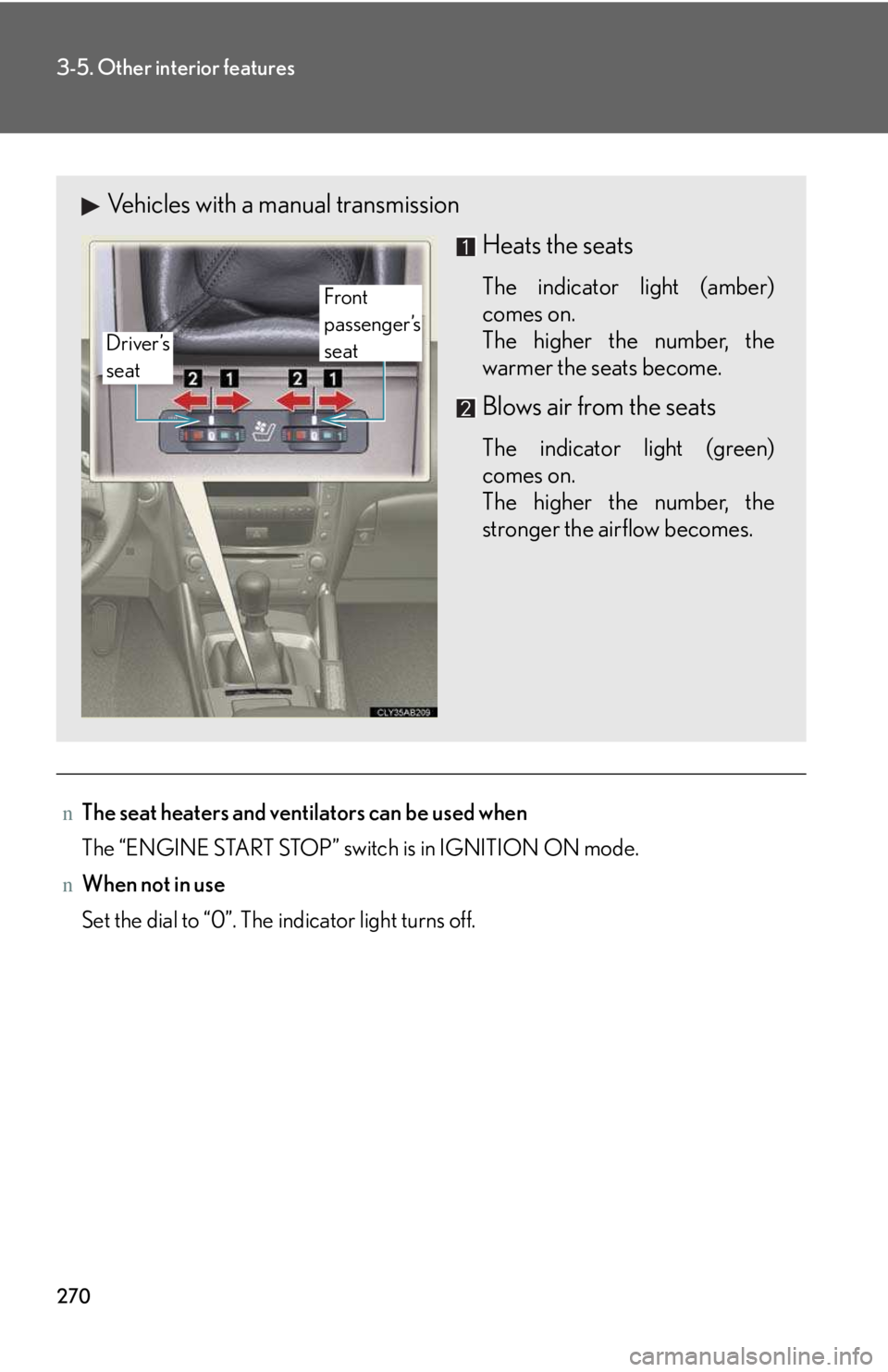
nThe seat heaters and ventilators can be used when
The “ENGINE START STOP” switch is in IGNITION ON mode.
nWhen not in use
Set the dial to “0”. The indicator light turns off.
Vehicles with a manual transmission
Heats the seats
The indicator light (amber)
comes on.
The higher the number, the
warmer the seats become.
Blows air from the seats
The indicator light (green)
comes on.
The higher the number, the
stronger the airflow becomes.
Driver’s
seat
Front
passenger’s
seat
Page 320 of 542
322
4-3. Do-it-yourself maintenance
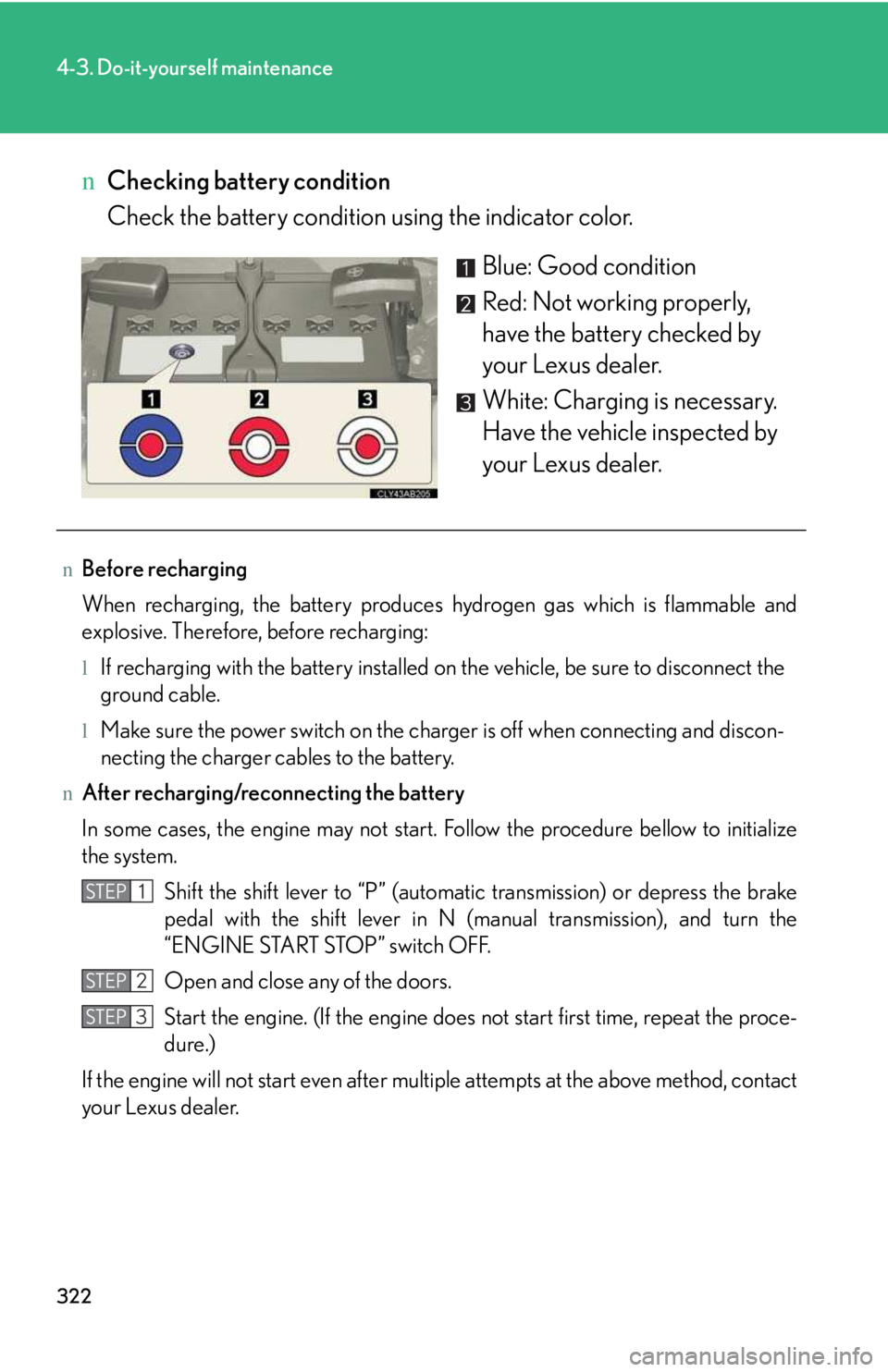
nChecking battery condition
Check the battery condition using the indicator color.
Blue: Good condition
Red: Not working properly,
have the battery checked by
your Lexus dealer.
White: Charging is necessary.
Have the vehicle inspected by
your Lexus dealer.
nBefore recharging
When recharging, the battery produces hydrogen gas which is flammable and
explosive. Therefore, before recharging:
lIf recharging with the battery installed on the vehicle, be sure to disconnect the
ground cable.
lMake sure the power switch on the charger is off when connecting and discon-
necting the charger cables to the battery.
nAfter recharging/reconnecting the battery
In some cases, the engine may not start. Follow the procedure bellow to initialize
the system.
Shift the shift lever to “P” (automatic transmission) or depress the brake
pedal with the shift lever in N (manual transmission), and turn the
“ENGINE START STOP” switch OFF.
Open and close any of the doors.
Start the engine. (If the engine does not start first time, repeat the proce-
dure.)
If the engine will not start even after multiple attempts at the above method, contact
your Lexus dealer.
STEP1
STEP2
STEP3
Page 357 of 542
359
4-3. Do-it-yourself maintenance
4
Maintenance and care
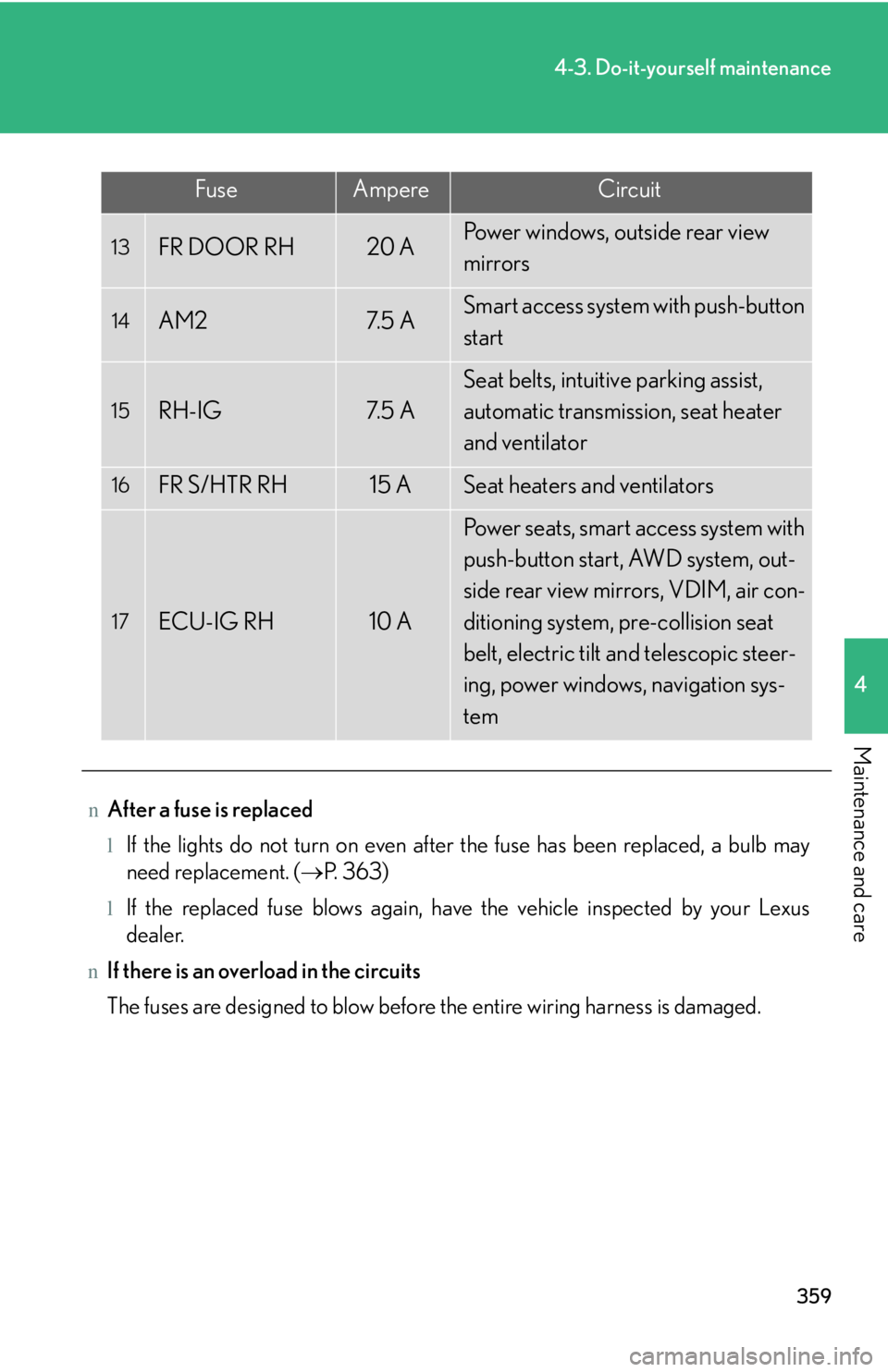
FuseAmpereCircuit
13FR DOOR RH20 APower windows, outside rear view
mirrors
14AM27. 5 ASmart access system with push-button
start
15RH-IG7. 5 A
Seat belts, intuitive parking assist,
automatic transmission, seat heater
and ventilator
16FR S/HTR RH15 ASeat heaters and ventilators
17ECU-IG RH10 A
Power seats, smart access system with
push-button start, AWD system, out-
side rear view mirrors, VDIM, air con-
ditioning system, pre-collision seat
belt, electric tilt and telescopic steer-
ing, power windows, navigation sys-
tem
nAfter a fuse is replaced
lIf the lights do not turn on even after the fuse has been replaced, a bulb may
need replacement. (→P. 3 6 3 )
lIf the replaced fuse blows again, have the vehicle inspected by your Lexus
dealer.
nIf there is an overload in the circuits
The fuses are designed to blow before the entire wiring harness is damaged.